- CDSCO registration is mandatory in India for all dermatology and plastic surgery medical devices under the Medical Devices Rules, 2017.
- Devices are classified into Class A (lowest risk) to Class D (highest risk) — each class has a different registration process and fee structure.
- This guide covers 56+ dermatology and plastic surgery devices with their official CDSCO classifications sourced from MD-121 to MD-127.
- Knowing your device class before applying saves time, reduces rejection risk, and ensures full regulatory compliance in 2026.
What is CDSCO License for Dermatology and Plastic Surgery?
CDSCO (Central Drugs Standard Control Organization) registration is the mandatory government approval process for all medical devices sold in India. For dermatology and plastic surgery devices, every manufacturer or importer must register their product under the Medical Devices Rules, 2017.
Devices are classified as Class A, B, C, or D based on risk level. Class A devices (like surgical gloves and wound dressings) are low-risk and have simpler requirements. Class C devices (like CO2 lasers and electrosurgical units) are high-risk and need more documentation. Getting the correct CDSCO registration protects patients, ensures product safety, and is legally required before any device can be marketed in India.
What is CDSCO and Why Does It Matter for Medical Devices in India?
CDSCO is India's national regulatory body for medical devices, drugs, and cosmetics — operating under the Ministry of Health and Family Welfare. Under the Medical Devices Rules, 2017 (amended periodically through 2026), all medical devices including dermatology and plastic surgery equipment must obtain a valid CDSCO license before manufacturing, importing, or selling in India.
Whether you manufacture surgical lasers, wound dressings, electrosurgical units, or simple skin markers — CDSCO registration is not optional. Failure to register can result in product seizure, penalties, and legal action.
CDSCO Medical Device Classification: Class A, B, C & D Explained
India follows a four-tier risk-based classification system for medical devices. Here is how it works:
| Class | Risk Level | Regulatory Authority | Examples (Dermatology/Plastic Surgery) |
| Class A | Low Risk | State Licensing Authority (SLA) | Surgical gloves, wound dressings, skin markers |
| Class B | Low-Moderate Risk | State Licensing Authority (SLA) | Liposuction catheter, cryosurgical unit, powered dermatome |
| Class C | Moderate-High Risk | CDSCO (Central) | CO2 laser, electrosurgical unit, laparoscope |
| Class D | Highest Risk | CDSCO (Central) | Active implantable devices (not currently listed in this category) |
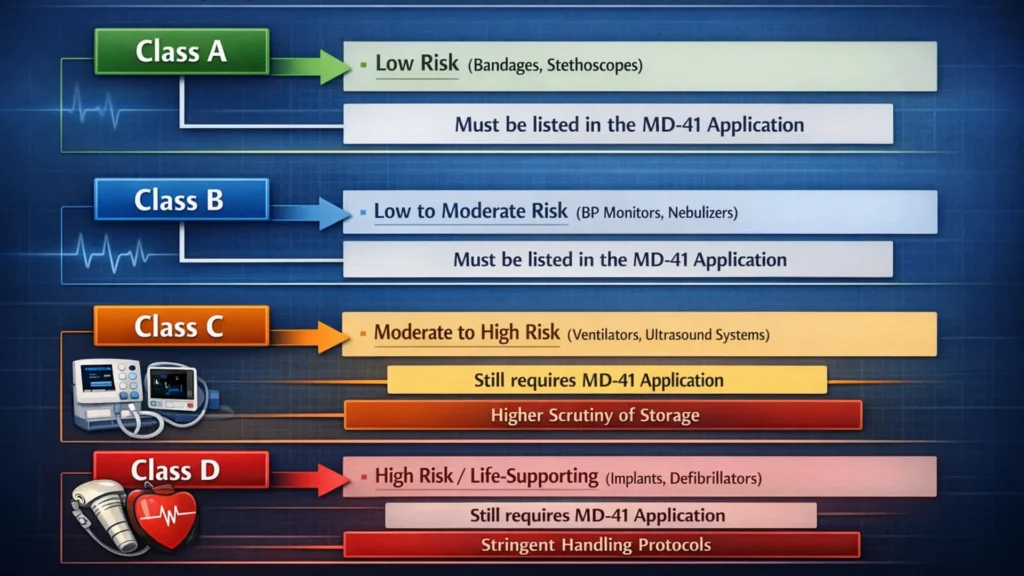
Note: Based on the official CDSCO classification list MD-121 to MD-127, the dermatology and plastic surgery devices listed fall under Class A, B, and C only. No Class D devices are identified in this specific category.
Class A Dermatology and Plastic Surgery Medical Devices — CDSCO Registered List
Class A devices are low-risk devices typically regulated at the state level. These include basic surgical tools, protective apparel, and wound management products. Here is the complete list of Class A dermatology and plastic surgery devices:
| Sl. No. | Device Name | Intended Use | Class |
| 1 | Non-powdered Surgeon's Glove | Worn by OR personnel to protect surgical wound from contamination | A |
| 2 | Dermatome | Surgical knife used to harvest skin for grafting; manual or electric-powered | A |
| 3 | Dermatome Skin Approximation Tape | Adhesive tape attached to skin graft knife to collect skin graft tissue; single-use | A |
| 4 | Drape Adhesive | Placed on the skin to attach a surgical drape | A |
| 5 | Eye Pad | Pad made of gauze/cotton used as bandage over the eye for protection or absorption | A |
| 6 | Hydrophilic Wound Dressing | Sterile/non-sterile device to cover wounds and absorb exudate | A |
| 7 | Internal Tissue Marker | Used prior to or during surgery to demarcate selected internal tissue sites | A |
| 8 | Laparoscopy Tray | Single-use tray enabling trained HCP to perform a laparoscopic procedure | A |
| 9 | Manual Operating Table & Chair | Non-powered devices with movable components to support patients during procedures | A |
| 10 | Manually-Operated Dermatome | Hand-held device to sever thin skin for grafting or resect small skin lesion | A |
| 11 | Occlusive Wound Dressing | Non-resorbable device to cover wound, maintain moist environment, allow gas exchange | A |
| 12 | Plastic Surgery Osteotome | Chisel-like instrument to cut/shape small bones and cartilage during plastic surgery | A |
| 13 | Reusable Dermatome Blade | Reusable blade attached to skin graft knife to harvest skin graft; sterilizable | A |
| 14 | Skin Marker | Pen-like device to write on patient skin for surgical incision outline or anatomical marking | A |
| 15 | Surgical Apparel | Worn by OR personnel to protect patient and staff from microorganism transfer | A |
| 16 | Surgical Guillotine | Metal frame cutter in various configurations to sever tissue | A |
| 17 | Surgical Lamp | Provides visible illumination of surgical field or patient | A |
| 18 | Surgical Microscope & Accessories | AC-powered device for magnified view of surgical field during surgery | A |
| 19 | Surgical Camera & Accessories | Records operative procedures | A |
Key Takeaway: Class A devices involve minimal patient risk. Registration is managed by the State Licensing Authority (SLA). The process is relatively straightforward with fewer documentation requirements.
Class B Dermatology & Plastic Surgery Medical Devices — CDSCO Registered List
Class B devices are low-to-moderate risk devices. They include powered surgical tools, endoscopic equipment, and advanced wound care systems. The State Licensing Authority oversees registration for Class B devices as well.
| Sl. No. | Device Name | Intended Use | Class |
| 1 | Organ Bag | Flexible plastic bag as temporary receptacle for an organ to prevent moisture loss | B |
| 2 | Low Energy Ultrasound Wound Cleaner | Uses ultrasound energy to vaporize solution and generate mist for wound cleaning | B |
| 3 | Surgical Drape & Drape Accessories | Natural/synthetic material to isolate surgical incision site from contamination | B |
| 4 | Suture Retention Device | Retention bridge/surgical button to distribute suture tension over larger area | B |
| 5 | Wound Autofluorescence Imaging Device | Views autofluorescence images from skin wounds exposed to excitation light | B |
| 6 | Battery-Powered Trephine System | Rotary surgical device for removal of intervertebral disc or tissues; battery-driven | B |
| 7 | Colonoscope (General & Plastic Surgery) | Used for foreign body removal, polypectomy, hemorrhage control, cancer diagnosis | B |
| 8 | Cryosurgical Unit & Accessories | Destroys tissue during surgery by applying extreme cold via liquid nitrogen cryoprobe | B |
| 9 | Dermal Dilator | Temporarily implanted subcutaneously with balloon to dilate surrounding skin | B |
| 10 | Electrically-Powered Trephine System | Rotary surgical device for removal of intervertebral disc or soft tissues; electric | B |
| 11 | Electrosurgical Device for OTC Aesthetic Use | Uses radiofrequency energy for non-invasive aesthetic tissue heating | B |
| 12 | Esophagoscope (General & Plastic Surgery) | Endoscope for visual examination, diagnosis, and treatment of the esophagus | B |
| 13 | Gas-Powered Dermatome | Gas pressure-operated device to cut thin skin for grafting or resect skin lesion | B |
| 14 | Gas-Powered Surgical Saw | Handpiece generating vibration/reciprocal movements; uses compressed air/nitrogen | B |
| 15 | Gas-Powered Trephine System | Rotary device for removal of intervertebral disc or tissues; gas-driven | B |
| 16 | Hemostatic Knife | Heated blade transmits heat to body tissues for hemostasis; no grounding pad needed | B |
| 17 | Irrigating Wound Retractor Device | Retracts incision, provides access, protects, irrigates wound, and removes fluid | B |
| 18 | Liposuction Catheter | Rigid tube inserted subcutaneously for removal of fatty deposits; single-use | B |
| 19 | Powered Corneal Trephine | Electric cylindrical device for resection/removal of ring-shaped corneal tissue | B |
| 20 | Powered Dermatome | Electric device for removal of damaged skin fragment or slicing donor skin for graft | B |
| 21 | Powered Suction Pump | Portable AC/compressed air device to remove infectious materials or fluids from wounds | B |
| 22 | Removable Skin Clip | Clip to temporarily connect skin tissues to aid healing; not absorbable | B |
| 23 | Removable Skin Staple | Staple to temporarily connect external tissues to aid healing; not absorbable | B |
| 24 | Single-Use Dermatome Blade | Blade attached to dermatome for skin graft collection; single-use | B |
| 25 | Skin Stapler | Applied to close lacerations on the outer layer of the dermis | B |
| 26 | Soft Tissue Trephine | Cylindrical/coronary saw to resect discs of non-bone tissues; various sizes | B |
Key Takeaway: Class B devices carry moderate risk and include many powered surgical tools used in dermatology and plastic surgery. The registration process requires more technical documentation than Class A but is still managed by the SLA.
Class C Dermatology & Plastic Surgery Medical Devices — CDSCO Registered List
Class C devices are moderate-to-high risk and are regulated directly by CDSCO at the central level. This category includes advanced laser systems, electrosurgical units, and implantable devices. The registration process is more rigorous and requires central government approval.
| Sl. No. | Device Name | Intended Use | Class |
| 1 | Polymer Ligating Clips (Hem-o-lok) | For ligation of vessels or tissue structures; contraindicated for renal artery ligation in laparoscopic donor nephrectomy | C |
| 2 | Implantable Ligating Clip | Clip-like device to connect internal tissues to aid healing; not absorbable | C |
| 3 | Laser Surgical Instrument (General/Plastic/Dermatology) | CO2 laser device to cut, destroy, or remove tissue by light energy | C |
| 4 | Ultraviolet Lamp for Dermatologic Disorders | Provides UV radiation to photoactivate a drug in treatment of dermatologic disorder | C |
| 5 | Carbon Dioxide Laser | Gas laser used in gynecology, neuroscience, dermatology surgical procedures | C |
| 6 | Copper Vapour Laser | Gas laser for dermatology treatment of cutaneous vascular lesions (port-wine stains, telangiectasia) | C |
| 7 | Electrosurgical Cutting & Coagulation Device | Removes tissue and controls bleeding using high-frequency electrical current | C |
| 8 | Gastroscope (General & Plastic Surgery) | Flexible tube with light and camera; used to examine stomach and take tissue samples | C |
| 9 | General Electrosurgical Unit | Cuts/coagulates tissues with high-frequency current; used for incision/coagulation confirmation | C |
| 10 | Implantable Staple | Staple-like device to connect internal tissues to aid healing; not absorbable | C |
| 11 | Laparoscope (General & Plastic Surgery) | For minimally invasive surgical procedures using monopolar electrosurgical cutting/coagulation | C |
Key Takeaway: Class C devices are high-risk and require CDSCO central approval. These include laser systems, implantable clips/staples, and electrosurgical equipment used in dermatology and plastic surgery. Comprehensive clinical and technical documentation is mandatory.
Who Needs CDSCO Registration for Dermatology & Plastic Surgery Devices?
The following entities must obtain CDSCO registration before marketing or distributing dermatology and plastic surgery medical devices in India:
- Indian Manufacturers: Any company manufacturing dermatology or plastic surgery devices within India
- Importers: Any company importing foreign-made dermatology/plastic surgery devices for sale in India
- Authorised Agents: Foreign manufacturers must appoint an Indian authorised agent for CDSCO registration
- Distributors/Stockists: Must operate only with products that have valid CDSCO registration
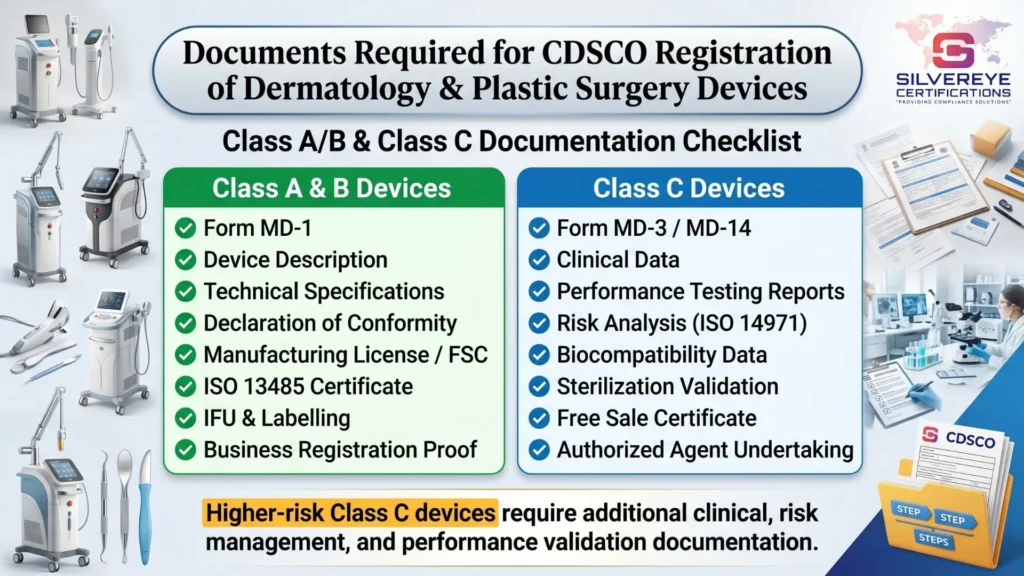
Documents Required for CDSCO Registration of Dermatology & Plastic Surgery Devices
For Class A & B Devices (SLA Registration)
- Form MD-1 application (duly filled and signed)
- Device description and intended use document
- Technical specifications / product literature
- Declaration of conformity (safety & performance standards)
- Manufacturing licence or Certificate of Free Sale (for importers)
- ISO 13485 certificate (Quality Management System)
- Labelling and instructions for use (IFU) in English
- Proof of establishment in India (for manufacturers)
For Class C Devices (CDSCO Central Registration — Additional Documents)
- Form MD-3 / Form MD-14 as applicable
- Performance testing and clinical data / clinical investigation reports
- Risk analysis report (ISO 14971)
- Biocompatibility data (ISO 10993 series) for devices with patient contact
- Sterilisation validation report (if applicable)
- Free Sale Certificate from country of origin (for imported devices)
- Undertaking by authorised agent (for foreign manufacturers)
- CDSCO Form 40 / Form 45 as applicable
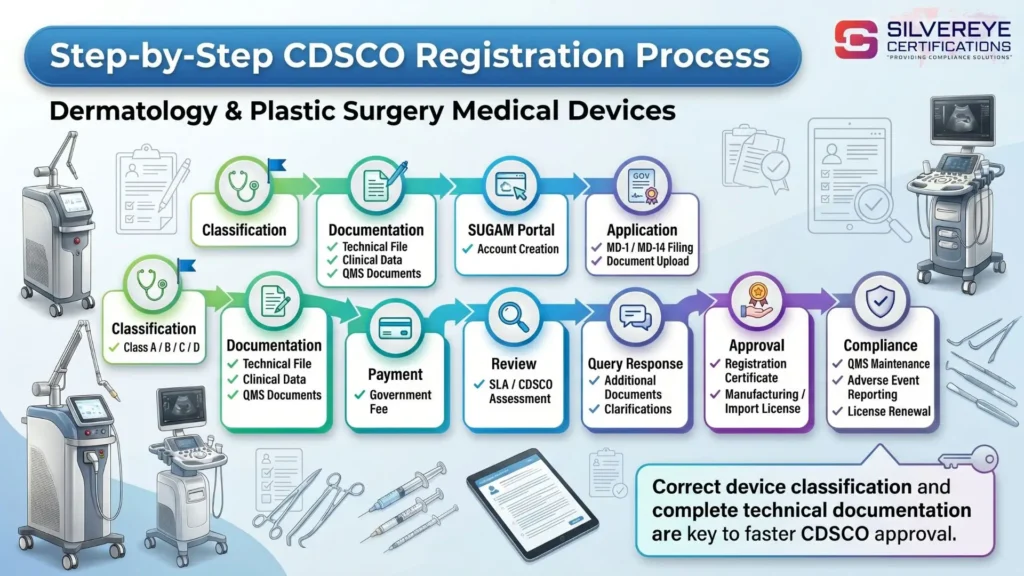
Step-by-Step CDSCO Registration Process for Dermatology & Plastic Surgery Medical Devices
- Determine your device class (A, B, C, or D) using CDSCO's published classification lists (MD-121 to MD-127)
- Prepare technical documentation as per device class requirements
- Create an account on the SUGAM portal (sugam.gov.in) — CDSCO's official online application platform
- Submit the application form (Form MD-1 for Class A/B; Form MD-14 or relevant form for Class C) with all required documents
- Pay the applicable registration fee online through SUGAM
- Application is reviewed by SLA (Class A/B) or CDSCO's Central Licensing Authority (Class C/D)
- Respond to any queries or additional document requests from the licensing authority within specified timelines
- Upon approval, receive your manufacturing/import licence or registration certificate
- Ensure ongoing compliance: maintain QMS, report adverse events, renew licence before expiry
CDSCO Registration Fees for Dermatology & Plastic Surgery Medical Devices (2026)
Fees are subject to revision. Always verify the latest fee schedule on the SUGAM portal or CDSCO website before submitting your application.
| Device Class | Type | Approx. Fee (INR) | Regulatory Authority |
| Class A | Manufacturing Licence | Rs. 2,500 – Rs. 5,000 | State Licensing Authority |
| Class A | Import Licence | Rs. 10,000 – Rs. 25,000 | State Licensing Authority |
| Class B | Manufacturing Licence | Rs. 5,000 – Rs. 10,000 | State Licensing Authority |
| Class B | Import Licence | Rs. 25,000 – Rs. 50,000 | State Licensing Authority |
| Class C | Manufacturing Licence | Rs. 50,000 – Rs. 1,00,000 | CDSCO Central |
| Class C | Import Licence | Rs. 1,00,000 – Rs. 5,00,000 | CDSCO Central |
Note: Fees above are indicative ranges based on publicly available CDSCO fee schedules. Actual fees vary based on device category, number of models, and application type. Confirm current fees on the official SUGAM portal at sugam.gov.in.
Validity and Renewal of CDSCO Registration for Dermatology & Plastic Surgery Devices
| Licence Type | Validity Period | Renewal Timeline |
| Manufacturing Licence (Class A/B) | 5 years | Apply 3–6 months before expiry |
| Import Licence (Class A/B) | 3 years | Apply 3 months before expiry |
| Manufacturing Licence (Class C) | 5 years | Apply 6 months before expiry |
| Import Licence (Class C) | 3 years | Apply 6 months before expiry via CDSCO |
Important: Selling or distributing devices with an expired licence is a legal violation under the Drugs and Cosmetics Act, 1940. Always track your renewal dates carefully.
Benefits of CDSCO Registration for Dermatology & Plastic Surgery Medical Devices
- Legal compliance: Operate legally in India without risk of product seizure or penalties
- Market access: CDSCO registration is mandatory for hospitals, distributors, and government tenders
- Patient safety: Ensures your device meets Indian safety and performance standards
- Brand credibility: Registered devices are trusted by healthcare professionals and procurement bodies
- Export opportunities: CDSCO certification supports regulatory submissions in other countries
- Government tender eligibility: Central and state government tenders require valid CDSCO registration
Common Mistakes to Avoid During CDSCO Registration
- Wrong device classification — Always verify your device's class using official CDSCO lists before applying
- Incomplete documentation — Missing a single document can delay approval by months
- Applying to wrong authority — Class A/B goes to SLA; Class C/D must go to CDSCO central
- Outdated standards — Ensure all technical files reference current Indian standards or harmonised international standards
- Ignoring SUGAM portal updates — CDSCO regularly updates application formats and guidance documents
- Missing renewal deadlines — Always set calendar reminders at least 6 months before expiry
Conclusion
CDSCO registration for dermatology and plastic surgery medical devices is not just a regulatory formality — it is the foundation of your business in the Indian healthcare market. With 56+ devices classified under Class A, B, and C, getting the right classification, documentation, and submission process right is critical.
Whether you are registering a simple Class A surgical glove or a complex Class C CO2 laser system, this guide gives you the complete framework — from classification to renewal — to navigate the CDSCO registration process confidently in 2026.
For device-specific guidance, always consult the latest CDSCO notifications, visit the SUGAM portal, or work with a qualified regulatory consultant who specialises in Indian medical device registration.
Frequently Asked Questions
Is CDSCO registration mandatory for all dermatology devices in India?
Yes. All dermatology and plastic surgery medical devices notified under the Medical Devices Rules, 2017 must be registered with CDSCO before they can be manufactured, imported, or sold in India.
What is the difference between Class A, B, C, and D medical devices?
Classes are based on risk level. Class A is lowest risk (e.g., wound dressings), Class B is low-moderate risk (e.g., powered dermatomes), Class C is moderate-high risk (e.g., CO2 lasers), and Class D is highest risk. Class A and B are regulated by State Licensing Authorities; Class C and D are regulated by CDSCO centrally.
How long does CDSCO registration take for a Class C dermatology device?
Typically, Class C device registration with CDSCO takes 6 to 18 months, depending on documentation completeness, CDSCO workload, and whether additional queries are raised. Starting early and submitting complete documentation reduces delays significantly.
Can a foreign manufacturer apply for CDSCO registration directly?
No. Foreign manufacturers must appoint an Indian Authorised Agent who will apply on their behalf through the SUGAM portal. The authorised agent takes legal responsibility for the product in India.
What is the SUGAM portal?
SUGAM (sugam.gov.in) is CDSCO's official online platform for all medical device registration applications, licence renewals, amendments, and communication with the regulatory authority. All applications must be submitted through SUGAM.
Is ISO 13485 certification mandatory for CDSCO registration?
Yes, ISO 13485 (Quality Management System for medical devices) certification is a mandatory requirement for both manufacturers and importers applying for CDSCO registration under the Medical Devices Rules, 2017.
What happens if I sell a dermatology device without CDSCO registration in India?
Selling, importing, or distributing an unregistered medical device in India is a legal offence under the Drugs and Cosmetics Act, 1940. Penalties include product seizure, heavy fines, and in serious cases, criminal prosecution.
Does a skin marker or surgical glove also need CDSCO registration?
Yes. Even Class A low-risk devices like skin markers and surgical gloves are notified medical devices requiring CDSCO registration. They follow a simpler registration process via the State Licensing Authority, but registration is still mandatory.
How do I find out if my specific device is classified under CDSCO lists?
You can check the official CDSCO website (cdsco.gov.in) or refer to the published classification lists MD-121 to MD-127. These lists cover devices by specialty category including dermatology, plastic surgery, general surgery, and more. If your device is not listed, consult CDSCO for appropriate classification guidance.
When should I start the CDSCO renewal process
You should begin the renewal process at least 3 to 6 months before your licence expires. For Class C devices, start at least 6 months early. Renewing on time ensures uninterrupted market authorisation and avoids legal complications.