- CDSCO regulates Software as a Medical Device (SaMD) under IMDR 2017 — Class A, B, C, and D define your regulatory pathway.
- All 60 officially notified software medical devices require mandatory CDSCO registration before legal sale or import in India.
- The approval process involves Form MD-3, MD-9, or MD-14 depending on device class — Class C and D require clinical data.
- Registration fees, timelines, and technical file requirements differ significantly across classes — know your classification first.
CDSCO registration for SaMD in India is mandatory for all Software as a Medical Device products under the Medical Devices Rules (IMDR) 2017. SaMD is classified into Class A (low risk), B (low-moderate), C (moderate-high), and D (high risk). The registration process requires filing with the Central Drugs Standard Control Organization (CDSCO) via SUGAM portal, submission of technical documentation, and — for Class C and D — clinical evaluation data. Processing timelines range from 30 to 180 days. All 60 notified software medical devices must be registered before import or sale in India.
What is Software as a Medical Device (SaMD)?
Software as a Medical Device, commonly called SaMD, refers to software that is intended to be used for one or more medical purposes — independently of any hardware medical device. In simple terms, if software diagnoses, treats, monitors, or mitigates a disease without being embedded in a physical device, it qualifies as SaMD.
The definition is drawn from the International Medical Device Regulators Forum (IMDRF) guidance, which India has largely adopted through CDSCO. Examples include AI-powered diagnostic tools, mobile health apps that detect arrhythmias, clinical decision support software, and radiology image analysis platforms.
India regulates SaMD under the Medical Devices Rules (IMDR) 2017, as amended in 2020, making CDSCO registration mandatory for all software medical devices sold or imported in India.
Why Does SaMD Need CDSCO Registration?
Unregistered software medical devices risk patient harm, misdiagnosis, or inappropriate treatment decisions. CDSCO registration ensures:
- Safety and performance standards are met before market entry
- Post-market surveillance and recall mechanisms are in place
- Manufacturers take accountability for clinical claims made by their software
- Healthcare providers and patients can trust the product's intended use
SaMD Classification Under IMDR 2017: Class A, B, C & D
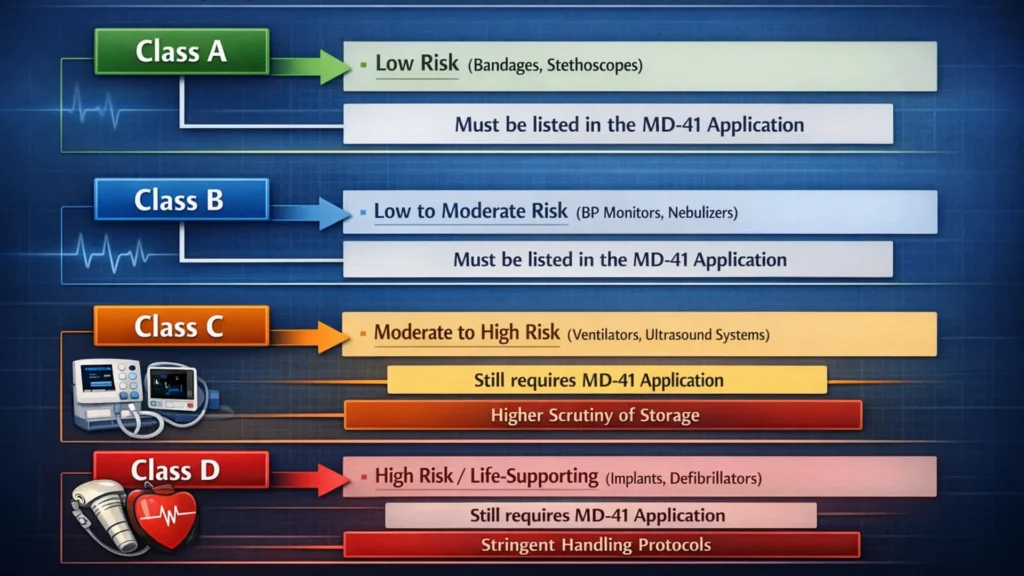
CDSCO classifies all medical devices — including software — into four risk-based classes. For SaMD, the classification depends on the healthcare situation (critical, serious, or non-serious) and the significance of the information provided by the software (treat/diagnose, drive clinical management, or inform clinical management).
| Class | Risk Level | Healthcare Situation | Information Significance | Examples |
| Class A | Low Risk | Non-serious | Inform clinical management | General wellness tracking, administrative software |
| Class B | Low-Moderate Risk | Serious | Inform clinical management | ECG analysis software, CGM secondary display, CAD for fractures |
| Class C | Moderate-High Risk | Critical or Serious | Treat/diagnose or drive clinical management | AI cancer detection, EEG interpretation aids, fertility diagnostic apps |
| Class D | High Risk | Critical | Treat or diagnose | Software controlling life-sustaining active implanted devices (in principle) |
Class A SaMD Devices — Low Risk
Class A SaMD products carry the lowest risk. No devices from the official CDSCO SaMD notification (MD-163 to MD-167) fall under Class A in the 60-product list. However, general administrative software and non-diagnostic wellness apps may qualify as Class A. These products typically require registration but face the least regulatory burden — no clinical data is required.
| S.No | Product Name | Intended Use |
| 1 | No Class A SaMD listed in the official MD-163 to MD-167 notification | Refer to CDSCO for Class A SaMD applicability |
Class B SaMD Devices — Low-Moderate Risk
Class B SaMD represents the largest segment in the notified list, covering 30 products. These are software devices that provide diagnostic support or processing for acquired signals and images — but all outputs remain subject to clinician review and are not autonomous. Registration for Class B requires technical documentation and quality management system (QMS) compliance, but no clinical trials.
| S.No | Product Name | Intended Use |
| 1 | Continuous Glucose Monitor Secondary Display | Notifies a follower of patient's CGM sensor glucose information in real time |
| 2 | Insulin Pump Secondary Display | Notifies another person of patient's insulin pump usage information in real time |
| 3 | Multivariate Vital Signs Index | Automated calculation of a summary index based on multiple vital sign inputs |
| 4 | Electrocardiograph Software for Home Use | Creates, analyzes, and displays ECG data; identifies cardiac arrhythmias for home users |
| 5 | Photoplethysmograph Analysis Software for Home Use | Analyzes PPG data and provides information for identifying irregular heart rhythms |
| 6 | Diagnostic Software, K-Nearest Neighbor Algorithm, Autoimmune Disease | Suggests systemic autoimmune disease association as aid for differential diagnosis |
| 7 | Ataxiagraph With Interpretive Software | Determines extent of ataxia by measuring body sway; provides interpretation |
| 8 | Colon CT System, Computer Aided Detection | Assists radiologists in reviewing CT exams of the colon; highlights potential polyps |
| 9 | Lung CT System, Computer Aided Detection | Assists radiologists in reviewing CT exams of the chest; highlights potential nodules |
| 10 | Chest X-Ray Computer Aided Detection | Assists radiologists reviewing chest radiographic images; highlights potential nodules |
| 11 | Radiological CAD Software For Fracture | Aids in detection, localization, and characterization of fracture on acquired medical images |
| 12 | X-Ray Angiographic Imaging Based Coronary Vascular Simulation Software | Assesses blood flow in coronary vascular system using X-ray angiographic imaging data |
| 13 | Automated Radiological Image Processing Software | Provides automated radiological image processing and AI-based analysis tools |
| 14 | Image Acquisition/Optimization Guided By Artificial Intelligence | Aids in acquisition and/or optimization of images and/or diagnostic signals |
| 15 | Chairside Dental CAD/CAM Unit | Intended for CAD or CAM of dental restorations |
| 16 | Software for Mammography-Combined Diagnostic X-Ray System | Processes data obtained from combined diagnostic mammography-radiography system |
| 17 | Software for Public Thoracic and Abdominal Health Screening Diagnostic X-Ray | Processes data from thoracic and abdominal public health screening diagnostic X-ray system |
| 18 | Software for Visual Evoked Response Stimulator | Processes data from visual evoked response stimulator for diagnosis |
| 19 | Software for Auditory Evoked Response Stimulator | Processes data from auditory evoked response stimulator for diagnosis |
| 20 | Software for Pulmonary Exercise Stress Monitoring System | Processes data from pulmonary exercise stress monitoring system |
| 21 | Software for ECG Recorder with Real-Time Analysis | Processes data from ECG recorder with real-time analysis for diagnosis |
| 22 | Software for Film-Recorded Digital Radiography | Processes data from film-recorded digital radiography for diagnosis |
| 23 | Software for Dye Dilution Cardiac Output Calculator | Processes data from dye dilution cardiac output unit for diagnosis |
| 24 | Software for Urodynamic Measurement System | Processes data from urodynamic measurement system for diagnosis |
| 25 | Software for Vestibular Function Caloric Stimulator | Processes data from vestibular function caloric stimulator for diagnosis |
| 26 | Supporting Software for External Fixators Treatment Plan | Analyzes information for bone fracture correction; supports treatment plan preparation |
| 27 | Diagnostic Supporting Software for Diabetes | Supports analysis of therapeutic effects of diabetes treatment based on blood glucose data |
| 28 | Quantitative Calculation Software for IGC Test | Performs quantitative calculation of blood flow from ICG angiography video images |
| 29 | Analyzing Software for Hemodynamics or Cardiac Function | Analyzes hemodynamics or cardiac function from diagnostic imaging system data |
| 30 | Supporting Software for Root Canal Treatment | Supports treatment plan preparation for root canal treatment from diagnostic imaging data |
Class C SaMD Devices — Moderate-High Risk
Class C SaMD covers 29 products in the notified list. These are software devices that directly drive clinical management decisions, provide diagnoses, or make therapeutic recommendations. Class C registration requires a full technical file, clinical evaluation report, and post-market surveillance plan. CDSCO scrutiny at this level is significantly higher.
| S.No | Product Name | Intended Use |
| 1 | Continuous Glucose Monitor Retrospective Data Analysis Software | Analyzes and correlates retrospective data from a CGM device |
| 2 | Insulin Pump Therapy Adjustment Calculator for Healthcare Professionals | Recommends insulin pump therapy parameter adjustments based on CGM and external device data |
| 3 | Coronary Vascular Physiologic Simulation Software | Aids identification of functionally significant cardiovascular disease via offline imaging analysis |
| 4 | Angiographic Coronary Vascular Physiologic Simulation Software | Aids in identification of functionally significant cardiovascular disease via angiographic analysis |
| 5 | Software for Visualization of Vascular Anatomy and Intravascular Devices | Visualization and measurement of blood vessels and intravascular devices for preoperative planning |
| 6 | Orthodontic Software | Used for diagnosis and treatment planning of orthodontic patients and conditions |
| 7 | Dental Abutment Design Software for Dental Laboratory | Aids in designing patient-specific dental abutment components for implant restoration |
| 8 | Neuropsychiatric Interpretive Electroencephalograph Assessment Aid | Provides interpretation of patient's neuropsychiatric condition as an aid |
| 9 | Normalizing Quantitative Electroencephalograph Software | Post-hoc statistical analysis of EEG signals with comparison to normative database |
| 10 | Index-Generating Electroencephalograph Software | Transforms EEG signals into a dimensionless index number for clinical interpretation |
| 11 | Source Localization Software for EEG or MEG | Correlates electrical brain activity using neuroimaging modalities for source localization |
| 12 | Automatic Event Detection Software for Polysomnograph with EEG | Automatically marks EEG/PSG signals to aid identification and annotation of events |
| 13 | Automatic Event Detection Software for Full-Montage EEG | Automatically marks EEG waveforms for spikes and seizures to aid clinical review |
| 14 | Computerized Cognitive Assessment Aid for Concussion | Assessment aid in the management of concussion |
| 15 | Computerized Behavioral Therapy Device for Psychiatric Disorders | Provides cognitive behavioral therapy to treat substance use disorder via mobile app |
| 16 | Brain Injury Adjunctive Interpretive Oculomotor Assessment Aid | Uses tracked eye movements to provide interpretation of patient's brain functional condition |
| 17 | Device, Fertility Diagnostic, Contraceptive, Software Application | Monitors and provides fertility information to prevent pregnancy |
| 18 | Diabetic Retinopathy Detection Device | Evaluates ophthalmic images for diagnostic screening to identify retinal diseases |
| 19 | Computer-Assisted Diagnostic Software for Lesions Suspicious for Cancer | Assists clinical users in characterizing lesions identified on acquired medical images |
| 20 | Radiological CAD Software for Lesions Suspicious for Cancer | Aids detection, localization, and characterization of lesions suspicious for cancer on acquired images |
| 21 | Burn Resuscitation Decision Support Software | Predicts hourly fluid volume during initial 24 hours of burn resuscitation |
| 22 | Software, Similarity Score Algorithm, Tissue of Origin for Malignant Tumor Types | Measures similarity between RNA expression pattern in tumor and database of tumor samples |
| 23 | Software for Peritoneal Dialysis Treatment | Performs prescription simulation of peritoneal dialysis based on peritoneal function test results |
| 24 | Software for Radiation Planning | Calculates and displays radiation treatment area and internal dose distribution for radiotherapy |
| 25 | Software for Radiotherapy QA/QC Planning | Verifies validity of radiotherapy plan by recalculating dose and MU values |
| 26 | Software for Ophthalmic Surgery Treatment Planning | Aids ophthalmic surgical planning based on pre-surgery eye measurements; simulates results |
| 27 | Software for Active Implanted Device Control | Transmits and changes electrical operating characteristics of active implanted devices |
| 28 | Information Collating Software for Radiotherapy | Collates irradiation parameters with radiotherapy equipment conditions during X-ray delivery |
| 29 | Software for Gene Variants Analysis (Cancer Genome Profiling) | Performs cancer genome profiling based on gene variants from body tissue samples |
| 30 | Supporting Software for Differential Diagnosis with Endoscopic Imaging | Processes endoscopic image data for benign/malignant differentiation and disease staging |
Class D SaMD Devices — High Risk
Class D SaMD represents the highest risk category — software that directly treats or diagnoses in critical healthcare situations. No products from the MD-163 to MD-167 notification are classified as Class D in the 60-product list. However, software used to control life-sustaining active implanted devices (e.g., advanced pacemaker control software) may be classified as Class D in future notifications.
| S.No | Product Name | Intended Use |
| 1 | No Class D SaMD listed in the official MD-163 to MD-167 notification | Subject to CDSCO review for future notifications |
Who Needs CDSCO SaMD Registration?
Any entity that manufactures, imports, or sells a software medical device in India must obtain CDSCO registration. This includes:
- Indian manufacturers of software medical devices — diagnostic apps, clinical decision support tools, AI-based imaging software
- Foreign manufacturers seeking to import or distribute SaMD in India — registration through an authorized Indian agent is mandatory
- Startups and health-tech companies developing mobile applications with medical diagnostic claims
- Hospitals or institutions that develop proprietary SaMD for clinical use beyond their premises
If your software makes a medical claim — diagnosis, treatment, monitoring, or mitigation — it likely qualifies as SaMD and requires registration.
Documents Required for CDSCO SaMD Registration
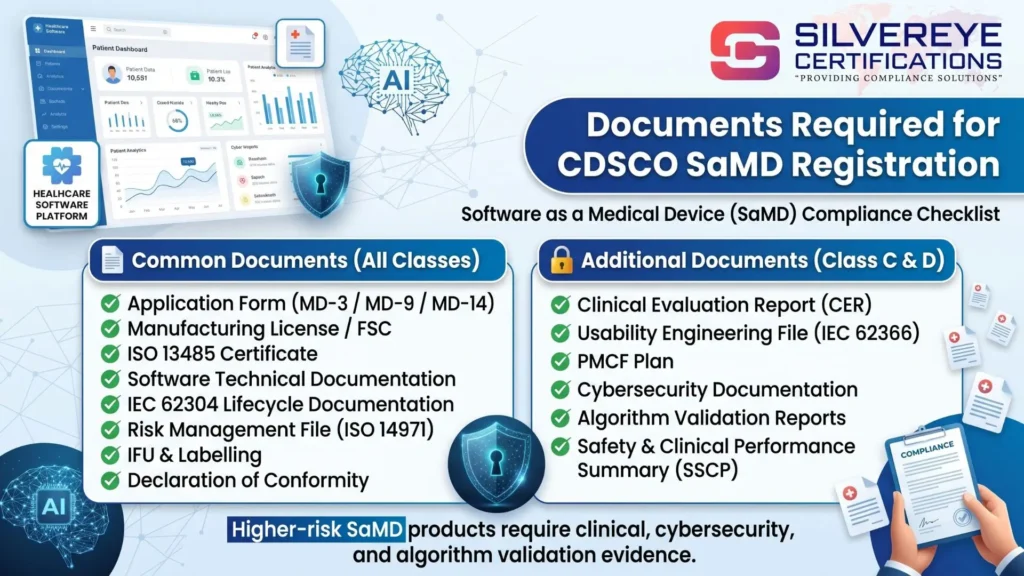
The documentation requirement varies by class. Below is a comprehensive list of documents required across all classes:
Common Documents (All Classes)
- Form MD-3 (application for grant of license) or Form MD-9 (import license) or Form MD-14 (loan license)
- Manufacturing license or Certificate of Free Sale (for importers)
- ISO 13485 Quality Management System certificate
- Technical documentation covering software description, intended use, and user interface
- Software Lifecycle Management documentation (IEC 62304 compliance)
- Risk management file (ISO 14971)
- Labelling and Instructions for Use (IFU)
- Declaration of conformity
Additional Documents for Class C and D
- Clinical evaluation report (CER) with clinical data supporting safety and performance claims
- Usability engineering file (IEC 62366)
- Post-market clinical follow-up (PMCF) plan
- Cybersecurity documentation and data protection compliance proof
- Algorithm validation study reports (especially for AI/ML-based SaMD)
- Summary of Safety and Clinical Performance (SSCP)
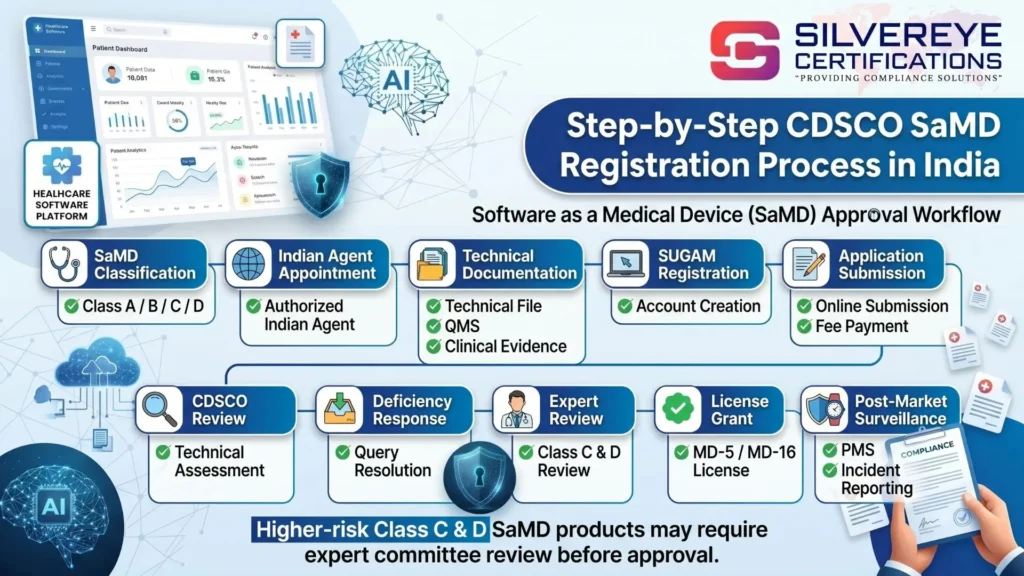
Step-by-Step CDSCO SaMD Registration Process in India
- Determine your SaMD classification (Class A, B, C, or D) based on intended use and healthcare situation.
- Appoint an authorized Indian agent (mandatory for foreign manufacturers).
- Prepare your technical file, QMS documentation, and clinical evaluation report as applicable.
- Register on the SUGAM portal (sugam.gov.in) and create an account.
- Submit the application online along with prescribed fees.
- CDSCO issues an acknowledgment and assigns a review team.
- Deficiency queries (if any) are raised — respond within the stipulated time to avoid rejection.
- For Class C and D, a technical committee review and expert scrutiny may be required.
- Upon successful review, CDSCO grants Form MD-5 (manufacturing license) or Form MD-16 (import license).
- Post-registration, maintain post-market surveillance and report serious incidents (PMSR).
CDSCO SaMD Registration Fees in India
Fees are prescribed under IMDR 2017, Schedule I, and are subject to periodic revision. The following are indicative standard fees — always verify current amounts on the SUGAM portal before filing.
| Application Type | Class A | Class B | Class C | Class D |
| Manufacturing License (Form MD-5) | ₹2,500 | ₹5,000 | ₹25,000 | ₹50,000 |
| Import License (Form MD-16) | ₹1,000 | ₹3,000 | ₹15,000 | ₹30,000 |
| Loan License | ₹1,000 | ₹2,500 | ₹10,000 | ₹25,000 |
| Renewal (per class) | ₹1,500 | ₹3,000 | ₹10,000 | ₹20,000 |
Note: Small-scale manufacturers and startups under DPIIT recognition may be eligible for fee concessions — check CDSCO notifications for the latest exemptions.
Validity and Renewal of CDSCO SaMD Registration
| Aspect | Details |
| License Validity | 5 years from date of grant (manufacturing and import licenses) |
| Renewal Timeline | Apply for renewal 6 months before expiry — delay attracts penalties |
| Renewal Form | Form MD-7 (manufacturing) or Form MD-17 (import) |
| Post-Renewal Validity | 5 additional years upon successful renewal |
| Major Change Reporting | Any change in software algorithm, intended use, or hardware interface requires fresh variation application |
| Annual Returns | Form MD-17A for importers must be filed each year |
Benefits of CDSCO Registration for SaMD
- Legal market access — only registered SaMD can be lawfully sold, imported, or distributed in India
- Builds clinician and patient trust — CDSCO registration is a mark of regulatory compliance and quality
- Opens doors to government procurement — hospitals and public health programs prefer or require registered devices
- Enables export opportunities — many countries accept CDSCO registration as proof of GMP compliance
- Protects against enforcement action — unregistered SaMD risks product seizure, penalties, and prosecution
- Supports reimbursement eligibility — insurance and payer schemes increasingly require regulatory clearance
Common Challenges in SaMD Registration and How to Overcome Them
| Challenge | Solution |
| Incorrect classification of SaMD risk class | Use IMDRF N12 guidance and CDSCO classification rules; consult a regulatory expert |
| Incomplete technical documentation | Prepare documents aligned with IMDRF N41 technical framework before filing |
| Lack of IEC 62304 (Software Lifecycle) compliance | Engage a QMS consultant to build your software lifecycle management system |
| Clinical evidence gaps for Class C devices | Plan clinical validation early; consider using literature-based clinical evaluation where permitted |
| Algorithm validation for AI/ML SaMD | Follow WHO and FDA/IMDRF guidance on predetermined change control plans and algorithm performance reporting |
| Post-market surveillance obligations | Set up a formal PMS system — periodic safety update reports (PSUR) are mandatory |
Key Regulations and Guidelines Governing SaMD in India
- Medical Devices Rules (IMDR) 2017 — primary legislation for all medical devices including SaMD
- Medical Devices (Amendment) Rules 2020 — expanded the definition and classification of medical devices
- CDSCO Guidance Document on SaMD — provides interpretive guidance on SaMD classification
- IEC 62304 — Software lifecycle processes (internationally referenced standard)
- ISO 14971 — Risk management for medical devices
- IEC 62366 — Usability engineering for medical devices
- IMDRF N12 — SaMD key definitions
- IMDRF N41 — Software as a Medical Device: Clinical Evaluation
- IMDRF N23 — SaMD quality management system
All 60 Notified Software Medical Devices: Complete CDSCO Classification Table
The following consolidated table lists all 60 software medical devices officially notified by CDSCO under MD-163 to MD-167, organized with their IMDR risk class for quick reference.
| S.No | Product Name | Risk Class |
| 1 | Continuous Glucose Monitor Retrospective Data Analysis Software | C |
| 2 | Continuous Glucose Monitor Secondary Display | B |
| 3 | Insulin Pump Secondary Display | B |
| 4 | Insulin Pump Therapy Adjustment Calculator for HCPs | C |
| 5 | Coronary Vascular Physiologic Simulation Software | C |
| 6 | Multivariate Vital Signs Index | B |
| 7 | Electrocardiograph Software for Home Use | B |
| 8 | Photoplethysmograph Analysis Software for Home Use | B |
| 9 | Angiographic Coronary Vascular Physiologic Simulation Software | C |
| 10 | Software for Visualization of Vascular Anatomy and Intravascular Devices | C |
| 11 | Orthodontic Software | C |
| 12 | Dental Abutment Design Software for Dental Laboratory | C |
| 13 | Diagnostic Software, K-Nearest Neighbor Algorithm, Autoimmune Disease | B |
| 14 | Neuropsychiatric Interpretive EEG Assessment Aid | C |
| 15 | Normalizing Quantitative EEG Software | C |
| 16 | Index-Generating EEG Software | C |
| 17 | Source Localization Software for EEG or MEG | C |
| 18 | Automatic Event Detection Software for Polysomnograph with EEG | C |
| 19 | Automatic Event Detection Software for Full-Montage EEG | C |
| 20 | Computerized Cognitive Assessment Aid for Concussion | C |
| 21 | Ataxiagraph With Interpretive Software | B |
| 22 | Computerized Behavioral Therapy Device for Psychiatric Disorders | C |
| 23 | Brain Injury Adjunctive Interpretive Oculomotor Assessment Aid | C |
| 24 | Device, Fertility Diagnostic, Contraceptive, Software Application | C |
| 25 | Diabetic Retinopathy Detection Device | C |
| 26 | Colon CT System, Computer Aided Detection | B |
| 27 | Lung CT System, Computer Aided Detection | B |
| 28 | Chest X-Ray Computer Aided Detection | B |
| 29 | Computer-Assisted Diagnostic Software for Lesions Suspicious for Cancer | C |
| 30 | Radiological CAD Software for Fracture | B |
| 31 | Radiological CAD Software for Lesions Suspicious for Cancer | C |
| 32 | X-Ray Angiographic Imaging Based Coronary Vascular Simulation Software | B |
| 33 | Automated Radiological Image Processing Software | B |
| 34 | Image Acquisition/Optimization Guided by Artificial Intelligence | B |
| 35 | Burn Resuscitation Decision Support Software | C |
| 36 | Software, Similarity Score Algorithm, Tissue of Origin for Malignant Tumors | C |
| 37 | Software for Peritoneal Dialysis Treatment | C |
| 38 | Software for Radiation Planning | C |
| 39 | Software for Radiotherapy QA/QC Planning | C |
| 40 | Software for Ophthalmic Surgery Treatment Planning | C |
| 41 | Software for Active Implanted Device Control | C |
| 42 | Information Collating Software for Radiotherapy | C |
| 43 | Software for Gene Variants Analysis (Cancer Genome Profiling) | C |
| 44 | Supporting Software for Differential Diagnosis with Endoscopic Imaging | C |
| 45 | Chairside Dental CAD/CAM Unit | B |
| 46 | Software for Mammography-Combined Diagnostic X-Ray System | B |
| 47 | Software for Public Thoracic and Abdominal Health Screening X-Ray | B |
| 48 | Software for Visual Evoked Response Stimulator | B |
| 49 | Software for Auditory Evoked Response Stimulator | B |
| 50 | Software for Pulmonary Exercise Stress Monitoring System | B |
| 51 | Software for ECG Recorder with Real-Time Analysis | B |
| 52 | Software for Film-Recorded Digital Radiography | B |
| 53 | Software for Dye Dilution Cardiac Output Calculator | B |
| 54 | Software for Urodynamic Measurement System | B |
| 55 | Software for Vestibular Function Caloric Stimulator | B |
| 56 | Supporting Software for External Fixators Treatment Plan | B |
| 57 | Diagnostic Supporting Software for Diabetes | B |
| 58 | Quantitative Calculation Software for IGC Test | B |
| 59 | Analyzing Software for Hemodynamics or Cardiac Function | B |
| 60 | Supporting Software for Root Canal Treatment | B |
Conclusion
CDSCO registration for SaMD isn't just a compliance requirement — it's what makes your product legally viable and clinically trustworthy in one of the world's largest healthcare markets.
The process is structured, but it's manageable if you approach it in the right order. Get your classification right first — everything else, from documentation to fees to timelines, flows from that single decision. Class B and Class C have meaningfully different burdens, and a misclassification caught late is expensive.
A few things that consistently trip people up: underestimating how seriously CDSCO treats ISO 13485 and IEC 62304 compliance, assuming international clearances (CE, FDA) will carry weight here, and appointing an Indian authorized agent without thinking through their actual capabilities.
India's SaMD regulatory framework is maturing fast. The SUGAM portal works, the fast-track pathway for innovative devices is real, and CDSCO is increasingly aligned with IMDRF globally. The companies that do well here are simply the ones who prepare early and classify honestly.
Start with your risk class. The rest will follow.
Frequently Asked Questions
Is my mobile health app a SaMD and does it need CDSCO registration?
If your app makes a medical claim — such as detecting arrhythmias, monitoring blood glucose, or diagnosing a disease — it qualifies as SaMD and requires CDSCO registration. General wellness apps without diagnostic claims may be exempt, but you should seek regulatory opinion to confirm.
What is the difference between Class B and Class C SaMD?
Class B SaMD informs clinical management in serious healthcare situations — output aids clinicians but is not autonomous. Class C SaMD drives clinical management decisions or provides diagnoses in serious or critical situations
How long does CDSCO SaMD registration take?
For Class B, registration typically takes 45 to 90 days with complete documentation. Class C may take 90 to 180 days, including technical committee review. Deficiency responses and re-submissions can extend timelines significantly.
Can a foreign software company get CDSCO import registration without a local office?
Yes. Foreign manufacturers must appoint an authorized Indian agent who will hold the import license on their behalf. The Indian agent is legally responsible for compliance, post-market surveillance, and communication with CDSCO.
Is ISO 13485 certification mandatory for SaMD registration?
Yes, ISO 13485 (Quality Management System for Medical Devices) certification is a core requirement for all SaMD registration categories. CDSCO may accept an audit report in lieu of full certification in some cases — check with a regulatory consultant.
Do AI and machine learning-based SaMD face additional requirements?
Yes. AI/ML-based SaMD require algorithm validation studies, training/test dataset documentation, performance metrics reporting, and — where the algorithm continuously learns — a predetermined change control plan (PCCP). CDSCO is progressively aligning with international guidance on this.
What happens if I sell an unregistered SaMD in India?
Selling or importing an unregistered medical device (including SaMD) in India is a punishable offence under IMDR 2017 and the Drugs and Cosmetics Act. Penalties include product seizure, fines up to ₹3 lakh or more, and prosecution of the responsible person.
Is there a fast-track route for SaMD registration in India?
CDSCO has introduced an accelerated review pathway for innovative and breakthrough devices. SaMD that addresses unmet clinical needs or uses novel technology may qualify. Applications must be flagged at submission for expedited review consideration
How often do I need to renew my SaMD registration?
CDSCO SaMD registration (manufacturing or import license) is valid for 5 years. Renewal must be applied for at least 6 months before expiry using Form MD-7 (manufacturing) or Form MD-17 (import). Late renewal attracts penalties and may result in lapsed market access.
If I update my SaMD algorithm significantly, do I need a fresh CDSCO application?
Yes. Significant changes to software intended use, algorithm logic, clinical claims, or interoperability require a variation application to CDSCO. Minor bug fixes and security patches may not require fresh approval — but all changes must be documented and risk-assessed under your QMS.