
- Cosmetic License For Hair oil and shampoo are regulated under the Drugs and Cosmetics Act, 1940 — not as drugs — unless they make therapeutic or medicinal claims.
- To import hair oil or shampoo in India, you must apply using Form COS-1 and receive Form COS-2 (Grant of Import License) from CDSCO or the State Licensing Authority.
- To manufacture hair oil or shampoo in India, you must apply using Form COS-5 and receive Form COS-8 (Grant of Manufacturing License) from the State Licensing Authority after a GMP inspection.
- Operating without a valid cosmetic license — for both manufacturing and import — is a punishable offense under the Drugs and Cosmetics Act, 1940, with penalties including product seizure and fines.
To legally manufacture or import hair oil and shampoo in India in 2026, you need a cosmetic license under the Drugs and Cosmetics Act, 1940, and Cosmetics Rules, 2020. Importers must apply using Form COS-1 and obtain Form COS-2 (import license). Manufacturers must apply using Form COS-5 and obtain Form COS-8 (manufacturing license) after a factory inspection for GMP (Schedule M-II) compliance. The process typically takes 60–150 working days depending on the license type.
How Are Hair Oil and Shampoo Regulated in India?
Hair oil and shampoo products in India are categorized as cosmetics under the Drugs and Cosmetics Act, 1940, and are fully governed by the Cosmetics Rules, 2020 — which replaced the cosmetic provisions of the older Drugs and Cosmetics Rules, 1945. This regulatory framework covers everything from how these products are manufactured to how they are imported, labeled, and sold in the Indian market.
The two primary regulatory bodies involved in this process are:
- CDSCO (Central Drugs Standard Control Organization): The national apex body under the Ministry of Health and Family Welfare that oversees cosmetic imports and sets national standards.
- State Licensing Authority (SLA): Each state's drug regulatory authority that grants manufacturing licenses and conducts factory inspections for cosmetic producers.
An important distinction to remember: if your hair oil or shampoo makes therapeutic claims — such as treating scalp fungal infections, stimulating hair regrowth medically, or treating alopecia — it may be classified as a drug and would require a drug manufacturing or import license, not a cosmetic one. Standard hair care claims like 'strengthens hair' or 'reduces hair fall' generally remain in the cosmetic category.
Complete List of Hair Oil and Shampoo Products — License Planning Table
Before applying for your cosmetic license, you need to clearly identify the product types you plan to manufacture or import. The tables below give you a comprehensive product-level view so you can map the exact licensing pathway for your business.
Hair Oil Products — Types, Categories, and License Forms
| S.No. | Product Name | Category | Form | License Type | Applicable Form |
| 1 | Coconut Hair Oil | Pure Hair Oil | Liquid Oil | Mfg / Import | COS-5/COS-1 |
| 2 | Amla Hair Oil | Herbal Hair Oil | Liquid Oil | Mfg / Import | COS-5/COS-1 |
| 3 | Bhringraj Hair Oil | Ayurvedic Hair Oil | Liquid Oil | Mfg / Import | COS-5/COS-1 |
| 4 | Argan Oil Hair Serum | Luxury Hair Oil | Serum/Oil | Mfg / Import | COS-5/COS-1 |
| 5 | Onion Black Seed Hair Oil | Herbal Growth Oil | Liquid Oil | Mfg / Import | COS-5/COS-1 |
| 6 | Hair Growth Tonic Oil | Scalp Treatment Oil | Liquid Oil | Mfg / Import | COS-5/COS-1 |
| 7 | Castor Hair Oil | Thick Hair Oil | Liquid Oil | Mfg / Import | COS-5/COS-1 |
| 8 | Lightweight Dry Hair Oil | Non-Greasy Hair Oil | Fluid Oil | Mfg / Import | COS-5/COS-1 |
| 9 | Jasmine Perfumed Hair Oil | Scented Hair Oil | Liquid Oil | Mfg / Import | COS-5/COS-1 |
| 10 | Vitamin E Hair Oil | Nourishing Hair Oil | Liquid Oil | Mfg / Import | COS-5/COS-1 |
| 11 | Baby Hair Oil (Mild Formula) | Baby/Kids Hair Oil | Liquid Oil | Mfg / Import | COS-5/COS-1 |
| 12 | Anti-Dandruff Hair Oil | Medicated-Style Hair Oil | Liquid Oil | Mfg / Import | COS-5/COS-1 |
| 13 | Hot Oil Treatment (Pre-Shampoo Oil) | Intensive Care Oil | Liquid Oil | Mfg / Import | COS-5/COS-1 |
| 14 | Hair Fall Control Oil | Strengthening Hair Oil | Liquid Oil | Mfg / Import | COS-5/COS-1 |
| 15 | Imported Branded Hair Oil (e.g., Moroccan Oil) | Imported Hair Oil | Serum/Oil | Import Only | COS-1 → COS-2 |
Shampoo Products — Types, Categories, and License Forms
| S.No. | Product Name | Category | Form | License Type | Applicable Form |
| 1 | Mild Everyday Shampoo | General Hair Cleansing | Liquid | Mfg / Import | COS-5/COS-1 |
| 2 | Anti-Dandruff Shampoo (Zinc Pyrithione) | Scalp Treatment | Liquid | Mfg / Import | COS-5/COS-1 |
| 3 | Herbal / Ayurvedic Shampoo | Natural Hair Care | Liquid | Mfg / Import | COS-5/COS-1 |
| 4 | Sulphate-Free Shampoo | Gentle Hair Cleansing | Liquid | Mfg / Import | COS-5/COS-1 |
| 5 | Keratin Shampoo | Smoothing & Repair | Liquid | Mfg / Import | COS-5/COS-1 |
| 6 | Colour-Protect Shampoo | Color-Treated Hair | Liquid | Mfg / Import | COS-5/COS-1 |
| 7 | Baby Shampoo (Tear-Free) | Baby / Kids | Liquid | Mfg / Import | COS-5/COS-1 |
| 8 | Dry Shampoo (Spray / Powder) | On-the-Go Cleansing | Spray/Powder | Mfg / Import | COS-5/COS-1 |
| 9 | 2-in-1 Shampoo + Conditioner | Combo Hair Care | Liquid | Mfg / Import | COS-5/COS-1 |
| 10 | Onion Shampoo (Anti Hair Fall) | Hair Growth | Liquid | Mfg / Import | COS-5/COS-1 |
| 11 | Biotin Shampoo | Thinning Hair Care | Liquid | Mfg / Import | COS-5/COS-1 |
| 12 | Volumizing Shampoo | Fine Hair Care | Liquid | Mfg / Import | COS-5/COS-1 |
| 13 | Argan Oil Shampoo | Luxury Hair Care | Liquid | Mfg / Import | COS-5/COS-1 |
| 14 | Clarifying Shampoo (Deep Cleanse) | Buildup Removal | Liquid | Mfg / Import | COS-5/COS-1 |
| 15 | Imported Branded Shampoo (e.g., L'Oréal, Head & Shoulders) | Imported Hair Care | Liquid | Import Only | COS-1 → COS-2 |
Understanding the Four COS License Forms — COS-1, COS-2, COS-5, COS-8
The Cosmetics Rules, 2020 prescribe four key forms for the licensing of cosmetics in India. Whether you are importing or manufacturing hair oil and shampoo, you will work with one of these two pathways. Here is a side-by-side comparison:
| Form | Purpose | Who Applies / Who Issues | Issued To | Validity | Governing Rule |
| COS-1 | Application for Import License | Importer / Brand Owner | CDSCO / State Licensing Authority | On Application | Rule 21 — Cosmetics Rules 2020 |
| COS-2 | Grant of License to Import | Regulatory Authority | Issued to Importer | 1–3 Years | After COS-1 approval |
| COS-5 | Application for Manufacturing License | Manufacturer | State Licensing Authority (SLA) | On Application | Rule 32 — Schedule M-II GMP |
| COS-8 | Grant of Manufacturing License | State Licensing Authority | Issued to Manufacturer | 5 Years (Renewable) | After inspection & COS-5 approval |
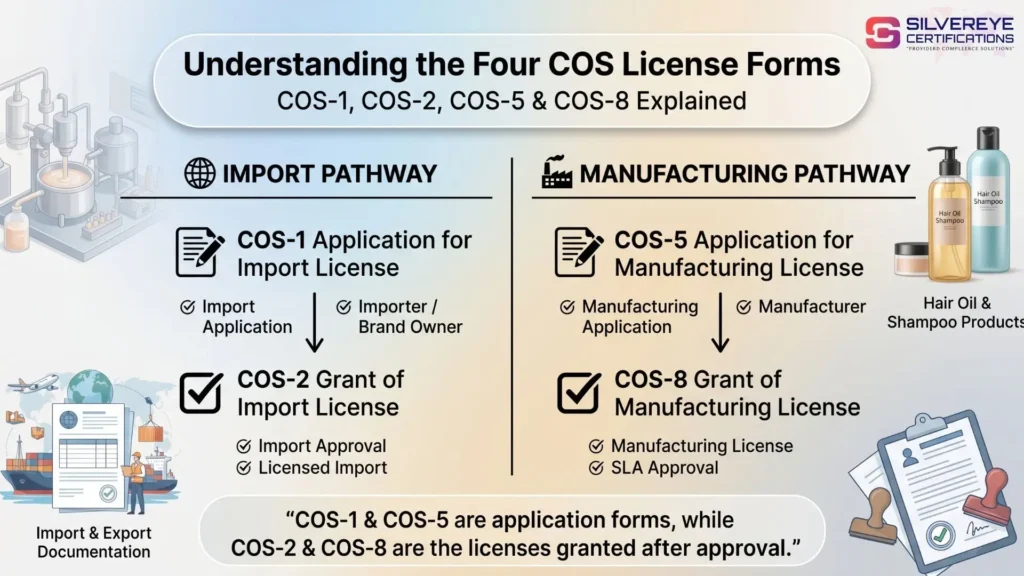
Think of it this way: COS-1 and COS-5 are the application forms you submit. COS-2 and COS-8 are the actual licenses you receive. There is no shortcut — you must go through the application stage before the license is granted.
How to Get a Cosmetic Import License for Hair Oil and Shampoo (COS-1 → COS-2)
If your business model involves importing hair oil, shampoo, or any hair care product from international manufacturers — whether you are a distribution company, a brand owner sourcing overseas, or a startup building a private-label import business — this is the licensing pathway you need to follow.
Who Can Apply for COS-1 Import License?
Any individual, proprietorship, partnership firm, LLP, or private/public limited company registered in India that intends to import cosmetics for commercial sale can apply. However, the following pre-conditions must be met:
- The business must be a legally registered entity in India
- A valid Import Export Code (IEC) from DGFT must be in place before applying
- The applicant must designate a Responsible Person — someone with basic technical qualifications — for the products being imported
- The overseas manufacturer must be a recognized and legitimate cosmetic producer in their country of origin
- The products must not be banned or restricted under Indian regulations
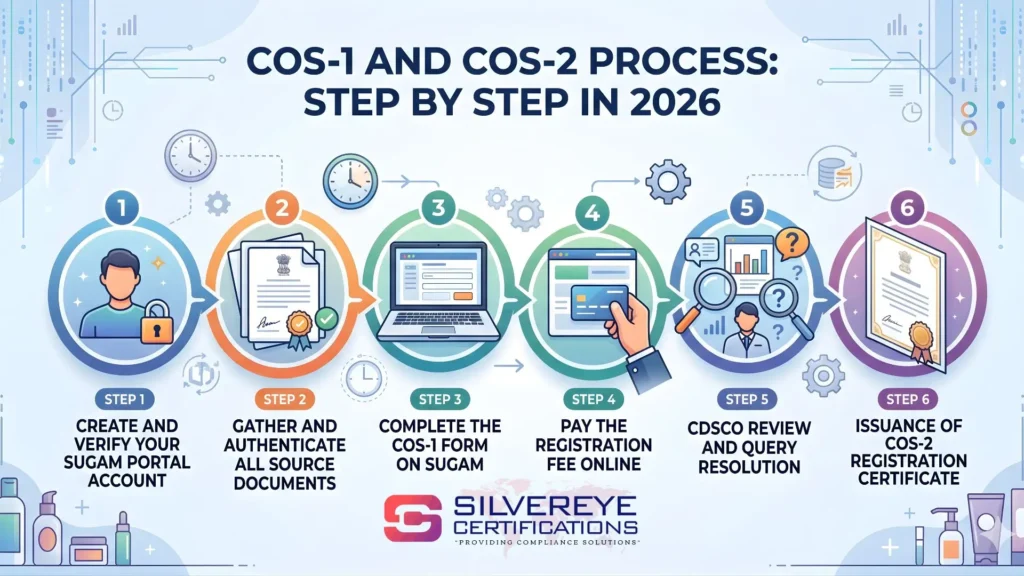
Step-by-Step Process: COS-1 Application for Hair Oil and Shampoo Import
- Obtain your Import Export Code (IEC) from DGFT if you do not already have one.
- Register your business entity in India (Proprietorship / LLP / Pvt. Ltd., etc.) and obtain GST registration.
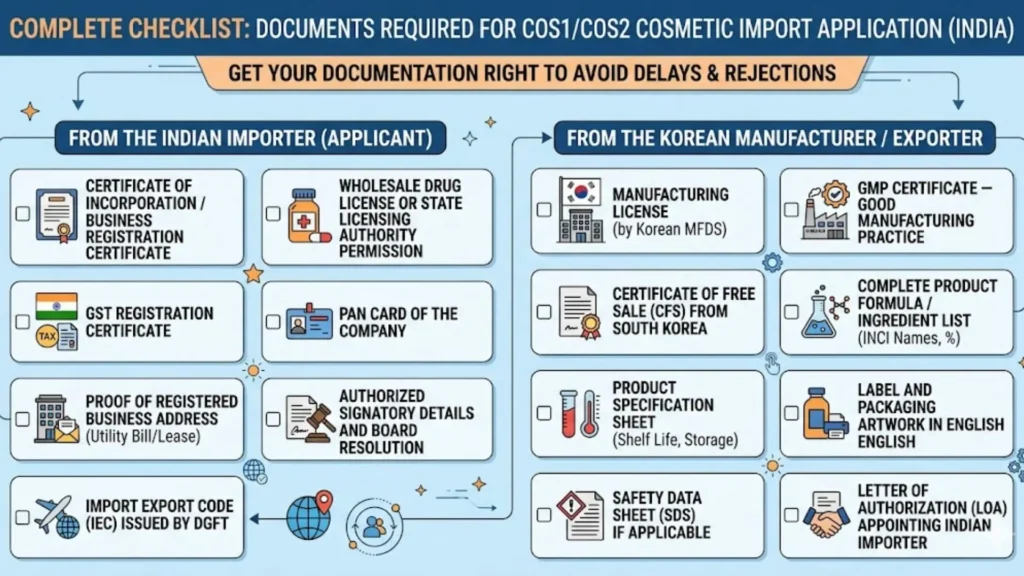
- Gather all required documents from your overseas supplier — Free Sale Certificate, Certificate of Analysis, formulation details, authorization letter.
- Prepare the draft product label complying with the Cosmetics Rules, 2020 Indian labeling standards.
- Fill Form COS-1 completely with all product details, formulation, ingredients, and applicant information.
- Submit the application to the State Licensing Authority (SLA) of your state or CDSCO, along with all supporting documents and the prescribed fee.
- Respond to any queries or clarifications raised by the authority within the specified timeframe.
- Upon approval, receive Form COS-2 — your Grant of License to Import the cosmetic products.
Key Details Required in Form COS-1
- Full name, address, and contact details of the importing business
- Full name, address, and country of the overseas manufacturer
- Complete product name and intended use / product category
- Full ingredient list (INCI international nomenclature preferred)
- Quantitative formulation (percentage of each ingredient)
- Country of origin and country of manufacture
- Proposed Indian market label / artwork (draft)
- IEC number, GST number
- Name and qualifications of the Responsible Person
What Is COS-2? — Grant of Import License
COS-2 is the official Grant of License to Import Cosmetics issued by the authority after reviewing and approving your COS-1 application. Once you hold a valid COS-2 license, you are legally authorized to import those specific hair oil or shampoo products into India and sell them in the Indian market.
- Validity: COS-2 import licenses are generally valid for 1–3 years depending on the product and the authority's decision.
- Renewal: The renewal application must be submitted before the expiry date. A lapsed license means you cannot import until renewed.
- Amendment: If you change the product formulation, overseas manufacturer, or any key detail, an amendment application must be filed.
How to Get a Cosmetic Manufacturing License for Hair Oil and Shampoo (COS-5 → COS-8)
If you are setting up a hair oil or shampoo manufacturing unit in India — whether as a brand owner running your own plant, a contract/third-party manufacturer serving multiple brands, or a startup entering the hair care segment — you must obtain a manufacturing license under the Cosmetics Rules, 2020.
Pre-Condition: Build a GMP-Compliant Manufacturing Facility
The single most important prerequisite before applying for COS-5 is having a manufacturing facility that is fully compliant with Schedule M-II of the Cosmetics Rules, 2020 — India's Good Manufacturing Practices (GMP) standard for cosmetics. Schedule M-II compliance is not optional — it is legally mandatory and will be physically verified by a Drug Inspector during the factory inspection.
Key Schedule M-II requirements for hair oil and shampoo manufacturers include:
- Dedicated manufacturing area separated from storage, QC lab, and administrative areas
- Smooth, washable, and non-porous walls and floors in production areas
- Adequate ventilation, lighting, and temperature control
- Purified water system (water quality tested and documented)
- Calibrated and qualified manufacturing equipment (mixing tanks, filling machines, etc.)
- Separate raw material and finished goods storage areas
- In-house quality control laboratory or a documented arrangement with an approved external lab
- Pest control and sanitation program with records
- Batch Manufacturing Records (BMR) system for traceability
- Staff hygiene protocols and training records
Appoint a Technically Qualified Person (TQP)
Every cosmetic manufacturing unit in India must employ at least one Technically Qualified Person responsible for overseeing manufacturing operations and quality. The typical qualifications accepted by State Licensing Authorities include:
- Graduate in Pharmacy (B.Pharm) — most widely accepted
- Graduate in Chemistry (B.Sc. Chemistry) with relevant industry experience
- Diploma in Cosmetology or Hair Technology (accepted in some states)
- Graduate in Biochemistry or Biotechnology with relevant experience (state-specific)
The TQP must be physically present at the manufacturing site during operations and their credentials form a mandatory part of the COS-5 application.
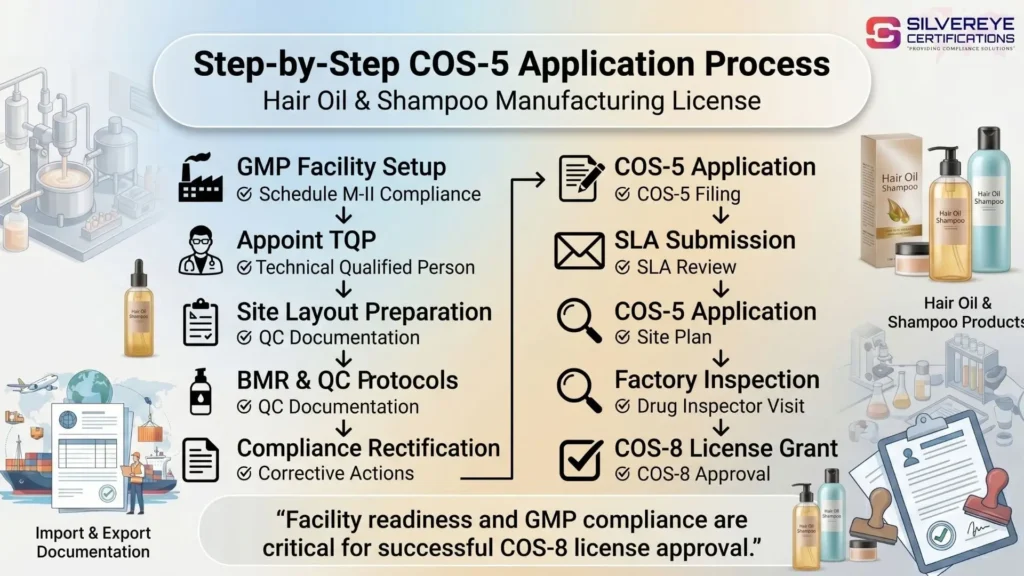
Step-by-Step Process: COS-5 Application for Hair Oil and Shampoo Manufacturing
- Set up your manufacturing facility to be fully Schedule M-II GMP compliant.
- Appoint and onboard a Technically Qualified Person (TQP) for your facility.
- Get a site plan / layout of the manufacturing premises prepared by a civil engineer or architect.
- Finalize your product formulations for all hair oil and shampoo products you plan to manufacture.
- Prepare Batch Manufacturing Records (BMR) templates and Quality Control (QC) testing protocols.
- Fill Form COS-5 completely with all facility details, product list, formulations, TQP credentials, and equipment list.
- Submit the COS-5 application to the State Licensing Authority (SLA) of your state with all supporting documents and the prescribed fee.
- Receive acknowledgment and application number from the SLA.
- Appear for the Drug Inspector's factory inspection — ensure the facility is fully operational and GMP-compliant on the inspection day.
- Address any non-conformance observations raised by the inspector and submit rectification evidence.
- Receive Form COS-8 — your Grant of License to Manufacture Cosmetics.
What Is COS-8? — Grant of Manufacturing License
Form COS-8 is the official Grant of License to Manufacture Cosmetics, issued by the State Licensing Authority after a successful factory inspection and complete document scrutiny of your COS-5 application. Holding a COS-8 license means you are legally authorized to manufacture the specified hair oil and shampoo products at your licensed facility and sell them in the Indian market.
- Validity: COS-8 is typically valid for 5 years from the date of grant.
- Renewal: Apply for renewal at least 3 months before expiry. Late renewal may disrupt your manufacturing operations.
- Scope: The license specifies the categories and products permitted for manufacture. Adding new product categories requires a license amendment.
- Multiple Products: A single COS-8 license can cover multiple hair oil and shampoo products under the same cosmetic category at the same facility.
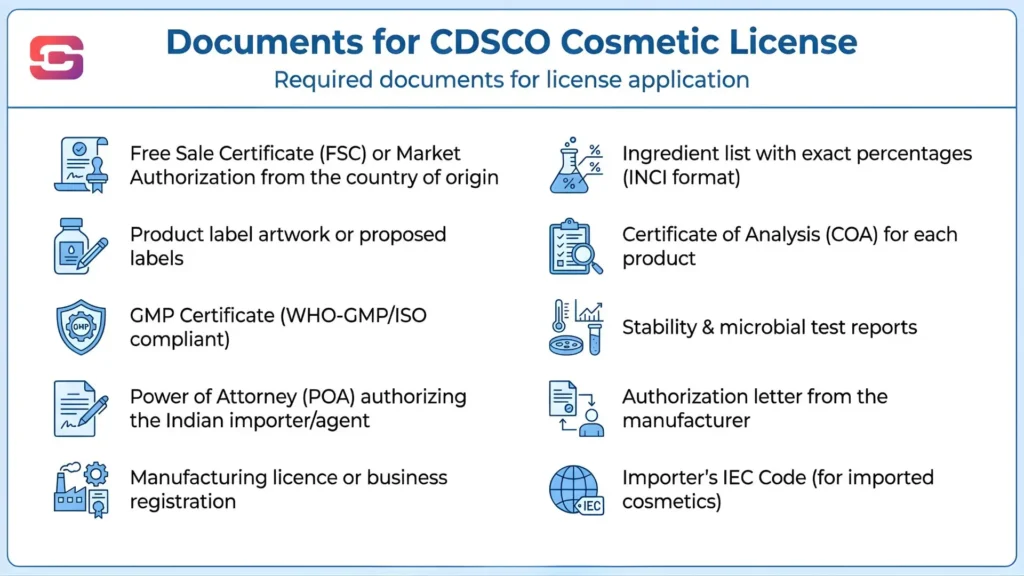
Complete Document Checklist — Manufacturing vs Import License
Use this master checklist before submitting your application. Incomplete applications are the most common reason for delays, objections, and rejections.
| Document Required | Manufacturing (COS-5) | Import (COS-1) |
| Application Form | COS-5 (filled, signed) | COS-1 (filled, signed) |
| Business Registration Proof | Required | Required |
| GST Registration Certificate | Required | Required |
| Site / Plant Layout Plan | Required | Not Applicable |
| GMP / Schedule M-II Compliance Declaration | Required | Not Applicable |
| Manufacturing Process Flow | Required | Not Applicable |
| Product Formulation / Composition | Required | Required |
| Certificate of Analysis (CoA) | Required | Required |
| Safety Data Sheet (SDS) | Required | Required |
| Draft Label / Artwork (Indian compliance) | Required | Required |
| Import Export Code (IEC) from DGFT | Not Applicable | Required |
| Free Sale Certificate (Exporting Country) | Not Applicable | Required (attested) |
| Country of Origin Certificate | Not Applicable | Required |
| Authorization Letter from Overseas Manufacturer | Not Applicable | Required |
| Technically Qualified Person (TQP) Credentials | Required | Not Applicable |
| Equipment List with Capacity | Required | Not Applicable |
| Water Testing Report | Required | Not Applicable |
| Premises Ownership / Lease Deed | Required | Required |
| Authorized Signatory Documents | Required | Required |
| Affidavit / Declaration | Required | Required |
| Application Fee (DD / Online) | As per state schedule | As per CDSCO schedule |
Eligibility Criteria — Who Can Apply for Hair Care Cosmetic License?
For COS-1 / COS-2 — Import License Eligibility
- Legally registered business entity in India (Proprietorship, Partnership, LLP, Private or Public Limited Company)
- Valid Import Export Code (IEC) issued by DGFT
- Active GST registration
- Must not be a debarred or blacklisted entity under any regulatory body
- Designated Responsible Person with basic technical qualification
- Products being imported must comply with Indian cosmetic safety standards and must not be in the prohibited or restricted list
For COS-5 / COS-8 — Manufacturing License Eligibility
- Legally registered business entity in India
- Own or legally leased manufacturing premises within India
- Manufacturing facility GMP-compliant as per Schedule M-II — Cosmetics Rules, 2020
- Minimum one Technically Qualified Person (TQP) employed and present on-site
- In-house or third-party quality control laboratory arrangement
- State Pollution Control Board (SPCB) consent for manufacturing operations (if applicable)
- Compliance with local municipal and factory act requirements for the premises
License Fees for Hair Oil and Shampoo Cosmetic License in India
License fees for hair care cosmetics vary by state, product category, and the number of products or premises being licensed. The figures below are indicative for planning purposes:
| License Type | Form | Approximate Fee (INR) | Validity | Renewal Fee (Approx.) |
| Import License Application | COS-1 | ₹3,000 – ₹5,000 per product/category | As Granted | Re-apply with updated documents |
| Grant of Import License | COS-2 | Included within COS-1 process | 1–3 Years | ₹2,000 – ₹3,500 |
| Manufacturing License Application | COS-5 | ₹2,500 – ₹5,000 per premises/category | As Granted | Re-apply |
| Grant of Manufacturing License | COS-8 | ₹5,000 – ₹15,000 (state-specific) | 5 Years | ₹3,000 – ₹8,000 |
License Validity and Renewal Timeline for Hair Care Products
Manufacturing License (COS-8) — Renewal
- Validity: 5 years from date of issuance
- Renewal Trigger: Apply at least 3 months before expiry date
- Documents for Renewal: Updated GMP compliance declaration, TQP credentials, fee payment, and any changes to product list or premises
- Late Renewal Risk: If renewed after expiry, the license lapses — manufacturing must stop until renewed, which may require a fresh inspection
Import License (COS-2) — Renewal
- Validity: 1–3 years as specified in the license
- Renewal Trigger: Apply before expiry to ensure continuity of import operations
- Amendment Required: Any change in product formulation, overseas manufacturer, or importer details requires a formal amendment application
- Grace Period: Some states and CDSCO allow a grace period if renewal is filed before expiry — but do not rely on this
Why Getting a Proper Cosmetic License Is Worth It for Your Hair Care Business
Many first-time entrepreneurs in the hair care space ask if licensing is really necessary, especially for small-scale operations. Here is why it is not just a legal obligation but a genuine business growth enabler:
- Legal Safety: A valid COS-8 or COS-2 license protects your business from raids, product seizures, legal notices, and penalties under the Drugs and Cosmetics Act.
- Market Access: Major retail chains (DMart, Reliance, pharmacies), e-commerce platforms (Amazon, Flipkart, Nykaa, Myntra), and modern trade require sellers to provide valid cosmetic license numbers before listing products.
- Export Opportunities: A valid Indian manufacturing license (COS-8) is recognized as a prerequisite for export to many international markets. It demonstrates your GMP compliance and product quality standards.
- Investor Confidence: Regulatory due diligence is standard in fundraising. A proper license significantly strengthens your brand's credibility with investors, distributors, and institutional buyers.
- Third-Party Manufacturing: Contract manufacturers will only produce for your brand if you provide your license details. A valid license unlocks access to India's vast third-party cosmetic manufacturing ecosystem.
- Brand Protection: Only licensed manufacturers can rightfully display their manufacturing license number on product labels — a key trust signal for consumers in the post-COVID era.
Labeling Requirements for Hair Oil and Shampoo in India
A valid cosmetic license alone is not sufficient — your product labels must also comply with the Cosmetics Rules, 2020 labeling requirements. Non-compliant labels can result in regulatory action even if you hold a valid license. The following details are mandatory on every hair oil and shampoo product label sold in India:
- Brand name and product name
- Name and full address of the manufacturer (and importer, if imported)
- Batch number or lot number for traceability
- Date of manufacture and best before / expiry date
- Net quantity — weight (g/kg) or volume (ml/L) as applicable
- Complete ingredient list using INCI names, in descending order of concentration
- Directions for use (how to apply the product)
- Precautions and warnings (e.g., 'Avoid contact with eyes', 'Keep out of reach of children')
- 'For external use only' declaration
- Manufacturing License Number (COS-8) or Import License Number (COS-2)
- Country of origin — mandatory for imported products
- MRP (Maximum Retail Price) inclusive of all taxes — mandatory for retail products
- Customer care / grievance address or helpline number
End-to-End Process Timeline — From Application to License Grant
Import License (COS-1 → COS-2) — Estimated Timeline
- Document preparation and gathering from overseas supplier: 7–14 days
- IEC registration from DGFT (if not already done): 3–7 working days
- COS-1 application submission to SLA / CDSCO: Day 0
- Acknowledgment receipt and application number: 3–5 working days
- Document scrutiny by authority: 15–30 working days
- Queries (if any) and applicant response: 7–15 working days
- Final review and issuance of COS-2: 15–30 working days post-query resolution
- Estimated total timeline: 60–90 working days (3–4.5 months) from full application
Manufacturing License (COS-5 → COS-8) — Estimated Timeline
- Facility setup and Schedule M-II GMP compliance: 30–90 days (varies by facility readiness)
- COS-5 application submission to State Licensing Authority: Day 0
- Acknowledgment and initial document scrutiny: 15–30 working days
- Factory inspection scheduling by Drug Inspector: 30–45 working days after submission
- Physical factory inspection: Single day (but preparation time required)
- Rectification of inspection observations (if any): 15–30 days
- Final document review and COS-8 issuance: 15–30 working days post-inspection35. Estimated total timeline: 90–150 working days (4.5–7.5 months) from application
Conclusion — Getting Your Hair Care Cosmetic License Right
Getting a cosmetic license for hair oil and shampoo in India — whether for manufacturing via COS-5 and COS-8 or for import via COS-1 and COS-2 — is a clearly defined, structured process under the Cosmetics Rules, 2020. The key to success is thorough preparation: compliant facility setup for manufacturers, complete documentation for both pathways, and staying current with any CDSCO circulars or state-level updates.
India's hair care market is one of the fastest growing personal care segments in 2026, driven by consumer demand for natural, herbal, and premium hair care products. Whether you are launching an Ayurvedic hair oil brand, importing a European shampoo line, or setting up a third-party manufacturing unit, a valid cosmetic license is your single most important business credential.
If you are unsure about specific requirements for your product category or state, always consult a registered regulatory affairs consultant who specializes in Indian cosmetic regulations. Regulatory requirements can vary by state, product type, and business model — professional guidance can save significant time and cost.
Frequently Asked Questions
Are hair oil and shampoo classified as cosmetics or drugs in India?
Hair oils and shampoos are classified as cosmetics under the Drugs and Cosmetics Act, 1940 and Cosmetics Rules, 2020 — as long as they do not make therapeutic or medicinal claims. Products making drug-like claims (e.g., treating scalp infections medically) may be regulated as drugs.
Which government authority grants cosmetic licenses for hair products in India?
For manufacturing licenses (COS-8), the State Licensing Authority (SLA) of the state where the factory is located is the issuing authority. For import licenses (COS-2), CDSCO (Central Drugs Standard Control Organisation) or the delegated state authority grants the license.
Do I need a separate license for each hair oil or shampoo product?
You need a manufacturing or import license for your premises/entity and applicable cosmetic category. However, each product may require individual listing or registration under applicable rules. Product range expansions may require an amendment to your existing license.
What is Schedule M-II and is it mandatory for hair oil and shampoo manufacturers?
Yes. Schedule M-II under the Cosmetics Rules, 2020 prescribes Good Manufacturing Practices (GMP) for all cosmetic manufacturers in India, including hair oil and shampoo producers. Compliance with Schedule M-II is mandatory before the COS-8 license is granted.
How long does it take to get a shampoo or hair oil manufacturing license in India?
The typical timeline is 90–150 working days from the date of complete application submission. This includes document scrutiny, factory inspection scheduling, rectification of observations (if any), and final issuance of COS-8 by the State Licensing Authority.
Can I import hair oil and shampoo under the same import license?
Import licenses are generally product-category or product-specific. You may be able to cover multiple products under one license application if they belong to the same cosmetic category — but this depends on the authority's decision and applicable state rules. Always check with your SLA or CDSCO.
What is the validity of the hair oil and shampoo manufacturing license (COS-8)?
The COS-8 manufacturing license is typically valid for 5 years from the date of grant. Renewal must be applied for at least 3 months before expiry. If renewal is filed before the expiry date, the license remains valid during the renewal processing period.
Can I manufacture hair oil and shampoo in my home or small unit without GMP compliance?
No. All cosmetic manufacturers in India — regardless of scale — must comply with Schedule M-II GMP norms under the Cosmetics Rules, 2020. Home-based or unlicensed manufacturing and sale of hair care products is illegal under the Drugs and Cosmetics Act.
What is an Import Export Code (IEC) and do I need it for importing shampoo?
An Import Export Code (IEC) is a 10-digit code issued by DGFT (Directorate General of Foreign Trade) and is mandatory for any business importing or exporting goods in India. You must have a valid IEC before applying for a cosmetic import license (COS-1) for hair oil or shampoo.
Can I sell imported hair oil or shampoo on Amazon, Flipkart, or other e-commerce platforms without a license?
No. E-commerce platforms in India require sellers to provide valid cosmetic import or manufacturing license details. Selling unlicensed cosmetic products online can result in product delisting, regulatory action, and fines under the Drugs and Cosmetics Act.