
- EPR Registration For Pharma Companies requirements for blister packs, plastic bottles & electronic devices used by pharma companies in 2026
- Step-by-step EPR registration & annual return filing process on the CPCB portal
- Fee structure, validity, renewal timelines & required documents for each packaging category
- Penalties for non-compliance & practical tips to stay EPR-compliant without operational disruption
Introduction
If you run a pharmaceutical company in India, EPR Registration for pharma companies is no longer optional. Whether you manufacture tablets wrapped in aluminium blister packs, liquids in HDPE plastic bottles, or market diagnostic electronic devices, the Central Pollution Control Board (CPCB) has specific obligations for every category. And in 2026, enforcement has only gotten stricter.
This guide is built for compliance managers, founders, and legal teams who want clarity — not confusion — about what EPR actually demands from the pharma sector. We cover blister pack obligations, plastic bottle producer responsibilities, electronic device e-waste duties, registration steps, fee breakdowns, document checklists, penalty structures, and answers to the most searched questions about EPR compliance in the pharmaceutical industry.
What Is EPR Registration and Why Does It Matter for Pharma in 2026?
Extended Producer Responsibility (EPR) is a policy approach that holds producers — manufacturers, importers, and brand owners — responsible for the end-of-life management of the products and packaging they introduce into the market. Under India's EPR framework, pharma companies are categorized as Producers of Plastic Packaging and, where applicable, as Producers under the E-Waste Management Rules.
If you put plastic or electronic waste into the market, you are responsible for taking it back, recycling it, or ensuring it reaches authorized recyclers. EPR Registration for pharma companies means you cannot simply hand off this responsibility to municipal waste bodies.
Why Is 2026 a Critical Year for Pharma EPR?
- The Plastic Waste Management (Amendment) Rules 2022 have progressively tightened targets — pharma companies now face mandatory EPR target fulfilment, not just registration.
- CPCB has intensified portal-based monitoring; non-filers are being flagged automatically.
- The E-Waste (Management) Rules 2022 have expanded to include diagnostic equipment, lab devices, and monitoring instruments commonly used by pharma companies.
- Brand owners and importers of finished pharmaceutical products in plastic packaging are now equally liable alongside manufacturers.
Which Pharma Companies Are Required to Register Under EPR?
Understanding your eligibility is the first practical step toward EPR Registration for pharma companies. Here is who needs to register:
Producers of Plastic Packaging (Blister Packs & Plastic Bottles)
- Pharmaceutical manufacturers using plastic packaging (PVC, PVDC, aluminium-laminated blister packs, HDPE/PET bottles, LDPE strips, polypropylene closures).
- Importers of pharmaceutical products in plastic packaging sold in India.
- Brand owners of Over-The-Counter (OTC) medicines packaged in plastic.
- Contract manufacturers whose clients are brand owners registered under EPR — both parties may carry obligations.
Producers Under E-Waste Management Rules
- Pharma companies manufacturing or importing electronic laboratory equipment (diagnostic analysers, thermometers, patient monitoring systems, centrifuges with electronic components).
- Companies that market electronic medical devices (Schedule III to V under E-Waste Rules 2022 cover medical equipment).
- IT equipment manufacturers catering to the pharma sector who sell or transfer ownership of devices in India.
EPR Obligation Overview: Packaging & Device Types
Use this quick reference table to identify which rule applies to your specific product packaging or device:
| Packaging / Device Type | Applicable Rule | Regulatory Body | Compliance Category |
| Aluminium Blister Packs | Plastic Waste Mgmt Rules 2016 (Amended 2022) | CPCB / SPCB | Extended Producer Responsibility |
| HDPE / PET Plastic Bottles | Plastic Waste Mgmt Rules 2016 (Amended 2022) | CPCB / SPCB | EPR for Plastic Packaging |
| Electronic Devices & Equipment | E-Waste (Mgmt) Rules 2022 | CPCB | EPR for E-Waste |
| Glass & Secondary Packaging | Solid Waste Mgmt Rules 2016 | SPCB / ULB | Extended Responsibility |
Blister Pack EPR Registration: What Pharma Companies Must Know
Blister packs are the most common pharmaceutical packaging — those push-through aluminium-plastic combinations holding tablets and capsules. Despite being a multi-layer packaging, blister packs fall squarely within the ambit of the Plastic Waste Management Rules 2016 (as amended in 2022), because they contain plastic layers (PVC, PVDC) combined with aluminium.
Key Obligations for Blister Pack Producers
- Register on the CPCB EPR portal and obtain your EPR Registration Certificate before placing packaged products on the market.
- Calculate and declare the total weight (in metric tonnes) of plastic in blister packs introduced into the market each financial year.
- Achieve EPR collection and recycling targets as prescribed — targets increase progressively through 2026 and beyond.
- File the Annual Return by June 30, disclosing actual plastic packaging placed on market vs. collected and recycled.
- Engage a CPCB-registered Producer Responsibility Organisation (PRO) or develop a self-managed collection system if you prefer to manage collection independently.
Challenges Specific to Blister Pack Compliance
Blister pack waste is notoriously difficult to recycle because of the mixed material (aluminium + PVC). This means finding CPCB-registered recyclers who accept multi-layer blister packs is a real operational challenge. Many pharma companies are resolving this by:
- Partnering with specialized recyclers who handle multi-material pharmaceutical packaging.
- Working with PROs that have established pharmaceutical waste collection channels — particularly in Tier 1 and Tier 2 cities.
- Transitioning to mono-material packaging where regulatory and product stability requirements allow, which eases future recycling obligations.
Plastic Bottle EPR Obligations for Pharmaceutical Companies
Plastic bottles — whether HDPE for solid dosage forms, PET for liquid medicines, or PP for medical devices — constitute another major EPR obligation category. EPR Registration for pharma companies producing plastic bottles means understanding both your packaging weight obligations and the category-based targets set by CPCB.
Categories of Plastic Packaging Under EPR Rules
| Category | Examples in Pharma | EPR Target Year-on-Year Direction |
| Category I | Rigid plastic bottles, containers, jars | Increasing annually toward 100% by 2025–26 |
| Category II | Flexible packaging — sachets, pouches, strips | Separate targets; often outsourced via PRO |
| Category III | Multi-layer plastic packaging (blister packs) | Phased targets; energy recovery allowed where recycling not feasible |
| Category IV | Compostable / biodegradable alternatives | Separate certification route via CPCB |
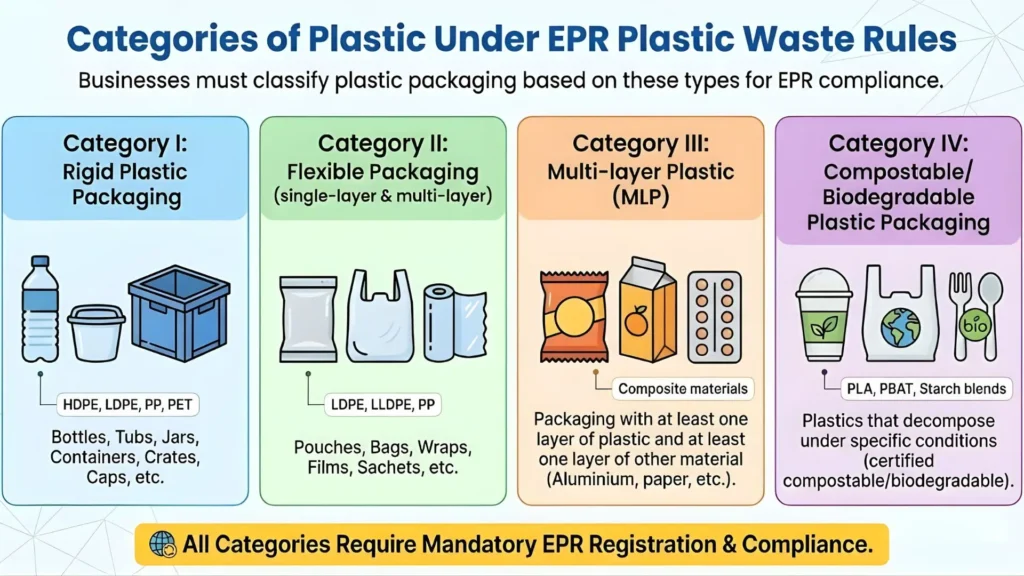
If you are a pharma company using rigid HDPE or PET bottles, you fall primarily under Category I, which has the most stringent and progressing EPR targets. Getting ahead of this now — rather than scrambling at the end of the financial year — is the smartest compliance move in 2026.
Electronic Device EPR Obligations for Pharma Companies
This is an area many pharma compliance teams overlook. Under the E-Waste (Management) Rules 2022, a pharmaceutical company becomes a 'Producer' for EPR purposes if it:
- Manufactures, imports, or sells electronic equipment (including medical devices with electronic components).
- Has an annual turnover above Rs. 1 Crore from such products.
- Sells or transfers ownership of electronic products to consumers or institutions in India.
Pharma-Specific Electronic Devices Covered Under E-Waste EPR
Patient monitoring systems and vital sign monitors.
- Digital thermometers, glucometers, and diagnostic kits with electronic circuitry.
- Laboratory analysers, centrifuges, and automated testing equipment.
- Hospital IT infrastructure (if supplied or managed by pharma companies as part of product service).
- Pharmaceutical manufacturing control systems and IoT-enabled production monitoring devices.
For E-waste EPR compliance, pharma companies must register separately on the CPCB e-waste EPR portal (different from the plastic EPR portal), set annual collection targets based on prior year sales/imports, and report against those targets each year.
EPR Registration Process for Pharma Companies: Step by Step
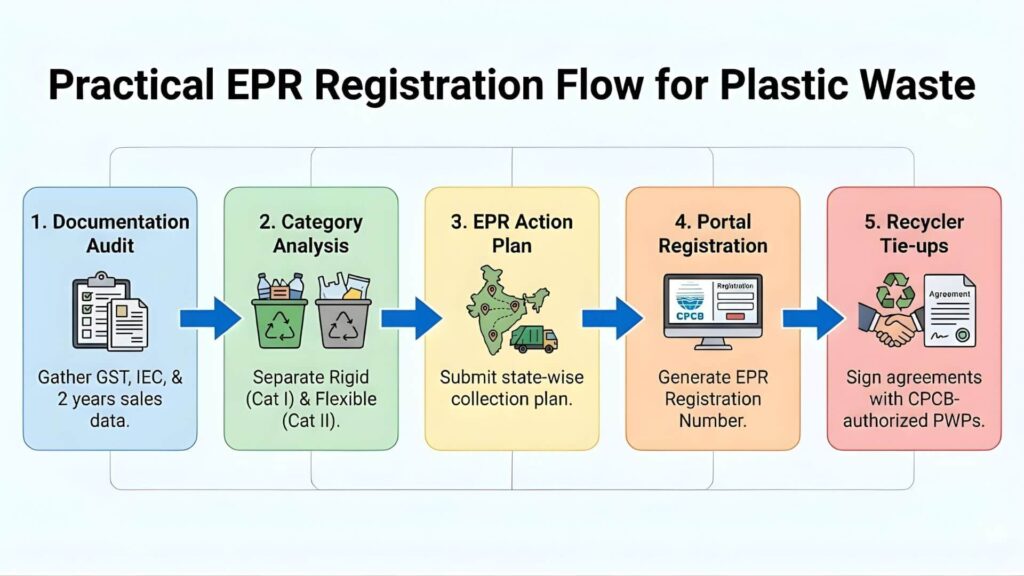
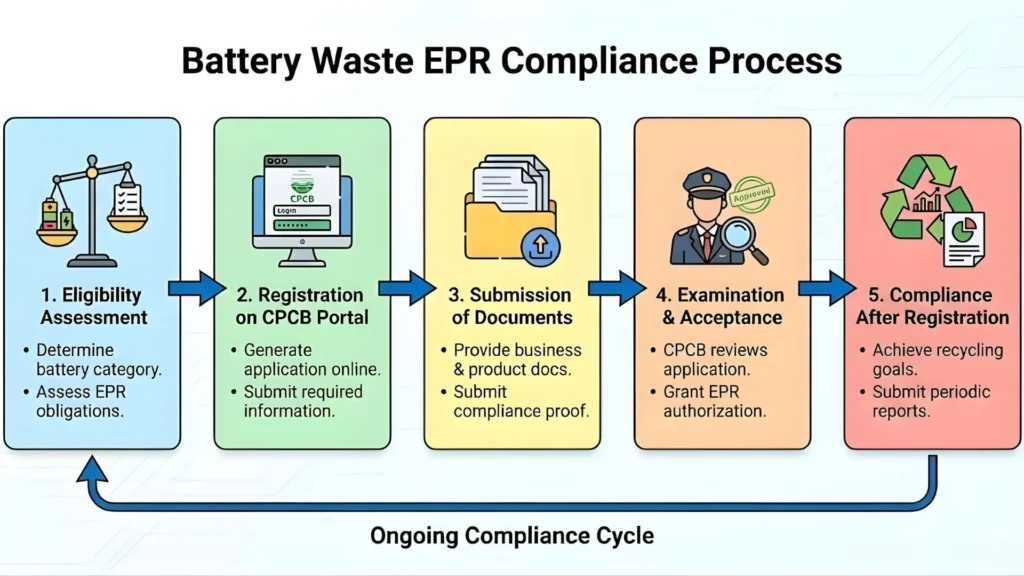
The registration process for EPR Registration for pharma companies is handled through the CPCB's centralized online portals. Here is a practical breakdown for 2026:
Step-by-Step: Plastic Packaging EPR Registration
- Visit the CPCB EPR Portal for Plastic Packaging (epr-plastics.cpcb.gov.in) and create a producer account.
- Select your entity type: Producer / Importer / Brand Owner.
- Fill in company details — name, address, CIN/LLPIN, PAN, GST, and Drug License number.
- Upload all required documents (see checklist below).
- Declare plastic packaging quantity introduced into market (in MT/KG) for the previous year.
- Select your EPR fulfilment method: Self-managed collection system OR engagement with a CPCB-registered PRO.
- If via PRO, upload the PRO agreement.
- Pay the applicable registration fee online.
- Submit and await CPCB verification (typically 15–30 working days).
- Download and preserve your EPR Registration Certificate.
Step-by-Step: E-Waste EPR Registration
- Visit the CPCB E-Waste EPR Portal and register as a Producer of Electrical and Electronic Equipment (EEE).
- Identify the applicable EEE schedule(s) your products fall under.
- Declare prior year sales volumes in units and weight.
- Set current year collection targets (minimum prescribed percentage of prior year sales).
- Engage authorized e-waste dismantlers and recyclers — upload their CPCB authorization certificates.
- Submit and pay fees; await CPCB approval.
- File quarterly progress reports and annual returns.
Required Documents for EPR Registration — Pharma Companies
Having your documents ready before you start the portal registration saves significant time. Here is the complete checklist:
| Document | Plastic Packaging EPR | E-Waste EPR |
| Company PAN Card | Required | Required |
| GST Registration Certificate | Required | Required |
| Certificate of Incorporation / Partnership Deed | Required | Required |
| Drug Manufacturing / Import License | Required | Required |
| Authorised Signatory Aadhaar & PAN | Required | Required |
| Product & Packaging Details (Type, Weight, Qty) | Required | Required |
| Previous Year Plastic Tonnage Data | Required | — |
| E-Waste Generation / Sales Data | — | Required |
| PRO Agreement (if applicable) | If outsourcing | If outsourcing |
EPR Registration Fee Structure for Pharma Companies (2026)
The fee for EPR Registration for pharma companies depends on your production volume and the type of packaging or device being registered. These are government fees payable directly on the CPCB portal — separate from any PRO engagement fees, which are market-negotiated.
| Category | Sub-Category | Approx. Fee Range (INR) | Validity |
| Plastic Packaging EPR | Small Producer (< 10 MT/yr) | Rs. 5,000 – Rs. 10,000 | 1 Year |
| Plastic Packaging EPR | Medium Producer (10–100 MT/yr) | Rs. 10,000 – Rs. 50,000 | 1 Year |
| Plastic Packaging EPR | Large Producer (> 100 MT/yr) | Rs. 50,000+ | 1 Year |
| E-Waste EPR | Pharma Equipment / Lab Devices | Based on tonnage target | 1 Year |
| PRO Engagement | Plastic Waste Collection via PRO | Market-based (per KG/MT) | Contract-based |
Important note: PRO engagement costs are over and above CPCB registration fees. PRO rates vary based on the weight of plastic packaging you need to offset, the geography of your market presence, and the PRO's own operational efficiency. Always get multiple quotes from CPCB-registered PROs before committing.
EPR Certificate Validity and Renewal Timeline
| Milestone | Timeframe |
| EPR Registration Validity | 1 Year (Annual Renewal Mandatory) |
| Annual Return Filing Deadline | June 30 of each financial year |
| EPR Target Achievement Reporting | By end of respective financial year |
| Renewal Application Submission | At least 30–60 days before expiry |
| Grace Period (if any) | No official grace period; penalties apply from Day 1 of lapse |
The renewal process mirrors the initial registration — you update your plastic/e-waste tonnage data for the preceding year, demonstrate target fulfilment or declare shortfall, and pay the renewal fee. Starting the renewal process at least 60 days before expiry is strongly recommended for pharma companies, as portal verification can take up to 30 working days.
Benefits of Being EPR Compliant for Pharma Companies
- EPR compliance is not just about avoiding penalties — it creates tangible value for pharmaceutical businesses:
- Regulatory clearance: EPR compliance is increasingly being checked during Drug License renewals, factory inspections, and environmental audits.
- ESG credibility: Institutional investors, hospital procurement committees, and export customers increasingly demand sustainability compliance from pharma suppliers.
- Competitive differentiation: EPR-compliant pharma brands can communicate their environmental responsibility to healthcare professionals and patients — a growing market consideration.
- Supply chain resilience: Building collection and recycling relationships now prepares your supply chain for tighter global packaging regulations, especially relevant for pharma exporters to the EU where the Corporate Sustainability Reporting Directive (CSRD) is already reshaping supplier expectations.
- Government tender eligibility: Several central and state government drug procurement tenders now include EPR compliance as a pre-qualification criterion.
Conclusion
EPR Registration for pharma companies is not a box-ticking exercise — it is a fundamental part of operating a responsible, future-ready pharmaceutical business in India. Whether you are dealing with blister packs, plastic bottles, or electronic medical devices, the regulatory framework is clear, the enforcement is real, and the cost of non-compliance far exceeds the cost of getting compliant.
The good news? Once you understand your obligations — which packaging categories apply to you, what targets you need to meet, which documents you need, and how to file your annual return — EPR compliance becomes a manageable, annual compliance task rather than an existential regulatory risk.
Start with your packaging audit. Register on the CPCB portal. Engage a PRO if you need collection support. File your annual return by June 30. And keep your EPR certificate current. That is EPR compliance for pharma companies, distilled into its five most important actions.
Frequently Asked Questions
Is EPR mandatory for all pharma companies or only large ones?
EPR registration is mandatory for all producers, importers, and brand owners who introduce plastic packaging into the Indian market — regardless of company size.
Are aluminium blister packs really covered under plastic EPR rules?
Yes. Blister packs contain plastic layers (PVC, PVDC, or PET) that make them subject to the Plastic Waste Management Rules. CPCB classifies blister packs as Category III multi-layer plastic packaging.
Can a pharma company fulfil its EPR obligations entirely through a PRO?
Yes. Engaging a CPCB-registered Producer Responsibility Organisation (PRO) is a fully compliant fulfilment route.
What is the EPR annual return filing deadline for pharma companies?
The deadline for filing the annual EPR return is June 30 of each financial year. For example, for the financial year 2025–26, the annual return must be submitted by June 30, 2026.
Do pharma importers need separate EPR registration from manufacturers?
Yes. Importers of pharmaceutical products in plastic packaging are independently required to register under EPR as Importers.
How are EPR targets calculated for pharma plastic packaging?
EPR targets are calculated as a percentage of the total plastic packaging (in metric tonnes) introduced into the market during the previous financial year. CPCB publishes the target percentages each year.
What happens if a pharma company fails to achieve its EPR target
If you miss your annual EPR target, CPCB requires you to purchase EPR certificates equivalent to the shortfall from the open market.
Is EPR compliance required for pharma companies exporting 100% of their products?
Generally, EPR obligations apply to plastic packaging placed on the Indian market. If a pharma company exclusively exports all its products and none of the packaging enters the Indian waste stream, their domestic EPR obligation may be minimal or nil.
How long does EPR registration take for a pharma company?
There are no size-based exemptions under the Plastic Waste Management Rules for plastic packaging EPR — registration is mandatory regardless of company size or turnover.