
- Five waste streams, five portals: India's EPR framework now covers Plastic, E-Waste, Battery, Tyre, and Used Oil, each running on its own CPCB EPR portal but accessible via a single sign-on at epr.cpcb.gov.in.
- 2026 brought major plastic reform: The Plastic Waste Management (Amendment) Rules, 2026 (notified 31 March 2026) added mandatory recycled-content and reuse targets, tradable EPR certificates, and independent environmental audits.
- Approval is fast but document-sensitive: Most categories are approved in 15–40 working days online, and registration typically runs for two years before renewal is due.
- Non-compliance is costly: Selling regulated products without EPR Registration can trigger Environmental Compensation, certificate suspension, and blocked customs or marketplace approvals.
Introduction
EPR Registration is the mandatory process under India's Ministry of Environment, Forest and Climate Change (MoEFCC) framework that requires every Producer, Importer, and Brand Owner (PIBO) to register with the Central Pollution Control Board (CPCB) before selling products that create plastic, e-waste, battery, tyre, or used oil waste.
Registration happens online through category-specific CPCB EPR portals, is generally approved in 15–40 working days, and stays valid for about two years before renewal. Businesses operating without a valid EPR Certificate risk Environmental Compensation penalties, customs holds, and marketplace delisting.
What started as an environmental policy initiative has now become a core legal obligation. The Ministry of Environment, Forest and Climate Change (MoEFCC) has built a digitally enforced, auditable compliance system operated by the Central Pollution Control Board (CPCB). Sales data, recycling credits, and annual returns are cross-verified on the CPCB EPR Portal, leaving very little scope for manual adjustments or delayed reporting.
If your business manufactures, imports, or sells regulated products in India — plastic packaging, electronics, batteries, tyres, used oil, or vehicles — this guide covers everything you need to know.
| EPR Certification the way you think of GST Registration — not a formality, but a legal licence to operate. The moment you introduce a regulated product into the Indian market, the clock starts. |
What is EPR Certification?
EPR stands for Extended Producer Responsibility. The word 'extended' is deliberate — it extends the responsibility of a producer beyond the point of sale, all the way to the end-of-life of the product. Traditional waste management placed the burden on municipalities and local bodies. EPR shifts that burden upstream, to the entities that created the demand for the product in the first place.
EPR Certification is the formal registration and approval issued by CPCB through the EPR Portal, confirming that your business is compliant with the applicable waste management rules. It is not a one-time exercise. It is a continuous, annually renewing compliance obligation that requires you to meet recycling targets, file returns, and maintain partnerships with authorised recyclers every financial year.
Legal Framework: Which Rules Govern EPR in India?
EPR in India is not a single law. It is implemented through six separate waste-specific regulations, each targeting a different product category. All registrations, filings, and certificate issuances are managed through the CPCB EPR Portal.
| Waste Category | Governing Rules | Effective Since |
| Plastic Packaging | Plastic Waste Management Rules, 2016 (amended 2022) | 2022 (EPR mandate) |
| E-Waste | E-Waste (Management) Rules, 2022 | 2022 |
| Battery Waste | Battery Waste Management Rules, 2022 | 2022 |
| Tyre Waste | Tyre Waste Management Rules, 2022 | 2022 |
| Used Oil | Used Oil Management (Amendment) Rules | 2024 |
| End-of-Life Vehicles | Environment Protection (ELV) Rules, 2025 | 1 April 2025 (NEW) |
Role of CPCB in EPR Certification
The Central Pollution Control Board functions as the official registration authority, the compliance monitor, the penalty regulator, and the administrator of the national EPR Portal. Without a valid CPCB-issued EPR Certificate, businesses operating in regulated product categories are considered non-compliant — regardless of intent or size.
Why EPR Registration Matters in 2026
EPR Registration is not just a regulatory checkbox anymore. Marketplaces, distributors, and institutional buyers increasingly ask for a valid EPR Certificate before onboarding a supplier, and customs authorities have started linking import clearances to CPCB registration status for e-waste, batteries, and plastic packaging. A few reasons EPR Registration has moved to the top of the compliance list for Indian businesses:
- Legal necessity, not a formality: Selling a regulated product without EPR Registration is a violation of the Environment (Protection) Act, 1986, and can attract Environmental Compensation.
- Business continuity: E-commerce marketplaces and large retailers are now verifying EPR Certificates before listing products, especially for electronics, batteries, and packaged goods.
- Import and export clearance: Importers of electronics, batteries, and plastic-packaged goods can face customs delays without a valid CPCB EPR Registration Certificate.
- ESG and investor confidence: With ESG reporting becoming standard practice for Indian companies, a documented EPR compliance trail directly strengthens sustainability disclosures and audit readiness.
- Environmental accountability: Proper EPR compliance genuinely reduces landfill burden, prevents illegal dumping, and channels recyclable material back into India's circular economy.
Who Needs EPR Registration? Eligibility by Category
The umbrella term for anyone obligated to register is a PIBO — Producer, Importer, or Brand Owner. Exact eligibility, however, differs slightly by waste stream.
1. Plastic Waste EPR — Eligibility
Any business that manufactures, imports, or brands plastic packaging — rigid, flexible, or multi-layered — for sale in India must register, regardless of company size, once packaging is placed in the market. This covers FMCG brands, e-commerce sellers using plastic packaging, food and beverage companies, and plastic raw-material producers and sellers now brought into the reporting chain under the 2026 amendment.
2. E-Waste EPR — Eligibility
Manufacturers, producers, importers, and brand owners of the 21 categories of notified Electrical and Electronic Equipment (EEE) listed in Schedule I — laptops, mobile phones, televisions, refrigerators, solar panels, medical electronics, and more — must register. Unlike some other categories, e-waste EPR has no turnover-based exemption: even a small importer of a single notified electronic product must register.
3. Battery Waste EPR — Eligibility
Every producer, manufacturer, importer, or brand owner dealing in batteries — portable, automotive, industrial, or electric-vehicle batteries, whether sold standalone or built into equipment — must register under the Battery Waste Management Rules, 2022. Refurbishers and recyclers must separately register with their State Pollution Control Board (SPCB) through the same centralized portal.
4. Tyre Waste EPR — Eligibility
Producers (manufacturers and importers of new tyres), recyclers, and retreaders involved in manufacturing, sale, transfer, purchase, storage, or processing of tyres or waste tyres fall under Schedule IX. A producer that is also a recycler must register separately in both capacities.
5. Used Oil EPR — Eligibility
Producers and importers of base oil or finished lubricating oil, importers of used oil, collection agents, and recyclers must register on the dedicated Used Oil EPR Portal. This is one of the newest EPR categories in India and is still seeing steadily rising registration numbers as enforcement increases.
Types of EPR Certification in India
| Type | Applicable Products | Who Needs It |
| EPR for Plastic Waste | Rigid, flexible, multilayer, and compostable plastic packaging | Plastic producers, importers, brand owners, packaging users |
| EPR for E-Waste | TVs, mobiles, laptops, IT and consumer electronics | Manufacturers, importers, brand owners of electronic products |
| EPR for Battery Waste | Li-ion, lead-acid, portable, automotive, and EV batteries | Battery producers, importers, battery-using OEMs |
| EPR for Tyre Waste | New tyres, imported tyres, tyres fitted on vehicles | Tyre manufacturers, importers, vehicle importers |
| EPR for Used Oil | Base oil, lubricating oil, used oil from industrial/automotive use | Used oil producers, importers, lubricant manufacturers |
| EPR for ELV (New — 2025) | All vehicles including EVs, e-rickshaws, e-carts | Vehicle manufacturers, assemblers, importers, sellers |
EPR Certification for Plastic Waste
Plastic waste EPR is the most widely applicable category in India. If your product uses any form of plastic packaging before it reaches the consumer, you are responsible for that packaging's end-of-life management. The Plastic Waste Management Rules require that recycling must be conducted at a rate that matches the volume of plastic packaging your business introduces into the market.
Plastic Packaging Categories Under EPR Rules
| Category | Type of Plastic Packaging |
| Category I | Rigid plastic packaging (bottles, containers, tubs) |
| Category II | Flexible plastic packaging (pouches, wraps, films) |
| Category III | Multilayer plastic packaging (laminated or composite materials) |
| Category IV | Compostable plastic packaging |
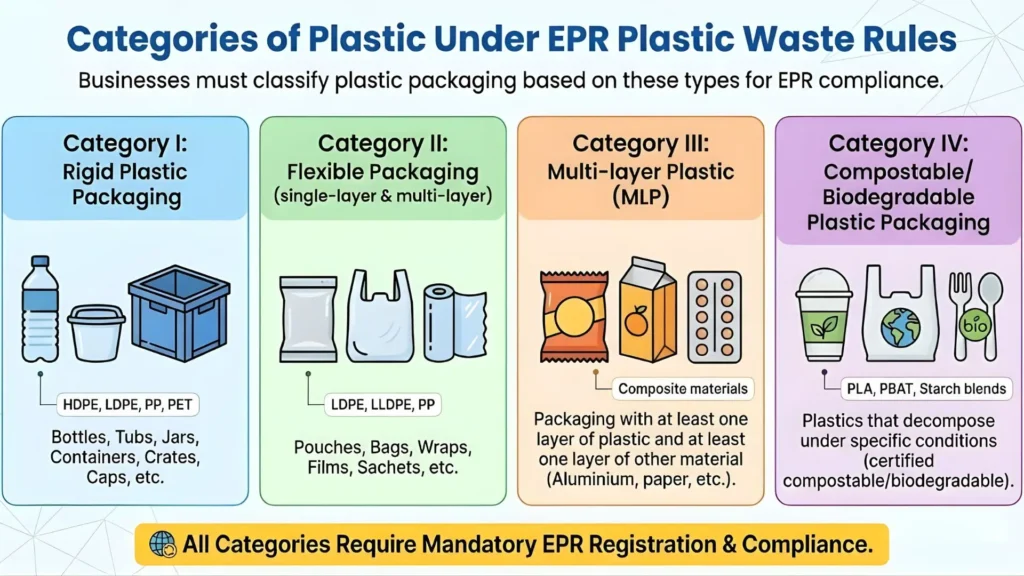
Getting the category right is critical. EPR targets and recycling obligations differ for each type, and incorrect classification can lead to compliance shortfalls or regulatory penalties.
Key Obligations for Plastic Producers & Brand Owners
- Register on the CPCB EPR Portal and declare annual plastic packaging volumes
- Meet prescribed collection and recycling targets through CPCB-authorised recyclers
- File annual returns within the prescribed timelines
- Targets are non-transferable unless supported by CPCB-approved credit mechanisms
EPR Certification for E-Waste
The E-Waste Management Rules establish EPR obligations for all manufacturers, importers, and brand owners operating in the electrical and electronic equipment space. If your product has a circuit board, a screen, or a battery — there is a good chance e-waste EPR applies to you.
Electronic Products Covered
- Televisions and display devices
- Laptops, desktops, tablets, and peripherals
- Mobile phones and accessories
- IT and communication equipment
- Consumer electronics (cameras, audio equipment)
- Large and small household appliances
All collected e-waste must be channelised through CPCB-authorised recyclers. Informal disposal, dismantling, or resale outside the approved system is explicitly prohibited under the EPR framework.
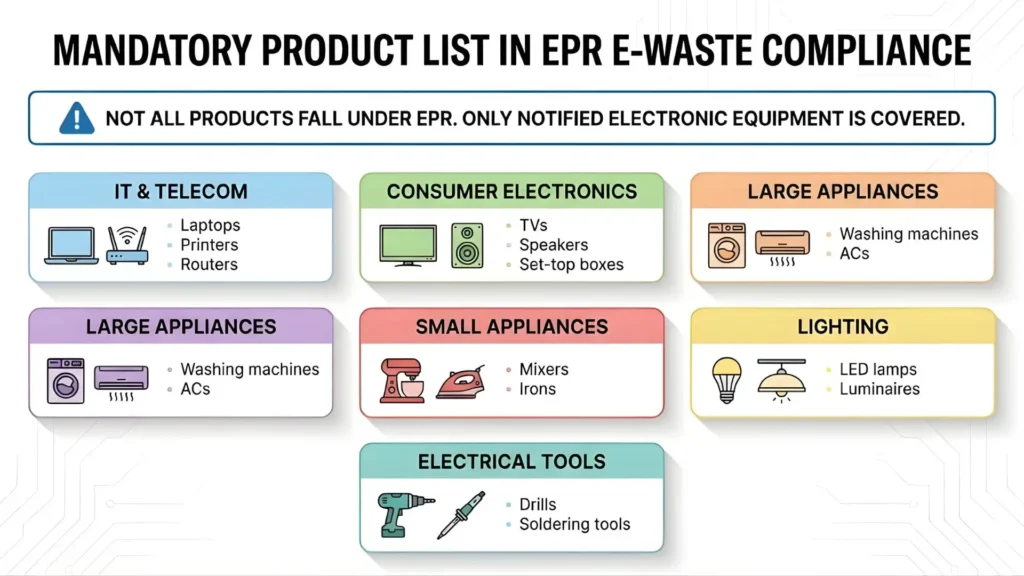
E-waste EPR targets are calculated based on the quantity of electronic products placed in the Indian market during the relevant financial year. Non-fulfilment results in environmental compensation charges and regulatory action.
EPR Certification for Battery Waste
Battery EPR is a fast-evolving compliance area, particularly with the rapid expansion of the electric vehicle sector in India. The Battery Waste Management Rules require producers, importers, and brand owners of batteries to ensure collection, recycling, and environmentally sound management of battery waste.
Types of Batteries Covered
| Battery Type | Common Examples |
| Lithium-ion | EV batteries, laptop batteries, mobile phone batteries |
| Lead-acid | Automotive batteries, UPS systems, industrial storage |
| Portable consumer batteries | AA, AAA, coin cells, rechargeable packs |
| Automotive and EV batteries | Two-wheeler, four-wheeler, commercial vehicle packs |
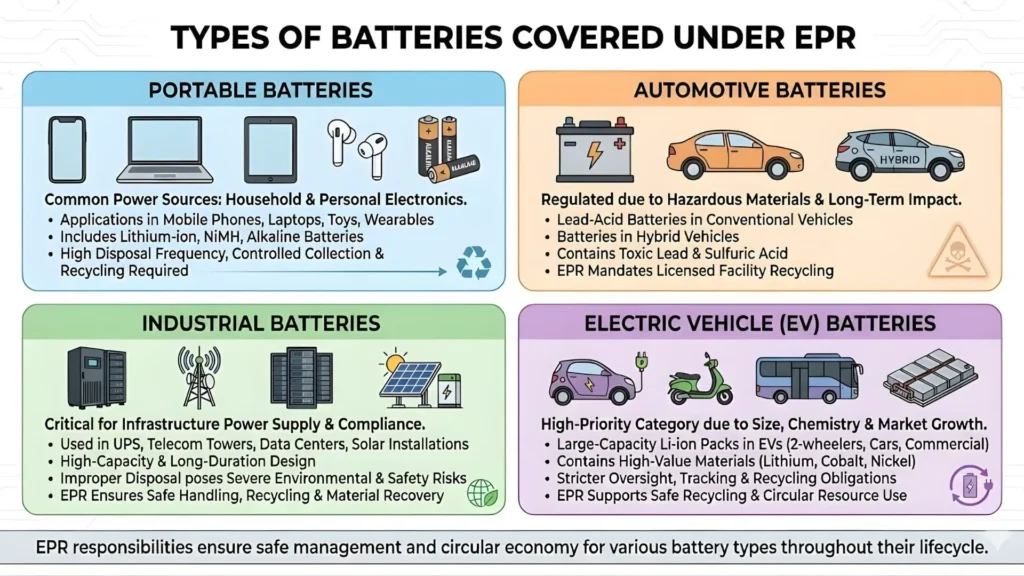
Each battery category carries distinct recycling and collection obligations. Annual targets are assigned based on market introduction volumes and must be fulfilled through CPCB-authorised recyclers or refurbishes.
EPR Certification for Tyre Waste
The Tyre Waste Management Rules obligate tyre producers, importers, and brand owners to ensure collection, recycling, and environmentally safe disposal of end-of-life tyres. Compliance applies regardless of whether tyres are sold individually or as part of a finished vehicle.
End-of-life tyres must be processed only through CPCB-authorised recyclers using approved methods such as material recovery or regulated pyrolysis. Tyre EPR targets are assigned in weight terms and increase progressively year on year.
Who Must Register for Tyre Waste EPR
- Tyre manufacturers in India
- Importers of new tyres
- Importers of vehicles fitted with tyres
EPR Certification for Used Oil
EPR for used oil is one of the newer mandates and applies to producers and importers of base oil and lubricating oil. The obligation covers the collection, recycling, and environmentally sound management of used oil generated after consumption.
Who Must Register for Used Oil EPR
- Producers of base oil and lubricating oil
- Importers of lubricants and oil-based products
- Brand owners placing oil products into the Indian market
Used oil must be collected and channelised through CPCB-authorised recyclers. Recycling certificates generated by these recyclers are used to fulfil EPR targets on the portal. Annual compliance reports must be filed within prescribed timelines.
| NEW IN 2025: EPR Certification for End-of-Life Vehicles (ELV) The Environment Protection (End-of-Life Vehicles) Rules, 2025 — notified on 6 January 2025 — came into force on 1 April 2025. This is India's sixth EPR category and the first to directly regulate the automotive sector. |
EPR Certification for End-of-Life Vehicles (ELV) — New Mandate Effective 1 April 2025
If you are a vehicle manufacturer, assembler, importer, or seller in India, 2025 brought a major new compliance obligation. The Ministry of Environment, Forest and Climate Change (MoEFCC) officially notified the Environment Protection (End-of-Life Vehicles) Rules, 2025 — vide S.O. 98(E) dated 6 January 2025. These rules came into force on 1 April 2025 and represent the sixth stream of EPR regulation in India.
This is not a future obligation. If your business introduces vehicles into the Indian market, ELV EPR compliance is active right now.
Why Did India Introduce EPR for End-of-Life Vehicles?
India is the third-largest passenger vehicle market in the world. Cumulative end-of-life vehicle volumes could rise from around 10 million in 2020 to nearly 23 million by 2025 and close to 50 million by 2030. At the same time, a passenger car contains approximately 70% steel and 7–8% aluminium — materials that, if recycled properly, can be fed back into the supply chain, reducing dependence on primary mining and lowering lifecycle emissions.
The ELV Rules address both challenges: they formalise the scrapping ecosystem, eliminate hazardous informal dismantling, and create a structured circular economy pathway for automotive steel and other recoverable materials.
Who Does ELV EPR Apply To?
| Stakeholder | Role Under ELV Rules |
| Vehicle Producers (Manufacturers, Assemblers, Importers, Sellers) | Must register with CPCB, declare EPR obligations annually, and meet steel scrapping targets |
| Registered Owners | Must deposit end-of-life vehicles at RVSFs or designated collection centres |
| Bulk Consumers (Fleets, Government Departments, Large Operators) | Must comply with deposit and scrapping obligations for their vehicle fleets |
| Registered Vehicle Scrapping Facilities (RVSFs) | Must conduct depollution, dismantling, and segregation, and issue EPR certificates |
| Automated Testing Stations | Must upload data on vehicles declared unfit directly to the CPCB centralised portal |
| No Double Regulation: The ELV Rules do not apply to waste batteries (governed by Battery Waste Management Rules, 2022), plastic packaging (Plastic Waste Management Rules, 2016), waste tyres and used oil (Hazardous Waste Rules, 2016), or e-waste (E-Waste Rules, 2022). Each stream has its own separate EPR regulation. |
Vehicles Covered and Excluded
The ELV Rules apply to all vehicles defined in Section 2(28) of the Motor Vehicles Act, 1988, including electric vehicles, battery-operated vehicles, e-rickshaws, and e-carts.
The following are explicitly excluded: agricultural tractors, agricultural trailers, combine harvesters, and power tillers.
EPR Scrapping Targets Under the ELV Rules
Vehicle producers are required to meet annual steel scrapping targets based on the volume of vehicles they have introduced into the Indian market in prior years. The targets are based on the steel content of vehicles and are designed to increase progressively.
| Compliance Period | Steel Scrapping Target | Vehicle Reference Year |
| 2025–26 to 2029–30 | 8% of steel content | Vehicles sold 15–20 years prior |
| 2030–31 to 2034–35 | 13% of steel content | Escalating each year |
| 2035–36 onwards | 18% of steel content | Based on updated schedule |
EPR obligations are defined separately for transport vehicles (average service life: 15 years) and non-transport vehicles (average service life: 20 years).
How ELV EPR Targets Are Fulfilled — The RVSF and EPR Certificate System
The compliance mechanism under the ELV Rules works through EPR certificates generated by Registered Vehicle Scrapping Facilities (RVSFs). Here is how the process works in practice:
| Step | Action | Who Is Responsible |
| 1 | End-of-life vehicle is deposited at an authorised RVSF | Vehicle owner / Producer (if no certificates are available) |
| 2 | RVSF carries out depollution, dismantling, and material segregation | RVSF |
| 3 | RVSF generates EPR certificate based on verified steel recovered, via CPCB portal | RVSF |
| 4 | Producer purchases EPR certificate to fulfil their annual scrapping obligation | Producer |
EPR certificates are valid for five years from the date of generation. However, they can only be purchased to meet the current year's EPR obligation (plus any carry-forward from prior years). EPR certificates are non-transferable between producers.
If RVSF-generated certificates are unavailable in sufficient quantities, the burden shifts back to the producer — who must then make independent arrangements to collect end-of-life vehicles through designated collection centres.
Important: MoRTH Registration vs. EPR Registration for RVSFs
| Many RVSFs are making a costly mistake: MoRTH registration permits physical scrapping operations, but it does not allow an RVSF to generate EPR certificates. Separate registration on the CPCB EPR Portal is required. Without it, an RVSF cannot participate in producer compliance programmes — and producers will not engage with unregistered facilities. |
Key Compliance Deadlines for Producers Under ELV Rules
| Compliance Requirement | Deadline |
| Declare EPR obligations for the current financial year | 30 April of each year |
| Submit annual returns for the previous financial year | 30 June of each year |
| Registration on the CPCB centralised portal | Before commencing operations under ELV Rules |
| CPCB publishes defaulting producers list | 31 August of each year (publicly visible) |
| Update CPCB on any changes to registration | As and when changes occur |
Producer Obligations Beyond Meeting Scrapping Targets
Operational obligations
- Register on the CPCB EPR portal before introducing vehicles into the market
- Declare EPR obligations annually by 30 April
- Ensure end-of-life vehicles are channelled to authorised RVSFs or collection centres
- Submit list of designated collection centres to CPCB and display at sales outlets and service centres
Consumer-facing obligations
- Implement buy-back programmes or deposit-refund schemes to encourage formal scrapping
- Organise awareness campaigns and workshops to educate vehicle owners
Ongoing obligations
- Inform CPCB of any changes to EPR registration or business details
- Report violations by entities involved in ELV handling to CPCB or the State PCB
- Adopt sustainable production measures per CPCB guidelines
Penalties for Non-Compliance Under ELV Rules
The ELV Rules carry some of the sharpest penalties in India's EPR framework:
| Penalty Type | Detail |
| Environmental Compensation | Equivalent to the loss, damage, or injury caused to the environment or public health, as assessed by CPCB |
| Monetary Penalty | Not less than INR 10,00,000 and up to INR 15,00,000 per contravention |
| Continuing Contravention | Additional penalty of INR 10,00,000 for each day of continued non-compliance |
| Failure to Pay Penalty | Imprisonment for up to three years, or fine up to twice the penalty amount, or both |
| Registration Action | CPCB may suspend or cancel the producer's EPR registration after giving an opportunity to be heard |
| Reputational Risk | CPCB publishes a public list of defaulting producers every year by 31 August |
Latest EPR Notifications & Regulatory Updates (2024–2026)
EPR rules in India are being tightened every year. If you registered even 12–18 months ago, it's worth checking whether these recent changes affect your obligations.
Plastic Waste Management (Amendment) Rules, 2026
Notified on 31 March 2026 (G.S.R. 237(E)), this is the most significant plastic-EPR update to date. It introduces mandatory minimum recycled-content percentages for rigid, flexible, and multi-layered packaging (Category I, II, and III), phased reuse obligations for rigid and drinking-water packaging, a carry-forward mechanism for unmet targets, tradable recycled-content and EPR certificates on a centralized CPCB exchange, and compliance verification by CPCB-designated agencies or Registered Environmental Auditors notified under the Environment Audit Rules, 2025.
Plastic Waste Management (Amendment) Rules, 2025
Notified on 23 January 2025 and effective for labelling from 1 July 2025, this amendment made QR codes, barcodes, or unique identification numbers mandatory on plastic packaging so that every unit can be traced from production through to disposal.
Battery Waste Management (Amendment) Rules, 2025
Notified in February 2025, this update strengthens digital traceability, formally recognises second-life battery use (such as stationary energy storage) as a valid stage before final recycling, and sets the stage for mandatory recycled lithium, cobalt, and nickel content in new batteries from FY 2027-28 onward.
E-Waste (Management) Amendment Rules, 2024
This amendment expanded Schedule I to bring solar photovoltaic modules, cells, and EV components under e-waste EPR, added most electronic medical devices, and empowered CPCB to set floor and ceiling prices for EPR certificate trading between producers and recyclers.
Used Oil EPR — Enforcement Push (2024–2025)
EPR for used oil became effective from 1 April 2024 under the Hazardous and Other Wastes (Management and Transboundary Movement) Second Amendment Rules, 2023. The dedicated portal went live in June 2024, and in February 2025, CPCB issued a formal directive to State Pollution Control Boards asking producers, importers, and recyclers who had not yet registered to do so within 15 days — a clear signal that enforcement is now active, not theoretical.
Waste Tyre EPR — Full Target Achieved
Tyre recycling targets under Schedule IX are calculated on a two-year lag (the 2024-25 target is based on tyres produced or imported in 2022-23), and producers are now expected to meet 100% End-of-Life Tyre (ELT) collection and recycling, up from the phased targets of earlier years.
Why is EPR Compliance Mandatory — and What Really Happens if You Ignore It?
EPR compliance in India has moved decisively from voluntary to digitally enforced. The CPCB EPR Portal cross-verifies sales data, recycling credits, and annual returns. There is very limited room for manual adjustment or delayed reporting.
The practical impact of non-compliance can be severe. For importers in particular, a suspended EPR Registration can block customs clearance entirely. For manufacturers, it can result in marketplace delisting and operational disruption.
| Consequence | Detail |
| Environmental Compensation Charges | Financial penalties based on the quantity of unmet EPR targets |
| Regulatory Notices and Audits | CPCB can issue show-cause notices and conduct compliance audits for violations |
| Suspension or Cancellation | Continued non-compliance can result in loss of EPR Certificate, restricting operations |
| Import and Business Restrictions | Non-compliant importers may face import curbs and marketplace delisting |
| Business Continuity Risk | Sales operations in regulated product categories can be halted entirely |
Required Documents for EPR Registration
Having the right documents ready before you start the application significantly reduces processing time and the likelihood of CPCB queries. Incomplete or inaccurate documentation is the most common reason for application delays or rejection.
- Certificate of Incorporation or business registration proof
- PAN card of the company
- GST registration certificate
- Import Export Code (IEC), if applicable
- Authorised signatory ID proof and letter of authorisation
- Product details including model numbers and HS codes
- Annual sales data for EPR-covered products
- Waste category and quantity declaration
- Agreement or MoU with CPCB-authorised recyclers or Producer Responsibility Organisations (PROs)
Step-by-Step Process for EPR Certification
The entire registration process is digital, managed through the CPCB EPR Portal. Here is how it works in practice, from eligibility to certificate issuance.
| Stage | What Happens | Who Acts |
| 1. Eligibility Assessment | Determine whether your business qualifies as a Producer, Importer, or Brand Owner, and identify applicable waste categories | Business / Consultant |
| 2. Product & Sales Evaluation | Analyse product mix, determine waste categories, and calculate EPR obligations from annual sales volumes | Business / Consultant |
| 3. Documentation Preparation | Compile all required company, product, and compliance documents in CPCB-prescribed formats | Business / Consultant |
| 4. Portal Registration | Create an account on the CPCB EPR Portal and submit the registration application with all supporting documents | Business |
| 5. EPR Plan Submission | Upload a detailed EPR plan covering collection, recycling, and target fulfilment strategy | Business |
| 6. CPCB Review | CPCB reviews the application and may raise queries or request additional information — timely responses are essential | CPCB / Business |
| 7. Certificate Issuance | Upon successful review, the EPR Certificate is issued digitally through the CPCB portal | CPCB |
EPR Certification Cost in India
There is no single fixed cost for EPR Registration in India. The total cost depends on your product category, annual sales volumes, and the compliance strategy you adopt. The EPR target fulfilment cost is often the largest component — and the one businesses most commonly underestimate.
| Cost Component | What It Covers |
| Government / Statutory Fees | Nominal charges, if applicable, as prescribed by CPCB for the relevant waste category |
| Consultancy / Professional Fees | Document preparation, application filing, portal management, and handling of CPCB queries |
| EPR Target Fulfilment Cost | Recycling costs or credit purchase costs — typically the largest component, varies by sales volume and product category |
| Annual Return Filing Charges | Fees for yearly compliance reporting on the CPCB EPR Portal |
| Renewal and Amendment Charges | Costs associated with certificate renewal or updating product categories and sales data |
| Important: Many businesses factor in the registration cost but overlook the ongoing annual cost of meeting recycling targets. Depending on your product category and sales volume, this can be a significant recurring expense. Professional consultation before application helps estimate this accurately. |
EPR Targets, Annual Returns & Ongoing Compliance
How EPR Targets Are Calculated
Targets are calculated based on the quantity of products or packaging you declare as having been placed into the Indian market during a financial year. The higher your sales volumes, the higher your targets. These targets are non-negotiable and increase year on year across most categories.
How to Fulfil EPR Targets
Targets must be met through one of two approved routes:
- Direct recycler agreements — formal agreements with CPCB-authorised recyclers who process your waste and generate recycling certificates on the portal
- EPR credit purchases — buying recycling credits generated by other authorised entities through the CPCB credit marketplace
| Informal recycling — even if genuine and verifiable — is not recognised for EPR target fulfilment. Only CPCB-authorised recyclers generate valid credits. This is a hard rule, not a guideline. |
Annual Return Filing
Annual returns must be filed within prescribed timelines through the CPCB EPR Portal. Filing is mandatory — non-filing is a separate compliance violation, independent of whether your recycling targets were met. Deadlines are firm, and there is no provision for late filing without regulatory consequence.
Validity and Renewal of EPR Certification
| Aspect | Detail |
| Validity Period | EPR Certificates are typically issued for a defined period, commonly 1–5 years, depending on waste category and CPCB guidelines |
| Renewal Process | Renewal applications must be filed through the CPCB EPR Portal before expiry, with updated sales data and compliance documents |
| Amendments | Changes in product categories, sales volumes, or business details require formal amendment applications on the portal |
| During Validity Period | Continuous adherence to annual targets, return filing, and documentation updates is required throughout |
Do not wait for expiry before initiating renewal. CPCB portal processing times mean that a late application can leave your business operating without a valid certificate — which carries the same compliance risks as not registering at all.
Common Mistakes Businesses Make With EPR Registration
Based on the experience of handling EPR registrations across categories, these are the most frequent pain points:
| Mistake | Why It Matters |
| Wrong waste category classification | Misclassifying packaging (e.g., treating multilayer as simple flexible) leads to incorrect targets and compliance shortfalls |
| Underreporting annual sales volumes | Reduces declared targets but creates a gap that CPCB can identify through cross-verification with GST and IEC data |
| Delayed recycler agreements | Waiting until year-end to arrange recyclers often means targets cannot be fulfilled within the prescribed period |
| Missing annual return deadlines | Non-filing is a separate violation even if recycling targets are technically fulfilled |
| Assuming one category covers multiple categories | If your business operates across EPR categories (e.g., electronics and plastic packaging), separate registrations are needed for each |
| RVSFs relying only on MoRTH registration (ELV) | MoRTH registration allows scrapping but not EPR certificate generation — separate CPCB EPR registration is required |
Benefits of EPR Certification for Your Business
Beyond legal compliance, EPR Certification has tangible business benefits that are often overlooked by companies that treat it purely as a regulatory burden.
- Protects import and sales continuity — a valid EPR Certificate keeps supply chains and marketplace listings uninterrupted
- Avoids escalating penalties — early compliance is always cheaper than catching up after regulatory action
- Strengthens brand credibility — institutional buyers and large retailers increasingly require suppliers to demonstrate environmental compliance
- Aligns with circular economy goals — EPR-compliant businesses are better positioned for sustainability-focused investors and partners
- Future-proofs operations — India's EPR regime is expanding, not contracting; getting compliant now avoids larger disruption later
How Silvereye Certifications Helps with EPR Registration
Silvereye Certifications is a regulatory compliance consultancy that supports Indian and international businesses with BIS, CDSCO, WPC-ETA, TEC/MTCTE, and EPR Authorization, among other approvals. For EPR Registration specifically, Silvereye Certifications works across all five waste categories — Plastic, E-Waste, Battery, Tyre, and Used Oil — helping producers, importers, and brand owners with:
- Category and applicability assessment before you start the application
- Preparation and CPCB-aligned formatting of documents to reduce query and rejection risk
- End-to-end filing on the relevant CPCB EPR portal, from account creation to certificate receipt
- EPR Action Plan drafting, including recycler/PRO tie-ups where required
- Ongoing quarterly and annual return filing to keep the registration compliant, not just “active”
- Renewal management so validity deadlines (such as the 2-year tyre EPR cycle) are never missed
Because Silvereye Certifications works across multiple regulatory frameworks (BIS, CDSCO, WPC, TEC/MTCTE, and EPR), businesses that need more than one approval — for example, a BIS-certified electronic product that also needs E-Waste EPR Registration — can manage related compliance requirements through a single consultancy relationship rather than juggling several vendors.
Conclusion
EPR Certification in India is no longer a back-office paperwork exercise. It is a live, annually renewing compliance obligation that sits at the intersection of your imports, your sales, and your brand's legal standing in the Indian market.
With the addition of the End-of-Life Vehicles Rules in 2025, India's EPR framework now spans six waste categories — and the trend is clear. The regulatory net is expanding, the portal is becoming more sophisticated, and the penalties for non-compliance are getting sharper.
Whether you need EPR Registration for Plastic Waste, E-Waste, Battery Waste, Tyre Waste, Used Oil, or End-of-Life Vehicles — the principles are the same: register on time, classify your products correctly, meet your annual targets through authorised recyclers, and file your returns within deadlines.
The businesses that treat EPR as a core operational function — not a compliance afterthought — are the ones that avoid regulatory disruption, protect their market access, and build the kind of environmental credibility that increasingly influences how buyers, investors, and partners choose who they work with.
Frequently Asked Questions
What is the EPR full form and what does it mean for my business?
EPR stands for Extended Producer Responsibility. In practical terms, it means that if your business introduces regulated products into the Indian market, you are legally responsible for ensuring those products are collected and recycled after consumer use.
Who issues EPR Certificates in India?
EPR Certificates are issued by the Central Pollution Control Board (CPCB) through the online CPCB EPR Portal, following successful application and review.
Is EPR Registration mandatory for importers?
Yes. Any importer introducing plastic packaging, electronics, batteries, tyres, used oil, or vehicles into India must obtain EPR Registration before selling or distributing those products.
What products are covered under EPR Registration?
EPR currently applies to plastic packaging (Categories I–IV), electrical and electronic equipment, batteries (all chemistries), tyres, used oil, and — from 1 April 2025 — vehicles including EVs, e-rickshaws, and e-carts.
How is the EPR target calculated?
Targets are calculated based on the quantity of EPR-covered products or packaging declared as placed in the Indian market during the relevant financial year. For ELV EPR, targets are based on the steel content of vehicles introduced into the market in prior years.
Can EPR targets be fulfilled without using authorised recyclers?
No. EPR targets can only be fulfilled through CPCB-authorised recyclers or via valid recycling credits generated on the EPR Portal. Informal recycling, regardless of how genuine, does not count towards EPR compliance.
What happens if EPR targets are not met?
Non-fulfilment leads to environmental compensation charges, regulatory notices, and the possibility of suspension or cancellation of your EPR Registration. Under the ELV Rules specifically, additional monetary penalties and potential imprisonment also apply.
What is the validity of an EPR Certificate?
EPR Certificates are typically issued for a fixed period, generally 1–5 years, subject to continuous compliance and annual return filing. EPR certificates issued to RVSFs under the ELV Rules are valid for 5 years.
From when is ELV EPR applicable, and who needs to comply?
The Environment Protection (End-of-Life Vehicles) Rules, 2025 came into force on 1 April 2025. Vehicle manufacturers, assemblers, importers, and sellers operating in India must register with CPCB and declare their EPR obligations for 2025–26 by 30 April 2025.
Is professional consultation required for EPR Registration?
It is not legally mandatory, but it is strongly recommended. EPR involves complex waste categorisation, target calculations, portal processes, and CPCB scrutiny. Professional guidance significantly reduces errors, delays, and the risk of regulatory action.