
| A payment gateway license is legally required to process, route, or settle digital transactions in most regulated markets. |
| There are four core license types — EMI, PSP/PI, MSB/MTL, and country-specific (RBI, PSO) — each built for a different business model. |
| Costs range from ~USD 45,000 (Mauritius PIS) to over USD 1,000,000 for full-stack, multi-jurisdiction setups. |
| In 2026, white-label gateway solutions let startups enter the market in weeks while remaining licensing-compliant. |
| Global digital transaction value is projected to exceed USD 11.3 trillion in 2026 — regulators are watching closely. |
Introduction
If you are planning to launch a fintech startup, operate a payment processing business, or offer digital payment services to merchants, one question will surface almost immediately: do you actually need a payment gateway license? The honest answer depends entirely on what your platform does with money — specifically, whether you route it, hold it, settle it, or issue it.
In 2026, the digital payments landscape is expanding faster than at any point in its history. Regulatory bodies — from India's Reserve Bank to the European Banking Authority to FinCEN in the United States — have significantly tightened oversight of who is permitted to operate in this space, under what license, and subject to which ongoing obligations.
This guide is written for founders, compliance leads, ISOs, and fintech operators who want a direct, practical, and current resource — not a surface-level overview that leaves them with more questions than answers. We cover license types, eligibility criteria, requirements, benefits, costs, step-by-step application process, jurisdiction selection, and the most common mistakes that cause delays and rejections.
What Is a Payment Gateway License?
A payment gateway license is a regulatory authorization issued by a central financial authority permitting a company to legally offer payment processing, transaction routing, or settlement services. It governs how your platform stores, processes, and transmits payment data — and in many jurisdictions, it also determines whether you can hold customer funds, issue electronic money, or simply facilitate the transfer between buyer and seller.
If your platform sits between a customer's bank account and a merchant's receiving account and facilitates that movement of money — in any form — you are almost certainly operating in a regulated space. Depending on your model, the license you need will vary. But operating without one, even unknowingly, exposes you to regulatory fines, platform shutdowns, banking relationship terminations, and in serious cases, criminal liability.
Not all payment gateway operators require the same license. If you are functioning purely as a technology layer — where merchants bring their own acquiring bank relationships and you never touch or settle funds — you may only require PCI DSS certification. The moment you begin settling funds, holding balances, aggregating merchant transactions, or issuing electronic money, a formal license becomes mandatory.
Types of Payment Gateway Licenses in 2026
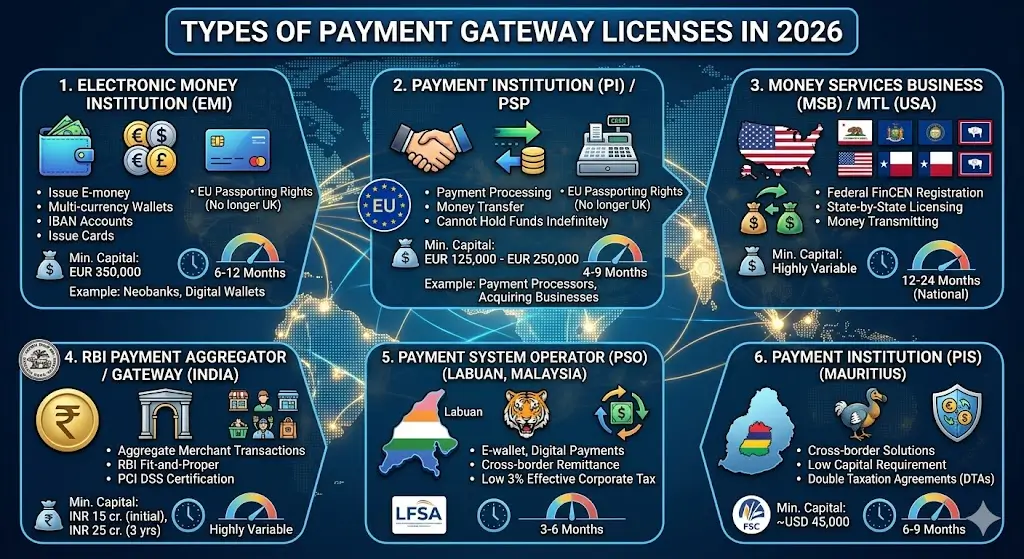
Choosing the right license type is the single most consequential decision you will make at the start of this process. Each license carries a different scope of permitted activity, minimum capital requirement, regulatory burden, and jurisdiction-specific process. Below is a detailed breakdown of the main license types available globally in 2026.
1. Electronic Money Institution (EMI) License
The EMI license is the broadest and most powerful option for payment businesses. It authorizes your company to issue electronic money, operate multi-currency e-wallets, hold client balances, provide IBAN-style account numbers, and issue prepaid or virtual cards. In the European Union, this license operates under Directive 2009/110/EC.
Minimum capital requirements sit at EUR 350,000 in most EU member states. Lithuania and Estonia remain the fastest EU jurisdictions for EMI approvals, with typical timelines of 6 to 12 months. The Bank of Lithuania (CBL) is widely regarded as the most streamlined regulator for fintech EMI applications. Neobanks, digital wallet platforms, crypto-fiat on-ramp services, and Revolut-style products typically hold this license. Post-Brexit, UK EMI licenses issued by the FCA do not carry EU passporting rights.
2. Payment Institution (PI) / PSP License
A PSP license — formally called a Payment Institution (PI) license in the EU under PSD2 (Payment Services Directive 2) — authorises payment processing, money transfers, and transaction facilitation without the right to issue electronic money or hold client funds indefinitely. This is the most common license type for payment processors, acquiring businesses, and white-label payment service providers.
3. Money Services Business (MSB) / Money Transmitter License (MTL) — USA
The United States has no single federal payment gateway license. Instead, any business involved in transferring or transmitting money must register as an MSB with FinCEN at the federal level and independently obtain a Money Transmitter License (MTL) in each state where it operates. This is commonly called a state-by-state licensing strategy.
As of 2026, most US payment businesses operating nationally hold MTLs in 40 to 50 states, with some states — notably Wyoming, Montana, and New Mexico — either not requiring them or offering expedited processes. California, New York, and Texas have the most demanding requirements and longest timelines. Total state MTL acquisition across all jurisdictions can take 12 to 24 months and cost upwards of USD 200,000 in filing fees and compliance costs.
4. RBI Payment Aggregator / Payment Gateway License — India
In India, the Reserve Bank of India mandates that any entity aggregating payment transactions on behalf of merchants must obtain formal authorization under the Payments and Settlement Systems Act, 2007. The RBI draws a specific regulatory distinction between Payment Aggregators (PAs), who settle funds to merchants, and Payment Gateways (PGs), who provide technology infrastructure.
As of the latest RBI guidelines, Payment Aggregators must maintain a minimum net worth of INR 15 crore at application and INR 25 crore within three years of receiving in-principle approval. All applicants must achieve PCI DSS certification, and all directors must pass the RBI's fit-and-proper criteria screening. The RBI first issues an in-principle approval, after which applicants must meet technical and operational standards within a stipulated period before receiving the final certificate of authorization.
5. Payment System Operator (PSO) License — Labuan, Malaysia
The Labuan PSO license, issued by the Labuan Financial Services Authority (LFSA), has become increasingly popular for payment businesses targeting Southeast Asian, South Asian, and broader Asia-Pacific markets. It authorizes e-wallet operations, digital payment processing, cross-border remittance, and payment aggregation.
6. Payment Institution License — Mauritius (PIS/FSC)
For businesses building cross-border payment solutions, remittance services, or global PSP infrastructure with cost efficiency as a priority, the Payment Intermediary Services (PIS) license issued by the Financial Services Commission (FSC) of Mauritius is a compelling option. Minimum capital requirements are approximately USD 45,000 — the lowest of any reputable regulated jurisdiction globally.
License Type Comparison — 2026
| License Type | Best For | Min. Capital | Timeline | Key Regulator | EU Passport? |
| EMI License (EU) | E-wallets, neobanks, prepaid | EUR 350,000 | 6–12 months | FCA / CBL Lithuania | Yes |
| PSP / PI License (EU/UK) | Payment processors, acquirers | EUR 125,000–250,000 | 4–9 months | FCA / CBL / BaFin | Yes (EU only) |
| MSB / MTL (USA) | US money transfer, fintech apps | Varies by state | 12–24 months | FinCEN + State | N/A |
| RBI PA/PG License (India) | Indian payment aggregators | INR 15 Cr net worth | 6–12 months | Reserve Bank of India | N/A |
| PSO License (Labuan) | Asian PSPs, e-wallets, remittance | ~USD 150,000 | 3–6 months | LFSA Malaysia | No |
| PIS License (Mauritius) | Cross-border payment businesses | ~USD 45,000 | 6–9 months | FSC Mauritius | No |
Do You Actually Need a Payment Gateway License?
Before investing months and significant capital into a licensing application, ask yourself exactly what your platform does with money. This is not a compliance question — it is a business model question. The answer determines not only whether you need a license, but which license is appropriate.
- If you process and settle funds on behalf of merchants — you almost certainly need a PSP or PA license.
- If you issue electronic money, operate an e-wallet, or hold customer balances — you need an EMI license.
- If you are a pure technology layer (merchants bring their own acquirer and you never touch funds) — you may only need PCI DSS compliance.
- If you transfer money for customers through remittance or wire services — you need an MTL or MSB registration.
- If you operate as a payment aggregator in India — the RBI payment aggregator authorization is mandatory, regardless of your technology model.
A common misconception among founders is that using a third-party acquiring bank removes regulatory responsibility. It does not. Even if you rely on external providers for settlement, you remain responsible for conducting AML and KYC/KYB checks on your merchants, maintaining secure transaction infrastructure, and ensuring your platform's compliance at the appropriate PCI DSS certification level.
Key Benefits of Holding a Payment Gateway License
A payment gateway license is not only a regulatory requirement — it is also a significant commercial asset. Licensed payment businesses consistently outperform unlicensed competitors across several critical dimensions. Here is what a valid license actually gives you:
1. Legal Authority to Operate in Regulated Markets
The most obvious benefit: a payment gateway license gives your business the legal right to operate in regulated markets without exposure to enforcement action. In markets like the EU, UK, India, and the US, operating without the appropriate license is a criminal offense that carries fines, platform shutdowns, and personal liability for directors.
2. Access to Banking Relationships
Banks will not open business accounts or provide settlement infrastructure to unlicensed payment businesses. Holding a recognized license — especially an EMI or PSP license from a reputable regulator like the FCA or CBL — is the single most important factor that determines whether major banks will partner with you. Without this, merchant payouts, FX conversion, and cross-border settlement become logistically impossible.
3. EU Passporting Rights (for EU Licenses)
An EMI or PSP license issued in one EU member state — Lithuania, Estonia, or the Netherlands, for example — can be passported across all 27 EU member states without requiring separate national applications. This gives a single licensed entity legal authority to operate across the entire European single market, a substantial competitive advantage for payment businesses targeting European merchants and consumers.
4. Ability to Issue Electronic Money and Payment Cards
Only licensed EMIs can issue electronic money, provide IBAN-linked account numbers, and issue prepaid or virtual cards under Mastercard or Visa programs. This unlocks revenue streams — interchange fees, FX spreads, subscription revenues from cardholders — that are not available to unlicensed technology providers. In 2026, EMI-issued virtual cards have become a significant revenue line for digital banking platforms globally.
5. Participation in Card Scheme Networks
Visa and Mastercard require payment processors and acquirers to be licensed financial institutions or to partner with licensed principals. Holding your own license — rather than processing under a sponsor's umbrella — gives you independent access to card scheme agreements, better economic terms, direct settlement, and control over your merchant terms. This is a significant long-term commercial advantage as transaction volumes scale.
6. Regulatory Protection and Dispute Framework
Licensed payment businesses operate within a defined regulatory framework for dispute resolution, chargebacks, and customer complaint handling. Regulators provide a structured framework for managing these, which protects both your business and your merchants. In jurisdictions like the UK and EU, licensed businesses also benefit from access to financial ombudsman services and regulatory arbitration mechanisms.
Eligibility Criteria for a Payment Gateway License
Regulators across all major jurisdictions assess eligibility against a common set of criteria before a payment gateway license application is approved. Understanding these upfront — before you file — significantly increases your approval probability and reduces costly back-and-forth with regulators.
Corporate Eligibility
- Your company must be incorporated in the jurisdiction in which you are applying, or have a registered branch in that jurisdiction.
- Most regulators require a minimum shareholding structure — typically with disclosed beneficial ownership above 25% requiring full KYC documentation.
- Some jurisdictions (Lithuania, for example) require a locally resident director on the board for EMI applications.
- Your articles of association and constitutional documents must specify the intended payment services activities as permitted objects of the company.
Financial Eligibility
- Minimum paid-up capital must be fully funded, held in a dedicated bank account, and verifiable at the time of application.
- Audited financial statements for the preceding 2 to 3 years are required for existing companies. For new entities, detailed financial projections covering at least 3 years must be submitted.
- Proof of solvency and sufficient working capital to sustain operations through the license period is required — not just minimum capital.
- For the RBI PA license in India, net worth — not just paid-up capital — must meet the INR 15 crore threshold and must be verified by a Chartered Accountant.
Director and Officer Eligibility (Fit and Proper Criteria)
- All directors, senior officers, and beneficial owners holding 10% or more of shares must pass fit-and-proper screening.
- This includes criminal record checks, financial sanctions screening, past regulatory actions in any jurisdiction, and insolvency history.
- Directors must demonstrate relevant professional experience in financial services, compliance, risk management, or technology — depending on the regulator's specific requirements.
- Some regulators (CBL Lithuania) require at least one director to have a recognized professional qualification in banking or finance.
Technical and Operational Eligibility
- Applicants must demonstrate a functioning or credibly planned technical infrastructure that meets applicable PCI DSS certification requirements.
- An operational AML/KYC program must be in place — not merely documented — at the time of application.
- A designated Money Laundering Reporting Officer (MLRO) with appropriate qualifications and experience must be named and available for regulatory interview.
- Transaction monitoring systems, fraud detection mechanisms, and incident response procedures must be documented and technically demonstrable.
Payment Gateway License Requirements: What Regulators Scrutisise
Beyond formal eligibility, regulators evaluate the substance and quality of your application across several technical and compliance dimensions. Below is a detailed breakdown of the core requirement areas, based on how regulators actually assess applications — not just what their guidelines say.
Capital Requirements
Capital requirements are hard minimums, not targets. They must be maintained — not just deposited at application — throughout your license period. Here is the current capital landscape:
| License / Jurisdiction | Min. Capital Required | Notes | Currency |
| EMI License — EU | EUR 350,000 | Must be maintained throughout license period | EUR |
| PSP / PI License — EU | EUR 125,000–250,000 | Depends on services scope | EUR |
| EMI License — UK (FCA) | GBP 350,000 | No EU passport post-Brexit | GBP |
| RBI PA License — India | INR 15 Cr (net worth) | Rises to INR 25 Cr within 3 years | INR |
| PSO License — Labuan | ~USD 150,000 | Maintained as regulatory capital | USD |
| PIS License — Mauritius | ~USD 45,000 | Lowest threshold among regulated jurisdictions | USD |
| Standard PI — Singapore (MAS) | SGD 100,000 | For standard payment institution class | SGD |
PCI DSS Compliance
PCI DSS (Payment Card Industry Data Security Standard) is non-negotiable. Card networks — Visa and Mastercard — mandate it independently of any regulatory requirement, and virtually every financial regulator treating payment processing treats PCI certification as a baseline prerequisite.
Your required PCI compliance level depends on your annual transaction volume. Level 1, for processors handling more than 6 million card transactions annually, requires a formal on-site assessment conducted by a Qualified Security Assessor (QSA), typically costing USD 25,000 or more per year. Levels 2 through 4 allow for self-assessment using the appropriate SAQ (Self-Assessment Questionnaire) form.
Even if you outsource card processing entirely via a Hosted Payment Page (HPP) model, your business must complete at minimum an SAQ A or SAQ A-EP and maintain secure HTTPS connections throughout your transaction flow. Outsourcing does not transfer PCI responsibility.
AML/KYC and CTF Program
Every payment license applicant must demonstrate an operational, documented, and tested Anti-Money Laundering (AML), Know Your Customer (KYC), Know Your Business (KYB), and Counter-Terrorism Financing (CTF) program. Regulators do not accept draft frameworks — they want to see implemented processes.
IT Infrastructure and Cybersecurity
Regulators require documented evidence that your technical infrastructure meets the applicable security and resilience standards. This includes end-to-end encryption of data in transit and at rest, tokenization of cardholder data, fraud detection and velocity checks, system redundancy and failover architecture, a documented Business Continuity Plan (BCP) and Disaster Recovery Plan (DRP), and formal incident response procedures.
The RBI additionally requires a detailed network architecture diagram showing how cardholder data flows through your system, which servers handle what data, and how data segregation is enforced. EU regulators increasingly require cloud-hosting agreements that specify data residency within the EEA.
Business Plan and Financial Projections
A payment gateway license application is not just a form — it is a business case submitted to a regulator. Your business plan must cover your revenue model in detail, projected transaction volumes by merchant category, staffing plan, technology roadmap, market analysis, risk management framework, and 3-year financial projections with assumptions clearly stated. Regulators actively read and challenge business plans; vague or optimistic projections without evidence are common rejection triggers.
Documents Required for a Payment Gateway License Application
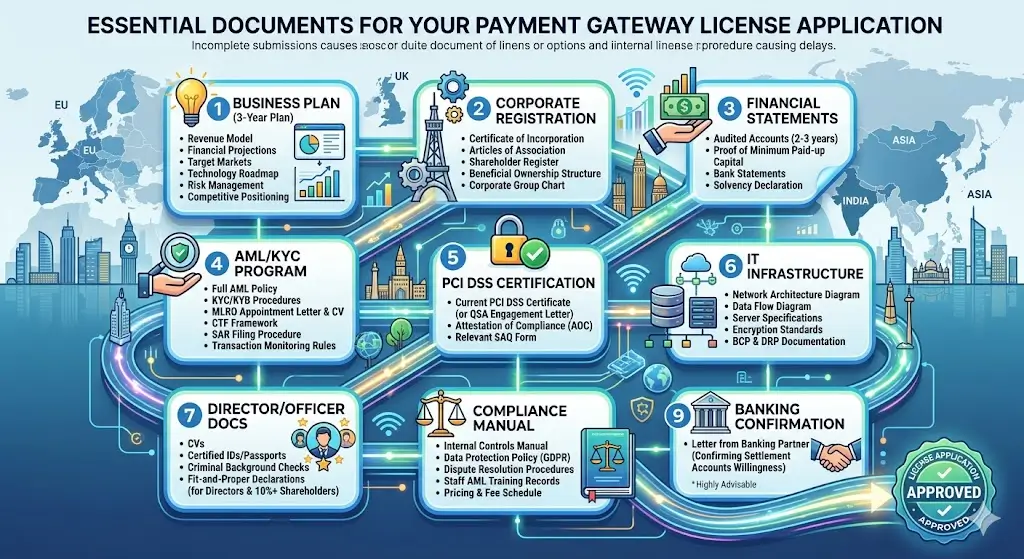
Incomplete document submissions are the leading cause of application delays across every jurisdiction. Gathering the right documentation before filing saves months. Below is the comprehensive document checklist based on common requirements across EU, UK, Indian, and Asian jurisdictions.
| Document Category | Specific Requirements |
| Business Plan | 3-year plan: revenue model, financial projections, target markets, technology roadmap, risk management framework, and competitive positioning |
| Corporate Registration | Certificate of incorporation, articles of association, shareholder register, beneficial ownership structure, corporate group chart |
| Financial Statements | Audited accounts (2–3 years for existing entities), proof of minimum paid-up capital, bank statements, solvency declaration |
| AML/KYC Program | Full AML policy, KYC/KYB procedures, MLRO appointment letter and CV, CTF framework, SAR filing procedure, transaction monitoring rules |
| PCI DSS Certification | Current PCI DSS certificate (or QSA engagement letter for pending), Attestation of Compliance (AOC), relevant SAQ form |
| IT Infrastructure | Network architecture diagram, data flow diagram, server specifications, encryption standards documentation, BCP and DRP documentation |
| Director/Officer Docs | CVs, certified copies of IDs/passports, criminal background check certificates, fit-and-proper declaration forms for all directors and 10%+ shareholders |
| Compliance Manual | Internal controls manual, data protection policy (GDPR-compliant for EU), dispute resolution procedures, staff AML training records, pricing and fee schedule |
| Banking Confirmation | Letter from banking partner confirming willingness to provide settlement accounts upon license approval (not always mandatory but strongly advisable) |
How to Get a Payment Gateway License: Step-by-Step Process
The application process for a payment gateway license is methodical, document-intensive, and typically involves structured back-and-forth with the regulatory authority. Rushing any stage is the most common source of avoidable delays. Here is the process in full:
Step 1 — Define your business model precisely.
Are you a technology-only gateway, a full PSP, an electronic money issuer, or a payment aggregator? Your answer determines which license you need, which jurisdiction is appropriate, and what your compliance roadmap looks like. Do not begin infrastructure build or capital deployment before this is clear.
Step 2 — Select your jurisdiction strategically.
Consider time-to-approval, capital requirements, tax environment, banking partner access, and your target markets. In 2026, Lithuania and Estonia remain the fastest EU options. Labuan is the fastest overall for Asian market access. Mauritius offers the lowest entry cost for cross-border models.
Step 3 — Incorporate your legal entity.
Most regulators require a locally incorporated legal entity in the target jurisdiction. In India, a private limited company under the Companies Act 2013 is the mandatory vehicle. In Lithuania, a UAB (private limited company) is standard. Allow 4 to 8 weeks for incorporation, banking, and company setup.
Step 4 — Build your compliance infrastructure.
Appoint your MLRO. Document and test your AML/KYC program. Prepare your compliance manual and internal controls framework. This step is non-negotiable and should be done before filing — not after. Regulators increasingly ask to interview the MLRO as part of the review process.
Step 5 — Achieve PCI DSS compliance.
Determine your applicable certification level based on projected transaction volumes. If you expect to qualify at Level 1, engage a QSA early — the audit and remediation process typically takes 3 to 6 months. For lower levels, complete the appropriate SAQ and ensure your hosting environment meets scope requirements.
Step 6 — Prepare and submit your application.
File your application with the relevant authority — RBI for India, FCA for the UK, CBL for Lithuania, LFSA for Labuan, FSC for Mauritius. Applications submitted with complete documentation and a well-prepared business plan receive significantly faster initial review responses. Work with a regulated compliance consultant for the first application if your team lacks prior experience with that specific regulator.
Step 7 — Respond to regulator queries promptly.
All major regulators will issue one or more rounds of information requests (IFRs) or regulatory questions during the review period. The speed and quality of your responses directly impact your approval timeline. Designate a single point of contact who can coordinate across legal, compliance, and technical teams to provide consistent, accurate answers quickly.
Step 8 — Secure in-principle approval (where applicable).
The RBI, FSC Mauritius, and certain other regulators issue in-principle approval (IPA) before final authorization. The IPA grants a defined period — typically 6 months — during which you must complete technical testing, demonstrate live transaction processing capabilities, and fulfil any outstanding conditions set by the regulator.
Step 9 — Receive and activate your final license.
On final approval, your license certificate or registration is issued. This must be displayed on your platform in accordance with regulatory requirements. Banking relationships can now be formalized, card scheme agreements can be initiated, and commercial operations can begin.
Step 10 — Maintain continuous compliance.
A payment gateway license is not a one-time event. Ongoing obligations include annual AML audits, regulatory renewal filings, changes-in-control notifications, transaction monitoring reporting, PCI DSS recertification, and keeping regulators informed of material changes to your business model, ownership, or technology infrastructure. Non-compliance post-license is treated as seriously as operating without one.
Payment Gateway License Cost Breakdown: What to Budget in 2026
The cost of obtaining and maintaining a payment gateway license has multiple components. Founders consistently underestimate the total cost by focusing only on regulatory filing fees while underbudgeting for PCI compliance, AML infrastructure, legal advisory, and banking setup. Here is a realistic and comprehensive cost breakdown:
| Cost Component | Estimated Range | Notes |
| Gateway Software License | USD 50,000–250,000 | One-time or annual; white-label options available at significant discount |
| Tokenization Appliance / HSM | USD 50,000–100,000 | Hardware Security Module required for secure cardholder data storage |
| Annual PCI DSS Level 1 Audit | USD 25,000+/year | Mandatory for processors handling 6M+ card transactions annually |
| Monthly PCI-Compliant Hosting | USD 2,500–3,500/month | Typically 4 servers minimum (2 production, 2 backup) |
| Bank/Processor Integration | USD 5,000–15,000 each | Per individual banking or processor connection; multiple typically required |
| Regulatory / Licensing Fees | EUR 10,000–100,000 | Varies significantly by jurisdiction and license type |
| Legal and Compliance Advisory | USD 15,000–50,000+ | Includes AML/KYC program build, business plan preparation, application filing support |
| Company Incorporation & Setup | USD 3,000–15,000 | Varies by jurisdiction; includes registered office, directorship, bank account opening |
| MLRO / Compliance Officer | USD 80,000–150,000/year | Senior compliance talent; mandatory for most licenses |
| AML/KYC Technology Platform | USD 12,000–60,000/year | Transaction monitoring, sanctions screening, identity verification tools |
| Total Cost Ranges at a Glance |
| • White-label payment gateway model (inheriting provider's PCI certification): USD 100,000–350,000 total first-year cost |
| • Custom-built payment gateway with single EU license: USD 400,000–700,000 in year one |
| • Full-stack multi-jurisdiction setup (EU + India + USA): USD 800,000–1,500,000 across years 1–2 |
| Note: Ongoing annual compliance, audit, and regulatory costs typically run USD 75,000–200,000 per year depending on license type and transaction volume. |
Best Jurisdictions for a Payment Gateway License in 2026
Jurisdiction selection is a strategic business decision, not just a compliance one. Your choice of jurisdiction affects your time-to-market, banking access, tax obligations, regulatory burden, and EU passporting rights. Here is the current landscape as of Q2 2026:
Lithuania — Top Tier for EU Market Entry
Lithuania's central bank, the Bank of Lithuania (CBL), remains the preferred EU regulator for fintech EMI and PSP applications. The application process does not require a pre-established company before filing, reducing upfront commitment. Operational costs are low relative to Germany, France, or the Netherlands. Approved licenses carry full EU passporting rights. Approximate timeline: 6 to 10 months for well-prepared applications. As of 2026, Lithuania hosts over 200 licensed payment and e-money institutions.
Estonia — Strong E-Governance Infrastructure
Estonia is popular among digital-first fintech startups for its advanced e-residency program, strong tech ecosystem, and efficient digital government services. The Financial Supervision Authority handles EMI applications. Timelines are comparable to Lithuania. Estonia is particularly well-suited for businesses with a primarily digital product and minimal physical office requirements.
United Kingdom (FCA) — Global Credibility
An FCA-authorized EMI or payment institution license remains one of the most globally respected financial regulatory authorizations available. Banking partners, institutional merchants, and enterprise clients worldwide recognize FCA authorization as a tier-1 credential. Post-Brexit, FCA licenses do not carry EU passporting, meaning separate EU authorization is required for European operations. Timelines: 9 to 18 months. Ongoing compliance requirements are the most demanding of any major jurisdiction.
Labuan, Malaysia — Best for Asia-Pacific Speed
For businesses targeting Southeast Asian, South Asian, or broader Asia-Pacific markets, Labuan is the fastest commercially viable licensed jurisdiction available in 2026. A 3% effective corporate tax rate, LFSA regulatory credibility, 3 to 6 month approval timelines, and strong banking relationships with Asian financial institutions make this a standout choice. The PSO license covers e-wallet operations, digital payment processing, and cross-border remittance.
Mauritius — Lowest Entry Cost
The FSC Mauritius PIS license offers the lowest capital entry point of any reputable regulated jurisdiction globally — approximately USD 45,000. Combined with a 3% effective tax rate, a network of Double Taxation Agreements with key markets, and a straightforward application process, Mauritius is ideal for cross-border payment businesses, Africa-focused remittance services, and startups that need regulatory credibility at a controlled initial cost. Timeline: 6 to 9 months.
Canada (FINTRAC) — Fast and Crypto-Inclusive
Canada's FINTRAC MSB registration is relatively fast to obtain — typically 3 to 4 months — and covers both fiat currency and virtual currency services, making it attractive for crypto-adjacent payment businesses. It is federally recognized and provides a credible compliance foundation for businesses serving North American markets. FINTRAC registration does not, however, provide the same level of institutional credibility as an FCA or CBL license for enterprise merchant onboarding.
Common Mistakes to Avoid When Applying for a Payment Gateway License
Having reviewed payment licensing processes across multiple jurisdictions, the same avoidable mistakes appear repeatedly. Each one costs time, money, or both.
Starting technology build before securing banking partnerships.
Building your gateway before confirming acquirer relationships, banking partners, or card scheme access means you may build a product for a market you cannot actually access. Banking access is the single biggest practical barrier for licensed payment businesses — and it must be validated in parallel with the licensing process, not after it.
Underestimating compliance costs.
PCI DSS certification, AML/KYC technology platforms, MLRO compensation, annual audits, and ongoing reporting obligations routinely exceed early-stage estimates by 2x or more. Build a compliance budget that is entirely separate from your technology budget, and treat it as a recurring operating cost — not a one-time investment.
Choosing a jurisdiction based on cost alone.
A license that looks cheap and fast on paper may create serious banking access problems, card scheme eligibility issues, or merchant credibility gaps later. Always evaluate jurisdiction selection through the lens of: will credible banks open accounts here for my license type? Will major merchants accept this regulator? What are the ongoing compliance costs?
Neglecting ongoing post-license obligations.
Many founders focus entirely on obtaining the license and underinvest in the systems and people required to maintain it. Annual renewals, AML audit submissions, change-in-control notifications, and regulatory reporting are ongoing requirements. Regulators revoke licenses for compliance failures after approval — sometimes more aggressively than they would reject an initial application.
Assuming PCI outsourcing means zero compliance responsibility.
Even with a Hosted Payment Page model where cardholders enter data directly on a third-party's form, your business is still in PCI scope for its own infrastructure. The appropriate SAQ must be completed, HTTPS connections to the HPP must be secure, and your website must not transmit cardholder data to your own servers. Non-compliance at this level has led to card scheme fines and license challenges for otherwise well-run businesses.
Filing an incomplete application.
Regulators in all major jurisdictions cite incomplete applications as the single largest cause of timeline delays. Every document listed in the regulator's published requirements must be submitted — not most of them. Missing a director's criminal background certificate or a signed fit-and-proper declaration can pause your application for weeks.
Payment Gateway License vs. White-Label Gateway: Which Fits Your Model?
Not every business that wants to process payments needs to go through a full independent licensing process. In 2026, white-label payment gateway platforms offer a commercially viable alternative — particularly for ISOs, SaaS platforms embedding payments, and high-volume merchants wanting to bring payment processing in-house under their own brand.
With a white-label model, you license a pre-built, PCI DSS Level 1 certified platform under your brand. You inherit the provider's existing compliance certifications and regulatory infrastructure, dramatically reducing your own regulatory burden, time-to-market, and initial capital requirements. The typical commercial structure is a setup fee plus a monthly license fee — usually a fraction of the cost of building and licensing from scratch.
| When white-label is sufficient: |
| • You want your own branded payment gateway without building proprietary infrastructure |
| • You do not need to hold customer funds or issue electronic money |
| • Speed-to-market is a priority and your capital budget is under USD 300,000 |
| • You are an ISO, SaaS platform, or high-volume merchant bringing processing in-house |
| When you must obtain your own license: |
| • Your business model requires holding customer funds or merchant balances |
| • You intend to issue electronic money, prepaid cards, or IBAN-linked accounts |
| • You are aggregating merchant payments and settling funds in your own name |
| • You are operating in India as a payment aggregator (RBI mandates direct authorization) |
| • You require direct card scheme membership independent of a sponsor bank |
2026 Regulatory Updates You Need to Know
The payment licensing landscape has seen meaningful regulatory movement in 2026. Here are the key updates that directly affect new applicants and existing licensees:
EU — PSD3 Implementation Progress
The European Commission's Payment Services Directive 3 (PSD3) and the accompanying Payment Services Regulation (PSR) are in progressive implementation across EU member states through 2026. PSD3 introduces stricter Open Banking access standards, enhanced fraud liability frameworks, and tightened requirements for payment initiation service providers (PISPs) and account information service providers (AISPs). Existing EU licensees should review their AML frameworks and data sharing protocols against PSD3 obligations. New applicants should ensure their business plans reference PSD3 compliance requirements explicitly.
India — RBI Tightening PA/PG Oversight
The Reserve Bank of India has significantly strengthened its oversight of payment aggregators and payment gateway operators in 2026. Key updates include mandatory co-branding disclosures on checkout pages, stricter merchant onboarding timelines (maximum 7 days for standard merchants), enhanced dispute resolution requirements with defined turnaround times, and increased frequency of regulatory reporting. Net worth requirements remain at INR 15 crore at application, with the INR 25 crore threshold maintaining its 3-year post-authorization deadline.
USA — Increased MTL Enforcement
The Federal Reserve's FedNow instant payment network has driven increased regulatory scrutiny of payment intermediaries operating without appropriate MTL coverage. Several state regulators — particularly in California (DFPI) and New York (NYDFS) — issued enforcement actions in 2025 against payment businesses operating without adequate state licensing coverage. In 2026, the practical expectation for US-operating payment businesses is full MTL coverage across all 50 states, not selective state-by-state coverage.
UK — FCA Authorization Timelines
The FCA has committed to reducing EMI and PI application review timelines following sustained industry criticism of multi-year delays. As of Q2 2026, the FCA's target timeline for complete applications is 12 months, down from the 18 to 24 months seen in 2023 and 2024. However, applications with gaps in AML documentation, IT security evidence, or business plan substance continue to face extended reviews. FCA has also increased scrutiny of safeguarding arrangements for licensed payment institutions.
Conclusion: Getting Your Payment Gateway License Right in 2026
Getting a payment gateway license right — on the first attempt — is not primarily about budget. It is about preparation. The businesses that sail through regulatory approval are those that define their model clearly before applying, build their compliance infrastructure before filing, choose their jurisdiction strategically, and treat regulators as partners in a structured evaluation process rather than gatekeepers to bypass.
If you are at the early stage of this process, the most valuable thing you can do right now is define exactly what your platform does with money. Does it route transactions? Settle them? Hold them? Issue them? That single question points you to the right license type, the right jurisdiction, and the right compliance path — and it eliminates months of misdirected effort.
If you are building something more complex — a multi-market fintech, a neobank infrastructure product, or a white-label PSP platform — the investment in proper legal and compliance advisory before you file will consistently save you multiples of that cost in delayed timelines, regulatory rejections, and remediation work.
The digital payment space in 2026 is genuinely one of the most commercially exciting areas to build in. Transaction volumes are at historic highs, merchant demand for licensed payment partners is intense, and the gap between licensed and unlicensed operators has never been wider in the eyes of banks, card schemes, and enterprise merchants. The companies that get licensing right early are the ones that grow confidently, attract institutional partnerships, and hold the merchant trust that is ultimately at the foundation of every successful payment business.
| Read More :- NBFC Registration |
| Read More :- Wallet License |
Frequently Asked Questions
Is a payment gateway license the same as a PSP license?
Not exactly, though the terms are sometimes used interchangeably in informal contexts. A PSP (Payment Service Provider) license is one specific type of payment license that covers processing and transaction facilitation. A payment gateway license is a broader commercial term that, depending on jurisdiction, may refer to a PSP license, an EMI license, or a country-specific aggregator authorization. In India, the RBI uses the specific term 'payment aggregator authorization' for entities that settle funds to merchants.
How long does it take to get a payment gateway license?
Timelines vary significantly by jurisdiction and application quality. Labuan (Malaysia): 3 to 6 months. Mauritius: 6 to 9 months. Lithuania and Estonia EMI/PSP: 6 to 12 months. UK FCA: 12 to 18 months in 2026. US MTL across all states: 18 to 30 months. India RBI: 6 to 12 months including the in-principle approval stage. Applications with complete documentation, a detailed business plan, and an operational compliance program consistently achieve the shorter end of these ranges.
Can I operate a payment gateway without a license?
Only in a very specific circumstance: if you are a pure technology provider where merchants bring their own acquirer, you never touch or settle funds, and no cardholder data passes through your systems. Even then, PCI DSS compliance is required if cardholder data interacts with your infrastructure in any way. Offering payment aggregation, settlement, or e-money services without a license in regulated markets is a serious legal offense in every major jurisdiction — carrying fines, operational shutdowns, and director liability.
What is the cheapest jurisdiction to get a payment gateway license in 2026?
Mauritius offers the lowest minimum capital requirement at approximately USD 45,000 through its Financial Services Commission (FSC) PIS license. It also has a low effective tax rate and a credible regulatory framework. For businesses prioritizing speed alongside low cost, Labuan, Malaysia is also competitive, though minimum capital requirements are higher (approximately USD 150,000). Both jurisdictions are suitable for cross-border and international payment businesses.
Do I need a new license for each country I operate in?
It depends on your license type and jurisdiction. An EU EMI or PSP license obtained in one EU member state can be passported across all 27 EU member states without requiring separate applications. Outside the EU, separate national licenses or registrations are typically required for each jurisdiction where you actively process transactions or hold customer funds. In the US, this means state-by-state MTL coverage. In India, the RBI PA authorization covers Indian operations only.
What is PCI DSS and why is it required?
PCI DSS — the Payment Card Industry Data Security Standard — is a globally recognized set of technical and operational security requirements governing how organizations store, process, and transmit cardholder data. It is mandated by card networks (Visa, Mastercard, Amex, Discover) as a condition of participating in card payment processing, independent of any regulatory license. Most financial regulators treating payment processing additionally require PCI DSS certification as a baseline prerequisite for license eligibility.