

- RBI Mandatory Approval: No NBFC can legally operate in India without a Certificate of Registration from the Reserve Bank of India.
- Minimum Net Owned Fund: As of 2026, you need at least Rs. 10 crore as NOF to qualify for most NBFC categories.
- Online Application via COSMOS Portal: RBI now processes all new NBFC registration applications through its COSMOS online portal.
- Typical Approval Timeline: The entire NBFC registration process usually takes 3 to 6 months, subject to complete documentation and RBI review.
Introduction
If you are planning to start a financial services business in India, NBFC registration in India is probably the most important step you need to get right from day one. Whether you want to offer loans, do asset financing, invest in securities, or run a microfinance business, you need a valid NBFC license from the Reserve Bank of India (RBI) before you accept a single rupee from the public.
The good news? The process is clearly defined. The challenge is that most applicants get rejected not because of bad intentions, but because of incomplete paperwork, wrong company structure, or not meeting the capital requirements. This guide cuts through all that confusion and gives you everything you need to know, in plain language, so you can move forward with confidence in 2026.
What Is an NBFC Registration ? And Why Does Registration Matter?
A Non-Banking Financial Company (NBFC) is a company registered under the Companies Act, 2013, that is engaged in the business of lending money, investing in shares or debentures, leasing, hire-purchase, insurance, or chit-fund activities. The key word here is "non-banking" — meaning it does financial work like a bank but cannot accept demand deposits (current accounts or savings accounts) from the general public.
So why does registration matter so much? Because under Section 45-IA of the RBI Act, 1934, it is a criminal offence to carry on NBFC business without a Certificate of Registration from RBI. Penalties can include imprisonment of up to five years and heavy fines. That alone should tell you how seriously the regulator takes this.
NBFC vs Bank: Key Differences at a Glance
| Feature | NBFC | Bank |
| Accept demand deposits | No | Yes |
| Issue cheques | No | Yes |
| Deposit Insurance (DICGC) | No | Yes |
| Payment & settlement system | Not part of | Integral part |
| CRR/SLR requirements | Not applicable | Mandatory |
| Minimum capital required | Rs. 10 crore (NOF) | Rs. 500 crore and above |
| Ease of setup | Comparatively easier | Highly complex |
Types of NBFCs Registration in India You Can Register in 2026
Before you apply for NBFC registration, you need to decide which type of NBFC you want to be. RBI classifies NBFCs based on the kind of business they conduct. Picking the wrong category wastes months of effort.
| NBFC Type | Primary Activity | Min. NOF Required |
| NBFC-ICC (Investment & Credit) | Lending, investing, asset finance | Rs. 10 crore |
| NBFC-MFI (Microfinance) | Small loans to low-income groups | Rs. 10 crore |
| NBFC-P2P (Peer-to-Peer Lending) | Online lending marketplace | Rs. 2 crore |
| NBFC-AA (Account Aggregator) | Financial data aggregation | Rs. 2 crore |
| Infrastructure Finance Company | Infrastructure project funding | Rs. 300 crore |
| Mortgage Guarantee Company | Mortgage default guarantees | Rs. 100 crore |
| NBFC-Factor | Factoring of receivables | Rs. 5 crore |
| Residuary NBFC (RNBC) | Deposit acceptance (specific) | Rs. 250 crore |
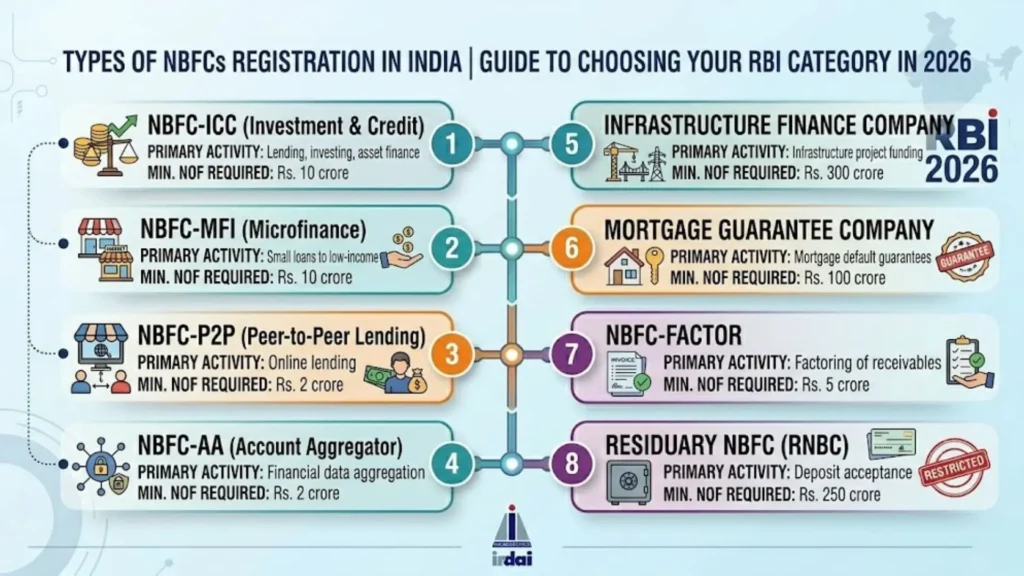
For most new applicants who want to start a lending or investment business in 2026, the NBFC-ICC category is the most commonly chosen path because it covers a broad range of financial activities under one license.
Who Can Apply for NBFC Registration? Eligibility Criteria
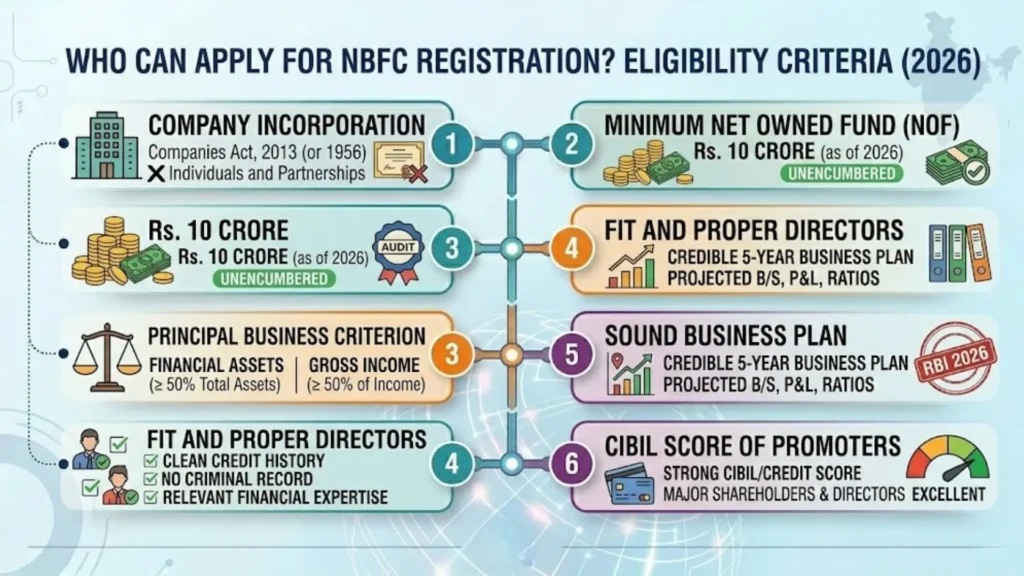
Not everyone can walk up and register an NBFC. RBI has strict eligibility conditions in place, and honestly, that is a good thing — it protects the financial system and genuine investors. Here is what you need to qualify:
- Company Incorporation: The applicant must be a company incorporated under the Companies Act, 2013 (or the older Companies Act, 1956). Individuals, partnerships, or LLPs cannot register an NBFC directly.
- Minimum Net Owned Fund (NOF): Your company must have a minimum NOF of Rs. 10 crore for most NBFC categories as of 2026. This should be unencumbered and verifiable through audited financial statements.
- Principal Business Criterion: At least 50% of your total assets must be financial assets, AND at least 50% of gross income must come from financial assets. This is the so-called 50-50 test that RBI applies.
- Fit and Proper Directors: All directors and promoters must pass RBI's fit and proper criteria — clean credit history, no criminal record, relevant financial expertise.
- Sound Business Plan: You must present a credible, well-researched 5-year business plan showing projected balance sheets, P&L, and financial ratios.
- CIBIL Score of Promoters: A strong CIBIL or credit score for all major shareholders and directors is unofficially an important factor during scrutiny.
One important thing many first-time applicants miss: your company's Memorandum of Association (MoA) must explicitly mention financial activity as the main object. If it does not, your NBFC registration application will be returned.
Documents Required for NBFC Registration with RBI
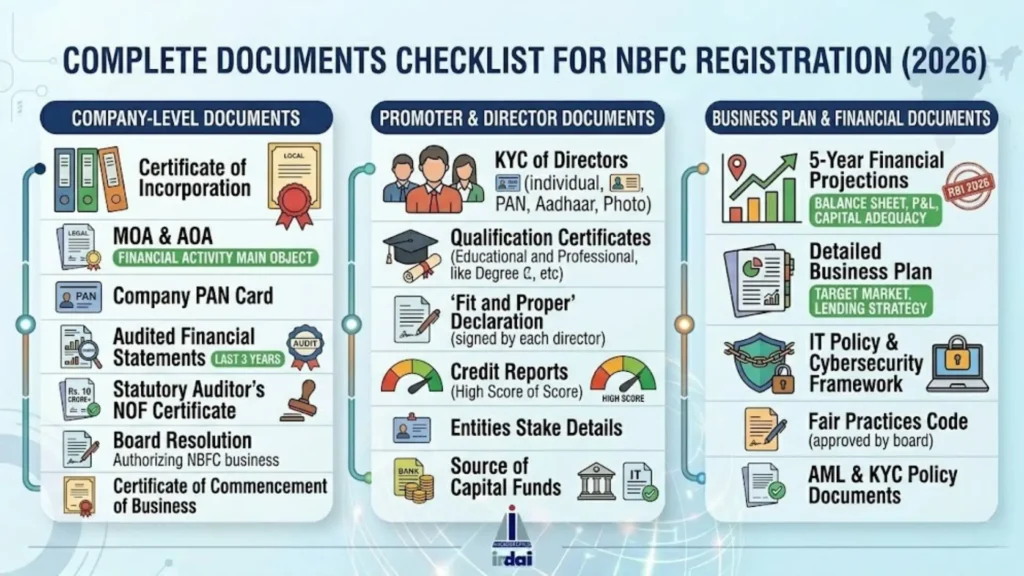
Gathering the right documents is half the battle won. Missing even one key document is the most common reason applications get delayed or rejected. Below is the complete checklist for 2026:
Company-Level Documents
- Certificate of Incorporation issued by the Registrar of Companies (ROC)
- Memorandum of Association (MoA) and Articles of Association (AoA) — with financial activity as main object
- PAN Card of the company
- Audited financial statements for the last 3 years (or since incorporation if newer)
- Statutory Auditor's Certificate confirming Net Owned Fund of Rs. 10 crore or more
- Board Resolution authorising the application and the company to conduct NBFC business
- Certificate of Commencement of Business
Promoter & Director Documents
- KYC of all directors: PAN, Aadhaar, passport-size photos
- Educational and professional qualifications certificates
- Declaration of "Fit and Proper" criteria by each director
- CIBIL/credit reports of directors and major shareholders
- Details of other entities in which directors/shareholders hold stake
- Source of funds for capital infusion — bank statements, IT returns
Business Plan & Financial Documents
- Detailed 5-year financial projections (balance sheet, P&L, capital adequacy)
- Business plan covering target market, lending strategy, and risk management
- IT policy and cybersecurity framework document
- Fair Practices Code as approved by the Board
- Anti-Money Laundering (AML) and KYC policy documents
NBFC Registration Process: Step-by-Step Guide for 2026
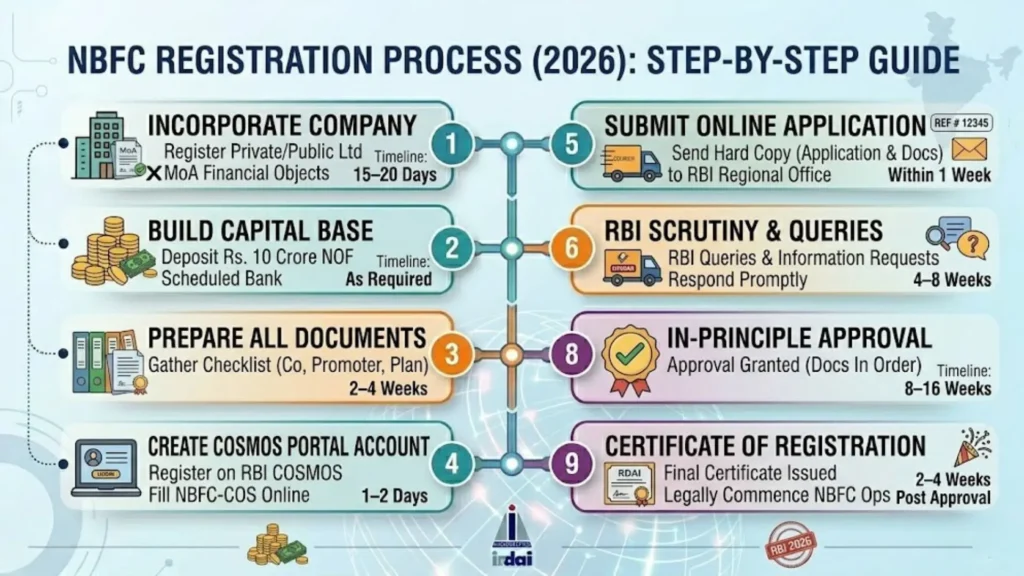
Here is exactly how the NBFC registration process works from start to finish in 2026. Follow these steps in order and you will avoid the most common pitfalls:
| Step | Action | Details | Timeline |
| 1 | Incorporate the company | Register a private or public limited company with financial objects in MoA | 15–20 days |
| 2 | Build the capital base | Deposit and maintain minimum Rs. 10 crore as NOF in a scheduled commercial bank | As required |
| 3 | Prepare all documents | Collect incorporation docs, promoter KYC, audited financials, business plan, policies | 2–4 weeks |
| 4 | Create COSMOS Portal account | Register on RBI's COSMOS portal and fill the NBFC-COS application form online | 1–2 days |
| 5 | Submit online application | Upload all required documents and submit online. Note the application reference number | 1 day |
| 6 | Submit physical copy | Send hard copy of the application and documents to the concerned Regional Office of RBI | Within 1 week |
| 7 | RBI scrutiny & queries | RBI may send queries or request additional information. Respond promptly | 4–8 weeks |
| 8 | In-principle approval | RBI grants in-principle approval if documents are in order | 8–16 weeks |
| 9 | Certificate of Registration | Final Certificate of Registration (CoR) issued. You can now legally commence NBFC operations | 2–4 weeks post approval |
Important note for 2026: RBI has become significantly more tech-forward. The COSMOS portal is the only accepted channel for new applications. There is no walk-in or email submission route anymore. Make sure your digital signatures are valid before you start the process.
NBFC Registration Fees and Cost in 2026
One of the most searched questions is: "How much does NBFC registration cost?" The honest answer is that the RBI application fee itself is zero — RBI does not charge a fee for processing the NBFC application. But the total cost you will realistically incur includes legal, professional, and capital costs. Here is a realistic breakdown:
| Cost Head | Estimated Range (Rs.) | Notes |
| Company Incorporation | 5,000 – 15,000 | ROC filing fees |
| CA / CS / Legal Professional Fee | 50,000 – 2,00,000 | Varies by firm quality |
| Statutory Audit for NOF Certificate | 15,000 – 50,000 | Depends on CA |
| Document Preparation (Policies, Business Plan) | 20,000 – 75,000 | Can be done in-house too |
| RBI Application Filing Fee | NIL | No fee charged by RBI |
| Minimum Net Owned Fund (Capital) | Rs. 10,00,00,000 (Rs. 10 crore) | Locked in bank account |
| Total Professional Costs (approx.) | Rs. 1 lakh – Rs. 3.5 lakh | Excluding capital requirement |
The Rs. 10 crore capital requirement is the biggest barrier for most applicants, and it is non-negotiable. This money needs to be visible in the company's bank account and reflected in audited financials before RBI will take your application seriously.
Common Reasons Why NBFC Registration Gets Rejected
RBI rejects a significant number of NBFC registration applications every year. Knowing the reasons in advance can save you enormous time and money:
- Insufficient or Incorrectly Calculated NOF: Many applicants calculate Net Owned Fund wrong. NOF = Paid-up capital + Free reserves - Accumulated losses - Deferred revenue expenditure - Other intangible assets. One wrong entry and the figure falls below Rs. 10 crore on paper.
- MoA Doesn't Mention Financial Activity: If your company's main objects do not explicitly state lending, investment, or financial activity, RBI will return the application without processing.
- Directors Fail Fit and Proper Test: Any default in loan repayments, criminal cases, or disqualification under the Companies Act for any director will lead to rejection.
- Weak or Incomplete Business Plan: A generic or vague 5-year plan without credible financial projections is one of the top rejection triggers.
- Missing Policy Documents: Not submitting AML policy, KYC policy, Fair Practices Code, or IT Security Policy is a common oversight.
- Application Mismatch: Data entered online on COSMOS portal not matching the physical documents submitted to RBI's regional office causes confusion and delays.
- Unexplained Source of Funds: If promoters cannot clearly explain how they arranged the Rs. 10 crore capital, RBI raises red flags.
RBI Compliance Requirements After NBFC Registration
Getting your NBFC registration is just the beginning. Once you have the Certificate of Registration, there is an ongoing compliance structure you must follow. Non-compliance can lead to cancellation of registration, penalties, or both.
Annual Compliance
- File Annual Return with RBI (NBS-1 to NBS-9 depending on NBFC type)
- Submit audited financial statements to RBI every year
- Maintain Capital Adequacy Ratio (CRAR) of minimum 15%
- Follow RBI's Fair Practices Code in all customer interactions
- Submit returns on NPAs, asset classification, and provisioning
Operational Compliance
- Maintain at least 15% of Net Demand and Time Liabilities as liquid assets
- File Suspicious Transaction Reports (STRs) with FIU-IND as required
- Update KYC for all borrowers as per RBI guidelines
- Get Credit Information Bureau (CIBIL/Equifax/Experian) reporting done
- Ensure all customer grievance redressal mechanisms are in place and functioning
Regulatory Reporting
- Submit monthly, quarterly, and annual returns via RBI's XBRL and COSMOS portals
- Intimate RBI of any change in directors, ownership, or registered address
- Seek prior approval for any merger, acquisition, or change in management control
NBFC Registration Timeline: What to Realistically Expect
People often ask: "How long does NBFC registration take?" Based on standard RBI processing in 2026, here is a realistic timeline:
| Phase | Activity | Time Required |
| Phase 1: Pre-Application | Company incorporation, capital arrangement | 30–60 days |
| Phase 2: Document Preparation | Business plan, policies, audited accounts | 15–30 days |
| Phase 3: Online Filing | COSMOS portal submission and physical copy | 3–5 days |
| Phase 4: RBI Scrutiny | Review, queries, clarifications | 60–120 days |
| Phase 5: Certificate Issuance | Final CoR issued by RBI | 15–30 days |
| Total (Realistic Estimate) | End-to-end process | 4 to 7 months |
Note: If your application is incomplete or requires clarification, the timeline can stretch beyond 7 months. Working with an experienced CA or NBFC consultant who has handled RBI submissions before can significantly speed things up.
What Is the Net Owned Fund (NOF) and How Is It Calculated?
The Net Owned Fund (NOF) is the cornerstone of NBFC registration eligibility. Many applicants confuse it with paid-up capital, which leads to mistakes. Here is the correct formula:
| Component | Impact on NOF |
| Paid-up Equity Capital | Add (+) |
| Free Reserves | Add (+) |
| Share Premium | Add (+) |
| Accumulated Losses / Deficit | Deduct (–) |
| Deferred Revenue Expenditure | Deduct (–) |
| Other Intangible Assets | Deduct (–) |
| Investments in Subsidiaries / Group Companies (above threshold) | Deduct (–) |
The resulting figure must be Rs. 10 crore or more for NBFC-ICC registration. Your Statutory Auditor must certify this figure in a specific format prescribed by RBI, and it must be based on the most recent audited balance sheet.
Key RBI Circulars and Regulations Governing NBFCs in 2026
If you are serious about NBFC registration, you need to be aware of the current regulatory framework. Here are the key regulations governing NBFC operations in India as of 2026:
- RBI Master Direction – NBFC (Reserve Bank) Directions, 2016 (Updated): The master document covering all NBFC regulations, periodically updated by RBI.
- Scale Based Regulation (SBR) Framework: Introduced by RBI from October 2022, this framework classifies NBFCs into four layers — Base Layer, Middle Layer, Upper Layer, and Top Layer — with corresponding regulatory requirements.
- Section 45-IA of RBI Act, 1934: The foundational legal requirement mandating every NBFC to obtain a Certificate of Registration before commencing business.
- NBFC Ombudsman Scheme, 2018: Provides customers with a free grievance redressal mechanism against NBFCs.
- RBI's Digital Lending Guidelines (2022 & Updated 2023-24): Mandatory for all NBFCs operating online lending platforms or working with fintech partners.
Choosing the Right Consultant for NBFC Registration: What to Look For
Given the complexity of the NBFC registration process, most serious applicants work with a qualified CA, CS, or law firm. But not every consultant has real experience with RBI applications. Here is what to look for:
- Track record of successfully filed and approved NBFC applications (ask for proof)
- Deep familiarity with COSMOS portal submissions and RBI's current requirements
- Experience across multiple NBFC types — not just ICC but also MFI, P2P, etc.
- Ability to prepare a high-quality, RBI-compliant 5-year business plan
- Strong post-registration compliance support — not just application filing
- Transparent fee structure with no hidden costs
Red flags to avoid: consultants who promise "guaranteed approval" (no one can guarantee RBI decisions), those who ask for cash payments, or those who offer suspiciously low fees without explaining what is included.
Conclusion: Is Starting an NBFC in 2026 Worth It?
India's NBFC sector continues to be one of the most dynamic segments of the financial services industry. With over 10,000 registered NBFCs and a combined asset base crossing Rs. 60 lakh crore, the sector is growing fast — and there is genuine room for well-run, compliant new entrants.
The NBFC registration process in 2026 is more streamlined than it was five years ago, thanks to the digitisation of RBI's COSMOS portal. But it still demands careful preparation, the right capital, and absolute attention to documentation. Shortcutting any step tends to backfire.
If you have the capital, a clear business idea, and the patience to work through the regulatory process correctly, registering an NBFC is absolutely worth the effort. The license opens doors to a range of financial products and a market of hundreds of millions of underserved customers.
Start with the right foundation — get your company structure, MoA, and NOF in order first. Everything else follows from there.
| Read More :- IRDA Broker License |
| Read More :- Wallet License |
Frequently Asked Questions
Can a Private Limited Company Apply for NBFC Registration?
Yes, absolutely. In fact, most NBFCs in India start as private limited companies. A private limited company with the right MoA objectives and sufficient NOF is perfectly eligible to apply for NBFC registration in India.
Can a Foreign Company Register an NBFC in India?
Foreign companies cannot directly register an NBFC. However, they can incorporate an Indian subsidiary company and route the application through that entity, subject to FEMA regulations and RBI's FDI guidelines for the NBFC sector.
Is It Possible to Convert an Existing Company Into an NBFC?
Yes. If an existing company meets the 50-50 test (50% financial assets and 50% income from financial activities) and has the minimum NOF of Rs. 10 crore, it can apply for registration as an NBFC with RBI through the same COSMOS portal process.
What Happens If I Do Not Renew My NBFC Registration?
NBFC registration once granted does not require annual renewal. However, if you fail to comply with ongoing regulatory requirements, RBI has the power to cancel your Certificate of Registration. That is why compliance matters as much as registration itself.
Can an NBFC Accept Fixed Deposits from the Public?
Only specifically authorised NBFCs — those classified as NBFC-D (Deposit-Taking) — can accept public deposits, and that too only within the limits set by RBI. Most NBFCs today are non-deposit-taking entities.