

- Wallet license is an official government or regulatory authorization that allows individuals or companies to legally operate a digital payment wallet service.
- Any business planning to offer prepaid payment services, mobile wallet apps, or e-wallet solutions must obtain a wallet license from the relevant authority.
- Without a valid wallet license, operating a digital wallet is illegal and can result in heavy fines, legal action, and business shutdown.
- The wallet license application process varies by country, but typically involves submitting financial documents, meeting capital requirements, and passing a compliance review.
Introduction
If you have ever wondered whether you need a wallet license to run a digital payment service — the answer is almost certainly yes. Whether you are a fintech startup, a payments company, or an individual entrepreneur looking to launch a mobile wallet app, a proper wallet license is not optional. It is the legal foundation your business stands on.
In this guide, we break down everything about wallet licenses — what they are, the different types, who issues them, how to apply, and what happens if you skip this step. No fluff, no jargon. Just clear, useful information you can act on today.
What Is a Wallet License?
A wallet license is a regulatory permit that authorizes a business or individual to legally store, transfer, and manage digital funds through an electronic wallet system. Think of it as the same way a bank needs a banking license — a wallet provider needs a wallet license.
Regulatory bodies issue these licenses to ensure that:
- Consumer funds are protected and secured
- The business follows anti-money laundering (AML) rules
- Know Your Customer (KYC) norms are being followed
- There is a proper grievance redressal mechanism in place
Without a valid wallet license, you are essentially running an unauthorized financial service — and that carries serious legal consequences in 2026.
Why Is a Wallet License Important?
The digital payments landscape has grown dramatically over the past five years. With billions of transactions happening through mobile wallets every day, governments and financial regulators worldwide have tightened their oversight. Here is why getting your wallet license right matters:
| Reason | Impact |
| Legal Compliance | Avoid fines, shutdowns, and criminal liability |
| Consumer Trust | Licensed wallets build user confidence and drive adoption |
| Banking Partnerships | Banks and payment gateways only work with licensed entities |
| Investor Credibility | Investors prefer businesses that are fully regulated |
| Market Expansion | A proper license allows you to operate across states or countries |
If you are serious about your fintech business, a wallet license is not just a formality — it is your license to operate.
Types of Wallet Licenses
Not all licenses are the same. The type you need depends on the nature of your business, the country you operate in, and the services you plan to offer.
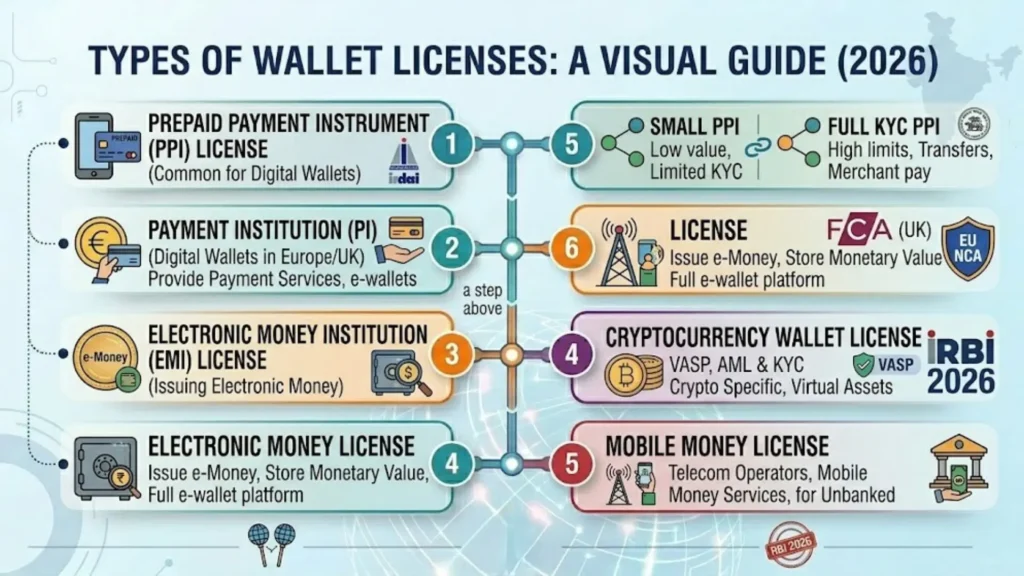
1. Prepaid Payment Instrument (PPI) License
This is the most common type of license for businesses offering digital wallets. In India, for example, the Reserve Bank of India (RBI) issues PPI licenses. There are two main sub-categories:
- Small PPI License: For low-value wallets with limited KYC requirements. Transaction limits typically apply.
- Full KYC PPI License: For full-featured wallets with higher transaction limits, fund transfers, and merchant payments.
2. Payment Institution (PI) License
Common in Europe and the UK, a Payment Institution license allows companies to provide payment services, including e-wallets. Issued by regulators like the FCA (Financial Conduct Authority) in the UK or the relevant National Competent Authority within the EU.
3. Electronic Money Institution (EMI) License
An EMI license is a step above a basic PI license. It allows the holder to issue electronic money, which means users can store actual monetary value in the wallet — not just initiate payments. This is ideal for businesses building a full-scale e-wallet platform.
4. Cryptocurrency Wallet License
As crypto adoption grows in 2026, many countries require a separate crypto wallet license or Virtual Asset Service Provider (VASP) registration. This ensures compliance with crypto-specific AML and KYC regulations.
5. Mobile Money License
Common in African and Southeast Asian markets, this type of wallet license allows businesses — often telecom operators — to offer mobile money services to the unbanked population.
Who Issues Wallet Licenses?
The issuing authority for a wallet license depends on the country of operation. Here is a quick reference:
| Country / Region | Regulatory Authority |
| India | Reserve Bank of India (RBI) |
| United States | FinCEN + State Money Transmitter Licenses |
| European Union | National Competent Authorities (EBA oversight) |
| United Kingdom | Financial Conduct Authority (FCA) |
| Singapore | Monetary Authority of Singapore (MAS) |
| UAE | Central Bank of the UAE |
| Nigeria | Central Bank of Nigeria (CBN) |
| Kenya | Central Bank of Kenya (CBK) |
Always verify with the local regulator, as licensing frameworks are updated regularly. In 2026, several new digital payments frameworks have come into effect, particularly in the EU under PSD3 and in the US under evolving state-level requirements.
Wallet License Requirements: What Do You Actually Need?
While requirements vary by jurisdiction, most regulatory bodies ask for a similar set of documents and conditions. Here is a general checklist:
Business and Legal Documents
- Certificate of Incorporation or Business Registration
- Memorandum and Articles of Association
- List of directors, shareholders, and beneficial owners
- Proof of registered business address
Financial Requirements
- Minimum net worth or paid-up capital (varies by license type)
- Bank statements and audited financial reports
- Source of funds declaration
Technical and Operational Requirements
- A detailed description of the wallet platform and technology stack
- IT security policy and data protection framework
- Business continuity and disaster recovery plan
- Customer grievance mechanism documentation
Compliance Documents
- AML/CFT policy (Anti-Money Laundering / Combating Financing of Terrorism)
- KYC policy and onboarding procedures
- Risk management framework
- Internal audit and governance structure
Key Personnel
- Fit and Proper declarations for directors and key management
- Background checks and qualifications of compliance officers
How to Apply for a Wallet License: Step-by-Step
Getting a license does not have to be overwhelming if you approach it systematically.
Step 1: Choose the Right License Type
Understand which license applies to your business model. A prepaid wallet for consumers in India is different from a multi-currency EMI license in Europe.
Step 2: Meet the Capital Requirements
Most regulators require you to demonstrate a minimum paid-up capital before they even review your application. Check the exact figure for your target jurisdiction.
Step 3: Prepare Your Documentation
Compile all required documents — legal, financial, technical, and compliance-related. Missing even one can delay your application by months.
Step 4: Submit Your Application
Applications are typically submitted online through the regulator's portal. Some jurisdictions still require physical submissions. Pay the applicable application fee.
Step 5: Regulatory Review
After submission, the regulator will review your application. This can take anywhere from 30 days to 12 months depending on the country and the completeness of your application.
Step 6: In-Person Interviews or Additional Queries
Some regulators call applicants for interviews or send queries requesting additional information. Respond promptly and accurately.
Step 7: License Approval and Issuance
Once approved, you receive your license. This comes with ongoing compliance obligations — not just a one-time certificate.
Wallet License Fees: What to Budget For
One question everyone asks: how much does a wallet license cost? Here is a realistic breakdown:
| Jurisdiction | Application Fee | Minimum Capital Requirement |
| India (PPI - Full KYC) | Approx. INR 10,000 | INR 15 Crore (net worth) |
| UK (EMI License) | GBP 5,000 approx. | EUR 350,000 (initial capital) |
| EU (Payment Institution) | Varies by country | EUR 125,000 |
| Singapore (MPI License) | SGD 1,000 approx. | SGD 250,000 |
Note: These figures reflect general estimates and are subject to regulatory updates. Always check with the official regulatory authority for the most current fee structures.
Beyond application fees, budget for legal consultants, compliance officers, IT infrastructure, and ongoing regulatory reporting costs. The true cost of getting a wallet license is an investment in your long-term business legitimacy.
Common Reasons Wallet License Applications Get Rejected
Understanding why applications fail can save you time and money:
- Insufficient capital: Not meeting the minimum net worth requirement is the fastest way to get rejected.
- Weak AML/KYC policies: Regulators take financial crime prevention very seriously. A vague or copied policy will not pass.
- Incomplete documentation: Missing even one required document can stall or kill your application.
- Unclear business model: If the regulator cannot understand exactly how your wallet works and how you make money, they will not approve it.
- Unqualified key personnel: Directors or compliance officers who do not meet fit-and-proper criteria are a red flag.
- Technology vulnerabilities: Weak IT security policies signal that consumer data and funds are at risk.
Wallet License Renewal: Staying Compliant After Approval
Getting a wallet license is not a one-and-done process. Most wallet licenses require periodic renewal and ongoing compliance:
- Annual compliance reports submitted to the regulator
- Audited financial statements showing continued financial health
- Updated AML/KYC policies reflecting any regulatory changes
- Technology audits to ensure platform security meets current standards
- License renewal fees paid within stipulated timelines
Failure to renew your license on time can result in suspension or cancellation — even if your business is operating perfectly. Set reminders well in advance of your renewal date.
Wallet License for Startups: Is It Worth It?
Many fintech startups ask whether getting a wallet license is worth the time and expense. The honest answer is — it depends on your growth ambitions.
If you are building a small, local payment tool, you might initially operate under a larger licensed partner's umbrella (a model called "Banking-as-a-Service" or BaaS). But as soon as you want to scale, take deposits, or operate independently, you will need your own wallet license.
The startups that plan for regulatory compliance early almost always scale faster because:
- They attract institutional investors more easily
- They can partner directly with banks and financial institutions
- They avoid the costly and disruptive process of retrofitting compliance at a later stage
Getting a wallet license early is a growth strategy, not just a legal box to check.
Digital Wallet License vs. Payment Gateway License: What Is the Difference?
Many people confuse a digital wallet license with a payment gateway license. These are not the same:
| Feature | Wallet License | Payment Gateway License |
| Stores funds | Yes | No |
| Facilitates transactions | Yes | Yes |
| Issues electronic money | Yes (EMI) | No |
| Holds user balances | Yes | No |
| KYC required | Yes | Sometimes |
A payment gateway routes transactions between a customer and a merchant — it does not hold money. A wallet stores value on behalf of the user. If your business does the latter, you need a wallet license, not just a payment gateway license.
Conclusion
The world of digital payments is only going to get more regulated in 2026 and beyond. Regulators are paying closer attention to who is handling consumer money, how funds are protected, and whether businesses are following global financial crime prevention standards.
If you are serious about building a sustainable fintech business, getting your wallet license sorted is the smartest first move you can make. It is not the most exciting part of starting a payments company — but it is the part that determines whether your business gets to operate tomorrow.
Take the time to understand which wallet license applies to you, prepare your documentation properly, and engage a qualified regulatory consultant if needed. The upfront investment in compliance pays dividends for years.
| Read More :- IRDA Broker License |
Frequently Asked Questions
Can an individual get a wallet license or is it only for companies?
In most jurisdictions, a wallet license is granted to a registered business entity, not to an individual. You will need to incorporate a company first.
How long does it take to get a wallet license?
Processing times vary widely — from 30 days in some jurisdictions to over 12 months in others. India's RBI typically takes 3 to 6 months for PPI applications. EU regulators can take 6 to 12 months.
Can I operate a wallet while my license application is pending?
No. Operating without a valid wallet license — even during a pending application — is illegal in most countries.
Do I need a separate wallet license for each country?
Yes, in most cases. A wallet license is jurisdiction-specific. The EU is an exception where an EMI license issued in one member state can be passported to others.
What happens if I operate without a wallet license?
Consequences include heavy monetary fines, criminal charges against directors, forced shutdown of the platform, and damage to your business reputation.