
| ✔ IRDA broker license is mandatory for any entity that wants to legally sell insurance products in India as an intermediary. |
| ✔ Governed by IRDAI (Insurance Brokers) Regulations, 2018 — the primary legal framework for all insurance broker registrations in India. |
| ✔ Three license categories: Direct Broker, Reinsurance Broker, and Composite Broker — each with different capital and eligibility requirements. |
| ✔ IRDA broker license fees range from ₹25,000 to ₹5,00,000 with mandatory net worth starting from ₹75 lakh depending on category. |
Introduction
If you are planning to enter the insurance distribution business in India, the first question that hits your desk is simple — do I need an IRDA broker license? The answer is almost always yes. Whether you want to help individuals buy term plans or help corporates arrange commercial insurance covers, working as a licensed insurance broker is both a legal requirement and a strong business credential.
This guide walks you through everything you genuinely need to know about the IRDA broker license in 2026 — the types available, exact eligibility conditions, capital requirements, step-by-step application process, fees, timeline, and renewal. No fluff, no confusion.
| Note: IRDA is now officially referred to as IRDAI — the Insurance Regulatory and Development Authority of India. Both terms are widely used and refer to the same authority. This guide uses both interchangeably, as most users search using both. |
What Is an IRDA Broker License?
An IRDA broker license is an official permission granted by the Insurance Regulatory and Development Authority of India (IRDAI) that allows a company or LLP to act as a professional intermediary between insurance buyers and insurance companies.
Unlike an insurance agent who works for a single insurer, a licensed insurance broker represents the policyholder. That is a key legal distinction. A broker's job is to understand the client's risk, compare options across multiple insurers, and recommend the best policy — without being tied to one company's products.

The governing framework is the IRDAI (Insurance Brokers) Regulations, 2018, which replaced the earlier 2013 regulations and introduced significant changes to capital requirements, reporting, and compliance norms.
Types of IRDA Broker Licenses in 2026
IRDAI currently issues three categories of insurance broker licenses in India. Choosing the right one before you apply matters because your minimum net worth, fees, and scope of operations depend entirely on it.
| License Type | What You Can Do | Min Net Worth | Application Fee |
| Direct Broker (Life) | Sell life insurance products only | ₹75 Lakh | ₹25,000 |
| Direct Broker (General) | Sell general/non-life insurance only | ₹75 Lakh | ₹25,000 |
| Direct Broker (Life & General) | Sell both life and general insurance | ₹75 Lakh | ₹25,000 |
| Reinsurance Broker | Arrange reinsurance for insurance companies | ₹4 Crore | ₹5,00,000 |
| Composite Broker | Both direct insurance and reinsurance brokerage | ₹5 Crore | ₹5,00,000 |
For most startups and new entrants, the Direct Broker (Life & General) license is the practical choice because it gives you the widest client base without the steep capital commitment of a reinsurance or composite license.
Who Is Eligible to Apply for an IRDA Broker License?
IRDAI has defined clear eligibility criteria for insurance broker registration in India. Meeting these before you apply saves time and avoids rejection.
Entity Type
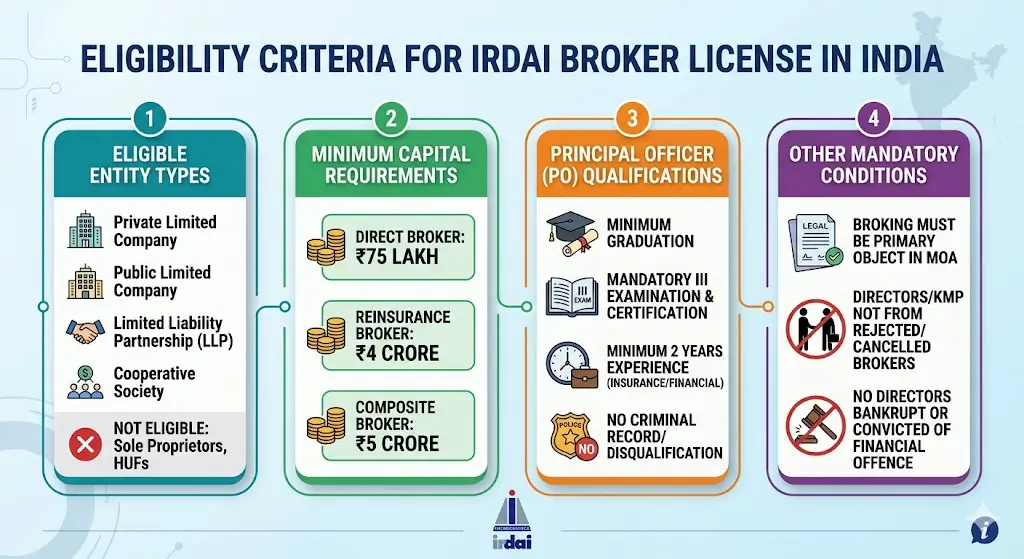
Only the following business structures can apply for an IRDA broker license:
- Private Limited Company (most common)
- Public Limited Company
- Limited Liability Partnership (LLP)
- Cooperative Society
- Any body corporate permitted by IRDAI
Sole proprietors and Hindu Undivided Families (HUFs) are not eligible to apply. If you are currently operating as a sole proprietor, you will need to incorporate a company or LLP first.
Capital Requirements
- Direct Broker: Minimum paid-up capital of ₹75 lakh
- Reinsurance Broker: Minimum paid-up capital of ₹4 crore
- Composite Broker: Minimum paid-up capital of ₹5 crore
Principal Officer Qualification
Every licensed insurance broker must appoint a Principal Officer (PO). The PO is the person accountable to IRDAI for the company's compliance. Qualification requirements:
- Minimum graduation in any discipline
- Mandatory completion of the III (Insurance Institute of India) examination for insurance brokers, or equivalent qualifications recognised by IRDAI
- Minimum 2 years of work experience in insurance or financial services
- No criminal record or disqualification under any financial sector regulation
Other Conditions
- The company must have insurance broking as its primary stated business object in its MOA
- Directors or KMP should not have been associated with a previously rejected or cancelled insurance broker
- No director should have been declared bankrupt or convicted of a financial offence
| Important: If any director or shareholder holds more than 10% stake in another IRDAI-regulated entity, IRDAI may request additional disclosures. Always consult a professional before filing if this applies to you. |
Documents Required for IRDA Broker License Application
Getting your documentation in order upfront is one of the most practical things you can do. Incomplete or incorrect documents are the most common reason for delays in IRDA broker registration in India.
| Document Category | Specific Documents | Status |
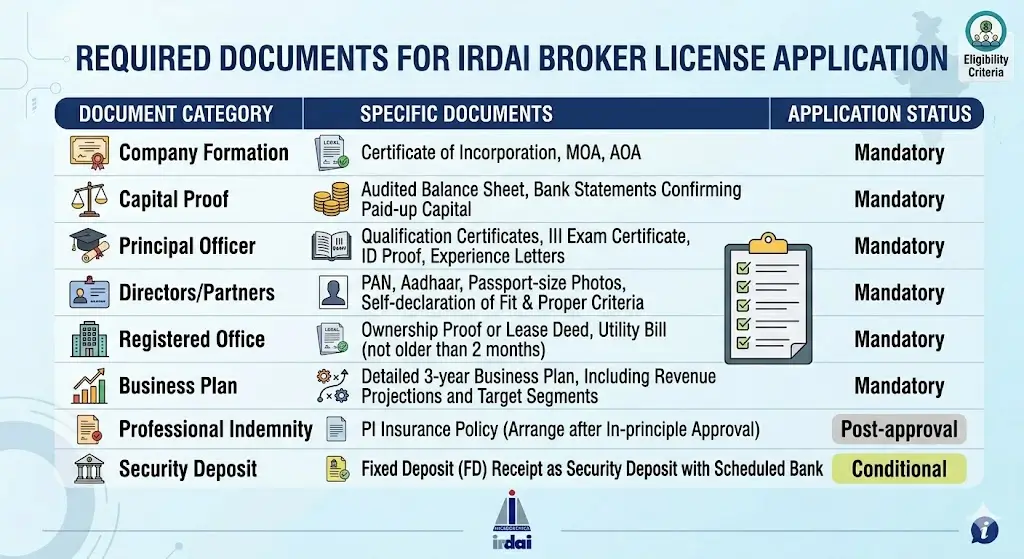
| Company Formation | Certificate of Incorporation, MOA, AOA | Mandatory |
| Capital Proof | Audited balance sheet, bank statements confirming paid-up capital | Mandatory |
| Principal Officer | Qualification certificates, III exam certificate, ID proof, experience letters | Mandatory |
| Directors/Partners | PAN, Aadhaar, passport-size photos, self-declaration of fit & proper criteria | Mandatory |
| Registered Office | Ownership proof or lease deed, utility bill not older than 2 months | Mandatory |
| Business Plan | Detailed 3-year business plan including revenue projections and target segments | Mandatory |
| Professional Indemnity | PI insurance policy (to be arranged after in-principle approval) | Post-approval |
| Security Deposit | Fixed Deposit receipt as security deposit with scheduled bank | Conditional |
Step-by-Step Process to Get an IRDA Broker License in 2026
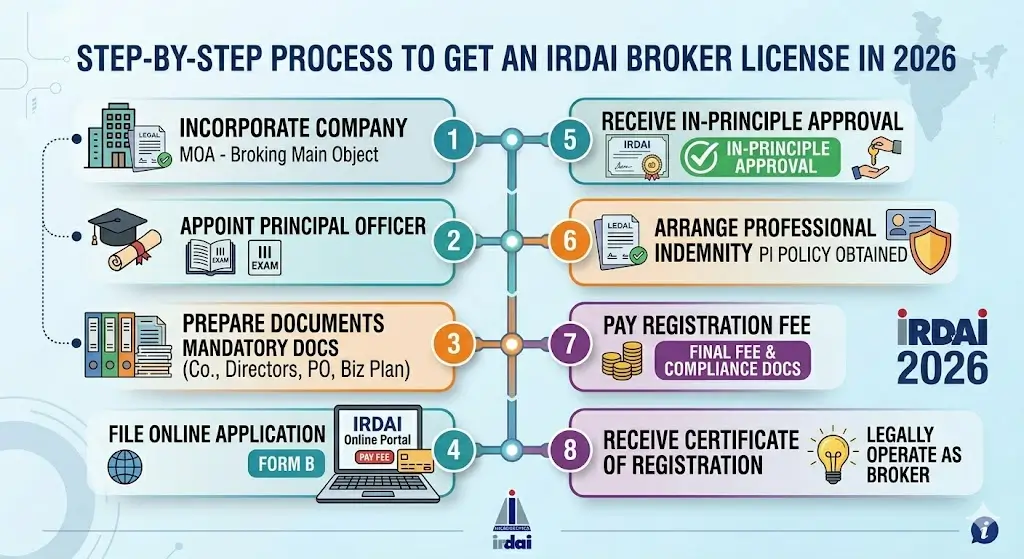
The IRDA broker registration process in 2026 is handled through IRDAI's online portal. Here is how it works, step by step.
| Step | Action Required |
| 1 | Incorporate your company — Register a Pvt Ltd or LLP with insurance broking as the main object in MOA |
| 2 | Appoint a Principal Officer — Ensure the PO holds the III exam certificate and meets all eligibility conditions |
| 3 | Prepare your documents — Compile all mandatory documents for company, directors, PO, and business plan |
| 4 | File online application — Submit Form B on IRDAI's online portal along with the prescribed application fee |
| 5 | Receive in-principle approval — IRDAI reviews and grants in-principle approval if the application meets all conditions |
| 6 | Arrange Professional Indemnity insurance — Obtain a PI policy as required post in-principle approval |
| 7 | Pay registration fee — Pay the balance registration fee and submit final compliance documents |
| 8 | Receive your Certificate of Registration — You can now legally operate as a licensed insurance broker |
IRDA Broker License Fees: Complete Breakdown
One of the most searched questions around this topic is — how much does it actually cost to get an IRDA broker license? Here is a complete, honest fee breakdown.
| Fee Head | Direct Broker | Reinsurance Broker | Composite Broker |
| Application fee (non-refundable) | ₹25,000 | ₹5,00,000 | ₹5,00,000 |
| Registration fee (first year) | ₹25,000 | ₹5,00,000 | ₹5,00,000 |
| Renewal fee (every 3 years) | ₹25,000 | ₹5,00,000 | ₹5,00,000 |
| Minimum Net Worth Required | ₹75 Lakh | ₹4 Crore | ₹5 Crore |
Beyond the IRDAI fees, you also need to budget for incorporation costs, professional indemnity insurance premiums, compliance software, staff salaries, and office setup. A realistic total startup investment for a direct broker business in India ranges between ₹90 lakh to ₹1.25 crore for the first year, when you factor in all operational requirements.
IRDA Broker License Validity and Renewal
An IRDA insurance broker license is valid for 3 years from the date of issue. It must be renewed before expiry to continue operations legally.
How to Renew Your IRDA Broker License
- Apply for renewal at least 30 days before the expiry date
- Submit the renewal application through IRDAI's online portal
- Pay the applicable renewal fee (same as the registration fee)
- Submit updated compliance certificates, audited financials, and PO qualification confirmation
- Ensure professional indemnity insurance is current and valid
| IRDAI can cancel or suspend a broker's license if you fail to renew on time, fall below the minimum net worth, or violate any regulatory conditions. Operating without a valid license carries serious legal penalties under the Insurance Act, 1938. |
Key Compliance Obligations After Getting Your IRDA Broker License
Getting the license is only the beginning. Licensed insurance brokers in India are required to meet a continuing set of regulatory obligations.
- Annual audit and filing: Submit audited financial statements and compliance reports to IRDAI every year
- Professional Indemnity insurance: Maintain a PI policy for the full tenure of the license
- Training requirements: The Principal Officer and all qualified persons must complete mandatory CPD training hours each year
- Code of conduct: Follow IRDAI's prescribed code of conduct for insurance brokers including proper disclosure and avoidance of conflict of interest
- Client account management: Maintain a separate client account for premium collections — client money cannot be mixed with company funds
- Grievance redressal: Put in place a documented internal grievance system accessible to policyholders
- FDI compliance: FDI in insurance intermediaries is permitted up to 100% under the automatic route — confirm latest DPIIT notifications
Common Reasons for IRDA Broker License Application Rejection
IRDAI does reject applications. Knowing the common pitfalls helps you avoid them before you invest time and money.
- MOA does not explicitly state insurance broking as the primary business object
- Principal Officer does not hold a valid III exam certificate
- Paid-up capital is below the minimum required threshold at the time of application
- Business plan is vague, unrealistic, or clearly templated without genuine market analysis
- Directors have undisclosed associations with previously rejected broker entities
- Registered office proof is outdated or in a name different from the company
- Application is filed without proper self-declaration forms from all directors
Insurance Broker vs Insurance Agent: Key Differences
This is a question many people ask when researching the IRDA broker license, and it is worth addressing clearly.
| Aspect | Insurance Broker (IRDA Licensed) | Insurance Agent |
| Represents | The policyholder / client | The insurance company |
| Can work with | Multiple insurers | One insurer only (usually) |
| License authority | IRDAI (for the entity) | IRDAI (through the insurer) |
| Minimum capital | ₹75 Lakh+ | No capital requirement |
| Legal responsibility | Fiduciary duty to the client | Works on insurer's behalf |
| Entity type | Company or LLP required | Individual allowed |
How Long Does It Take to Get an IRDA Broker License?
The timeline depends significantly on how prepared your application is when you submit it.
- Company incorporation: 2 to 3 weeks (if not already done)
- Principal Officer's III exam preparation and clearance: 4 to 8 weeks
- Document compilation: 2 to 4 weeks
- IRDAI processing time after submission: typically 2 to 4 months
- Post in-principle approval compliance: 4 to 6 weeks
In total, plan for a 6 to 9 month timeline from the decision to apply to receiving your Certificate of Registration — assuming your application is complete and correctly filed. Incomplete applications reset this timeline.
Conclusion
Getting an IRDA broker license in India is a serious but completely achievable goal for any well-prepared business. The regulatory requirements exist to protect policyholders, and the framework under the 2018 regulations is clear and structured.
The most important things to get right from the start are: choosing the right broker category for your business model, ensuring your Principal Officer holds the right qualifications before you apply, and presenting a credible, well-researched business plan to IRDAI.
The insurance distribution business in India has genuine long-term potential, and a licensed broker is positioned to capture a meaningful share of it. The license is not just a compliance requirement — it is a business asset.
| Content Accuracy Note: This guide is based on the IRDAI (Insurance Brokers) Regulations, 2018, and publicly available IRDAI circulars current as of April 2026. Regulatory requirements can change — always verify current guidelines directly on the official IRDAI website (irdai.gov.in) or consult a licensed regulatory professional before filing your application. |
| Read More :- EPR Certification in India |
Frequently Asked Questions
Can an individual apply for an IRDA broker license directly?
No. IRDAI only grants insurance broker licenses to incorporated entities — private limited companies, public limited companies, LLPs, or cooperative societies. An individual must first form a company or LLP before applying.
What is the III exam for insurance brokers and is it mandatory?
The III (Insurance Institute of India) exam is the qualifying examination for the Principal Officer of an insurance broker. Yes, it is mandatory. The PO must have passed the relevant module before the application can be approved.
Can a foreign company apply for an IRDA broker license in India?
Foreign entities can invest in Indian insurance brokerage companies, with FDI up to 100% currently permitted under the automatic route in insurance intermediaries. However, the licensed entity must be incorporated in India under Indian law.
What happens if I miss the renewal deadline for my broker license?
Operating with an expired license is a regulatory violation. IRDAI may impose penalties and you will be required to cease operations until the license is renewed. IRDAI does allow late renewal applications in certain cases, but this is not guaranteed and may attract additional scrutiny.
Is an IRDA broker license the same as an IRDAI broker license?
Yes, both terms refer to the same license. IRDA was the original name of the authority, which was renamed to IRDAI (Insurance Regulatory and Development Authority of India). The license issued is a Certificate of Registration under the IRDAI (Insurance Brokers) Regulations, 2018.