
- IRDAI has scrapped the 3-year renewal cycle — insurance broker registration is now perpetual, subject to an annual fee, effective 5 February 2026.
- Minimum capital ranges from ₹75 lakh (Direct Broker) to ₹5 crore (Composite Broker), with matching net worth and bank deposit rules.
- The entire IRDA broker license online registration process runs through IRDAI's official portal using Schedule I – Form B, along with Form C documents and Form D fees.
- Existing 3-year Certificate of Registration holders must move to the new continuous registration by 31 January 2027 (grace period till 31 March 2027).
Introduction
An IRDA (IRDAI) broker license is the Certificate of Registration that allows a company, LLP, or cooperative society to legally operate as an insurance broker in India, representing policyholders across multiple insurers rather than one company. To get it, you incorporate an eligible entity, meet IRDAI's minimum capital (₹75 lakh to ₹5 crore depending on category), appoint a qualified Principal Officer who clears the National Insurance Academy exam, and submit Schedule I – Form B online with the required documents and fees. Since 5 February 2026, IRDAI has replaced the old 3-year renewal system with perpetual registration — once approved, your license stays valid indefinitely, subject to an annual fee and continued compliance.

Planning to enter India's insurance distribution business through the broking route? This guide walks you through the entire IRDA broker license online registration journey — what it is, who is eligible, how much capital and documentation you need, the exact online process, fees, and the single biggest regulatory change of 2026: the shift from a 3-year renewal cycle to perpetual (continuous) registration. Everything below is based on the IRDAI (Insurance Brokers) Regulations, 2018, the Sabka Bima Sabki Raksha (Amendment of Insurance Laws) Act, 2025, and IRDAI's official circulars and amendment regulations issued through 2026.
What is IRDA Broker License?
An IRDA broker license — more accurately called a Certificate of Registration (CoR) issued by the Insurance Regulatory and Development Authority of India (IRDAI) — is the legal authorisation that allows an entity to act as an insurance broker in India. "IRDA" was the authority's original short name before it was renamed IRDAI; both terms are used interchangeably in the market, and the license itself is issued under the IRDAI (Insurance Brokers) Regulations, 2018.
The defining feature of a broker is who it represents. Unlike an insurance agent or corporate agent, who is tied to one or a handful of insurers and effectively sells on the insurer's behalf, a licensed insurance broker represents the client (the policyholder). A broker is legally required to survey the entire market, compare products across insurers, and give the client written, reasoned advice before recommending a policy. This client-first duty is exactly why IRDAI holds brokers to a much higher bar on capital, net worth, qualified personnel, and reporting than it does for agents.
Types of Insurance Broker Licenses in India
IRDAI issues a Certificate of Registration under one of five categories, and an applicant must choose the category at the time of registration:
- Direct Broker (Life) — can solicit and service life insurance business only.
- Direct Broker (General) — can solicit and service general (non-life) insurance business only.
- Direct Broker (Life & General) — combines both life and general insurance broking.
- Reinsurance Broker — arranges reinsurance placements between insurance companies and reinsurers; does not deal with retail policyholders.
- Composite Broker — the widest category, combining direct insurance broking (life and general) with reinsurance broking under a single Certificate of Registration.
Most new entrants start as a Direct Broker and later apply to upgrade to a Composite Broker once the business has scaled and the higher capital and net worth thresholds can be comfortably maintained.
IRDA Broker License vs Insurance Agent vs Corporate Agent
A common point of confusion for first-time applicants is how a broker license differs from an agent or corporate agent registration. The table below sets out the key differences:
| Parameter | Insurance Broker | Individual Agent | Corporate Agent |
|---|---|---|---|
| Represents | The policyholder (client) | A single insurer | Up to 3 insurers per line of business |
| Market access | All insurers in the market | One insurer only | Limited, multi-insurer tie-ups |
| Regulator relationship | Directly licensed by IRDAI | Appointed by insurer, IRDAI-regulated | Directly licensed by IRDAI |
| Minimum capital | ₹75 lakh – ₹5 crore | Not applicable | Varies by entity type |
| Advisory duty | Mandatory written, reasoned recommendation | Not mandatory | Limited recommendation |
| Compensation | Brokerage / fee from insurer or client | Commission from insurer | Commission from insurer |
Benefits of Holding an IRDA Broker License
- Full market access — you can place business with every registered insurer in India instead of a fixed panel, which builds client trust.
- Recurring revenue through brokerage and, where permitted, fee-based consulting, risk management, and claims advocacy services.
- Composite and reinsurance categories open access to corporate risk management, employee benefits, and reinsurance placement business.
- A regulated, IRDAI-recognized brand identity that is far more credible to corporate and institutional clients than an unlicensed advisory setup.
- Under the 2026 perpetual registration regime, no more repetitive 3-year re-registration paperwork — only an annual fee and ongoing compliance, which lowers long-term administrative cost.
Eligibility Criteria for IRDA Broker License Online Registration
IRDAI lays down entity-level and individual-level eligibility conditions under the IRDAI (Insurance Brokers) Regulations, 2018. Every condition below must be satisfied before you file the application; missing even one is the most common reason applications get delayed or returned.
Entity-level eligibility
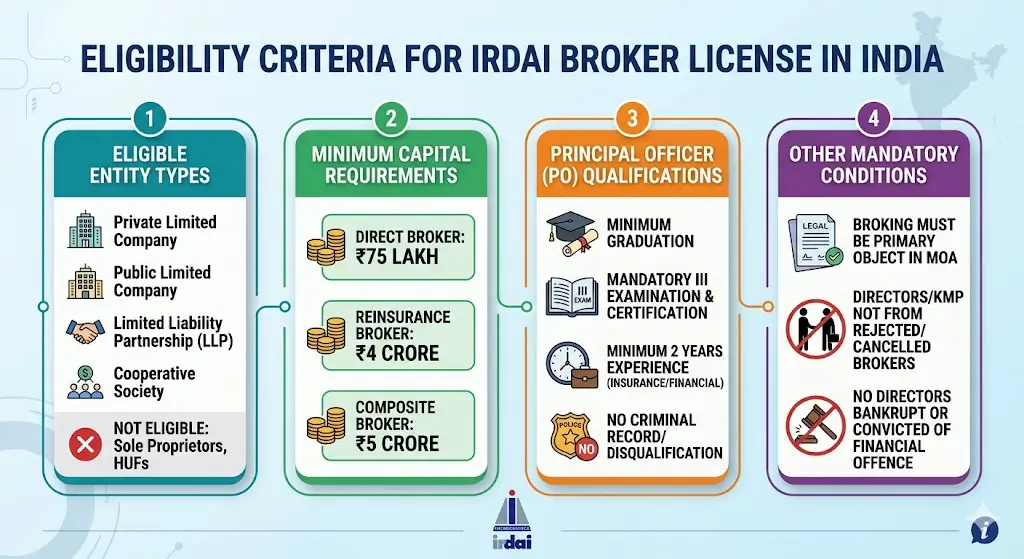
- Must be registered as a company under the Companies Act, 2013 (private or public limited), a Limited Liability Partnership (LLP) under the LLP Act, 2008, or a cooperative society. Sole proprietorships and traditional partnership firms are not eligible.
- Insurance broking must be stated as the principal object in the Memorandum of Association (MoA) or LLP Agreement — the exact wording must match the category applied for (e.g., "to act as a Composite Broker under the IRDA (Insurance Brokers) Regulations, 2018").
- The Articles of Association (AoA) must not permit issuance of any share class other than equity, and must not allow allotment of shares for consideration other than cash.
- For companies limited by shares and cooperative societies, capital must be in the form of equity shares; for LLPs, partner contribution must be entirely in cash.
- The applicant (and its group entities, where applicable) is ordinarily granted only one Certificate of Registration, and any existing insurance-intermediation activity within the group is examined for conflict of interest.
- The entity must not be under winding-up, must not have had a broker license previously cancelled without the grounds being remedied, and must not be under any regulatory investigation.
Individual / Principal Officer eligibility
- The Principal Officer must meet the educational qualification prescribed under Schedule I – Form E of the Regulations.
- The Principal Officer must complete mandatory IRDAI-approved training (25 or 50 hours, depending on category) through the National Insurance Academy (NIA), Pune.
- The Principal Officer must clear the NIA broker examination with a minimum of 50% marks, and must sit for the exam within one year of completing the training.
- All directors, promoters, and key management persons must satisfy IRDAI's "fit and proper" criteria — a clean criminal, financial, and regulatory record.
Capital, Net Worth & Deposit Requirements
Regulation 19 of the IRDAI (Insurance Brokers) Regulations, 2018 prescribes the minimum paid-up capital, the net worth that must be maintained continuously after registration, and the fixed deposit that must be kept with a scheduled bank before commencing business. These figures are category-specific:
| Broker Category | Minimum Paid-up Capital | Minimum Net Worth (post-registration) | Minimum Bank Deposit |
|---|---|---|---|
| Direct Broker | ₹75 lakh | ₹50 lakh | ₹10 lakh |
| Reinsurance Broker | ₹4 crore | ₹2 crore (50% of capital) | ₹40 lakh (10% of capital) |
| Composite Broker | ₹5 crore | ₹2.5 crore (50% of capital) | ₹50 lakh (10% of capital) |
Net worth is calculated as defined under the Companies Act, 2013, and every registered broker must submit a net worth certificate certified by a chartered accountant / auditor every half-year. If net worth falls below the prescribed floor at any point, the broker must restore it immediately and report the restoration to IRDAI — this is an ongoing obligation, not a one-time check at registration.
Documents Required for IRDA Broker License Online Registration
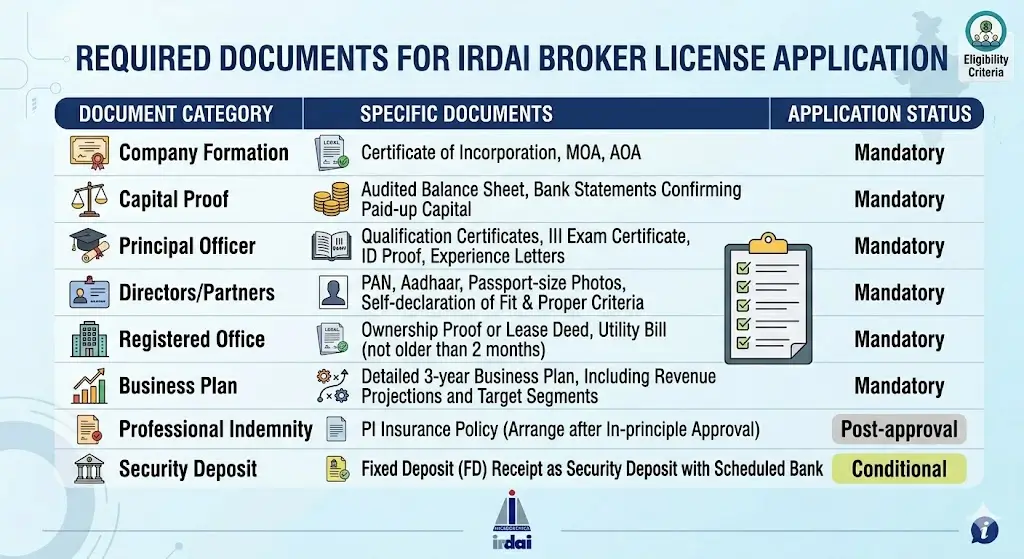
Keep the following ready before you start the online application — incomplete documentation is the single biggest cause of delay in IRDA broker registration:
Entity & incorporation documents
- Certificate of Incorporation and Memorandum & Articles of Association (or LLP Agreement)
- PAN and GST registration of the entity
- Board resolution authorizing the application and the Principal Officer
- Shareholding pattern, including details of foreign investors, if any
Financial documents
- Bank certificate / statement confirming minimum paid-up capital deposited
- Audited financial statements / balance sheet (for existing entities)
- Proof of the fixed deposit maintained with a scheduled bank
- Proof of payment of the non-refundable application fee
Principal Officer & personnel documents
- Principal Officer's educational qualification certificates matching Form E criteria
- NIA training completion certificate and broker exam passing certificate
- Details of Key Management Persons (CEO, CFO, Compliance Officer, and, for larger brokers, CTO/Head-IT and Head-Reinsurance)
Business & infrastructure documents
- A detailed business plan covering products, target segments, and 3-year financial projections
- Infrastructure details — office space, IT systems, data security policy, and staffing plan
- Draft agreements / terms of business with insurers (mandatory for reinsurance and composite categories)
- Professional indemnity insurance proposal or policy
Step-by-Step IRDA Broker License Online Registration Process
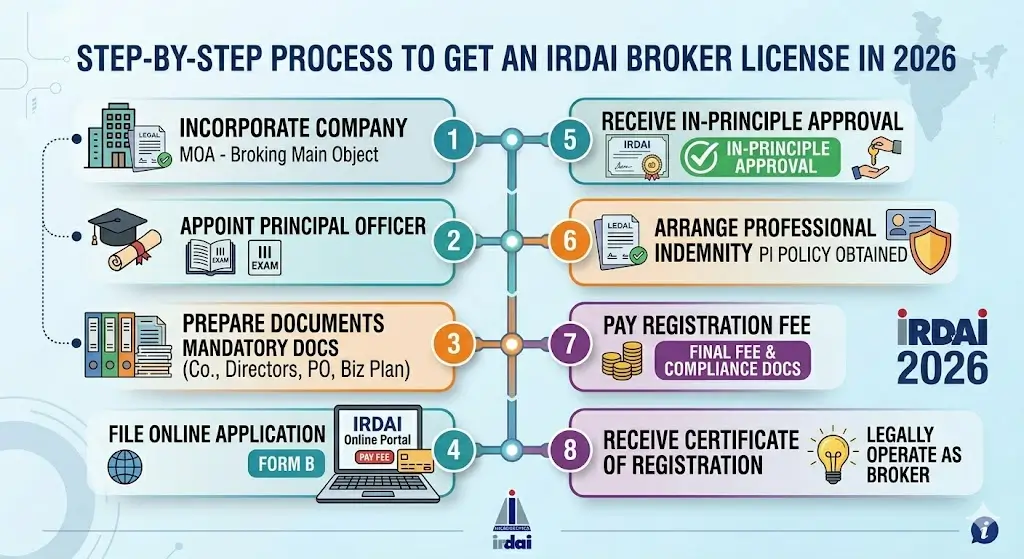
The complete IRDA broker registration process in 2026 is conducted online through IRDAI's broker application portal. Here is how it works, start to finish:
- Incorporate the entity: Register a company, LLP, or cooperative society with insurance broking as the stated principal object, and infuse the required minimum capital.
- Register on the IRDAI portal: Create a login on IRDAI's online broker registration system; a username and password are generated and sent to the registered email ID.
- File Schedule I – Form B: Submit the formal application in Form B, selecting the broker category (Direct Life/General/Life & General, Reinsurance, or Composite), along with the documents listed in Form C and the application fee under Form D.
- IRDAI scrutiny: IRDAI examines the application. If information is missing or unclear, it raises queries, typically giving the applicant around 30 days to respond with clarifications or additional documents.
- In-principle approval: Once satisfied that all conditions are met, IRDAI grants in-principle approval for registration.
- Complete post-approval requirements: The applicant finalises infrastructure, appoints/confirms the Principal Officer, arranges professional indemnity insurance, deposits the bank fixed deposit, and pays the registration fee.
- Certificate of Registration issued: On confirming full compliance, IRDAI issues the Certificate of Registration, and the entity can legally commence insurance broking business.
End-to-end, applicants should realistically budget for a timeline of roughly 3 to 6 months for a complete, error-free application; more complex composite or reinsurance broker applications, or files that draw multiple IRDAI queries, can extend closer to 9–12 months.
IRDA Broker License Fees (2026)
Fees fall into three buckets: a non-refundable application fee paid with Form B, a registration fee paid once in-principle approval is granted, and — since February 2026 — a recurring annual fee that has replaced the old 3-year renewal fee. Historical renewal-fee figures under the pre-2026 regime (for reference and for brokers still transitioning) were roughly:
| Broker Category | Application Fee (indicative) | Pre-2026 Renewal Fee (3-year cycle) |
|---|---|---|
| Direct Broker | ₹25,000 (non-refundable) | ≈ ₹35,000 – ₹1,00,000 |
| Reinsurance Broker | ₹25,000 (non-refundable) | ≈ ₹3,00,000 |
| Composite Broker | ₹25,000 (non-refundable) | ≈ ₹1,75,000 – ₹5,00,000 |
These renewal figures are now superseded — see the perpetual registration update below for the annual fee structure that applies from 2026 onward. Applicants should always confirm the current fee schedule on IRDAI's official portal at the time of filing, since fee circulars are updated periodically.
Major 2026 Update: IRDAI Broker License Is Now Perpetual (No More 3-Year Renewal)
This is the most significant regulatory change to insurance broker registration in India in over a decade, and every applicant and existing broker needs to understand it.
What changed
The Sabka Bima Sabki Raksha (Amendment of Insurance Laws) Act, 2025 received Presidential assent on 20 December 2025 and came into force on 5 February 2026. It amended Section 42D of the Insurance Act, 1938, and replaced the old system — under which every Certificate of Registration was valid for exactly three years and had to be renewed on expiry — with a perpetual (continuous) registration model.
In simple terms: once your IRDA broker license is granted or renewed on or after 5 February 2026, it does not carry an expiry date. It remains valid indefinitely, as long as you pay the prescribed annual fee and stay compliant with IRDAI's conduct, disclosure, and reporting norms. Non-payment of the annual fee, or a breach of compliance obligations, can still lead to suspension or cancellation — perpetual does not mean unconditional.
How IRDAI rolled it out
- 16 March 2026 — IRDAI issued its first circular on transitional arrangements, prescribing an interim annual fee for brokers and other intermediaries receiving fresh registration or renewal between 5 February and 30 June 2026.
- 7 April 2026 — A follow-up circular extended and clarified the transitional arrangement's applicability to Insurance Surveyors and Loss Assessors.
- 2 July 2026 — IRDAI extended the transitional interim-fee arrangement further, from 30 June 2026 to 31 August 2026 (or until the final amended regulations were notified, whichever came first).
- 30 July 2026 — IRDAI formally notified the Insurance Regulatory and Development Authority of India (Insurance Intermediaries) (Amendment) Regulations, 2026, amending the Insurance Brokers Regulations, 2018 (along with the Corporate Agents, Insurance Marketing Firms, Web Aggregators, and Common Public Service Centres regulations) to fully embed the continuous registration model.
The new annual fee formula
Under the July 2026 amendment regulations, registered brokers and other intermediaries now pay an annual supervisory fee equal to the higher of ₹10,000 or 0.04% of their aggregate commission and other receipts from insurers in the preceding financial year. This makes the fee revenue-linked — small and mid-sized brokers pay closer to the ₹10,000 floor, while larger brokers pay proportionally more as their business grows.
Transition timeline for existing brokers
If you already hold a Certificate of Registration issued under the old 3-year system, you are not automatically moved onto the perpetual model. Existing brokers and corporate agents holding 3-year registration certificates must obtain a fresh, continuous registration certificate by 31 January 2027, with a grace period extending to 31 March 2027 on payment of an additional fee for late transition.
Other related 2026 changes worth knowing
- The threshold for prior IRDAI approval on transfer of shares in an intermediary entity has been raised from 1% to 5% of paid-up equity capital, easing minor ownership changes.
- Enhanced disclosure norms now require individual-level traceability of who solicited and serviced each policy across distribution channels.
- Larger and foreign-owned intermediaries face additional annual disclosure requirements covering commission structures, related-party transactions, profits, and dividends.
- The regulatory emphasis has shifted from periodic, calendar-driven renewal approvals to continuous, data-driven supervision — meaning ongoing filings and conduct now matter more than a fixed renewal date.
Because this framework was still being operationalised through 2026, brokers should treat IRDAI's official portal and its latest circulars as the final word on exact fee amounts and transition deadlines applicable to their specific registration date.
Ongoing Compliance Obligations After Registration
Getting the Certificate of Registration is the beginning, not the end, of IRDAI's oversight. Registered brokers must continuously meet the following obligations:
- Maintain the prescribed net worth at all times and submit a half-yearly net worth certificate certified by an auditor.
- Keep professional indemnity insurance in force, covering the broker's liability to clients.
- Maintain segregated client money / premium accounts, separate from the broker's own operating funds.
- File quarterly and annual returns with IRDAI covering business volumes, complaints, and financial position.
- Display the registered name, registered and corporate office address, IRDAI registration number, category of registration, and validity status in all client-facing correspondence.
- Obtain prior IRDAI approval before any change in shareholding beyond the prescribed threshold, or before any merger, amalgamation, or transfer of business.
- Pay the annual supervisory fee on time to keep the perpetual registration active and in good standing.
Common Mistakes That Delay IRDA Broker License Registration
- Filing Form B before the Principal Officer has actually cleared the NIA exam — training and exam completion should be finished well before submission.
- Vague or mismatched wording of the "main object" clause in the MoA/LLP Agreement that doesn't match the exact category being applied for.
- Underestimating net worth requirements — capital deposited on day one can fall short of the ongoing net worth threshold once initial setup costs are deducted.
- Incomplete infrastructure and IT security documentation, which are increasingly scrutinised given IRDAI's data-protection and traceability expectations.
- Missing the post-2026 transition deadline for existing 3-year Certificate of Registration holders, risking a lapse in continuous registration.
Why Choose Silvereye Certifications for Your IRDA Broker License Registration
IRDA broker license online registration touches company law, insurance regulation, and financial compliance all at once — and the 2026 shift to perpetual registration has added a fresh layer of transition rules that many applicants are still unfamiliar with. Silvereye Certifications works with entrepreneurs, NBFCs, insurtech founders, and established distribution businesses to take this process from paperwork to an active Certificate of Registration, without the back-and-forth that usually causes delays.
- End-to-end handling of entity structuring, MoA/AoA drafting, and capital and net-worth planning aligned to your chosen broker category.
- Guided support for Principal Officer qualification, National Insurance Academy training enrolment, and exam preparation.
- Accurate, IRDAI-compliant preparation of Schedule I – Form B, Form C documentation, and Form D fee filing to minimise query cycles.
- Up-to-date guidance on the 2026 perpetual registration transition, annual fee computation, and the 31 January 2027 migration deadline for existing brokers.
- Ongoing compliance support after registration — net worth certification, quarterly/annual filings, and renewal-to-pe
Frequently Asked Questions
What is an IRDA broker license?
An IRDA broker license is the Certificate of Registration issued by IRDAI under the IRDAI (Insurance Brokers) Regulations, 2018, allowing a company, LLP, or cooperative society to legally operate as an insurance broker representing policyholders across multiple insurers.
Is IRDA the same as IRDAI?
Yes. IRDA was the original short name of the regulator; it was later renamed the Insurance Regulatory and Development Authority of India (IRDAI). Both names refer to the same authority and the same license.
What are the different types of IRDA broker licenses?
Five categories exist: Direct Broker (Life), Direct Broker (General), Direct Broker (Life & General), Reinsurance Broker, and Composite Broker, which combines direct and reinsurance broking under one license.
What is the minimum capital required for an IRDA broker license?
₹75 lakh for a Direct Broker, ₹4 crore for a Reinsurance Broker, and ₹5 crore for a Composite Broker, along with matching net worth and bank deposit requirements.
Who is eligible to apply for an IRDA broker license?
A company registered under the Companies Act, 2013, an LLP under the LLP Act, 2008, or a cooperative society, with insurance broking as its principal business object. Sole proprietorships and general partnership firms are not eligible.
How do I apply for IRDA broker license online registration?
You incorporate an eligible entity, register on IRDAI's online broker portal, file Schedule I – Form B with the required Form C documents and Form D fee, respond to any IRDAI queries, receive in-principle approval, complete post-approval requirements, and finally receive the Certificate of Registration.
How long does IRDA broker license registration take?
A complete, well-documented application typically takes about 3 to 6 months. More complex composite or reinsurance broker applications, or files with multiple IRDAI queries, can take closer to 9–12 months.
What qualifications does the Principal Officer need?
The Principal Officer must meet the educational criteria under Schedule I – Form E, complete mandatory training through the National Insurance Academy, Pune, and pass the NIA broker examination with at least 50% marks.
Has the IRDA broker license renewal process changed in 2026?
Yes — this is the biggest recent change. Effective 5 February 2026, IRDAI abolished the 3-year renewal cycle in favour of perpetual (continuous) registration, subject to an annual fee. Existing 3-year Certificate holders must transition to the new continuous registration by 31 January 2027, with a grace period to 31 March 2027.
What is the annual fee under the new perpetual registration system?
Under IRDAI's Insurance Intermediaries (Amendment) Regulations, 2026, the annual fee is the higher of ₹10,000 or 0.04% of the broker's aggregate commission and other receipts from insurers in the preceding financial year.
Can an LLP apply for an IRDA broker license?
Yes. LLPs registered under the LLP Act, 2008 are an eligible entity type, provided partner contribution is made entirely in cash and insurance broking is stated as the principal object in the LLP Agreement.
What happens if a broker doesn't pay the annual fee on time?
Non-payment of the annual fee, or non-compliance with IRDAI's conduct and reporting requirements, can lead to suspension or cancellation of the Certificate of Registration, even under the perpetual registration model.