

- COS-1 is an application form — you file it with CDSCO to request import registration.
- COS-2 is the actual certificate — CDSCO issues it after approving your COS-1 application.
- Without COS-2, import is illegal — no drugs, cosmetics, or medical devices can legally enter India.
- Most brands confuse the two — one is the entry ticket request, the other is the entry ticket itself.
Introduction
If you're in the business of importing drugs, cosmetics, or medical devices into India, you have probably come across the terms COS-1 and COS-2. And honestly, the confusion is understandable — both sound like certificates, both are part of the CDSCO registration process, and both are absolutely non-negotiable if you want to operate legally. But here is the thing: they are not the same, and mixing them up can delay your import approval by months, or worse, get your shipment rejected at the port.
In this complete guide, we will break down exactly what COS-1 and COS-2 are, how they differ, what documents you need, how the application process works in 2026, what the fees look like, how long it takes, and what happens at renewal time. Whether you are a first-time importer or a regulatory professional, this guide gives you everything you need to know in one place.
COS-1 vs COS-2 — Difference Between
COS-1 (Certificate of Registration – Form 1) is the official application form that an importer or their authorized agent files with CDSCO (Central Drugs Standard Control Organization) to seek permission to import a regulated product — drugs, cosmetics, or medical devices — into India. Think of it as your formal request to the regulator.
COS-2 (Certificate of Registration – Form 2), on the other hand, is the registration certificate that CDSCO actually issues after reviewing and approving your COS-1 application. COS-2 is the legal document that grants you import permission. You cannot import a single unit of a regulated product into India without a valid COS-2. Many brands make the mistake of thinking COS-1 itself gives them permission — it does not. COS-1 starts the process; COS-2 completes it
What is the COS-1 vs COS-2?
COS-1 — Certificate of Registration (Form 1)
- Type: Application Form
- Filed By: Importer / Authorised Agent
- Purpose: To initiate the drug/cosmetic import registration process with CDSCO.
In plain language: COS-1 is your application. It says, 'We want to import this product, here are all the details and documents — please review and approve us.'
COS-2 — Certificate of Registration (Form 2)
- Type: Registration Certificate
- Issued By: CDSCO (Central Drugs Standard Control Organization)
- Purpose: To grant legal permission to the importer to bring the registered product into India.
In plain language: COS-2 is the government's response. It says, 'We have reviewed your COS-1 application, everything checks out — here is your official certificate to import.'
Comparison Between: COS-1 vs COS-2
The table below gives you a side-by-side view of every major parameter so you can see the difference at a glance.
| Parameter | COS-1 (Application Form) | COS-2 (Registration Certificate) |
| Full Name | Certificate of Registration – Form COS-1 | Certificate of Registration – Form COS-2 |
| What It Is | Application form submitted to CDSCO | Final registration certificate issued by CDSCO |
| Stage in Process | Step 1 — Initiation | Step 2 — Approval/Outcome |
| Who Submits | Applicant (importer/manufacturer's agent) | Issued by CDSCO to the applicant |
| Purpose | To apply for import permission for drugs/cosmetics | To legally import drugs/cosmetics into India |
| Legal Authority | Drugs and Cosmetics Act, 1940 | Drugs and Cosmetics Act, 1940 |
| Validity | N/A (it's a form, not a certificate) | 3 years (renewable before expiry) |
| Transferable? | No | No — non-transferable by law |
| Issued By | Filed by applicant | CDSCO, Ministry of Health & Family Welfare |
| Can You Import Without It? | No — required to start the process | No — mandatory before any import begins |
Why Do So Many Importers Confuse COS-1 and COS-2?
This is actually one of the most common regulatory mistakes in the pharmaceutical and cosmetics import industry in India. Here is why it happens so often:
- Both forms carry the name 'Certificate of Registration', which makes them sound like official certifications rather than one being an application and the other being the actual grant.
- Consultants and agents sometimes use the terms interchangeably in conversation, leading to incorrect assumptions.
- New entrants in the market often see COS-1 acknowledgement receipts and assume that equals approval — it does not.
- The physical format of COS-1 forms can sometimes resemble certificates, adding to the confusion.
Who Needs COS-1 and COS-2 — Eligibility
Not every product category requires the same forms. Here is a clear breakdown of who needs what:
Products That Require COS-1/COS-2 Registration
- New Drugs: Any drug not previously approved in India requires COS-1 application before import.
- Imported Cosmetics: Foreign cosmetics must be registered under the Cosmetics Rules 2020 via the COS application process.
- Medical Devices: Class A, B, C, and D medical devices being imported need registration through CDSCO.
- Nutraceuticals and Herbal Products: Depending on claims made, these may fall under drug regulations and require COS registration.
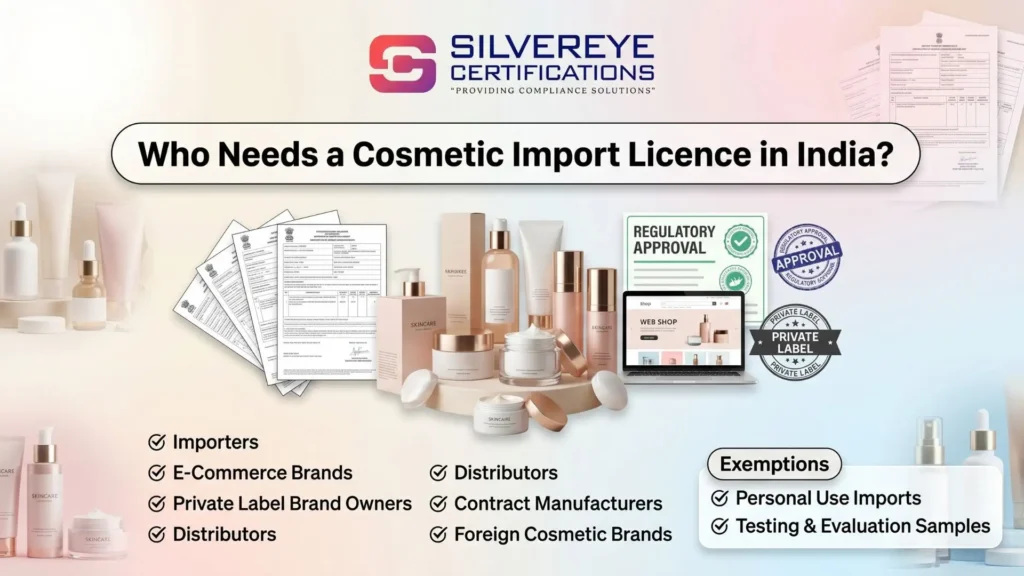
Who Can File COS-1?
The Indian importer of the product
- The authorized agent or representative of the foreign manufacturer
- A wholly owned Indian subsidiary of the foreign manufacturer
- A contract research organization or regulatory consultant acting on behalf of the importer (with proper authorization documents)
Documents Required for COS-1 Application
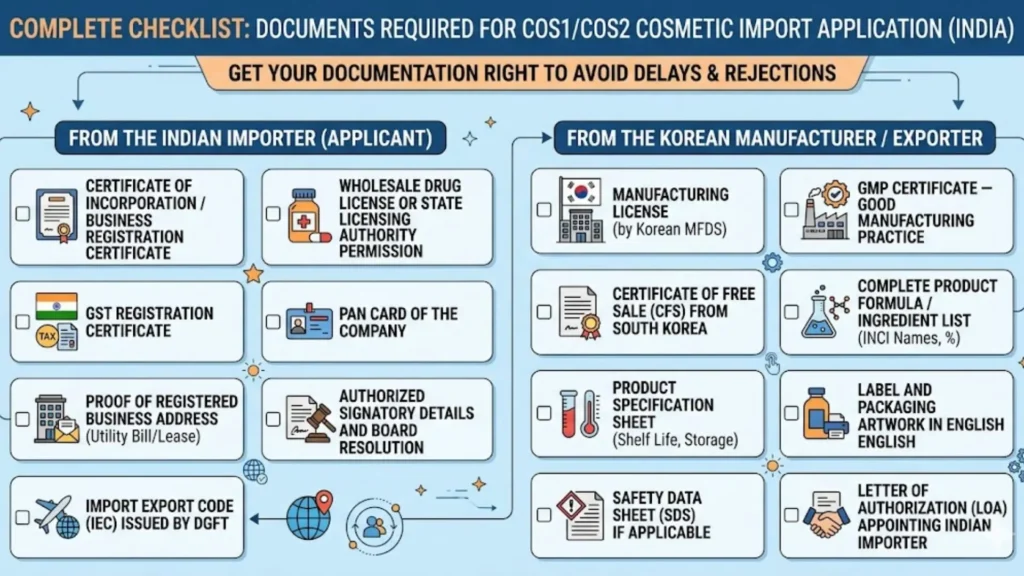
Filing a complete and accurate COS-1 application is critical. Incomplete submissions are the number-one reason CDSCO raises queries, causing delays in COS-2 issuance. Here is the full document checklist you need:
| S.No | Document Required | Status |
| 1 | Completed COS-1 Application Form | Mandatory |
| 2 | Certificate of Pharmaceutical Product (CoPP) | Mandatory |
| 3 | Free Sale Certificate from Country of Origin | Mandatory |
| 4 | Good Manufacturing Practice (GMP) Certificate | Mandatory |
| 5 | Product Dossier / Technical Data | Mandatory |
| 6 | Label and Labelling Details | Mandatory |
| 7 | Authorization Letter from Foreign Manufacturer | Mandatory |
| 8 | Import License (Form 10) – if applicable | Conditional |
| 9 | Site Master File / DMF (if applicable) | Conditional |
| 10 | Undertaking / Declaration by Applicant | Mandatory |
| Pro Tip: All foreign documents must be apostilled or notarized and translated into English if in another language. CDSCO is strict about document authenticity. A single missing or incorrect document can delay your COS-2 by several months. |
Step-by-Step Process: From COS-1 Application to COS-2 Issuance
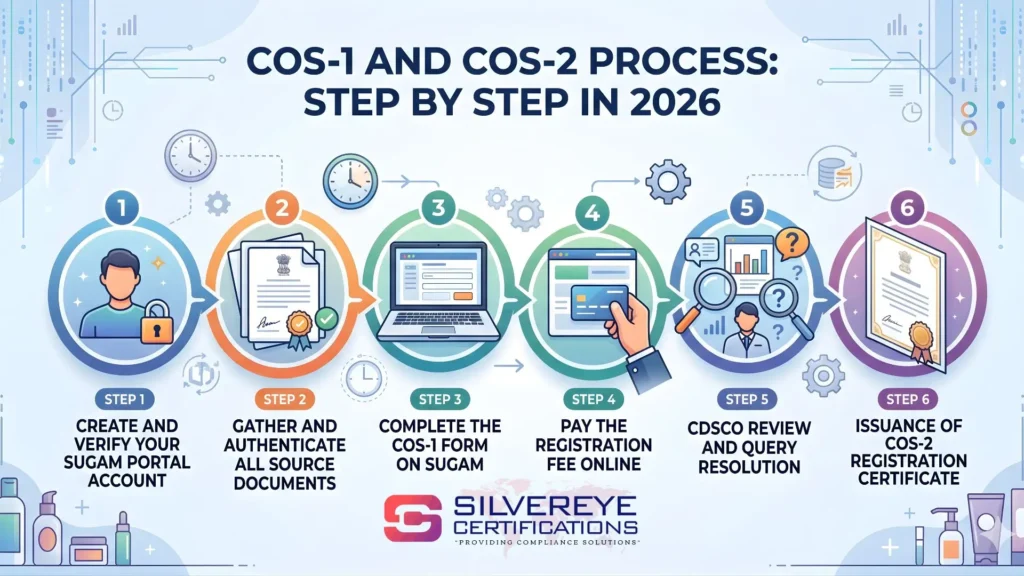
Here is exactly how the process works in 2026, from the moment you decide to import a product to the day you hold your COS-2 certificate:
Step 1 — Prepare Your Product Dossier
Before you even open the SUGAM portal, you need to compile your full product dossier. This includes technical data, manufacturing details, clinical/safety data (for drugs), and all mandatory documents listed above. Getting this right upfront saves months of back-and-forth queries from CDSCO.
Step 2 — Register on SUGAM Portal
Visit https://sugam.gov.in — CDSCO's official online regulatory portal. Create or log in to your account as an importer or authorised agent. All COS-1 applications in 2026 are submitted digitally through SUGAM. Physical submissions are no longer the primary mode.
Step 3 — Fill and Submit COS-1
Complete the COS-1 application form on SUGAM with accurate product details, manufacturer information, and importer details. Upload all required documents in the specified formats. Pay the applicable registration fee online. Submit the application and note your application reference number.
Step 4 — CDSCO Technical Screening
CDSCO's technical team reviews your COS-1 application for completeness. If documents are missing or data is insufficient, they raise queries (also known as Deficiency Letters) through the SUGAM portal. You are expected to respond to these queries within the stipulated time — typically 30 to 90 days depending on the query type.
Step 5 — Expert Committee Review (For Drugs)
For new drug products, the application goes before the relevant Expert Committee or Technical Committee constituted by CDSCO. They evaluate safety, efficacy, and clinical data. For cosmetics, the review is more straightforward and focuses on ingredient compliance and labelling.
Step 6 — Approval and COS-2 Issuance
Once CDSCO is satisfied with your application and all queries are resolved, they issue COS-2 — the Certificate of Registration. This certificate carries a unique registration number, the product details, validity period (3 years), and the conditions of import. You can now legally import the product into India.
CDSCO Registration Fees: COS-1 and COS-2
Registration fees for CDSCO vary by product category. The table below shows approximate fee ranges for 2026. Always check the current Schedule of Fees on the official CDSCO website or SUGAM portal, as these are subject to revision.
| Category | COS-1 Filing Fee (approx.) | COS-2 Certificate Fee |
| New Drug (Schedule H/H1) | ₹50,000 per product | Included in application fee |
| Cosmetics (Form COS) | ₹1,500 – ₹5,000 per product | Included in application fee |
| Medical Device | Varies by class (A/B/C/D) | Included in application fee |
| Renewal of COS-2 | As prescribed by CDSCO | Payable before expiry |
Note: Fees must be paid online via SUGAM using the designated payment gateway. Keep the payment receipt as it forms part of your submission record.
COS-2 Validity and Renewal — What You Need to Know
Validity Period
A COS-2 certificate is valid for 3 years from the date of issuance. This applies to all product categories — drugs, cosmetics, and medical devices — unless otherwise specified on the certificate itself.
Renewal Timeline
- Initiate Renewal: Begin the renewal process at least 6 months before the COS-2 expiry date. Do not wait until the last month — CDSCO processing times mean late applications risk a gap in your import permission.
- File Renewal Application: Submit a renewal application on SUGAM with updated documents. If any details (manufacturer, formulation, labelling) have changed, update them during renewal.
- Continue Importing During Renewal: If your renewal application is filed before the COS-2 expiry date, CDSCO generally allows import to continue while the renewal is under review — but this must be confirmed with your regulatory consultant based on current CDSCO guidelines.
- Renewal Fee: A renewal fee is payable as per CDSCO's schedule at the time of renewal.
Benefits of Getting the COS-1 to COS-2
- Legal Protection: A valid COS-2 ensures your import operations are fully compliant with the Drugs and Cosmetics Act, 1940, protecting you from penalties, seizures, and legal action.
- Market Access: Only products with valid COS-2 registration can be sold and distributed in India. Without it, you cannot approach distributors, retailers, or hospitals.
- Brand Credibility: Regulatory compliance builds trust with Indian partners, distributors, and healthcare professionals who require proof of proper registration before associating with a foreign brand.
- Customs Clearance: Port authorities and customs officers check for COS-2 validity during clearance. A valid certificate ensures smooth, delay-free customs processing.
- Export Opportunity: A product registered in India with COS-2 can also be used as proof of market approval when seeking registration in other countries that use India as a reference market.
Common Mistakes to Avoid in the COS-1 to COS-2 Process
- Starting import before COS-2 is issued: The most serious mistake. Always wait for the physical or digital COS-2 certificate before importing a single unit.
- Submitting incomplete dossiers: Incomplete applications are the biggest cause of delays. Follow the CDSCO checklist precisely.
- Using outdated GMP certificates: GMP certificates older than one to two years may not be accepted. Always use current, valid certificates from the manufacturer.
- Ignoring query deadlines: CDSCO sets deadlines for responding to queries. Missing these deadlines can result in application abandonment.
- Not tracking COS-2 expiry: Many companies lose import permission simply because they forgot to renew. Set calendar reminders six months before expiry.
Conclusion: COS-1 vs COS-2
| COS-1 = Your application to CDSCO requesting import registration. COS-2 = The certificate CDSCO gives you after approving that application. You need both — in that order — to legally import drugs, cosmetics, or medical devices into India. There are no shortcuts, and the process cannot be reversed or skipped. |
The COS-1 to COS-2 journey in India requires precision, patience, and a deep understanding of CDSCO's regulatory framework. In 2026, with CDSCO increasingly digitizing its processes through SUGAM and tightening compliance checks, it is more important than ever to get every step right — from filing a complete COS-1 to securing your COS-2 and keeping it renewed.
If you are entering the Indian market for the first time or are an established importer looking to stay compliant, the guidance in this article gives you a reliable, up-to-date roadmap for 2026 and beyond. When in doubt, always consult a CDSCO-registered regulatory consultant who specialises in drug and cosmetic import registrations.
Frequently Asked Questions
What is COS-1 in India?
COS-1 is the official application form (Certificate of Registration – Form 1) filed with CDSCO to seek import permission for drugs, cosmetics, or medical devices. It is the starting point of the registration process, not the final approval.
What is COS-2 certificate?
COS-2 (Certificate of Registration – Form 2) is the final registration certificate issued by CDSCO after reviewing the COS-1 application. Holding a valid COS-2 is legally mandatory before importing any regulated product into India.
Can I import drugs without COS-2?
No. Importing drugs, cosmetics, or medical devices without a valid COS-2 certificate is a violation of the Drugs and Cosmetics Act, 1940 and can result in seizure, penalties, or cancellation of import license.
How long does it take to get COS-2 after filing COS-1?
Typically, CDSCO takes 6 to 12 months to process and issue COS-2 after receiving a complete COS-1 application. Timelines can vary based on product category, completeness of dossier, and CDSCO workload.
What is the validity of COS-2?
COS-2 is valid for 5 years from the date of issue. It must be renewed before expiry to continue importing the registered product legally.
Who can apply for COS-1?
The Indian importer, authorised agent of the foreign manufacturer, or the manufacturer's Indian subsidiary can file COS-1 with CDSCO. An authorization letter from the original manufacturer is mandatory.
Is COS-1 the same as Form 40?
No. Form 40 is the application for import of drugs under the Drugs and Cosmetics Rules. COS-1 specifically refers to the Certificate of Registration application form used for new drug registrations under CDSCO's New Drugs & Clinical Trials Rules, 2019.
What documents are required for COS-1 application?
Key documents include CoPP, Free Sale Certificate, GMP certificate, product dossier, labelling details, authorization letter from foreign manufacturer, and the completed COS-1 form. A full checklist is provided above in this article.
Can COS-2 be transferred to another company?
No. COS-2 is non-transferable. If there is a change in manufacturer or importer, a fresh COS-1 application must be filed and a new COS-2 must be obtained.
Where can I apply for COS-1 online?
COS-1 applications are filed through the SUGAM portal (https://sugam.gov.in), which is CDSCO's official online platform for drug import and registration submissions.