
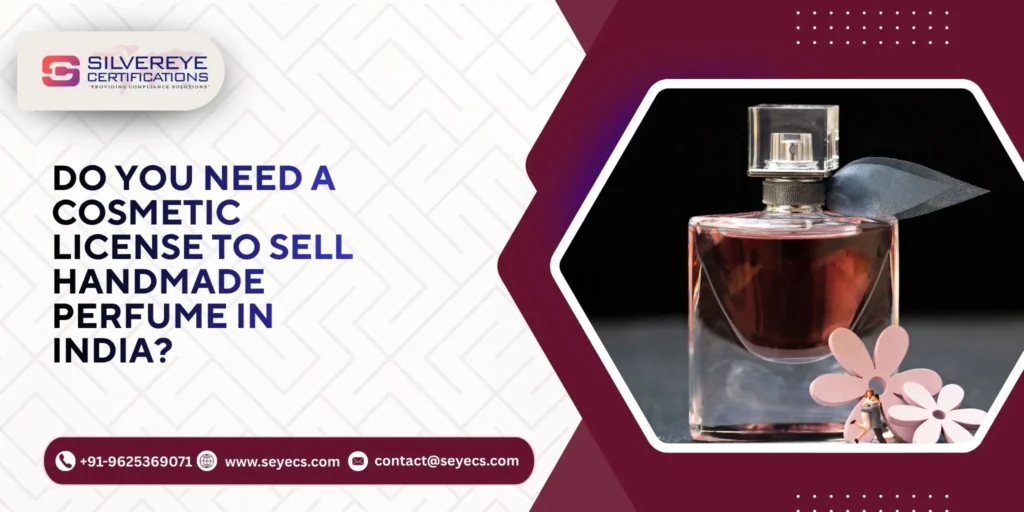
- Selling perfume for profit in India — even a small home-blended attar or eau de parfum — puts you under the Drugs and Cosmetics Act, 1940, the same law that governs skincare and makeup. There's no small-batch or "handmade" exemption.
- GMP compliance (per the Seventh Schedule / Schedule M-II standards) is the realistic starting point for a home-based perfumer who doesn't yet have a dedicated manufacturing unit.
- A Cosmetic Manufacturing License (Form COS-8) becomes mandatory once you set up a commercial blending unit or start selling under your own brand at real scale.
- Most perfumes are alcohol-based, which means a State Excise permit for handling rectified or denatured spirit is usually required on top of your cosmetic license — a step soap and skincare makers don't face.
- The licence is perpetual once granted, but a retention fee is due every 5 years to keep it active.
Introduction
If you blend perfumes at home — attars, eau de parfums, colognes, or alcohol-free oil-based fragrances — and haven't set up a dedicated manufacturing unit yet, you don't need a full Cosmetic Manufacturing License from day one. What you need first is a GMP-compliant home setup: a clean, ventilated, well-documented blending space that follows the Seventh Schedule hygiene and process standards, along with basic registrations like Udyam (MSME) and GST.
A GMP license signals that your blending process, raw material handling, and storage are safe and consistent. A Cosmetic Manufacturing License (Form COS-8) under the Drugs and Cosmetics Act, 1940 becomes mandatory once you scale into a dedicated commercial premises, sell at volume, or supply to retailers and e-commerce marketplaces.
Perfume has one added layer most other cosmetics don't: if your formula contains ethanol or any spirit-based carrier, you're also stepping into State Excise compliance.
Do You Need a Cosmetic License to Make and Sell Perfume from Home in India?
Most people who start blending perfume at home assume the rules that apply to big cosmetic factories don't apply to them. It's an understandable assumption — you're working out of a spare room, not a plant with production lines. But Indian law doesn't draw that line. The moment a fragrance is made to be sold, gifted for commercial return, or listed on a marketplace, it's treated the same way as a bottle of moisturizer from a national skincare brand.
The good news is that the compliance path is manageable, and it scales with your business. You don't need a full manufacturing license to start blending and selling on a small scale — you need a workspace and process that meets Good Manufacturing Practice (GMP) standards. The license requirement kicks in once you set up a dedicated commercial unit or start operating at volume. Perfume has one extra wrinkle that soap and skincare don't: if your formula is alcohol-based, you're also dealing with the State Excise Department.
Are Handmade Perfumes Regulated Like Factory-Made Cosmetics in India?
Yes, and the definition in law is broader than most people expect. Section 3(aaa) of the Drugs and Cosmetics Act, 1940 defines a cosmetic as anything meant to be rubbed, poured, sprinkled, sprayed, or applied to the body for cleansing, beautifying, or altering appearance. Perfumes, eau de toilettes, body mists, and traditional attars all fit that definition — the law makes no distinction based on batch size or whether the business is run from home.
That means once you sell commercially, you fall under the Cosmetics Rules, 2020, and answer to two authorities: the Central Drugs Standard Control Organization (CDSCO) at the national level, and the State Licensing Authority (your State Drug Controller) where your unit is based.
Perfume adds a third layer that most other cosmetics skip entirely. Because fine fragrance is typically carried in ethanol — commonly 60–90% alcohol by volume — the State Excise Department also has jurisdiction over how you buy, store, and move that spirit. It's a separate approval track that runs alongside your cosmetic compliance, not a substitute for it.
What GMP Requirements Apply to Handmade Perfume Businesses in India?
Good Manufacturing Practice (GMP) is a set of operating standards that make sure every bottle of perfume you blend is safe, consistent, and free from contamination or mislabeled concentration. For cosmetics manufactured in India, the relevant benchmark is the Seventh Schedule of the Cosmetics Rules, 2020 (aligned with the older Schedule M-II framework), which lays down requirements for premises, equipment, personnel hygiene, raw material handling, batch records, and testing.
Unlike toilet soap, there isn't a single dedicated Bureau of Indian Standards (BIS) specification that perfumers are formally held to. In practice, small and home-based perfumers use ISO 22716 (the international cosmetics GMP standard) and IFRA (International Fragrance Association) guidelines as their working reference — IFRA sets allergen disclosure thresholds and maximum-use levels for fragrance ingredients, which matters a great deal for a category built almost entirely around aroma chemicals and essential oils.
For someone blending in a spare room or a converted home studio, GMP is less about a certificate and more about a way of working: a dedicated, non-residential-mixed workspace where possible, closed and labelled containers for essential oils and aroma compounds, accurate batch and maceration logs (perfume oils are typically rested or “cured” for weeks before bottling), a fire-safe storage arrangement for any alcohol base, and simple hygiene practices — clean gloves, covered surfaces, and no cross-contamination between scent families. This is the foundation regulators, marketplaces, and buyers expect, whether you're selling on Instagram, at a pop-up, or through an e-commerce platform.
Why Is GMP Important for Handmade Perfume Businesses?
For small and home-based perfume businesses, GMP compliance is important because handmade fragrances are still considered cosmetic products the moment they're manufactured for sale or distribution. The Cosmetics Rules, 2020 require a person intending to manufacture cosmetics for sale or distribution to obtain the applicable manufacturing license from the State Licensing Authority.
Importance of GMP for Handmade Perfumes
GMP provides a structured framework to ensure that perfumes are blended under clean, controlled, and consistent conditions. It covers premises, personnel hygiene, equipment, raw material sourcing, dilution accuracy, maceration and storage, packaging, quality control, and record keeping. The Seventh Schedule of the Cosmetics Rules, 2020 specifically lays down GMP requirements for premises, plant, and equipment for cosmetic manufacturing, including fragrance products.
For a handmade perfume business, GMP compliance helps to:
- Maintain consistent scent strength and composition from batch to batch.
- Reduce the risk of contamination, incorrect dilution, or degraded raw materials.
- Ensure proper handling and storage of essential oils, aroma chemicals, fixatives, and alcohol bases.
- Establish proper batch and maceration records.
- Improve consumer confidence and reduce allergic-reaction complaints tied to undisclosed ingredients.
- Support regulatory compliance when applying for a cosmetic manufacturing licence.
- Provide a professional foundation for moving from a home-based operation into a licensed commercial unit.
Applicability to Home-Based / Small Perfume Makers
A common misconception is that a cosmetic manufacturing license doesn't apply if perfumes are blended at home in small batches. The determining factor is not the scale of the business or whether the owner calls it a “home brand” — it is whether the fragrance is being manufactured for sale or distribution.
Under Rule 23 of the Cosmetics Rules, 2020, a person intending to manufacture cosmetics for sale or distribution must apply for a manufacturing license or loan license through the State Licensing Authority. The application requires details of the manufacturing premises, layout, machinery/equipment, competent technical staff, fragrance formulation, and a self-certificate of GMP compliance in Form COS-7.
Simply blending perfume in an ordinary residential kitchen or living space does not automatically make the premises suitable for a cosmetic manufacturing license. GMP requirements specify that the manufacturing premises should be sanitary, hygienic, adequately ventilated, and designed to prevent contamination and cross-contact between fragrance batches. For perfume specifically, ventilation and fire safety carry extra weight because of the flammable alcohol base most formulas use.
Cosmetic Manufacturing License (COS-8) — Once You Have a Commercial or Manufacturing Area
The moment you move from a hobby workspace to a dedicated blending unit — even a small one — and plan to sell perfume commercially (online, in stores, at exhibitions, or via marketplaces), you are legally required to hold a Cosmetic Manufacturing License.
This is issued under the Cosmetics Rules, 2020, framed under the Drugs and Cosmetics Act, 1940, by the State Licensing Authority (State Drug Controller) of the state where your unit is located.
Who Needs It
- Home-based or small-batch perfumers who want to sell commercially, not just gift or sample
- Sellers listing perfume on e-commerce marketplaces, their own website, or through retail/wholesale channels
- Anyone manufacturing perfume, attar, or fragrance mist under a brand name for sale or distribution in India
- Perfumers using alcohol-based carriers, who additionally need to register with the State Excise Department
Eligibility
- Applicant should be an Indian citizen or a registered business entity (proprietorship, partnership, LLP, or company)
- A technical/competent person overseeing production should have passed the intermediate examination with chemistry as a subject, or hold an equivalent qualification recognised by the Licensing Authority
- A defined manufacturing premises — owned or rented — that can be laid out and inspected for GMP compliance
- Where alcohol is used, a compliant storage arrangement that can pass excise scrutiny alongside the cosmetic inspection
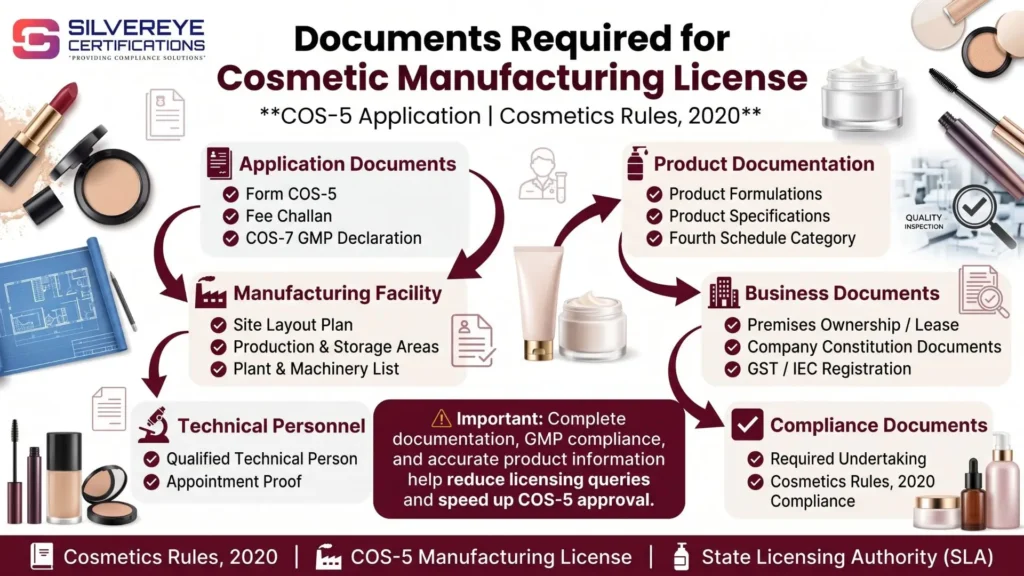
Documents Required for Cosmetic License for Handmade Perfumes
| Category | Documents |
|---|---|
| Business proof | Business registration certificate / incorporation documents; PAN; GST registration (if applicable) |
| Premises proof | Ownership document or rent/lease agreement of the manufacturing site; site plan and plant layout |
| Manufacturing details | List of machinery/equipment (blending vessels, maceration tanks, filling line), manufacturing process flow, fragrance formula and specifications |
| GMP compliance | GMP self-declaration (Form COS-7) confirming the site meets Schedule-prescribed GMP requirements |
| Technical staff | Qualification proof of the technical/competent person responsible for production |
| Product details | List of fragrance products/categories to be manufactured, with labels/artwork in triplicate |
| Alcohol handling (if applicable) | State Excise permit/pass for procurement and storage of rectified or denatured spirit; storage facility approval |
| Statutory | Fee payment receipt; undertaking of compliance with the Cosmetics Rules, 2020; Pollution Control Board NOC (as applicable to your unit) |
Step-by-Step Process for Cosmetic License for Handmade Perfumes
- Set up your manufacturing/blending space and align it with GMP requirements (layout, hygiene, ventilation, equipment, storage, batch and maceration records).
- Register your business (proprietorship/LLP/company) and get PAN and GST registration if applicable.
- If your formulas are alcohol-based, apply separately to the State Excise Department for the relevant permit before you start procuring or storing spirit.
- Prepare the Site Master File, plant layout, equipment list, fragrance formulas, and technical staff qualification proof.
- File Form COS-5 with your State Licensing Authority (through the applicable state or CDSCO SUGAM portal), along with Form COS-7 (GMP self-declaration) and the prescribed fee.
- The Licensing Authority scrutinizes your documents and schedules a physical inspection of your premises, typically within 30 days.
- Address any deficiencies or queries raised by the inspecting drug officer, including any excise-related storage concerns if alcohol is involved.
- On satisfactory verification, the State Licensing Authority grants the Cosmetic Manufacturing License in Form COS-8, usually within 45 days of completed document verification.
- Print your manufacturing license number on all product labels as required under the Cosmetics Rules, 2020, along with ingredient and allergen disclosures per IFRA guidance where applicable.

Benefits of GMP License for Handmade Perfumes
GMP helps handmade and small-scale perfume businesses maintain hygienic, consistent, and safely stored production practices.
- Builds Customer Trust: Demonstrates commitment to hygiene, accurate dilution, and product safety.
- Ensures Consistent Quality: Helps maintain uniform scent strength, longevity, and clarity across batches.
- Reduces Contamination and Safety Risks: Promotes proper handling of flammable alcohol bases and volatile aroma chemicals.
- Supports Regulatory Compliance: Helps businesses meet applicable cosmetic manufacturing and excise requirements together.
- Improves Documentation: Enables proper batch records, maceration logs, and raw material traceability.
- Strengthens Brand Credibility: Provides a more professional image when dealing with customers, retailers, and distributors.
- Supports Business Growth: Establishes systematic processes that make it easier to scale from a home studio to a full unit.
Cost for GMP License & Cosmetic Manufacturing License – Handmade Perfumes
For a small/home-based perfume business in India, the cost generally depends on whether the client already has a compliant manufacturing premises, and whether alcohol-based formulas bring an excise layer into the picture.
| Particulars | Approx. Cost |
|---|---|
| Government fee for Cosmetic Manufacturing Licence (COS-8) | ₹10,000* |
| GMP documentation & compliance support | ₹15,000 – ₹30,000 |
| State Excise permit for spirit-based perfumes (where applicable) | ₹5,000 – ₹20,000+ (varies significantly by state) |
| Fragrance/product testing, if required | ₹3,000 – ₹12,000+ |
| Documentation & application support | ₹5,000 – ₹15,000 |
| Professional service package | ₹25,000 – ₹45,000+ |
The official Cosmetics Rules, 2020 prescribe ₹10,000 for a COS-8 manufacturing licence covering up to 10 items in each category; additional items attract additional fees. Excise fees, permit categories, and storage-approval costs vary widely by state and are set independently of the cosmetic licensing fee schedule.
Important for Home-Based Units
If the applicant does not have a dedicated manufacturing unit, the cost may increase because the premises may need to be made GMP-compliant, and — for alcohol-based fragrances — fitted out for compliant flammable-liquid storage before either inspection can be passed.
Alternatively, a loan license (COS-9) may be considered where appropriate; its government fee is also ₹10,000 for up to 10 items in a category. Many new perfume brands start with white-label or contract manufacturing through an already-licensed facility precisely to avoid building out excise-compliant storage on day one.
Timeline, Validity, Renewal & Retention
As per the Cosmetics Rules, 2020, the applicable details for a Cosmetic Manufacturing Licence (COS-8) are:
| Particular | Details |
|---|---|
| Application Timeline | The licence is processed by the State Licensing Authority after scrutiny of the application and documents, generally within 45 days of completed document verification, followed by a physical inspection. |
| Validity | Perpetual — the license remains valid unless suspended or cancelled. |
| Retention | Retention fee must be paid before completion of every 5 years from the date of issue of the licence. |
| Renewal | There is no conventional renewal every 5 years. Instead, the licence continues through payment of the applicable retention fee. |
| Late Payment | A late fee of 2% of the retention fee per month or part thereof applies for up to 180 days. If the fee remains unpaid during this period, the licence is deemed cancelled. |
| Inspection | Licensed premises may be inspected at least once every 3 years, or as required under a risk-based approach; alcohol storage may be separately inspected by Excise officials. |
Why Choose Silvereye Certifications for Cosmetic License for Handmade Perfumes?
- Expert Regulatory Guidance: Our team provides practical guidance on cosmetic licensing, GMP requirements, excise considerations for alcohol-based fragrances, and documentation.
- End-to-End Support: From initial consultation and document preparation to application filing and follow-up, we assist throughout the process.
- Specialised Fragrance Compliance: Silvereye provides support for cosmetic manufacturing, loan manufacturing licences, and state-specific excise formalities perfume brands often overlook.
- Accurate Documentation: We help prepare and review the required documents to minimise errors, objections, and unnecessary delays.
- Transparent Process & Pricing: Clear communication and structured support without hidden charges.
- Dedicated Client Support: Our team remains available to guide clients through regulatory queries and compliance requirements as they scale.
Conclusion
For handmade and small-scale perfume businesses, following the applicable GMP and cosmetic manufacturing requirements — and, where relevant, the excise formalities around alcohol-based formulas — is an important step toward building a safe, consistent, and professionally managed fragrance brand. With the right documentation and regulatory guidance, businesses can avoid common compliance issues and build a stronger foundation for growth.
Silvereye Certifications provides end-to-end consultancy and documentation support to help clients navigate cosmetic licensing, GMP compliance, and related excise requirements efficiently. Government licenses and approvals are issued by the respective authorities; Silvereye provides professional consulting support throughout the process.
Frequently Asked Questions
Do handmade perfume businesses need a cosmetic manufacturing license in India?
Yes. Handmade perfumes manufactured for sale or distribution are subject to the applicable requirements under the Cosmetics Rules, 2020. A Cosmetic Manufacturing License may be required depending on the manufacturing setup and activity.
Can I manufacture and sell perfume from my home?
A home-based setup is not automatically exempt from cosmetic licensing requirements. If you manufacture perfume for commercial sale, the premises must meet the applicable GMP, hygiene, ventilation, equipment, and contamination-control requirements.
What is the Cosmetic Manufacturing License for handmade perfumes?
The Cosmetic Manufacturing Licence (Form COS-8) is issued by the State Licensing Authority for manufacturing cosmetics for sale or distribution. The application generally involves premises details, equipment, product formulations, technical staff qualifications, and GMP documentation.
What documents are required for a cosmetic license for handmade perfumes?
Common documents include business registration documents, PAN, GST registration where applicable, premises proof, site plan, plant layout, equipment list, manufacturing process, fragrance formulations, Form COS-7, technical staff qualification proof, product details, and applicable alcohol-related approvals.
Do alcohol-based perfumes require an Excise Permit?
Yes, where applicable. Perfume businesses using rectified spirit, denatured spirit, or other regulated alcohol bases may need separate permission from the State Excise Department for procurement, storage, and movement of spirit.
Do alcohol-free perfumes need excise approval?
If the perfumes are completely alcohol-free, such as oil-based attars, solid perfumes, or roll-ons, the alcohol-related excise layer described in this guide does not apply. However, the applicable cosmetic compliance requirements still need to be considered.
What is Form COS-7?
Form COS-7 is the GMP self-declaration submitted as part of the cosmetic manufacturing license process. It confirms that the manufacturing premises comply with the applicable GMP requirements.
How long does it take to obtain a Cosmetic Manufacturing License?
The Licensing Authority generally processes the application after document scrutiny and physical inspection. The source material states that the licence is usually granted within 45 days of completed document verification, subject to satisfactory verification and resolution of any deficiencies.
How long is a Cosmetic Manufacturing Licence valid?
The COS-8 licence is perpetual unless it is suspended or cancelled. However, a retention fee must be paid every 5 years to keep the license active. There is no conventional renewal process every five years.
Can Silvereye Certifications help with cosmetic licensing for handmade perfumes
Yes. Silvereye Certifications provides support covering eligibility checks, document preparation, GMP compliance, application filing, regulatory follow-up, excise considerations, amendments, and related compliance requirements for handmade perfume businesses.