

- APEDA RCMC registration is legally mandatory before exporting any scheduled agricultural or processed food product from India.
- Since July 2023, RCMC is issued only through the DGFT e-RCMC portal, not the old APEDA website.
- Government fee is ₹5,900 (incl. GST); the certificate is valid for 5 years from issue.
- 2026 brings a new APEDA support scheme, the Bharat Krishi Niryat Yojana, for the 16th Finance Commission cycle (2026-31).
Introduction
APEDA registration is the Registration-Cum-Membership Certificate (RCMC) that every exporter of scheduled agricultural and processed food products must hold under the Agricultural and Processed Food Products Export Development Authority (APEDA), Ministry of Commerce and Industry.

Since 17 July 2023, it is applied for online through the DGFT e-RCMC portal (Form ANF-2C), after first obtaining an Import Export Code (IEC). The certificate costs ₹5,900 (incl. 18% GST), stays valid for 5 years, and must be renewed before expiry to keep exporting products such as fruits, vegetables, meat, dairy, cereals, honey, and organic foods legally, and to remain eligible for APEDA's export incentive schemes.
What Is APEDA RCMC Registration?
The Agricultural and Processed Food Products Export Development Authority (APEDA) was set up under the APEDA Act, 1985, and functions under India's Ministry of Commerce and Industry. Its job is to promote and regulate the export of a defined list of “scheduled products” — everything from fresh mangoes to processed cereals, honey, and floriculture items.
The Registration-Cum-Membership Certificate (RCMC) is the document that proves an exporter is registered with APEDA for one or more of these scheduled product categories. Holding a valid RCMC is what most people actually mean when they refer to “APEDA registration.”
A key procedural shift matters for anyone researching APEDA registration in 2026: in compliance with DGFT Trade Notice No. 35/2021-22 dated 24 February 2022, APEDA stopped issuing RCMC through its own portal from 17 July 2023. Every fresh application, renewal, or amendment now runs through the DGFT e-RCMC facility on dgft.gov.in, under the “Services” menu. Older blog posts or videos that describe logging into apeda.gov.in to file RCMC are describing a process that no longer exists.
Why APEDA RCMC Registration Matters for Exporters
APEDA registration is not an optional formality — it is a legal precondition for trading in scheduled products, and it is also the entry ticket to a range of government support that non-registered exporters simply cannot access.
- Legal compliance: Exporting a scheduled product without a valid RCMC is not permitted under the APEDA Act framework, and shipments can face customs-level scrutiny or hold-ups.
- Access to incentives: RCMC holders become eligible for APEDA's financial assistance and export promotion schemes.
- Credibility with buyers: Overseas buyers and import authorities increasingly expect proof of registration with the relevant Indian export promotion council.
- Gateway to other certifications: Many organic (NPOP), quality, and packhouse-recognition processes assume the exporter already holds a valid RCMC.
Who Needs APEDA RCMC Registration?
APEDA RCMC registration eligibility is broad and deliberately simple — the framework is built to bring every genuine exporter of scheduled products into the formal system, not to filter out small players.
- Any Indian business entity — proprietorship, partnership firm, LLP, private limited company, public limited company, cooperative society, Farmer Producer Organization (FPO), or trust — that exports one or more scheduled products.
- Merchant exporters (trading only, not manufacturing), manufacturer exporters, and manufacturer-cum-merchant exporters are all eligible, each with a slightly different document set.
- There is no minimum turnover or minimum export volume threshold to qualify.
- A valid Import Export Code (IEC) from DGFT is a non-negotiable prerequisite — APEDA registration cannot be filed without one.
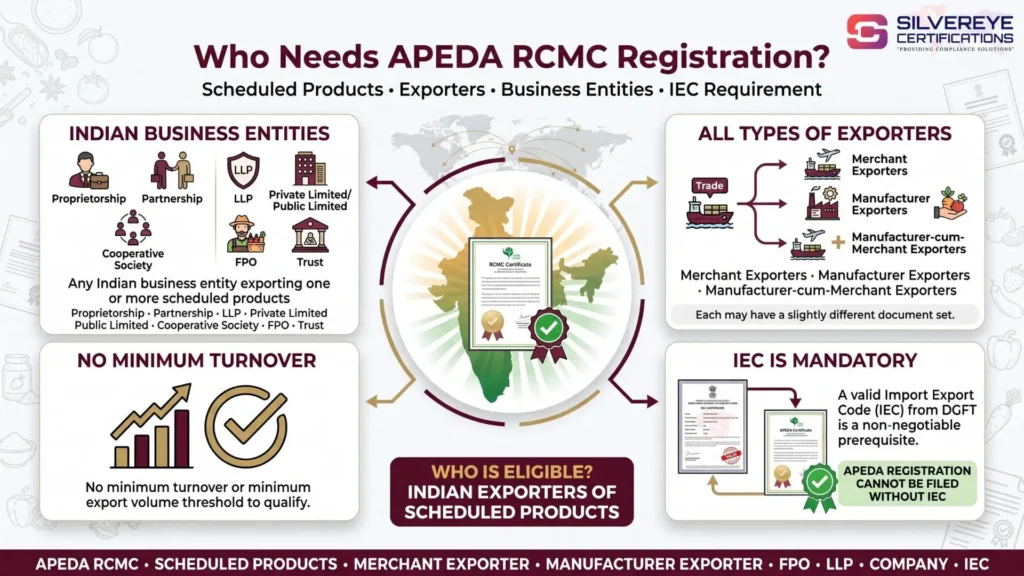
In practice, the moment a business plans its first export shipment of a scheduled product, it should already be applying for RCMC — the APEDA framework expects registration before export activity begins, not after.
APEDA Scheduled Products List (2026)
APEDA's mandate covers 14 broad scheduled product groups, plus a few products added to its jurisdiction by separate government notifications over the years. Knowing exactly where a product sits is the first real step in the APEDA registration process, because it decides which manufacturing-proof document you will later need to upload.
| S.No. | Scheduled Product Group | Representative Examples |
| 1 | Fruits, Vegetables and their Products | Fresh mangoes, grapes, mango pulp, frozen vegetables, fruit juices |
| 2 | Meat and Meat Products | Buffalo meat, sheep/goat meat |
| 3 | Poultry and Poultry Products | Eggs, egg powder, processed poultry |
| 4 | Dairy Products | Ghee, butter, cheese, milk powder |
| 5 | Confectionery, Biscuits and Bakery Products | Biscuits, cakes, sugar confectionery |
| 6 | Honey, Jaggery and Sugar Products | Natural honey, jaggery |
| 7 | Cocoa and its Products, Chocolates of all kinds | Cocoa powder, chocolate bars |
| 8 | Alcoholic and Non-Alcoholic Beverages | Beer, wine, non-alcoholic drink concentrates |
| 9 | Cereal and Cereal Products | Wheat products, maize products, non-basmati rice |
| 10 | Groundnuts, Peanuts and Walnuts | Raw and processed groundnuts, walnuts |
| 11 | Pickles, Papads and Chutneys | Pickles, papads, ready chutneys |
| 12 | Guar Gum | Guar gum powder and derivatives |
| 13 | Floriculture and Floriculture Products | Cut flowers, dried flowers, seeds |
| 14 | Herbal and Medicinal Plants | Medicinal herbs, plant extracts |
Also under APEDA's jurisdiction by separate notification: De-oiled rice bran; Basmati Rice (added to the Second Schedule of the APEDA Act); and Cashew Kernels, Cashewnut Shell Liquid (CSNL), and Cardanol (brought under APEDA vide DGFT Notification No. 6/2015-2020 dated 14 June 2021). APEDA is also entrusted with monitoring sugar imports into India.
Not covered by APEDA: Marine and seafood products fall under the Marine Products Export Development Authority (MPEDA); tea under the Tea Board; coffee under the Coffee Board; spices under the Spices Board; and tobacco under the Tobacco Board. Exporters of these items register with their own commodity board instead of applying for APEDA RCMC.
Documents Required for APEDA RCMC Registration
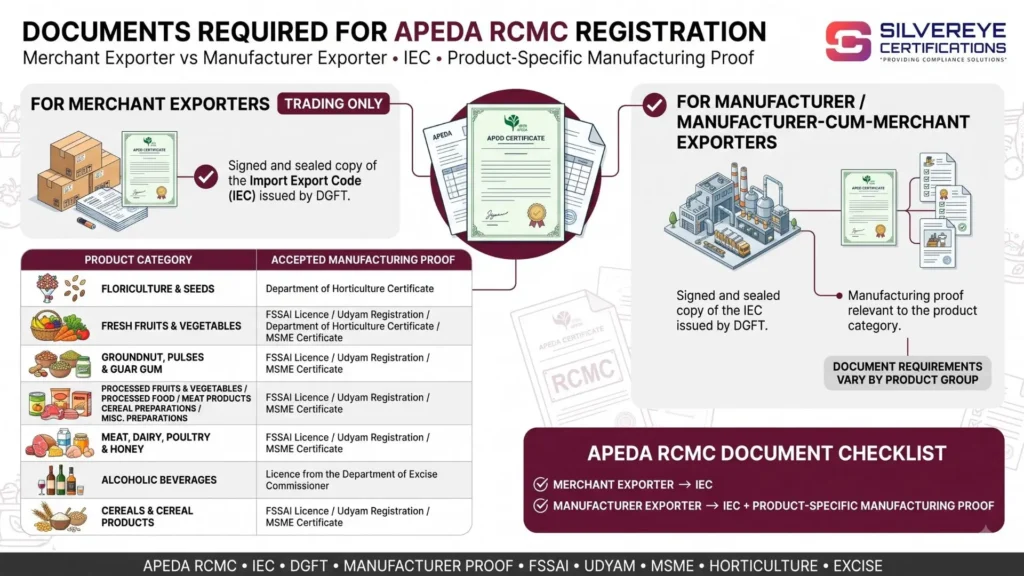
The exact document list depends on whether the applicant is a pure trader or is also manufacturing/processing the scheduled product. This split comes directly from APEDA's own e-RCMC circular.
For Merchant Exporters (Trading Only)
- Signed and sealed copy of the Import Export Code (IEC) issued by DGFT.
For Manufacturer / Manufacturer-cum-Merchant Exporters
- Signed and sealed copy of the IEC issued by DGFT.
- Manufacturing proof relevant to the product category — this varies by product group, as shown below.
| Product Category | Accepted Manufacturing Proof |
| Floriculture and Seeds | Certificate from the Department of Horticulture |
| Fresh Fruits & Vegetables | FSSAI licence / Udyam Registration / Dept. of Horticulture certificate / MSME certificate |
| Groundnut, Pulses, Guar Gum | FSSAI licence / Udyam Registration / MSME certificate |
| Processed Fruits & Vegetables, Processed Food, Meat Products, Cereal Preparations, Misc. Preparations | FSSAI licence / Udyam Registration / MSME certificate |
| Meat, Dairy, Poultry, Honey | FSSAI licence / Udyam Registration / MSME certificate |
| Alcoholic Beverages | Licence from the Department of Excise Commissioner |
| Cereals and Cereal Products | FSSAI licence / Udyam Registration / MSME certificate |
Additional supporting documents commonly requested on the DGFT e-RCMC form include: PAN card of the business, GST registration certificate, a bank certificate or cancelled cheque of the current account, the certificate of incorporation/partnership deed as applicable, address proof of the registered office, and identity proof of the authorized signatory.
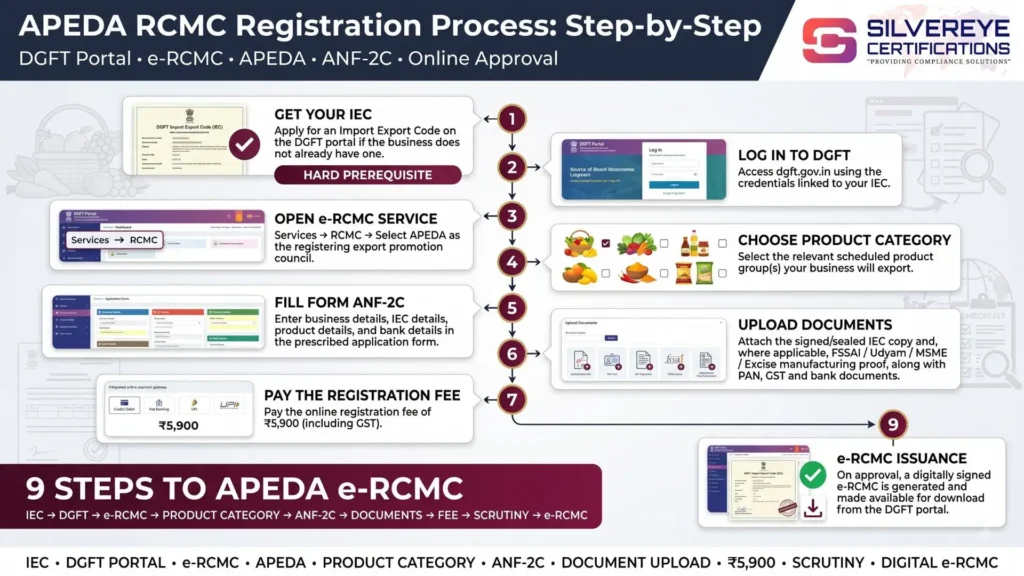
APEDA RCMC Registration Process: Step-by-Step
Because RCMC now routes entirely through DGFT, the process is a single online journey rather than separate APEDA and DGFT steps.
- Step 1 — Get your IEC: Apply for an Import Export Code on the DGFT portal if the business does not already have one. This is a hard prerequisite.
- Step 2 — Log in to the DGFT portal: Access dgft.gov.in using the same credentials linked to your IEC.
- Step 3 — Open the e-RCMC service: Go to “Services” → “RCMC” → select APEDA as the registering export promotion council.
- Step 4 — Choose product category: Select the relevant scheduled product group(s) your business will export.
- Step 5 — Fill Form ANF-2C: Enter business details, IEC details, product details, and bank details in the prescribed application form.
- Step 6 — Upload documents: Attach the signed/sealed IEC copy and, where applicable, the FSSAI/Udyam/MSME/Excise manufacturing proof, along with PAN, GST, and bank documents.
- Step 7 — Pay the fee: Pay the online registration fee of ₹5,900 (incl. GST) through the integrated payment gateway.
- Step 8 — Application scrutiny: APEDA/DGFT verify the submitted details and documents against the selected product category.
- Step 9 — RCMC issuance: On approval, a digitally signed e-RCMC is generated and made available for download from the DGFT portal.
APEDA RCMC Registration Fees (2026)
| Particulars | Fee (as per official APEDA/DGFT schedule) |
| Online registration fee | ₹5,000 + 18% GST (₹900) = ₹5,900 |
| Online renewal fee | ₹5,900 (same structure as fresh registration) |
| Amendment / modification to an issued RCMC | No fee |
These figures reflect APEDA's official e-RCMC fee circular. Government fee schedules can be revised, so it's worth re-checking the live fee on the DGFT e-RCMC page at the time of filing, especially if you are applying close to a financial year change.
Validity, Renewal & Timeline For APEDA RCMC Registration
- Validity: An APEDA RCMC is valid for 5 years from the date of issue — the same validity period applies to a fresh registration and to a renewed one.
- Renewal: Renewal is filed through the same DGFT e-RCMC facility before the certificate expires, using the same Form ANF-2C flow and the same ₹5,900 fee. There is no separate “renewal portal.” Exporters who let the RCMC lapse lose the legal cover to export scheduled products and drop out of eligibility for APEDA's scheme benefits until they re-register.
- Timeline: Most applications with complete, correctly matched documents are processed within roughly 3 to 7 working days; incomplete submissions or product-category mismatches can push this out further, since the file goes back for correction rather than outright rejection in most cases.
- Amendments: Adding a new product category, correcting an address, or updating bank details on an already-issued RCMC can be done as a free amendment — there's no need to apply afresh.
Benefits of APEDA RCMC Registration
| Benefit | What It Means for Exporters |
| Legal export authorisation | Removes the compliance risk of exporting scheduled products without valid cover |
| Financial assistance schemes | Eligibility for APEDA's infrastructure, quality-development, and market-access support |
| Trade fair participation | Access to APEDA-organised India Pavilions, Buyer-Seller Meets, and global trade fairs |
| Market intelligence | Access to APEDA's export statistics, product standards, and buyer databases |
| Organic export linkage | RCMC status supports the documentation trail needed for NPOP organic certification |
| Long-term credibility | A 5-year certificate that signals compliance to overseas buyers and Indian banks/DGFT alike |
2026 Regulatory Update: Bharat Krishi Niryat Yojana
The financial support that has historically accompanied APEDA registration ran under the “Agriculture and Processed Foods Export Promotion Scheme of APEDA” for the 15th Finance Commission Cycle (2021-22 to 2025-26), covering infrastructure development, quality development, and market promotion assistance for RCMC-registered exporters. That cycle has now closed.
For 2026, APEDA's own tender records show the authority moving to a newly named scheme — the Bharat Krishi Niryat Yojana (BKNY), positioned for the 16th Finance Commission Cycle (2026-27 to 2030-31). As of this writing, APEDA has floated official tenders to engage a Project Management Unit (PMU) agency to help design and roll out BKNY, which signals the scheme's detailed operating guidelines, assistance ceilings, and application windows are still being finalised rather than fully notified.
What this means for registered exporters: your existing RCMC and the registration process itself are unaffected — BKNY concerns the scheme benefits layered on top of registration, not the RCMC application procedure. Exporters should keep an eye on APEDA's official announcements page for the formal BKNY guidelines once notified, since the specific subsidy percentages published for the earlier 15th Finance Commission scheme should not be assumed to carry over automatically to BKNY.
Other genuine 2026 developments worth noting: APEDA opened a new regional office in Raipur, Chhattisgarh (January 2026) to widen exporter facilitation reach, and issued a circular extending the validity of Registration-cum-Allocation Certificates (RCACs) for Basmati and non-Basmati rice exporters (24 August 2026) — a reminder that rice exporters holding RCMC should track rice-specific RCAC timelines separately from the 5-year RCMC cycle. The DGFT e-RCMC portal, introduced in July 2023, remains the sole filing channel through 2026, with no indication of APEDA reverting to its own registration system.
APEDA RCMC vs IEC vs FSSAI: How They Differ
Exporters new to agri-trade often confuse these three documents. Each serves a distinct legal purpose, and most exporters of processed food end up needing all three.
| Document | Issued By | Purpose |
| IEC (Import Export Code) | DGFT | Basic 10-digit code required for any import or export activity from India; prerequisite for RCMC |
| FSSAI Licence/Registration | Food Safety and Standards Authority of India | Food safety compliance for anyone manufacturing, processing, or handling food; often used as manufacturing proof for RCMC |
| APEDA RCMC | APEDA (via DGFT e-RCMC portal) | Specific registration for exporting scheduled agricultural/processed food products and accessing APEDA's export schemes |
Common Reasons for Rejection or Delay
- Business name, address, or IEC details on the application not matching the DGFT IEC record exactly.
- Missing product-specific manufacturing proof — for example, a processed-food manufacturer applying without a valid FSSAI license.
- Selecting the wrong scheduled product category, which mismatches the manufacturing proof uploaded.
- Uploading scanned documents that are not properly signed and sealed as specified in the e-RCMC circular.
- Bank certificate or cancelled cheque details not matching the current operative bank account.
Most of these are correctable through resubmission rather than outright rejection, but each round of correction adds several working days to the timeline — getting the document set right the first time is the single biggest lever exporters have over their own approval speed.
Get Expert Help with Your APEDA Registration
The APEDA registration process is straightforward on paper, but small mismatches — a wrong product category, an unsigned document, a bank detail that doesn't line up with the IEC — are what actually slow most applications down. Silvereye Certifications helps Indian agri-exporters, food processors, and first-time exporters handle the full APEDA registration journey: IEC verification, document preparation, DGFT e-RCMC filing, product-category selection, and timely renewal tracking — so the certificate is filed right the first time and the business can focus on the actual export order, not the paperwork.
Frequently Asked Questions For APEDA RCMC Registration
Is APEDA RCMC registration mandatory for all exporters?
No. It is mandatory only for exporters dealing in APEDA's scheduled agricultural and processed food products. Exporters of marine products, tea, coffee, spices, or tobacco register with their respective commodity boards instead.
What is the validity of an APEDA RCMC?
An APEDA RCMC is valid for 5 years from the date of issue, whether it is a fresh registration or a renewal.
Can I still apply for RCMC on the APEDA website?
No. Since 17 July 2023, APEDA stopped issuing RCMC directly. All applications, renewals, and amendments are filed through the DGFT e-RCMC portal under “Services.”
How much does APEDA registration cost in 2026?
The official fee is ₹5,900, made up of a ₹5,000 registration fee plus 18% GST (₹900). The same fee applies to renewal. It's worth confirming the live fee on the DGFT portal before paying, since government fees can be revised.
What documents are required for APEDA registration?
At minimum, a signed and sealed IEC copy. Manufacturers additionally need product-specific manufacturing proof — typically an FSSAI licence, Udyam/MSME certificate, Department of Horticulture certificate, or Excise Department licence, depending on the product category — plus supporting PAN, GST, and bank documents.
How long does APEDA registration take?
Applications with complete, correctly matched documents are typically processed within about 3 to 7 working days. Missing or mismatched documents extend this timeline.
Is there a minimum turnover requirement for APEDA registration?
No. There is no minimum turnover, export volume, or business size threshold. Any eligible entity with a valid IEC can apply.
What happens if I export scheduled products without RCMC?
Exporting APEDA-scheduled products without a valid RCMC is not compliant with the regulatory framework and can expose a shipment to customs-level queries, while also cutting the exporter off from APEDA's financial assistance and promotional schemes.
Can one RCMC cover multiple product categories?
Yes. An exporter can select more than one scheduled product group at the time of application, and additional categories can later be added to an existing RCMC as a free amendment.
How do I renew my APEDA RCMC before it expires?
Renewal is filed through the same DGFT e-RCMC facility, using Form ANF-2C, before the 5-year validity lapses, at the same ₹5,900 fee. There is no separate renewal-only portal.
Is IEC different from APEDA RCMC?
Yes. IEC is the basic import-export code needed for any cross-border trade from India and is a prerequisite. APEDA RCMC is a separate, product-specific registration required only for scheduled agricultural and processed food exports, applied for after the IEC is in place.
What is the Bharat Krishi Niryat Yojana, and does it affect my existing RCMC?
Bharat Krishi Niryat Yojana (BKNY) is APEDA's newly positioned export promotion scheme for the 16th Finance Commission Cycle (2026-27 to 2030-31), replacing the earlier 15th Finance Commission scheme. It affects the scheme benefits layered on top of registration, not the RCMC registration process itself — your existing or upcoming RCMC application is unaffected. Detailed BKNY guidelines are still being finalised, so registered exporters should track APEDA's official announcements for the notified scheme rules.