
- Four packaging categories, four target sets: Rigid (I), flexible (II), multi-layered (III), and compostable (IV) plastic packaging each carry their own recycling and recycled-content targets that rise every year through 2028-29.
- Recycled content is now mandatory, not optional: Since 2025-26, Category I packaging needs a minimum recycled-plastic share, rising to 60% by 2028-29, with Categories II and III following their own lower but still rising targets.
- EPR certificates are now category-locked: The 2026 amendment stops producers from using rigid-packaging recycling credits to offset flexible or multi-layered obligations, tightening how EPR certificate trading works.
- Traceability is now built into the process: QR codes or barcodes on packaging, mandated since mid-2025, link every registered unit back to its EPR Registration on the CPCB portal.
Introduction
The EPR Registration Process for Plastic Waste requires every producer, importer, and brand owner (PIBO) placing plastic packaging on the Indian market to register on the CPCB's centralized plastic EPR portal, classify packaging into Category I (rigid), II (flexible), III (multi-layered), or IV (compostable), declare annual recycling and recycled-content targets, and file returns supported by EPR certificates from registered recyclers.
The Plastic Waste Management (Amendment) Rules, 2026 introduced binding recycled-content targets, category-specific EPR certificate trading, and mandatory QR code or barcode traceability on packaging, building on the January 2025 labelling amendment.
What Is the EPR Registration Process for Plastic Waste?
The EPR Registration Process for Plastic Waste is the CPCB-administered procedure through which every Producer, Importer, and Brand Owner (PIBO) that places plastic packaging in the Indian market — along with every Plastic Waste Processor (PWP) that recycles or processes that packaging — formally registers, declares its packaging categories, commits to recycling and recycled-content targets, and files ongoing compliance returns. It operates under the Plastic Waste Management Rules, 2016, as amended repeatedly since, most recently and significantly by the Plastic Waste Management (Amendment) Rules, 2026.
Unlike a one-time approval, plastic EPR registration is the start of a running compliance obligation: every registered PIBO must show, year after year, that it collected, recycled, and increasingly reused or recycled-content-sourced the plastic packaging it introduced into the market. This guide walks through exactly how that process works on the CPCB portal in 2026, category by category.
Why the Plastic EPR Registration Process Matters in 2026
- Recycled content is now enforced, not encouraged: The 2026 amendment turned recycled-content sourcing from a best practice into a binding, auditable target with category-specific percentages.
- Traceability closes old compliance gaps: QR code/barcode requirements mean packaging can now be traced back to a specific EPR Registration, making under-reporting far easier for CPCB to detect.
- Certificate trading rules have tightened: Category-locked EPR certificates mean PIBOs can no longer over-recycle in one easy category to offset a harder one — sourcing strategy now has to match actual packaging mix.
- Marketplace and retailer checks are increasing: E-commerce platforms and large retailers increasingly verify plastic EPR registration and category compliance before onboarding packaged-goods suppliers.
- Non-compliance risk is rising: With digital traceability in place, Environmental Compensation exposure is no longer limited to companies that get randomly audited — QR-linked data makes gaps far more visible.
Who Needs to Complete the Plastic EPR Registration Process?
Registration is required for anyone who manufactures, imports, or brands plastic packaging sold in India, as well as entities that process that packaging once it becomes waste:
- Producers: Manufacturers of plastic packaging material or plastic sheet, and manufacturers or importers of the plastic raw material used to make packaging.
- Importers: Any entity importing plastic packaging or products packaged in plastic for the Indian market.
- Brand Owners: Companies that sell products under their own brand using plastic packaging, whether or not they manufacture it themselves.
- Plastic Waste Processors (PWPs): Recyclers, co-processors, and waste-to-energy/waste-to-oil operators that register on the same portal to generate EPR certificates for PIBOs.
Micro and Small enterprise brand owners are exempted from plastic EPR registration, but this exemption does not extend to Producers or Importers, who must register regardless of scale.
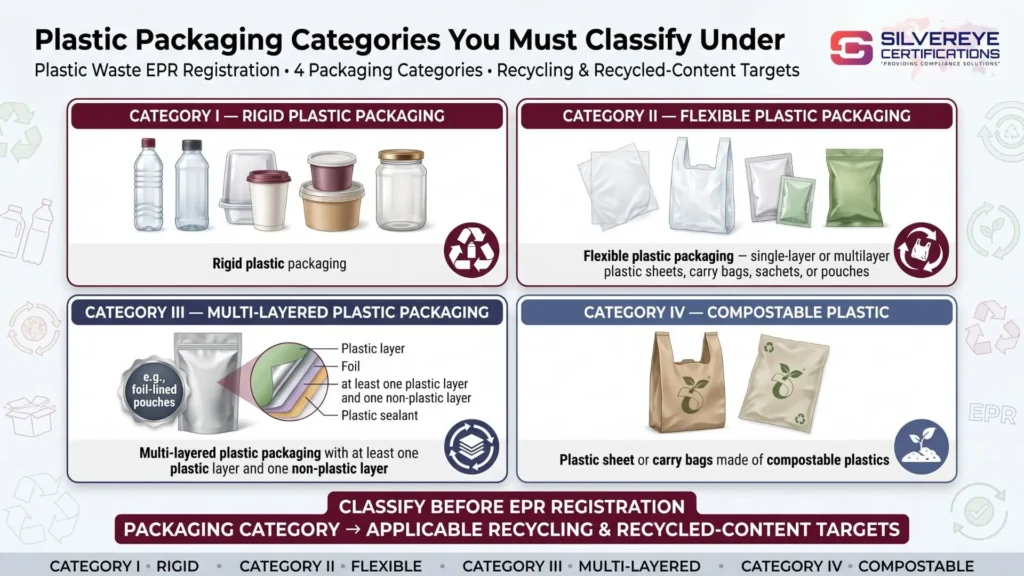
Plastic Packaging Categories You Must Classify Under
Before you can complete the EPR Registration Process for Plastic Waste, every packaging type your business uses must be classified into one of four categories — this classification determines which recycling and recycled-content targets apply to you.
| Category | Definition |
| Category I | Rigid plastic packaging |
| Category II | Flexible plastic packaging — single-layer or multilayer plastic sheets, carry bags, sachets, or pouches |
| Category III | Multi-layered plastic packaging with at least one plastic layer and one non-plastic layer (e.g., foil-lined pouches) |
| Category IV | Plastic sheet or carry bags made of compostable plastics |
Plastic EPR Recycling & Recycled-Content Targets (2025–29)
Two separate sets of targets now apply to every registered category: how much of your packaging you must recycle each year, and how much recycled plastic your new packaging must contain.
Recycling Targets by Category
| Category | 2025-26 | 2026-27 | 2027-28 Onward |
| I (Rigid) & IV (Compostable) | 60% | 70% | 80% |
| II (Flexible) & III (Multi-layered) | 40% | 50% | 60% |
Recycled-Content Targets (New Under the 2026 Amendment)
| Category | 2025-26 Baseline | By 2028-29 |
| I (Rigid) | 30% | 60% |
| II (Flexible) | 10% | 20% |
| III (Multi-layered) | 5% | 10% |
These recycled-content figures are calculated against the total plastic packaging manufactured, imported, or used in that financial year, and apply separately to producers, importers, and brand owners.
Category IV (compostable) is exempt from the recycled-content mandate, since compostable plastics are designed around decomposition rather than recycled-material reuse.
Latest Plastic EPR Notifications & Updates (2025–2026)
Plastic Waste Management (Amendment) Rules, 2026 (G.S.R. 237(E), 31 March 2026)
This is the most significant update to the plastic EPR registration process to date. Key changes include binding recycled-content targets by category (detailed above), category-locked EPR certificate trading (recycling credits from one category can no longer offset another), mandatory QR code or barcode traceability on every unit of plastic packaging, an expanded and clarified definition of end-of-life disposal covering co-processing, waste-to-energy, waste-to-oil (pyrolysis), and road construction using plastic-bitumen blends, and a Refuse Derived Fuel (RDF) mandate requiring cement and steel plants to replace a minimum share of conventional fuel — starting around 5% and rising to roughly 15% over six years.
Plastic Waste Management (Amendment) Rules, 2025
Notified on 23 January 2025 and effective for labelling from 1 July 2025, this amendment made QR codes, barcodes, or unique identification numbers mandatory on plastic packaging, laying the groundwork for the full digital traceability system the 2026 amendment builds on.
Enforcement Structure Under the 2026 Amendment
The Rules now specify a multi-tier enforcement structure involving CPCB, State-level monitoring committees, and local bodies such as Urban Local Bodies and Gram Panchayats, reflecting a push toward decentralized monitoring of plastic EPR compliance alongside the centralized registration process.
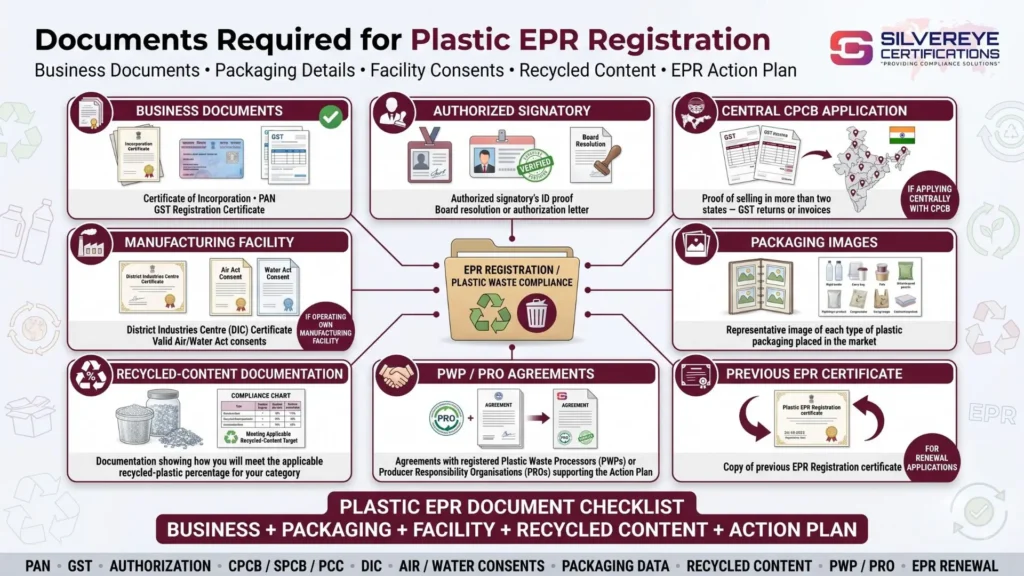
Documents Required for the Plastic EPR Registration Process
- Certificate of Incorporation, PAN, and GST registration certificate
- Authorized signatory's ID proof and a board resolution or authorization letter
- Proof of selling in more than two states (GST returns or invoices), if applying centrally with CPCB rather than an SPCB/PCC
- District Industries Centre (DIC) Certificate and valid Air/Water Act consents, if operating your own manufacturing facility
- Category-wise packaging details — type, quantity, and material composition for every packaging category you use
- A representative image of each type of plastic packaging placed in the market
- Recycled-content sourcing documentation, showing how you'll meet your category's recycled-plastic percentage
- Agreements with registered Plastic Waste Processors (PWPs) or Producer Responsibility Organizations (PROs) supporting your Action Plan
- Copy of your previous EPR Registration certificate, if this is a renewal application
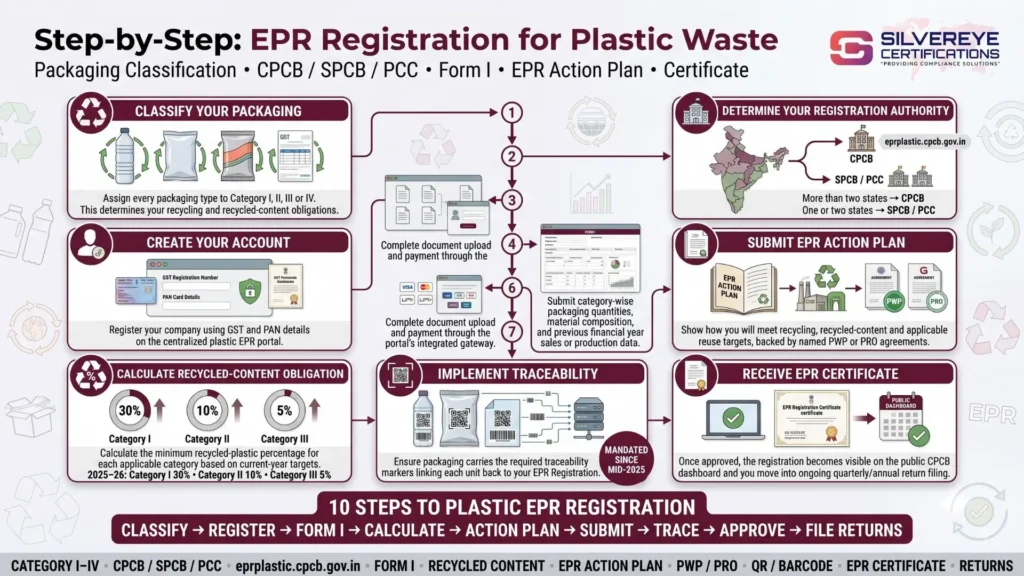
Step-by-Step: The EPR Registration Process for Plastic Waste
- Classify your packaging: Assign every packaging type your business uses to Category I, II, III, or IV — this determines your recycling and recycled-content obligations for the rest of the process.
- Determine your registration authority: PIBOs selling in more than two states register centrally with CPCB via eprplastic.cpcb.gov.in; those active in one or two states register with their SPCB/PCC through the same portal interface.
- Create your account: Register your company using GST and PAN details on the centralized plastic EPR portal.
- Complete Form I: Submit category-wise packaging quantities, material composition, and the previous financial year's sales or production data.
- Calculate your recycled-content obligation: Work out your minimum recycled-plastic percentage for each applicable category based on the current year's targets (30% Category I, 10% Category II, 5% Category III for 2025-26, rising each year).
- Submit your EPR Action Plan: Show how you'll meet recycling, recycled-content, and (for applicable rigid and drinking-water packaging) reuse targets, backed by named PWP or PRO agreements.
- Upload documents and pay the registration fee: Complete document upload and payment through the portal's integrated gateway.
- Implement QR code/barcode traceability: Ensure packaging carries the required traceability markers linking each unit back to your EPR Registration, as mandated since mid-2025.
- Track and respond to CPCB/SPCB queries: Respond promptly to any clarification requests to avoid delays in approval.
- Receive your EPR Certificate and begin annual filing: Once approved, your registration becomes visible on the public CPCB dashboard, and you move into ongoing quarterly/annual return filing.
EPR Certificates & Category-Locked Credit Trading
Registered Plastic Waste Processors generate EPR certificates when they recycle, co-process, or otherwise process plastic waste on behalf of a PIBO. PIBOs who fall short of their own recycling target can purchase these certificates through the CPCB portal to close the gap.
Under the 2026 amendment, this trading is now category-specific — a PIBO cannot use EPR certificates earned from recycling rigid (Category I) plastic to meet a flexible (Category II) or multi-layered (Category III) obligation. This tightening means sourcing recyclers whose processing capability actually matches your packaging mix has become a more important part of Action Plan strategy than before.
EPR Registration Fees for Plastic Waste
Fees for plastic EPR registration are set by CPCB based on the applicant's category (PIBO or PWP) and packaging volume, and are revised periodically — always confirm the current fee table on eprplastic.cpcb.gov.in before making payment.
| Applicant Type | Fee Basis |
| Producers, Importers, Brand Owners (PIBOs) | Based on category (large, medium, small) determined by annual packaging volume |
| Plastic Waste Processors (PWPs) | Based on registered processing/recycling capacity |
Validity, Renewal & Filing Timeline
- Plastic EPR Registration remains active on an ongoing basis, tied to continuous annual target compliance rather than a fixed expiry date
- Annual returns confirming recycling, recycled-content, and (where applicable) reuse target achievement must be filed each year
- Typical approval time for a complete new application is 15–40 working days
- Renewal applications should include updated category-wise packaging data and a refreshed Action Plan reflecting current-year targets
Benefits of Completing the Plastic EPR Registration Process Correctly
- Avoids Environmental Compensation exposure: With QR-code traceability now live, gaps between declared and actual packaging volumes are far easier for CPCB to spot.
- Smoother recycler sourcing: Understanding category-locked certificate trading early helps you build the right PWP relationships instead of discovering a mismatch at filing time.
- Marketplace and retail readiness: A valid, category-compliant EPR Certificate is increasingly required for onboarding with large retailers and e-commerce platforms.
- Supply-chain planning advantage: Knowing your recycled-content trajectory (30%→60% for rigid packaging by 2028-29, for example) lets you plan sourcing years ahead instead of scrambling.
Common Mistakes in the Plastic EPR Registration Process
- Misclassifying packaging — for example, treating a foil-lined pouch (Category III) as flexible-only (Category II)
- Assuming recycled-content targets are optional guidance rather than a binding, auditable obligation since 2025-26
- Buying EPR certificates without checking they match your actual packaging category, given the 2026 amendment's category-lock rule
- Delaying QR code/barcode implementation until close to an audit, rather than building it into packaging design
- Registering centrally with CPCB when the business actually qualifies to register with an SPCB/PCC (or vice versa), based on the states it operates in
How Silvereye Certifications Helps with Plastic EPR Registration
Silvereye Certifications is a regulatory compliance consultancy supporting Indian and international businesses with BIS, CDSCO, WPC-ETA, TEC/MTCTE, and EPR Authorization, among other approvals. For the EPR Registration Process for Plastic Waste specifically, Silvereye Certifications helps producers, importers, brand owners, and processors with:
- Accurate packaging classification across Categories I–IV before you start the application
- Calculating your category-wise recycling and recycled-content obligations for the current and upcoming years
- Preparing Form I and a CPCB-aligned EPR Action Plan backed by verifiable PWP or PRO agreements
- Guidance on category-matched EPR certificate sourcing under the 2026 amendment's trading rules
- Support with QR code/barcode traceability implementation on packaging
- Ongoing annual return filing and renewal management to keep your registration compliant year after year
Because Silvereye Certifications also manages BIS, CDSCO, WPC, and TEC/MTCTE approvals, packaged-goods businesses that need plastic EPR alongside other product certifications can consolidate their compliance work through a single consultancy relationship.
Conclusion
The EPR Registration Process for Plastic Waste has become considerably more precise since the 2026 amendment — it's no longer enough to register once and recycle “something” each year. Getting your packaging categories right, understanding your specific recycled-content trajectory, and sourcing EPR certificates that actually match your packaging mix are now central to staying compliant.
Businesses that build this into their sourcing and packaging design decisions early will find the process considerably smoother than those trying to retrofit compliance at filing time. If you'd rather have classification, Action Plan preparation, and ongoing filing handled by specialists, Silvereye Certifications supports the plastic EPR registration process from first application through renewal.
Frequently Asked Questions
Who must complete the EPR Registration Process for Plastic Waste?
Every Producer, Importer, and Brand Owner (PIBO) placing plastic packaging on the Indian market must register, along with Plastic Waste Processors (recyclers, co-processors, waste-to-energy operators). Only Micro and Small brand owners are exempt.
What are the four plastic packaging categories under EPR?
Category I is rigid plastic packaging, Category II is flexible plastic packaging, Category III is multi-layered packaging with at least one non-plastic layer, and Category IV is compostable plastic packaging.
Is recycled content mandatory for plastic packaging now?
Yes, since 2025-26. Category I (rigid) packaging needs a minimum 30% recycled plastic content, rising to 60% by 2028-29; Category II needs 10% rising to 20%; Category III needs 5% rising to 10%. Category IV compostable packaging is exempt.
What changed in the Plastic Waste Management (Amendment) Rules, 2026?
The 2026 amendment introduced binding recycled-content targets, made EPR certificate trading category-specific, mandated QR code/barcode traceability, expanded the definition of end-of-life disposal, and introduced a Refuse Derived Fuel obligation for cement and steel plants.
Can I use EPR certificates from one packaging category to meet another category's target?
No, not since the 2026 amendment. EPR certificate trading is now category-locked, meaning rigid-packaging recycling credits cannot offset flexible or multi-layered packaging obligations.
How long does plastic EPR registration approval take?
Most complete applications are approved in 15–40 working days; applications with mismatched or incomplete data can take longer due to CPCB queries.
Do I register with CPCB or my State Pollution Control Board?
PIBOs selling in more than two states or Union Territories register centrally with CPCB; those operating in only one or two states register with their concerned SPCB/PCC through the same portal interface.
What is a Plastic Waste Processor (PWP), and does it need separate registration?
A PWP is a recycler, co-processor, or waste-to-energy/waste-to-oil operator that processes plastic waste. PWPs register separately on the same CPCB portal to generate EPR certificates that PIBOs can purchase to meet their targets.
Are QR codes mandatory on all plastic packaging?
Yes, traceability markers such as QR codes, barcodes, or unique identification numbers have been mandatory since 1 July 2025 under the January 2025 amendment, and remain central to the 2026 amendment's compliance verification approach.
What happens if my plastic packaging doesn't meet its recycling or recycled-content target?
Shortfalls can be covered by purchasing category-matched EPR certificates from registered recyclers; unresolved shortfalls can attract Environmental Compensation under the Plastic Waste Management Rules.
Is plastic EPR registration a one-time process?
No. While the registration itself doesn't have a fixed expiry, it requires continuous annual return filing showing target achievement, and your Action Plan should be refreshed each year as targets rise.
Can Silvereye Certifications handle my plastic EPR registration end-to-end?
Yes. Silvereye Certifications supports packaging classification, target calculation, Action Plan preparation, recycler sourcing guidance, QR-code compliance, and ongoing annual filing for plastic EPR registration.