- Manufacture cosmetics legally without owning a factory, using another unit's licensed premises
- Filed as Form COS-6 with the State Licensing Authority, granted as Form COS-9
- Approval typically comes within 45 days once documents and the manufacturing agreement are in order
- Valid in perpetuity, subject to a retention fee every 5 years under the Cosmetics Rules, 2020
Introduction
A Cosmetic Loan License Registration lets a brand manufacture and sell cosmetics in India without owning a factory, by "borrowing" the production capacity of an already-licensed third-party manufacturer. Under the Cosmetics Rules, 2020, the brand owner files Form COS-6 with the State Licensing Authority of the state where the loan manufacturer operates, along with a manufacturing agreement, product formulations, and a GMP self-declaration in Form COS-7.
Once the State Licensing Authority verifies the documents, it grants the license in Form COS-9, usually within 45 days. The license is valid for life, provided the retention fee is paid every 5 years, and it lets brand owners launch cosmetic lines fast without capital-heavy manufacturing setup.
What Is a Cosmetic Loan License?
A Cosmetic Loan License is a manufacturing authorization granted under the Cosmetics Rules, 2020 (framed under the Drugs and Cosmetics Act, 1940) to a company or individual who wants to sell cosmetics under their own brand name but does not have their own manufacturing facility. Instead of setting up a factory, the applicant enters into a manufacturing arrangement with an existing, GMP-compliant cosmetic manufacturer and "loans" that unit's production capacity, technical staff, and premises for making the licensed products.
This is different from the standard cosmetic manufacturing license (Form COS-8), which is meant for companies that own and operate their manufacturing plant. The loan license route, by contrast, is built for brand owners, private-label sellers, and startups who want to outsource production while still holding the legal authorization to market cosmetics under their own name.
| Quick Fact The application for a loan license is filed in Form COS-6; once approved by the State Licensing Authority, the license itself is issued in Form COS-9. The manufacturing license held by the loan-giving factory, by comparison, is issued in Form COS-8. |
Why Brands Choose the Loan License Route
- No capital investment in land, building, machinery, or a full-time production plant
- Faster market entry — production can begin as soon as the loan manufacturer's line is ready and the license is granted
- Access to an already GMP-compliant, inspected facility instead of building compliance from scratch
- Flexibility to switch or add manufacturing partners as order volumes grow
- Full legal ownership of the brand, formulation, and marketing rights, even though production is outsourced
- Lower fixed overheads, which suits D2C cosmetic brands, private-label sellers, and salon or spa brands testing new product lines
Who Needs a Cosmetic Loan License?
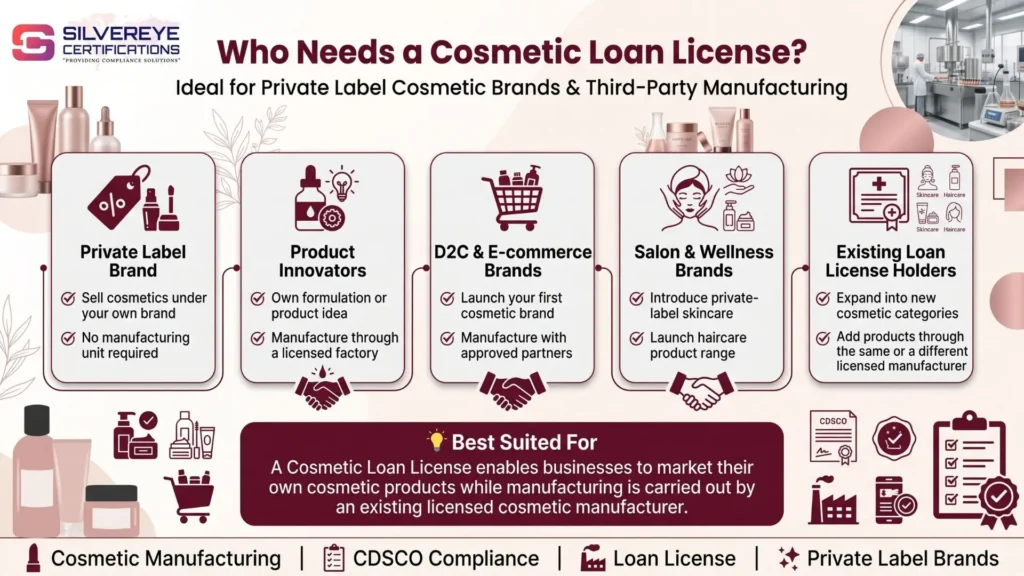
A loan license is the right fit if any of the following applies to your business:
- You want to sell cosmetics under your own brand name but don't own a manufacturing unit
- You have a formulation or product idea and want to tie up with an existing licensed factory to produce it
- You are a D2C or e-commerce cosmetic brand entering manufacturing for the first time
- You run a salon, spa, or wellness brand and want to launch a private-label skincare or haircare range
- You already hold a loan license for one product category and want to add new cosmetic categories under the same or a different loan manufacturer
Loan License vs. Manufacturing License: Key Differences
| Parameter | Loan License (COS-9) | Manufacturing License (COS-8) |
| Application form | Form COS-6 | Form COS-5 |
| Ownership of facility | Not required — uses another licensed unit | Applicant owns/operates the facility |
| Ideal for | Brand owners, private-label sellers, startups | Companies with their own factory |
| Technical staff | Provided by the loan-giving manufacturer | Employed directly by the license holder |
| Approval timeline | Within 45 days of document scrutiny | Within 45 days of document scrutiny |
| Validity | Perpetual, subject to 5-year retention fee | Perpetual, subject to 5-year retention fee |
Documents Required for Cosmetic Loan License Registration
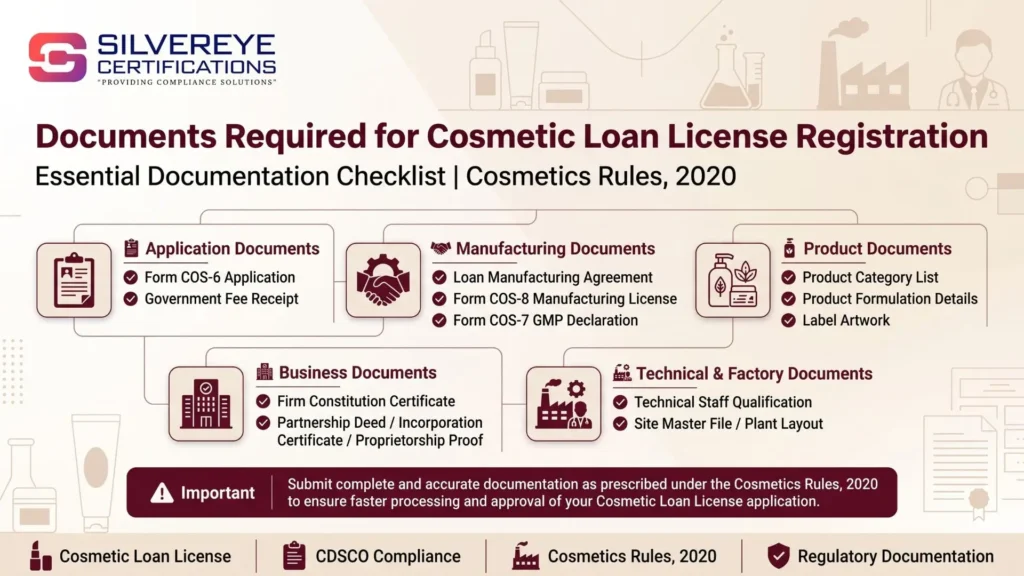
The documentation is filed as per Part II of the Second Schedule of the Cosmetics Rules, 2020, and typically includes:
- Duly filled Form COS-6 application
- Manufacturing/loan agreement between the brand owner and the loan-giving manufacturer
- Copy of the loan manufacturer's existing cosmetic manufacturing license (Form COS-8)
- Self-declaration in Form COS-7 confirming Good Manufacturing Practices compliance as per the Seventh Schedule
- List of cosmetic products and categories proposed to be manufactured, mapped to the Fourth Schedule
- Product formulation and composition details for each item
- Label drafts complying with the Cosmetics Rules, 2020 labelling requirements
- Constitution documents of the applicant firm (partnership deed, certificate of incorporation, or proprietorship proof)
- Details and qualification proof of technical staff at the loan manufacturer's premises
- Site master file or plant layout of the loan-giving unit, where required by the State Licensing Authority
- Prescribed government fee as per the Third Schedule
| Source Note Documentation requirements can vary slightly by state, since loan licenses are granted by the State Licensing Authority (State Drug Controller), not by the central CDSCO. Always confirm the exact checklist with the relevant state authority or an experienced consultant before filing. |
Technical Staff Requirement
Whether under a loan license or a standard manufacturing license, the manufacturing premises must have qualified technical staff overseeing production. The Cosmetics Rules, 2020 recognise any of the following as an eligible qualification for the manufacturing in-charge:
- Diploma in Pharmacy approved by the Pharmacy Council of India under the Pharmacy Act, 1948
- Intermediate examination with Chemistry, or an equivalent examination recognized by the Licensing Authority
- Bachelor's degree in Cosmetic Technology from a recognized university
In a loan license arrangement, this technical staff is typically already employed at the loan-giving manufacturer's premises, which is one reason the route is faster for brands without in-house technical hiring.
Step-by-Step Registration Process For Cosmetic Loan License
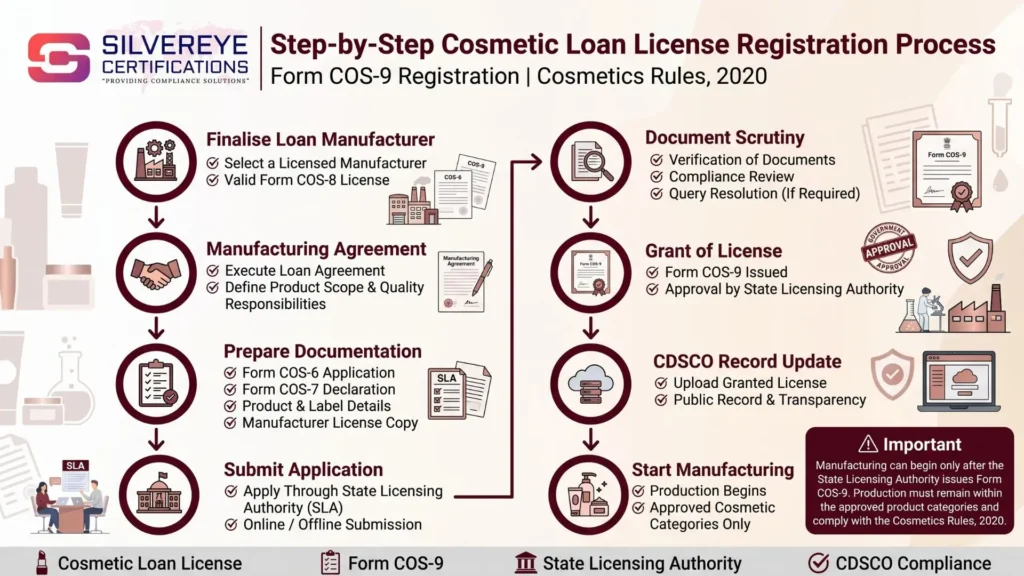
- Finalise a loan manufacturer: Identify and tie up with a cosmetic manufacturing unit that already holds a valid Form COS-8 license for the product categories you want to make.
- Sign the manufacturing/loan agreement: Draft and execute a formal agreement covering product scope, quality responsibility, batch records, and confidentiality of your formulation.
- Prepare documentation: Compile the Form COS-6 application, Form COS-7 self-declaration, product and label details, and the loan manufacturer's license copy.
- File with the State Licensing Authority: Submit the application online through the applicable state portal (or offline at the SLA office where an online facility is unavailable) for the state where the loan manufacturer's unit is located.
- Document scrutiny: The State Licensing Authority examines the application against the Second Schedule requirements and may raise queries or request clarifications.
- Grant of license: If the application is in order, the SLA issues the loan license in Form COS-9, generally within 45 days from the date of application.
- Upload to CDSCO records: The applicant uploads a copy of the granted license to the CDSCO website for transparency and public record.
- Begin production: Manufacturing can commence at the loan-giving unit strictly for the categories and products covered under the granted license.
Cosmetic Loan License Fees (Third Schedule)
Fees are prescribed under the Third Schedule of the Cosmetics Rules, 2020, and are payable to the State Licensing Authority at the time of application:
| Fee Head | Amount | |
| Grant of loan license (COS-9), up to 10 items per cosmetic category | Rs 10,000 | |
| Each additional item within a category | Rs 500 | |
| Retention fee, up to 10 items per category (payable every 5 years) | Rs 10,000 | |
| Retention fee, each additional item within a category | Rs 500 | |
| Late fee for delayed retention payment (within 180 days of due date) | 2% of retention fee per month or part thereof | |
Validity, Retention, and Renewal For Cosmetic Loan License
Under Rule 30 of the Cosmetics Rules, 2020, a loan license granted in Form COS-9 remains valid in perpetuity — there is no fixed expiry date — as long as the licensee pays the prescribed retention fee before the completion of every 5 years from the date of issue.
- Retention fee is due before the 5-year mark from the date of grant
- A late fee of 2% of the retention fee per month applies if payment is delayed, for up to 180 days past the due date
- If the retention fee remains unpaid beyond 180 days, the license is deemed cancelled
- The license can also be suspended or cancelled earlier by the State Licensing Authority for non-compliance, independent of the retention cycle
Post-License Compliance and Inspections
Holding a loan license comes with ongoing compliance obligations for both the brand owner and the loan-giving manufacturer:
- The licensed premises are inspected by government-appointed inspectors at least once every 3 years, or more frequently on a risk basis
- Inspectors can enter the premises, inspect products, draw samples, and examine registers and records at any time
- Any change in product labelling, composition, testing method, or specification must be reported to the Licensing Authority
- Any change in the constitution of the firm, or in the name or address of the manufacturer, must be intimated within the prescribed timeframe
- Cosmetics must comply with the Ninth Schedule standards and any other applicable quality and safety norms
- Animal testing of cosmetics is prohibited under Rule 39(7) of the Cosmetics Rules, 2020
Common Mistakes That Delay Loan License Approval
- Filing with a manufacturer whose COS-8 license doesn't cover the product category you intend to make
- Incomplete or vague manufacturing agreements that don't clearly assign quality and compliance responsibility
- Mismatched product categorization against the Fourth Schedule, leading to State Licensing Authority queries
- Missing or outdated Form COS-7 self-declaration on GMP compliance
- Overlooking state-specific document formats, since loan licenses are granted by State Licensing Authorities and processes vary slightly by state
- Forgetting the 5-year retention fee deadline, which can lead to late fees or deemed cancellation
Why Choose Silvereye Certifications For Cosmetic Registration
Silvereye Certifications helps cosmetic brand owners, private-label sellers, and D2C startups secure their Cosmetic Loan License without the back-and-forth that usually slows down State Licensing Authority approvals. From vetting loan manufacturer tie-ups and drafting compliant manufacturing agreements to preparing Form COS-6, Form COS-7, and the full document set, our team manages the entire filing so your brand can start production without regulatory delays.
- End-to-end documentation support for Form COS-6 and Form COS-9 applications
- Guidance on choosing and vetting a compliant loan manufacturer
- Accurate product categorization against the Fourth Schedule to avoid rejection
- Ongoing support for retention fee tracking and license renewal
Frequently Asked Questions
What is a Cosmetic Loan License in India?
It is a manufacturing authorization under the Cosmetics Rules, 2020 that allows a brand owner without their own factory to manufacture cosmetics using another company's already-licensed production facility, while still selling the products under their own brand name.
What is the difference between Form COS-6 and Form COS-9?
Form COS-6 is the application form filed with the State Licensing Authority to request a loan license. Form COS-9 is the license itself, issued once the application is approved.
Who grants a Cosmetic Loan License?
The State Licensing Authority (State Drug Controller) of the state where the loan-giving manufacturing unit is located grants the license, not the central CDSCO office.
How long does it take to get a Cosmetic Loan License?
The State Licensing Authority is required to grant or reject the application within 45 days from the date of filing, after scrutinising the documents and the manufacturing agreement.
What is the government fee for a Cosmetic Loan License?
As per the Third Schedule of the Cosmetics Rules, 2020, the fee for grant of a loan license is Rs 10,000 for up to 10 items per category, and Rs 500 for each additional item, plus applicable retention fees every 5 years.
Is a Cosmetic Loan License valid for a lifetime?
Yes. Under Rule 30 of the Cosmetics Rules, 2020, the license remains valid in perpetuity, provided the licensee pays the prescribed retention fee before completing every 5 years from the date of issue.
What happens if the retention fee is not paid on time?
A late fee of 2% of the retention fee per month applies for up to 180 days past the due date. If the fee remains unpaid beyond 180 days, the license is deemed cancelled
Can I add new product categories to an existing loan license?
Yes, additional cosmetic categories can generally be added through an endorsement or amendment to the existing loan license, subject to the loan manufacturer's own license covering those categories.
Do I need my own technical staff for a loan license?
No. Since production happens at the loan-giving manufacturer's premises, the technical staff already employed and qualified at that facility oversees manufacturing, which is one of the key advantages of this route.
Can a loan license be used for exporting cosmetics?
A loan license authorises manufacturing for sale or distribution in India. Export-specific requirements and any additional documentation should be confirmed separately based on the destination country's regulations.
What documents does the loan-giving manufacturer need to provide?
The loan manufacturer must share a copy of its valid Form COS-8 manufacturing license, details of its technical staff, and cooperate on the manufacturing agreement and GMP self-declaration filed with the application.
Is a loan license inspected like a regular manufacturing license?
Yes. The licensed premises are subject to inspection by government-appointed inspectors at least once every 3 years, or more frequently based on a risk assessment, regardless of whether it's a loan license or a standard manufacturing license.