

- Mandatory across the stainless steel range: Ingots, flat-rolled coils/sheets, bars, wire, and semi-finished stainless products under HS headings 7218–7223 all require SIMS registration before customs clearance.
- Major 2026 BIS update: The Ministry of Steel suspended the mandatory BIS quality control order for several stainless steel products on April 27, 2026, and extended the certification waiver until October 26, 2026 — though SIMS registration is unaffected and still compulsory.
- Anti-dumping scrutiny is active: India's Directorate General of Trade Remedies (DGTR) has ongoing anti-dumping investigations on cold-rolled 300/400 series stainless steel and stainless steel seamless tubes and pipes from China and other countries — worth tracking before you commit to a shipment.
- Same core SIMS mechanics apply: Register 60 days to 2–3 days before arrival, pay a fee starting at ₹500, and use your Automatic Registration Number (ARN), valid for 75 days, on the Bill of Entry.
Introduction
SIMS registration for stainless steel products is mandatory before importing stainless steel ingots, flat-rolled coils and sheets, bars, wire, and semi-finished items into India. These products fall under HS headings 7218 to 7223 of Chapter 72, and every shipment needs a valid Automatic Registration Number (ARN) from the DGFT SIMS portal before customs clearance. Registration costs a minimum of ₹500 and stays valid for 75 days.

A key 2026 update: the mandatory BIS quality control order for several stainless steel products was suspended on April 27, 2026 and the certification waiver has been extended until October 26, 2026 — but SIMS registration itself remains compulsory throughout.
What Is SIMS Registration for Stainless Steel Products?
Stainless steel — prized for corrosion resistance and used across kitchenware, construction, automotive, pharma, and process industries — is one of the most actively traded and closely monitored categories within India's Steel Import Monitoring System (SIMS). SIMS itself was introduced on November 1, 2019, through DGFT Notification No. 17/2015-2020, bringing all items under Chapters 72, 73, and 86 of the ITC(HS), including stainless steel, under a mandatory pre-import registration requirement.
SIMS registration for stainless steel products means filing shipment details — product form, HS code, quantity, value, country of origin, and expected arrival date — on the DGFT SIMS portal before the goods reach India. Like all SIMS categories, it is not an import license; the import policy for these items is "free, but subject to compulsory registration under SIMS," so approval isn't required, but advance registration is.
SIMS was upgraded to SIMS 2.0 on July 25, 2024, streamlining the registration and authorization workflow, including for stainless steel importers, on a unified DGFT-linked platform tied to the Importer Exporter Code (IEC) and digital signature.
Why SIMS Registration Matters for Stainless Steel Importers
- Smoother customs clearance: A correctly filed SIMS registration prevents your Bill of Entry from being held up for missing advance information.
- Real-time trade visibility: Given the current surge in stainless steel imports, SIMS data helps the government and industry track import volumes and country-wise sourcing patterns closely.
- Early warning on trade remedy exposure: Because SIMS captures product-level and origin-level data, it also feeds into how authorities monitor categories currently under anti-dumping investigation, including cold-rolled stainless flat products.
- Support for compliant trade: Registration data helps distinguish genuine, well-documented stainless steel shipments from those at higher risk of misdeclaration.
Who Needs SIMS Registration for Stainless Steel?
- Direct importers: Businesses importing stainless steel ingots, coils, sheets, plates, bars, rods, or wire for manufacturing, fabrication, or trading.
- Customs brokers and agents: Anyone filing the Bill of Entry for a stainless steel consignment must confirm SIMS registration is complete before submission.
- Kitchenware, appliance, and utensil manufacturers: A large share of India's stainless steel imports feed this segment, and SIMS registration applies regardless of the downstream product.
- SEZ/EOU units: Clearance of stainless steel from an SEZ or EOU into the domestic tariff area (OTA) follows the same SIMS timeline as regular imports.
A valid Import Export Code (IEC) is the non-negotiable prerequisite — without it, you cannot generate an Automatic Registration Number (ARN) for any stainless steel shipment.
HS Codes Covered for Stainless Steel Under SIMS
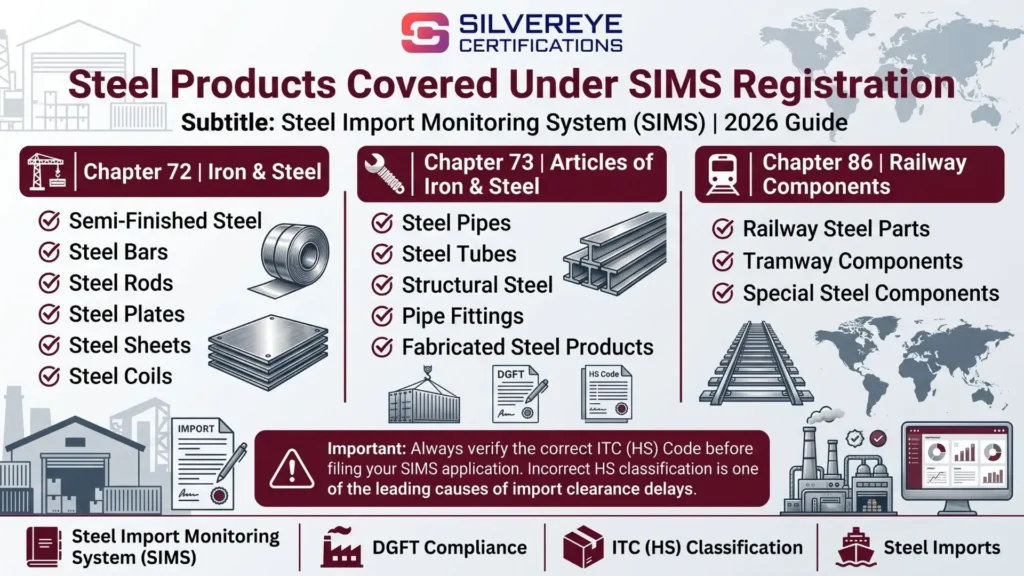
Stainless steel products sit under their own dedicated headings within Chapter 72 of the ITC(HS), separate from the general iron and non-alloy steel codes. Always confirm the exact 8-digit code for your specific grade and form on the SIMS portal before filing.
| HS Heading | Covers |
| 7218 | Stainless steel in ingots or other primary forms; semi-finished stainless steel products |
| 7219 | Flat-rolled products of stainless steel, width 600 mm or more (coils, sheets, plates) |
| 7220 | Flat-rolled products of stainless steel, width less than 600 mm |
| 7221 | Bars and rods of stainless steel, hot-rolled, in irregularly wound coils |
| 7222 | Other bars and rods of stainless steel; angles, shapes, and sections of stainless steel |
| 7223 | Wire of stainless steel |
Grade matters as much as form. Austenitic grades (commonly the 300 series, with roughly 6% or more nickel content) and ferritic/martensitic grades (commonly the 400 series) are treated as distinct product categories in customs and trade-remedy data, so declaring the correct grade alongside the HS code helps avoid classification disputes.
Documents Required for SIMS Registration of Stainless Steel
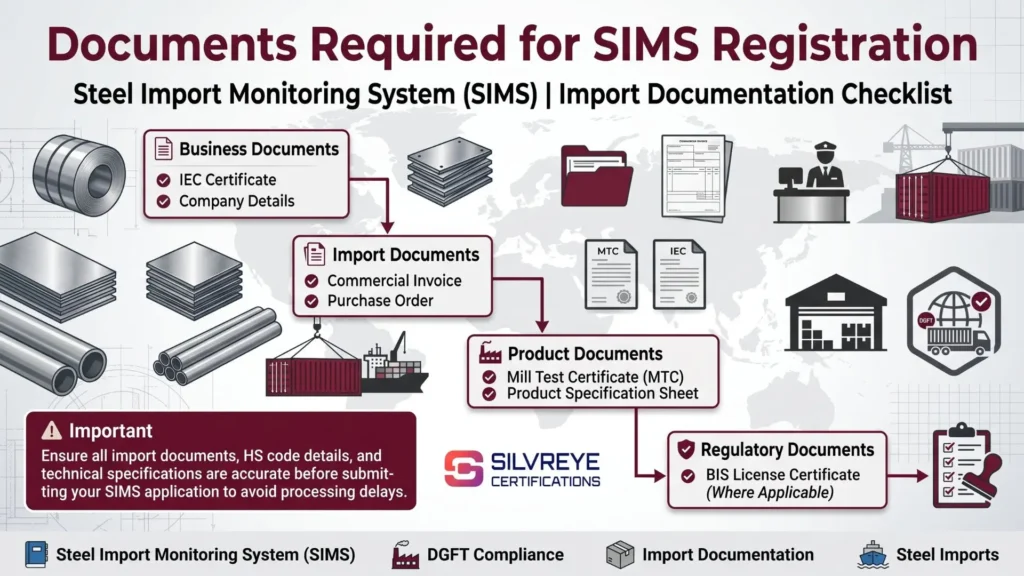
- IEC Certificate: Your valid Import Export Code, used to log in to the SIMS portal.
- Commercial Invoice / Purchase Order: Should specify the stainless steel grade (for example, 304, 316, 430), form (coil, sheet, plate, bar, wire), thickness, and width.
- Mill Test Certificate (MTC): Confirms chemical composition — especially nickel and chromium content — and mechanical properties, which are central to correct stainless steel classification.
- Product Specification Sheet: Technical datasheet supporting the declared HS code and grade.
- BIS Certificate (where currently applicable): Required only for stainless steel products still covered by an active Quality Control Order — check current QCO status before assuming it's needed (see the 2026 update below).
- Certificate of Origin: Increasingly important for stainless steel given active anti-dumping investigations tied to specific countries of origin.
Step-by-Step SIMS Registration Process for Stainless Steel
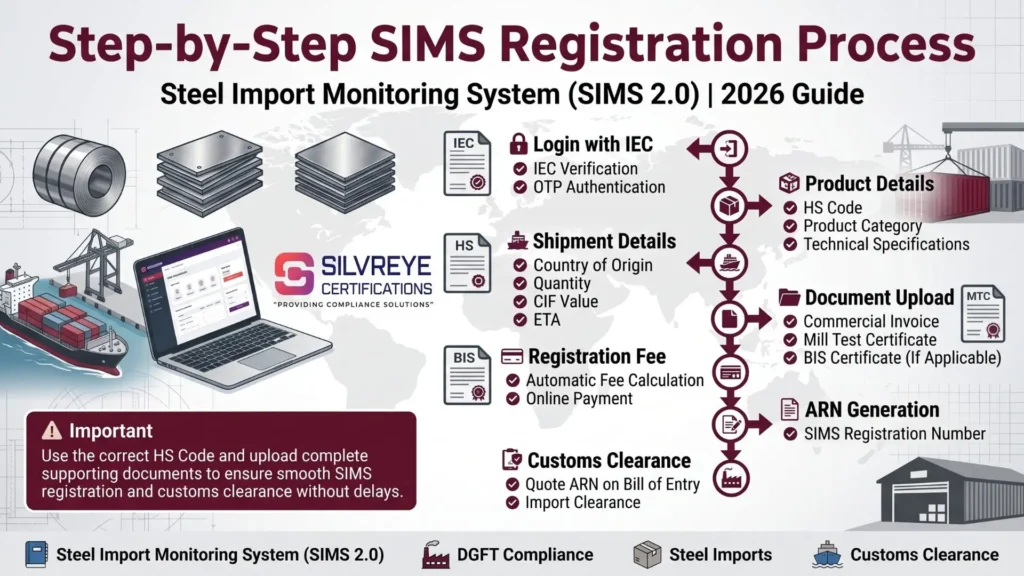
- Confirm the HS code and grade: Match your stainless steel product's form, width, and grade (300 series, 400 series, or other) against the SIMS portal's HS code list.
- Log in with your IEC: Access the SIMS portal and authenticate using your IEC and OTP or digital signature.
- Enter product details: Declare the 8-digit HS code, stainless steel grade, form, thickness, and width.
- Add shipment details: Provide country of origin, country of melt and pour, quantity, CIF value, and expected date of arrival.
- Upload supporting documents: Attach the invoice, Mill Test Certificate, product specification sheet, BIS certificate (if currently required for that product), and certificate of origin.
- Pay the registration fee: The portal calculates the fee automatically based on the CIF value of the covered stainless steel portion.
- Generate your ARN: On successful submission, the SIMS portal issues your Automatic Registration Number — this is your SIMS certificate for the consignment.
- Quote the ARN at customs: Share the ARN and its expiry date with your customs broker for the Bill of Entry.
Once submitted, a SIMS application for stainless steel cannot be edited. If the grade, thickness, or country of melt and pour changes, file a fresh registration rather than trying to amend the original.
SIMS Registration Fees for Stainless Steel
| Fee Component | Detail |
| Rate | Re. 1 per ₹1,000 of the covered stainless steel portion's CIF value |
| Minimum Fee | ₹500 per registration |
| Maximum Fee | ₹1,00,000 per registration |
| Refund Policy | Non-refundable, even if the shipment is delayed or cancelled |
Validity and Renewal Timeline
- Validity period: The Automatic Registration Number (ARN) for stainless steel imports is valid for 75 days from the date of registration.
- Multiple consignments: One ARN can cover several shipments of the same stainless steel product from the same country of origin, as long as they arrive within the 75-day window.
- No formal renewal: If the ARN lapses, or product details (grade, thickness, origin) change, a fresh SIMS registration is required — there's no amendment or extension process.
- Bill of Entry linkage: The ARN and expiry date must both appear on the Bill of Entry for customs to process a stainless steel shipment.
Advance Registration Timeline (2026 Update)
The Ministry of Steel revised the advance registration timeline through Notice No. S-21022/9/2025-TRADE-TAX, dated February 19, 2026, effective from February 20, 2026 — applicable to stainless steel imports the same way it applies to all SIMS-covered steel products.
| Import Category | Registration Window |
| Imports from Nepal, Bhutan, and Sri Lanka | Not earlier than 60 days and not later than 2 days before expected arrival |
| Imports from all other countries | Not earlier than 60 days and not later than 3 days before expected arrival |
| Imports from SEZ/EOU into the domestic tariff area (OTA) | Not earlier than 60 days and not later than 2 days before expected arrival |
Important 2026 Update: BIS Certification Status for Stainless Steel
This is the single biggest recent development for stainless steel importers, and it's easy to miss if you're relying on older guidance. On April 27, 2026, the Ministry of Steel suspended the mandatory Quality Control Order (QCO) that required BIS certification for several stainless steel products, including low-grade stainless steel plates, sheets, and strips used in utensils and kitchen appliances. The original QCO covered roughly 25 stainless steel grades under Indian Standards including IS 5522, IS 15997, and IS 6911, and had been introduced to keep substandard stainless steel out of the utensil and appliance market.
The stated reason for the suspension was to ease the compliance burden on domestic manufacturers, particularly MSMEs. Separately, the BIS certification exemption covering imported stainless steel flat products — including semi-finished forms under IS 14650 and mainstream grades like 304 and 316 — has been extended until October 26, 2026.
- What this means for importers: Many stainless steel products that previously needed a BIS certificate for import can currently move without individual mill BIS certification, through the exemption window.
- What hasn't changed: SIMS registration remains fully mandatory regardless of BIS status — the ARN requirement and advance-registration timeline apply exactly as before.
- Why this could change again: Domestic small and medium stainless steel producers have publicly pushed for the QCO to be reinstated, citing a sharp rise in imports — stainless steel imports in April 2026 alone were reported at roughly 101,252 metric tons, about 65% higher year-on-year.
Because the BIS waiver has a stated end date of October 26, 2026, it's worth checking the current QCO and waiver status on the Ministry of Steel or BIS website close to your shipment date — this is exactly the kind of rule that can revert with little notice.
Anti-Dumping Investigations to Watch for Stainless Steel Imports
Separate from SIMS and BIS, stainless steel is currently under active anti-dumping scrutiny in India, and staying aware of these cases helps importers avoid pricing and compliance surprises.
- Cold-rolled 300/400 series stainless steel: India's Directorate General of Trade Remedies (DGTR) initiated an anti-dumping investigation on September 29, 2025, covering cold-rolled stainless steel flat products from China, Indonesia, and Vietnam.
- Stainless steel seamless tubes and pipes: DGTR initiated a further anti-dumping investigation on June 24, 2026, concerning stainless steel seamless tubes and pipes originating from or exported from China.
- Flat-rolled stainless steel (older case): A separate, longer-running DGTR case has examined flat-rolled stainless steel imports from a wide list of countries, including China, Korea, the EU, Japan, and several ASEAN nations.
An investigation being initiated does not mean duties are in effect immediately — under standard trade-remedy procedure, provisional duties can only follow a preliminary injury finding, and final duties require a completed investigation. Even so, importers sourcing cold-rolled 300/400 series or seamless stainless tube and pipe products from the countries named above should track these cases and factor potential future duty exposure into contracts and pricing.
Common Mistakes to Avoid
- Assuming BIS certification is always required: With the 2026 QCO suspension and waiver in place, some stainless steel products currently don't need individual mill BIS certification — but this status can change, so don't assume either way without checking.
- Misclassifying grade or form: Confusing 300 series with 400 series, or a coil with a sheet, changes both the HS code and potential anti-dumping exposure.
- Ignoring country-of-origin sensitivity: Given active anti-dumping investigations tied to specific countries, an inaccurate or incomplete country-of-origin declaration is a bigger risk for stainless steel than for many other steel categories.
- Late registration: Missing the 60-day to 2–3-day advance window under the February 2026 notice delays customs clearance.
- Trying to amend a submitted SIMS application: Not possible — a fresh registration is required for any change in grade, thickness, or shipment details.
Conclusion
SIMS registration for stainless steel products follows the same fundamental process as any other steel category — IEC-based login, accurate HS code and shipment details, a modest registration fee, and a 75-day ARN validity window. What makes stainless steel different in 2026 is the fast-moving regulatory backdrop around it: the BIS QCO suspension and waiver running through October 26, 2026, and active anti-dumping investigations on cold-rolled 300/400 series products and seamless tubes and pipes.
Treat SIMS registration as the non-negotiable baseline, but build a habit of checking current BIS and anti-dumping status for your specific stainless steel grade and country of origin before every shipment — in this category, the rules around SIMS have stayed stable, but everything around them is moving quickly.
Frequently Asked Question
Is SIMS registration mandatory for all stainless steel imports into India?
Yes. Stainless steel products under HS headings 7218 to 7223 of Chapter 72 require SIMS registration before the Bill of Entry can be filed, regardless of grade or form.
Do I still need BIS certification for stainless steel imports in 2026?
It depends on the specific product. The Ministry of Steel suspended the mandatory QCO for several stainless steel products on April 27, 2026, and extended a BIS certification waiver until October 26, 2026. Always confirm current status for your exact product before assuming either way, since SIMS registration is required regardless.
What is the difference between SIMS registration and BIS certification for stainless steel?
SIMS registration is a mandatory pre-import declaration filed with DGFT/Ministry of Steel. BIS certification is a separate product-quality compliance requirement issued by the Bureau of Indian Standards, currently suspended or waived for several stainless steel product categories through October 26, 2026.
Which HS codes cover stainless steel coils and sheets?
Flat-rolled stainless steel of width 600 mm or more, including coils, sheets, and plates, generally falls under HS heading 7219. Flat-rolled stainless steel narrower than 600 mm falls under HS heading 7220.
How long is a SIMS registration valid for stainless steel imports?
The Automatic Registration Number (ARN) is valid for 75 days from the date of registration, the same validity period used across all SIMS-covered steel products.
What is the SIMS registration fee for stainless steel?
The fee is Re. 1 per ₹1,000 of the covered stainless steel portion's CIF value, subject to a minimum of ₹500 and a maximum of ₹1,00,000.
Is there an anti-dumping duty on stainless steel imports from China right now?
India's DGTR has active anti-dumping investigations on cold-rolled 300/400 series stainless steel (initiated September 2025, covering China, Indonesia, and Vietnam) and on stainless steel seamless tubes and pipes from China (initiated June 2026). An investigation does not automatically mean a duty is in force — check the DGTR website for the current status of the specific case before importing.
How early should I register a stainless steel shipment on SIMS?
As per the Ministry of Steel notice effective February 20, 2026, registration can be done up to 60 days before arrival and must be completed at least 2–3 days before arrival, depending on the country of origin.
Can one SIMS registration cover multiple stainless steel shipments?
Yes, a single ARN can cover multiple consignments of the same stainless steel product from the same country of origin, as long as they're cleared within the 75-day validity window.
What happens if I import stainless steel without SIMS registration?
Customs will not clear the Bill of Entry without a valid ARN, which can lead to a shipment hold, demurrage charges, and possible re-export or financial penalties.
Can I modify my SIMS registration if the stainless steel grade changes after filing?
No. Once submitted, a SIMS application cannot be edited. A change in grade, thickness, or country of melt and pour requires a fresh registration.
Is the SIMS registration fee refundable if my stainless steel shipment is cancelled?
No. The SIMS registration fee is non-refundable, even if the import does not ultimately take place.