
- The COS-1 application to CDSCO requires at least 12 core documents — missing even one can delay your import license by months.
- Korea's MFDS-issued Free Sale Certificate must be apostilled under the Hague Convention before submission to CDSCO in India.
- A manufacturer authorization letter, heavy metal test report, and non-animal testing declaration are mandatory for all Korean cosmetic imports.
- This checklist covers documents for both the import route (COS-1/COS-2) and the manufacturing route (COS-5/COS-8) with exact specifications.
Introduction
To import Korean cosmetics into India legally, you need to file Form COS-1 with CDSCO. The mandatory documents include: Free Sale Certificate (FSC) from Korea's MFDS (apostilled), GMP Certificate, Manufacturer Authorization Letter, complete INCI ingredient list with percentage content, product labels in English, Certificate of Analysis (CoA), heavy metal test report, non-animal testing declaration, and COS-1 application form with prescribed fees.
For Indian manufacturing of Korean formulations, the documents are filed via Form COS-5 to the State Licensing Authority. CDSCO processes COS-1 in 30–90 working days. All foreign documents must be apostilled or notarized before submission.
Why Getting the Documents Right Matters
If you are importing Korean cosmetics into India — whether you are a Korean brand, an Indian distributor, or a regulatory consultant — the documents you submit to CDSCO make or break your import license application. One missing paper, an apostille that was skipped, or an ingredient list that lacks percentage concentrations is enough to get your COS-1 application rejected or delayed.
India's Central Drugs Standard Control Organization (CDSCO) operates under the Drugs & Cosmetics Act 1940 and its Rules 1945. Every cosmetic import requires prior approval in the form of a COS-2 license — and that license only comes after CDSCO reviews your COS-1 application and all supporting documents.
This guide gives you the complete, verified document checklist for 2026 — covering both the import path (COS-1 → COS-2) and the manufacturing path (COS-5 → COS-8). It also explains what each document must contain, which authority issues it, and what the apostille requirement means in practice.
Regulatory Framework: Who Asks for What
| Regulatory Body | Role in Korea-India Cosmetics | Key Document They Issue or Verify |
| CDSCO (India) | Issues COS-2 import license; reviews COS-1 application | COS-2 license; COS-1 approval |
| MFDS (Korea) | Issues Free Sale Certificate confirming legal sale in Korea | Free Sale Certificate (FSC) |
| State Licensing Authority (India) | Issues COS-8 manufacturing license; reviews COS-5 application | COS-8 manufacturing license |
| Ministry of External Affairs (India) / Apostille Authority (Korea) | Apostilles Korean documents for use in India | Apostille stamp on FSC, GMP, etc. |
| NABL-accredited labs (India) | Tests product samples for CoA, heavy metals, microbiological safety | Certificate of Analysis, heavy metal report |
| Customs (CBIC, India) | Verifies COS-2 license number at port of entry | Bill of Entry clearance |
| Legal Metrology Dept (India) | Checks MRP, net quantity, language compliance on label | Inspection report; show cause notice on violations |
CDSCO Cosmetic Import Documents Checklist: COS-1 Application (Import License — Korea to India)
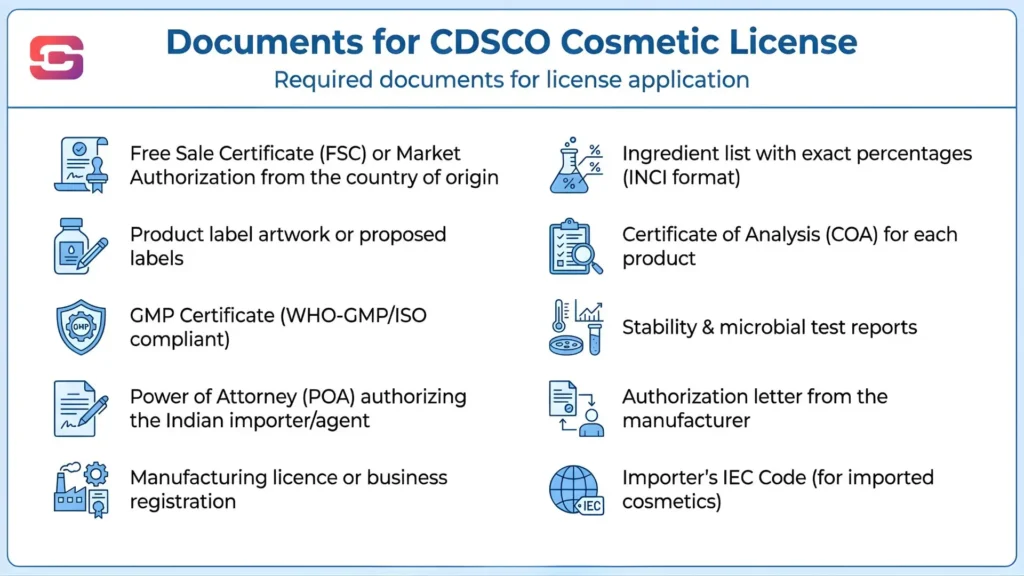
The following is the complete, sequential checklist of documents required for a COS-1 application with CDSCO. Each document is mandatory unless marked 'Conditional'.
| S.No. | Document Name | Status | Issuing Authority | Key Requirements |
| 1 | Form COS-1 — Application for Import License | Mandatory | Filed by Indian importer on CDSCO Sugam portal | All fields completed; product-wise details; correct fee payment |
| 2 | Free Sale Certificate (FSC) | Mandatory | MFDS — Ministry of Food and Drug Safety, Korea | Must be apostilled; product name must match application exactly; valid within 2 years |
| 3 | GMP Certificate (Good Manufacturing Practice) | Mandatory | Korean manufacturer / MFDS Korea | Must be apostilled; must cover the specific manufacturing site; valid within 3 years |
| 4 | Manufacturer Authorization Letter | Mandatory | Korean manufacturer | On company letterhead; authorises Indian importer specifically; product-wise; apostilled or notarised |
| 5 | Certificate of Analysis (CoA) | Mandatory | Accredited lab (Korean or NABL India) | Must cover all batches; includes physical, chemical, microbiological parameters; signed by QC head |
| 6 | INCI Ingredient List with Percentage Content | Mandatory | Korean manufacturer | All ingredients in INCI nomenclature; in descending order; % concentration for each; on company letterhead |
| 7 | Product Labels (English) | Mandatory | Indian importer / brand | Must include all CDSCO & Legal Metrology mandatory fields; English language; printable specimen submitted |
| 8 | Heavy Metal Test Report | Mandatory | NABL-accredited lab or ISO 17025 lab | Tests for Lead, Arsenic, Mercury, Cadmium; values must be within CDSCO Schedule S limits |
| 9 | Non-Animal Testing Declaration | Mandatory | Korean manufacturer / importer | Declares product and ingredients were not tested on animals; required since India banned animal testing in 2014 |
| 10 | Proof of Fee Payment | Mandatory | CDSCO Sugam portal | Fee receipt / challan for applicable product count; submitted with application |
| 11 | Undertaking by Importer | Mandatory | Indian importer | Legal declaration of compliance with D&C Act; signed by authorised signatory; on company letterhead |
| 12 | GST Registration Certificate | Mandatory | GST authority (India) | Proves Indian entity identity; address must match label importer address |
| 13 | Product Safety Data Sheet (SDS) | Conditional | Korean manufacturer | Required for products with active ingredients, sunscreens, hair dyes, or novel ingredients |
| 14 | Clinical / In-vitro Safety Study Report | Conditional | Accredited laboratory | Required for products making specific claims (anti-ageing, whitening, SPF claims); CDSCO may request case-by-case |
| 15 | Stability Test Report | Conditional | Korean manufacturer / lab | Required for products with short shelf life or novel formulations; confirms declared expiry date |
| 16 | Power of Attorney (if filed by regulatory agent) | Conditional | Indian importer | If a third-party regulatory consultant files on behalf of importer; notarised |
| 17 | Import-Export Code (IEC) | Mandatory | DGFT (Directorate General of Foreign Trade) | All importing entities must hold a valid IEC; must be submitted with COS-1 application |
| 18 | Microbial Limit Test Report | Conditional | NABL-accredited lab | Required for rinse-off and leave-on products; aerobic microbial count and absence of specified pathogens |
Pro Tip — Apostille Requirement for Korean Documents
India joined the Hague Apostille Convention on 14 July 2005. This means all public documents originating in Korea — including the Free Sale Certificate and GMP Certificate — must carry an apostille stamp before CDSCO will accept them. In Korea, the apostille is issued by the Ministry of Foreign Affairs (MOFA). The process takes 3–5 business days. Skipping apostillation is the single most common reason for COS-1 rejection.
Detailed Requirements for Each Critical Document
Free Sale Certificate (FSC) from MFDS Korea
The Free Sale Certificate (FSC) is the single most important document in your COS-1 application. It is the official proof that your Korean cosmetic product is legally manufactured and sold in Korea.
- Issued by: Ministry of Food and Drug Safety (MFDS), Korea
- Korean term: 수출용 제품 판매 증명서 (Export Sale Certificate)
- How to obtain: Apply at the MFDS integrated portal (nedrug.mfds.go.kr)
- Processing time: 5–10 business days in Korea
- Apostille requirement: Yes — apostille from Korea's MOFA is mandatory before submission to CDSCO
- Validity: CDSCO accepts FSCs issued within the last 2 years
- Common mistakes: Product name on FSC not matching the application exactly; expired FSC; apostille missing or incomplete
What the FSC must state:
- Name and address of the Korean manufacturer
- Product name (exactly as it will appear on the Indian label)
- Product category (e.g., moisturiser, toner, sunscreen)
- Confirmation that the product is legally sold in Korea
- Date of issue and MFDS seal
GMP Certificate (Good Manufacturing Practice)
The GMP certificate confirms that the Korean facility manufacturing the product operates to internationally recognised quality standards.
- Issued by: MFDS Korea or an internationally accredited certification body (ISO 22716)
- Apostille requirement: Yes — required for MFDS-issued GMPs
- Validity: CDSCO accepts GMP certificates valid within the last 3 years
- Scope: Must explicitly name the manufacturing site address and cover the product category
- ISO 22716: The international GMP standard for cosmetics — widely accepted by CDSCO
CDSCO may request an inspection of the manufacturing facility for high-risk categories or novel ingredients. In practice, this is rare for standard cosmetic categories but common for hair dyes and sunscreens.
Manufacturer Authorization Letter
This letter is the legal instrument through which the Korean manufacturer authorises the Indian importer to import, distribute, and market their products in India.
- Must be on the manufacturer's official company letterhead
- Must name the Indian importer specifically — a generic letter ('to whom it may concern') is not acceptable
- Must list the specific products authorized for import — product-wise and SKU-wise if possible
- Must include the authorization period (typically 1–3 years)
- Must be signed by an authorised signatory of the Korean manufacturer (CEO, Director, or authorised officer)
- Must be apostilled or notarized — CDSCO officers may reject letters without notarization
If the Korean brand has a subsidiary in India, the letter must still be issued by the Korean manufacturing entity
| Element Required in Letter | Why It Matters |
| Manufacturer's full legal name and address | CDSCO verifies this against the GMP and FSC |
| Indian importer's full legal name, GST number, and address | Must match the COS-1 application exactly |
| Product names authorised for import | Covers only listed products; new products need a fresh letter |
| Validity period | Ensures authorisation is current; CDSCO checks date |
| Signatory's name, designation, and signature | Identifies the authorised company representative |
| Apostille / notarisation | Legalises the document for Indian regulatory use |
INCI Ingredient List with Percentage Content
This is the most technically demanding document in the checklist. CDSCO requires not just the INCI names but also the actual concentration of each ingredient.
- All ingredients must use INCI (International Nomenclature of Cosmetic Ingredients) names — not trade names, Korean names, or chemical abbreviations
- Listed in descending order of concentration (highest first)
- Percentage (%) content must be declared for each ingredient
- Ingredients present at less than 1% may be grouped and listed in any order after those above 1% — but each must still have a % declared
- Must be on the manufacturer's official letterhead and signed by the QC/R&D head
- This document is treated as confidential by CDSCO and is not published publicly
Why % concentration matters: CDSCO cross-checks concentrations against Schedule S (restricted substances list). For example, hydroquinone is restricted to 2%; if your product contains more than this, it cannot be imported.
English Product Labels (Label Specimen)
A printed specimen of the proposed English label must be submitted with the COS-1 application. This label must be compliant with both CDSCO and Legal Metrology requirements.
Label elements that CDSCO checks:
- Product name and generic description
- Full INCI ingredient list (in descending order, without % — % is in the separate document)
- Net quantity in metric units (ml or g)
- Manufacturing date and expiry date / PAO symbol
- Batch number
- Country of origin: 'Made in Republic of Korea'
- Importer's name, full Indian address, and customer care contact
- MRP (Incl. of all taxes) — can be left blank on label draft if not yet fixed, but slot must be visible
- Directions for use (for functional products like sunscreens, hair dyes)
- Any required warnings or precautions
Label rejection is common. The most frequent reason is missing importer contact details or INCI names not matching the ingredient list submitted separately.
Heavy Metal Test Report
Since 2018, CDSCO has consistently required heavy metal test reports for cosmetic import applications, especially for skincare, colour cosmetics, and lip products.
| Heavy Metal | CDSCO Permissible Limit (ppm) | Risk if Exceeded |
| Lead (Pb) | 20 ppm (as per Schedule S) | Neurotoxin; reproductive harm |
| Arsenic (As) | 3 ppm (as per Schedule S) | Carcinogen; skin damage |
| Mercury (Hg) | 1 ppm (except Thimerosal in eye products — 0.0065%) | Neurotoxin; kidney damage |
| Cadmium (Cd) | 5 ppm (industry standard; CDSCO aligned) | Carcinogen; organ toxicity |
- Test must be performed by a NABL-accredited laboratory in India, or an ISO 17025 accredited laboratory internationally
- CDSCO may request fresh Indian lab testing even if a Korean lab report is submitted
- Report must include the batch number tested, methodology used (typically ICP-MS), and detection limits
Non-Animal Testing Declaration
- India banned cosmetic animal testing in 2014 under the Drugs & Cosmetics (Fifth Amendment) Rules. This means no cosmetic product — or any ingredient used solely in cosmetics — can be imported into India if it was tested on animals after the ban date.
- The declaration must be signed by the Korean manufacturer's authorized signatory
- It must state: (a) the finished product was not tested on animals, and (b) the cosmetic ingredients were not tested on animals specifically for cosmetic purposes
- The declaration should cover the specific product(s) listed in the COS-1 application
- Internationally recognized cruelty-free certifications (Leaping Bunny, PETA) can be attached as supporting evidence
- This is a self-declaration — CDSCO does not independently verify, but false declarations attract legal liability
Important Clarification
The animal testing ban applies to testing for cosmetic purposes. If an ingredient is used in both a drug and a cosmetic, the testing prohibition covers only cosmetic-specific testing. Korean manufacturers supplying both pharmaceutical and cosmetic markets must document this distinction carefully in their declaration.
COS-1 Application: Step-by-Step Filing Process
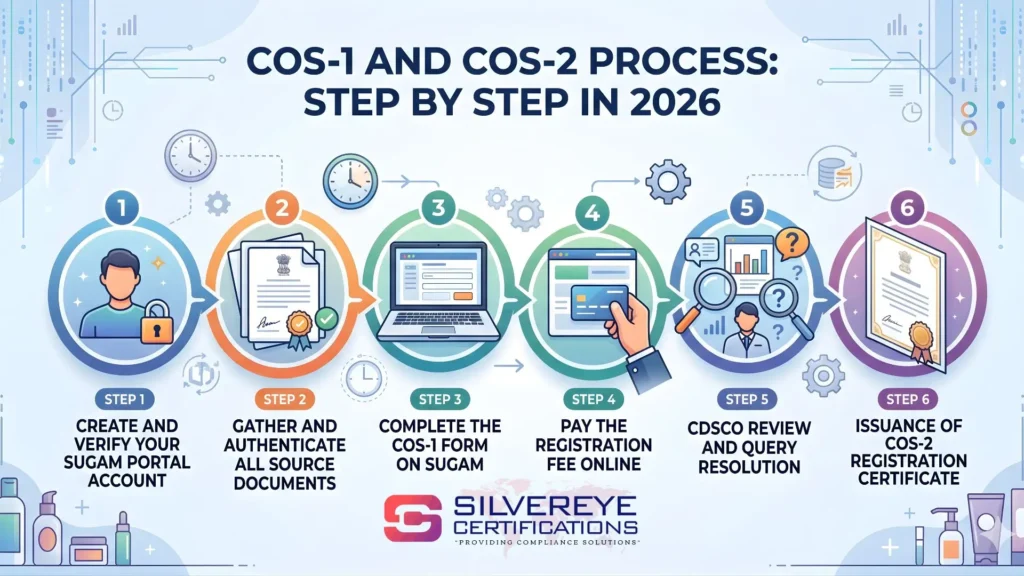
- The COS-1 form is available on the CDSCO Sugam portal. Here is how to file it correctly in 2026.
- Create or log in to your account on the CDSCO Sugam portal (sugam.gov.in). The Indian importer must hold the account.
- Select 'Application for Import License — Cosmetics' and choose Form COS-1.
- Enter importer details: company name, GST number, Import-Export Code (IEC), registered address, and customer care contact.
- Add product details for each product: product name (as on label), category, manufacturer name and address, country of origin, shelf life, and label description.
- Upload all supporting documents in PDF format. Each document must be clearly named and under the file size limit specified on the portal.
- Calculate the fee based on the number of products. Pay online through the Sugam portal's payment gateway.
- Download and keep the fee payment receipt (challan). This is part of the application.
- Submit the application. Note the application reference number.
- Monitor the portal for queries from CDSCO reviewers. Respond to all queries within the specified timeline (typically 30 days).
- Upon approval, download the COS-2 license from the Sugam portal.
| COS-1 Filing Detail | Specification |
| Portal URL | sugam.gov.in |
| Who can file? | Indian importing entity (company, LLP, or proprietorship with GST + IEC) |
| Document format | PDF; individual file size typically under 2 MB per document |
| Fee payment mode | Online (NEFT/RTGS/UPI through Sugam portal) |
| Application acknowledgement | System-generated; keep for records |
| Query response window | 30 working days from CDSCO query date |
| Processing timeline | 30–90 working days from complete application submission |
| Status tracking | Live on Sugam portal under 'Track Application' |
| Physical submission required? | No — fully online since 2020 |
| Multiple products in one application? | Yes — products from the same manufacturer can be clubbed in one COS-1 |
Form COS-2 — Grant of Import License: What You Receive
Once CDSCO approves your COS-1 application, they issue Form COS-2 — the actual Import License for Cosmetics. This is the document that makes your import operation legal in India.
| COS-2 License Detail | Information |
| What it is | Official import license authorising the Indian entity to import listed cosmetics from the specified manufacturer |
| Legal basis | Rule 130 of the Drugs & Cosmetics Rules 1945 |
| Issued by | CDSCO (Central Drugs Standard Control Organisation) |
| Validity | 5 years from the date of grant |
| Renewal | Apply on Sugam portal at least 3 months before expiry |
| Coverage | Lists each authorised product by name; new products require amendment or fresh application |
| License number format | Alphanumeric; e.g., COS/IMP/2024/XXXXX |
| Port clearance use | License number must be declared to customs at port of entry for each shipment |
| Public verification | COS-2 license details are verifiable on CDSCO's public portal |
| Consequences of lapse | Import is legally prohibited; customs will detain or return shipments; stock in India cannot be sol |
Form COS-5 — Application for Manufacturing License
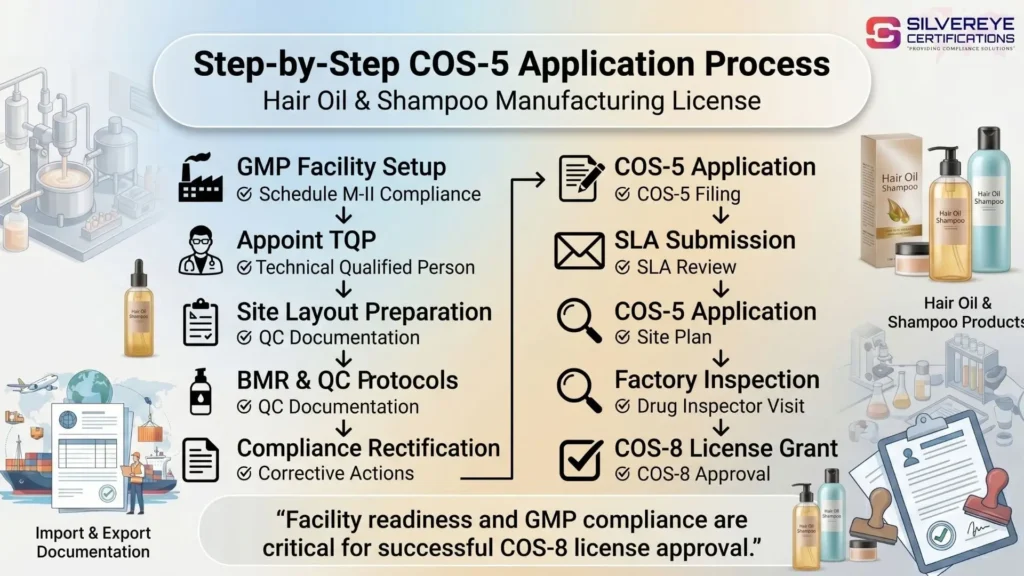
If your Korean brand or its Indian partner wants to manufacture cosmetics in India — either from Korean formulations or locally developed K-beauty inspired products — you need a COS-5 application and the resulting COS-8 manufacturing license.
Who Needs COS-5?
- Indian companies manufacturing Korean-formulated products under a license or technology transfer agreement
- Contract manufacturers (CMOs/CDMOs) in India who will produce products for a Korean brand
- Korean companies that have set up Indian subsidiaries with manufacturing facilities
- Businesses shifting from importing to Indian manufacturing to reduce duty costs
Documents Required for COS-5 Application
| S.No. | Document | Source / Authority | Notes |
| 1 | Form COS-5 — Application for Manufacturing License | Indian manufacturer; filed with State Licensing Authority | Available on state drug controller portal; not on CDSCO Sugam |
| 2 | Site Plan of Manufacturing Premises | Indian manufacturer (architect-certified) | Must show clean rooms, storage, QC lab, production areas with dimensions |
| 3 | List of Manufacturing Equipment | Indian manufacturer | Equipment names, capacities, and compliance with GMP standards |
| 4 | Qualified Person (QP) / Technical Staff Credentials | The qualified individual | Minimum: Graduate in pharmacy, chemistry, or microbiology; employment proof |
| 5 | Product List for which License is Sought | Indian manufacturer | Includes product name, category, intended market |
| 6 | Proof of Premises Ownership or Lease | Indian manufacturer | Registered sale deed or registered lease agreement |
| 7 | GST Registration of Manufacturing Entity | GST authority | Confirms Indian entity's legal identity |
| 8 | Technology Transfer Agreement / Formulation License | Korean brand + Indian manufacturer | Required when Indian manufacturer uses Korean intellectual property or formulations |
| 9 | Raw Material Sources and Supplier List | Indian manufacturer | Confirms local and imported ingredient sourcing |
| 10 | Undertaking for GMP Compliance | Indian manufacturer | Declares commitment to Schedule M-II requirements |
COS-5 is filed with the State Licensing Authority (SLA) — not CDSCO centrally. Each Indian state has its own Drug Controller who handles COS-5 applications. The process, fees, and timelines vary by state.
Form COS-8 — Grant of Manufacturing License
COS-8 is the manufacturing license issued by the State Licensing Authority once the COS-5 application is approved and the manufacturing premises have been inspected.
| COS-8 License Detail | Information |
| What it is | Manufacturing license authorising the Indian entity to manufacture listed cosmetics at the specified premises |
| Legal basis | Rule 132 of the Drugs & Cosmetics Rules 1945 |
| Issued by | State Licensing Authority (State Drug Controller) |
| Validity | 5 years from the date of grant |
| Inspection | Mandatory GMP inspection of premises before license is granted |
| Renewal | Apply 3 months before expiry; fresh inspection may be required |
| Coverage | Covers listed product categories at the specified manufacturing site address |
| Label declaration | Products manufactured under COS-8 carry 'Manufactured by [Indian entity]' — may state 'Formulation by [Korean brand]' |
| Consequences of lapse | Manufacturing must stop; products manufactured after lapse are deemed illegal |
Import vs Manufacturing Route: Document Comparison
| Document | COS-1 (Import) | COS-5 (Manufacturing) |
| Application Form | Form COS-1 (CDSCO Sugam) | Form COS-5 (State Drug Controller) |
| Free Sale Certificate (Korea) | Required | Not required |
| GMP Certificate (Korea) | Required | Not required (Indian GMP applies) |
| Manufacturer Authorization | Required | Technology Transfer Agreement instead |
| INCI List with % content | Required | Required (as part of product formulation) |
| English Product Label | Required | Required |
| Heavy Metal Test Report | Required | Required (post-manufacturing) |
| Non-Animal Testing Declaration | Required | Required |
| Site Plan | Not required | Required |
| Equipment List | Not required | Required |
| Qualified Technical Person proof | Not required | Required |
| Schedule M-II GMP Compliance | Not directly | Required for inspection |
| Import-Export Code (IEC) | Required | Not required |
| Processing Authority | CDSCO (Central) | State Licensing Authority |
| Processing Time | 30–90 working days | 60–120 working days |
| License Validity | 5 years (COS-2) | 5 years (COS-8) |
Apostille Process for Korean Documents: Step-by-Step
Korea is a member of the Hague Apostille Convention. India joined in 2005. This means Korean official documents — primarily the Free Sale Certificate and GMP Certificate — must carry a Korean apostille before they are legally valid in India.
| Step | Action | Authority | Timeline |
| 1 | Obtain the original document (FSC, GMP) from MFDS Korea | MFDS (Ministry of Food and Drug Safety) | 5–10 business days |
| 2 | Verify the document is an official public document (required for apostille eligibility) | MFDS | Concurrent with Step 1 |
| 3 | Submit document to Korea's apostille authority with application form and fee | Ministry of Foreign Affairs (MOFA), Republic of Korea | 3–5 business days |
| 4 | Receive apostilled document (apostille stamp/certificate attached) | MOFA Korea | Same day or next day after processing |
| 5 | Submit apostilled documents to CDSCO as part of COS-1 application | CDSCO Sugam portal | On COS-1 submission date |
Note: If any document has been translated from Korean to English, the translated version must also be apostilled or certified by a notary. CDSCO officers verify the apostille chain for Korean-language originals.
MOFA Korea Apostille portal: apostille.go.kr (Korean language; use a Korean regulatory consultant for guidance).
Fees for CDSCO COS-1 Application (2026)
Fees are prescribed under the Drugs & Cosmetics (Fees) Rules. Always confirm current fees on the CDSCO Sugam portal before filing, as revisions may occur. The following are indicative 2026 figures.
| Application Type | No. of Products | Indicative Fee (INR) | Notes |
| COS-1 Import License | 1–5 products | ₹3,000 per product | Each distinct SKU counts as one product |
| COS-1 Import License | 6–20 products | ₹2,500 per product (approx.) | Slab-based pricing on Sugam portal |
| COS-1 Import License | 21–50 products | ₹2,000 per product (approx.) | Confirm current slab on portal |
| COS-1 Import License | 50+ products | Approx. ₹50,000–₹1,00,000 flat | Bulk application; confirm with CDSCO |
| COS-1 Amendment (add products) | Per new product | Same as initial per-product fee | Adding new products or new manufacturer |
| COS-2 Renewal | All products | Same as initial fee | Renew before 5-year expiry |
| COS-5 Manufacturing License | State-specific | ₹3,500–₹10,000 (state variation) | Paid to State Drug Controller |
| COS-8 Manufacturing Renewal | State-specific | Same as initial | State Drug Controller |
| Apostille Fee (Korea) | Per document | KRW 3,000–5,000 per document | Paid in Korea to MOFA; approximately ₹200–350 INR |
All CDSCO fees must be paid through the Sugam portal's online gateway. Do not make cash payments or bank transfers outside the portal — these are not accepted.
End-to-End Timeline: Korean Cosmetics Import License India
| Phase | Activity | Estimated Duration | Responsible Party |
| Pre-application (Korea) | Obtain FSC from MFDS | 5–10 business days | Korean manufacturer |
| Pre-application (Korea) | Apostille FSC and GMP at MOFA Korea | 3–5 business days | Korean manufacturer / exporter |
| Pre-application (Korea) | Prepare manufacturer authorization letter (apostilled) | 3–7 business days | Korean manufacturer |
| Pre-application (India) | Heavy metal and CoA testing in India (if required) | 10–20 business days | Indian importer / lab |
| Pre-application (India) | Draft English label and get internal approval | 5–10 business days | Indian importer |
| Application filing | Compile and submit COS-1 on Sugam portal | 2–5 business days | Indian importer / regulatory consultant |
| CDSCO review | CDSCO review and query issuance | 30–60 working days | CDSCO |
| Query response | Importer responds to CDSCO queries (if any) | 10–30 working days | Indian importer |
| Approval & grant | COS-2 license issued | Within 5–10 working days of final approval | CDSCO |
| Total typical timeline | From Korea document collection to COS-2 in hand | 3–6 months | End-to-end |
Fast-track or priority processing is not a formal CDSCO programme. However, complete applications with no deficiencies are processed faster. Engaging a CDSCO-experienced regulatory consultant significantly reduces query rates and delays.
Validity and Renewal: COS-2 & COS-8
| License | Validity | Renewal Window | Renewal Documents | Consequence of Non-Renewal |
| COS-2 (Import) | 5 years | Apply 3 months before expiry | Updated fee payment; no significant change if same products/manufacturer | Import banned; customs detains shipments; stock cannot be sold |
| COS-8 (Manufacturing) | 5 years | Apply 3 months before expiry | Fresh GMP inspection likely; updated product list if changed | Manufacturing must stop; products from the facility are deemed illegal post-expiry |
Common Reasons for COS-1 Application Rejection or Delay
| S.No. | Common Mistake | Impact | How to Avoid |
| 1 | FSC not apostilled or apostille expired | Immediate rejection | Always check apostille date before filing |
| 2 | Product name on FSC doesn't match COS-1 application | Query or rejection | Use exact product name as it appears on the original Korean label |
| 3 | INCI list without % concentration | Query — delays application | Always provide % for each ingredient; Korean manufacturer must disclose |
| 4 | Missing heavy metal test report | Application put on hold | Get NABL-accredited test done before filing |
| 5 | Label draft missing importer details | Label rejected; re-draft required | Include all Legal Metrology and CDSCO fields in label draft |
| 6 | Non-animal testing declaration too generic | Query from CDSCO | Declaration must name specific products and certify both finished product and ingredients |
| 7 | Power of Attorney not notarised (if consultant filing) | Application may not be accepted | Notarise PoA before submission |
| 8 | Manufacturer authorization letter not product-specific | Query from CDSCO | List each product by name in the authorization letter |
| 9 | IEC (Import-Export Code) not submitted | Application incomplete | Obtain IEC from DGFT before filing |
| 10 | Fee calculation error (product count mismatch) | Application on hold | Count each distinct SKU as one product; recheck before payment |
Frequently Asked Questions
Is the Free Sale Certificate from MFDS the same as the Certificate of Analysis?
No. They are two separate documents. The Free Sale Certificate (FSC) from MFDS confirms the product is legally sold in Korea. The Certificate of Analysis (CoA) from a laboratory confirms the product meets its quality specifications (purity, pH, viscosity, microbial counts, etc.). Both are mandatory for COS-1
Can the manufacturer authorization letter be a general letter valid for all products?
CDSCO prefers product-specific authorization letters. While a general letter may sometimes be accepted during review, it frequently triggers a query asking for product-wise clarification. The safest approach is to list all products by name in the authorization letter. A general letter is more likely to cause delays than save time.
Does the Korean manufacturer need to register directly with CDSCO?
No. The Korean manufacturer does not register directly with CDSCO. The Indian importer is the regulated entity who holds the COS-2 license. The Korean manufacturer's details (name, address, GMP certificate) are referenced in the COS-2 license but the legal obligation rests with the Indian importer.
How long is the apostille on a Korean FSC valid in India?
India does not set a separate validity period for apostilles. However, CDSCO generally requires the underlying document (FSC) to have been issued within the last 2 years. If the FSC is within this window and has a valid apostille, CDSCO will accept it. Always check the MFDS issue date on the FSC itself.
Can I start importing Korean cosmetics while my COS-1 application is being processed?
No. Importing cosmetics into India without a valid COS-2 license — even one application in process — is a violation of the Drugs & Cosmetics Act 1940. Goods may be detained at the port and the importer faces penalties including product seizure. You must wait for the COS-2 license before the first commercial shipment.
Can I add new Korean cosmetic products to an existing COS-2 license?
Yes. You can file an amendment to an existing COS-2 license to add new products from the same manufacturer. You will need a new FSC covering the new products, an updated manufacturer authorization letter, and the applicable per-product fee. The amendment is typically processed faster (30–45 working days) than a fresh COS-1.
What happens if my Korean manufacturer changes their manufacturing site?
A change in manufacturing site invalidates the GMP coverage in your existing COS-2 license. You must file an amendment with CDSCO, submitting a new GMP Certificate for the new site (apostilled) and a fresh manufacturer authorization letter. Continue importing from the original site until the amendment is approved.
Are there restrictions on which Korean cosmetic products can be imported into India?
Yes. Products containing ingredients listed in CDSCO's Schedule S (prohibited substances) — such as certain hair dyes, mercury compounds above limits, or banned preservatives — cannot be imported regardless of their legal status in Korea.
Can the COS-5 application be filed online like COS-1?
The COS-5 application is filed with the State Licensing Authority (SLA), which varies by Indian state. Many states have moved to online portals, but some still require physical submission. Check your specific state's Drug Controller website for the current process. Unlike COS-1 (fully online on Sugam), COS-5 is state-dependent.
What is the difference between an Import-Export Code (IEC) and a COS-2 license?
They serve completely different functions. The Import-Export Code (IEC) is a 10-digit code issued by DGFT (Directorate General of Foreign Trade) that allows any business to import or export goods into India — it is not cosmetic-specific. The COS-2 license is issued by CDSCO specifically for cosmetic imports and authorizes the import of listed cosmetic products. Both are required for legal Korean cosmetics import; IEC to cross the customs border and COS-2 to sell the products in India.