
- CE marking is legally mandatory for all in vitro diagnostic (IVD) devices sold in the European Union under Regulation (EU) 2017/746 (IVDR).
- The IVDR fully replaced the old IVD Directive (IVDD 98/79/EC) — most manufacturers must now work with a Notified Body, regardless of their device risk class.
- Getting CE marking for IVD devices involves device classification, technical documentation, performance evaluation, conformity assessment, and EU registration in EUDAMED.
- Timelines typically range from 6 months to 3+ years depending on device class, Notified Body availability, and documentation readiness — plan early for 2026 compliance.
What Is CE Marking for IVD Devices?
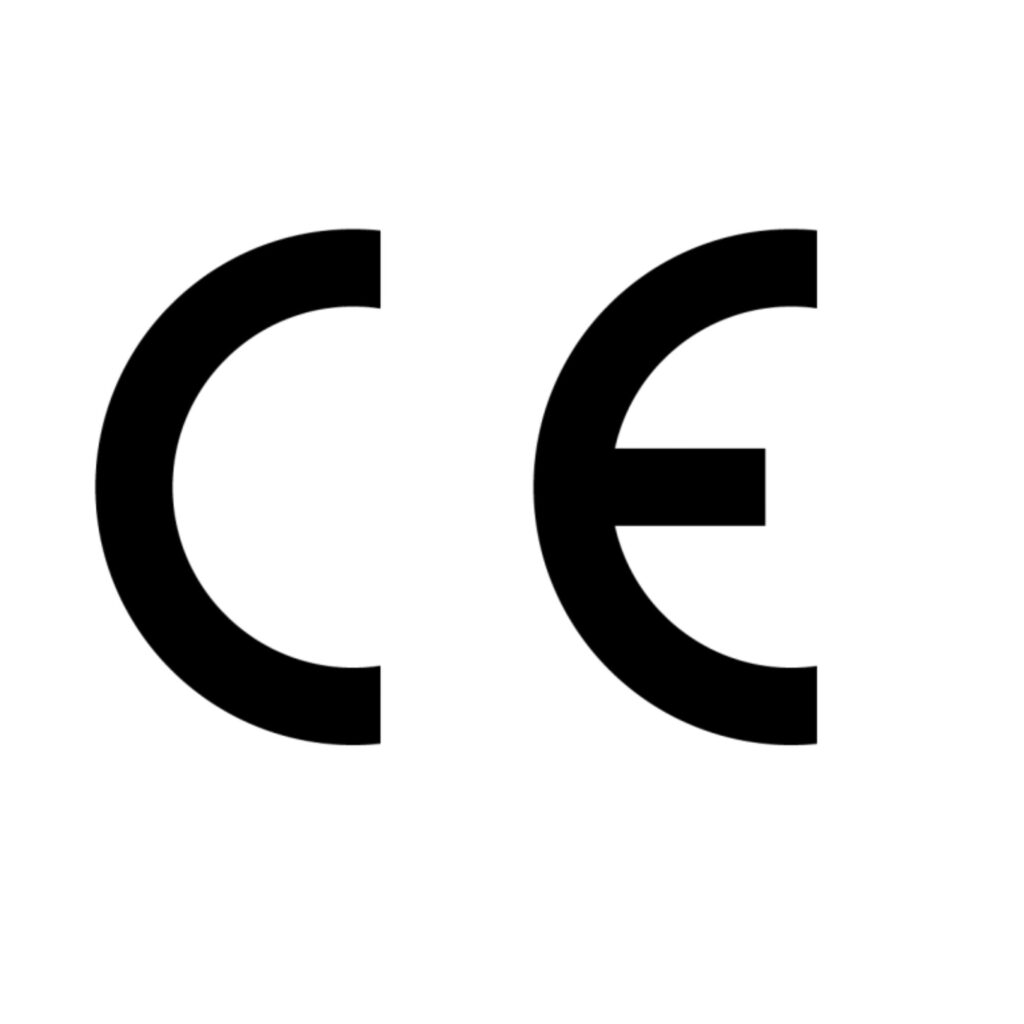
CE marking on an in vitro diagnostic device is the manufacturer's declaration that the product meets all applicable European Union health, safety, and performance requirements. The 'CE' stands for Conformité Européenne — French for European Conformity.
If your device tests samples taken from the human body (blood, urine, tissue, saliva, etc.) to provide information about a physiological or pathological state, it almost certainly qualifies as an IVD medical device under EU law. That means it requires a CE mark before it can be placed on the EU market, put into service, or commercially distributed in the European Economic Area (EEA).
The governing regulation since May 26, 2022 (and extended timelines for some devices) is Regulation (EU) 2017/746, commonly called the IVDR. This replaced the previous IVD Directive 98/79/EC and introduced far stricter requirements for clinical evidence, post-market surveillance, and independent third-party assessment.
Why CE Marking Matters for IVD Manufacturers
- It is the legal gateway to the EU/EEA market — you cannot sell without it.
- It signals conformity to performance, safety, and quality standards to healthcare providers and patients.
- It protects manufacturers from significant legal and financial liability.
- Without CE marking, your devices can be seized, recalled, and your company can face enforcement action.
IVDR vs IVDD: Key Differences in 2026
Many manufacturers transitioned from the old IVD Directive (IVDD 98/79/EC) to IVDR and found the change more significant than expected. Here is a direct comparison of the key differences:
| Aspect | IVDD (Old) | IVDR (Current 2026) |
| Legal basis | Directive 98/79/EC | Regulation (EU) 2017/746 |
| Direct applicability | Transposed into national law | Directly applicable in all EU states |
| Classification system | List A, List B, Self-test, General | Class A, B, C, D (risk-based) |
| Notified Body requirement | ~20% of devices | ~80–85% of devices |
| Clinical/performance evidence | Limited requirements | Rigorous PMPF & performance evaluation |
| Post-market surveillance | Basic PMS plans | Comprehensive PMCF & PMPF required |
| EUDAMED registration | Not mandatory | Mandatory for all devices & actors |
| UDI (Unique Device Identification) | Not required | Mandatory for all devices |
| Labelling requirements | Standard | Enhanced, including UDI-DI |
The IVDR transition deadlines were extended by EU Regulation 2022/112. For 2026, if your device does not yet have IVDR certification but had valid IVDD conformity, the grace period depends on its class — Class D devices had the earliest deadline (May 2025), while Class B/C and Class A sterile devices have extended timelines. Verify your specific deadline with a regulatory expert or your Notified Body.
Who Needs CE Marking for IVD Devices?
If you fall into any of the following categories and deal with IVD medical devices for the EU/EEA market, CE marking applies to you:
| Role | CE Marking Obligation |
| Manufacturer | Full IVDR compliance; places CE mark; responsible for QMS, technical file, DoC |
| Authorised Representative (EU Rep) | Required for non-EU manufacturers; acts as EU legal entity |
| Importer | Must verify manufacturer compliance before placing on EU market |
| Distributor | Must verify CE mark is in place; report issues to manufacturer/competent authority |
| System/Procedure Pack assembler | Must follow IVDR Article 22; CE mark the system if combining devices |
Note: Devices manufactured and used entirely within a single health institution (in-house devices) may be exempt under specific IVDR Article 5(5) conditions — but this is not a blanket exemption and has strict limitations.
IVDR Device Classification Rules
One of the biggest changes under IVDR is the new risk-based classification system. Under the old IVDD, most devices fell into the 'General' category and self-certified. Under IVDR, the classification is more granular and shifts most devices into classes that require Notified Body involvement.
| Class | Risk Level | Examples | Notified Body Required? |
| A | Lowest risk | Specimen reception containers, general lab instruments | No (unless sterile) |
| B | Low-moderate risk | Self-test pregnancy tests, urinalysis strips, CRP tests | Yes |
| C | Moderate-high risk | HbA1c tests, PSA tests, rubella IgG serology | Yes |
| D | Highest risk | HIV, Hepatitis B/C/D, blood grouping, SARS-CoV-2 confirmatory tests | Yes (+ EU Reference Lab) |
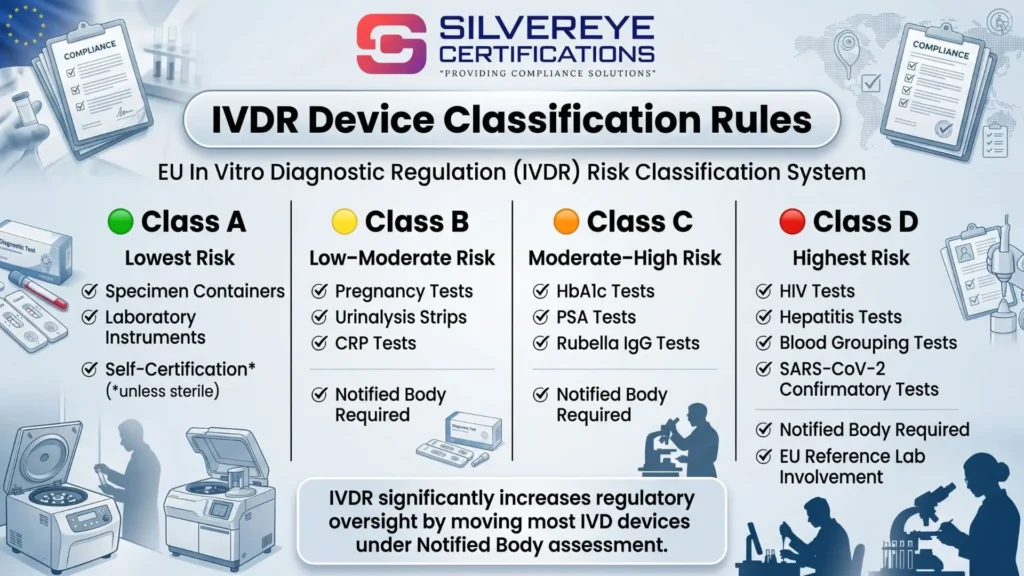
Classification is determined by applying the rules in Annex VIII of IVDR. There are 7 classification rules. When in doubt about classification, engage a regulatory consultant early — misclassification is one of the most common and costly errors in IVD CE marking applications.
CE Marking Requirements Under IVDR
To affix a CE mark to an IVD device, manufacturers must demonstrate compliance with the General Safety and Performance Requirements (GSPR) set out in Annex I of IVDR. These cover:
- Chemical, physical, and biological safety of the device
- Design and manufacturing requirements for performance and reproducibility
- Analytical performance: accuracy, precision, sensitivity, specificity, linearity
- Clinical performance: diagnostic sensitivity, specificity, PPV, NPV where applicable
- Labelling and Instructions for Use (IFU) requirements
- Information supplied by the manufacturer including post-market obligations
- Sterility and shelf-life requirements where applicable
Compliance with harmonised standards (such as EN ISO 13485, EN ISO 15189, or relevant ISO/IEC standards for specific test methods) provides a presumption of conformity for the covered requirements. However, harmonised standards do not cover all GSPR requirements — manufacturers must address all requirements even where no standard exists.
Conformity Assessment Pathways
The conformity assessment pathway depends on the device class. Below is a summary of the routes available under IVDR Annex IX, X, and XI:
| Class | Pathway | Key Requirements |
| A (non-sterile) | Self-declaration (Annex IV) | Technical documentation + DoC; no Notified Body needed |
| A (sterile) | Annex IX or XI (sterility aspects only) | Notified Body assesses sterility manufacturing |
| B | Annex IX or Annex XI + X | QMS assessment + Technical file review by Notified Body |
| C | Annex IX or Annex XI + X | Full QMS + technical documentation; batch verification if applicable |
| D | Annex IX + Annex IX Ch. II + EU Reference Lab | Full QMS + tech doc + EU Reference Laboratory verification |
For Class D devices, EU Reference Laboratories play a critical role. They assess performance claims and verify that test batches meet the standard — this adds significant time to the certification process.
Required Documents and Technical File For CE Marking
The technical documentation (also called the technical file) is the backbone of your CE marking application. Under IVDR Annex II and III, it must include:
| Document Category | What It Must Cover |
| Device description & specification | Intended purpose, design, materials, components, accessories, variants, UDI |
| Design & manufacturing information | Manufacturing processes, sites, suppliers, sterilisation if applicable |
| General Safety & Performance Requirements (GSPR) | Compliance checklist referencing each Annex I requirement |
| Benefit-risk analysis | Risk management file per ISO 14971; justification of benefits vs residual risks |
| Performance evaluation report (PER) | Analytical & clinical performance data, comparator data, reference standards |
| Post-market performance follow-up (PMPF) plan | Ongoing data collection strategy, periodic summary update reports (PSUR) |
| Labelling & IFU | All labels including UDI; Instructions for Use in required languages |
| Declaration of Conformity (DoC) | Signed statement of IVDR compliance by manufacturer's legal entity |
| Quality Management System records | ISO 13485 QMS certification or equivalent; NB quality assessment records |
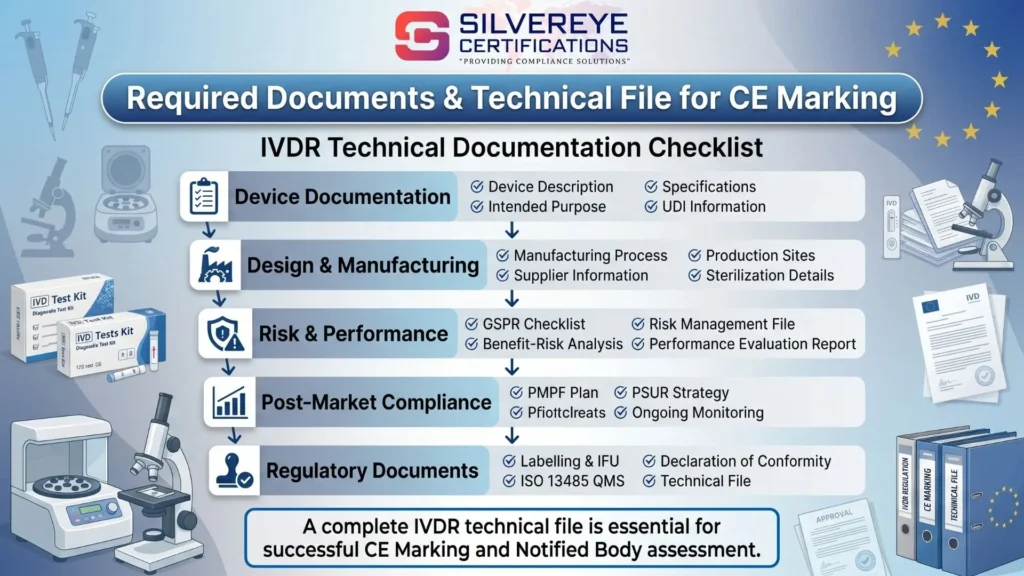
Your technical documentation must be written in the official language(s) of the EU member state(s) where you intend to market the device, or in English where accepted. It must be kept up to date throughout the product lifecycle.
Performance Evaluation Under IVDR
Performance evaluation is arguably the most rigorous and time-consuming part of the IVDR compliance process. Under IVDR Article 56 and Annex XIII, it is an ongoing process — not a one-time activity.
What Performance Evaluation Covers
- Scientific validity: Is the analyte associated with the clinical condition the device claims to detect?
- Analytical performance: Sensitivity, specificity, accuracy, precision, interference, carry-over, stability
- Clinical performance: Diagnostic sensitivity, specificity, PPV, NPV, likelihood ratios — from clinical studies or equivalent data sources
Performance evaluation data must come from performance studies, literature, and/or data generated on equivalent devices (where equivalence can be demonstrated). For Class C and D devices, clinical performance studies are generally required and must follow IVDR Annex XIII Part A.
The Performance Evaluation Report (PER) documents all of this data. It is a living document — it must be updated regularly as part of Post-Market Performance Follow-Up (PMPF).
Notified Body: When and How to Involve One
A Notified Body (NB) is a third-party conformity assessment organisation designated by EU member states to assess whether devices meet IVDR requirements. If your device is Class B, C, or D — or Class A sterile — you cannot self-certify; a Notified Body assessment is mandatory.
How to Choose a Notified Body
- The Notified Body must be designated (notified) under IVDR specifically — IVDD designations are no longer valid.
- Check the NANDO database (New Approach Notified and Designated Organisations) on the European Commission website.
- Confirm the NB is designated for your specific device class and code — scope matters significantly.
- Ask about their current application backlog — wait times from application to audit can exceed 12–18 months.
Tip: Initiate contact with your chosen Notified Body as early as possible, even before your technical documentation is complete. Waiting lists are long, and early engagement can save months of delay.
EUDAMED Registration Requirements
EUDAMED — the European Database on Medical Devices — is the EU's central repository for IVD device and actor information. Under IVDR, EUDAMED registration is mandatory for:
- Manufacturers (must register as 'economic operator')
- Authorised Representatives (EU Reps)
- Importers
- All IVD devices placed on the EU market (device registration, including UDI-DI)
- Clinical performance studies and post-market performance follow-up data
Manufacturers must obtain an SRN (Single Registration Number) from EUDAMED before placing devices on the market. Device registration (with UDI) must also be completed and kept up to date. EUDAMED aims to enhance transparency — much of the information will eventually be publicly accessible.
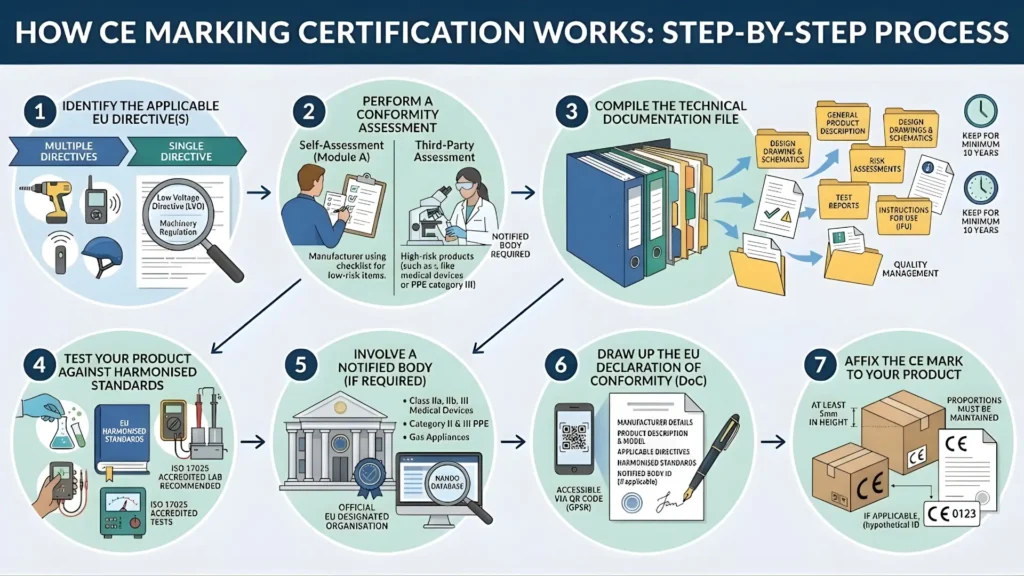
CE Marking Process: Step-by-Step
Here is the end-to-end CE marking process for IVD devices under IVDR in 2026:
| Step | Phase | Actions Required |
| 1 | Device classification | Apply IVDR Annex VIII classification rules; confirm Class A/B/C/D |
| 2 | Identify conformity assessment pathway | Select applicable Annex (IX, X, XI) based on class |
| 3 | Implement Quality Management System | Achieve ISO 13485 certification (or equivalent QMS) |
| 4 | Compile technical documentation | Prepare full Annex II & III technical file |
| 5 | Conduct performance evaluation | Complete analytical, scientific & clinical performance studies |
| 6 | Risk management | Complete ISO 14971 risk file and benefit-risk analysis |
| 7 | Notified Body engagement (if required) | Submit application, undergo QMS audit and technical documentation review |
| 8 | EU Reference Lab review (Class D only) | Submit device batch for EU Reference Laboratory verification |
| 9 | EUDAMED registration | Register as economic operator; obtain SRN; register device with UDI |
| 10 | Issue Declaration of Conformity (DoC) | Manufacturer signs DoC; affixes CE mark to device and labelling |
| 11 | Post-market obligations | Implement PMS system, PMPF plan, PSUR, vigilance reporting |
Costs and Fees for IVD CE Certification in 2026
CE marking costs for IVD devices vary significantly based on device class, the complexity of the technical file, whether new performance studies are needed, and the Notified Body selected. Here is a realistic breakdown:
| Cost Component | Estimated Range (EUR) | Notes |
| ISO 13485 QMS certification | 5,000 – 25,000 | Depending on company size and audit scope |
| Technical documentation preparation | 10,000 – 80,000+ | In-house vs. outsourced regulatory writing |
| Performance studies (analytical) | 5,000 – 50,000 | Depends on study design and laboratory used |
| Clinical performance studies | 20,000 – 200,000+ | Class C & D; site costs, monitoring, data management |
| Notified Body application & audit fees | 10,000 – 100,000+ | Varies by NB, class, and number of devices |
| EU Reference Lab (Class D only) | Variable; significant | Costs set by the specific Reference Laboratory |
| EUDAMED registration | Free (self-registration) | Staff time only for data entry and maintenance |
| Regulatory consultant fees | 5,000 – 50,000+ | Optional but often cost-effective for smaller companies |
Total costs for a Class A self-certified device can be as low as EUR 15,000–30,000. For a Class D device requiring clinical studies and EU Reference Lab involvement, total costs can reach EUR 500,000 or more. Budget and plan accordingly.
Validity and Renewal of CE Certificates
CE certificates issued by Notified Bodies under IVDR are typically valid for 5 years. However, validity is conditional:
- The QMS certificate must remain valid and the annual surveillance audits must be passed.
- The technical documentation must be kept current and updated when the device changes.
- Post-market surveillance data must be reviewed regularly and the PER and PSUR updated.
- Any significant change to design, manufacturing, performance claims, or intended purpose triggers a new conformity assessment.
Renewal process: Manufacturers should initiate the renewal process at least 12–18 months before certificate expiry, given current Notified Body backlogs. Delays in renewal can result in loss of market access — this is a serious commercial risk that requires proactive planning.
Note: A CE certificate lapsing does not automatically mean you withdraw devices already placed on the market, but you cannot place new devices on the market until valid certification is in place.
Common Reasons IVD CE Applications Fail or Get Delayed
Understanding why applications fail is as important as knowing the steps. These are the most common issues identified by Notified Bodies and regulatory consultants:
- Incorrect device classification — applying the wrong IVDR classification rules, leading to mismatched conformity assessment pathway
- Insufficient performance data — particularly lack of clinical performance data for Class C and D devices
- Poor risk management documentation — risk files that do not meet ISO 14971 requirements or lack adequate benefit-risk analysis
- Incomplete GSPR checklist — not addressing all Annex I requirements, or referencing outdated/inapplicable standards
- Weak post-market surveillance plan — PMPF plans that are vague or do not specify methods and frequency for data collection
- Labelling and IFU non-compliance — missing mandatory IVDR labelling elements such as UDI, intended purpose, or required symbols
- Inadequate QMS — ISO 13485 certification not yet in place, or QMS scope not aligned with device manufacturing processes
- Late EUDAMED registration — failure to complete SRN and device registration before CE marking
Conclusion: Navigating CE Marking for IVD Devices in 2026
CE marking for IVD devices under the IVDR is more demanding than ever, but it is a manageable process when approached systematically. The key is to start early, understand your device classification, invest in robust performance evidence, and build a genuine quality management system — not just a paper exercise.
Whether you are a global diagnostics manufacturer or an emerging life sciences startup, the principles are the same: know your regulatory pathway, engage your Notified Body early, and treat compliance as an ongoing commitment rather than a one-time hurdle.
The EU market for in vitro diagnostics remains one of the most commercially significant in the world. Getting CE marking right is not just about compliance — it is a foundation for market access, patient safety, and long-term business growth.
Frequently Asked Questions
What is the difference between CE marking and IVDR certification?
CE marking is the visible mark on the device — it signals EU conformity. IVDR certification (issued by a Notified Body for Class B, C, D devices) is the formal third-party assessment that enables you to legitimately affix the CE mark. For Class A non-sterile devices, no NB certificate is needed; the manufacturer self-declares conformity.
Does every IVD device need a Notified Body?
No. Class A non-sterile IVD devices can go through a self-declaration route without a Notified Body. All other classes (A sterile, B, C, D) require Notified Body involvement. Under IVDR, this means roughly 80–85% of IVD devices now require a Notified Body, compared to only around 20% under the old IVDD.
Can I still sell under the old IVD Directive in 2026?
No. The IVDD grace periods have largely expired. Class D devices transitioned in May 2025. For remaining classes, check the extended transition provisions under EU Regulation 2022/112 and its amendments — but do not assume old IVDD certificates are still valid without verifying your specific situation.
How long does CE marking for IVD devices take?
Timelines vary significantly by class. A Class A self-certification can take 3–9 months if your documentation is already prepared. Class B and C devices typically take 12–24 months from Notified Body application. Class D devices with EU Reference Lab involvement can take 2–4 years or more in complex cases.
Do I need a European Authorized Representative?
Yes, if your company is based outside the EU/EEA. Every non-EU manufacturer must designate an EU Authorized Representative (EU Rep) before placing devices on the EU market. The EU Rep is the legal point of contact with regulators and must be registered in EUDAMED.
What is EUDAMED and when must I register?
EUDAMED is the EU's central medical device database. Manufacturers must register as economic operators and obtain an SRN before placing devices on the market. Device registration (including UDI-DI) is also mandatory. While some EUDAMED modules are being phased in, economic operator registration is already required.
What are the costs to get CE marking for an IVD device?
Costs range from approximately EUR 15,000–30,000 for a simple Class A device with no Notified Body involvement, up to EUR 300,000–500,000+ for complex Class D devices requiring full clinical studies, Notified Body audits, and EU Reference Laboratory review. Performance study costs are often the largest variable.
What happens if my CE certificate expires?
An expired CE certificate means you cannot legally place new devices on the EU market. You must renew with your Notified Body — a process that typically takes 6–12 months. Given current backlogs, initiate renewal at least 12–18 months in advance of the expiry date.
Is a performance study always required for CE marking?
Not always. For lower-risk devices or where robust literature data and data from equivalent devices are available, it may be possible to support performance claims without conducting new clinical studies. However, this relies on demonstrating technical and scientific equivalence, which itself requires rigorous documentation.
What is the UDI requirement under IVDR?
All IVD devices must be assigned a Unique Device Identifier (UDI). The UDI consists of a UDI-DI (Device Identifier) and UDI-PI (Production Identifier). UDIs must appear on device labels, be registered in EUDAMED (UDI database), and be used in post-market and vigilance reporting.