


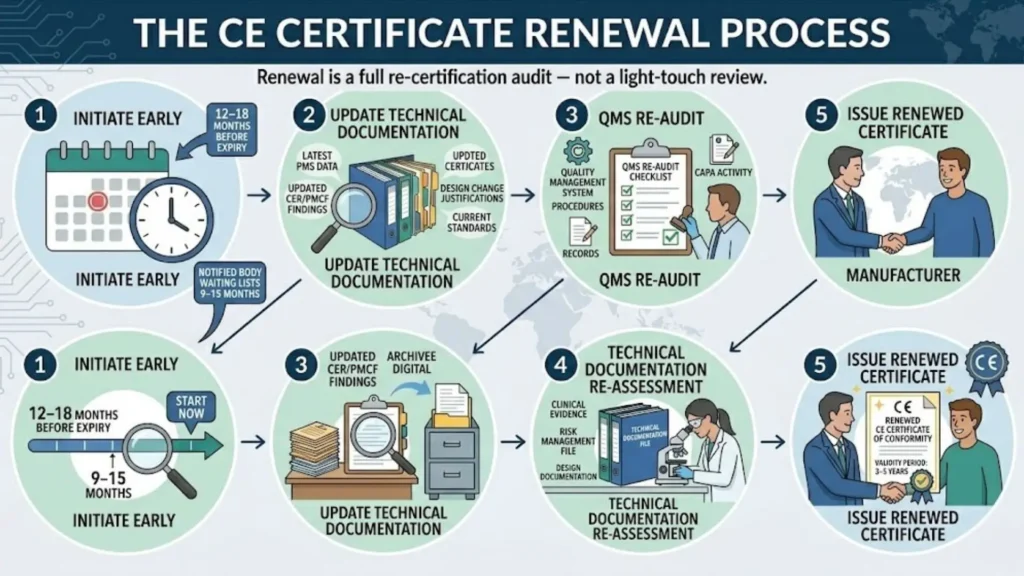
- CE marking certificates issued by Notified Bodies under EU MDR typically last 5 years — but renewal must start 12–18 months before expiry to avoid market access gaps.
- The renewal process is not just a paperwork exercise — your Notified Body will reassess your QMS, technical documentation, and post-market surveillance data.
- Under EU MDR (Regulation 2017/745) and IVDR (2017/746), a lapsed or expired CE certificate means you cannot place new devices on the EU/EEA market until recertification is complete.
Introduction
CE marking renewal is one of the most commercially critical regulatory tasks a medical device manufacturer faces. Miss the deadline, and you cannot legally sell new devices in the EU. Rush the process, and you risk rejection by your Notified Body. Plan it well, and it is a smooth, predictable process that protects your EU market access without interruption.
If you are asking 'When does my CE marking certificate expire?' or 'How do I renew a CE certificate for a medical device in Europe?' — you are in the right place. This complete 2026 guide walks you through everything: validity periods, what triggers early renewal, the step-by-step renewal process, required documents, costs, and how to handle common complications like Notified Body changes or device modifications.
Whether you are renewing under EU MDR (Regulation 2017/745) for general medical devices, or EU IVDR (Regulation 2017/746) for in vitro diagnostic devices, the core renewal framework is the same — with a few important differences covered in detail below.
What Is CE Marking Renewal and Why Does It Matter?
CE marking is not a permanent approval. When a Notified Body certifies your medical device under EU MDR or IVDR, it issues a certificate with a defined expiry date. To continue legally marketing your device in the EU after that date, you must successfully renew — also called recertification or certificate renewal.
CE marking renewal is distinct from the initial certification process, but it is not necessarily simpler. Your Notified Body will conduct a fresh review of your Quality Management System (QMS), your technical documentation, and your post-market surveillance (PMS) data. In essence, you need to demonstrate that your device and your organization remain in full compliance with the applicable EU regulation.
What Happens If You Do Not Renew?
- You lose the legal right to place new devices on the EU/EEA market.
- Distributors and importers may halt orders or deliveries.
- Competent authorities can take enforcement action if expired-certificate devices are found in the market.
- Regaining CE marking after a lapse requires a full new certification process — which takes significantly longer than a planned renewal.
- Commercial relationships, tenders, and procurement contracts can be disrupted or terminated.
Key Point: CE marking renewal protects your EU revenue. An expired certificate is not just a regulatory problem — it is a direct commercial risk. Treat renewal planning as a business-critical activity, not just a regulatory task.
How Long Is a CE Marking Certificate Valid?
Under EU MDR and IVDR, CE marking certificates issued by Notified Bodies are typically valid for a maximum of 5 years. However, the actual validity of your certificate can be shorter depending on:
- The scope and complexity of the device
- The outcome of the initial certification audit
- Conditions placed on the certificate by the Notified Body
- Whether interim surveillance audits are passed satisfactorily
| Certificate Type | Typical Validity | Notes |
| QMS Certificate (ISO 13485 / Annex IX) | 3 years | Annual surveillance audits required; renewal at year 3 |
| EU MDR Technical Documentation Certificate | 5 years | Covers specific device types; linked to QMS certificate |
| IVDR Technical Documentation Certificate | 5 years | Same principle as MDR; Class D has additional requirements |
| Product Certificate (legacy MDD/AIMDD) | No longer applicable | MDD certificates expired; MDR transition required |
| Type Examination Certificate | 5 years | May be issued separately for implantable or Class III devices |
When Should You Start the CE Marking Renewal Process?
This is the question most manufacturers get wrong — usually by starting too late. Given the current workload at Notified Bodies across Europe, waiting until 6 months before expiry is far too late. The realistic timeline is:
| Time Before Expiry | Action Required | Why This Timing Matters |
| 18–24 months | Internal readiness review; update technical documentation; confirm PMPF/PMS data is current | Gives time to address gaps before NB engagement |
| 15–18 months | Submit renewal application to your Notified Body | NB backlogs mean scheduling delays of 6–12 months are common |
| 12 months | QMS surveillance or renewal audit with Notified Body | Audits cannot be rushed; document requests take weeks to fulfil |
| 6–9 months | NB issues renewed certificate (target) | Leaves buffer for any additional information requests or minor findings |
| 3 months | Upload/update renewed certificate in EUDAMED | Maintain accurate registration; avoid compliance gap |
| 0 months (expiry) | Old certificate expires; new certificate must be in place | Market access continues uninterrupted if planned correctly |
What Triggers CE Marking Renewal Before Expiry?
Your 5-year certificate covers your device as it was assessed. Certain changes to your device or organisation trigger an obligation to notify your Notified Body — and depending on the change, may require early reassessment or even a new CE marking application.
Changes That Require Notified Body Notification
- Significant design changes to the device (materials, components, software, packaging)
- Changes to manufacturing processes or manufacturing sites
- Changes to intended purpose or indications for use
- New clinical evidence that affects the benefit-risk profile
- Safety-related design changes triggered by post-market surveillance data
- Changes to sterilisation methods or parameters
- Changes in supply chain for critical components
| Type of Change | Notification Required? | Possible Outcome |
| Minor labelling update (no intended purpose change) | Yes — inform NB; typically no reassessment | NB acknowledges; no new certificate needed |
| Software update (non-critical, documented) | Yes — submit change documentation to NB | NB reviews; may require technical documentation update |
| Software update affecting safety or performance | Yes — full NB assessment likely required | May trigger new Type Examination or design change assessment |
| New device variant / model | Yes — full extension of scope or new certification | New or amended certificate required |
| Significant design change to safety-critical component | Yes — NB reassessment required | May require new CE marking application |
| Manufacturing site relocation | Yes — NB notification and possible QMS audit | QMS audit to verify equivalence; certificate may be amended |
| Change of legal manufacturer name | Yes — administrative update to NB | Certificate amendment; no new audit typically required |
The key question is always: does this change affect safety, performance, or the intended purpose? If yes, it is a significant change under MDR Article 120 or IVDR Article 110, and proactive Notified Body engagement is mandatory — not optional.
CE Marking Renewal Requirements Under EU MDR 2026
To successfully renew your CE marking certificate under EU MDR (Regulation 2017/745), you need to demonstrate continued compliance across four main areas:
Quality Management System (QMS)
Your QMS — typically certified to ISO 13485 — must be current, operational, and scope-appropriate. During renewal, the Notified Body will:
- Conduct a QMS surveillance audit (if not already done in the renewal year)
- Review any corrective actions raised since the last audit
- Assess changes to your quality procedures, management review outputs, and supplier controls
- Confirm that your QMS scope still covers all devices in your CE certificate
Updated Technical Documentation
Technical documentation is not a static archive — it must reflect your device as it exists today. For renewal, ensure your tech file includes:
- Updated device description reflecting any modifications since initial certification
- Current risk management file (per ISO 14971), updated with post-market data
- Updated clinical evaluation report (CER) with new literature, PMCF data, and current state-of-the-art
- Updated labelling and IFU reflecting any changes, including current UDI
- Updated GSPR checklist with current harmonized standard references
Post-Market Surveillance Data
One of the areas where MDR raised the bar significantly compared to the old MDD is post-market surveillance. At renewal, your Notified Body expects to see real, substantive PMS data:
- Periodic Safety Update Report (PSUR) — required for Class IIa, IIb, and III devices under MDR Article 86
- Post-Market Clinical Follow-Up (PMCF) reports — updated evidence from real-world use
- Complaint and vigilance records since last certification
- Field Safety Corrective Actions (FSCAs) and any related regulatory actions
- Trend analysis of complaints, incidents, and near-misses
EUDAMED Registration
Before renewal can be completed, your EUDAMED registration must be current and accurate:
- Economic operator registration with valid SRN
- Device registration with up-to-date UDI-DI information
- PSUR submissions in EUDAMED where applicable
- Any change to authorized representative or importer reflected in EUDAMED
Step-by-Step CE Marking Renewal Process
Here is the complete step-by-step renewal process for medical device CE marking under EU MDR in 2026:
| Step | Action | Who Is Responsible | Typical Timeframe |
| 1 | Check certificate expiry date and set renewal trigger at 18 months prior | Regulatory Affairs team / QA Manager | Ongoing — should be calendared |
| 2 | Conduct internal readiness review: QMS, technical file, PMS, EUDAMED | RA/QA team | 4–8 weeks |
| 3 | Update technical documentation (CER, risk file, GSPR, labelling, IFU) | RA team / Clinical Affairs | 8–16 weeks |
| 4 | Prepare updated PSUR and PMCF data | RA / Clinical team | 4–8 weeks (concurrent with step 3) |
| 5 | Submit renewal application to Notified Body with updated documentation | RA Manager / Regulatory Director | 1–2 weeks to prepare submission |
| 6 | Notified Body reviews application and schedules audit | Notified Body | 4–12 weeks (NB-dependent backlog) |
| 7 | QMS surveillance or renewal audit conducted | Notified Body auditor on-site or remote | 1–3 days depending on scope |
| 8 | Respond to NB findings / additional information requests | RA/QA team | 2–6 weeks depending on findings |
| 9 | NB technical documentation review (including CAPA if needed) | Notified Body | 4–12 weeks |
| 10 | Notified Body issues renewed CE certificate | Notified Body | Certificate issued; typically 5-year validity |
| 11 | Update Declaration of Conformity with new certificate reference | Legal manufacturer | 1 week |
| 12 | Update EUDAMED with renewed certificate details and UDI data | RA/QA team | 1–2 weeks |
| 13 | Update labelling / IFU if certificate scope changed | RA / Labelling team | As required |
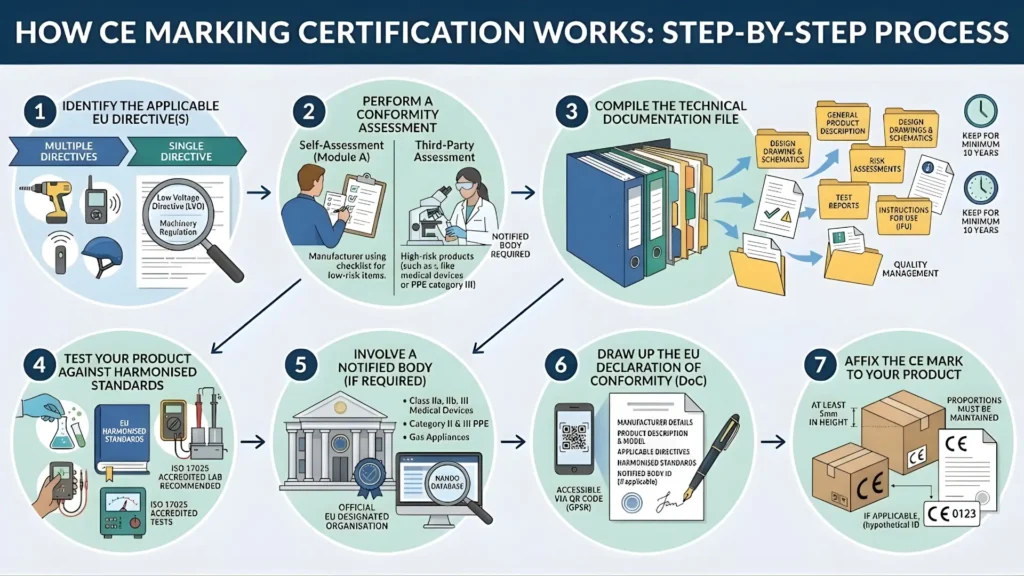
Important: Steps 3–5 can and should run concurrently where possible to compress the overall timeline. Do not wait for the technical documentation to be fully finalised before contacting your Notified Body — early scheduling is the most valuable time-saver in the renewal process.
Documents Required for CE Marking Renewal
Your Notified Body will typically request the following documentation package for CE marking renewal. Having these ready before submission dramatically reduces delays:
| Document | Status Required for Renewal | MDR Reference |
| Updated technical documentation (Annex II & III) | Must reflect current device state | MDR Annex II, III |
| Updated clinical evaluation report (CER) | Current literature + PMCF data integrated | MDR Article 61, Annex XIV |
| Post-Market Clinical Follow-Up (PMCF) report | Data collected since last certification | MDR Annex XIV Part B |
| Periodic Safety Update Report (PSUR) | Class IIa/IIb/III: current PSUR | MDR Article 86 |
| Risk management file (ISO 14971) | Updated with PMS data and residual risk review | MDR Annex I, ISO 14971 |
| GSPR compliance checklist | Updated with current harmonised standards | MDR Annex I |
| ISO 13485 QMS certificate | Current; valid scope covering all devices | MDR Annex IX |
| CAPA records since last certification | Demonstrates continuous improvement | MDR Annex IX |
| QMS Management Review output | Most recent management review minutes | ISO 13485 §5.6 |
| Supplier / subcontractor control records | Critical supplier qualification status | MDR Annex IX |
| Updated labelling and IFU samples | Current versions including UDI | MDR Article 10(11), Annex I §23 |
| UDI registration confirmation (EUDAMED) | UDI-DI registered and current | MDR Article 27 |
| Declaration of Conformity (draft / existing) | To be updated post-certificate issue | MDR Article 19 |
| Summary of device changes since last certification | Clearly documented change history | MDR Article 120 |
CE Marking Renewal Costs and Fees in 2026
Renewal costs are generally lower than initial certification costs — but they are still significant, and many manufacturers underestimate them. Key cost drivers include Notified Body fees, internal team time, and the cost of updating clinical evidence.
| Cost Component | Estimated Range (EUR) | Notes |
| Notified Body renewal application fee | 1,500 – 5,000 | Administrative fee; varies by NB and certificate type |
| QMS surveillance or renewal audit | 5,000 – 20,000 | Depends on audit duration, scope, and whether remote/on-site |
| Technical documentation review by NB | 5,000 – 30,000 | Based on device complexity and number of variants |
| Updating CER / PMCF data | 5,000 – 50,000+ | New literature review; PMCF study data; clinical writer fees |
| PSUR preparation (internal or outsourced) | 3,000 – 15,000 | Depends on complexity and data volume |
| ISO 13485 certification renewal (if concurrent) | 3,000 – 10,000 | Certification body fees; typically every 3 years |
| Regulatory consultant support | 5,000 – 40,000+ | Optional but valuable for SMEs with limited RA resource |
| EUDAMED updates and UDI maintenance | Minimal direct cost | Staff time only; EUDAMED access is free |
| Labelling updates (if scope changes) | 2,000 – 15,000 | Design, print, and language translation if needed |
Total CE marking renewal cost for a straightforward Class IIa device with no major changes typically falls in the range of EUR 20,000–60,000. Complex Class III implantable devices with multiple product variants and required PMCF updates can cost EUR 100,000–250,000 or mor
CE Marking Renewal for Different Device Classes
The renewal process is broadly consistent across device classes, but the depth of review and specific requirements differ. Here is a class-by-class overview:
| Device Class (MDR) | Renewal Pathway | Key Focus Areas for Renewal |
| Class I (non-sterile, non-measuring) | Self-declaration; no NB renewal needed | Update tech documentation, DoC, and EUDAMED — self-managed |
| Class I (sterile / measuring / reusable surgical) | Notified Body renewal for specific aspects only | NB reviews sterility or measuring function; QMS not always required |
| Class IIa | Full NB renewal — QMS + technical documentation | CER, PMCF, PSUR, risk file; typically straightforward if PMS is current |
| Class IIb | Full NB renewal — QMS + technical documentation | Strong PMCF data expected; PSUR required; NB scrutiny is higher |
| Class III (implantable / highest risk) | Full NB renewal + scrutiny procedure | EU Scrutiny Committee opinion may be required for new data; PSUR annual |
| Device Class (IVDR) | Renewal Pathway | Key Focus Areas |
| Class A (non-sterile) | Self-declaration; no NB certificate to renew | Update tech documentation and DoC |
| Class A (sterile) | Limited NB renewal (sterility aspects) | QMS for sterility; technical documentation |
| Class B / C | Full NB renewal | Performance evaluation report (PER), PMPF data, QMS |
| Class D | Full NB renewal + EU Reference Laboratory | PMPF, PER, EU Reference Lab batch verification — most complex renewal route |
Changing Your Notified Body at Renewal
Changing Notified Body at renewal is more common than many manufacturers expect — particularly since several Notified Bodies lost their MDR designation, and manufacturers were forced to find a new NB mid-cycle. Here is what you need to know:
- You can change your Notified Body at any time, including at renewal — there is no regulatory restriction on switching.
- The new Notified Body cannot simply rely on the previous NB's assessment — they will conduct their own review of your documentation and QMS.
- Allow extra time when switching NB — the new NB needs to onboard your file from scratch, which typically adds 3–6 months to the process.
- Request a 'certificate transfer package' from your previous NB — this should include all assessment reports and correspondence to help the new NB understand the history of your device.
- The previous NB is required under MDR to cooperate and share relevant documentation with the new NB.
Important 2026 Note: Not all Notified Bodies are designated for all device types and risk classes. Always confirm that your chosen NB holds a valid MDR or IVDR designation that covers your specific device code and class before submitting a renewal application.
What Happens If Your CE Certificate Expires?
If your CE marking certificate expires before renewal is completed, the consequences are serious. Here is a clear breakdown:
| Situation | What Is Allowed? | What Is NOT Allowed? |
| Certificate expired — renewal in progress | Devices already placed on market can remain in service | Placing NEW devices on the EU market is prohibited |
| Certificate expired — no renewal application submitted | Existing devices in use may remain; competent authority may investigate | All new placements on market prohibited; regulatory enforcement risk |
| Certificate lapsed for >12 months | High risk of enforcement action; no market activity for affected devices | New placements prohibited; possible recall of recently sold inventory |
| QMS certificate expired (not device certificate) | Device certificate may still be technically valid short-term | NB will suspend or withdraw device certificate if QMS is not renewed promptly |
In practical terms, most competent authorities understand that Notified Body delays can cause gaps in certification through no fault of the manufacturer. Proactively communicating delays to your Notified Body and the relevant national competent authority demonstrates good faith and can help manage enforcement risk.
However, this should never be relied upon as a strategy. There is no formal grace period for an expired CE certificate under EU MDR — the obligation to have a valid certificate before market placement is absolute.
Conclusion: Staying Ahead of Your CE Marking Renewal in 2026
CE marking renewal is not something you can manage reactively. In 2026, with Notified Bodies operating at capacity and EU MDR/IVDR requirements demanding substantive post-market evidence, the manufacturers who maintain uninterrupted EU market access are those who treat renewal as a continuous process — not a point-in-time event.
The practical advice is simple: calendar your certificate expiry dates today, assign clear internal ownership for renewal activities, build PMCF and PMS into your live QMS operations rather than scrambling at renewal time, and engage your Notified Body early. None of these steps are complicated — but all of them require discipline and forward planning.
Regulatory compliance and commercial success are not in conflict here. A well-managed CE marking renewal process is faster, cheaper, and less disruptive than an emergency recertification after a lapse. Get ahead of it, and it becomes a routine part of your quality management cycle.
Frequently Asked Questions
How long is a CE marking certificate valid for medical devices?
CE marking certificates issued by Notified Bodies under EU MDR or IVDR are typically valid for 5 years from the date of issue. QMS certificates (ISO 13485 under Annex IX) are typically valid for 3 years, with annual surveillance audits in between. Both must be renewed proactively before expiry.
When should I apply for CE marking renewal?
Apply at least 15–18 months before your certificate expires. Given current Notified Body backlogs across Europe in 2026, waiting until 6 months before expiry almost guarantees a gap in your certification.
Do I need the same Notified Body for renewal?
No. You can switch Notified Bodies at renewal if you choose. However, the new NB will carry out a full assessment from scratch rather than relying on your previous NB's work. This adds time to the process — typically 3–6 months more than renewing with your existing NB.
What is the cost of CE marking renewal for a medical device?
Renewal costs vary significantly by device class and complexity. A simple Class IIa device with no major changes typically costs EUR 20,000–60,000 in total (NB fees, CER update, QMS audit, PSUR preparation).
Can I still sell my devices if my CE certificate has expired?
Devices that were legally placed on the EU market before your certificate expired may remain in service. However, you cannot place any new devices on the EU market after the certificate expiry date — not even from existing manufactured stock — until a valid renewed certificate is in place. This is a hard regulatory requirement under EU MDR.
Does CE marking renewal require a new clinical evaluation?
Your clinical evaluation report (CER) must be kept up to date throughout the device lifecycle, not just at renewal. At renewal, your NB will expect to see a current CER that integrates post-market clinical follow-up (PMCF) data and recent literature
What triggers a CE marking renewal outside the normal 5-year cycle?
Significant changes to your device, manufacturing processes, intended purpose, or clinical data can require Notified Body notification and, in some cases, early reassessment. Under MDR Article 120, any change that could affect compliance with general safety and performance requirements, or that changes the intended purpose, must be assessed.
Is EUDAMED registration required for renewal?
Yes. Your EUDAMED registration must be current and accurate as part of the renewal process. This includes your economic operator registration (SRN), device registration with current UDI-DI, and updated certificate information.
What is a PSUR and do I need one for CE renewal?
A Periodic Safety Update Report (PSUR) is a document summarising post-market surveillance data, benefit-risk conclusions, and sales volumes for your device. Under MDR Article 86, PSURs are mandatory for Class IIa (every 2 years), Class IIb (every 2 years), and Class III (annually).
What happens if my Notified Body loses its MDR designation?
If your Notified Body loses its MDR designation (as happened to several NBs during the MDR transition period), your existing certificates may remain valid temporarily under specific transitional conditions — but you must actively seek a new designated Notified Body as quickly as possible.