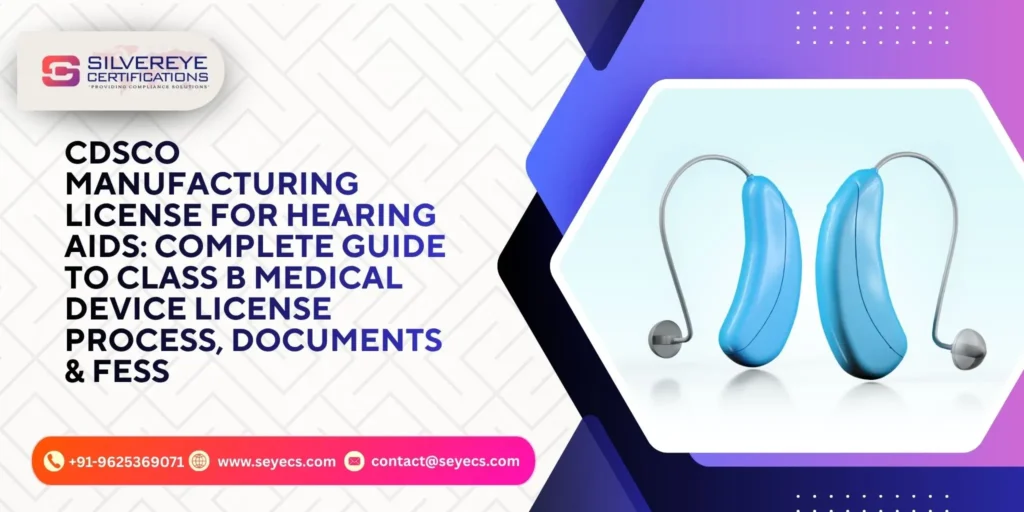
- CDSCO Manufacturing License For Hearing Aids Mandatory Under Class B Medical Device Manufacturing License required before legally manufacturing or selling hearing aids in India.
- Application filed through Form MD-3 on the SUGAM online portal license issued as Form MD-5 under the Medical Device Rules, 2017.
- CDSCO license remains valid for a period of 3 years and must be renewed before expiry to ensure uninterrupted manufacturing operations.
- Non-compliance with CDSCO licensing rules can result in heavy penalties, product recall, or complete shutdown of manufacturing operations.
Introduction
If you are planning to manufacture hearing aids in India, getting a CDSCO Manufacturing License for Hearing Aids is the very first legal step you cannot skip. Since hearing aids are classified as Class B Medical Devices under the Medical Device Rules, 2017, every manufacturer — whether a startup, an established company, or a contract manufacturer — must obtain this Central Drugs Standard Control Organization (CDSCO) license before commencing production or commercial sale.
This comprehensive 2026 guide walks you through everything you need to know about the CDSCO Class B Medical Device Manufacturing License: what it is, who needs it, how to apply through Form MD-3, what documents are required, the fee structure, the complete process from application to the issuance of Form MD-5, and how to renew it on time. Whether you are a first-time applicant or looking to understand the renewal process, this guide has all the answers.
What is the CDSCO Manufacturing License for Hearing Aids?
The CDSCO Manufacturing License for Hearing Aids is an official authorization granted by the Central Drugs Standard Control Organization (CDSCO) — India's apex regulatory authority for medical devices and drugs — that permits a facility to legally manufacture hearing aids for domestic sale or export.
Hearing aids are battery-powered electronic instruments designed to amplify sound for individuals with hearing loss. Because they are implanted close to or inside the ear canal and directly impact the health and safety of users, they are subject to strict quality, safety, and performance standards under Indian law.
Under the Medical Device Rules, 2017 notified under the Drugs and Cosmetics Act, 1940, hearing aids are classified as Class B Medical Devices — meaning they carry a low to moderate risk and require state-level or central licensing based on the type of activity. However, for manufacturing, the CDSCO (Central Licensing Authority) is the competent authority for Class B devices.
| Particulars | Details |
| Device Category | Class B Medical Device |
| Applicable Law | Drugs and Cosmetics Act, 1940 & Medical Device Rules, 2017 |
| Licensing Authority | CDSCO (Central Licensing Authority) |
| Application Form | Form MD-3 (Application for Manufacturing License) |
| License Issued In | Form MD-5 (Grant of Manufacturing License) |
| Portal | SUGAM (sugam.gov.in) |
| License Validity | 3 Years from date of grant |
| Renewal Form | Form MD-3 (before expiry) |
Legal Framework: Medical Device Rules, 2017 and Hearing Aids
The Medical Device Rules (MDR), 2017 came into effect on January 1, 2018, replacing the earlier Schedule M-III provisions. These rules brought a comprehensive, risk-based classification system for medical devices in India, aligning the country's regulatory framework closer to global standards like the EU MDR and ISO 13485.
Classification of Hearing Aids
As per Schedule III, Part II of the Medical Device Rules, 2017, hearing aids are classified as Class B medical devices. This classification is based on their intended use (non-invasive but in-contact with the ear canal), duration of use, and risk profile.
| Class | Risk Level | Examples | Licensing Authority |
| Class A | Low Risk | Tongue depressors, bandages | State Licensing Authority (SLA) |
| Class B | Low-Moderate Risk | Hearing Aids, contact lenses | CDSCO (Central) |
| Class C | Moderate-High Risk | Lung ventilators, bone fixation plates | CDSCO (Central) |
| Class D | High Risk | Implantable cardiac devices, HIV kits | CDSCO (Central) |
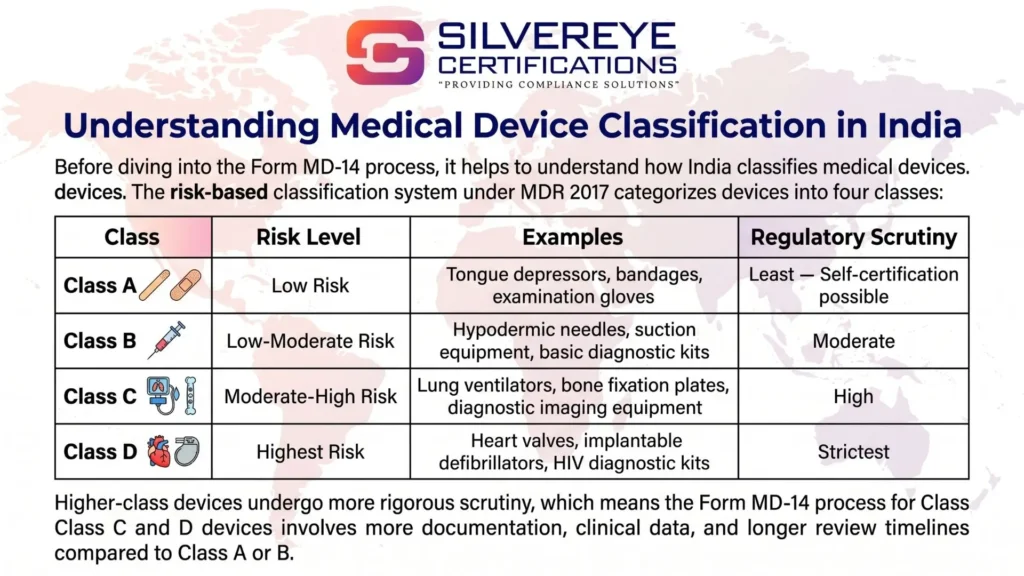
Since hearing aids fall in Class B, the Central Licensing Authority — i.e., CDSCO — is responsible for granting manufacturing licenses to hearing aid manufacturers across India, regardless of which state the manufacturing unit is located in.
Who Needs a CDSCO Class B Manufacturing License for Hearing Aids?
Any individual, company, firm, or corporate entity engaged in the following activities related to hearing aids in India must obtain this license:
- Manufacturing hearing aids for domestic sale within India
- Manufacturing hearing aids intended for export from India
- Assembling hearing aid components into finished devices
- Relabelling or repackaging imported hearing aids under a new brand name
- Contract manufacturing hearing aids for a third party
- Manufacturing hearing aids incorporating software (SaMD — Software as a Medical Device) features
It is important to note that importers of hearing aids require a separate Import License under Form MD-15, and distributors/wholesalers may require a sale license depending on the state. The CDSCO Manufacturing License is specifically for entities involved in the production process.
Key Benefits of Obtaining a CDSCO Manufacturing License for Hearing Aids
Beyond mere regulatory compliance, obtaining a CDSCO Manufacturing License for Hearing Aids delivers several tangible business and legal advantages:
Legal Authorization to Manufacture & Sell
Without this license, manufacturing or selling hearing aids in India is illegal and can attract penalties including fines, imprisonment, and product seizure under the Drugs and Cosmetics Act, 1940.
Market Access — Domestic and Global
A valid CDSCO license allows you to sell hearing aids across all Indian states. It also facilitates export, as several importing countries require proof of home country regulatory approval before allowing entry of medical devices.
Enhanced Brand Credibility
Being CDSCO-licensed signals quality and safety compliance to hospitals, audiologists, ENT clinics, and end consumers — significantly boosting brand trustworthiness in a competitive market.
Eligibility for Government Tenders
Government health programs such as ADIP (Assistive Devices for Persons with Disabilities) and state-level hearing aid procurement tenders require suppliers to hold a valid CDSCO manufacturing license.
Investor & Partnership Confidence
Investors, distribution partners, and hospital procurement committees are far more likely to engage with a CDSCO-licensed manufacturer, as it demonstrates regulatory seriousness and operational legitimacy.
Eligibility Requirements for a CDSCO Hearing Aid Manufacturing License
To be eligible for a CDSCO Class B Manufacturing License for hearing aids, an applicant must meet the following conditions:
Legal Entity Status
- Applicant must be a legally registered entity — Proprietorship, Partnership Firm, LLP, Private Limited Company, or Public Limited Company
- Certificate of Incorporation / Partnership Deed / GST Registration must be in place
Qualified Technical Staff
One of the most critical eligibility criteria is the mandatory appointment of qualified technical personnel:
| Staff Designation | Minimum Qualification Required |
| Technical Staff / Qualified Person | Degree or Diploma in Engineering (Electronics/Electrical/Biomedical) or Science (Physics/Chemistry) with relevant experience |
| Production-in-Charge | Relevant technical degree with 2+ years experience in medical device manufacturing |
| Quality Manager / QA Head | Degree in Science/Engineering with experience in quality management systems |
Manufacturing Premises
- A dedicated, enclosed manufacturing facility with defined production, testing, and storage areas
- The premises must comply with Schedule I of the Medical Device Rules, 2017 (Good Manufacturing Practices for Medical Devices)
- Facility must have adequate power supply, dust-free environment, and ESD (Electrostatic Discharge) protection measures for electronic device manufacturing
Quality Management System (QMS)
- Documented QMS covering design controls, production controls, complaint handling, CAPA (Corrective and Preventive Actions), and internal audits
- SOPs (Standard Operating Procedures) for all critical manufacturing and testing activities must be in place before applying
Testing Infrastructure
- In-house or third-party NABL-accredited laboratory for testing finished devices as per applicable performance standards (IEC 60118 series for hearing aids)
- Test equipment must be calibrated with valid calibration certificates
Documents Required for CDSCO Hearing Aid Manufacturing License (Form MD-3 Application)
Compiling the correct and complete documentation set is the single most important factor in ensuring a smooth and timely approval. Missing or incorrect documents are the leading cause of CDSCO application rejections and delays. Here is the complete document checklist for 2026:
Business & Legal Documents
- Certificate of Incorporation / Partnership Deed / Proprietorship declaration
- PAN Card of the company or proprietor
- GST Registration Certificate
- Board Resolution authorizing the signatory (for companies)
- Power of Attorney (if application is filed through a consultant)
Manufacturing Premises Documents
- Proof of ownership or registered lease agreement of manufacturing premises
- Approved building layout / site plan with dimensions (clearly showing all production, testing, QC, and storage areas)
- Utility connection proofs (electricity, water)
- No Objection Certificate (NOC) from local municipality or pollution control board if applicable
Technical & Qualified Staff Documents
- Educational qualification certificates of all technical staff
- Appointment letters and experience certificates of technical personnel
- Signed declaration of availability and commitment from qualified person(s)
Product & Device-Related Documents
- List of hearing aid products / models to be manufactured
- Product classification justification (confirming Class B classification)
- Technical file or Device Master File (DMF) for each model — including design specifications, materials, components, and assembly process
- Performance testing data / test reports as per IEC 60118 series
- Risk Management File (as per ISO 14971)
- Intended use / indications for use document
- Labelling and packaging specifications (as per Schedule VII of MDR 2017)
Quality Management System Documents
- QMS Manual (aligned with Schedule I of MDR 2017 / ISO 13485)
- SOPs for production, quality control, testing, storage, distribution, and recall
- CAPA procedure, complaint handling procedure, and post-market surveillance plan
- List of critical suppliers and vendor qualification records
Fee Payment
- Government application fee payment receipt (online payment through SUGAM portal)
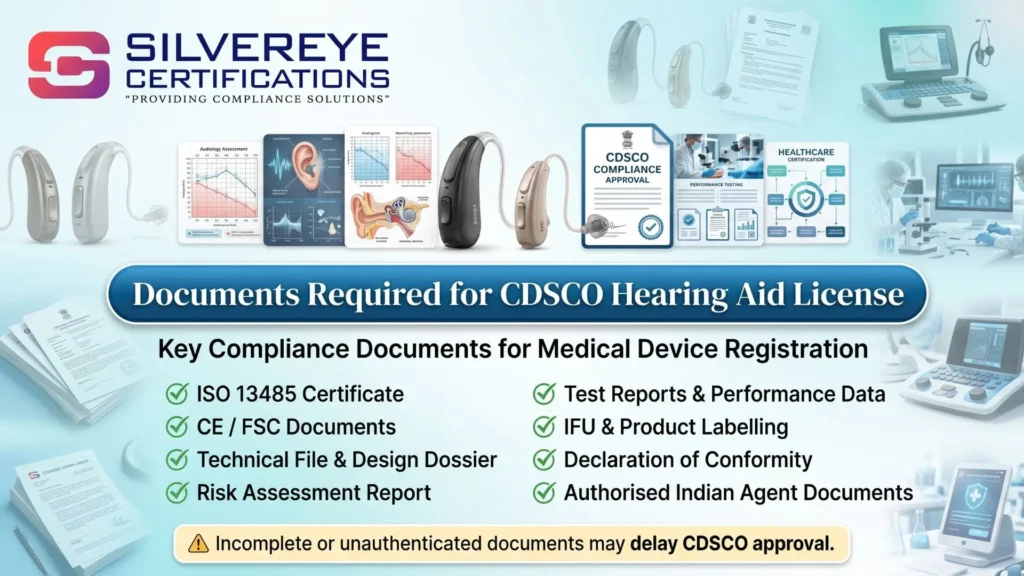
| Document Category | No. of Documents (Approx.) |
| Business & Legal | 4–5 documents |
| Premises & Infrastructure | 3–4 documents |
| Technical Staff | 3–4 documents |
| Product Technical File | 6–8 documents per device model |
| QMS Documentation | 5–7 documents |
| Fee Receipt | 1 document |
CDSCO Hearing Aid Manufacturing License Fees
The government fee for CDSCO medical device licenses is prescribed under Schedule VII of the Medical Device Rules, 2017. Below are the applicable fee details for Class B manufacturing licenses as of 2026. Note that fees may be revised by the government, so always verify the latest fee schedule on the SUGAM portal before payment.
| Application Type | Government Fee (INR) | Notes |
| Fresh Manufacturing License — Class B | INR 3,500 per device category | Payable online via SUGAM at time of application |
| Renewal of License — Class B | INR 2,500 per device category | Renewal fee applicable within validity period |
| Late Renewal (after expiry) | Late fee applicable | Additional penalty fee charged as per rules |
| Amendment to Existing License | INR 1,000–2,500 (varies) | Depends on type of amendment |
| Duplicate License | INR 500 | For loss or damage of original license |
| Important Note: The government fee is only one component of the total cost. Professional/consultant fees, documentation preparation costs, testing charges (NABL lab testing of hearing aid performance), and infrastructure compliance costs are additional. The total investment for first-time applicants typically ranges from INR 1.5 Lakh to INR 5 Lakh or more, depending on the readiness of the facility and QMS. |
Complete Step-by-Step Process: How to Apply for CDSCO Hearing Aid Manufacturing License
Here is the complete step-by-step process for obtaining your CDSCO Class B Medical Device Manufacturing License for hearing aids in 2026:
Step 1: Assess Eligibility & Conduct Gap Analysis
Before filing the application, conduct a thorough gap analysis of your manufacturing facility, technical staff qualifications, documentation status, and QMS maturity against the requirements of Schedule I and Schedule VII of the Medical Device Rules, 2017. Identify and address all gaps before applying.
Step 2: Prepare Documentation
Compile all required documents as listed in Section 6 above. Prepare the complete Device Master File (DMF) for each hearing aid model. Ensure all quality system documentation is in place and duly signed by authorized persons.
Step 3: Get Testing Done
Hearing aids must be tested against applicable Indian/International Standards. Testing under the IEC 60118 series (Electroacoustics — Hearing aids) by a NABL-accredited or CDSCO-recognized laboratory is mandatory. Obtain valid test reports before filing.
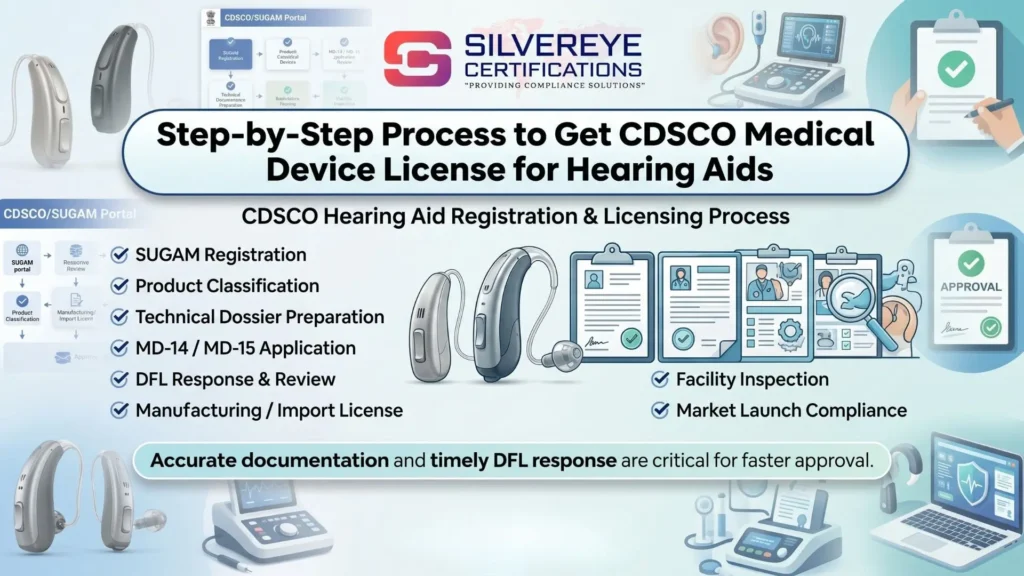
Step 4: Register on SUGAM Portal
Visit the official SUGAM portal (sugam.gov.in) and create a company account. Complete entity registration by providing company details, authorized signatory information, and uploading company registration documents.
Step 5: File Form MD-3 Application Online
Log in to SUGAM, navigate to the Medical Device Module, and select the option for Form MD-3 (Application for Manufacturing License — Class B). Fill in all required details online, upload the complete document set in the prescribed formats (PDF, max file sizes as specified), and pay the applicable government fee online.
Step 6: Acknowledgement & Scrutiny by CDSCO
Upon successful submission, SUGAM generates an Application Reference Number (ARN). CDSCO officials conduct a primary scrutiny of the application for completeness. If any documents are missing or deficient, CDSCO issues a deficiency query online through SUGAM, which must be resolved within the stipulated time.
Step 7: Premises Inspection (GMP Inspection)
CDSCO assigns an inspection team (typically comprising CDSCO officials and technical experts) to conduct a Good Manufacturing Practice (GMP) inspection of the applicant's manufacturing facility. The inspection assesses compliance with Schedule I requirements — infrastructure, equipment, QMS, production controls, testing facilities, and staff competence.
Step 8: Addressing Inspection Observations
Post-inspection, CDSCO may raise observations or non-conformities. The applicant must submit a detailed CAPA (Corrective and Preventive Action) report with evidence addressing all observations within the specified timeline. Failure to satisfactorily address observations can lead to rejection of the application.
Step 9: Grant of License — Form MD-5
Upon satisfactory review of the application, documents, and inspection report, CDSCO grants the manufacturing license in Form MD-5 (Grant of Manufacturing License). The Form MD-5 is issued digitally through the SUGAM portal and serves as the official CDSCO Manufacturing License for Hearing Aids.
Form MD-3 vs. Form MD-5: What Is the Difference?
Many applicants confuse Form MD-3 and Form MD-5. Here is a clear explanation:
| Form | Type | Purpose | Filed By / Issued By |
| Form MD-3 | Application Form | Application for grant/renewal of manufacturing license for Class B, C & D medical devices | Filed by the applicant/manufacturer on SUGAM portal |
| Form MD-5 | License Document | Official grant of manufacturing license for Class B medical devices — the actual license certificate | Issued by CDSCO (Central Licensing Authority) upon approval |
In simple terms: Form MD-3 is what you submit; Form MD-5 is what you receive. Your manufacturing license is the Form MD-5 document. Always keep the original Form MD-5 safe and accessible for regulatory inspections, audits, and tender submissions.
Validity and Renewal of CDSCO Hearing Aid Manufacturing License
10.1 License Validity
The CDSCO Class B Medical Device Manufacturing License (Form MD-5) for hearing aids is valid for 3 years from the date of grant. After 3 years, the license must be renewed to continue manufacturing operations legally.
Renewal Process
The renewal application must be filed in Form MD-3 (the same application form as the original application) on the SUGAM portal before the expiry of the existing license. CDSCO recommends initiating the renewal process at least 3 to 6 months before expiry to allow adequate processing time.
| Renewal Timeline | Action Required |
| 6 months before expiry | Initiate renewal preparation — update documents, check compliance status |
| 3 months before expiry | File renewal application in Form MD-3 on SUGAM with updated documents and fee |
| Before expiry | Ensure renewal application is filed — manufacturing can continue during pending renewal |
| After expiry (without renewal) | Manufacturing becomes illegal — stop operations immediately and file renewal with late fee |
What Happens If the License Expires?
If the license expires without renewal, the manufacturer cannot legally continue manufacturing or selling hearing aids. This can also trigger regulatory action, cancellation of existing purchase orders, and disqualification from government tenders. It is therefore critical to track license expiry dates and initiate renewal well in advance.
CDSCO vs. State Licensing Authority (SLA): Who Issues What for Hearing Aids?
This is a frequently asked question. Here is a clear breakdown:
| License Type | Issuing Authority | Form |
| Manufacturing License — Class B Hearing Aids | CDSCO (Central Licensing Authority) | Form MD-5 (against Form MD-3 application) |
| Import License — Hearing Aids from outside India | CDSCO | Form MD-15 (against Form MD-14 application) |
| Sale/Distribution License — Wholesale | State Licensing Authority (varies by state) | As per state rules |
| Sale License — Retail | State Licensing Authority | As per state rules |
If you are manufacturing hearing aids in India, your primary license is from CDSCO. If you are importing, it is also CDSCO. If you are only distributing or retailing, it is your State Licensing Authority.
Hearing Aid Market in India: Why Regulatory Compliance Is More Critical Than Ever in 2026
India's hearing aid market is growing rapidly, driven by increasing awareness of hearing loss, government-backed programs like the National Programme for Prevention and Control of Deafness (NPPCD), aging population demographics, and rising middle-class disposable incomes.
However, CDSCO's enforcement of the Medical Device Rules has significantly strengthened since 2022. The government has actively cracked down on unlicensed medical device manufacturers, with several high-profile enforcement actions taken against manufacturers operating without valid CDSCO licenses. In 2026, with CDSCO's digital tracking through the SUGAM portal and enhanced state-level coordination, the risk of operating without compliance is higher than ever.
For businesses looking to enter or scale in the hearing aid segment, obtaining and maintaining a CDSCO Manufacturing License is not just a regulatory checkbox — it is a strategic business asset that opens doors to government tenders, hospital supply chains, and export markets.
Conclusion
Getting a CDSCO Manufacturing License for Hearing Aids is a structured, transparent, and achievable process — but it requires thorough preparation, correct documentation, a compliant manufacturing facility, and technical expertise. The Form MD-3 to Form MD-5 journey may seem complex at first, but with the right approach and support, most well-prepared applicants successfully obtain their licenses within 3 to 6 months.
In 2026, as CDSCO continues to tighten enforcement of the Medical Device Rules, 2017, being licensed is not optional — it is the foundation of any serious hearing aid business in India. Whether you are a manufacturer, startup, or established company looking to formalize operations, starting the licensing process today is the smartest business decision you can make.
For personalized guidance on your CDSCO hearing aid manufacturing license application — from gap analysis and documentation preparation to SUGAM filing, GMP inspection readiness, and post-license compliance — it is advisable to work with a regulatory consultant experienced in medical device licensing under the Medical Device Rules, 2017.
Frequently Asked Questions
What is Form MD-3 in CDSCO medical device licensing?
Form MD-3 is the official application form prescribed under the Medical Device Rules, 2017 for applying for a manufacturing license for Class B, Class C, and Class D medical devices. Hearing aid manufacturers file Form-3 on the SUGAM portal to apply for their CDSCO manufacturing license. Upon approval, CDSCO issues the license in Form MD-5.
Is hearing aid classified as a Class A or Class B medical device in India?
Hearing aids are classified as Class B Medical Devices under Schedule III, Part II of the Medical Device Rules, 2017. This classification places them in the low to moderate risk category, and manufacturing licenses for Class B hearing aids are issued by CDSCO (the Central Licensing Authority), not the State Licensing Authority.
How long does it take to get a CDSCO hearing aid manufacturing license?
The end-to-end process typically takes 3 to 6 months for a well-prepared applicant. This includes document preparation (4–8 weeks), performance testing (2–4 weeks), SUGAM filing, CDSCO scrutiny, GMP inspection, CAPA resolution, and final grant of Form MD-5. Delays occur primarily due to incomplete documentation or non-compliant manufacturing infrastructure.
What is Form MD-5 and what does it mean for my business?
Form MD-5 is the official grant of license document issued by CDSCO upon approval of a Form-3 application. It is your actual manufacturing license — the legal proof that your facility is authorized to manufacture the specified hearing aid models in India.
What are the mandatory technical staff qualifications for a hearing aid manufacturing license?
The technical staff (qualified person) must hold a degree or diploma in engineering (Electronics, Electrical, or Biomedical) or science (Physics), with relevant experience in medical device or electronics manufacturing.
Can I apply for the CDSCO license online? Is the entire process digital?
Yes. CDSCO has fully digitized the application process through the SUGAM portal (sugam.gov.in). You can register, file Form-3, upload documents, pay fees, track application status, respond to deficiency queries, and download the Form MD-5 license entirely online. However, the GMP inspection of your physical manufacturing facility is conducted in person by CDSCO officials.
What standards must hearing aids comply with for CDSCO licensing?
Hearing aids are primarily tested against the IEC 60118 series of international standards (Electroacoustics — Hearing aids), which covers performance, reliability, electromagnetic compatibility, and safety parameters.
What is the government fee for a CDSCO Class B Manufacturing License for hearing aids?
As of 2026, the government application fee for a Class B medical device manufacturing license is INR 3,500 per device category, payable online through the SUGAM portal at the time of filing. Renewal fee is INR 2,500 per device category.
How do I renew my CDSCO hearing aid manufacturing license?
You must file a renewal application in Form-3 on the SUGAM portal before your existing Form MD-5 license expires. CDSCO recommends starting the renewal process at least 3 to 6 months before the expiry date.
What happens if I manufacture hearing aids without a CDSCO license in India?
Manufacturing, selling, or distributing hearing aids without a valid CDSCO license is a serious violation of the Drugs and Cosmetics Act, 1940 and the Medical Device Rules, 2017. It can result in product seizure, heavy financial penalties, criminal prosecution of company directors and responsible persons, and permanent cancellation of the ability to obtain future licenses. It also makes your products ineligible for sale in all organized retail and hospital channels.