
- Cosmetics in India are regulated under the Drugs and Cosmetics Act, 1940 and the Cosmetics Rules, 2020 — NOT under the Medical Device Rules, 2017.
- CDSCO (Central Drugs Standard Control Organization) is the nodal regulatory authority for cosmetic product imports, while State Licensing Authorities handle domestic manufacturing licenses.
- All cosmetics imported into India must have a valid CDSCO Import Registration Certificate — no exemptions for any brand or product category.
- The Cosmetics Rules, 2020 introduced a simplified, online-first registration framework replacing the old Schedule 'S' system, making compliance faster but more document-intensive.
What Is the CDSCO Cosmetics Products List and Why Does It Matter?
If you are a cosmetic brand, importer, contract manufacturer, or retail distributor operating in India, the CDSCO cosmetics products list is the regulatory foundation you need to understand in 2026. The Central Drugs Standard Control Organization oversees the import registration of cosmetic products and the enforcement of quality standards across India's beauty and personal care industry — one of the fastest-growing consumer segments in the country.
Unlike pharmaceuticals or medical devices, cosmetics in India do not require pre-market approval based on safety and efficacy data. However, they are tightly regulated on labelling, ingredient safety, permissible colorants, preservatives, heavy metal limits, and manufacturing standards. Any product that falls under the definition of a 'cosmetic' under Section 3(aaa) of the Drugs and Cosmetics Act, 1940 — any article intended to be rubbed, poured, sprinkled, or sprayed on, or introduced into, or otherwise applied to, the human body for cleansing, beautifying, promoting attractiveness, or altering appearance — must comply with the Cosmetics Rules, 2020.
Regulatory Framework for Cosmetics in India — Key Laws and Rules
Understanding the legal framework is the first step before diving into the product list. Here is the governing structure for cosmetics regulation in India:
| Regulation / Authority | Scope | Year |
| Drugs and Cosmetics Act, 1940 | Parent legislation defining 'cosmetic', prohibiting adulteration, misbranding, and substandard products | 1940 (amended through 2023) |
| Cosmetics Rules, 2020 | Detailed rules on manufacture, import, sale, labelling, and standards for cosmetics | 2020 (in force from Jan 2021) |
| CDSCO (Central Drugs Standard Control Organisation) | Nodal authority for import registration of cosmetics; sets national policy | Ongoing |
| State Licensing Authorities (SLAs) | Grant manufacturing licenses for cosmetics produced within respective states | Ongoing |
| Bureau of Indian Standards (BIS) | Prescribes quality standards for specific cosmetic categories where BIS mark is mandatory | Ongoing |
| Schedule M-II, Cosmetics Rules 2020 | Good Manufacturing Practices (GMP) for cosmetic manufacturers in India | 2020 |
| Schedule Q, Cosmetics Rules 2020 | Standards for cosmetics — permissible ingredients, heavy metal limits, microbiological standards | 2020 |
It is important to note that 'cosmeceuticals' — products marketed with both cosmetic and therapeutic claims — do not exist as a legal category in India. A product is either a cosmetic OR a drug, and CDSCO classifies borderline products on a case-by-case basis. Making drug claims for a cosmetic product can lead to its reclassification as a drug, triggering stricter regulatory requirements.
What Counts as a Cosmetic Under Indian Law?
Section 3(aaa) of the Drugs and Cosmetics Act, 1940, defines a cosmetic as any article intended to be rubbed, poured, sprinkled or sprayed on, or introduced into, or otherwise applied to, the human body or any part thereof for cleansing, beautifying, promoting attractiveness, or altering the appearance, and includes any article intended for use as a component of a cosmetic.
Practically, this covers a vast range of everyday beauty and personal care products. The key test is the intended use and labelling — not the formulation. A product with the same active ingredient can be a cosmetic if used for beautification, or a drug if marketed for treatment.
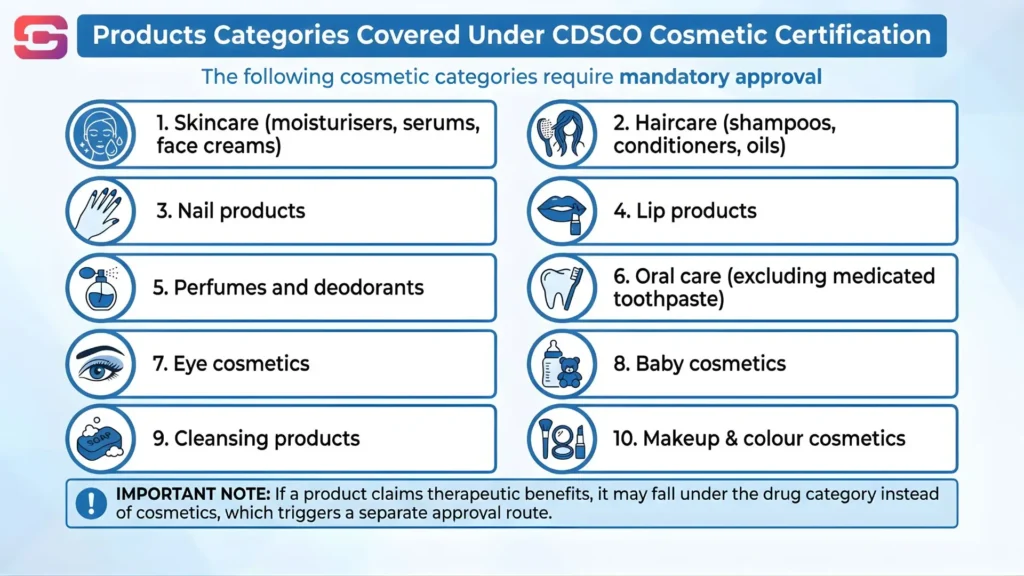
- Hair care: shampoos, conditioners, hair dyes, hair oils, hair masks, anti-dandruff products (without therapeutic claims)
- Skin care: moisturisers, sunscreens (SPF-based), face washes, toners, serums, exfoliants, face masks
- Colour cosmetics: lipsticks, foundations, eyeshadows, blushes, concealers, nail polishes
- Oral care: toothpastes (fluoride-based cosmetic claims), mouthwashes, teeth-whitening strips
- Fragrances: perfumes, colognes, body sprays, deodorants
- Baby care products: baby shampoos, baby lotions, baby oils, baby powders
- Men's grooming: shaving creams, aftershave lotions, beard oils
- Bath and body: soaps, shower gels, body lotions, body scrubs, bath salts, talcum powders
CDSCO Cosmetics Products List — Complete Category-Wise Breakdown (2026)
Below is the comprehensive CDSCO cosmetics products list organized by category. All products listed fall under the definition of 'cosmetic' under the Drugs and Cosmetics Act, 1940 and are subject to Cosmetics Rules, 2020 compliance.
1. Skin Care Products
Skin care is the largest cosmetic category by volume and value in India. The following products are regulated as cosmetics under CDSCO:
| S.No. | Product Name | Sub-category / Type |
| 1 | Face Wash / Facial Cleansers | Cleansers |
| 2 | Facial Scrubs and Exfoliants | Cleansers |
| 3 | Micellar Cleansing Water | Cleansers |
| 4 | Cleansing Balms and Cleansing Oils | Cleansers |
| 5 | Facial Toners and Astringents | Toning |
| 6 | Facial Mists and Hydrating Sprays | Toning |
| 7 | Moisturising Creams and Lotions | Moisturisers |
| 8 | Day Creams (without SPF drug claims) | Moisturisers |
| 9 | Night Creams | Moisturisers |
| 10 | Under-Eye Creams and Gels | Moisturisers |
| 11 | Facial Serums (Vitamin C, Hyaluronic Acid, Niacinamide) | Treatment Serums |
| 12 | Facial Oils (Rosehip, Jojoba, Argan) | Facial Oils |
| 13 | Sunscreen Lotions and Creams (cosmetic SPF claims) | Sun Protection |
| 14 | Sunscreen Gels and Sticks | Sun Protection |
| 15 | After-Sun Lotions and Gels | Sun Repair |
| 16 | Self-Tanning Lotions and Sprays | Tanning |
| 17 | Face Masks (sheet, clay, peel-off, sleeping) | Face Masks |
| 18 | Pore Strips | Targeted Treatment |
| 19 | Skin Brightening Creams (non-drug claim) | Brightening |
| 20 | Anti-Ageing Creams and Serums (non-drug claim) | Anti-Ageing |
| 21 | BB Creams and CC Creams | Hybrid Colour / Skincare |
| 22 | Primers (facial) | Base Makeup |
| 23 | Setting Sprays and Finishing Sprays | Setting Products |
| 24 | Talcum Powder / Face Powder | Powders |
| 25 | Petroleum Jelly (cosmetic grade, non-medicated) | Skin Protectants |
2. Hair Care Products
Hair care products represent one of the highest-volume cosmetic segments imported and manufactured in India. All the following are classified as cosmetics provided they carry no therapeutic or medicinal claims:
| S.No. | Product Name | Sub-category / Type |
| 1 | Shampoos (all hair types) | Hair Cleansing |
| 2 | Dry Shampoos | Hair Cleansing |
| 3 | Hair Conditioners (rinse-out) | Conditioning |
| 4 | Leave-In Conditioners | Conditioning |
| 5 | Hair Masks and Deep Conditioning Treatments | Conditioning |
| 6 | Hair Serums (frizz control, shine) | Styling / Treatment |
| 7 | Hair Oils (coconut, almond, argan, amla — non-medicated) | Hair Oils |
| 8 | Hair Growth Oils (without drug claim) | Hair Oils |
| 9 | Hair Tonics (non-medicated) | Scalp Products |
| 10 | Scalp Scrubs and Scalp Exfoliants | Scalp Care |
| 11 | Anti-Dandruff Shampoos (cosmetic claim only) | Scalp Care |
| 12 | Hair Dyes and Colours (permanent, semi-permanent, temporary) | Hair Colouring |
| 13 | Hair Bleaching Preparations | Hair Lightening |
| 14 | Hair Highlighting Kits | Hair Colouring |
| 15 | Henna-Based Hair Colouring Products | Natural Hair Colouring |
| 16 | Hair Straightening and Relaxing Preparations | Chemical Treatments |
| 17 | Hair Perming Solutions | Chemical Treatments |
| 18 | Hair Styling Gels | Styling |
| 19 | Hair Mousses and Hair Foams | Styling |
| 20 | Hair Waxes and Hair Pomades | Styling |
| 21 | Hair Sprays (non-medicated) | Styling |
| 22 | Heat Protection Sprays and Serums | Heat Styling Protection |
| 23 | Hair Setting Lotions | Styling |
| 24 | Dry Hair Oils and Hair Elixirs | Finishing |
| 25 | Beard Oils and Beard Conditioners | Men's Grooming / Hair |
3. Colour Cosmetics (Makeup Products)
Colour cosmetics are heavily regulated under Cosmetics Rules, 2020 with specific Schedule Q standards for permissible colorants. The following colour cosmetics constitute the CDSCO-regulated product list:
| S.No. | Product Name | Sub-category / Type |
| 1 | Lipstick | Lip Products |
| 2 | Lip Gloss | Lip Products |
| 3 | Lip Liner | Lip Products |
| 4 | Lip Balm (non-medicated, tinted or plain) | Lip Products |
| 5 | Lip Stain | Lip Products |
| 6 | Liquid Lipstick and Lip Mousse | Lip Products |
| 7 | Foundation (liquid, powder, stick, cushion) | Face Makeup |
| 8 | Concealer (liquid, stick, pencil) | Face Makeup |
| 9 | Compact Powder / Face Powder | Face Makeup |
| 10 | Loose Setting Powder | Face Makeup |
| 11 | Blush / Blusher (powder, cream, liquid) | Face Makeup |
| 12 | Bronzer and Highlighter | Face Makeup |
| 13 | Contour Products (powder, cream, stick) | Face Makeup |
| 14 | Eyeshadow (powder, cream, liquid palettes) | Eye Makeup |
| 15 | Eyeliner (pencil, liquid, gel, kohl) | Eye Makeup |
| 16 | Kajal / Surma / Kohl | Eye Makeup |
| 17 | Mascara | Eye Makeup |
| 18 | Eye Primer | Eye Makeup |
| 19 | Eyebrow Pencils, Powders, Gels, and Pomades | Eye Makeup |
| 20 | False Eyelash Adhesives | Eye Makeup Accessories |
| 21 | Nail Polish / Nail Lacquer | Nail Products |
| 22 | Nail Polish Remover | Nail Products |
| 23 | Nail Treatments (base coat, top coat, ridge filler) | Nail Products |
| 24 | Nail Art Products (stamping polishes, nail gels) | Nail Products |
| 25 | Setting Spray and Makeup Fixing Spray | Makeup Finishing |
4. Fragrance and Deodorant Products
| S.No. | Product Name | Sub-category / Type |
| 1 | Eau de Parfum (EDP) | Fine Fragrances |
| 2 | Eau de Toilette (EDT) | Fine Fragrances |
| 3 | Eau de Cologne (EDC) | Fine Fragrances |
| 4 | Perfume Oils and Attar / Ittar | Natural Fragrances |
| 5 | Body Mists and Body Sprays | Light Fragrances |
| 6 | Solid Perfumes | Fine Fragrances |
| 7 | Antiperspirant Deodorant Sprays (cosmetic claim) | Deodorants |
| 8 | Roll-On Deodorants | Deodorants |
| 9 | Deodorant Sticks and Creams | Deodorants |
| 10 | Natural Crystal Deodorants | Deodorants |
| 11 | Talcum Powder (scented, body-use) | Scented Powders |
| 12 | Aftershave Lotions and Balms | Men's Fragrances |
| 13 | Shaving Foam and Shaving Gel (scented) | Men's Grooming Fragrances |
5. Oral Care Products
Oral care products are cosmetics when they function to clean and beautify teeth and oral cavity without making drug claims. The following are regulated as cosmetics by CDSCO:
| S.No. | Product Name | Sub-category / Type |
| 1 | Toothpaste (fluoride-containing, standard cosmetic claim) | Oral Hygiene |
| 2 | Toothpowder | Oral Hygiene |
| 3 | Whitening Toothpaste (cosmetic claim) | Teeth Whitening |
| 4 | Mouthwash and Oral Rinse (cosmetic, non-medicated) | Oral Freshness |
| 5 | Teeth-Whitening Strips (cosmetic use, low peroxide) | Teeth Whitening |
| 6 | Teeth-Whitening Gels (OTC cosmetic) | Teeth Whitening |
| 7 | Dental Floss | Oral Hygiene |
| 8 | Tongue Cleaners (cosmetic category) | Oral Hygiene |
| 9 | Lip Scrubs (oral area exfoliation) | Lip Care |
| 10 | Breath Freshening Sprays and Drops (non-medicated) | Oral Freshness |
6. Bath and Body Products
| S.No. | Product Name | Sub-category / Type |
| 1 | Bar Soaps (toilet soaps, beauty soaps) | Body Cleansing |
| 2 | Liquid Hand Wash and Body Wash | Body Cleansing |
| 3 | Shower Gels | Body Cleansing |
| 4 | Bubble Bath Preparations | Bath Products |
| 5 | Bath Bombs and Bath Salts | Bath Products |
| 6 | Bath Oils | Bath Products |
| 7 | Body Scrubs and Exfoliating Preparations | Exfoliation |
| 8 | Body Lotions and Body Creams | Moisturisers |
| 9 | Body Butters (Shea, Cocoa) | Moisturisers |
| 10 | Body Oils | Moisturisers |
| 11 | Stretch Mark Creams (non-drug claim) | Targeted Body Care |
| 12 | Foot Creams and Heel Balms (non-medicated) | Foot Care |
| 13 | Hand Creams and Hand Lotions | Hand Care |
| 14 | Cuticle Oils and Cuticle Creams | Nail/Cuticle Care |
| 15 | Body Glitter and Body Shimmer | Cosmetic Body Decoration |
| 16 | Intimate Wash (pH-balanced, cosmetic claim) | Intimate Hygiene |
| 17 | After Bath Powders and Dusting Powders | Post-Bath Products |
| 18 | Tanning Lotions and Gradual Tanners | Body Tanning |
| 19 | Hair Removal Creams (depilatory) | Hair Removal |
| 20 | Shaving Cream and Pre-Shave Oils | Men's Body Grooming |
7. Baby and Child Cosmetic Products
Baby cosmetic products face the most stringent scrutiny under CDSCO — specifically under Schedule Q for microbiological limits and permissible preservatives. The following are regulated as baby cosmetics:
| S.No. | Product Name | Sub-category / Type |
| 1 | Baby Shampoo | Baby Hair Cleansing |
| 2 | Baby Soap (bar and liquid) | Baby Skin Cleansing |
| 3 | Baby Lotion | Baby Moisturisers |
| 4 | Baby Cream | Baby Moisturisers |
| 5 | Baby Oil (cosmetic, non-medicated) | Baby Oils |
| 6 | Baby Powder / Baby Talc | Baby Powders |
| 7 | Baby Wash and Baby Body Wash | Baby Body Cleansing |
| 8 | Baby Sunscreen (cosmetic SPF) | Baby Sun Protection |
| 9 | Baby Massage Oil (non-medicated) | Baby Massage |
| 10 | Baby Lip Balm (cosmetic) | Baby Lip Care |
| 11 | Baby Hair Oil | Baby Hair Care |
| 12 | Diaper Rash Cream (cosmetic, non-drug claim) | Baby Skin Protection |
| 13 | Baby Bath Foam | Baby Bath Products |
8. Men's Grooming Cosmetic Products
| S.No. | Product Name | Sub-category / Type |
| 1 | Shaving Cream (foam-based, gel-based) | Shaving Preparations |
| 2 | Shaving Foam (aerosol) | Shaving Preparations |
| 3 | Aftershave Lotion | Post-Shave Products |
| 4 | Aftershave Balm | Post-Shave Products |
| 5 | Pre-Shave Oil | Pre-Shave Preparations |
| 6 | Beard Oil | Beard Grooming |
| 7 | Beard Balm | Beard Grooming |
| 8 | Beard Wash / Beard Shampoo | Beard Grooming |
| 9 | Beard Conditioner and Beard Mask | Beard Grooming |
| 10 | Moustache Wax | Beard Styling |
| 11 | Men's Face Wash and Cleansers | Men's Skin Care |
| 12 | Men's Moisturisers and Face Creams | Men's Skin Care |
| 13 | Men's Under-Eye Gel and Serum | Men's Skin Care |
| 14 | Men's Hair Styling Gel, Wax, and Pomade | Men's Hair Styling |
| 15 | Men's Deodorant Spray and Roll-On | Men's Deodorants |
9. Sun Care and Tanning Products
Sun care products occupy a regulatory grey zone in India. Products with SPF claims can be classified as either cosmetics or drugs depending on the specific claims made. Products making only cosmetic SPF claims (e.g., SPF 15–50 for sun protection) are regulated as cosmetics. Products claiming to treat or prevent specific UV-induced diseases may be regulated as drugs.
| S.No. | Product Name | Sub-category / Type |
| 1 | Sunscreen Lotion (SPF 15 to SPF 50+) | Sun Protection |
| 2 | Sunscreen Gel | Sun Protection |
| 3 | Sunscreen Spray | Sun Protection |
| 4 | Sunscreen Stick | Sun Protection |
| 5 | Tinted Sunscreen | Sun Protection + Cosmetic |
| 6 | Mineral Sunscreen (Zinc Oxide / Titanium Dioxide-based) | Sun Protection |
| 7 | After-Sun Lotion and Gel | Sun Repair |
| 8 | Self-Tanning Lotion (DHA-based) | Self-Tanning |
| 9 | Bronzing Lotion and Body Bronzer | Tanning Cosmetics |
| 10 | Gradual Tanning Moisturiser | Tanning Cosmetics |
10. Specialty and Emerging Cosmetic Categories
The following categories have gained significant market relevance in India and are regulated under the Cosmetics Rules, 2020:
| S.No. | Product Name | Sub-category / Type |
| 1 | Micellar Water and Bi-Phase Cleansers | Cleansing Technologies |
| 2 | Retinol Serums and Creams (cosmetic concentration) | Active Ingredient Products |
| 3 | Alpha Hydroxy Acid (AHA) Exfoliants (cosmetic use) | Chemical Exfoliants |
| 4 | Beta Hydroxy Acid (BHA) Toners and Serums (cosmetic use) | Chemical Exfoliants |
| 5 | Hyaluronic Acid Serums and Creams | Hydration Actives |
| 6 | Niacinamide Serums | Brightening Actives |
| 7 | Peptide Creams and Serums | Anti-Ageing Actives |
| 8 | Collagen Creams and Boosters (topical) | Anti-Ageing Actives |
| 9 | Probiotic Skin Care Products | Next-Gen Skin Care |
| 10 | Bakuchiol Serums and Creams | Natural Actives |
| 11 | Waterless / Anhydrous Beauty Products | Sustainable Cosmetics |
| 12 | Colour-Correcting Primers | Hybrid Cosmetics |
| 13 | Cushion Compacts and Air Cushion Foundations | Format Innovation |
| 14 | Multi-Stick Products (lip, cheek, eye) | Multi-Use Cosmetics |
| 15 | Translucent Makeup Setting Powder | Face Finishing |
| 16 | Ink-Type Eyebrow Products | Brow Cosmetics |
| 17 | Eyebrow Lamination Kit (cosmetic) | Brow Cosmetics |
| 18 | Eyelash Serums (cosmetic claim) | Lash Care |
| 19 | Hair Gloss Treatments | Hair Finishing |
| 20 | Scalp Serums and Scalp Tonics (cosmetic claim) | Scalp Care |
Cosmetics vs. Drugs — Where CDSCO Draws the Line
One of the most common compliance mistakes Indian and international brands make is marketing a cosmetic with drug claims, triggering reclassification. Here is how CDSCO distinguishes the two:
| Product Example | Cosmetic Claim (Allowed) | Drug Claim (Not Allowed as Cosmetic) |
| Sunscreen | Protects skin from sun, SPF 30 | Prevents skin cancer, treats UV-induced dermatitis |
| Anti-Dandruff Shampoo | Reduces visible flakes, cleanses scalp | Treats seborrhoeic dermatitis, antifungal activity |
| Anti-Ageing Cream | Reduces appearance of fine lines | Clinically proven to reverse skin ageing |
| Hair Oil | Nourishes hair, promotes shine | Clinically treats alopecia, regrows hair |
| Whitening Cream | Brightens complexion, evens skin tone | Treats melasma, reduces hyperpigmentation (disease) |
| Deodorant | Controls body odour for 48 hours | Treats hyperhidrosis (excessive sweating disorder) |
When CDSCO determines that a product makes drug claims, it is removed from the cosmetics regulatory pathway and becomes subject to the full drug approval process under the New Drugs and Clinical Trials Rules, 2019 — a far more time-consuming and expensive process.
CDSCO Cosmetics Import Registration — Step-by-Step Process (2026)
Every cosmetic product imported into India for commercial sale requires a CDSCO Import Registration Certificate. Here is the complete, updated process for 2026:
- Create an importer account on the CDSCO Sugam online portal at sugam.mohfw.gov.in.
- Engage a licensed Indian importer — the importing entity must hold a valid drug/cosmetic import license (Form 42A or Form COS-6 under Cosmetics Rules 2020).
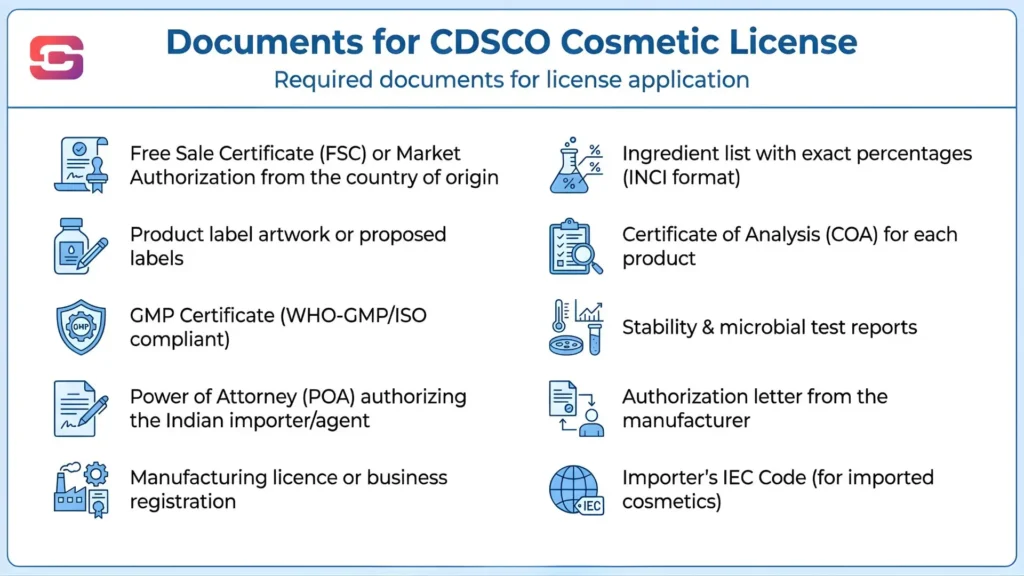
- Prepare the product dossier for each product to be registered — this includes the complete ingredient list (INCI names), product specifications, CoA, stability data, and labelling.
- Obtain the Free Sale Certificate (FSC) or Certificate of Conformity from the country of manufacture, confirmed by a competent authority.
- Prepare the safety data and comply with Schedule Q standards — confirm the product does not contain prohibited ingredients listed in Appendix A of Cosmetics Rules, 2020.
- Submit the import registration application online in the prescribed form, along with the application fee.
- CDSCO scrutinizes the application and may raise queries within 30 working days. Respond with supporting documents promptly.
- Once approved, CDSCO issues the Import Registration Certificate (Form COS-7 / applicable form under current rules), valid for 3 years.
- Display the Registration Number on all product labels in India as per labelling requirements under Cosmetics Rules, 2020.
- Maintain post-market vigilance — report adverse cosmetic events (ACEs) to CDSCO as required.

Cosmetics Manufacturing License in India — State Licensing Authority (SLA) Process
Manufacturing cosmetics in India requires a Cosmetics Manufacturing License from the State Licensing Authority (SLA) of the state in which the manufacturing facility is located. The SLA issues licenses under the Cosmetics Rules, 2020.
Step-by-Step Manufacturing License Process
- Establish the manufacturing facility complying with Schedule M-II Good Manufacturing Practices under Cosmetics Rules, 2020.
- Apply to the State Licensing Authority (State Drug Controller / Drugs Controller of the respective state) in the prescribed form.
- Submit factory layout, equipment list, qualified technical staff details, water quality reports, and GMP compliance declaration.
- Pay the prescribed state-level license fee.
- The SLA inspects the manufacturing premises — typically within 30 to 60 working days of application.
- If the facility is found compliant, the SLA issues the Manufacturing License (Form COS-3 or applicable state form), authorising the manufacture of specific cosmetic categories.
- Maintain GMP records, batch manufacturing records, quality control logs, and annual returns to the SLA.
Who Needs a CDSCO Cosmetics Registration or License?
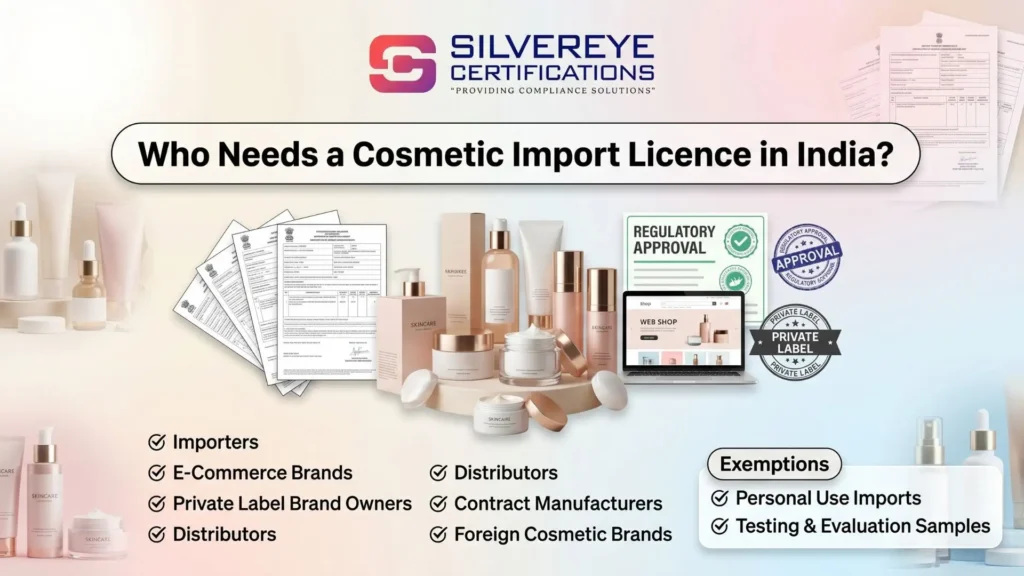
- Importers of any cosmetic product from any country for commercial sale in India — CDSCO import registration is mandatory.
- Domestic manufacturers of cosmetics for sale in India — State Licensing Authority (SLA) manufacturing license is mandatory.
- Contract manufacturers producing cosmetics on behalf of a brand — manufacturing license in the name of the CMO is required.
- Brand owners (brand on label) who manufacture at a third-party CMO — responsible for ensuring the CMO is licensed; may also need CDSCO registration for specific claims.
- E-commerce sellers sourcing and selling imported cosmetics — must ensure all imported products carry valid CDSCO Import Registration Certificates.
- Re-labellers and repackagers of imported cosmetics — separate import registration for re-labelled products is required.
Documents Required for CDSCO Cosmetics Registration (2026 Checklist)
| Document | Import Registration | Manufacturing License |
| Complete ingredient list (INCI names) | Mandatory | Mandatory |
| Product specification and Certificate of Analysis (CoA) | Mandatory | Mandatory |
| Stability test reports (accelerated and real-time) | Mandatory | Mandatory |
| Challenge / Preservative Efficacy Test reports | Mandatory | Mandatory |
| Heavy metal test reports (as per Schedule Q limits) | Mandatory | Mandatory |
| Microbiological test reports (as per Schedule Q) | Mandatory | Mandatory |
| Free Sale Certificate (FSC) from country of origin | Mandatory | Not applicable |
| Product labelling (draft, English and regional language) | Mandatory | Mandatory |
| Manufacturing process description / flow diagram | Desirable | Mandatory |
| Safety Data Sheet (SDS) for active ingredients | Desirable | Mandatory |
| Site Master File / GMP certificate of manufacturer | Mandatory | N/A (SLA inspection) |
| Undertaking by authorised Indian importer | Mandatory | Not applicable |
| Power of Attorney / Authorisation letter from foreign manufacturer | Mandatory | Not applicable |
| Factory layout and equipment list | Not required | Mandatory |
| Qualified technical person (QTP) details | Not required | Mandatory |
| Water analysis report (purified water / WFI if applicable) | Not required | Mandatory |
CDSCO Prohibited and Restricted Ingredients in Cosmetics (Key Highlights)
Appendix A and related schedules of the Cosmetics Rules, 2020 specify ingredients that are completely prohibited, or restricted to specific concentrations, in cosmetics sold in India. Non-compliance leads to product seizure, import bans, and license cancellation.
| Category | Examples of Prohibited / Restricted Ingredients | CDSCO Action if Violated |
| Prohibited Colorants | Amaranth (FD&C Red No. 2), Sudan dyes, Auramine | Seizure and product ban |
| Heavy Metal Limits | Lead ≤10 ppm, Arsenic ≤3 ppm, Mercury ≤1 ppm, Cadmium | Recall and prosecution |
| Prohibited Preservatives | Formaldehyde-releasing agents above threshold, Thimerosal in some categories | Product ban |
| Prohibited Sunscreens | PABA (Para-aminobenzoic acid) at concentrations above limit | Import refusal |
| Restricted Hair Dye Ingredients | p-Phenylenediamine (PPD) must meet maximum concentration limit | Labelling requirement + limit |
| Microbiological Limits | Staphylococcus aureus: absent; E. coli: absent; Pseudomonas: absent | Batch recall |
Brands must conduct ingredient screening against both the Indian prohibited list and applicable international standards (EU Cosmetics Regulation No. 1223/2009 is often used as a global benchmark) before launching products in India.
CDSCO Cosmetics Registration Fees — Government Charges (2026)
The following fee structure is applicable under the Cosmetics Rules, 2020. These are indicative figures based on the current fee schedule; always verify on the official CDSCO portal before making payment, as fees are subject to revision:
| Application Type | Fee (INR) — Approximate |
| Import Registration — Single Product (Non-Indian Manufacturer) | INR 5,000 per product |
| Import Registration — Multiple Products (Same Manufacturer) | INR 5,000 for first product + INR 2,500 per additional product |
| Renewal of Import Registration | INR 2,500 per product |
| Amendment to Import Registration | INR 1,000 per amendment |
| Manufacturing License — New Application (SLA) | State-specific (approx. INR 2,500–5,000 per category) |
| Manufacturing License — Renewal (SLA) | State-specific (approx. INR 1,500–3,000 per category) |
| Certificate of Cosmetic Product (for export) | INR 500 per certificate |
Note: Professional fees for regulatory consultants, testing charges, and translation of foreign documents are separate from government fees and can range from INR 25,000 to INR 2,00,000 depending on product complexity and the number of products being registered.
Validity Period and Renewal Timeline for CDSCO Cosmetics Registration
| License / Certificate Type | Validity | Renewal Window | Approx. Processing Time |
| CDSCO Import Registration Certificate | 3 years | 90 days before expiry | 30–60 working days |
| State Manufacturing License (Cosmetics) | 5 years (varies by state) | 90–180 days before expiry | 30–90 working days |
| Certificate for Cosmetic Product (Export) | 1 year | Annual renewal | 7–15 working days |
Failure to renew before expiry results in lapse of the registration certificate. Products cannot be legally imported or sold during a lapsed period, and re-application as a fresh registration (with full documentation) may be required. CDSCO has tightened enforcement on lapsed registrations since 2023.
Cosmetic Labelling Requirements Under Cosmetics Rules, 2020 — What Must Appear on Every Pack
Non-compliant labelling is the most common cause of product rejection and enforcement action for imported cosmetics in India. Every cosmetic label must display:
- Name of the cosmetic product
- Name and address of the manufacturer (and importer, if imported)
- Net contents (weight, volume, or unit count)
- Complete list of ingredients in INCI nomenclature — in descending order of weight
- Date of manufacture (Month & Year) and Best Before / Expiry Date (Month & Year)
- Batch number or lot number
- CDSCO Import Registration Number (for imported products)
- Country of origin (for imported products)
- Directions for use (where necessary for safe use)
- Warnings and precautions (e.g., 'Keep away from eyes', 'For external use only', 'Patch test recommended' for hair dyes)
- MRP (Maximum Retail Price) inclusive of all taxes, as per Legal Metrology Act
Labels must be in English. Regional language labels are optional unless required by state-level authorities. Labels affixed after import (stickering) are permitted but must carry all required information accurately.
Benefits of Obtaining CDSCO Cosmetics Registration for Your Brand
- Legal Market Access: Imported cosmetics without CDSCO registration are liable to be seized at ports of entry. Registration is the legal gateway to sell in India.
- Consumer Trust: CDSCO registration signals to retailers, distributors, and consumers that the product meets India's safety and quality standards.
- E-commerce Listing: Major marketplaces including Amazon India, Flipkart, Nykaa, and Myntra require CDSCO Import Registration Numbers for listed imported cosmetics.
- Government and Institutional Procurement: CDSCO-registered cosmetics are eligible for procurement by government hospitals, defence establishments, and public health programmes.
- Protection from Market Bans: Registered products are less likely to face arbitrary enforcement action from state drug controllers.
- Brand Credibility for Retail Distribution: Modern trade retailers (supermarkets, pharmacy chains, specialty beauty chains) mandate CDSCO compliance documentation.
CDSCO Cosmetics Regulatory Updates — 2025 to 2026
- Digital-First Compliance: CDSCO has fully migrated cosmetics registration applications to the Sugam online portal, eliminating physical document submission for routine applications. Digital signatures and Aadhaar-based verification are now integral to the process.
- Strengthened Enforcement at Ports: CDSCO has increased sampling and testing of imported cosmetics at major ports (Mumbai, Delhi, Chennai) in 2025 — particularly targeting hair dye products and skin lightening creams for ingredient compliance.
- Alignment with EU Prohibited List: CDSCO has been working toward greater harmonisation with the European Union Cosmetics Regulation 1223/2009 for prohibited and restricted ingredient lists, with several new ingredient restrictions added in 2024–2025.
- Microplastics Advisory: CDSCO has issued an advisory for the cosmetic industry to voluntarily phase out intentionally added microplastics (microbeads in scrubs) ahead of anticipated regulatory action in 2026–2027.
- Online Seller Compliance Notices: CDSCO and the Ministry of Consumer Affairs jointly issued notices to e-commerce platforms in 2025 requiring removal of unlicensed imported cosmetics, improving marketplace compliance significantly.
- Proposed Cosmeceuticals Framework: CDSCO has indicated it is reviewing a potential regulatory framework for 'active cosmetics' or cosmeceuticals as a separate category — expected for public consultation in 2026.
Conclusion
India's cosmetics market is projected to cross USD 30 billion by 2030, driven by rising disposable incomes, premiumization, and the explosive growth of direct-to-consumer beauty brands. With this growth comes heightened regulatory scrutiny. CDSCO and State Licensing Authorities have both intensified enforcement of the Cosmetics Rules, 2020 — and brands that invest proactively in regulatory compliance are the ones capturing market share without disruption.
Understanding the CDSCO cosmetics products list, getting the classification right (cosmetic vs. drug), ensuring ingredient compliance with Schedule Q, labelling accurately, and maintaining valid import registrations or manufacturing licenses are not just legal obligations — they are business fundamentals for any serious brand operating in India.
Whether you are a global beauty brand planning your India market entry, a domestic D2C skincare startup scaling up manufacturing, or an e-commerce entrepreneur sourcing imported beauty products, the CDSCO cosmetics compliance framework is your non-negotiable starting point.
Frequently Asked Questions
Are cosmetics regulated under the Medical Device Rules, 2017 in India?
No. Cosmetics in India are regulated under the Drugs and Cosmetics Act, 1940 and the Cosmetics Rules, 2020 — a separate and dedicated legal framework. The Medical Device Rules, 2017 exclusively govern medical devices. This is a very common misconception, and using the wrong regulatory pathway will result in application rejection.
Do I need CDSCO approval to sell cosmetics in India?
Domestic manufacturers need a State Manufacturing License (from the respective State Licensing Authority) rather than direct CDSCO approval. Importers of foreign cosmetics, however, must obtain a CDSCO Import Registration Certificate for each product before selling in India.
How long does CDSCO cosmetics import registration take?
Under standard processing timelines in 2026, a straightforward cosmetics import registration takes approximately 30 to 60 working days from complete application submission.
Is there a list of cosmetic ingredients banned in India?
Yes. Appendix A of the Cosmetics Rules, 2020 lists substances prohibited in cosmetics in India. This list is supplemented by specific Schedule Q restrictions on colorants, preservatives, UV filters, and heavy metal limits.
What is the penalty for importing cosmetics without CDSCO registration in India?
Importing cosmetics without a valid CDSCO Import Registration Certificate is an offense under the Drugs and Cosmetics Act, 1940. Penalties include seizure and destruction of the consignment, monetary fines, suspension or cancellation of the importer's drug license, and in repeated or aggravated cases, criminal prosecution.
Can the same CDSCO registration cover multiple product variants (e.g., different shades of lipstick)?
Each distinct cosmetic formulation typically requires its own registration. However, colour variants of the same base formula — for example, different shades of a lipstick sharing an identical formulation except for colourants — may be covered under a single registration in some cases, provided the variations are disclosed.
Does a cosmetic product need clinical trials in India before launch?
No. Unlike drugs, cosmetic products in India do not require clinical trials or pre-market efficacy studies. However, safety substantiation — through ingredient safety data, stability testing, preservative efficacy testing, and skin compatibility data — is required as part of the product dossier.
What is Schedule Q in Cosmetics Rules, 2020?
Schedule Q is the standards annexure of the Cosmetics Rules, 2020, specifying quality standards, permissible ingredients, maximum concentration limits for preservatives and colorants, heavy metal limits, and microbiological standards for different categories of cosmetic products.
Are natural or Ayurvedic cosmetics exempt from CDSCO regulation?
No. Natural, herbal, and Ayurvedic cosmetics are NOT exempt from Cosmetics Rules, 2020 compliance. They must still carry appropriate labelling, comply with ingredient restrictions, and in the case of imports, carry a valid CDSCO Import Registration Certificate
How do I find the current CDSCO approved cosmetics import registration list?
The CDSCO maintains a publicly searchable database of registered cosmetic products on its official website at cdsco.gov.in. You can search by product name, manufacturer name, or registration number to verify the current status of any cosmetic product's import registration. This database is updated periodically and is the authoritative source for compliance verification.