- Free Sale Certificate For Medical Device Import is an official document issued by the regulatory authority of the manufacturing country, confirming a medical device is legally marketed and sold there.
- The Central Drugs Standard Control Organization (CDSCO) mandates an FSC as proof of safety and regulatory compliance before granting import approval.
- Countries like the USA and Japan use alternative documents — we explain exactly what CDSCO accepts in their place.
Understanding the Free Sale Certificate (FSC) for Medical Device Import in India
If you are importing a medical device into India, the Free Sale Certificate — commonly called the FSC — is one of the most critical documents you will encounter. Yet many importers run into delays, rejections, or confusion simply because they did not fully understand what the FSC must say, who exactly issues it, and what alternatives exist when one cannot be obtained.
This guide covers every angle of the free sale certificate for medical device import in India. Whether you are a first-time importer, a foreign manufacturer setting up Indian distribution, or a regulatory consultant handling CDSCO submissions, this page is your complete reference for 2026.
What is a Free Sale Certificate for Medical Devices?
A Free Sale Certificate (FSC) is an official document issued by a competent authority — typically the national medicines or devices regulator — of the country where the medical device is manufactured. The certificate formally states that:
- The device is legally manufactured in that country.
- It is freely sold or distributed in the open market there without restriction.
- The manufacturer holds a valid license or regulatory approval for the product.
- No adverse regulatory action is currently pending against the device.
In simple terms, it is the manufacturing country's way of telling CDSCO: "This product meets our standards and is available for sale here." India's import regulator, CDSCO, uses this as one of the key benchmarks to evaluate whether a foreign medical device should be permitted entry into the Indian market.
The concept is rooted in the principle of mutual regulatory recognition. If a device is safe and freely sold in a country with a credible regulatory framework, India considers this a positive indicator of quality. The FSC does not, however, replace Indian registration — it is a supporting document in the overall CDSCO import license or Registration Application.
Who Issues the Free Sale Certificate — Country by Country
This is where most importers get confused. The issuing authority varies by country, and CDSCO expects the FSC to come from the correct, competent authority. Here is a country-wise reference:
| Country | Issuing Authority | Document Name / Equivalent |
| Germany | Regional Authority | Free Sale Certificate / Certificate of Free Sale |
| United Kingdom | Medicines and Healthcare products Regulatory Agency (MHRA) | Certificate of Free Sale |
| China | National Medical Products Administration (NMPA) | Free Sale Certificate |
| South Korea | Ministry of Food and Drug Safety (MFDS) | Free Sale Certificate |
| Australia | Therapeutic Goods Administration (TGA) | Certificate of Free Sale (via ARTG listing) |
| Canada | Health Canada | Medical Device Licence (as FSC equivalent) |
| France / EU | ANSM or Notified Body with CE Mark | CE Certificate + Declaration of Conformity |
| Japan | Pharmaceuticals and Medical Devices Agency (PMDA) / MHLW | Manufacturing/Marketing Approval (Shounin) |
| USA | U.S. Food and Drug Administration (FDA) | 510(k) Clearance / PMA / FDA Certificate to Foreign Government (CFG) |
| Other EU Countries | Respective National Competent Authority (NCA) | CE Mark documentation + FSC or equivalent |
Important note: For countries where the regulatory authority does not issue a standalone FSC document by that exact name, CDSCO generally accepts an equivalent document such as a Certificate to Foreign Government (CFG), an FDA 510(k) clearance letter, or a CE Certificate along with a Declaration of Conformity — provided these clearly confirm the device is legally marketed in that country.
What to Do When the Manufacturing Country Does Not Issue FSCs
The United States and Japan are two significant examples where the national regulator does not issue a document literally titled "Free Sale Certificate." This creates genuine confusion for Indian importers. Here is how to handle each:
For USA-manufactured medical devices:
- The FDA issues a Certificate to Foreign Government (CFG) — this is CDSCO's accepted FSC equivalent from the USA.
- Alternatively, a 510(k) clearance letter or a Premarket Approval (PMA) order, combined with an FDA Establishment Registration certificate, may be submitted.
- The CFG can be requested through FDA's Electronic Submissions Gateway (ESG) and is issued per device, per establishment.
- It confirms the device is legally marketed in the USA and the facility is registered.
For Japan-manufactured medical devices:
- Japan's MHLW issues a Shounin — a manufacturing and marketing approval certificate.
- A translated version of this document (by a certified translator), along with a notarized copy, is generally accepted by CDSCO.
- Some importers also obtain a letter from the Japanese Embassy or JETRO confirming the device's regulatory status.
For EU-manufactured devices (CE marked):
- CDSCO accepts the CE Certificate of Conformity issued by a Notified Body, along with the EU Declaration of Conformity.
- A supporting letter from the manufacturer confirming the device is legally sold in EU member states strengthens the submission.
When in doubt, CDSCO's official position is that the document must come from the competent regulatory authority and clearly state that the device is legally sold in the manufacturing country. If the document is in a language other than English, a certified translation is mandatory.
Why Does CDSCO Require a Free Sale Certificate?
CDSCO mandates the FSC under the Medical Devices Rules, 2017 (MDR 2017), which govern the import, manufacture, sale, and distribution of medical devices in India. The requirement is not bureaucratic box-ticking — it serves several practical regulatory purposes:
| Purpose | What It Means for Importers |
| Confirms legal status in origin country | Ensures India does not become a dumping ground for devices banned or restricted elsewhere |
| Validates manufacturer legitimacy | Verifies the manufacturer holds a valid licence in their home country |
| Supports safety assessment | Regulators use origin-country marketing status as a proxy for base-level safety |
| Enables faster Indian registration | A valid FSC from a recognised authority expedites CDSCO technical review |
| Protects Indian patients | Ensures only market-approved, commercially available devices enter the Indian supply chain |
Legal Basis: Where Is FSC Mandated in Indian Law?
The Free Sale Certificate requirement for medical device import in India is grounded in the following regulatory framework:
- Medical Devices Rules, 2017 (MDR 2017) — the primary legislation governing medical devices in India, introduced under the Drugs and Cosmetics Act, 1940.
- Schedule D-II of MDR 2017 — specifies the documents required for grant of import license for medical devices.
- CDSCO Guidance Documents — CDSCO has issued guidance notes clarifying acceptable FSC equivalents from various countries.
- Central License Approving Authority (CLAA) — CDSCO (New Delhi) is the CLAA for medical devices and administers FSC-related requirements.
Under MDR 2017, a medical device importer must obtain a valid Import License (Form MD-15) before commercially importing any Class A, B, C, or D device. The FSC is a mandatory supporting document for this application, along with several others detailed below.
Who Needs a Free Sale Certificate for Medical Device Import in India?
Not every person dealing with medical devices needs to worry about the FSC in the same way. Here is a clear breakdown of eligibility and applicability:
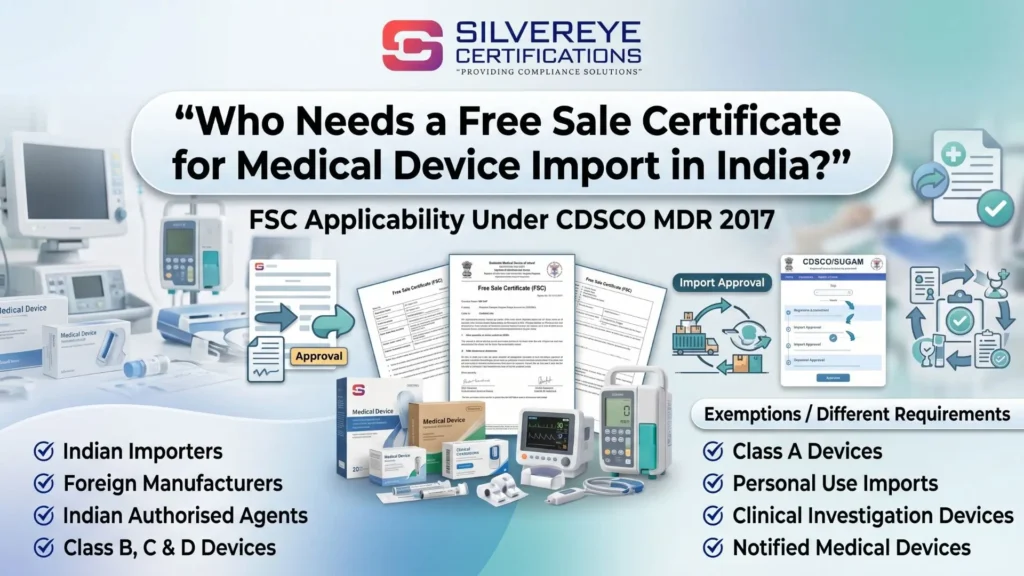
Who Must Submit an FSC:
- Authorized Indian importers (importers applying for a CDSCO Import License under MDR 2017 for Class B, C, and D devices).
- Foreign manufacturers seeking direct import approval.
- Indian entities acting as the authorized agent of a foreign manufacturer for registration and import purposes.
Who May Be Exempt or Has Different Requirements:
- Class A (non-measuring) medical devices — these are largely exempt from import license requirements but may still need regulatory documentation depending on the device.
- Devices imported for personal use in small quantities — different provisions apply.
- Devices imported for clinical investigation or trial — governed by a separate approval process.
- Notified medical devices under the CDSCO notification list — phased inclusion is ongoing; check the current notification status.
What Must the FSC Contain to Satisfy CDSCO?
This is one of the most commonly missed details. CDSCO has specific expectations about what the Free Sale Certificate must state. An FSC that is missing key elements will be rejected and your application returned. The document must include all of the following:
- Name and address of the manufacturer
- Generic name and brand name of the medical device
- Model number(s) or device identifier (catalogue number, if applicable)
- Statement that the device is freely sold and legally marketed in the manufacturing country
- Name and official seal/signature of the issuing competent authority
- Date of issue
- Validity period (typically 1 to 3 years depending on issuing country)
- Country of manufacture
CDSCO may also require the FSC to be apostilled or notarized, depending on the country of origin. Apostille requirements apply for countries that are signatories to the Hague Apostille Convention. For non-Hague countries, the document may need to be attested by the Indian Embassy or High Commission in the manufacturing country.
Documents Required Along with the FSC for CDSCO Import License
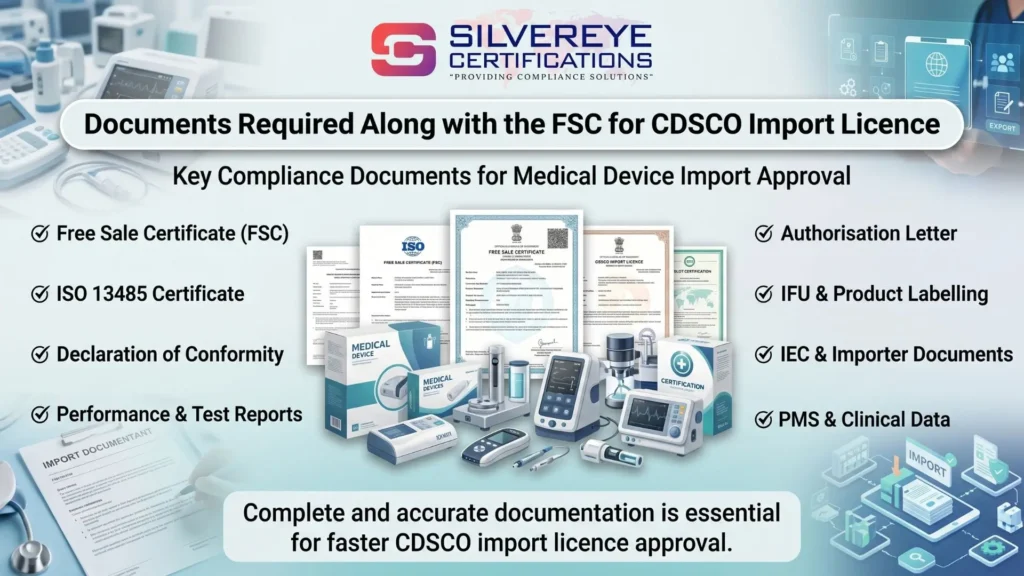
The FSC is one component of a larger documentation set. When you apply for an Import License (Form MD-14 application, Form MD-15 grant) for a medical device, CDSCO requires the following documents:
| Document | Details / Notes |
| Form MD-14 | Duly filled application form for import licence |
| Free Sale Certificate (FSC) | From manufacturing country's competent authority — as detailed above |
| Certificate of ISO 13485 / Quality System Certificate | Evidence of the manufacturer's quality management system |
| Performance / Test Reports | Technical data substantiating safety and efficacy of the device |
| Declaration of Conformity (DoC) | Manufacturer's self-declaration of conformity to applicable standards |
| Undertaking by Indian Importer | Commitment to comply with MDR 2017 conditions |
| Authorisation Letter | From foreign manufacturer authorising the Indian importer/agent |
| Labelling / Instructions for Use (IFU) | Draft Indian labelling as per MDR 2017 Schedule III |
| Device Description and Technical Summary | Intended use, device classification, materials, dimensions, etc. |
| Proof of Incorporation / Business registration of importer | Valid documents of the Indian importer entity |
| Import Export Code (IEC) | Issued by DGFT; mandatory for all importers |
| Relationship Agreement | Between foreign manufacturer and Indian authorised agent / importer |
| Post-Market Surveillance (PMS) Plan | Required for Class C and D devices |
| Clinical Data Summary | Required for high-risk (Class C, D) devices |
Note: Specific document requirements can vary based on the device risk classification (Class A, B, C, or D as per MDR 2017 Schedule II). Always cross-check with the latest CDSCO guidelines before filing your application, as requirements have been updated progressively through 2025 and 2026.
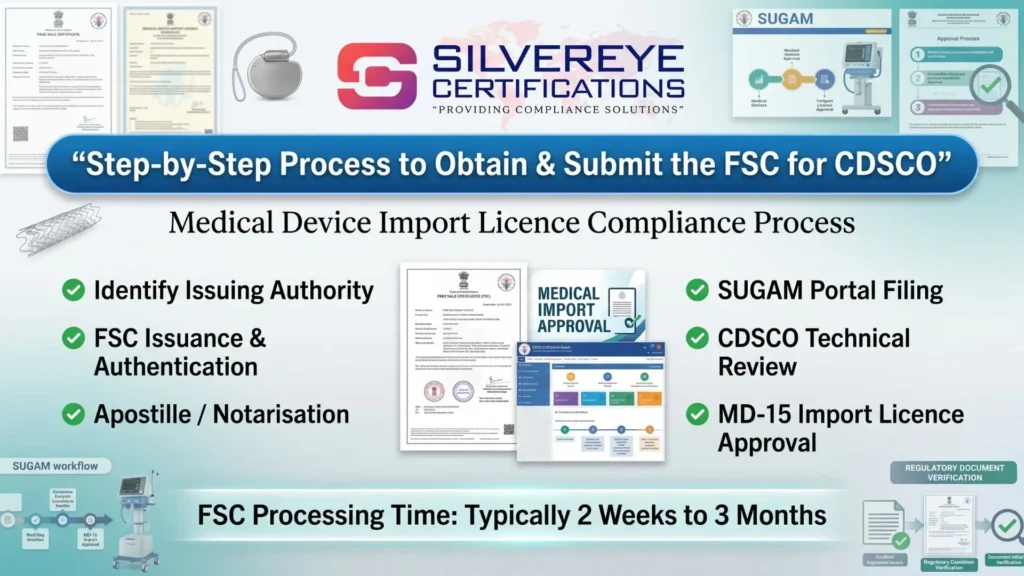
Step-by-Step Process to Obtain and Submit the FSC for CDSCO
Step 1: Identify the Correct Issuing Authority
Start by identifying which authority in the manufacturing country issues FSCs or equivalent certificates. Use the country-wise table above. Contact the authority directly or through the manufacturer to initiate the request.
Step 2: Manufacturer Applies for FSC in Their Country
In most countries, it is the manufacturer (not the Indian importer) who applies for and receives the FSC from their national regulator. The Indian importer should coordinate with the foreign manufacturer early — FSC processing times range from 2 weeks to 3 months depending on the country.
Step 3: Apostille or Notarization (if required)
Once issued, check whether the FSC needs apostille (for Hague Convention countries) or Indian Embassy attestation (for non-Hague countries). India is a signatory to the Hague Apostille Convention (effective 2005), so apostilled documents are widely accepted.
Step 4: Certified Translation (if required)
If the FSC is in a language other than English, get it translated by a certified translator. The translation must accompany the original document.
Step 5: Compile the Complete Application
Prepare all documents as listed in the previous section. Ensure the FSC is current (not expired), the device names and model numbers match across all documents, and the manufacturer details are consistent throughout the application.
Step 6: File Application on SUGAM Portal
CDSCO's online filing platform, SUGAM (sugam.gov.in), is the primary channel for submitting import licence applications for medical devices. Create an account, fill Form MD-14 online, upload all documents in the specified format (PDF, size limits apply), and pay the prescribed fee.
Step 7: CDSCO Technical Review
CDSCO officers review the application. If documents are found deficient or queries are raised, a deficiency letter is issued. Respond within the stipulated time (typically 30 days) with clarifications or additional documents.
Step 8: Approval and Issuance of Import License (Form MD-15)
On satisfaction, CDSCO grants the Import Licence in Form MD-15. This licence is device-specific and importer-specific and carries a validity period. Once you have this, the FSC has served its purpose in the application stage.
Fees for Medical Device Import License Application
The government fees for applying for an import licence under MDR 2017 are prescribed in the Medical Devices Rules. Here is the current fee schedule as per MDR 2017 Schedule VI (as updated):
| Device Risk Class | Application Fee (INR) | Notes |
| Class A (Notified) | ₹1,000 | Many Class A devices are self-declared; check notification status |
| Class B | ₹3,000 | Standard fee for moderate-risk devices |
| Class C | ₹5,000 | Higher-risk devices; additional clinical data required |
| Class D | ₹5,000 | Highest risk; stringent review |
| Amendment to existing licence | 50% of original fee | For adding models, updating importer details, etc. |
Note: These fees are for government filing only. Professional regulatory consulting fees, apostille charges, translation costs, and SUGAM platform usage are separate. Total end-to-end costs vary significantly based on the complexity of the device and the country of manufacture.
Validity and Renewal of FSC and Import License
FSC Validity:
The validity of the Free Sale Certificate itself depends on the issuing country's rules:
- Most countries issue FSCs valid for 1 to 3 years.
- CDSCO expects the FSC to be current at the time of application. An expired FSC will result in application rejection.
- Even if your Import License is still valid, a new FSC may be needed when renewing the license if the previous one has expired.
Import License (Form MD-15) Validity and Renewal:
| Aspect | Detail |
| Initial validity | Typically 3 years from date of grant |
| Renewal timeline | Apply at least 6 months before expiry to avoid regulatory gap |
| Renewal documents | Updated FSC, updated ISO certificate, any new technical data |
| Renewal fee | 50% of the original application fee as per MDR 2017 |
| Post-renewal validity | 5 years on first renewal; permanent thereafter (subject to conditions) |
| Online process | Renewal also filed through SUGAM portal |
Importer tip: Build a compliance calendar tracking the expiry dates of your FSC, ISO certificate, Import License, and IEC. CDSCO does not automatically notify you of approaching expiries. Missing renewal windows can mean a halt in import operations.
Benefits of Having a Valid FSC and CDSCO Import License
Going through the process of obtaining an FSC and securing your CDSCO import licence is not just a regulatory obligation — it delivers concrete business benefits:
- Market access: Only licensed importers can legally sell medical devices in India. A valid import license is your entry ticket to hospitals, distributors, and government tenders.
- Tender eligibility: Government procurement tenders (GeM, state government tenders) almost universally require a valid CDSCO import license. Without it, you are ineligible to bid.
- Brand credibility: Hospitals and healthcare institutions increasingly verify the regulatory status of devices. A licensed product signals quality and compliance.
- Avoidance of penalties: Importing without a valid license under MDR 2017 attracts serious consequences — seizure of goods, fines, and criminal liability under the Drugs and Cosmetics Act.
- Ease of customs clearance: A valid import license with a matching FSC streamlines customs procedures, reducing port delays.
- Investor confidence: For startups and mid-size importers, regulatory compliance builds investor and partner trust.
Conclusion: Getting the FSC Right the First Time
The Free Sale Certificate for medical device import in India is not just a formality — it is a substantive regulatory document that directly impacts your CDSCO application outcome. Getting it right the first time saves weeks of back-and-forth with the regulator and keeps your import operations on schedule.
Key takeaways for 2026:
- Know your manufacturing country's correct issuing authority and approach them early.
- For the USA, apply for an FDA Certificate to Foreign Government (CFG) — this is your FSC equivalent.
- Ensure the FSC explicitly lists your device name, model numbers, and states it is freely sold in the country of manufacture.
- Apostille or notarise as required based on the country.
- Align the FSC with your CDSCO application before filing — mismatches are the leading cause of deficiency notices.
- Track expiry dates proactively — a lapsed FSC at renewal time can stall your entire import operation.
Regulatory compliance in the Indian medical device space is becoming increasingly rigorous with each passing year. Importers who build structured compliance processes around documentation like the FSC will find the CDSCO pathway smoother and more predictable.
Frequently Asked Questions
What is a Free Sale Certificate (FSC) for a medical device?
A Free Sale Certificate is an official document from the regulatory authority of the manufacturing country, confirming that a medical device is legally manufactured and freely sold there. CDSCO requires it as part of the import licence application for medical devices in India.
Is an FSC mandatory for all medical devices imported into India?
An FSC (or its accepted equivalent) is generally required for notified medical devices that need a CDSCO import licence under MDR 2017. Class A non-measuring devices with a self-declaration route may have different requirements. Always check your specific device's current notification status on cdsco.gov.in.
The USA does not issue an FSC. What should I submit to CDSCO?
For USA-manufactured devices, CDSCO accepts the FDA Certificate to Foreign Government (CFG) as the FSC equivalent. You can also submit a 510(k) clearance letter or PMA order combined with an FDA Establishment Registration certificate. The CFG is the most straightforward option.
How long does it take to get an FSC from the manufacturing country?
Processing times vary by country. Most EU and UK authorities issue FSCs within 4 to 8 weeks. FDA CFGs typically take 2 to 4 weeks. Some Asian regulators may take up to 12 weeks. Plan early — do not start your CDSCO filing until the FSC is in hand.
Does the FSC need to be apostilled or notarized?
For countries that are signatories to the Hague Apostille Convention, the FSC must be apostilled. For non-Hague countries, attestation by the Indian Embassy or High Commission in the manufacturing country is required. Many major device-manufacturing nations (Germany, UK, France, Australia, South Korea) are Hague Convention signatories.
How long is an FSC valid? Will CDSCO accept an old FSC?
FSC validity depends on the issuing country — typically 1 to 3 years. CDSCO expects the FSC to be current and valid at the time of application. An expired FSC will result in rejection. If renewing your import licence, obtain a fresh FSC if the existing one has or will expire before the renewal process concludes.
Can one FSC cover multiple device models from the same manufacturer?
It depends on the issuing country's practice and CDSCO's review. Some countries issue a single FSC listing all devices from a manufacturer. CDSCO may accept this if all device models covered by your application are explicitly listed on the FSC. If models are not listed, separate FSCs may be needed. Always verify with CDSCO guidance or a regulatory consultant.
What happens if I import a medical device without a valid import license or FSC?
Importing a notified medical device without a valid CDSCO import license is a violation of MDR 2017 and the Drugs and Cosmetics Act, 1940. Consequences include: seizure of the imported goods at the port, monetary penalties, potential criminal prosecution, and cancellation of existing licenses. The risk far outweighs any short-term convenience.
How do I file the import license application with the FSC on SUGAM?
Go to sugam.gov.in, register as a medical device importer, and complete Form MD-14 online. Upload all required documents including the FSC in PDF format within the specified file size limits. Pay the prescribed government fee through the portal's payment gateway. After submission, track your application status through the SUGAM dashboard.
Can a regulatory consultant apply for the import license on my behalf?
Yes. A regulatory consultant or a CDSCO-authorized regulatory agent can assist in preparing and filing the import license application, including coordinating the FSC procurement with the foreign manufacturer. However, the Import License is issued in the name of the Indian importer, and an authorization letter from the foreign manufacturer appointing the Indian entity as its authorized agent is required.