
- CDSCO Cosmetic import license products over 12 distinct cosmetic product categories require a CDSCO import license before they can legally enter and be sold in India.
- Schedule M of the Cosmetics Rules, 2020 is the definitive reference — if your product appears there, registration is non-negotiable.
- Each product needs a separate Registration Certificate (Form Cos-6) and a government fee of USD 2,000 — no bundling allowed.
- Missing a single required document — like an apostilled Certificate of Free Sale — is the top reason for application delays in 2026.
Introduction
So you want to import cosmetics into India — great market, massive opportunity. But before a single unit clears customs, you need to answer one very specific question: does your product need a CDSCO cosmetic import license? The answer depends entirely on what the product is, what it contains, and what claims appear on its label.
This guide focuses exclusively on cosmetic products — what they are, which ones fall under the mandatory import license requirement, which ones are exempt, and why certain borderline products are treated differently by the Central Drugs Standard Control Organization (CDSCO). If you have ever searched for 'CDSCO cosmetic import license products list' and found vague or outdated answers, this is the definitive, up-to-date breakdown for 2026.
What Qualifies as a Cosmetic Under Indian Law?
Before diving into the product list, it helps to understand exactly how Indian regulations define a cosmetic — because the definition directly determines whether your product needs a CDSCO import license or a drug import license (which is a completely different and more complex process).
Under the Drugs and Cosmetics Act, 1940, a cosmetic is defined as any article intended for use by rubbing, pouring, sprinkling, or spraying on, or introducing into, or otherwise applying to, the human body or any part thereof, for cleansing, beautifying, promoting attractiveness, or altering the appearance.
| Cosmetic (needs CDSCO cosmetic import licence) | Drug (needs drug import licence — Form 10) |
| Sunscreen SPF 50 — cosmetic UV protection claim | Sunscreen claiming to prevent actinic keratosis |
| Anti-dandruff shampoo with zinc pyrithione 1% | Anti-dandruff shampoo with ketoconazole 2% |
| Skin-lightening cream — brightening / glow claim | Skin cream with hydroquinone above 2% — treating hyperpigmentation |
| Teeth whitening toothpaste — cosmetic whitening claim | Teeth gel with H2O2 above 6% — classified as bleaching agent |
| Hair dye (permanent or semi-permanent colour) | Hair treatment claiming to treat alopecia or scalp disease |
| Antiperspirant deodorant — cosmetic sweat-reduction claim | Antiperspirant claiming to treat hyperhidrosis (excessive sweating disorder) |
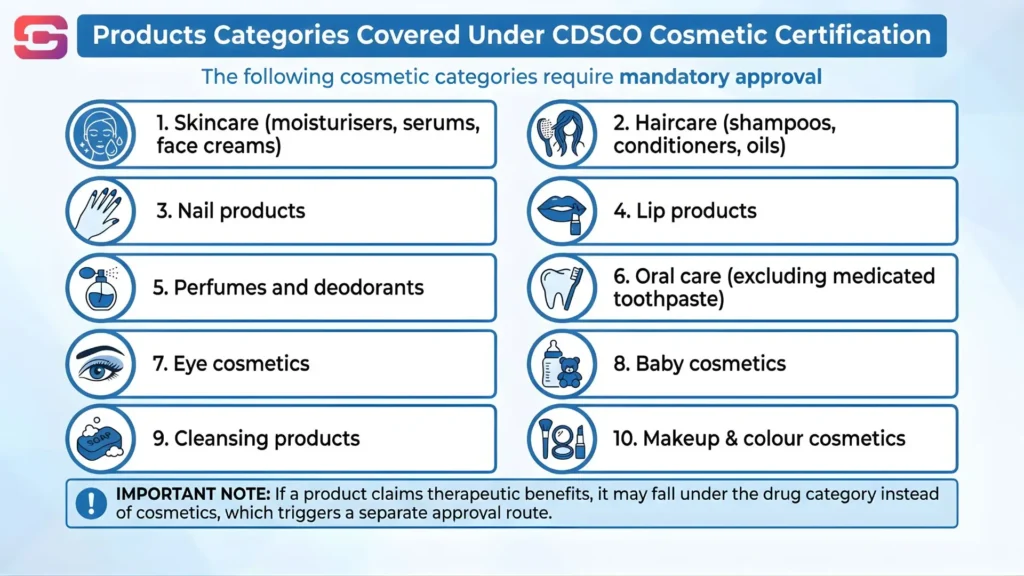
Complete List of CDSCO Cosmetic Import License Products (Schedule M, 2020)
Schedule M of the Cosmetics Rules, 2020 is the official government list of cosmetics that must be registered with CDSCO before they can be imported and sold in India. Below is the most detailed, plain-language breakdown available — covering all regulated categories with product examples, key ingredients that trigger the registration requirement, and important notes for each.
1. Sunscreens and Sun Protection Products
Sunscreens are one of the highest-volume imported cosmetic categories in India, and all of them — regardless of SPF level — require a CDSCO import license.
| Product Type | Common Examples | Registration Trigger |
| Chemical sunscreens | SPF 15, SPF 30, SPF 50 lotions and creams | UV filter chemicals (avobenzone, octocrylene, oxybenzone, etc.) |
| Physical / mineral sunscreens | Zinc oxide or titanium dioxide sunblocks | UV-filtering minerals above cosmetic threshold |
| Tinted sunscreens | BB creams, CC creams with SPF claims | Dual claim — colour + UV protection |
| After-sun products with SPF | After-sun lotion with SPF 15 | SPF claim on label |
| Sunscreen sprays | Continuous spray SPF 50 | Aerosol format + UV filter ingredients |
| Children's sunscreens | Kids SPF 50+ lotions | SPF claim — no exemption for child-specific variants |
| Sports / water-resistant sunscreens | SPF 50 water-resistant sport lotion | Extended-protection label claims |
Key point: Even a moisturizer with added SPF triggers the sunscreen registration requirement. It is the SPF claim on the label — not the primary function — that matters.
2. Hair Dye and Hair Coloring Products
Hair coloring products are among the most tightly regulated cosmetic imports in India, primarily because of safety concerns around para-phenylenediamine (PPD) and other oxidative dye intermediates that can cause allergic reactions.
| Product Type | Common Examples | Registration Trigger |
| Permanent hair dyes | Oxidative hair colours with PPD or resorcinol | PPD, resorcinol, aminophenol concentration |
| Semi-permanent hair dyes | Non-oxidative color creams, color balms | Synthetic dye intermediates |
| Temporary hair colour | Colour sprays, chalks, wash-out colour gels | Colourant type and concentration |
| Henna-based dyes with additives | Black henna (contains PPD), compound henna products | PPD addition to natural henna — makes it Schedule M |
| Natural/plant-based hair dyes | Indigo, amla-based dyes with no synthetic additives | Synthetic additive presence — plain natural henna is exempt |
| Hair colour shampoos | Colour-depositing shampoos, grey-coverage shampoos | Colourant + shampoo base combination |
| Bleaching powders and lightening kits | Hair bleach kits with hydrogen peroxide developer | Hydrogen peroxide developer concentration |
| Highlights and balayage kits | At-home highlight kits with bleach + toner | Peroxide developer content |
Note on plain henna: Pure, natural henna (Lawsonia inermis) without any synthetic dye additives is exempt from CDSCO import registration. The moment any synthetic colorant or PPD is added, it becomes a Schedule M product.
| Read More :- CDSCO Registration for Import Hair Oil |
3. Skin-Lightening, Whitening, and Brightening Products
Skin-lightening cosmetics represent one of the most sensitive and closely watched categories in Indian cosmetic regulation. The CDSCO has strict ingredient limits, and several substances that were previously in common use — such as mercury salts and hydroquinone above certain concentrations — are now either banned or tightly restricted.
| Product Type | Common Examples | Registration Trigger / Key Restriction |
| Fairness and brightening day creams | SPF-boosted fairness creams, glow creams | Whitening claim + active ingredient |
| Dark spot correctors | Serums targeting hyperpigmentation and melasma | Niacinamide above threshold, kojic acid, arbutin |
| Underarm whitening products | Brightening underarm roll-ons, dark-spot underarm creams | Whitening claim applied to sensitive skin areas |
| Body-lightening lotions | Full-body brightening lotions, glow body oils with whitening claims | Systematic whitening claim |
| Night creams with whitening claims | Anti-pigmentation night repair creams | Combination of AHA and whitening agents |
| Brightening face masks | Sheet masks and wash-off masks with vitamin C or kojic acid brightening claims | Whitening claim on label |
| Eye creams for dark circles | Under-eye serums targeting dark circles and pigmentation | Pigmentation-reduction claim |
Prohibited ingredients to watch: Mercury compounds in any concentration are banned in Indian cosmetics. Hydroquinone above 2% is not permitted in cosmetics and requires drug classification. Steroids (corticosteroids) are completely banned as cosmetic ingredients in India.
4. Anti-Dandruff and Scalp Treatment Products
Anti-dandruff products occupy an interesting middle ground. Products with mild anti-dandruff cosmetic claims and low-concentration actives are treated as cosmetics and require a CDSCO cosmetic import license. Products with higher-strength active pharmaceutical ingredients are re-classified as OTC drugs.
| Product Type | Active Ingredient | Classification |
| Anti-dandruff shampoo (cosmetic) | Zinc pyrithione up to 1%; coal tar up to 0.5%; piroctone olamine up to 1% | Cosmetic — needs CDSCO cosmetic import licence |
| Anti-dandruff conditioner (cosmetic) | Zinc pyrithione up to 0.5%; salicylic acid up to 3% | Cosmetic — needs CDSCO cosmetic import licence |
| Scalp serum with anti-dandruff claim | Tea tree oil; salicylic acid up to 2% | Cosmetic — needs CDSCO cosmetic import licence |
| Anti-dandruff shampoo (drug) | Ketoconazole 2%; selenium sulfide 2.5% | Drug — needs drug import licence, not cosmetic RC |
| Scalp treatment for seborrhoeic dermatitis | Clobetasol / betamethasone (corticosteroids) | Drug — completely outside cosmetic category |
If the anti-dandruff product is sold over the counter for general use and contains zinc pyrithione 1% or piroctone olamine, apply for a CDSCO cosmetic import license. If it contains ketoconazole 2% or any prescription-strength steroid, approach a drug regulatory consultant instead.
5. Teeth Whitening and Oral Care Products with Active Claims
Oral care products range from fully exempt (plain fluoride toothpaste) to cosmetic-regulated (whitening toothpaste) to drug-regulated (high-concentration bleaching gels). The split depends on the hydrogen peroxide concentration and the label claims.
| Product Type | H2O2 / Active Concentration | Regulatory Status in India |
| Whitening toothpaste | H2O2 below 0.1%; abrasive whitening agents | Cosmetic — CDSCO import licence required |
| Whitening strips (cosmetic grade) | H2O2 up to 3% — consumer OTC product | Cosmetic — CDSCO import licence required |
| Whitening mouthwash | H2O2 below 0.1%; whitening claims | Cosmetic — CDSCO import licence required |
| Charcoal teeth whitening powder (with active claims) | Active adsorption claims | Cosmetic — CDSCO import licence required if whitening claim present |
| Professional whitening gels | H2O2 above 6%; professional use only | Drug — drug import licence required, not cosmetic RC |
| Plain fluoride toothpaste (no whitening claim) | Fluoride up to 1,500 ppm — no bleaching agent | Cosmetic — EXEMPT from Schedule M registration |
6. Hair Straightening, Relaxing, and Chemical Treatment Products
Chemical hair treatment products that permanently alter hair structure — through thioglycolate chemistry, formaldehyde-releasing agents, or strong alkalis — are regulated cosmetics requiring a CDSCO import license.
- Permanent wave (perm) kits — ammonium thioglycolate-based wave solutions and neutralizers.
- Chemical hair relaxers — sodium hydroxide (lye) or guanidine hydroxide-based cream relaxers.
- Keratin smoothing treatments — formaldehyde-releasing or glyoxylic acid-based keratin treatments. Note: formaldehyde above 0.2% in rinse-off products is restricted.
- Thermally activated straightening creams — silicone-based heat-activated smoothing creams with label claims for structural straightening.
- Neutralizers for perm and relaxer systems — hydrogen peroxide or sodium bromate-based neutralizing solutions used with perm kits.
7. Depilatory and Hair Removal Products
Chemical depilatories break down the keratin structure of hair using thioglycolate or calcium hydroxide. All depilatory cosmetics with active chemical hair-removal action require CDSCO cosmetic import registration.
- Depilatory creams — thioglycolate-based creams for face, legs, underarms, and bikini area.
- Depilatory sprays — aerosol-format hair removal products.
- Wax-based depilatory strips — cold-wax or warm-wax pre-coated strips with cosmetic hair-removal claims.
- Enzymatic hair removal products — enzyme-based products with label claims for hair growth inhibition.
8. Antiperspirants and Clinical-Strength Deodorants
Standard deodorants that only mask body odour are generally exempt from CDSCO import registration. Antiperspirants — which actively reduce sweat production using aluminium salts — require registration.
| Product Type | Key Ingredient | CDSCO Status |
| Roll-on antiperspirant | Aluminium chlorohydrate (15–25%) | Cosmetic — CDSCO import licence required |
| Clinical-strength antiperspirant | Aluminium zirconium tetrachlorohydrex (above 20%) | Cosmetic — CDSCO import licence required |
| Antiperspirant spray | Aluminium chlorohydrate in aerosol base | Cosmetic — CDSCO import licence required |
| Plain deodorant (no antiperspirant claim) | Fragrance, triclosan, or alcohol — no aluminium salts | Cosmetic — EXEMPT from Schedule M registration |
| Natural crystal deodorant | Potassium alum — mild astringent, no sweat-reduction claim | Cosmetic — likely EXEMPT — verify label claims |
9. Nail Products with Active Ingredients
- Nail hardeners with formaldehyde — formaldehyde above 0.1% in nail hardeners triggers Schedule M; below 0.1% is exempt.
- Anti-fungal nail treatments with cosmetic claims — tea tree oil nail serums or nail hardeners claiming anti-fungal action.
- Nail growth serums with peptide or biotin actives and specific nail-health claims.
- Cuticle removing products — containing potassium hydroxide or urea-based cuticle dissolvers.
- Gel nail polishes with photo-initiators — UV-cured gel systems with active monomer ingredients.
10. Skin Exfoliation and Peeling Products with AHA / BHA
Chemical exfoliants using alpha hydroxy acids (AHAs) or beta hydroxy acids (BHAs) above defined concentration thresholds are regulated cosmetics in India. The EU Cosmetic Regulation benchmark is closely followed by CDSCO for these limits.
| Acid Type | Permitted Cosmetic Concentration | Above This Level |
| Glycolic acid (AHA) | Up to 10% with pH ≥ 3.5 for face; up to 30% for professional use with instructions | Requires specific safety warnings on label |
| Lactic acid (AHA) | Up to 10% for rinse-off; up to 5% for leave-on | Above 10% — needs safety dossier support |
| Salicylic acid (BHA) | Up to 2% in face products; up to 3% in body products | Above 3% — borderline drug classification |
| Mandelic acid (AHA) | Up to 10% in formulation | Label claim determines cosmetic vs drug classification |
| TCA (trichloroacetic acid) | Not permitted in consumer cosmetics | Drug-only — not registerable as a cosmetic |
11. Lip Care Products with Active Whitening or SPF Claims
Standard lipsticks and lip glosses without active claims are exempt from Schedule M. However, the following lip product types require registration:
- Lip balms or lip treatments with SPF — SPF claim immediately triggers sunscreen registration requirement even in a lip format.
- Lip-lightening or lip-brightening products — products targeting dark lips with active whitening ingredients like kojic acid or niacinamide.
- Medicated lip balms with therapeutic claims — these typically cross into drug territory.
12. Baby and Children's Cosmetics with Active Claims
Baby cosmetics are a growing import category, and CDSCO applies additional scrutiny to products intended for children under 3 years of age.
- Baby sunscreens — all SPF claims, even on baby-specific products, require CDSCO cosmetic import registration.
- Baby hair oil or scalp products with active ingredients — products claiming to treat cradle cap or scalp conditions.
- Baby rash creams with zinc oxide above threshold — if zinc oxide is used at concentrations that cross from cosmetic to drug action.
- Baby wipes with preservatives or antimicrobial claims — standard baby wipes are exempt, but wipes with active antimicrobial claims are reviewed under Schedule M.
Cosmetic Products Exempt from CDSCO Import License — Complete List
The following cosmetic product categories do not require a CDSCO Registration Certificate before import, provided they carry no active claims that push them into Schedule M territory. All exempt products must still comply with Schedule S safety standards and labelling rules under Rule 133.
| Exempt Cosmetic Category | Examples | Key Condition for Exemption |
| Plain moisturisers and emollients | Basic face cream, body lotion, hand cream — no SPF, no whitening | No active claims; no scheduled active ingredients |
| Standard shampoos and conditioners | Hydrating shampoo, colour-safe conditioner — no anti-dandruff claim | No anti-fungal or scalp-treatment actives |
| Perfumes and colognes | Eau de parfum, eau de toilette, body mist | No SPF or skin-active claims |
| Standard lipstick and lip gloss | Creamy lipstick, lip gloss, tinted lip balm — no SPF | Colourants from Annex IV approved list only |
| Foundation and concealer | Liquid foundation, powder concealer — no SPF claim | Standard cosmetic colourants, no skin-treatment claims |
| Eye make-up | Mascara, eye shadow, eyeliner, kajal | No prohibited colourants; kajal tested for lead |
| Blush, bronzer, highlighter | Powder blush, cream bronzer, illuminating highlighter | Approved colourants only |
| Nail polish (standard) | Regular nail lacquer, gel-effect nail polish — no formaldehyde above 0.1% | No nail-hardening active claim |
| Plain fluoride toothpaste | Standard toothpaste with fluoride — no whitening claim, no active bleach | Fluoride within permitted limits (max 1,500 ppm); no whitening agent |
| Standard deodorant (not antiperspirant) | Fragrance-based roll-on or spray with no sweat-reduction claim | No aluminium salts; no therapeutic claim |
| Plain baby wipes | Standard water-based baby wipes with mild preservative | No antimicrobial or therapeutic claims |
| Plain henna (natural, unadulterated) | 100% natural Lawsonia inermis henna powder or paste | Absolutely no synthetic dye additives |
| Shaving creams and gels | Standard lather shaving cream, transparent shave gel | No active skin-treatment ingredients; no SPF |
| Talcum powder (plain) | Standard body talc without fragrance or with simple fragrance | No active skin-treatment claims; asbestos-free certification required |
Important reminder: The exempt status is entirely claim-dependent. A plain moisturiser becomes a Schedule M product the moment the label says 'SPF 15' or 'brightening complex'. Train your label review process to catch these triggers before submitting to customs.
Borderline and Dual-Use Products — Cosmetic or Drug?
Some products genuinely sit on the fence. These are the products that cause the most confusion and the most customs delays in India. Here is a clear guide to how CDSCO typically classifies them:
| Product | Cosmetic if... | Drug if... |
| Sunscreen | Label says 'UV protection', 'SPF 30', 'protects from sun damage' | Label says 'prevents actinic keratosis' or 'reduces risk of skin cancer' |
| Skin-lightening cream | Label says 'brightens', 'evens skin tone', 'reduces appearance of dark spots' | Hydroquinone above 2%; label says 'treats melasma' or 'treats hyperpigmentation' |
| Anti-dandruff shampoo | Zinc pyrithione ≤1%; label says 'helps reduce dandruff' | Ketoconazole 2%; label says 'treats seborrhoeic dermatitis' |
| Teeth whitening | H2O2 ≤ 6%; consumer OTC product; label says 'whitens teeth' | H2O2 > 6%; professional-use only; label says 'bleaching treatment' |
| Antiperspirant | Label says 'reduces sweating', 'keeps you dry for 48 hours' | Label says 'treats hyperhidrosis' or 'prescribed for excessive sweating disorder' |
| Acne face wash | Salicylic acid ≤2%; label says 'helps clear breakouts' | Label says 'treats acne vulgaris' — acne is a medical condition |
| Hair loss shampoo | Label says 'reduces hair fall', 'strengthens hair roots' | Contains minoxidil or finasteride — drug by definition in India |
When in doubt, always get a regulatory opinion from a CDSCO-experienced consultant before importing. A wrong classification costs not just a penalty — it can mean seizure of your entire consignment.
Why the Product Category Matters for Your CDSCO Application
The product category you declare on Form Cos-6 affects everything — which documents you need, which tests CDSCO will scrutinise, how long the review takes, and whether your samples go to a government lab. Here is a category-by-category guide to what CDSCO looks for most closely during technical review:
| Product Category | Primary CDSCO Focus During Review | Most Common Deficiency Raised |
| Sunscreens | SPF test report (ISO 24444); UVA test report (ISO 24442); UV filter identity and concentration | SPF testing done outside India without ISO 24444 protocol |
| Hair dyes | PPD concentration; resorcinol level; patch test advisory on label; dermatological safety assessment | Missing patch test warning on English label |
| Skin-lightening creams | Absence certificate for mercury, hydroquinone above 2%, and corticosteroids from accredited lab | CoA from non-accredited laboratory not accepted |
| Anti-dandruff products | Active ingredient identity and concentration; Schedule S compliance | Active concentration not declared in INCI format |
| Teeth whitening | H2O2 or carbamide peroxide concentration certificate; enamel safety data | H2O2 concentration not certified by accredited lab |
| Chemical hair treatments | Thioglycolate or formaldehyde levels; pH data for application safety | Formaldehyde concentration report missing |
| Depilatories | Thioglycolate concentration; calcium hydroxide level; skin compatibility data | Skin compatibility/irritation data not submitted |
| Antiperspirants | Aluminium salt type and concentration; aluminium absorption safety data | Aluminium zirconium concentration not certified |
| AHA / BHA exfoliants | Acid concentration; pH measurement; consumer safety warnings on label | pH below 3.5 without safety justification |
Benefits of Getting Your CDSCO Cosmetic Import License Right
Compliance is not just about avoiding penalties. For the right cosmetic brand, getting a CDSCO Registration Certificate opens up India properly:
- Legal market access — only registered products can be imported commercially and sold through Indian retail, e-commerce, and professional channels.
- E-commerce listing eligibility — major Indian platforms including Amazon India, Nykaa, Flipkart, and Myntra require proof of CDSCO registration for Schedule M cosmetics.
- Brand trust and consumer confidence — displaying your CDSCO RC number on the label builds trust with Indian consumers who are increasingly ingredient-aware.
- Protection against counterfeit products — CDSCO-registered products have a traceable RC number that makes it harder for counterfeit versions to enter the market under your brand.
- Foundation for future product launches — once your importer entity has a track record with CDSCO, subsequent product registrations tend to be reviewed more efficiently.
- Access to institutional and B2B buyers — large hospital chains, beauty salon chains, and institutional buyers in India require proof of CDSCO registration before stocking imported cosmetics.
Labelling Requirements for CDSCO-Registered Cosmetic Products
The label you submit with your Form Cos-6 application must meet Rule 133 of the Cosmetics Rules, 2020. This is not a formality — CDSCO carefully checks the label during technical review, and a non-compliant label is a common reason for deficiency letters. Here is what must appear on the label of every imported cosmetic:
- Name of the cosmetic — as registered in the application.
- Name and address of the manufacturer — full legal name and country of manufacture.
- Name and address of the importer in India — the registered RC holder.
- CDSCO Registration Certificate number — must appear on the label post-approval (RC number format: COS/IMP/2024/XXXXX).
- Complete list of ingredients — in INCI nomenclature, in descending order of concentration; ingredients below 1% can be listed in any order after the 1% threshold.
- Net contents — weight or volume in metric units.
- Batch number and manufacturing date.
- Best before / expiry date — month and year.
- Directions for use — in English.
- Precautions and warnings — including patch test advisory for hair dyes; SPF application instructions for sunscreens; acid warnings for AHA/BHA products.
- Country of origin — 'Made in [Country]'.
- MRP (Maximum Retail Price) — for India market; must be printed or stickered on Indian market units.
Language requirement: All mandatory label information must be in English. Additional Indian languages are permitted but not mandatory for import registration.
How to Apply for CDSCO Cosmetic Import License for Your Products
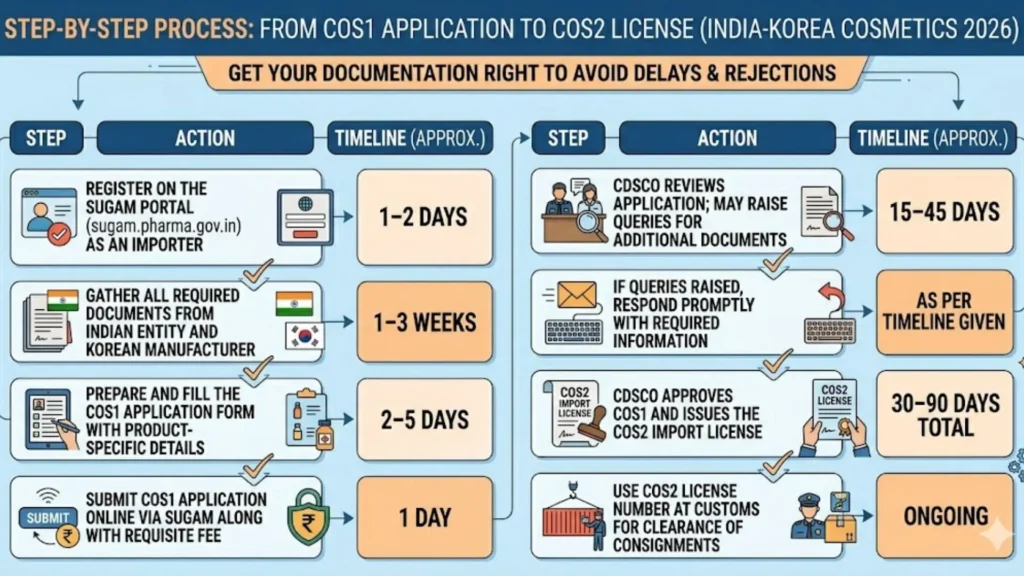
The entire process runs through the CDSCO Sugam portal (sugam.gov.in). There is no offline or manual application route for new cosmetic import registrations as of 2026.
- Product classification check — confirm your product is a cosmetic (not a drug) and whether it is Schedule M or exempt. If Schedule M, proceed with registration.
- Prepare the product dossier — compile all required documents for your specific product category (see category-specific checklist above).
- Register your company on Sugam portal — create an importer account; verify your IEC and GST details.
- Fill Form Cos-6 online — one form per product; enter INCI ingredient list, label text, manufacturing details, and product category.
- Upload all documents — in PDF format; total upload size limit is 50 MB per application.
- Pay the registration fee — USD 2,000 per product; payment through the online portal (debit card, credit card, or NEFT).
- Submit physical product samples — minimum 3 samples per product; send to the CDSCO regional office address provided during submission.
- Track application status — log in to Sugam portal to check status; deficiency letters are communicated through the portal.
- Respond to deficiencies — if CDSCO raises a deficiency, you have 30 days to upload the corrected documents.
- Receive Registration Certificate — once approved, download the RC from the portal; print the RC number on your product label before importing.
Required Documents for CDSCO-Registered Cosmetic Products
| Stage | Approximate Timeline |
| Document preparation (first-time importer) | 4–8 weeks |
| CDSCO application portal submission | 1–3 days |
| Initial scrutiny by CDSCO | 15–30 working days |
| Deficiency letter (if raised) + response | 30 days for applicant response |
| Laboratory testing (if ordered by CDSCO) | 30–45 additional working days |
| Technical Expert Committee review (if referred) | 30–60 additional working days |
| RC issuance after final approval | 10–15 working days |
| Total estimated timeline (no deficiencies) | 90–120 working days |
| Total estimated timeline (with deficiencies or lab testing) | 150–180 working days |
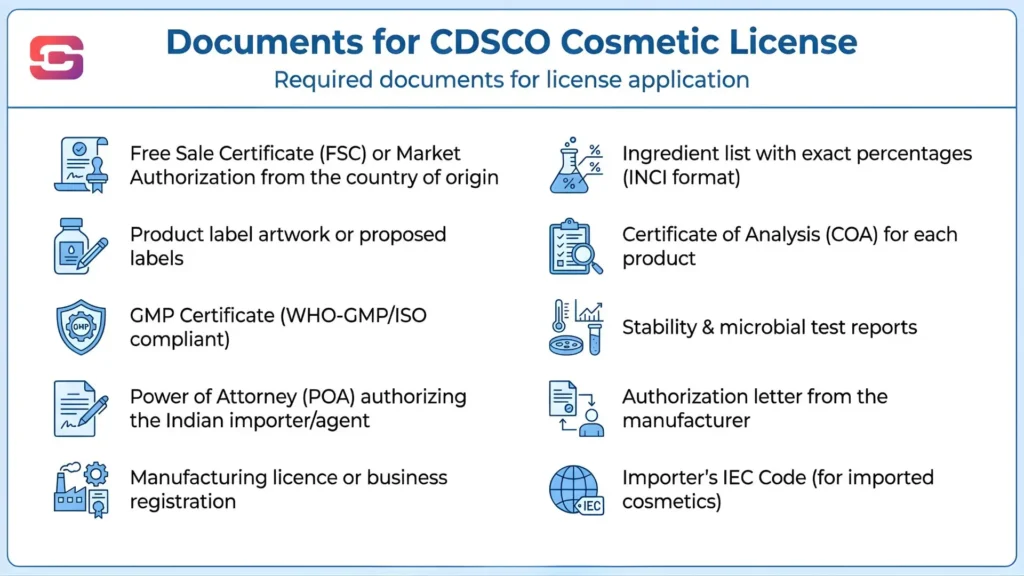
CDSCO Cosmetic Import License Fees Per Product
| Fee Type | Amount (USD) | Amount (INR approx.) | Applicability |
| New product registration | USD 2,000 | INR 1,66,000 | Per product; non-refundable |
| Renewal (every 3 years) | USD 1,000 | INR 83,000 | Per product; submit 90 days before expiry |
| Minor amendment | USD 500 | INR 41,500 | Label change, address update, importer change |
| Major amendment | USD 1,000 | INR 83,000 | Formulation change, new shade with different base, new claims |
| Duplicate RC | INR 5,000 | INR 5,000 | Lost or damaged RC — per certificate |
| Late renewal surcharge | 25% of renewal fee | ~INR 20,750 | If renewal filed within 30 days after expiry |
| Fresh application (lapsed RC) | USD 2,000 | INR 1,66,000 | RC lapsed more than 30 days — renewal not possible |
INR amounts are indicative, calculated at approximately INR 83 per USD. Actual INR equivalent is calculated at RBI reference rate on date of payment. All fees are paid through the Sugam portal and are non-refundable once the application is submitted, regardless of outcome.
Validity and Renewal of Product-Wise CDSCO Import License
Every Registration Certificate issued by CDSCO is product-specific and valid for 3 years from the date of issue. There is no blanket company-level RC — each product has its own certificate.
Renewal Checklist
- File renewal application on Sugam portal at least 90 days before the RC expiry date.
- Update Certificate of Analysis (CoA) — submit a new CoA dated within 12 months of the renewal application.
- Update GMP/ISO 22716 certificate — must be currently valid at the time of renewal.
- Declare any formula changes since original registration — undisclosed formula changes are a compliance violation.
- Submit updated product label if any changes were made since original registration.
- Pay renewal fee of USD 1,000 per product.
- If any ingredient is now on the CDSCO restricted or prohibited list, address this proactively — do not renew without reformulating.
What Happens If You Miss the Renewal Deadline?
Up to 30 days after expiry: You can still renew, but a 25% late fee applies. Between 30 days and 6 months after expiry: CDSCO may allow renewal on a case-by-case basis with a penalty — consult a regulatory advisor. Beyond 6 months after expiry: The RC is permanently lapsed; a fresh application must be filed at full fee (USD 2,000).
Conclusion
Getting clarity on which cosmetic products need a CDSCO import license is the single most important step before planning your India market entry in 2026. The regulated product list —sunscreens, hair dyes, skin-lightening and brightening products, anti-dandruff shampoos, teeth-whitening products, chemical hair treatments, depilatories, antiperspirants, active nail products, AHA/BHA exfoliants, and several others — covers a wide range of everyday cosmetics that are commonly imported.
The classification is not always intuitive. A plain moisturizer is exempt; a moisturizer with SPF 15 needs registration. A standard shampoo is exempt; an anti-dandruff shampoo with zinc pyrithione needs registration. A perfume is exempt; an antiperspirant roll-on needs registration. The product itself, combined with its label claims and active ingredient concentrations, determines the regulatory pathway.
If you are unsure about your product's classification, invest in a pre-submission consultation with a CDSCO-experienced regulatory consultant before preparing your full application dossier. It is significantly cheaper than getting it wrong at customs.
Frequently Asked Questions
Does every cosmetic product imported into India need a CDSCO import license?
No. Only cosmetics listed in Schedule M of the Cosmetics Rules, 2020 require mandatory CDSCO registration. Plain moisturisers, standard lipsticks, regular shampoos without anti-dandruff claims, perfumes, and basic make-up products are generally exempt — provided they make no active cosmetic claims that would classify them under Schedule M.
Do I need a separate CDSCO licence for each cosmetic product, or can I get one licence for all my products?
You need a separate Registration Certificate for every individual product. CDSCO does not issue a single blanket licence for multiple products. Each Form Cos-6 application covers one product, and the USD 2,000 fee applies per product. For shade variations of the same base formula, CDSCO has a limited provision to register variations under one master file — but this requires specific documentation and CDSCO's advance agreement.
My face cream has niacinamide for brightening. Does it need CDSCO registration?
It depends on the concentration and the label claim. Niacinamide is not a prohibited ingredient and is used widely in cosmetics. A moisturizer with niacinamide at 5% with the claim 'brightens skin tone' is likely to be treated as a Schedule M skin-lightening cosmetic and would need registration.
Can I import a small quantity of cosmetic products for testing without CDSCO registration?
Generally yes, for genuine testing purposes only. A limited consignment of cosmetic samples imported solely for testing, laboratory analysis, or regulatory evaluation (not for sale) can be imported without an RC in most cases. For Schedule M products, it is advisable to seek a specific prior permission letter from CDSCO before sending test samples, to avoid them being held at customs.
Is a sunscreen with SPF 15 treated differently from one with SPF 50 for CDSCO registration?
No. Both require the same CDSCO cosmetic import registration under Schedule M. SPF level does not affect the registration requirement — any SPF claim on any product triggers the sunscreen registration process. However, the SPF test report submitted must match the claimed SPF value, and higher SPF claims (SPF 50+) are scrutinised more carefully for the accuracy of the test protocol used.
My hair dye is 100% natural henna — does it still need CDSCO registration?
Pure, unadulterated natural henna (Lawsonia inermis) with no synthetic dye additives is exempt from CDSCO import registration. However, if your henna product contains PPD (para-phenylenediamine), resorcinol, or any other synthetic dye intermediate — including products marketed as 'black henna' — it becomes a Schedule M product and requires registration. CDSCO may test imported henna products to verify the absence of synthetic additives.
Does baby sunscreen need CDSCO registration, or are baby products treated differently?
Baby sunscreens require the same CDSCO cosmetic import registration as adult sunscreens. There is no blanket exemption for baby or children's cosmetics under Schedule M. In fact, CDSCO applies additional scrutiny to products intended for children, particularly regarding preservative types and concentrations. Baby products do not get a simplified registration pathway.
How do I know if my imported cosmetic has been tested for Schedule S prohibited substances?
Your manufacturer must provide a Certificate of Analysis (CoA) from an accredited third-party laboratory confirming the absence or permitted concentrations of all Schedule S restricted and prohibited substances relevant to your product category. For skin-lightening products, this means specific tests for mercury, hydroquinone, and corticosteroids. For teeth-whitening products, it means H2O2 concentration certification. CDSCO will not accept CoA from in-house manufacturer labs alone for Schedule M products.
Can I sell my imported cosmetic on Amazon India or Nykaa without CDSCO registration?
Major Indian e-commerce platforms have tightened their compliance requirements. Amazon India, Nykaa, Flipkart, and similar platforms require sellers to submit CDSCO Registration Certificate details for Schedule M cosmetic products before listing them.
What is the difference between a CDSCO cosmetic import license and a cosmetic manufacturing license?
A CDSCO cosmetic import license (Registration Certificate under Form Cos-6) is issued by CDSCO at the central government level for products manufactured outside India and imported commercially. A cosmetic manufacturing license is issued by the State Drug Controller of the relevant Indian state for products manufactured within India.