
- EPR Registration for Battery Waste is mandatory under the Battery Waste Management Rules, 2022 — applicable to all producers, importers, and assemblers of batteries in India.
- The rules cover four battery categories: Portable, Automotive, Industrial, and Electric Vehicle (EV) — each with separate, progressively increasing annual collection targets.
- In FY 2025-26, portable, automotive, and industrial battery producers must achieve 100% EPR collection targets — the highest compliance bar to date.
- Non-compliance with battery waste EPR norms carries penalties of up to Rs. 1 lakh per day and can result in import suspension, marketplace delisting, and criminal prosecution.
What Is EPR Registration for Battery Waste?
If your business manufactures, imports, or assembles batteries in India — from a small portable cell to a massive electric vehicle battery pack — EPR Registration for Battery Waste is a legal requirement you cannot afford to overlook. The Battery Waste Management (BWM) Rules, 2022, notified by the Ministry of Environment, Forest and Climate Change (MoEFCC) in August 2022, replaced the older Batteries (Management and Handling) Rules, 2001 with a far more comprehensive and enforceable extended producer responsibility framework.

If you profit from putting a battery into the hands of an Indian consumer or industrial buyer, you are responsible for ensuring that battery is collected, channelized, and safely recycled when it reaches end of life. The 2022 rules formalize this responsibility into a set of registration obligations, annual collection targets, quarterly returns, and a market-based EPR certificate exchange system.
With India's battery market growing explosively — driven by the EV boom, rising consumer electronics demand, and grid-scale energy storage expansion — the scale and complexity of battery waste management has never been greater. CPCB's enforcement machinery has been significantly upgraded in 2025-26, and businesses that are not registered or are not meeting their targets are increasingly receiving show-cause notices and penalty orders.
The Battery Waste Management Rules, 2022: What Changed from 2001
The shift from the Batteries (Management and Handling) Rules, 2001 to the Battery Waste Management Rules, 2022 was not just a name change — it was a fundamental overhaul of how India manages battery waste. Understanding what changed helps you appreciate why EPR Registration for Battery Waste is now a non-negotiable business requirement.
Scope Expansion:
The 2001 rules covered only lead-acid batteries. The 2022 rules cover all battery types — lead-acid, lithium-ion, NiMH, NiCd, alkaline, and all future battery chemistries used in portable, automotive, industrial, and EV applications.
EPR Framework Introduction:
The 2022 rules formally introduced an Extended Producer Responsibility framework with legally binding collection targets, a CPCB-administered EPR certificate exchange, and quarterly return obligations. The 2001 rules had no such mechanism.
EV Battery Category:
For the first time, EV traction batteries are separately recognised and regulated as a distinct category with their own targets, second-life provisions, and minimum material recovery obligations.
Digital Compliance Infrastructure:
All EPR registration, return filing, target declaration, and credit trading must be done digitally on CPCB's dedicated battery waste management portal. The 2001 rules had no digital compliance system.
Mandatory Labelling Requirements:
The 2022 rules introduced explicit labelling obligations — including battery chemistry type, capacity, manufacture date, EPR Registration Number, and the WEEE crossed-bin symbol — on all covered batteries.
Battery Categories Covered Under EPR Registration (2026)
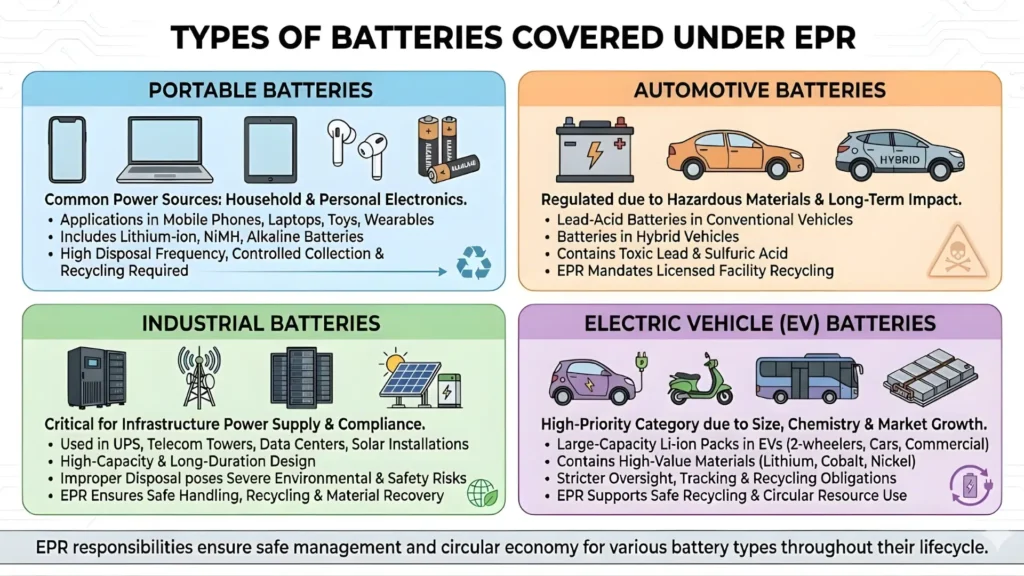
Not all batteries are managed under the same EPR framework. The Battery Waste Management Rules, 2022 define four distinct categories, each with its own registration requirements, collection targets, and compliance timelines. Knowing exactly which category your battery falls under is the first step in the EPR Registration for Battery Waste process.
| Category | Definition | Common Examples | Who Must Register |
| Portable Batteries | Batteries weighing up to 5 kg, used in consumer electronics, power tools, toys, torches, medical devices | Mobile phones, laptops, cameras, cordless drills, hearing aids, remote controls, flashlights | Producers, Importers, Assemblers |
| Automotive Batteries | Batteries used in motor vehicles for starting, lighting, and ignition (SLI) purposes | Lead-acid car batteries, motorcycle batteries, three-wheeler SLI batteries, boat starter batteries | Producers, Importers, Vehicle OEMs |
| Industrial Batteries | Batteries designed for industrial use, including stationary and motive applications above 5 kg | UPS batteries, telecom tower backup, forklift traction batteries, grid energy storage, solar storage | Producers, Importers, System Integrators |
| Electric Vehicle (EV) Batteries | Traction batteries exclusively used to propel electric vehicles — a distinct category from 2022 | EV battery packs (2-wheeler, 3-wheeler, 4-wheeler, bus), hybrid vehicle traction batteries | EV OEMs, Battery Producers, Importers |
Who Must Register for Battery Waste EPR?
EPR Registration for Battery Waste applies to a broader set of entities than many businesses initially assume. Here is a clear breakdown of every entity type required to register and what their obligations are:
| Entity Type | Who They Are | EPR Registration Required? |
| Producer | Any entity that manufactures batteries or products with batteries in India | Yes — mandatory before placing batteries in market |
| Importer | Any entity importing batteries or battery-integrated products into India | Yes — EPR registration before first import clearance |
| Assembler | Entities that assemble battery packs using cells or modules sourced from others | Yes — as notified; treated as producer |
| Refurbisher | Entities that remanufacture or refurbish used batteries for resale | Yes — separate registration category |
| Recycler | Facilities that recycle spent batteries using approved environmentally sound processes | Yes — registration + CPCB consent required |
| Producer Responsibility Org (PRO) | Third-party body that manages EPR obligations collectively for enrolled producers | Yes — own CPCB registration required |
| Bulk Consumer | Large users of batteries — telecom towers, hospitals, data centres, railways | Must ensure proper disposal; not EPR producers |
If you manufacture a product in India with a battery integrated into it — say, a cordless power tool, a UPS system, or an electric scooter — you are classified as a Producer and must register separately for the battery component, in addition to any product-level EPR registration under the e-waste framework. These are two separate registrations with two separate portals and two separate compliance tracks.
Battery Chemistry Types and Their EPR Applicability in India
India's market has batteries of many different chemistries, and each has different EPR implications, minimum recovery requirements, and hazardous material considerations. Here is how each major battery chemistry maps to the EPR Registration for Battery Waste framework:
| Battery Chemistry | Common Applications | EPR Category | Key 2026 Compliance Note |
| Lead-Acid (VRLA / Flooded) | Automotive SLI, UPS, telecom backup, inverters | Yes — Automotive / Industrial | Highest priority — heavy metal content; 100% target from 2024-25 |
| Lithium-Ion (Li-Ion) | EVs, laptops, smartphones, power banks, energy storage | Yes — Portable / EV / Industrial | EV target: 80% for FY 2025-26; portable: 100% |
| Lithium Iron Phosphate (LFP) | EV buses, stationary storage, solar home systems | Yes — EV / Industrial | Covered under EV battery category; growing segment |
| Nickel Metal Hydride (NiMH) | Hybrid vehicles, power tools, some consumer electronics | Yes — Automotive / Portable | Covered; relatively smaller market in India |
| Nickel Cadmium (NiCd) | Power tools, emergency lighting, older electronics | Yes — Portable / Industrial | Cadmium is a hazardous substance; strict disposal norms |
| Zinc-Carbon / Alkaline | Remotes, toys, clocks, flashlights (primary batteries) | Yes — Portable | Single-use primaries covered; disposal via collection centres |
| Solid-State Batteries | Next-gen EVs, premium consumer electronics (emerging) | Yes — EV / Portable | Covered under existing categories; watch for 2026 amendments |
How to Apply for EPR Registration for Battery Waste: Step-by-Step (2026)
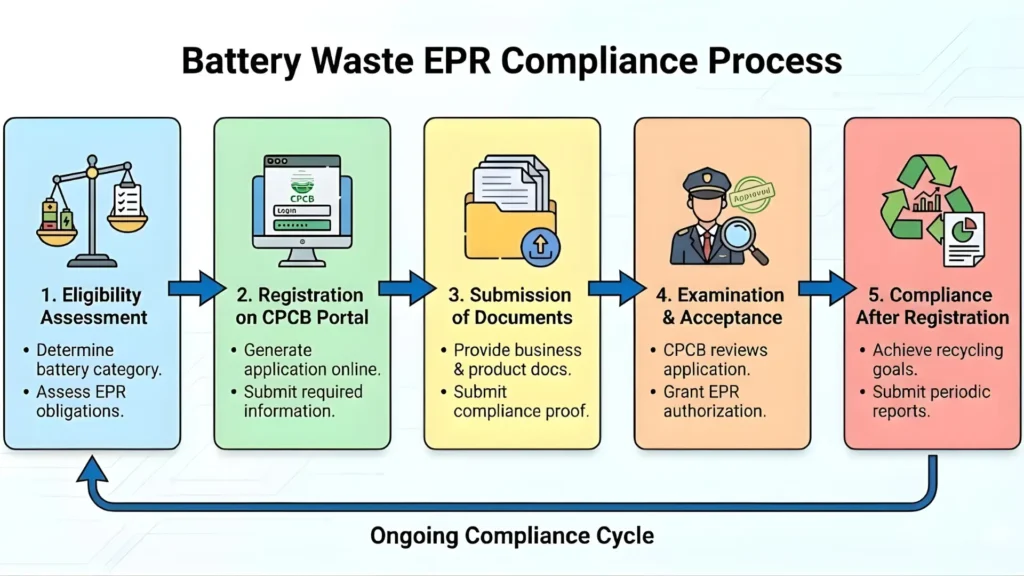
The entire EPR Registration for Battery Waste process is conducted online through CPCB's dedicated battery waste management portal. There is no offline or manual submission pathway. Here is a detailed walkthrough:
| Step | Action | What to Do |
| 1 | Access CPCB Battery Waste Portal | Visit the official CPCB Battery Waste Management portal. Create a new account using your company's authorised email ID and mobile number. |
| 2 | Select Entity Type | Choose your correct entity category: Producer, Importer, Assembler, Recycler, Refurbisher, or PRO. The registration form and document checklist vary by category. |
| 3 | Enter Battery Category Details | Declare all battery categories you deal in: Portable, Automotive, Industrial, or EV. For each category, provide product details, chemistry types, and annual volumes. |
| 4 | Upload Mandatory Documents | Upload all required documents in PDF format. Ensure each document is clear, self-attested, and name-consistent with your registration entity. |
| 5 | Pay Registration Fee Online | Make payment through the CPCB portal's payment gateway. Keep the transaction receipt for your records. |
| 6 | Submit Application | Review all entered information carefully and submit. An acknowledgment number is generated — note it for status tracking. |
| 7 | CPCB Review and Verification | CPCB verifies documents, may request clarifications or additional information. Average review time: 30-45 working days for complete applications. |
| 8 | EPR Certificate Issued | Upon approval, your EPR Registration Certificate is issued digitally through the portal. Download and store securely. |
| 9 | Set Annual EPR Targets | Log back into the portal after registration to declare the quantities/weight of batteries placed in the market and set your annual collection targets. |
| 10 | Begin Quarterly Return Filing | Start filing quarterly collection and channelization returns from the first quarter following registration. This is mandatory even if quarterly volumes are zero. |
Typical Timeline
For applications submitted with complete and consistent documentation, CPCB typically processes EPR Registration for Battery Waste in 30 to 45 working days. Applications with missing documents, name discrepancies, or technical queries from CPCB reviewers can take 60 to 90 days. Starting the registration process at least 90 days before your product launch or first import date is strongly advisable.
Documents Required for EPR Registration for Battery Waste
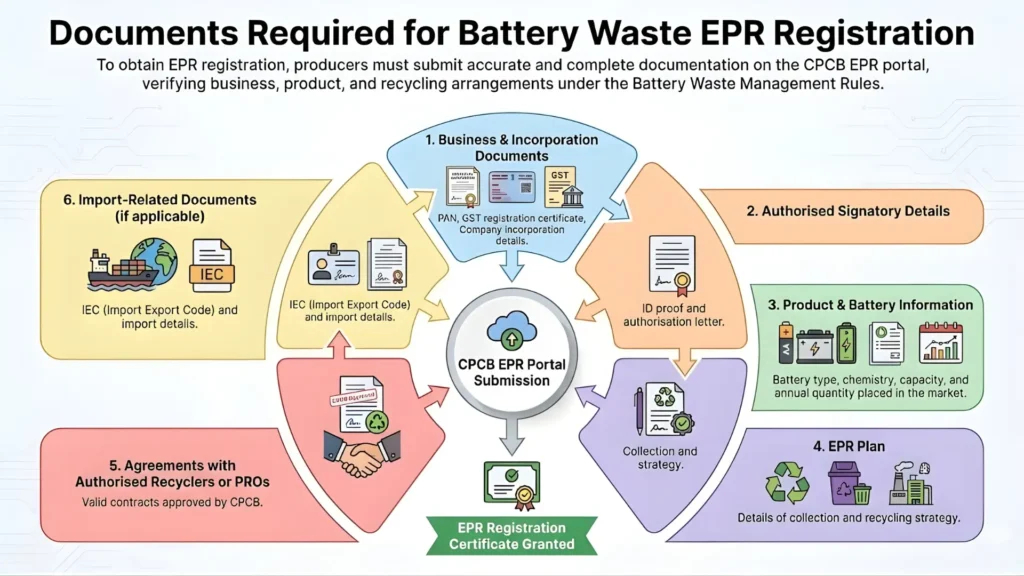
Document completeness and consistency are the two biggest factors determining how quickly your EPR Registration for Battery Waste is processed. The following is a comprehensive, category-specific document checklist:
| Document | Applicable To |
| Certificate of Incorporation / Partnership Deed / LLP Agreement | All entity types |
| PAN Card of the Company / Proprietor / Partnership Firm | All entity types |
| GST Registration Certificate | All entity types |
| Authorised Signatory Appointment Letter + ID Proof | All entity types |
| Factory / Manufacturing Licence or Trade Licence | Producers, Assemblers |
| Details of Battery Types Manufactured / Imported (with HS Code) | Producers, Importers |
| Import Export Code (IEC) Certificate | Importers |
| Previous Year Sales Data / Import Volume (quantity + weight) | All entity types (at renewal) |
| Consent to Establish / Consent to Operate from State PCB | Recyclers, Refurbishers |
| Facility Layout / Site Plan with Battery Handling Infrastructure | Recyclers, Refurbishers |
| Technology / Process Description for Recycling Operations | Recyclers |
| Environmental Clearance Certificate (if applicable) | Recyclers (large facilities) |
| PRO Agreement / Enrolment Letter (if using a PRO) | Producers, Importers using PRO |
| Board Resolution for Authorised Signatory | Companies (Pvt. Ltd, Ltd., LLP) |
The company name on your PAN card, GST certificate, and incorporation document must match exactly — including punctuation, abbreviations like Pvt. Ltd., and LLP. Even minor inconsistencies cause application rejection and require time-consuming correction and resubmission.
EPR Registration Fees for Battery Waste (2026)
The registration fees for battery waste EPR are set by CPCB and are nominal relative to the compliance obligations and legal protection the certificate provides. The fees applicable in 2026 are as follows:
| Entity Type | Approx. Fee (INR) | Validity |
| Producer / Importer of Batteries | Rs. 10,000 | 1 Year (Annual Renewal) |
| Assembler of Battery Packs | Rs. 10,000 | 1 Year (Annual Renewal) |
| Refurbisher | Rs. 5,000 | 1 Year (Annual Renewal) |
| Recycler | Rs. 5,000 | 1 Year (Annual Renewal) |
| Producer Responsibility Organization (PRO) | Rs. 25,000 | 1 Year (Annual Renewal) |
| Registration Amendment | Rs. 2,500 | Per amendment request |
| Renewal (all categories) | Same as above | Must be renewed before expiry |
Important note: Registration fees are subject to periodic revision by CPCB. Always verify the current fee schedule on the official battery waste management portal before initiating payment. State Pollution Control Boards may levy additional fees for Consent to Operate, particularly for recyclers and refurbishers.
Annual EPR Collection Targets for Battery Waste (FY 2025-26)
Meeting annual collection targets is the most operationally demanding aspect of EPR Registration for Battery Waste. The targets are progressive — increasing each year — and are calculated based on the total weight of batteries you placed in the Indian market in preceding financial years. Here are the targets as mandated under the BWM Rules, 2022:
| Battery Category | Financial Year | Mandatory EPR Collection Target |
| Portable Batteries | FY 2023-24 | Collection of 70% of batteries placed in market in preceding years |
| Portable Batteries | FY 2024-25 | Collection of 90% of batteries placed in market in preceding years |
| Portable Batteries | FY 2025-26 (Current) | Collection of 100% — full responsibility cycle |
| Automotive Batteries | FY 2023-24 | Collection of 90% by weight of batteries placed in market |
| Automotive Batteries | FY 2024-25 onwards | Collection of 100% by weight — full responsibility cycle |
| Industrial Batteries | FY 2023-24 | Collection of 90% by weight of batteries placed in market |
| Industrial Batteries | FY 2024-25 onwards | Collection of 100% by weight |
| EV Batteries | FY 2023-24 | Collection of 60% by weight of EV batteries placed in market |
| EV Batteries | FY 2024-25 | Collection of 70% by weight |
| EV Batteries | FY 2025-26 (Current) | Collection of 80% by weight — progressive annual increases continue |
Key takeaway for FY 2025-26: If you produce or import portable, automotive, or industrial batteries, you are now in a 100% collection obligation year. This means your EPR collection and channelization must account for every kilogram of batteries you placed in the market in prior years. The only category still in a progressive build-up is EV batteries, currently at 80%.
EPR Credits and the Battery Waste Certificate Exchange
One of the most practical and commercially significant aspects of EPR Registration for Battery Waste is the EPR certificate (credit) system. Rather than forcing every producer to build their own collection and recycling infrastructure, CPCB has created a market-based mechanism:
| Aspect | How It Works |
| Who Generates Credits? | CPCB-registered battery recyclers generate EPR certificates for each tonne of battery waste processed through approved, environmentally sound methods. |
| Who Can Buy Credits? | Producers, Importers, and Assemblers (PIAs) who fall short of their annual EPR collection targets can purchase EPR credits to cover the shortfall. |
| How Are Credits Priced? | Credit prices are market-determined on the CPCB's Battery EPR exchange. Prices vary by battery category, chemistry, and demand-supply dynamics. |
| Credit Validity Period | EPR credits for battery waste are valid for two financial years from the date of generation. Unused credits lapse after this period. |
| Surplus Credit Trading | PIAs that collect more than their target can sell surplus EPR credits on the CPCB exchange — creating a revenue opportunity from overcompliance. |
| Audit & Verification | From 2025-26, CPCB has introduced third-party audit requirements for recyclers before EPR credits are issued, to prevent fraudulent credit generation. |
| Key 2026 Update | CPCB is piloting a QR-code-based battery traceability system to link each battery from sale to end-of-life recycling — improving EPR credit accuracy. |
For producers and importers who are struggling to meet their targets through direct collection, purchasing EPR credits is the legally valid shortcut. But note that credits are not unlimited — their price fluctuates based on market demand, the quality of recycler documentation, and the battery category. Building a diversified network of registered recyclers and PRO partnerships, rather than relying solely on credit purchases, is the more sustainable compliance strategy for 2026 and beyond.
Lead-Acid Battery EPR Registration: What You Need to Know
Lead-acid batteries remain the most widely used battery type in India — powering everything from passenger car starters to railway traction to telecom towers and household inverters. They are also among the most hazardous, given that lead is a cumulative toxin. Here are the key EPR facts specific to lead-acid batteries:
| Lead-Acid EPR Aspect | Detail (2026) |
| Governing Rule | Battery Waste Management Rules, 2022 (replaces Batteries (M&H) Rules 2001) |
| Who Must Register | Automotive battery producers/importers, UPS battery manufacturers, inverter battery brands |
| Current EPR Target (FY25-26) | 100% collection by weight — lead-acid reached full target obligation from FY 2024-25 |
| Key Hazard | Lead — a highly toxic heavy metal; requires controlled smelting / hydrometallurgical recovery |
| Minimum Recycling Rate | Recyclers must recover a minimum 98% of lead content from collected lead-acid batteries |
| Common Collection Channels | Battery dealers (buy-back), authorised collection centres, vehicle service centres |
| CPCB Verification | Lead-acid battery recyclers must hold valid Consent to Operate from State PCB in addition to CPCB EPR registration |
| Bulk Consumer Obligation | Telecom towers, hospitals, railways that bulk-consume lead-acid batteries must channel used batteries to registered recyclers only |
The good news for lead-acid battery producers is that India already has a relatively mature informal recycling sector for lead batteries. However, the formalization under the 2022 rules means producers must now ensure their collected batteries reach CPCB-registered formal recyclers — not informal smelters — and must file proof of channelization in their returns.
EV Battery EPR Registration: A Growing Obligation in 2026
India's electric vehicle market is growing rapidly. With two-wheeler EV sales crossing significant milestones and four-wheeler EV adoption accelerating, the volume of EV battery waste that will flow into the recycling stream over the next decade is enormous. EPR Registration for Battery Waste specific to EV batteries is therefore one of the most strategically important compliance obligations for auto OEMs, battery manufacturers, and importers in 2026.
| EV Battery EPR Aspect | Detail (2026) |
| Governing Rule | Battery Waste Management Rules, 2022 (EV battery chapter) + MoRTH notifications |
| Who Must Register | EV OEMs, battery pack producers for EVs, importers of EV battery packs |
| Current EPR Target (FY25-26) | 80% collection by weight of EV batteries placed in market — increasing to 90% in FY 2026-27 |
| Second Life Provision | EV batteries with remaining capacity above 70% may be reused for stationary energy storage before recycling |
| Key Hazardous Elements | Lithium, cobalt, nickel, manganese — all subject to mandatory recovery in recycling |
| Minimum Recovery Rate | Recyclers must achieve minimum material recovery rates: Li ≥90%, Co ≥90%, Ni ≥90%, Pb ≥98% |
| Collection Channel Options | OEM take-back programs, authorised service centres, battery swap stations, CPCB-registered collection points |
| Reporting Requirement | Quarterly returns + Annual EPR return; EV-specific column in CPCB battery portal returns |
The second-life provision for EV batteries is a particularly important commercial opportunity. Batteries with capacity above 70% of original — even if no longer suitable for vehicle traction — can be reused in stationary energy storage applications. This extends battery value, delays the entry of batteries into the recycling stream, and helps producers meet sustainability goals. However, second-life usage must be declared to CPCB and does not exempt the producer from the eventual recycling obligation.
Critical 2026 Updates to Battery Waste EPR in India
Staying current with regulatory changes is as important as initial registration. Here are the most significant developments shaping EPR Registration for Battery Waste in 2026 that every business must be aware of:
| 2026 Update | What It Means for Your Business |
| 100% Collection Target for Portable Batteries | FY 2025-26 marks the first year that portable battery producers must achieve 100% collection of batteries placed in market in preceding years — the most ambitious target yet. |
| QR Code Traceability Pilot | CPCB has initiated a pilot for QR-code-based battery lifecycle tracking from point of sale to end-of-life. Expected to be mandatory for EV batteries by 2027. |
| Third-Party Audit for Recyclers | From FY 2025-26, recyclers must submit third-party audit reports before EPR credits are released on the exchange. Eliminates fraudulent EPR credit generation. |
| EV Battery End-of-Life Framework | Dedicated guidelines for EV battery second life (reuse as stationary storage) and eventual recycling have been issued. EV OEMs must now declare battery second-life plans. |
| Customs-EPR Integration | Battery imports are being cross-checked against CPCB EPR registration at select ports. Shipments by unregistered importers face clearance delays and penalties. |
| Extended Liability for Bulk Consumers | New CPCB advisory in 2025 holds bulk consumers (telecom, data centres) responsible for ensuring batteries they discard reach registered recyclers. |
| Mandatory Battery Labelling Upgrade | Batteries must now carry chemistry type, capacity (Wh or Ah), manufacture date, and EPR Registration Number on labels. Partial labelling is being penalised. |
| Digital-Only Return Filing | All quarterly and annual battery waste EPR returns must be filed on the CPCB battery waste portal. No physical submissions accepted from FY 2025-26. |
Penalties for Non-Compliance with Battery Waste EPR
CPCB's enforcement posture on battery waste EPR has strengthened considerably in 2025-26. Cross-referencing EPR registration status with customs data, GST filings, and marketplace seller databases is now actively done. Here is what non-compliance with EPR Registration for Battery Waste actually costs your business:
| Violation / Non-Compliance | Penalty / Consequence |
| Operating without EPR Registration | Up to Rs. 1 Lakh per day of default; potential closure notice from CPCB |
| Failure to meet annual EPR collection target | Financial penalty proportional to target shortfall; carry-forward obligation to next year |
| Non-submission of quarterly / annual returns | Rs. 10,000 per month of default; escalation to certificate suspension |
| Disposal of batteries through unauthorised channels | Criminal prosecution under Environment Protection Act, 1986; certificate cancellation |
| False data submission on CPCB portal | Immediate suspension of EPR certificate; potential blacklisting |
| Failure to apply WEEE / EPR markings on batteries | Notice from CPCB; fines under relevant provisions of EP Act 1986 |
| Non-renewal of EPR certificate after expiry | Operations become illegal; prior compliance record may attract enhanced penalties |
One thing worth repeating: penalties compound. Operating for 30 days without registration while your application is under review — even inadvertently — can technically attract Rs. 30 lakh in administrative penalties. This underlines why initiating your EPR Registration for Battery Waste process well before your first production run or import date is the only safe approach.
Ensuring Smooth EPR Registration for Battery Waste
Based on the most common reasons applications get delayed or rejected, here are actionable steps to ensure your EPR Registration for Battery Waste goes through without unnecessary friction:
- Verify document name consistency before uploading — your PAN, GST, and incorporation documents must carry identical entity names.
- Map every battery type in your product portfolio to the correct BWM Rules category before starting the application — mistakes here require amendments that delay the process.
- If you sell both battery-integrated products and standalone batteries, you may need separate EPR registrations under both the Battery Waste Management Rules and the E-Waste (Management) Rules.
- Appoint a dedicated EPR compliance officer — CPCB sends notices and clarification requests through the portal; missed communications delay registration and create compliance gaps.
- Engage a CPCB-registered PRO early — especially if you are a startup or mid-sized company without an existing collection and recycling network. PRO onboarding takes time.
- Archive all registration certificates, payment receipts, return acknowledgments, and recycler agreements for a minimum of five years — CPCB audits can request historical records.
- Set up a calendar reminder 90 days before your EPR certificate expiry to begin renewal — late renewal causes a lapse in registration status and attracts penalties.
- When filing annual returns, ensure battery weight data matches your company's own import declarations or manufacturing records — CPCB cross-references with other government databases.
Conclusion: Take Your Battery Waste EPR Seriously in 2026
EPR Registration for Battery Waste is one of the most important — and most frequently under-resourced — compliance obligations in India's growing battery and EV industry. The Battery Waste Management Rules, 2022 are real, enforceable, and actively being enforced. The targets have reached 100% for most battery categories in 2025-26. CPCB is integrating its systems with customs, GST, and marketplace platforms. The window to treat battery EPR as something to deal with later is closing fast.
Whether you make motorcycle batteries, import smartphone cells, assemble industrial UPS systems, or manufacture electric vehicle packs — your EPR registration needs to be current, your targets need to be tracked, your recycling partners need to be registered, and your returns need to be filed on time.
Ready to register? Visit https://batteries.cpcb.gov.in to begin or renew your EPR Registration for Battery Waste. If you need guidance on battery category classification, PRO selection, target calculations, or recycler partnerships — work with a CPCB-recognized compliance consultant who has direct experience with battery waste EPR in India. The cost of expert help is a fraction of the cost of a single day's non-compliance penalty.
Frequently Asked Questions
Is EPR Registration for Battery Waste mandatory for all battery businesses, or only large manufacturers?
It is mandatory for all businesses regardless of size or turnover. The Battery Waste Management Rules, 2022 do not have a small business exemption or a minimum scale threshold. Whether you import 100 units of lithium-ion power banks or manufacture 10 million lead-acid car batteries annually, the obligation to register and meet EPR targets applies equally.
I import battery-integrated products (like power banks and wireless earbuds). Do I need to register under the Battery Waste rules separately from e-waste EPR?
Yes — and this is one of the most commonly missed compliance obligations in India's electronics industry. If your imported product contains a battery (even a sealed, non-removable one), you need EPR Registration for Battery Waste as an importer under the BWM Rules, 2022, in addition to EPR registration under the E-Waste (Management) Rules, 2022 as a brand owner or importer of electronic equipment.
How are EPR collection targets calculated for my business specifically?
Your EPR collection target is calculated as a percentage of the total weight of batteries you placed in the Indian market during preceding financial years.
What does 'channelization' mean in the context of battery waste EPR?
Channelization refers to the process of directing collected used batteries to CPCB-registered recyclers or refurbishers through documented, traceable channels. Simply collecting old batteries and storing them in your warehouse does not satisfy your EPR obligation.
Can I use the same PRO for both my e-waste EPR and battery waste EPR obligations?
It depends on whether the PRO is registered with CPCB for both e-waste and battery waste management. Some PROs hold dual registration and can manage both obligations. Others are registered only for e-waste or only for battery waste.
My company sells both lead-acid and lithium-ion batteries. Do I need separate EPR registrations for each?
No — a single EPR Registration for Battery Waste can cover multiple battery categories. During registration, you declare all the battery categories you deal in: Portable, Automotive, Industrial, and/or EV.
What are the minimum material recovery requirements for battery recyclers in 2026?
The Battery Waste Management Rules, 2022 specify minimum material recovery rates that CPCB-registered recyclers must achieve. For lead-acid batteries, the minimum lead recovery rate is 98% by weight.
Can EV batteries be reused for stationary energy storage instead of being immediately recycled?
Yes. The BWM Rules, 2022 include a formal provision for battery second life. EV batteries with a residual capacity of 70% or more of their original rated capacity are eligible for reuse in stationary applications such as home energy storage, commercial backup power, or grid storage before being channelized for recycling
What happens if a company misses its annual EPR collection target?
If you fall short of your mandatory annual EPR collection target, CPCB requires you to: (1) carry forward the shortfall to the next year, adding it to that year's target; (2) pay a financial penalty determined on the basis of the shortfall in kilograms; and (3) purchase EPR credits from the CPCB battery waste exchange to cover the deficit, if you do not have the time or infrastructure to achieve the shortfall through actual collection.
Is EPR Registration for Battery Waste the same as the Consent to Operate (CTO) from a State PCB?
No — they are entirely separate authorisations from different regulatory bodies. EPR Registration for Battery Waste is issued by CPCB at the national level and governs your obligations as a producer, importer, or recycler under the BWM Rules.
How do I renew my EPR Registration for Battery Waste?
Q11. How do I renew my EPR Registration for Battery Waste?
EPR Registration certificates for battery waste are valid for one year and must be renewed annually before the expiry date. The renewal process involves logging into the CPCB battery waste portal, submitting the previous year's annual return (if not already filed), updating any changes in battery categories, volumes, or contact details, and paying the renewal fee. CPCB reviews the renewal application, typically within 15 to 30 working days for businesses with a clean compliance record.
Are imported batteries covered if the exporting country already has its own EPR compliance?
No — foreign EPR compliance does not satisfy India's domestic EPR obligation. Whether your battery supplier in South Korea, China, Japan, or Germany has full EPR compliance under their domestic laws is irrelevant to your obligation as an importer in India.