
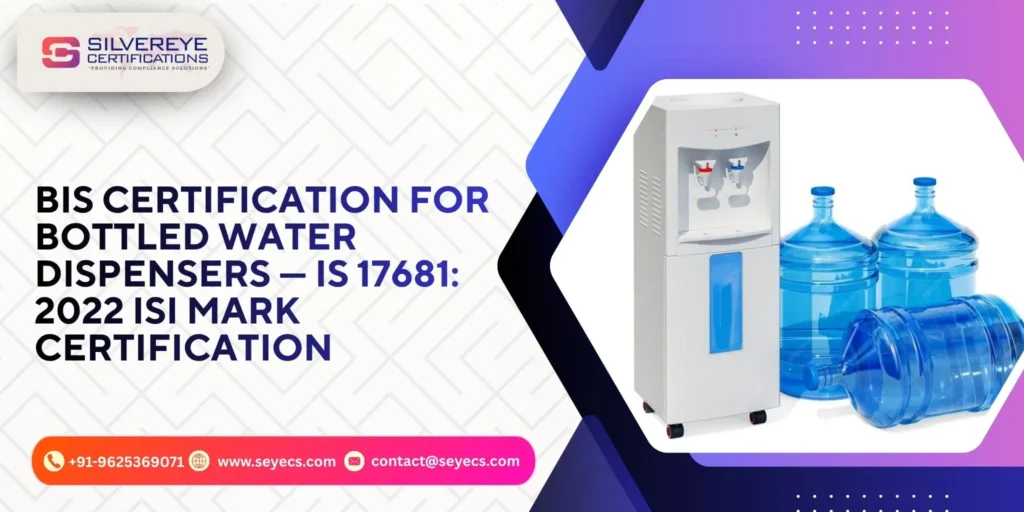
- All compliance deadlines passed — Every manufacturer and importer must hold a valid ISI Mark licence right now or face product seizure, port detention, and heavy penalties.
- All dispenser types covered — Bottom load, table top, freestanding, and combination models with refrigerator cabinets, operating up to 240V AC, 50Hz.
- Fast timelines available — Indian manufacturers: 30 to 65 working days. Foreign manufacturers via FMCS: up to 180 working days.
- Complete end-to-end support — Silvereye Certification manages gap analysis, documentation, lab testing, factory audit preparation, BIS portal filing, and post-certification compliance.
What Is BIS Certification for Bottled Water Dispensers and Why Is It Mandatory?
If you manufacture, import, or sell bottled water dispensers in India, one fact defines your legal situation in 2026: BIS certification under IS 17681: 2022 is mandatory. It is not a quality option, a market preference, or a future requirement to plan for. Every compliance deadline has already passed. If your dispensers do not carry the ISI Mark today, they are being sold outside Indian law.
The Bureau of Indian Standards (BIS) is India's national standards body, operating under the BIS Act, 2016. It issues the ISI Mark — India's most widely recognized and enforced product quality certification — to products that meet defined IS standards. For bottled water dispensers, the applicable Indian standard is IS 17681: 2022.
The Bottled Water Dispensers (Quality Control) Order, 2023 — issued by the Department for Promotion of Industry and Internal Trade (DPIIT), Ministry of Commerce and Industry, on 23 October 2023 — made ISI Mark certification mandatory for all bottled water dispensers manufactured in India or imported for sale in India.
| URGENT — All Compliance Deadlines Have Passed: If your bottled water dispensers do not carry a valid BIS ISI Mark under IS 17681: 2022, you are in active violation of Indian law. Every day of continued operation without certification increases your legal and commercial exposure. |
What Is a Bottled Water Dispenser Under IS 17681: 2022?
IS 17681: 2022 defines a bottled water dispenser as an electrically operated appliance that uses a vapour compression refrigeration system to dispense drinking water at cold, hot, or room temperature from a sealed water bottle. These appliances are found across homes, offices, hospitals, schools, hotels, corporate campuses, clinics, and public institutions throughout India.

The product is unique in the electrical appliance landscape because it combines three critical elements in a single unit: high-voltage electrical components including a compressor motor and heating element, a sealed water-handling system that includes internal storage tanks, tubing, faucets, and fittings, and direct dispensing of water for human consumption. This combination creates specific safety and hygiene risks that IS 17681: 2022 is specifically designed to address.
Types of Bottled Water Dispensers Covered Under IS 17681: 2022
| Dispenser Type | Description | Common Use |
| Bottom Load Water Dispenser | Water bottle loaded from the base compartment; internal pump draws water upward to the dispense taps | Offices, hospitals, corporate environments |
| Table Top Water Dispenser | Compact unit designed for desk, counter, or table surface; bottle inverted into the dispenser body from above | Small offices, clinics, home kitchens |
| Freestanding Water Dispenser | Floor-standing unit; most common type in commercial spaces; bottle inverted into the top of the unit | Offices, schools, public spaces, large households |
| Combination Unit — Dispenser + Refrigerator | Dispenses drinking water from the top section and includes an integrated refrigerator compartment below | Offices and commercial establishments with dual cooling needs |
Dispenser configurations covered include cold water only, cold and room temperature water, cold and hot water, cold, room temperature, and hot water, and water dispenser with in-built refrigerator cabinet.
Not covered: Water dispensers connected directly to a water supply line — whether from an overhead tank or through a direct pipeline connection. These units are governed under separate standards and are not within the scope of IS 17681: 2022 or QCO 2023.
Why Did the Government Make BIS Certification Mandatory for Water Dispensers?
The Government of India introduced mandatory BIS certification for bottled water dispensers for five specific and well-grounded reasons. Understanding these reasons also explains why the standard's requirements are as detailed as they are — and why independent testing matters for a product that delivers drinking water to millions of people daily.
1. Direct Contact with Drinking Water
Every internal component that water touches — tanks, tubing, faucets, and fittings — must be made from materials that are non-toxic, non-absorbent, corrosion-resistant, and hygienically safe. Without independent verification, substandard materials that leach chemicals, corrode over time, or support microbial growth can contaminate water consumed directly. IS 17681: 2022 requires tested compliance with food-contact material safety requirements — claims on a product specification sheet are not sufficient.
2. Combined Electrical and Water Risk
A water dispenser puts high-voltage electrical components — compressor motor, heating element, control circuits — inside the same housing as a water-handling system. This combination creates risk profiles that standard electrical appliance safety requirements do not fully address. IS 17681: 2022 specifically covers water ingress into electrical compartments, insulation requirements in a water-adjacent environment, and protection systems for electrical faults in a unit designed to handle liquid.
3. Temperature Performance for User Safety
Hot water dispensed above safe temperature limits causes scalding injuries. Cold water dispensed above safe temperature limits raises microbial growth concerns in the storage tank. IS 17681: 2022 sets defined temperature performance requirements for both hot and cold output — not just recommendations. Certified dispensers are tested to confirm they deliver water within these defined safe ranges under rated operating conditions.
4. Structural Safety
A freestanding or table-top dispenser that tips over creates three simultaneous hazards: water spillage near live electrical components, electric shock risk, and physical injury from the falling unit. The stability and construction requirements in IS 17681: 2022 address this specific risk through defined stability testing under lateral force application.
5. Market Integrity and Consumer Protection
Without mandatory certification, the market fills with products that are visually identical to quality units but assembled from substandard components — inferior heating elements with inadequate overload protection, water tanks made from food-contact-unsafe plastics, or electrical insulation that degrades rapidly. Consumers buying these products have no means to detect the risk before a safety incident or contamination event occurs. BIS certification under IS 17681: 2022 closes this information gap with independent, third-party testing.
Scope of IS 17681: 2022 — Technical Parameters
| Parameter | Specification |
| Operating System | Vapour compression refrigeration |
| Rated Voltage | Up to 240V AC, 50Hz, single phase |
| Maximum Cooling Capacity | Up to 8 litres per hour |
| Maximum Heating Capacity | Up to 5 litres per hour |
| Dispense Temperatures | Cold, hot, and room temperature |
| Climate Class — Normal (N) | 16°C to 32°C operating range |
| Climate Class — Tropical (T) | 16°C to 43°C operating range |
| Excluded Products | Direct pipeline or overhead tank connected dispensers |
Dispensers intended for peninsular India, coastal regions, and areas with high ambient temperatures must meet Tropical (T) class requirements. This is a detail that many importers overlook during product development — a dispenser specified to Normal (N) class that is sold and used in a tropical climate environment may not perform within required temperature limits, which constitutes a compliance failure at surveillance testing.
Key Technical Requirements Under IS 17681: 2022
Material Requirements — Water-Contact Components
- Internal components: Tanks, tubing, faucets, and all fittings in contact with water must be non-toxic, corrosion-resistant, non-absorbent, and food-contact safe.
- No contamination of water: Materials must not impart taste, odour, colour, or chemical contamination to dispensed water under normal operating conditions.
- Storage tank compliance: Tank materials must meet food-contact safety requirements applicable in India — material data sheets and compliance evidence are required at certification.
- External housing: Must be durable and capable of withstanding normal operating and cleaning conditions without degradation.
Electrical Safety Requirements
| Requirement | What It Tests |
| Dielectric Strength | High voltage applied between live electrical parts and accessible metal surfaces — insulation must not break down |
| Insulation Resistance | Resistance of insulating barrier between live components and accessible surfaces must meet defined minimum values |
| Leakage Current | Current through unintended paths under normal and fault conditions must remain within safe limits |
| Earth Continuity | For Class I appliances — earth path conductivity from motor housing and body to supply earth must be adequate |
| Water Ingress Protection | Electrical compartments must be protected against water from the water-handling system and normal use |
| Overload Protection | Compressor motor and heating element must have adequate overload and thermal protection systems |
Construction and Safety Requirements
| Requirement | What It Covers |
| Stability Test | Dispenser must not tip over under defined lateral force in all operating positions |
| Drip Tray Capacity | Must contain defined minimum spillage volumes without overflow |
| Power Cord Safety | Must meet household appliance cord and strain relief requirements |
| Thermal Cutouts | Must function correctly under fault conditions — verified by deliberate activation testing |
| Temperature Performance | Cold water output and hot water output must meet defined temperature limits under rated conditions |
| Marking and Labelling | Rated voltage, cooling capacity, heating capacity, climate class, ISI Mark with licence number — all permanently marked |
Benefits of BIS Certification for Bottled Water Dispensers — Beyond Just Compliance
Manufacturers and importers frequently approach BIS certification as a compliance checkbox. That framing undersells the real business value the ISI Mark delivers for bottled water dispenser brands in India. Here are the concrete benefits that certification delivers:
| Benefit | What It Means in Practice |
| Unrestricted Market Access | Sell through retail stores, wholesale distributors, e-commerce platforms, and institutional buyers without restriction — every channel requires the ISI Mark |
| Consumer Trust and Purchase Confidence | The ISI Mark is recognised by consumers as independent proof of safety and quality — critical for a product that directly contacts drinking water |
| Government and Institutional Procurement | All government procurement, hospital purchasing, educational institution supply, and corporate facility contracts specify ISI Mark compliance — this segment is entirely closed to non-certified products |
| E-Commerce Platform Access | Amazon India, Flipkart, Meesho, JioMart, and other major platforms enforce ISI Mark compliance for water dispenser listings — certified manufacturers have full platform access |
| Legal Protection and Reduced Liability | ISI Mark certification is documented evidence of independent safety testing — the strongest available defence in any legal proceeding involving a product safety or water contamination incident |
| Competitive Advantage During Enforcement | Certified manufacturers maintain legal market access when non-certified competitors face seizure, port detention, and platform delisting during BIS enforcement actions |
| Brand Credibility in a Sensitive Category | A product delivering drinking water earns disproportionate consumer trust when independently certified — and suffers disproportionate reputational damage if linked to contamination without certification |
| International Alignment | IS 17681: 2022 establishes a tested and documented quality baseline that supports both domestic market credibility and export market conversations |
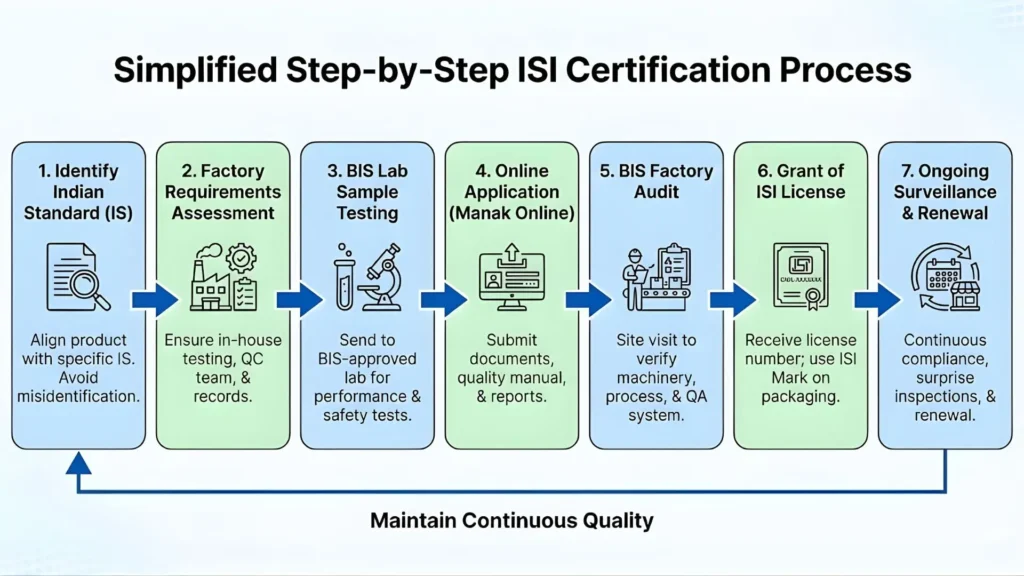
BIS Certification Process for Bottled Water Dispensers — Step by Step
Understanding the full process before you begin helps you plan realistically and avoid the delays that most commonly affect first-time applicants. Here is the complete step-by-step certification process under IS 17681: 2022:
Step 1 — Product and Standard Alignment Review
Every certification engagement begins with a complete product review against IS 17681: 2022. This covers internal water-contact material specifications, refrigeration system design and rated capacities, electrical safety systems and component specifications, climate class suitability for your target markets within India, construction and stability requirements, and marking obligations. Every gap identified at this stage is addressed before testing begins — not after.
Step 2 — Documentation Preparation
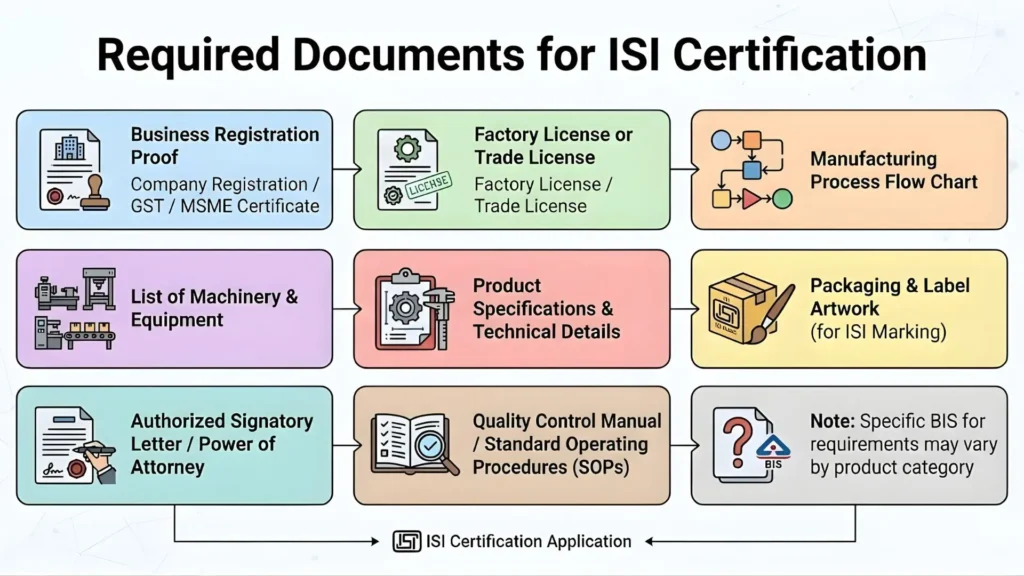
A complete and well-organised documentation package is the single most effective way to prevent BIS application delays. Missing or inconsistent documents are the leading cause of BIS document scrutiny queries that extend timelines. Required documents fall into three categories:
| Category | Document | Details |
| Administrative | Company registration certificate | Registered business entity proof |
| Administrative | Factory premises proof | Ownership or valid lease documentation |
| Administrative | Authorised signatory details | Person authorised to sign BIS documents and authority letter |
| Administrative | GST registration certificate | Valid GST number and certificate |
| Technical | Product specifications per model | Rated voltage, frequency, cooling/heating capacity, climate class, dispenser type |
| Technical | Refrigeration system description | Refrigerant type, compressor specifications, condenser and evaporator design |
| Technical | Heating system description | Element type, wattage, thermostat and thermal cutout specifications |
| Technical | Water-contact material data sheets | Food safety compliance evidence for tanks, tubing, fittings, and faucets |
| Technical | Electrical circuit diagram | Full schematic with all component specifications |
| Quality System | In-house lab equipment list | With current calibration certificates for every instrument |
| Quality System | Quality control plan | Incoming material inspection, in-process checks, finished product testing protocol |
| Quality System | Manufacturing process description | Assembly sequence, quality checkpoints, non-conforming product procedure |
Step 3 — In-House Testing Laboratory Setup
IS 17681: 2022 requires the manufacturer to maintain an operational in-house testing laboratory. This is a mandatory requirement — not a recommendation. A BIS factory inspector who finds laboratory instruments that are absent, uncalibrated, or non-operational will raise this as a major finding that delays the entire process.
Minimum in-house laboratory equipment for bottled water dispenser manufacturing includes: temperature measurement instruments for hot and cold water output testing, insulation resistance tester, leakage current measurement equipment, dielectric strength tester, cooling and heating capacity measurement setup, stability testing arrangement, and calibrated flow measurement equipment for litres-per-hour capacity verification.
Step 4 — Pre-Certification Testing at a BIS-Accredited Laboratory
Before submitting a formal BIS application, Silvereye Certification coordinates the complete IS 17681: 2022 test programme at a BIS-accredited laboratory. Running this pre-certification test before formal submission identifies any findings that need resolution — so the official BIS test programme proceeds without complications.
The key tests in the IS 17681: 2022 programme include: dielectric strength testing, insulation resistance and leakage current measurement, cold water temperature measurement at rated ambient conditions, hot water temperature measurement, cooling and heating capacity testing in litres per hour, stability testing under defined lateral force, water-contact material compliance and taste and odour assessment, thermal cutout functionality testing, and water ingress protection verification.
Step 5 — BIS Portal Application via Manakonline
All BIS applications are submitted through the official Manakonline portal. Silvereye Certification manages the complete portal process: manufacturer account registration, application form completion for each dispenser model and variant, complete document and pre-test report upload, application fee payment, and ongoing query management throughout BIS document scrutiny. Responding promptly and accurately to scrutiny queries is critical to keeping the application moving without unnecessary delays.
Step 6 — BIS Factory Inspection
Following successful document scrutiny, BIS assigns a technical officer for a factory inspection of your manufacturing premises. For bottled water dispenser manufacturers, the inspection covers:
- Production infrastructure review: Complete walkthrough of the assembly operation — refrigeration system assembly, water tank installation and sealing, heating element installation, tap and faucet assembly, electrical wiring and control board installation, housing assembly, and final quality inspection.
- In-house laboratory verification: Every instrument is checked for operational status and current calibration. All calibration certificates must be accessible and in date. Laboratory personnel must demonstrate competence in the required test methods.
- Component and material verification: Actual production components are compared against the declarations in your BIS application. Any substitution of different components — including water-contact materials — from those declared in the application is treated as a serious compliance violation.
- Quality control records review: Incoming material inspection records, in-process assembly checkpoint records, finished unit test records, and temperature performance verification data must be genuine, current, and systematic.
- Sealed sample production: BIS officers draw samples from your regular production line and seal them for independent laboratory testing. Results are compared against your pre-certification test programme results.
Step 7 — ISI Mark License Issuance
After the factory inspection and independent testing of sealed samples are complete, BIS conducts an internal review of the full application file. Upon successful review, BIS issues the ISI Mark license, authorizing its use on your certified bottled water dispensers.
Step 8 — Post-Certification Compliance Management
The ISI Mark licence is the beginning of a continuous compliance obligation. Silvereye Certification manages all post-certification requirements for bottled water dispenser manufacturers:
- Surveillance inspection preparation: BIS conducts periodic unannounced factory inspections. We prepare your facility and team to confirm compliance rather than reveal post-certification drift.
- Market sample monitoring: BIS purchases certified dispensers from retail and e-commerce channels for independent testing. Production quality must remain consistent with certified specifications throughout the license period.
- Batch testing record maintenance: Continuous production testing records are required. We ensure your documentation system captures and maintains these records correctly.
- Scope expansion management: Adding new dispenser models or variants to an existing license requires a managed scope expansion application. We handle this efficiently.
- License renewal management: Proactive renewal management before license expiry — including updated test reports and Production Statement submission — ensures your ISI Mark never lapses.
Who Needs BIS Certification Under IS 17681: 2022?
| Business Type | Requirement |
| Indian Manufacturers | ISI Mark licence required for each manufacturing premises — cannot legally manufacture for sale without it |
| Foreign Manufacturers | BIS certification via FMCS scheme with Authorised Indian Representative — mandatory before any import into India |
| Importers / Distributors | Must import only from BIS-licensed foreign manufacturers — importers cannot independently certify their supply |
| Private Label and OEM Brands | Complete supply chain must be BIS-compliant — brand owner is legally responsible for ISI Mark validity of products sold under their name |
| E-Commerce Sellers | All listings must carry valid ISI Mark — major platforms actively enforce this requirement |
| Export-Only Manufacturers | Exempt — documentation of export-only status must be maintained and verifiable at any inspection |
| R&D Imports | Not specifically provided for under QCO 2023 for this product category — consult a BIS expert before importing sample units without certification |
Compliance Deadlines — All Deadlines Have Passed
| Enterprise Category | Compliance Deadline | Status in 2026 |
| Large Enterprises | 1 July 2024 | Passed — compliance required immediately |
| Small Enterprises | 1 October 2024 | Passed — compliance required immediately |
| Micro Enterprises | 1 January 2025 | Passed — compliance required immediately |
No Grace Periods Remain: All three compliance deadline windows under the Bottled Water Dispensers (Quality Control) Order, 2023 have closed. There is no active grace period for any enterprise category. Every bottled water dispenser manufactured in India or imported for sale in India must carry a valid ISI Mark under IS 17681: 2022. Products without certification are legally at risk of seizure, penalty, and import rejection today.
Important Regulatory Update — What Changed in 2026 for BIS Certified Manufacturers
Regulatory Update — February 2026: The Government of India published an important amendment to BIS certification regulations in February 2026. This change directly affects every manufacturer and importer holding a BIS ISI Mark license — including bottled water dispenser manufacturers under IS 17681: 2022. The update is summarized below.
BIS (Conformity Assessment) Amendment Regulations, 2026 — License Validity Extended to 5 Years
On 25 February 2026, the Government of India published the Bureau of Indian Standards (Conformity Assessment) Amendment Regulations, 2026. This is the most significant structural change to BIS license validity rules in recent years. It directly affects every manufacturer holding or applying for a BIS Scheme-I ISI Mark license — including manufacturers of bottled water dispensers under IS 17681: 2022.
| Parameter | Previous Framework | Amended Framework (From 25 February 2026) |
| Initial Licence Validity | Up to 2 years from date of grant | Up to 5 years from date of grant |
| Renewal Period Options | 1 to 5 years (flexible) | Up to 5 years per renewal |
| Annual Fee Obligation | Required annually | Required annually in advance — before the due date, now more strictly enforced |
| Production Statement | Submitted separately from fee payment | Must be submitted simultaneously with annual fee payment — new requirement |
| Non-Payment Consequence | Notice issued with opportunity to regularise | Automatic 90-day licence suspension — immediate, no grace period |
| Reinstatement After Suspension | Variable process | Pay all outstanding dues plus late fee of INR 5,000 — formal application required |
| Late Renewal Application | Variable | Late fee of INR 5,000 applies if renewal application made after licence expiry |
| Applicable Certification Schemes | Scheme-I | Scheme-I, Scheme-II, and Scheme-X |
BIS Certification Cost for Bottled Water Dispensers
Understanding the cost structure before beginning certification helps you budget accurately. BIS certification costs for bottled water dispensers fall into three categories: official government fees, laboratory testing costs, and professional service fees.
| Fee Component | Amount | When Payable |
| Application Fee | INR 1,000 | At time of formal application submission on Manakonline |
| Factory Inspection Fee | INR 7,000 per man-day of BIS officer time | Before the factory inspection visit is confirmed and scheduled |
| Annual Licence Fee | INR 1,000 per year | Annually in advance before the anniversary due date — automatic suspension if missed under February 2026 amendment |
| Minimum Marking Fee | Product-specific per Annexure I, BIS (Conformity Assessment) Regulations 2018 | Annually in advance — submitted simultaneously with annual licence fee and Production Statement |
| Reinstatement Fee (if applicable) | INR 5,000 plus all outstanding dues | Only if licence is suspended for non-payment under the February 2026 amendment |
| Late Renewal Fee (if applicable) | INR 5,000 | Only if renewal application is submitted after licence expiry date |
The minimum marking fee is calculated based on your declared annual production or import quantity of certified units. For most bottled water dispenser manufacturers, the combined annual licence fee and marking fee falls in the range of INR 8,000 to INR 50,000 depending on production scale.
Laboratory Testing Costs
Product testing at a BIS-accredited laboratory under IS 17681: 2022 is mandatory and a significant cost component. Costs vary by laboratory, dispenser complexity, and number of models. Indicative ranges:
- Standard single-function dispenser (cold only or cold and room temperature): Complete IS 17681: 2022 test programme typically INR 20,000 to INR 45,000 per model per test run.
- Hot, cold, and room temperature dispenser: Additional heating system tests add cost. Budget INR 28,000 to INR 60,000 per model.
- Combination dispenser with refrigerator cabinet: Additional refrigerator compartment testing adds further cost. Budget INR 35,000 to INR 80,000 per model.
Two complete test runs per model are required for the full certification cycle: pre-certification testing before formal BIS submission, and independent testing of sealed samples drawn during the factory inspection. Budget for both runs when planning total laboratory costs
BIS Certification Timeline for Bottled Water Dispensers — Stage-by-Stage Breakdown
The official BIS processing time of 30 to 65 working days for Indian manufacturers is only part of the total calendar time from decision to ISI Mark. The preparatory stages before formal submission — documentation preparation, in-house lab setup, and pre-certification testing — take time that many manufacturers underestimate when planning their certification programme.
Indian Manufacturer — Realistic Total Timeline
| Stage | Activity | Typical Duration | Key Dependencies |
| Stage 1 | Product scope review, gap analysis against IS 17681: 2022 | 1 to 2 weeks | Access to product technical specifications and current component data sheets |
| Stage 2 | Documentation preparation — technical files, quality system documents | 2 to 5 weeks | Complexity of product range; availability of water-contact material compliance evidence; in-house lab status |
| Stage 3 | Pre-certification testing at BIS-accredited laboratory — booking, testing, report issuance | 4 to 8 weeks | Laboratory availability and queue; test programme complexity; any re-testing required after initial findings |
| Stage 4 | BIS portal application submission and document scrutiny | 2 to 4 weeks | Completeness of application at submission; number and complexity of BIS queries raised |
| Stage 5 | BIS factory inspection scheduling and site visit | 2 to 4 weeks post document clearance | BIS officer availability; any non-conformities requiring corrective action before inspection sign-off |
| Stage 6 | Independent sealed sample testing and BIS internal review | 2 to 4 weeks | Test results from sealed samples; BIS processing queue at time of submission |
| Stage 7 | ISI Mark licence issuance | 1 to 2 weeks after review completion | Clean sample test results; satisfactory inspection findings |
| Total Realistic Timeline | Decision to ISI Mark on product | 10 to 20 weeks (2.5 to 5 months) | Faster with clean documentation and first-pass testing; longer if gaps, rework, or re-testing required |
Foreign Manufacturer (FMCS) — Realistic Total Timeline
| Stage | Activity | Typical Duration |
| Stage 1 | Authorised Indian Representative appointment, scope review, gap analysis | 2 to 3 weeks |
| Stage 2 | Documentation preparation | 3 to 6 weeks |
| Stage 3 | Pre-certification testing — at BIS-accredited lab in country of manufacture or India | 4 to 8 weeks |
| Stage 4 | FMCS portal application and document scrutiny | 3 to 6 weeks |
| Stage 5 | BIS overseas factory inspection — travel scheduling, inspection, findings clearance | 4 to 8 weeks |
| Stage 6 | Sealed sample independent testing and BIS internal review | 3 to 5 weeks |
| Stage 7 | ISI Mark licence issuance | 2 to 3 weeks |
| Total Realistic Timeline | Decision to ISI Mark licence | 21 to 39 weeks (5 to 10 months) |
BIS ISI Mark License Validity and Renewal for Water Dispensers — Updated Rules for 2026
The validity and renewal rules for BIS ISI Mark licenses changed significantly on 25 February 2026 with the publication of the Bureau of Indian Standards (Conformity Assessment) Amendment Regulations, 2026. If you are working from information about BIS license validity that predates this amendment, review the updated rules carefully.
Current Validity and Renewal Rules — Post-February 2026
| Parameter | Current Rule (Post 25 February 2026) |
| Initial Licence Validity | Up to 5 years from the date of grant |
| Renewal Period | Manufacturers can apply to renew for 1, 2, 3, 4, or 5 years |
| Annual Fee Obligation | Annual licence fee and minimum marking fee due every year in advance regardless of multi-year grant period |
| Production Statement | Must be submitted simultaneously with each annual fee payment |
| Non-Payment Consequence | Automatic licence suspension after due date — 90-day cure period before potential cancellation |
| Reinstatement After Suspension | Pay all outstanding dues plus INR 5,000 late fee — formal reinstatement application required |
| Late Renewal Application | INR 5,000 late fee if renewal application submitted after licence expiry |
| Market and Surveillance Checks | Continue throughout entire licence validity period — compliance obligation is continuous |
The practical implication of 5-year validity is fewer formal renewal submissions. The practical implication of stricter annual fee enforcement is that the consequences of missing an annual payment are now immediate and automatic. These two changes together mean less renewal administration but more critical annual payment discipline.
What BIS Reviews at Renewal — Not Just an Administrative Process
BIS treats license renewal as an opportunity to verify continued product compliance and consistent production quality throughout the license period. The renewal application for bottled water dispensers requires:
- Updated laboratory test reports: Fresh IS 17681: 2022 test reports from a BIS-accredited laboratory — typically not more than 90 days old at the time of renewal submission.
- Production Statement for the preceding period: Certified declaration of actual production or import volume of certified dispenser units during the preceding license validity period.
- Current calibration records: Calibration certificates for all in-house laboratory instruments must be current — demonstrating that your quality monitoring capability has remained operational throughout the licence period.
- Scope confirmations: Confirmation that any scope expansion approvals were obtained for models added during the licence period.
Foreign Manufacturer Certification — How the FMCS Route Works
Foreign manufacturers who want to supply bottled water dispensers to India must apply through the Foreign Manufacturers Certification Scheme (FMCS). There is no alternative pathway for overseas manufacturers — every product that enters India for commercial sale must come from a BIS-licensed facility.
| Requirement | Indian Manufacturer | Foreign Manufacturer (FMCS) |
| Certification Scheme | Scheme-I — ISI Mark Licensing | Foreign Manufacturers Certification Scheme (FMCS) |
| Timeline | 30 to 65 working days | Up to 180 working days |
| Factory Inspection Location | At manufacturing premises in India | At overseas manufacturing facility — BIS officers travel to the factory |
| Authorised Indian Representative | Not required | Mandatory — an Indian entity that takes legal responsibility for certified products in India |
| Additional Documents | Standard BIS application package | AIR appointment letter, country-of-origin factory registration, regulatory compliance evidence from country of manufacture |
| Annual Obligations | Annual fee + Production Statement | Same annual fee and Production Statement obligations — managed through the AIR |
| Market Surveillance | BIS visits and market sampling in India | BIS visits to overseas factory and market sampling in India |
Why Manufacturers and Importers Choose Silvereye Certification
- Technical depth: Silvereye Certification's team understands IS 17681: 2022 at the engineering level — water-contact material compliance, refrigeration system safety, combined electrical and water risk requirements, and climate class considerations. Gap analysis with Silvereye is real technical assessment, not a generic documentation checklist.
- Pre-testing commitment: Complete laboratory testing is coordinated before formal BIS submission. Your dispensers are confirmed compliant before the official process begins — eliminating the test failures and rework cycles that cause the most significant timeline extensions.
- Factory audit preparation that works: Pre-audit walkthrough identifies every gap before the BIS inspector arrives. In-house laboratories are fully operational and calibrated, documentation is complete, and production quality is aligned with IS 17681: 2022 when the official visit happens.
- Complete end-to-end service: From product review and gap analysis through documentation preparation, laboratory coordination, portal management, BIS follow-up, factory audit preparation, and post-certification compliance management — Silvereye handles every stage.
- Post-certification compliance management: Including proactive annual fee management and Production Statement reminders under the stricter February 2026 amendment rules — so your licence never lapses due to an administrative oversight.
Get Your Bottled Water Dispenser BIS Certified Today
All compliance deadlines under the Bottled Water Dispensers (Quality Control) Order, 2023 have passed. If your dispenser products do not currently carry the ISI Mark, you are operating outside Indian law and every day of non-compliance increases your legal and commercial risk.
Silvereye Certification provides complete end-to-end BIS ISI Mark certification for bottled water dispenser manufacturers and importers under IS 17681: 2022 — from initial gap analysis through to ISI Mark license issuance and ongoing post-certification compliance management.
Frequently Asked Questions — BIS Certification for Bottled Water Dispensers
Is BIS ISI Mark certification mandatory for all bottled water dispensers sold in India?
Yes, without exception. Under the Bottled Water Dispensers (Quality Control) Order, 2023, BIS ISI Mark certification under IS 17681: 2022 is mandatory for all bottled water dispensers manufactured in India or imported for sale in India.
Does IS 17681: 2022 apply to water dispensers connected to a pipeline or overhead tank?
No. IS 17681: 2022 specifically covers bottled water dispensers — units that dispense drinking water from a sealed bottle using a vapour compression refrigeration system. Dispensers connected to a water supply line, pipeline, or overhead tank are outside the scope of this standard and the QCO 2023.
How long does BIS certification take for a bottled water dispenser manufacturer?
For Indian manufacturers, the realistic total timeline — from gap analysis through to ISI Mark licence issuance — is 10 to 20 weeks (2.5 to 5 months). For foreign manufacturers via FMCS, the realistic total timeline is 21 to 39 weeks (5 to 10 months).
What is the BIS ISI Mark licence validity for bottled water dispensers after February 2026?
Under the Bureau of Indian Standards (Conformity Assessment) Amendment Regulations published on 25 February 2026, the initial BIS ISI Mark licence validity under Scheme-I is now up to 5 years from the date of grant, increased from the previous maximum of 2 years. Renewal can also be applied for in periods of up to 5 years.
Can I list and sell bottled water dispensers on Amazon or Flipkart without the ISI Mark?
No. Major Indian e-commerce platforms including Amazon India, Flipkart, Meesho, and JioMart actively enforce ISI Mark compliance for water dispenser listings.
What is the difference between Normal (N) and Tropical (T) climate class under IS 17681: 2022?
Normal class (N) covers dispensers designed for ambient operating temperatures of 16°C to 32°C. Tropical class (T) covers 16°C to 43°C, which is relevant for peninsular India, coastal areas, and other high-ambient-temperature regions. A dispenser certified to Normal class only may not meet the cold water temperature performance requirements during summer months in tropical climate regions — which constitutes a compliance failure if BIS surveillance testing is conducted in those conditions.
Do I need a separate BIS licence for each water dispenser model?
Yes. Each model covered under IS 17681: 2022 must be individually listed under your BIS licence.
Can a private label or OEM brand sell BIS-certified bottled water dispensers without holding their own license?
A private label brand does not need to hold its own independent BIS license, but the OEM or ODM manufacturer who actually manufactures the dispensers must hold a valid BIS ISI Mark license under IS 17681: 2022 covering those specific models.
What happens if BIS purchases one of my certified dispensers from the market and it fails testing?
This is the risk that post-certification quality management is designed to prevent. If BIS market surveillance testing reveals that a certified dispenser fails to meet IS 17681: 2022 requirements, BIS can initiate license suspension or cancellation proceedings, require mandatory corrective action, issue penalties, and in serious cases pursue criminal proceedings.