
- BIS ISI Certification for Cookware, Utensils and Cans for Foods & Beverages is now mandatory under IS 14756:2024 for every stainless steel cookware and utensil manufactured or sold in India, effective October 2025 onwards.
- Three Indian Standards — IS 14756:2024, IS 13983:1994, and IS 18427:2024 — together define the quality, safety, and food-contact compliance benchmarks that every product in this category must meet.
- The QCO rollout follows a phased deadline structure — 1st October 2025, 1st January 2026, and 1st April 2026 — which means manufacturers and importers who delay their BIS license application are already running out of time.
- Products found without valid certification face real and immediate consequences — market bans, seizure, penalties reaching up to Rs 2 lakh, and forced product recalls — as BIS enforcement across India has been picking up considerable pace through 2026.
Introduction: Why BIS ISI Certification for Cookware, Utensils and Cans For Food and Beverages Matters in 2026
If you manufacture, import, or sell cookware, stainless steel utensils, or metal food cans in India, 2026 is a year you simply cannot afford to take lightly. The Bureau of Indian Standards has significantly tightened its compliance requirements for food-contact products — and the reasoning behind this is straightforward and hard to argue with.

Think about it this way. Every single day, millions of Indian households cook meals in stainless steel vessels, store food in tin cans, and use utensils that are in direct contact with what they eat. The quality of the metal matters. Substandard stainless steel can leach harmful heavy metals — including nickel, chromium, manganese, and lead — into food during cooking or storage. BIS ISI certification exists precisely to prevent this from happening at scale, and the government is now enforcing it seriously.
This guide covers everything you need to stay compliant and informed:
- The applicable Indian Standards and what their technical requirements actually mean in practice
- Phased Quality Control Order deadlines for 2025 and 2026 and which products each phase covers
- A step-by-step breakdown of the BIS license application process for both domestic manufacturers and foreign producers
- Documentation checklist, testing requirements, and what your obligations look like after you receive the license
- Enforcement powers BIS holds, penalties for non-compliance, and what consumer rights look like under this framework
- Latest BIS notifications and circulars relevant to this product category as of 2026
Whether you are a seasoned manufacturer navigating a new compliance cycle or an importer trying to understand where you stand, this guide is built to give you clarity — without the jargon.
What Is BIS ISI Certification?
BIS — the Bureau of Indian Standards — is India's apex national body for standardization, product certification, and quality regulation. Established under the BIS Act, 2016, it operates under the Ministry of Consumer Affairs, Food and Public Distribution. When a product carries the ISI mark (Indian Standards Institution mark), it legally signifies that the product has been independently tested against a notified Indian Standard and consistently meets the defined safety and quality parameters.

ISI Mark vs. BIS CRS — Understanding the Difference
| Parameter | BIS ISI Product Certification | BIS CRS (Compulsory Registration Scheme) |
| Applicable Products | Cookware, utensils, steel sinks, metal cans | Electronics, IT products, batteries |
| Factory Inspection | Mandatory before license grant | Not required — self-declaration |
| Mark Displayed | ISI mark on product | BIS Registration mark on product |
| Post-license Audit | Periodic BIS surveillance inspections | Market surveillance only |
| Foreign Manufacturers | FMCS route with overseas factory inspection | Online registration with documents |
| Renewal | Annual license renewal required | Annual renewal required |
Why ISI Mark Certification Is Non-Negotiable for Cookware
- Food Safety Guarantee Certified products use steel grades proven not to leach harmful quantities of heavy metals into food under normal cooking and storage conditions.
- Legal Market Access Once a Quality Control Order (QCO) is in force for a product, selling uncertified items is a criminal offence under the BIS Act, 2016.
- Consumer Trust The ISI mark is one of India's most recognized quality symbols — consumers actively look for it, especially in the cookware segment.
- E-commerce Compliance Major platforms like Amazon India and Flipkart require valid ISI certification for products in mandatory BIS categories — no mark means de-listing.
- Export Readiness BIS certification demonstrates quality compliance and strengthens a brand's position for export to neighbouring markets that recognize Indian standards.
The Three Governing BIS Standards: A Deep Dive
Three Indian Standards form the regulatory backbone of BIS ISI certification for cookware, utensils, and food packaging in India. Every product in this space maps to one of these standards.
IS 14756:2024 — Stainless Steel Utensils (Cookware)
| IMPORTANT: IS 14756:2024 is a revised and updated version of the earlier IS 14756. The 2024 edition introduces stricter heavy metal migration limits, updated steel grade specifications, expanded product scope, and improved marking guidelines aligned with international food-safety standards. |
IS 14756:2024 is the cornerstone standard for stainless steel cookware and utensils. It covers products used for food preparation, cooking, serving, and storage.
Phased QCO Implementation Timeline — IS 14756:2024
| Phase | Effective Date | Coverage | Who Is Affected |
| Phase 1 | 1st October 2025 | Initial mandatory compliance for priority product categories | Domestic manufacturers first |
| Phase 2 | 1st January 2026 | Extended to additional product types and distribution levels | Manufacturers + importers |
| Phase 3 | 1st April 2026 | Full mandatory compliance — all stainless steel utensil categories | All supply chain participants |
| Manufacturers who have not yet initiated their BIS license application are already behind the Phase 1 deadline. Phase 2 and Phase 3 windows are shrinking rapidly. Start now. |
Products Covered Under IS 14756:2024
- Pressure cookers (stainless steel body and lid)
- Cooking pots, dekchis, and patelas
- Frying pans, kadais, and tawas (stainless steel)
- Milk pots, tea kettles, and saucepans
- Serving bowls, thalis, and katoris
- Tiffin boxes, lunch boxes, and bento containers
- Storage dabbas, canisters, and airtight containers
- Ladles, spatulas, serving spoons, and skimmers
- Colanders, strainers, and steamers
- Water bottles and drinkware (stainless steel)
Key Technical Requirements — IS 14756:2024
| Requirement Area | Specification / Limit |
| Steel Grades Permitted | ISI 304 (18Cr-8Ni), AISI 202 (17Cr-5Ni-Mn) with defined composition limits; Grade 430 for specific applications |
| Nickel Migration Limit | Not more than 0.14 mg/dm² per week in food simulants per IS/ISO test methods |
| Chromium Migration Limit | Within safe limits as defined in IS 14756:2024 — tested via atomic absorption spectrometry |
| Surface Finish (Food Contact) | Minimum 2B finish or better; no pits, cracks, burrs, or porosity on food-contact surfaces |
| Weld Quality | Welds to be continuous, free of slag, porosity, or cracks; tested visually and by bend/tensile test |
| Dimensional Tolerance | As specified for each product type; capacity tolerance within +/- 3% of declared volume |
| Handle Attachment | Riveted or welded handles to withstand 5x the stated load without failure or loosening |
| Marking on Product | ISI mark, IS 14756, CM/L number, steel grade, capacity, and manufacturer name/brand |
| Packaging Mark | Batch number, date of manufacture, country of origin (for imports), and helpline number |
IS 13983:1994 — Stainless Steel Sinks for Domestic Purposes
IS 13983:1994 governs the manufacture and quality of stainless steel sinks designed for domestic kitchen use. Although this standard was first published in 1994, it remains fully operative and BIS certification under this standard is mandatory for all sinks sold in the Indian market.
Products Covered Under IS 13983:1994
- Single-bowl kitchen sinks (with or without draining board)
- Double-bowl kitchen sinks (equal or unequal bowl sizes)
- Sinks with integrated left or right draining boards
- Undermount and topmount sink configurations
- Sinks with pre-drilled tap holes
Key Technical Requirements — IS 13983:1994
| Parameter | Requirement |
| Steel Grade | Stainless steel conforming to IS 6911 — typically Grade 304 (18-8) |
| Sheet Thickness | Minimum 0.8 mm for small sinks; 1.0 mm or more for larger bowls (as per bowl dimensions) |
| Surface Finish | Minimum 2B (cold-rolled, annealed, pickled); no visible pits, cracks, scratches, or corrosion |
| Bowl Depth | As specified per sink type; standard domestic sink bowl minimum 150 mm depth |
| Drain Hole | Minimum 90 mm diameter; positioned as per standard drawing |
| Waste Fitting Compatibility | Drain to accept standard 1.5-inch waste fittings |
| Weld Quality | Continuous, smooth welds; no porosity or inclusions visible to naked eye |
| Chemical Resistance | Withstand immersion in household cleaning agents — bleach, detergent, mild acids — without pitting or staining |
| Load Test | Bowl base to support 100 kg distributed load without permanent deformation |
| Marking | ISI mark, IS 13983, CM/L number, manufacturer name, steel grade, and sink dimensions on product or packaging |
IS 18427:2024 — Three Piece Round Open Top Metal Cans for Foods and Beverages
IS 18427:2024 is a new Indian Standard specifically developed for three-piece round open-top metal cans used for packaging food products and beverages. This standard fills a long-standing gap in India's food packaging regulation and brings domestic can manufacturing norms in line with international benchmarks such as those set by the Codex Alimentarius Commission and the European Commission's Regulation (EC) No. 1935/2004 on food-contact materials.
What is a Three-Piece Metal Can?
A three-piece can is constructed from three separately manufactured components joined together:
- The Body A rectangular sheet of metal rolled into a cylinder with a longitudinal side seam (welded, soldered, or cemented)
- The Bottom End A round disc mechanically seamed to the bottom of the body before filling
- The Top End / Lid Applied and seamed after the can is filled with product — creates the final hermetic seal
Industries That Need IS 18427:2024 BIS Certification
- Fruit and vegetable processors (canned tomatoes, peas, mushrooms, mixed vegetables)
- Seafood and fish canneries (tuna, sardines, mackerel, prawns)
- Ready-to-eat food manufacturers (curries, soups, gravies, pulses)
- Dairy product packagers using metal cans (condensed milk, ghee)
- Beverage companies using open-top metal cans
- Tin can manufacturers and can-making equipment suppliers
- Metal packaging distributors and importers of food-grade tins
Key Technical Requirements — IS 18427:2024
| Requirement Area | Specification |
| Base Material | Tinplate (electrolytic tin-coated steel) or ECCS/TFS (electrolytic chromium-coated steel) |
| Tin Coating Weight | As specified in IS 18427:2024 — typically E2.8/2.8 or E5.6/5.6 (grams per square metre per side) |
| Internal Coating | Food-grade lacquer or enamel; tested for adhesion, flexibility, continuity, and migration into food simulants |
| Side Seam Type | Electric resistance welded (ERW), cemented, or soldered seam; welded preferred for food products |
| Side Seam Strength | Must withstand internal pressure test without failure; tensile strength of seam as per standard |
| Double Seam Dimensions | Seam width, thickness, body hook, cover hook, and overlap as per IS 18427 drawing tolerances |
| Corrosion Resistance | No red rust formation after salt spray test (48 hours at 5% NaCl solution) |
| Internal Lacquer Migration | Specific migration limits for lacquer components into food simulants as per IS/FSSAI guidelines |
| Can Body Dimensions | Standardised diameters and heights with defined tolerances; flanged and non-flanged variants |
| Marking | Manufacturer code, plant code, production date (Julian calendar), internal coating code, and steel grade |
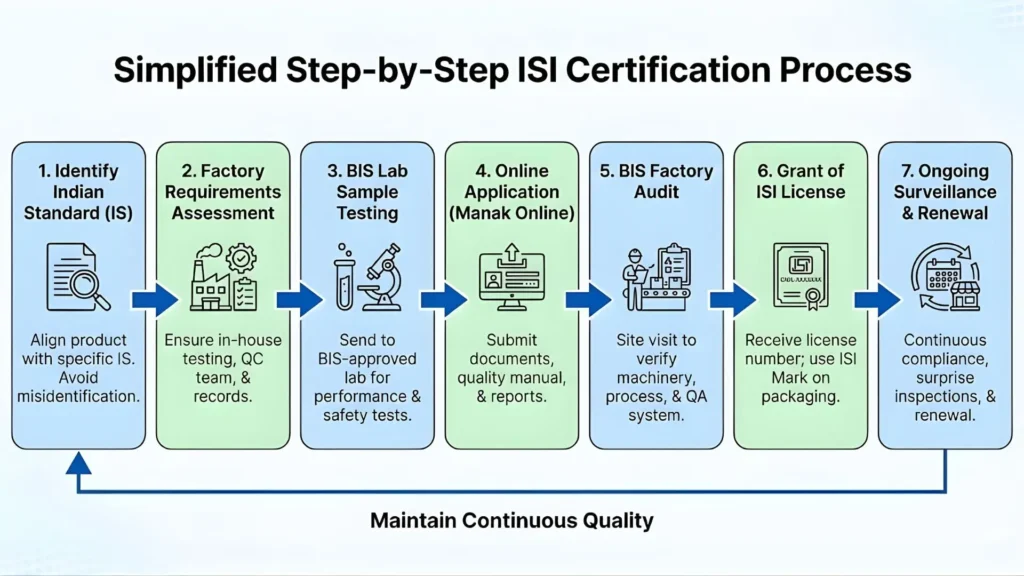
BIS ISI Certification Process: Complete Step-by-Step Guide
Obtaining BIS ISI certification for cookware, sinks, or metal cans follows a structured process. Here is the complete roadmap for 2026, from application to license grant.
1. Step 1: Confirm Your Applicable Standard
Map your product to the correct IS: IS 14756:2024 for stainless steel cookware and utensils, IS 13983:1994 for stainless steel kitchen sinks, and IS 18427:2024 for three-piece round open-top metal cans. A single manufacturer may need multiple licenses if they produce products across categories.
2. Step 2: Prepare Your Manufacturing Facility
Before applying, ensure your facility has the minimum required in-house testing equipment, documented quality control procedures, calibrated measuring instruments, and trained quality assurance personnel. BIS will verify all of this during the factory inspection.
3. Step 3: Get Products Tested at a BIS-Recognized Laboratory
Send representative product samples to a BIS-recognised testing laboratory for type-approval testing. The test report will form a core part of your application dossier. Choose a lab experienced in food-contact material testing and IS 14756 / IS 13983 / IS 18427 test methods.
4. Step 4: Submit Online Application on BIS Portal
Visit www.bis.gov.in and submit the Product Certification Scheme application for the applicable IS. Upload all required documents, pay the application fee, and submit the test report from the BIS-recognised laboratory. The portal allows real-time tracking of application status.
5. Step 5: Factory Inspection by BIS Officers
BIS will schedule an inspection of your manufacturing facility, typically within 30 to 60 days of application acceptance. Officers will verify equipment, raw materials, QC processes, records, and collect production samples for confirmatory testing.
6. Step 6: Confirmatory Testing
Samples collected during the factory inspection are tested at BIS's own laboratories or designated labs. Results are compared against IS requirements. Any non-conformance at this stage can delay or reject the license grant.
7. Step 7: Grant of BIS License (CM/L Number)
On satisfactory completion of inspection and testing, BIS grants a CM/L (Certificate of Marks / License) number. This license authorizes you to apply the ISI mark on qualifying products. Keep the CM/L number prominently displayed on products and packaging.
8. Step 8: Post-License Compliance
Maintain ongoing compliance through regular in-house testing, record keeping, BIS-mandated external testing at BIS labs, and cooperation during surprise surveillance inspections. License renewal is required annually.
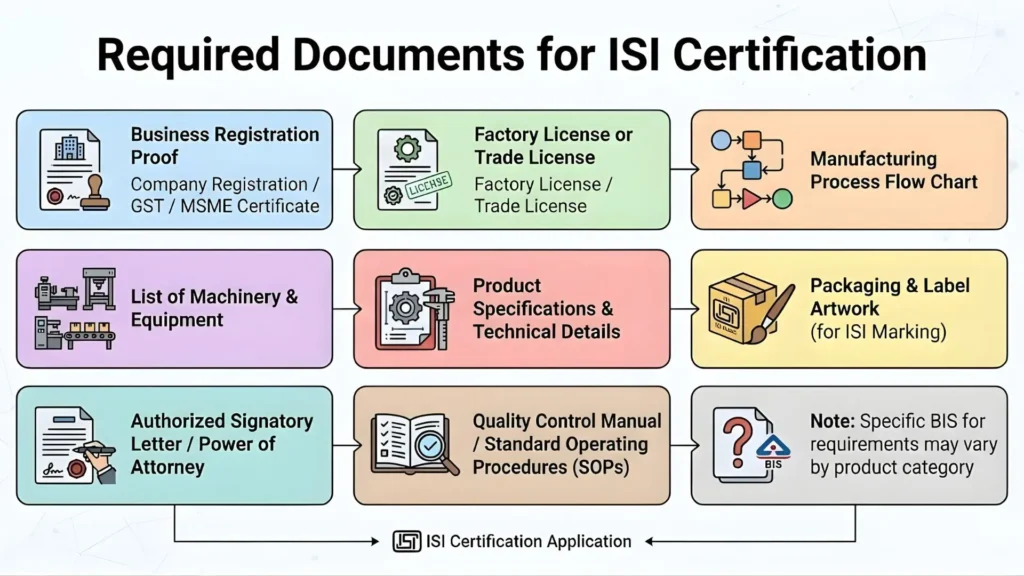
Complete Documentation Checklist for BIS License Application
| Document | Purpose | Format |
| Company Registration Certificate / MOA | Proof of legal entity | Scanned copy |
| GST Registration Certificate | Tax compliance verification | Scanned copy |
| Factory Layout Plan (to scale) | Verify manufacturing infrastructure | Drawing / PDF |
| List of Manufacturing Machinery | Assess production capability | Tabular list |
| In-house Testing Equipment List | Verify QC capability | Tabular list with calibration dates |
| Quality Control Manual / SOP | Process consistency documentation | Document |
| Raw Material Test Certificates | Verify steel grade compliance | Mill certificates / lab reports |
| Product Test Reports (BIS-recognised lab) | Type approval — core technical document | Original signed report |
| ISI Mark Specimen (proposed placement) | Confirm marking compliance | Drawing / photograph |
| Trademark / Brand Certificate (if any) | Brand identity verification | TM certificate |
| List of Products with specifications | Define certification scope | Tabular list |
| Authorised Signatory Details + ID | Contact and legal accountability | KYC documents |
BIS Certification for Foreign Manufacturers — The FMCS Route
Foreign manufacturers who wish to supply stainless steel cookware, sinks, or metal food cans to India must obtain BIS certification through the Foreign Manufacturers Certification Scheme (FMCS). This is not optional — without FMCS registration, imported products cannot clear Indian customs in mandatory certification categories.

Key Differences: Domestic vs. Foreign Manufacturer Certification
| Parameter | Domestic Manufacturer | Foreign Manufacturer (FMCS) |
| Application Route | Standard BIS Product Certification | Foreign Manufacturers Certification Scheme (FMCS) |
| Indian Representative | Not required | Mandatory — must appoint an authorised Indian agent |
| Factory Inspection | BIS officers visit Indian factory | BIS officers travel to overseas factory at applicant's cost |
| Inspection Costs | Relatively lower | Higher — includes BIS officer travel, stay, and per diem |
| Processing Time | 3 to 6 months typically | 6 to 12 months depending on country and scheduling |
| License Validity | 1 year, renewable annually | 1 year, renewable annually |
| Marking Requirement | Same ISI mark on product | Same ISI mark + country of origin on product/packaging |
FMCS Application Process — Key Steps
- Appoint a BIS-authorized Indian representative who will act as the local contact for all BIS communications
- Submit the FMCS application on the BIS portal along with factory details, product specifications, and test reports from an accredited laboratory
- BIS evaluates the application and schedules an overseas factory inspection — costs of BIS officer travel must be borne by the applicant
- Factory inspection is conducted at the overseas manufacturing site — the process mirrors domestic inspection
- Confirmatory testing of samples collected during inspection is conducted at BIS laboratories or designated test houses
- On successful clearance, BIS grants the CM/L license — the foreign manufacturer can then ship products with ISI marking to India
BIS Certification Fees: What to Budget For
BIS certification involves multiple fee components spread across the application, testing, inspection, and post-licensing stages. The following is a general overview — actual fees are subject to revision by BIS and should be verified at www.bis.gov.in before application.
| Fee Component | Approximate Range (INR) | Notes |
| Application fee | Rs 1,000 – Rs 5,000 | One-time at application; varies by product category |
| Product testing charges | Rs 5,000 – Rs 50,000+ | Depends on number and complexity of tests required under IS |
| Annual marking fee | Rs 5,000 – Rs 2,00,000+ | Based on annual production turnover; paid yearly |
| Inspection charges | Actual travel + TA/DA | For BIS officer factory visit; applicant bears cost |
| Annual license fee | Rs 1,000 – Rs 50,000+ | Based on company turnover slab; paid on renewal |
| FMCS overseas inspection | Rs 2,00,000 – Rs 5,00,000+ | International travel, accommodation for BIS officers |
| Surveillance testing | Rs 3,000 – Rs 20,000 | Products tested at BIS labs during surveillance visits |
| Tip: For Micro and Small Enterprises (MSEs), BIS offers concessional fee slabs. Maintain your Udyam Registration Certificate to avail these benefits during application. |
Testing Requirements: What Gets Tested and How
BIS certification is test-driven. Before a license is granted — and during post-licensing surveillance — products must pass a series of physical, chemical, and mechanical tests as defined in the applicable IS. Here is what manufacturers need to know.
Key Tests for Stainless Steel Cookware and Utensils (IS 14756:2024)
| Test Name | What It Checks | Method |
| Chemical Composition Analysis | Steel grade — Cr, Ni, Mn, C, Si percentages within IS limits | OES Spectrometry / Wet chemistry |
| Heavy Metal Migration Test | Nickel, chromium, manganese migration into food simulants | Atomic absorption spectrometry (AAS) |
| Corrosion Resistance Test | No pitting or staining after exposure to food acids | Citric acid / acetic acid immersion test |
| Surface Finish Evaluation | No sharp edges, porosity, cracks, or contamination | Visual + tactile inspection per IS |
| Handle/Knob Pull Test | Attachment integrity under 5x rated load | Mechanical tensile test |
| Dimensional Verification | Capacity and dimensions within tolerance | Calibrated instruments per IS drawing |
| Heat Resistance Test | No deformation or discolouration under repeated thermal cycling | Specified temperature cycle test |
| Weld Quality Inspection | Continuous, defect-free welds | Visual + bend test on welded section |
Key Tests for Metal Food Cans (IS 18427:2024)
| Test Name | What It Checks | Method |
| Tin Coating Weight | Tin deposit per side meets minimum specification | Coulometric stripping / gravimetric |
| Side Seam Strength | Weld seam withstands burst and tensile loading | Hydrostatic burst pressure test |
| Double Seam Dimensions | Seam geometry within tolerance for hermetic seal | Seam scope / profile projector measurement |
| Internal Coating Continuity | No pinholes or defects in food-grade lacquer | Enamel rater test (EMR) |
| Lacquer Adhesion Test | Coating does not peel or blister on bending | Cross-hatch adhesion per IS |
| Salt Spray Test | No red rust on cut edges after 48-hour exposure | Salt spray chamber at 5% NaCl |
| Migration Test | Lacquer components within food-safe migration limits | Food simulant extraction + GC/MS or HPLC |
| Can Dimensions | Body diameter, height, flange dimensions within tolerance | Calibrated gauges and micrometers |
BIS Enforcement and Penalties for Non-Compliance
The BIS Act, 2016 arms enforcement officers with significant legal powers to act against non-compliant products and manufacturers. In 2025–2026, BIS has substantially stepped up its market surveillance activities, covering physical retail, wholesale markets, and online e-commerce platforms.
Offences and Penalties Under the BIS Act, 2016
| Offence | Penalty |
| Using ISI mark without a valid BIS license | Imprisonment up to 2 years and/or fine up to Rs 2 lakh |
| Manufacturing / selling mandatory-category products without ISI | Imprisonment up to 1 year and/or fine up to Rs 1 lakh |
| Repeat offence within 5 years of prior conviction | Imprisonment up to 5 years and/or fine up to Rs 5 lakh |
| Misuse of BIS trademark or ISI mark | Prosecution under trademark and BIS Act provisions |
| Obstructing BIS officers during inspection or surveillance | Imprisonment and fine as per BIS Act provisions |
| Selling counterfeit ISI-marked products | Seizure, prosecution, and enhanced penalties |
BIS Enforcement Actions — What to Expect
- Market Raids BIS teams conduct surprise raids in wholesale markets, retail stores, and warehouses — seizing uncertified products on the spot
- E-commerce Monitoring BIS actively monitors Amazon, Flipkart, Meesho, and other platforms — uncertified products are flagged for de-listing
- Complaint-Based Action Consumer complaints through the BIS CareConnect app or portal trigger investigations against specific brands or sellers
- Customs Interception Imported cookware and food cans without valid ISI certification are detained at ports by BIS-liaised customs officials
- Brand Blacklisting Repeat violators may be publicly named by BIS, damaging brand reputation permanently
Special Guidance for Importers: Sourcing from China, Vietnam, and Other Countries
A significant share of stainless steel cookware and tin cans sold in India is sourced internationally — primarily from China, Vietnam, Bangladesh, South Korea, and Turkey. For importers, the BIS mandatory certification regime has direct operational and commercial implications that demand immediate attention.
- Verify FMCS Status of Your Supplier Ask your overseas supplier to confirm if they hold a valid BIS CM/L license under the relevant IS. Check the BIS license database at www.bis.gov.in to verify independently.
- Build Lead Time for FMCS Registration FMCS registration typically takes 6 to 12 months due to overseas factory inspection logistics. Factor this into your sourcing calendar.
- Check Product Compliance with IS Even if your supplier is FMCS-registered, verify that the specific product you are importing is covered under their BIS license scope — not all models may be certified.
- Update Import Documentation Your Bill of Entry at customs must reference the BIS CM/L license number of the overseas manufacturer. Missing or incorrect documentation causes costly customs holds.
- Audit Your Supplier's Steel Grade For stainless steel products, confirm the steel grade used by your supplier. Grade 202 and Grade 304 have very different properties — ensure the grade meets IS 14756:2024 requirements for the intended application.
- Plan for Product Testing in India BIS may collect import samples for confirmatory testing. Maintain a buffer stock to avoid supply disruptions if samples are detained for testing.
Consumer Guidance: How to Verify BIS ISI Certification Before Buying
For consumers — whether buying cookware for home use or procuring utensils for a commercial kitchen or catering business — knowing how to verify BIS ISI certification protects your health and your money.
| What to Check | Where to Look | Why It Matters |
| ISI Mark | Embossed or printed on product surface or base | Confirms product has been tested and certified |
| IS Number | Adjacent to ISI mark — e.g., IS 14756 | Confirms correct standard applies to the product |
| CM/L Number | Printed near ISI mark — e.g., CM/L-XXXXXXX | License number traceable in BIS database |
| Steel Grade | On product base or packaging — e.g., SS 304, SS 202 | Higher grades (304) are more food-safe than 202 |
| Manufacturer Name | On packaging or product | Enables traceability for complaints |
| BIS Portal Check | Visit www.bis.gov.in > License Verification and enter CM/L no | Verify license is active and not expired |
| BIS App Check | Download BIS CareConnect app — scan the ISI mark or enter CM/L | Quick mobile verification of authenticity |
Common Reasons for BIS License Rejection or Delay — And How to Avoid Them
- Incomplete or Incorrect Documentation Missing factory layout, incomplete equipment list, or wrong product specifications in the application cause immediate delays. Prepare a complete document dossier before submitting.
- Product Failing Chemical Composition Test Using steel with incorrect chromium or nickel content — or substandard tinplate for cans — leads to test failure. Always source raw materials with valid mill certificates and verify composition before testing.
- Inadequate In-House Testing Infrastructure BIS requires manufacturers to have calibrated in-house testing equipment for basic quality checks. Factories without basic measuring instruments — micrometers, weighing balances, surface finish comparators — will fail inspection.
- Non-Compliant Product Markings ISI mark size, placement, or accompanying information not meeting BIS marking guidelines is a frequent cause of non-compliance. Study the marking requirements in the IS thoroughly before production.
- Raw Material Traceability Gaps BIS requires traceability from finished product back to raw material batches. Factories without proper material receipt records, heat numbers, or supplier certificates will struggle during inspection.
- Inconsistent Manufacturing Processes BIS inspectors look for consistent, documented SOPs — not ad hoc production. Factories that cannot demonstrate repeatability across production batches face extended scrutiny.
- Test Reports from Non-BIS-Recognized Labs Submitting test reports from laboratories not on the BIS-recognized list will result in rejection. Always verify lab BIS recognition before commissioning tests.
What Is New in IS 14756:2024 — Key Changes from the Previous Version
| Area of Change | Previous Version | IS 14756:2024 (New) |
| Steel Grade Specifications | Based on older IS grade designations | Aligned with current ISO 15510 and ASTM A240 grade equivalents |
| Heavy Metal Migration Limits | Less specific migration thresholds | Explicit migration limits for Ni, Cr, Mn aligned with EU Regulation 10/2011 |
| Testing Methods | Some tests based on superseded IS methods | Updated test methods citing current IS and ISO procedures |
| Product Scope | Narrower product coverage | Expanded — includes water bottles, insulated containers, and modern kitchenware |
| Marking Requirements | Basic marking guidance | Detailed marking specifications including font size, ISI mark dimensions, and mandatory fields |
| Grade 202 Steel | Limited guidance on 202 grade limits | Clearer composition limits for Grade 202 to prevent adulteration with low-grade steel |
| Handle & Fitting Standards | General requirements | Specific tensile and torque test requirements for handles, knobs, and fittings |
| Packaging Requirements | Minimal packaging guidance | Comprehensive labelling requirements covering all mandatory consumer information |
Latest BIS Notifications and QCO Updates — 2025 to 2026
| This section covers the most recent and significant BIS orders, Quality Control Orders (QCOs), and circulars relevant to cookware, stainless steel utensils, sinks, and food cans. All information is current as of April 2026. Manufacturers and importers are strongly advised to monitor the BIS official Gazette and www.bis.gov.in for real-time updates. |
Quality Control Order — IS 14756:2024 (Stainless Steel Utensils)
The Ministry of Consumer Affairs, Food and Public Distribution issued a Quality Control Order (QCO) making BIS ISI certification under IS 14756:2024 mandatory for stainless steel cookware and utensils. This QCO came into effect with the following phased implementation:
| Phase | Date | Applicability |
| Phase 1 | 1st October 2025 | Mandatory for domestic manufacturers — initial product categories |
| Phase 2 | 1st January 2026 | Extended to additional product categories; importers covered |
| Phase 3 | 1st April 2026 | Full mandatory compliance — all stainless steel utensil types and all supply chain levels |
Products manufactured, imported, sold, stored, or distributed in India without valid ISI certification under IS 14756:2024 after the respective deadlines are in violation of the QCO and subject to seizure and prosecution under the BIS Act, 2016.
IS 18427:2024 Published — QCO Expected
IS 18427:2024 for three-piece round open-top metal cans was published by BIS in 2024. A formal Quality Control Order (QCO) linking mandatory BIS certification to this standard is anticipated by the food processing industry. Can manufacturers and food processors should proactively initiate BIS license applications under IS 18427:2024 to avoid last-minute compliance pressure once the QCO effective date is notified.
IS 13983:1994 — Continued Mandatory Status
BIS certification under IS 13983:1994 for stainless steel kitchen sinks continues to be mandatory. BIS has confirmed that IS 13983 is under periodic review and a revised version may be published in the near future. Manufacturers currently certified under IS 13983:1994 will be notified of migration requirements to any new standard once published. In the interim, IS 13983:1994 remains fully operative and all certification requirements under it continue to apply.
| Read More :- BIS New Standards QCO For Stainless Steel Utensils |
Conclusion
BIS ISI certification for cookware, stainless steel utensils, sinks, and metal food cans is no longer just a quality aspiration in India — it is a hard legal requirement with real enforcement teeth. The phased QCO for IS 14756:2024 is already in motion. IS 18427:2024 for metal cans is published and a QCO is imminent. BIS enforcement teams are active in markets, at customs, and on e-commerce platforms.
Whether you are a stainless steel utensil manufacturer in Punjab, an importer sourcing cookware from Southeast Asia, a food processor using three-piece tin cans, or a kitchen brand managing an OEM supply chain — the BIS ISI certification process is something that needs your immediate attention and resources.
Here is your action checklist:
- Identify which Indian Standards apply to your products — IS 14756:2024, IS 13983:1994, or IS 18427:2024
- Check whether your manufacturing facility or your overseas supplier already holds a valid BIS CM/L license
- If not certified, begin the BIS license application process without delay — timelines are tighter than they look
- Get your products tested at a BIS-recognized laboratory to identify any non-conformances before the formal inspection
- Train your quality team on the specific requirements of the applicable IS
- Subscribe to BIS Gazette notifications and www.bis.gov.in alerts to stay ahead of new QCOs and standard revisions
- For consumers — always look for the ISI mark, IS number, and CM/L number before purchasing any cookware or kitchen product
Frequently Asked Questions
Is BIS certification mandatory for all stainless steel cookware sold in India in 2026?
Yes. Under the Quality Control Order linked to IS 14756:2024, BIS ISI certification is mandatory for stainless steel cookware and utensils. The phased deadlines — October 2025, January 2026, and April 2026 — complete the full mandatory rollout. After April 2026, no uncertified stainless steel utensil can be legally manufactured, imported, or sold in India.
How long does the BIS ISI certification process take for cookware manufacturers?
Typically 3 to 6 months for domestic manufacturers — including document preparation, product testing, factory inspection, and license grant. Foreign manufacturers under FMCS should plan for 6 to 12 months due to overseas inspection scheduling. Starting early is strongly advised.
Can a small or micro manufacturer get BIS ISI certification?
Yes. BIS certification is open to manufacturers of all sizes. MSMEs registered under Udyam are eligible for concessional fees. However, your facility must meet minimum infrastructure requirements — basic in-house testing capability, documented SOPs, and raw material traceability systems.
I import cookware from China. What do I need to do?
Your Chinese supplier must be registered with BIS under the FMCS route and hold a valid CM/L license covering the specific products you import. Verify their license status on the BIS portal. If not registered, initiate FMCS registration immediately — it takes 6 to 12 months. Products without BIS certification cannot be imported after the QCO effective date.
What is the difference between Grade 304 and Grade 202 stainless steel for cookware?
Grade 304 (18% chromium, 8% nickel) is the premium food-grade stainless steel offering superior corrosion resistance and very low heavy metal migration. Grade 202 (17% chromium, 5% nickel, higher manganese) is less expensive but has stricter usage limits under IS 14756:2024. For critical food-contact surfaces and acidic foods, Grade 304 is always the recommended choice.
What happens if my BIS license is suspended or cancelled?
You must immediately stop affixing the ISI mark on products. Products already in the supply chain with the mark may be subject to recall if the suspension reason involves safety. You must rectify the non-conformance, apply for reinstatement, and pass a re-inspection before resuming marked production.
Is IS 18427:2024 certification mandatory yet for metal food cans?
IS 18427:2024 has been published as the standard. A formal QCO making certification mandatory has not yet been confirmed as of April 2026. However, the food processing industry and can manufacturers are strongly advised to begin the BIS license application process now, as QCO notification can come at any time and implementation timelines may be short.
How can I verify if a product I am buying has valid BIS certification?
Look for the ISI mark on the product or packaging along with the IS number (e.g., IS 14756) and the CM/L license number. Then visit www.bis.gov.in or use the BIS CareConnect mobile app to enter the CM/L number and verify that the license is active, covers the product, and has not expired.