- LMPC registration needs seven core document types — identity proof, business proof, IEC, GST, address proof, label artwork, and an authorization letter (if filed through an agent).
- Every document must be self-attested and uploaded as a PDF, usually capped at 2 MB per file, with signatures and photos in JPEG/PNG format — states differ slightly on exact limits.
- The single biggest document-related rejection cause isn't a missing file — it's label artwork that doesn't yet show the final MRP, net quantity, and importer details in the required format.
- Importers, packers, and manufacturers need slightly different document sets, so confirming your applicant category first saves you from uploading the wrong checklist
Introduction
The documents required for LMPC registration typically include PAN card, GST registration certificate, Import Export Code (IEC), Certificate of Incorporation or partnership deed, address proof for every business or warehouse premises, sample product label artwork showing MRP and net quantity declarations, a passport-size photograph of the authorized signatory, and an authorization letter if a consultant is filing on your behalf.

All documents must be self-attested and uploaded as PDFs (commonly capped at 2 MB per file). The most common reason applications stall isn't a missing document — it's label artwork that isn't yet finalized in the correct declaration format.
Why the Document List Matters More Than It Seems
LMPC registration itself is not a complicated form to fill — most applicants finish the online form in under an hour. What actually determines whether your application clears in one pass or bounces back for corrections is the quality of the documents behind it. Legal Metrology officers are checking two things at once: whether you are who you say you are (identity and business proof), and whether your product's packaging will tell buyers the truth (label artwork and declarations). Get either one wrong, and the review stalls.
This checklist is built around what state Legal Metrology departments and the National Single Window System (NSWS) actually ask for, so you can gather everything before you open the portal rather than discovering gaps midway through the form.
Document Required for LMPC Registration
| Document | What It's For | Format Notes |
| PAN card of the applicant/company | Confirms the tax identity of the applicant business or individual | Self-attested PDF |
| GST registration certificate | Confirms the entity is a registered taxpayer operating legally in India | Self-attested PDF |
| Import Export Code (IEC) certificate | Mandatory for importers — confirms authorisation to bring goods into India | Self-attested PDF |
| Certificate of Incorporation / Partnership Deed / Proprietorship proof | Establishes your business structure and legal existence | Self-attested PDF |
| Address proof of business/warehouse premises | Confirms every location where goods are stored, packed, or distributed | Self-attested PDF; needed for each declared premises |
| Sample product label/artwork | Shows MRP, net quantity, batch or import date, and 'imported by' declaration exactly as printed on the pack | PDF or image file, final or near-final format |
| Passport-size photograph of authorised signatory | Standard KYC requirement for the person signing the application | JPEG/PNG, typically 10–20 KB |
| Authorisation letter | Required only if a consultant or agent is filing on the applicant's behalf | Self-attested PDF, on business letterhead |
| Digital signature or physical signature scan of applicant | Used to authenticate the online application | JPEG/PNG, small file size as specified by the portal |
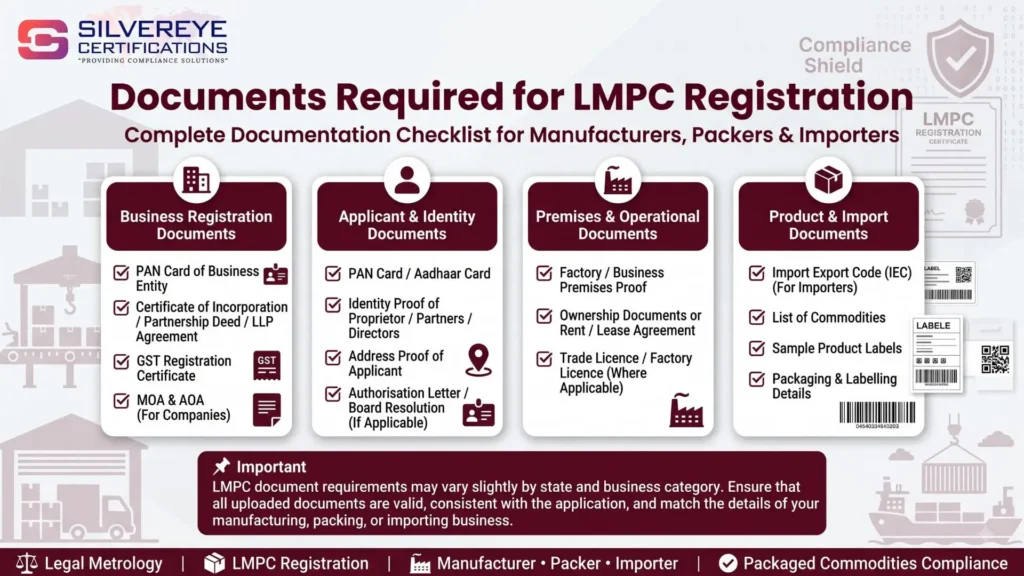
Most portals accept documents only as PDFs, with a common file-size limit of around 2 MB per document — a handful of states allow slightly more. If your scanned file is too large, compress it before upload rather than trying to submit a low-resolution version that officers might reject as unclear.
Document Requirements by Applicant Category
Not every applicant needs the exact same paperwork. Here's how the checklist shifts depending on whether you're registering as an importer, packer, or manufacturer.
| Applicant Type | Additional/Different Requirement |
| Importer | IEC certificate is mandatory; label artwork must show the 'imported by' declaration with full Indian address |
| Packer/Manufacturer | Factory or packing unit registration (e.g., under Shops & Establishments Act or applicable industry licence) is required instead of an IEC; label artwork must show 'packed by' or 'manufactured by' details |
| Dealer/Repairer | Generally a lighter document set — business proof and address proof, without the full label-artwork requirement that applies to importers and packers |
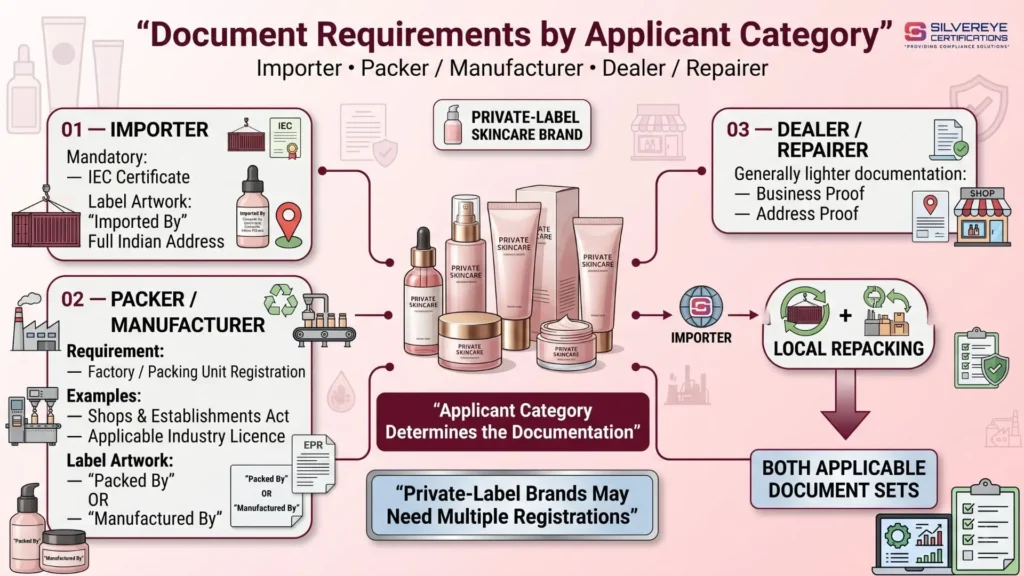
If your business both imports finished cosmetics and repacks certain items locally, you may need to prepare both document sets and register under both applicable categories — this is a common situation for private-label skincare brands.
Getting Your Label Artwork Right (the Part Most Applicants Get Wrong)
Of everything on this checklist, label artwork causes the most back-and-forth with Legal Metrology officers — more than any missing KYC document. That's because it's not just a file to upload; it has to show specific, correctly formatted declarations.
- MRP printed as part of the label design, not as a sticker applied after the goods land in India (stickers are only acceptable in specific, permitted circumstances before customs clearance).
- Net quantity stated in standard units (grams, millilitres, etc.) matching what's actually inside the pack.
- Month and year of manufacture or import, clearly stated — not just a batch code that requires decoding.
- Name and complete address of the importer, marked clearly as 'imported by,' 'packed by,' or 'marketed by' — leaving this label off can default to being read as a manufacturer's declaration, which most importers don't intend.
- Consumer care contact details, where applicable, so buyers have a way to reach the responsible party.
Submitting artwork that's still in draft form — missing the final MRP or with placeholder text — is one of the fastest ways to get your application sent back. Finalise this before you start the portal application, not while it's already under review.
Self-Attestation and Notarization: What's Actually Required
Most state portals accept self-attested copies for the standard document set — meaning you sign and date the copy yourself, confirming it's a true copy of the original. Some states, however, ask for notarised copies for certain documents, particularly the authorisation letter when a consultant is filing on your behalf.
- Self-attest every document by signing and dating a physical or digital copy before scanning it for upload.
- Keep a few notarised copies of your core documents (incorporation certificate, authorisation letter) ready in advance, since a handful of states specifically ask for these.
- Match your signature format across documents — a portal-uploaded signature that looks noticeably different from your ID proof signature can trigger a manual query.
Document Checklist for Renewal Applications
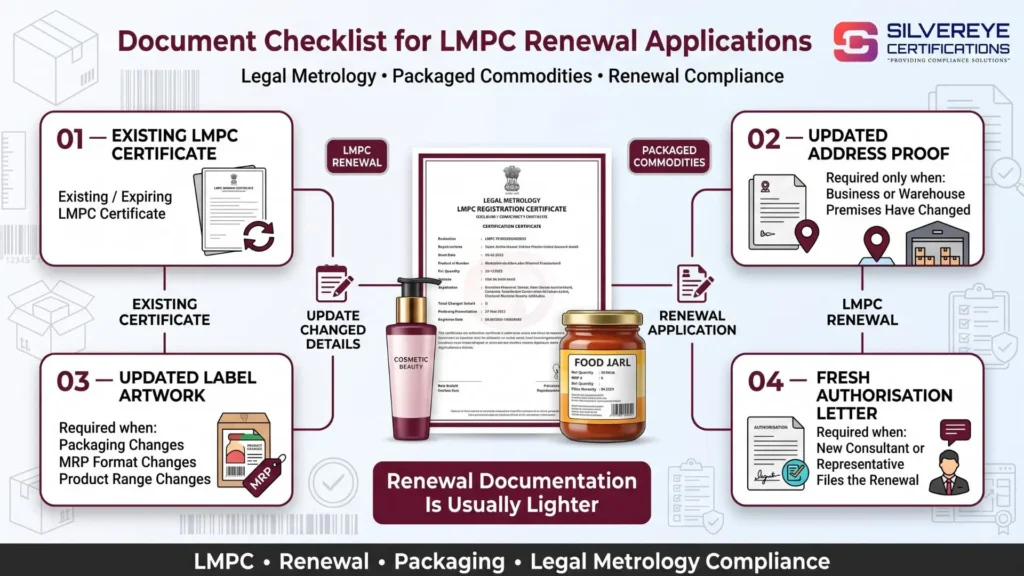
Renewal generally needs a lighter document set than the original registration, since your core business identity is already on file. Even so, a few updates are commonly asked for.
- Copy of the existing/expiring LMPC certificate.
- Updated address proof, only if your business or warehouse premises have changed.
- Updated label artwork, if your packaging, MRP format, or product range has changed since the original registration.
- Fresh authorization letter, if a new consultant or representative is filing the renewal on your behalf.
Common Document Mistakes That Delay LMPC Registration
- Uploading a document under 2 MB but at low resolution — officers reject unclear scans just as often as oversized files.
- Business name spelled or formatted differently across PAN, GST, and IEC documents — even small inconsistencies (an extra 'Pvt Ltd,' a missing hyphen) can trigger review delays.
- Submitting label artwork as a rough draft instead of the near-final version meant for actual printing.
- Forgetting to include address proof for a secondary warehouse or distribution point, which then surfaces as a query later.
- Using an authorization letter that doesn't clearly name the specific application or applicant it covers.
- Leaving the signature or photograph file in the wrong format (uploading a PDF where JPEG/PNG is required, or vice versa).
Benefits of Getting the Documentation Right the First Time
- Avoids the 5–10 working day delay that comes with responding to a department query on a returned application.
- Keeps your customs clearance timeline predictable, since a clean LMPC certificate supports Bill of Entry filing without last-minute scrambling.
- Builds a clean compliance file you can reuse for renewal, marketplace verification, or future product category additions.
- Reduces the chance of label-related penalties later, since getting the declarations right at registration stage usually means your printed packaging stays compliant too.
How Silvereye Certifications Can Help
Pulling together the right documents sounds simple until you're staring at a state portal upload screen wondering whether your label artwork is 'final enough' or whether your GST and IEC business names need to match exactly. Silvereye Certifications, a Noida-based regulatory compliance consultancy, reviews the full document set — from KYC papers to label declarations — before it goes anywhere near the portal, for LMPC registration as well as related approvals like CDSCO cosmetic registration, BIS certification, and EPR authorization.
That upfront review is usually what separates a one-pass application from one that bounces back twice. If you're not sure whether your current label artwork or document set is ready for submission, having it checked before you file is the cheaper option every time.
Conclusion
The documents required for LMPC registration aren't unusual or hard to obtain — most businesses already have their PAN, GST, IEC, and incorporation papers on hand. What trips people up is the fine print: matching business names exactly across documents, finalizing label artwork before submission, and knowing whether your applicant category needs an extra document or two. Get that right, and the paperwork stage of LMPC registration becomes the easiest part of the whole process, not the slowest.
If you're preparing your first LMPC application, or adding new product categories to an existing registration, it's worth running your document set past someone who reviews these applications regularly before you upload anything. Silvereye Certifications can check your documents and label artwork against current requirements so your application goes in clean the first time, without the back-and-forth that eats up weeks.
Frequently Asked Questions
What is the basic document checklist for LMPC registration?
PAN card, GST registration certificate, IEC certificate (for importers), Certificate of Incorporation or partnership deed, address proof of business premises, sample label artwork, a photograph of the authorised signatory, and an authorisation letter if filed through a consultant.
Do documents need to be notarised for LMPC registration?
Most documents only need to be self-attested. A few states ask for notarized copies of specific documents, such as the authorization letter, so it's wise to keep notarized sets ready as a backup.
What file format is accepted for LMPC document uploads?
Most portals accept documents as PDFs, commonly with a file-size limit around 2 MB. Photographs and signatures are usually uploaded separately in JPEG or PNG format.
What documents does an importer need that a manufacturer doesn't?
Importers must submit a valid Import Export Code (IEC) certificate, which manufacturers or packers typically don't need. Manufacturers instead submit factory or packing unit registration proof.
What should the label artwork document show?
It should show the final or near-final MRP, net quantity, month and year of manufacture or import, and the importer's or packer's name and address, exactly as it will appear on the retail pack.
Can I submit draft label artwork if the final design isn't ready?
It's not advisable. Draft artwork missing the final MRP or declaration format is one of the most common reasons applications are returned for correction.
Do I need separate address proof for each warehouse?
Yes. Every premises used for storage, packing, or distribution of the imported goods should be declared with its own address proof.
What happens if my business name doesn't match exactly across documents?
Even small mismatches — like an abbreviated company name — can trigger a manual review or query from the Legal Metrology officer, adding days to your timeline.
What documents are needed to renew an LMPC certificate?
Generally, a copy of your existing certificate, plus updated address proof or label artwork only if these have changed since your original registration.
Is an authorization letter mandatory if I'm filing the application myself?
No. An authorisation letter is only required when a consultant, agent, or representative is filing the LMPC application on the applicant's behalf.
Can I use the same document set for multiple product categories?
Your KYC and business documents typically remain the same, but you will need separate label artwork for each distinct product category or pack size you're registering.
What's the most common document-related reason LMPC applications get delayed?
Non-compliant or draft-stage label artwork is by far the most common cause, followed by business name mismatches across PAN, GST, and IEC documents.