
- The Cotton Bales Quality Control Order 2023 has been officially rescinded with immediate effect from 9 June 2026 via Gazette Notification S.O. 2956(E).
- BIS mandatory certification for cotton bales under IS standards is no longer legally required following this withdrawal by the Ministry of Textiles.
- Actions completed before the rescission date remain valid — manufacturers who obtained BIS certification are not penalised for past compliance.
- This is a significant regulatory relief for cotton ginners, balers, and traders across India's textile supply chain
| The Cotton Bales Quality Control Order (QCO) 2023 — originally notified on 28 February 2023 — has been rescinded by the Ministry of Textiles via S.O. 2956(E) dated 9 June 2026, published in the Gazette of India Extraordinary. This means the mandatory Bureau of Indian Standards (BIS) certification requirement for cotton bales is withdrawn with immediate effect. Cotton bale manufacturers, ginners, and exporters in India are no longer legally obligated to hold a BIS license under this QCO. Past actions taken in compliance with the original order remain unaffected. |
What Exactly Happened? The Official Cotton Bales Quality Control Order 2023 Rescinded Explained
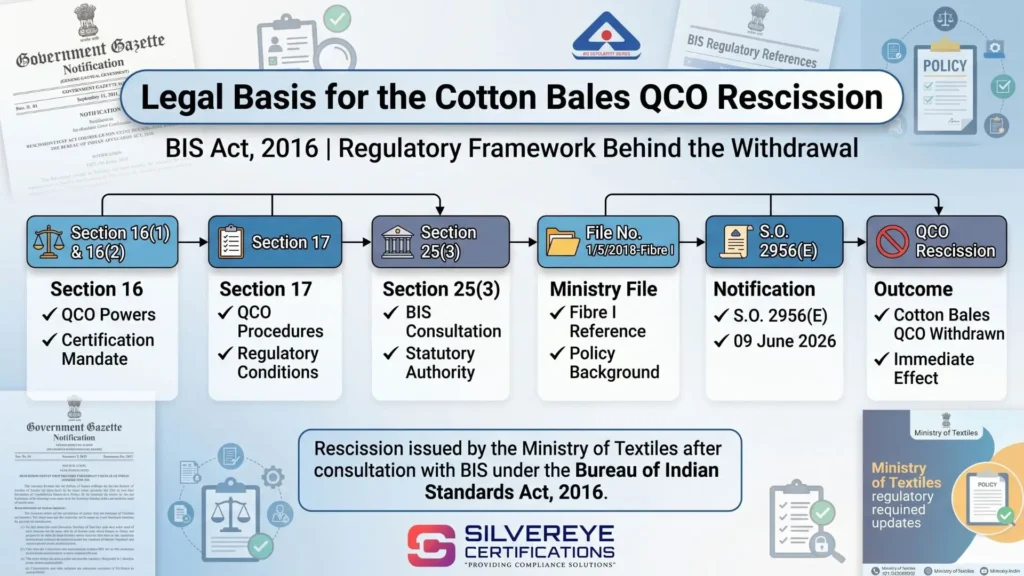
On 9 June 2026, the Ministry of Textiles issued S.O. 2956(E) under Section 16(1) and 16(2) read with Section 17 and Section 25(3) of the Bureau of Indian Standards Act, 2016 (11 of 2016). The Government exercised its powers — after consulting the Bureau of Indian Standards — and rescinded the Cotton Bales Quality Control Order 2023 in the public interest, with immediate effect.

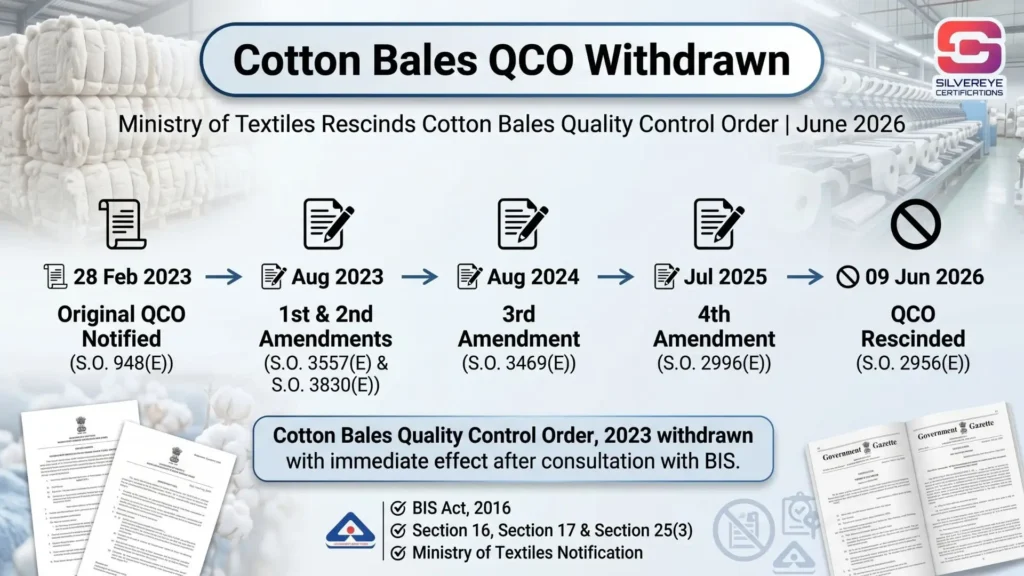
The original QCO (S.O. 948(E) dated 28 February 2023) had made BIS certification mandatory for cotton bales. It was subsequently amended four times before being fully withdrawn. Here is the complete legislative timeline:
| Notification No. | Date | Purpose |
| S.O. 948(E) | 28 February 2023 | Original Cotton Bales QCO notified |
| S.O. 3557(E) | 7 August 2023 | First amendment |
| S.O. 3830(E) | 28 August 2023 | Second amendment |
| S.O. 3469(E) | 13 August 2024 | Third amendment |
| S.O. 2996(E) | 3 July 2025 | Fourth amendment |
| S.O. 2956(E) | 9 June 2026 | Rescission — Order withdrawn with immediate effect |
What Did the Cotton Bales QCO 2023 Originally Cover?
To understand why this rescission matters, it helps to know what the original Cotton Bales Quality Control Order 2023 required. Under the QCO, cotton bale manufacturers were mandated to obtain BIS certification confirming their bales met the relevant Indian Standard. This applied across the cotton supply chain from ginners at the farm gate to the baling operations supplying mills.
Key requirements under the now-rescinded order included:
- Mandatory BIS licence for cotton bale manufacturers before sale or distribution
- Product conformity to the notified Indian Standard for cotton bales
- Standard Mark (ISI Mark) on each bale as proof of BIS certification
- Factory audits and third-party testing by BIS-authorised laboratories
- Periodic surveillance inspections by Bureau of Indian Standards officials
What Does the Rescission Mean for Cotton Bale Manufacturers?
This is the question most manufacturers, ginners, and traders are asking right now. Here is a plain-language breakdown of the practical impact:
| Area | Impact After Rescission (Effective 9 June 2026) |
| BIS Licence Requirement | No longer mandatory. Manufacturers are not required to hold or renew a BIS licence for cotton bales. |
| ISI Mark on Bales | Not required. Absence of ISI Mark on cotton bales is no longer a legal non-compliance issue. |
| Factory Audits by BIS | BIS surveillance audits under this QCO will cease. Existing schedules under this order are void. |
| Ongoing Applications | Pending BIS licence applications under the Cotton Bales QCO can be withdrawn or allowed to lapse. |
| Past BIS Certificates | Remain valid as historical compliance records. No penalty for having certified — or not certified — before rescission. |
| Sales & Distribution | Cotton bales can now be sold and distributed without BIS certification requirements under this particular QCO. |
| Export | Check with DGFT and importing country requirements — rescission of a domestic QCO does not automatically remove export quality conditions. |
| Industry Standards | Voluntary adoption of IS standards for cotton bales remains an option and may still be commercially advantageous. |
What Remains Intact — Critical Savings Clause
| IMPORTANT: The rescission is not retroactive in terms of liability. The official notification explicitly states that the withdrawal applies 'except as respects things done or omitted to be done before such rescission.' This is standard savings clause language in Indian administrative law. |
| What this means practically: If a manufacturer was found non-compliant or penalised under the Cotton Bales QCO before 9 June 2026, those proceedings can still continue. The rescission does not wipe out past enforcement actions or pending legal proceedings arising from the original order. |
Who Is Affected by This Regulatory Change?
This rescission affects a wide range of stakeholders in India's cotton and textile industry. Here is who needs to take note:
| Stakeholder | Relevance |
| Cotton Ginners & Balers | Primary manufacturers — no longer need BIS licence for cotton bales |
| Cotton Traders & Wholesalers | Can procure and sell bales without BIS certification requirement |
| Textile Mills (Yarn & Fabric) | Cotton bale inputs no longer need to carry BIS marks |
| Exporters of Raw Cotton | Domestic QCO obligation removed — verify importing country norms |
| Importers of Cotton Bales | QCO no longer applies to imports under this order |
| BIS Licence Holders (Cotton Bales) | Existing licences can be allowed to expire — renewal not required |
| Testing & Certification Labs | Demand for cotton bale BIS testing will decline post-rescission |
| Compliance Consultants | Must update client guidance to reflect 2026 regulatory position |
Why Was the Cotton Bales QCO 2023 Rescinded?
The Government cited public interest as the basis for rescission — the standard legal formulation used under Section 16 of the BIS Act, 2016. While the Gazette Notification does not elaborate on specific reasons, industry context provides useful insight:
- Implementation challenges at the ground level in India's fragmented cotton ginning sector, which includes over 500 cotton ginning mills across Maharashtra, Gujarat, Telangana, and Rajasthan
- Compliance burden on small-scale ginners who faced difficulty meeting BIS certification prerequisites
- Multiple amendments to the original 2023 order (four amendments in roughly two years) suggested ongoing difficulties in operationalizing the mandate
- Potential disruption to the cotton supply chain during a period of global textile market volatility
- Policy recalibration — the Ministry of Textiles may be evaluating an alternative standards framework before re-introducing quality benchmarks
It is worth noting that the rescission was issued with BIS consultation, underscoring that this was a considered, coordinated decision rather than an abrupt withdrawal.
Legal Basis for the Rescission
The rescission order draws authority from multiple provisions of the Bureau of Indian Standards Act, 2016:
| Legal Provision | Relevance in Rescission |
| Section 16(1) & 16(2), BIS Act 2016 | Empowers Central Government to mandate BIS certification (or rescind such mandates) via QCOs |
| Section 17, BIS Act 2016 | Provides for conditions and procedures related to quality control orders |
| Section 25(3), BIS Act 2016 | Relates to powers of the Bureau consulted in this process |
| File No. 1/5/2018-Fibre I | Internal Ministry of Textiles file reference tracing back to the original 2018 initiation of the cotton bales QCO process |
| S.O. 2956(E), 9 June 2026 | The operative rescission notification published in Gazette of India Extraordinary Part II, Section 3, Sub-section (ii) |
Action Checklist for Manufacturers and Traders
| IMMEDIATE ACTIONS — JUNE 2026 |
For Manufacturers Currently Holding BIS Licences (Cotton Bales):
- Note that your BIS license for cotton bales is now redundant for domestic legal compliance purposes
- Do not incur costs for renewal unless you have commercial reasons (buyer specifications, export requirements) to maintain voluntary certification
- Archive your past BIS certification documents — they serve as evidence of historical compliance
- Review existing purchase orders and supply contracts — check if buyers have BIS certification as a contractual specification
For Manufacturers Who Were Not BIS Certified:
- No retrospective penalty applies for the absence of BIS certification under this QCO as of 9 June 2026
- Confirm with your legal team that no pending enforcement action existed prior to the rescission date
- Ensure your standard quality practices for cotton bales remain robust — voluntary standards are still commercially relevant
For All Industry Participants:
- Update your internal compliance policies and QCO registers to reflect the 9 June 2026 rescission
- If operating in the export market, verify whether any destination country requires BIS or equivalent certification — the domestic QCO withdrawal does not affect foreign import requirements
- Watch for any fresh QCO notification that the Ministry of Textiles may issue for cotton bales in the future
Before vs After: Cotton Bales Regulatory Position
| Before 9 June 2026 (QCO in Force) | After 9 June 2026 (QCO Rescinded) |
| BIS licence mandatory for cotton bale manufacturers | No BIS licence required |
| ISI Mark required on cotton bales for sale | ISI Mark not legally required |
| BIS factory audits and inspections applicable | BIS audits under this QCO no longer applicable |
| Non-compliance could attract legal penalties | No new penalties under this QCO from 9 June 2026 |
| Standard Mark (ISI) on bales was a supply chain gate | Cotton bales can move in trade without ISI Mark |
| Ginners needed to budget for BIS certification costs | Certification cost savings realised |
Broader QCO Landscape: What This Tells Us About India's Quality Policy
The rescission of the Cotton Bales QCO 2023 is not an isolated event. It reflects an evolving pattern in India's Quality Control Order implementation strategy. The government has been issuing QCOs across numerous sectors under both DPIIT and Ministry of Textiles, but has also periodically deferred, amended, or rescinded orders where implementation complexity or supply chain disruption has been flagged.
Other active QCOs in the textiles and agriculture sector — including orders for jute, woollen blankets, and certain man-made fibres — remain in force. Manufacturers in these sub-sectors should not assume that this cotton bales rescission signals a broader withdrawal from QCO-based regulation.
| KEY TAKEAWAY FOR COMPLIANCE TEAMS: Treat each QCO independently. Monitor the Gazette of India for notifications specific to your product category. The cotton bales rescission does not affect other textile or fibre QCOs. |
What to Monitor Going Forward
Even though the Cotton Bales QCO 2023 has been rescinded, manufacturers and traders should stay alert to the following:
- New QCO Notification: The Ministry of Textiles may re-introduce a revised quality control order for cotton bales with updated IS standards or phased implementation timelines
- BIS Standard Revisions: IS standards for cotton bales may continue to be updated by BIS — staying current with voluntary standards protects commercial quality positioning
- Export Quality Norms: DGFT, EPC (Cotton Textiles Export Promotion Council), and importing country regulations for raw cotton and cotton bales remain applicable
- Cotton Corporation of India (CCI) Procurement Standards: CCI may maintain internal quality benchmarks for cotton bale procurement that operate independently of the BIS QCO framework
- State Government Regulations: Some state-level textile/ginning regulations may reference QCO requirements — check state-specific compliance with your legal team
Conclusion: What This Means for Your Business
The rescission of the Cotton Bales Quality Control Order 2023, effective 9 June 2026, represents one of the more significant regulatory rollbacks in India's textile compliance landscape in recent years. For manufacturers, ginners, and traders who were navigating the BIS certification requirement for cotton bales, this brings immediate relief — no more mandatory ISI Marks, BIS audits, or certification renewal costs tied to this particular order.
That said, good quality practices do not depend solely on regulatory mandates. Maintaining internal quality standards for cotton bales remains strategically important — for buyer confidence, mill performance requirements, and potential future quality regulations. Use this period to review your quality management processes and stay alert for any revised QCO that the Ministry of Textiles may introduce.
If you need guidance on navigating QCO compliance, BIS certification, or any other Indian regulatory framework across BIS, CDSCO, BEE, PESO, FSSAI, or DPIIT, the team at Silvereye Certifications is here to help.
Frequently Asked Questions
Is it legal to sell cotton bales without BIS certification after 9 June 2026?
Yes. Following the rescission of S.O. 948(E) via S.O. 2956(E) dated 9 June 2026, BIS certification is no longer legally mandatory for cotton bale manufacturers or sellers in India under this QCO.
Do I need to return or cancel my existing BIS license for cotton bales?
No, you are not required to formally cancel your existing BIS license. It simply becomes redundant for mandatory compliance purposes. You may choose to let it lapse at renewal or voluntarily surrender it — but there is no legal obligation to do either
Can I still get BIS certification for cotton bales voluntarily after the rescission?
Voluntary BIS certification (where a manufacturer chooses to get certified even without a mandatory QCO) is generally possible under BIS framework, but commercial interest typically drives this. If buyers or export markets require it, you may wish to maintain it. Consult BIS or a certification consultant for the current voluntary pathway.
Were there any penalties for manufacturers who were not BIS certified before the rescission?
The rescission order includes a savings clause covering 'things done or omitted to be done' before the rescission. This means that if enforcement action was initiated against a manufacturer for non-compliance before 9 June 2026, that action can still proceed. The rescission does not retrospectively grant immunity for prior non-compliance
Does this rescission affect cotton bale exports from India?
The rescission removes the domestic QCO obligation. However, export quality requirements — including those specified by DGFT, export promotion councils, or importing countries — operate under separate regulatory frameworks and are unaffected by this rescission. Exporters must continue to comply with applicable export norms.
Which Ministry issued the rescission order and under what authority?
The rescission was issued by the Ministry of Textiles, Government of India, via S.O. 2956(E) dated 9 June 2026. The legal authority is Section 16(1) and 16(2) read with Section 17 and Section 25(3) of the Bureau of Indian Standards Act, 2016 (11 of 2016), following mandatory consultation with the Bureau of Indian Standards.
Are other textile-related QCOs also being rescinded?
Not as a result of this notification. The 9 June 2026 order is specific to the Cotton Bales QCO 2023 (S.O. 948(E)). Other textile and fibre QCOs remain in force. Monitor the Official Gazette at egazette.gov.in for updates on specific product categories.
What is the Cotton Bales Quality Control Order 2023 notification number?
The original QCO was S.O. 948(E) dated 28 February 2023. The rescission notification is S.O. 2956(E) dated 9 June 2026. Both were published in the Gazette of India Extraordinary, Part II, Section 3, Sub-section (ii).
Should I update my company's compliance documentation to reflect this rescission?
Yes, absolutely. Update your QCO compliance register, internal policies, and any supplier qualification documentation to note that the Cotton Bales QCO 2023 is rescinded with effect from 9 June 2026. This protects your company during audits and third-party compliance reviews.
Who signed the Cotton Bales QCO rescission order?
The rescission order S.O. 2956(E) was signed by Manisha Chatterjee, Joint Secretary, Ministry of Textiles, Government of India. The file reference is F. No. 1/5/2018-Fibre I.