
IS 19442 is BIS's Indian Standard for air extraction Ḥijāma (cupping therapy) devices, covering material, pressure, sterilization, and labelling.
- It applies to both single-use wet cupping cups and multiple-use dry cupping cups sold or manufactured in India.
- Manufacturers get certified through BIS's standard product certification route: application, lab testing, factory audit, and licence.
- Certification helps protect patients from infection and device failure while giving manufacturers a genuine ISI mark to sell and export legally.
Introduction
BIS Certification For Hijama Cupping Devices under IS 19442: 2026 is the Bureau of Indian Standards (BIS) specification for air extraction Ḥijāma (cupping therapy) devices used in Unani medicine. Drafted by the BIS Unani Sectional Committee (AYD 04) under the AYUSH framework, it sets rules for cup material, inner volume, negative pressure levels, sterilization for single-use wet cupping cups, disinfection for multiple-use dry cupping cups, packaging, and labelling.
Manufacturers who want to legally sell, brand, or export cupping devices in India need BIS product certification against this standard, which involves lab testing, a factory inspection, and an annual licence renewal, similar to any other ISI-marked medical device.
What Is IS 19442: 2026? Understanding the Standard Behind Every Certified Cupping Device
If you manufacture, import, or sell Hijama (cupping therapy) cups in India, you have probably come across the term IS 19442: 2026 — the Bureau of Indian Standards specification for "Unani Medicine — Air Extraction Miḥjama (Cupping Therapy) Device." The standard was established by BIS on 2 February 2026.
It was developed for air extraction cupping therapy devices used in Unani medicine and establishes requirements for the device, including materials, performance, testing, packaging, and labelling.

Hijama (cupping therapy) is practiced widely across India and internationally, and it works on the Unani principles of Imāla (diversion) and Tanqiya (cleansing) to keep the Akhlāṭ Arba'a — the four bodily humors of Unani medicine — in balance. The therapy has two main forms:
- Ḥijāma bilā Sharṭ (dry cupping) — suction cups applied to intact skin with no incision, used for multiple sessions on the same device.
- Ḥijāma bi'l Sharṭ (wet cupping) — suction combined with a small skin incision to draw out a controlled amount of blood, which is why these cups must be single-use.
Because wet cupping cups come into direct contact with blood and broken skin, and dry cupping cups touch skin repeatedly across many patients, an uncertified or poorly made cup can create infection and safety risks. IS 19442: 2026 provides a standardized framework for the design, performance, testing, and related requirements of air extraction cupping therapy devices.
Why This Standard Matters Now
Three things are putting IS 19442: 2026 into the spotlight for manufacturers:
- Growing demand — Hijama therapy is used across wellness clinics, Unani hospitals, and other healthcare settings.
- A standardized benchmark — IS 19442: 2026 establishes an Indian Standard specifically for air extraction Miḥjama (cupping therapy) devices.
- Safety and performance requirements — The standard provides requirements for devices that function through negative pressure, helping establish consistent testing and performance expectations.
In short: IS 19442: 2026 provides a standardized framework for air extraction cupping therapy devices, giving manufacturers a defined Indian Standard against which relevant products can be assessed.
What Is BIS Certification for Hijama Cupping Devices?
BIS certification for Hijama cupping devices is the formal conformity assessment carried out by the Bureau of Indian Standards (BIS) to confirm that an applicable cupping device — including its material, pressure performance, packaging, labelling, and other applicable requirements — meets the requirements laid down in IS 19442: 2026.
In simple terms, it is the process a manufacturer follows to obtain the applicable BIS Standard Mark (ISI Mark) for a cupping device covered by the standard.
BIS is India's national standards body, established under the Bureau of Indian Standards Act, 2016, to develop Indian Standards and operate product certification, hallmarking, and conformity assessment schemes across industries.
Certification under the applicable BIS product certification scheme involves review of the applicant's documents, applicable product testing, assessment of the manufacturing facility, and other requirements before BIS grants the licence.
For a Hijama cupping device, BIS certification means the manufacturer has demonstrated, through applicable assessment and test evidence, that:
- Negative-pressure performance: The device meets the applicable performance requirements specified in IS 19442: 2026.
- Material and safety requirements: The device meets the applicable material and safety requirements specified by the standard.
- Single-use and reusable devices: The applicable requirements for single-use and reusable devices, including relevant cleaning, disinfection, or sterilization requirements, are addressed.
- Packaging and labelling: Packaging and labelling comply with the applicable requirements of IS 19442: 2026.
In practice, BIS certification provides manufacturers with a traceable certification framework, defined product requirements, and documented conformity assessment for applicable air extraction Ḥijāma (cupping therapy) devices covered by IS 19442: 2026.
Scope of IS 19442: 2026: What the Standard Covers
IS 19442: 2026 applies to air extraction cupping therapy devices that function through negative pressure. The standard focuses on requirements and methods for the sampling and testing of these devices.
The standard addresses areas including:
- Device materials and construction
- Negative-pressure performance
- Testing and sampling requirements
- Packaging
- Labelling and related product information
The exact scope and technical requirements should be checked against the latest BIS edition of IS 19442: 2026 before using the standard for certification or product-compliance decisions.
Cup Sizes and Technical Parameters Under IS 19442: 2026
The standard provides technical requirements for air extraction Miḥjama devices, including requirements related to their design and performance. The specific dimensions, volumes, pressure requirements, and test methods should be verified against the current standard before publishing numerical specifications.
| Parameter | Requirement / Purpose |
|---|---|
| Cup construction | Requirements related to the device's construction and materials |
| Negative pressure | Requirements for devices functioning through negative pressure |
| Performance testing | Testing to verify specified device performance |
| Sampling | Defined sampling and testing approach |
| Packaging & labelling | Requirements for product information and identification |
Biocompatibility and Sterilization Requirements
For products intended for contact with the body, manufacturers should carefully review the applicable biological evaluation, sterilization, cleaning, and disinfection requirements specified or referenced by IS 19442: 2026.
The exact tests and requirements can vary according to the device configuration, intended use, and whether the product is single-use or reusable. Therefore, manufacturers should not assume that the same testing package applies to every cupping device.
Before finalizing a compliance plan, manufacturers should verify the applicable requirements directly from the current IS 19442: 2026 standard and the relevant BIS certification requirements.
Packaging and Labelling: What BIS Checks on Every Pack
A cupping device is not compliant just because the cup itself passes laboratory tests — its packaging and labelling are also important parts of compliance. Primary packaging should protect the device during storage and transport and, where applicable, maintain sterility. Secondary (bulk) packaging should be suitable for handling and transportation.
Labels on primary and secondary packaging should include applicable product information, such as:
- Manufacturer/supplier name, trademark, and address
- Product name, size (cup number), and specification
- Date of manufacture and lot/batch number
- Applicable BIS certification details
- For single-use devices: applicable expiry information, sterilization details, and a clear “single use only / do not reuse” marking
- For multiple-use devices: applicable cleaning/disinfection instructions and reuse limitations
Compliance may involve checking the correctness, permanence, and legibility of the information provided on the product and packaging.
Who Needs BIS Certification Under IS 19442: 2026
BIS certification against IS 19442: 2026 is relevant to manufacturers seeking to manufacture or market air extraction Ḥijāma (cupping therapy) devices under the applicable BIS certification framework. In practical terms, this can include:
- Domestic manufacturers of glass, plastic, silicone, or other permitted cupping-device materials
- Foreign manufacturers supplying applicable cupping devices to India through the Foreign Manufacturers Certification Scheme (FMCS) route, where applicable
- Private-label manufacturers or brand owners whose products are manufactured by another facility
- Medical-device distributors and institutional buyers sourcing certified cupping devices for clinical use
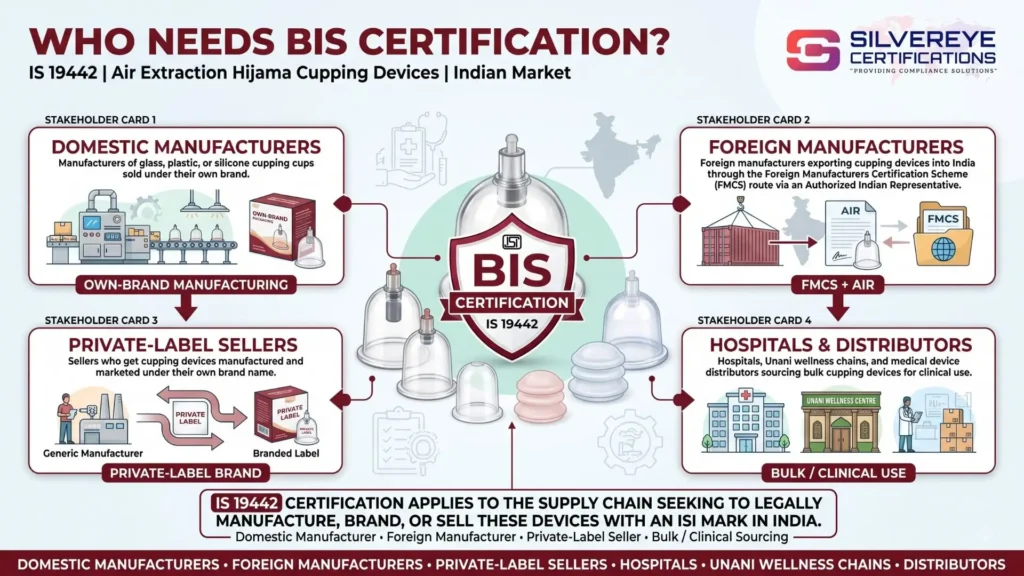
Eligibility check: Before applying, the manufacturer should confirm that the product falls within the scope of IS 19442: 2026 and meet the applicable BIS requirements for manufacturing, testing, quality control, documentation, and certification.
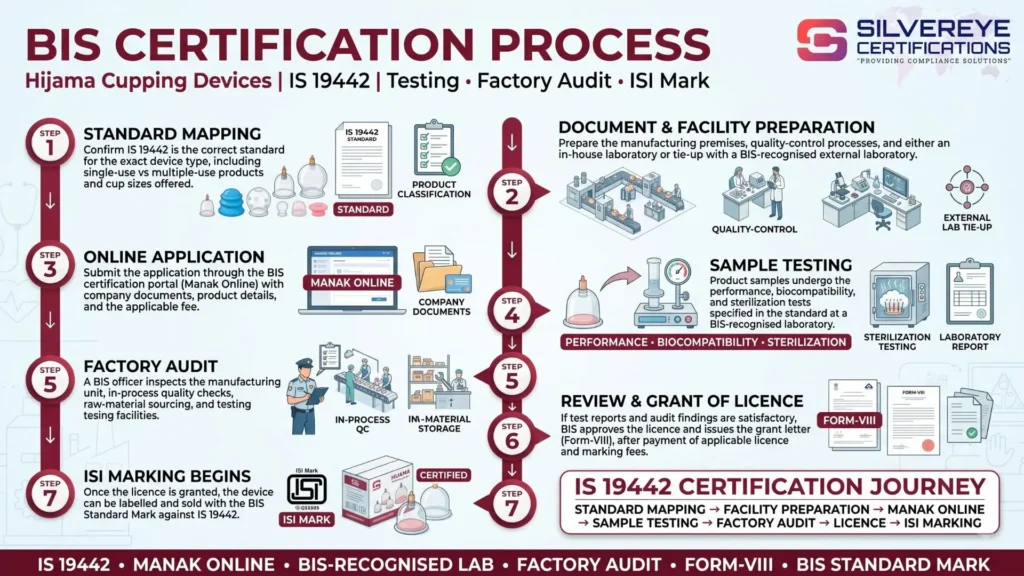
Step-by-Step BIS Certification Process for Hijama Cupping Devices
The certification pathway for applicable cupping devices follows the relevant BIS product-certification process, based on the requirements of IS 19442: 2026:
- Step 1 — Standard mapping: Confirm that IS 19442: 2026 applies to your exact device and intended use.
- Step 2 — Document and facility preparation: Prepare the manufacturing facility, quality-control procedures, product specifications, and required testing arrangements.
- Step 3 — Online application: Submit the application through the applicable BIS certification portal with the required company and product information.
- Step 4 — Sample testing: Product samples undergo the applicable tests specified under the standard at a BIS-recognised laboratory, where required.
- Step 5 — Factory assessment: BIS assesses the manufacturing facility, production process, quality-control arrangements, raw materials, and testing facilities as applicable.
- Step 6 — Review and grant of licence: BIS reviews the application, test results, and assessment findings before deciding on the grant of the licence.
- Step 7 — BIS Standard Mark: After the licence is granted and applicable marking requirements are fulfilled, the manufacturer can use the BIS Standard Mark in accordance with the licence conditions.
Documents Required for Hijama Cupping Devices
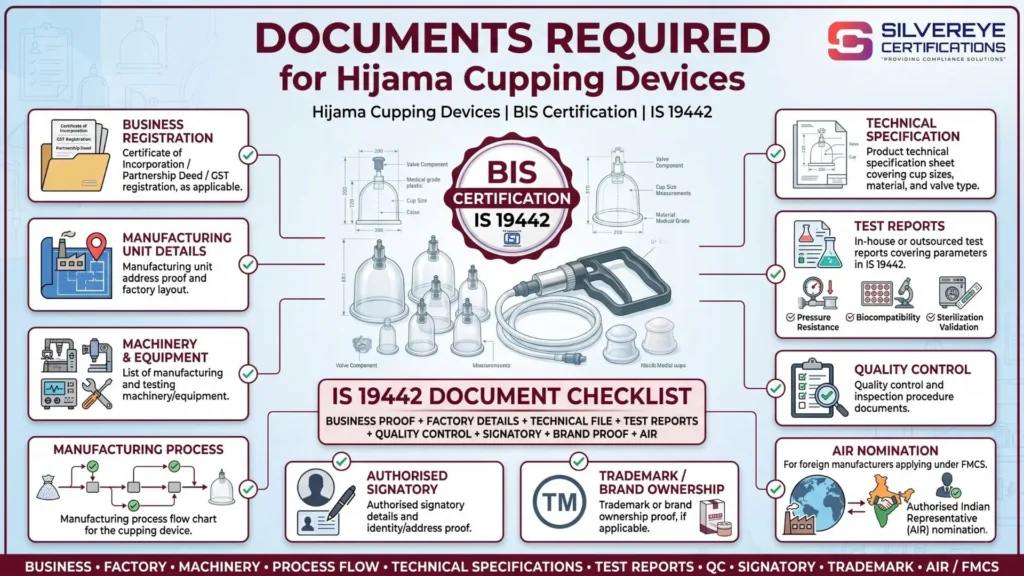
Commonly required documents may include:
- Business registration proof — Certificate of Incorporation, Partnership Deed, GST registration, etc., as applicable
- Manufacturing-unit address proof and factory layout
- List of manufacturing and testing equipment
- Manufacturing process flow chart
- Product technical specification sheet
- Material and component details
- Applicable test reports covering the requirements of IS 19442: 2026
- Quality-control and inspection procedures
- Authorized signatory details
- Trademark or brand ownership documents, where applicable
- Authorized Indian Representative (AIR) details for foreign manufacturers, where applicable
BIS Certification Fees for Cupping Devices
The applicable BIS fees depend on the certification route, product scope, testing requirements, inspection, and other applicable charges. Manufacturers should verify the current BIS fee structure before preparing a budget.
| Fee Component | What It Covers |
|---|---|
| Application fee | Fee applicable to submission of the BIS application |
| Processing / grant fee | Applicable processing or licence-related charges |
| Factory assessment | Inspection and associated charges, as applicable |
| Product testing | Laboratory testing charges based on applicable tests |
| Licence / marking fees | Applicable recurring fees under the certification scheme |
Exact fees can change based on BIS notifications and the certification requirements applicable to the product. Always verify the current BIS fee structure before quoting a final certification cost.
Certification Timeline: How Long Does It Take?
The timeline depends on the completeness of the application, testing requirements, laboratory availability, factory assessment, and BIS processing.
| Stage | Typical Considerations |
|---|---|
| Application and document review | Depends on completeness of submitted documents |
| Sample testing | Depends on applicable tests and laboratory schedule |
| Factory assessment | Depends on BIS scheduling and facility readiness |
| Final review and licence | Depends on test reports and assessment findings |
For planning purposes, manufacturers should allow several weeks to a few months for the complete process. The actual timeline can vary significantly where additional testing, corrections, or documentation are required.
Validity and Renewal of the BIS License
The validity and renewal requirements of a BIS licence depend on the applicable BIS certification scheme and the conditions stated in the licence. Manufacturers should monitor the licence validity and comply with applicable renewal requirements to continue using the BIS Standard Mark.
Renewal or continuation may involve:
- Submitting the required renewal application within the prescribed timeline
- Maintaining required quality-control and testing records
- Paying applicable licence, marking, and other fees
- Addressing any changes to the product, materials, manufacturing process, or facility
- Complying with applicable surveillance or factory assessment requirements
Manufacturers should check the specific licence conditions and current BIS requirements rather than relying on a fixed renewal period or a standard 90-day rule.
Benefits of BIS Certification for Cupping Device Manufacturers
- Legal market access — BIS certification against IS 19442: 2026 provides manufacturers with a recognised compliance route for applicable cupping devices in India.
- Patient and practitioner safety — Compliance with applicable performance, material, and safety requirements helps support consistent product quality.
- Stronger brand trust — BIS certification can help manufacturers demonstrate compliance to hospitals, Unani healthcare providers, distributors, and institutional buyers.
- Medical tourism readiness — As Indian wellness and Unani centres serve international patients, compliant devices can support professional procurement and quality-control practices.
- Competitive differentiation — Certification provides manufacturers with a documented quality and compliance benchmark in the cupping-device market.
- Easier institutional procurement — Where tenders or procurement policies specify BIS certification, having the required certification can help manufacturers meet those requirements.
Common Challenges Manufacturers Face
- Understanding product classification and applicability, particularly where different device configurations or intended uses may have different compliance requirements.
- Finding a suitable BIS-recognised laboratory with the capability to perform the applicable tests under IS 19442: 2026.
- Testing and validation requirements can take time, particularly when additional product or process testing is required.
- Labelling and packaging compliance — Missing product information, incorrect markings, or incomplete instructions can result in additional corrections.
- Factory-readiness requirements — Manufacturers need appropriate quality-control procedures, production records, testing arrangements, and documentation before the BIS assessment.
Why Manufacturers Choose Silvereye Certifications for IS 19442: 2026 Compliance
Because IS 19442: 2026 is a relatively new Indian Standard for air extraction Ḥijāma devices, manufacturers may need support in understanding the applicable certification process, testing requirements, documentation, and factory-readiness requirements.
Silvereye Certifications provides regulatory consulting support across BIS (ISI and CRS), CDSCO, and other Indian compliance requirements, helping manufacturers coordinate the certification process from initial assessment through application and follow-up.
For manufacturers approaching IS 19442: 2026 for the first time, this can include:
- Product and standard applicability review — Assessing the product against the scope and requirements of IS 19442: 2026 before the application process begins.
- Laboratory coordination — Supporting coordination with appropriate BIS-recognised laboratories for the applicable product testing.
- Documentation support — Helping prepare the required technical documents, product specifications, manufacturing details, and quality-control records.
- Factory-readiness support — Helping manufacturers prepare for the applicable BIS factory assessment and identify documentation or process gaps.
- Application support — Assisting with the BIS application process, documentation submission, fee coordination, and follow-up.
- Post-certification support — Supporting manufacturers with applicable renewal, surveillance, documentation, and ongoing compliance requirements.
If you are preparing to manufacture, import, or market air extraction Ḥijāma (cupping therapy) devices in India, understanding the requirements of IS 19442: 2026 before starting testing can help you plan the certification process more effectively. Silvereye Certifications can support manufacturers with the BIS certification process, laboratory coordination, documentation, and compliance preparation.
Frequently Asked Questions
What is IS 19442: 2026?
IS 19442:2026 is the Bureau of Indian Standards specification for air extraction Hijama (cupping therapy) devices, covering the cup's material, pressure performance, sterilization, packaging, and labelling.
Is BIS certification mandatory for cupping devices?
BIS certification becomes mandatory once a product falls under a Quality Control Order (QCO) notified for that category. Manufacturers should check the current QCO status for cupping devices with BIS directly or through a certification consultant, since notification status and enforcement dates can change.
Does IS 19442 apply to both wet and dry cupping devices?
Yes. The standard covers single-use devices used for wet cupping (Ḥijāma bi'l Sharṭ) and multiple-use devices used for dry cupping (Ḥijāma bilā Sharṭ), with different biocompatibility and sterilization requirements for each.
What cup sizes does the standard recognise?
Five standard sizes based on inner volume: Cup 1 (70±7 ml), Cup 2 (55±5.5 ml), Cup 3 (40±4.0 ml), Cup 4 (25±2.5 ml), and Cup 5 (15±1.5 ml).
What tests does a cupping device have to pass?
Resisting negative pressure, pressure maintenance over 10 minutes, mechanical stability under impact, transparency for skin observation, and repeated disinfection resistance for multiple-use devices, alongside biocompatibility testing per the IS/ISO 10993 series.
How long does BIS certification for a cupping device take?
Most first-time applicants can expect roughly 2 to 4 months from a complete application to license grant, depending on lab turnaround for biocompatibility and sterilization validation.
What documents are needed to apply?
Business registration proof, manufacturing facility details, a process flow chart, product specifications, test reports, quality control documentation, and authorized signatory details, plus an AIR nomination for foreign manufacturers.
How much does BIS certification cost?
Costs include an application fee, processing/grant fee, factory inspection charges, product testing fees, and an annual license plus marking fee. Exact amounts depend on the current BIS fee notification and your production volume, so confirm current figures before budgeting.
How long is a BIS license valid, and how is it renewed?
Validity is set out in the grant letter, commonly one to two years. Renewal should be initiated well before expiry, typically with updated test reports if anything about the product has changed, along with clearance of applicable fees.
Can foreign manufacturers get certified under IS 19442?
Yes, through BIS's Foreign Manufacturers Certification Scheme (FMCS), which requires appointing an Authorized Indian Representative (AIR) to manage the application and compliance on the manufacturer's behalf.
What happens if a manufacturer sells cupping devices without BIS certification once it becomes mandatory?
Selling a device without the required ISI mark after mandatory notification can attract penalties under the BIS Act and rules, along with the commercial risk of losing institutional buyers who require certified devices.
Who can help with the BIS certification process for cupping devices?
A BIS certification consultancy experienced in medical-adjacent product categories — such as Silvereye Certifications — can guide classification, lab coordination, documentation, and factory-readiness, reducing back-and-forth delays for first-time applicants.