

- If you pre-pack a commodity for sale — whether you made it or not — you're a “packer” under Rule 2(g) of the Legal Metrology (Packaged Commodities) Rules, 2011, and you need LMPC registration.
- Private-label brands, D2C sellers, and contract/co-packers are the businesses that most often miss this requirement, assuming outsourced manufacturing means someone else handles compliance.
- Registration costs a base ₹500 government fee under Rule 27, plus state-specific charges that typically add ₹500–₹5,000 depending on your state and product category.
- Missing the “packed by” wording on your label — not just missing registration — is what most often turns a packer into a legally “deemed manufacturer.”
Introduction
LMPC registration for packers is the mandatory approval under Rule 27 of the Legal Metrology (Packaged Commodities) Rules, 2011 for anyone who pre-packs a commodity into retail or wholesale units for sale in India — regardless of who manufactured it. Rule 2(g) defines a packer simply as a person, firm, or HUF that pre-packs a commodity in a bottle, tin, wrapper, or similar unit for sale.
This covers private-label brands, D2C companies, and contract or co-packers. Packers must apply within 90 days of starting to pre-pack goods, submit documents like PAN, GST, premises proof, and a packing agreement (for contract packers), and pay a base fee of ₹500 plus state charges. The label must clearly mark the packer's name as “packed by” — leaving that qualifier off can make the packer legally liable as the deemed manufacturer instead

Of the three LMPC categories, “packer” is the one private-label brands and D2C founders most often overlook — usually because they've outsourced manufacturing and assume the factory's compliance covers them too. It doesn't. If your business handles the final packing, sealing, or labeling of a product before it reaches a customer, you are the packer of record under Indian law, whether or not you own a single piece of manufacturing equipment.
Who Counts as a “Packer” Under Legal Metrology Rules?
Rule 2(g) of the Legal Metrology (Packaged Commodities) Rules, 2011 defines a packer as a person, firm, or Hindu undivided family that pre-packs any commodity — in a bottle, tin, wrapper, or otherwise — in units suitable for sale, whether wholesale or retail. Read that definition again: it says nothing about manufacturing. The act of pre-packing is what creates the packer's registration obligation, not the act of production.
This is exactly why the packer category matters so much for modern business models. If your company designs a brand, sources a finished or semi-finished product from a factory, and then handles the final sealing, labeling, and shipping yourself, you are the packer — full stop. If a third-party contractor does that packing for you, they're the packer, and you may need to be declared alongside them depending on how the arrangement is structured.
- Private-label and D2C brands that outsource production but manage final packing and labeling themselves
- Contract packers and co-packers who pre-pack products on behalf of one or multiple brands
- Businesses that buy commodities in bulk and repack them into smaller retail units
- Subscription-box and bundling businesses that assemble and seal multiple items into a single retail-ready package
- E-commerce sellers who repackage products before dispatch, where that repackaging changes the original retail unit
Packer vs Manufacturer: Why the Difference Isn't Just Semantics
A packer and a manufacturer are two different legal roles, and a business can be one, the other, or both. The distinction matters because it decides two separate things: which registration you need, and whose name legally carries responsibility for the package.
| Question | If You're the Manufacturer | If You're the Packer (not the manufacturer) |
| Who made the product? | You did | Someone else did — you sourced it finished or semi-finished |
| What must your label say? | Your name and address, unqualified | Your name marked “packed by” or “marketed by,” with the manufacturer separately marked “manufactured by” |
| What if the qualifying words are missing? | No issue — you are the manufacturer | You risk being treated as the “deemed manufacturer” under Rule 6, taking on liability that should sit with your factory |
| What registration do you need? | Manufacturer registration under Rule 27 | Packer registration under Rule 27 |
That third row is where most private-label brands run into trouble. Print your brand name on the package without “packed by” or “marketed by” next to it, and Rule 6's presumption treats you as the manufacturer for enforcement purposes — even though you never touched production. The registration itself won't fix a labeling mistake like this; the two need to be correct together.
Eligibility: Who Needs Packer Registration, and Who's Exempt
If your business pre-packs any commodity into a fixed quantity for retail or wholesale sale in India, you need packer registration — there's no exemption based on order volume, brand size, or whether you outsource manufacturing. A few narrow categories sit outside the requirement, and it's worth confirming applicability for your specific product before assuming you qualify:
- Bulk or wholesale packages above 25 kg or 25 litres, which are treated differently from retail packaging
- Commodities packed strictly for industrial or institutional consumers rather than retail sale
- Goods packed solely for export and not sold within India
Outside those exceptions, even a small D2C brand packing a handful of orders a week has the same Rule 27 obligation as a large contract packer running multiple production shifts — the requirement is triggered by the act of pre-packing for sale, not by scale.
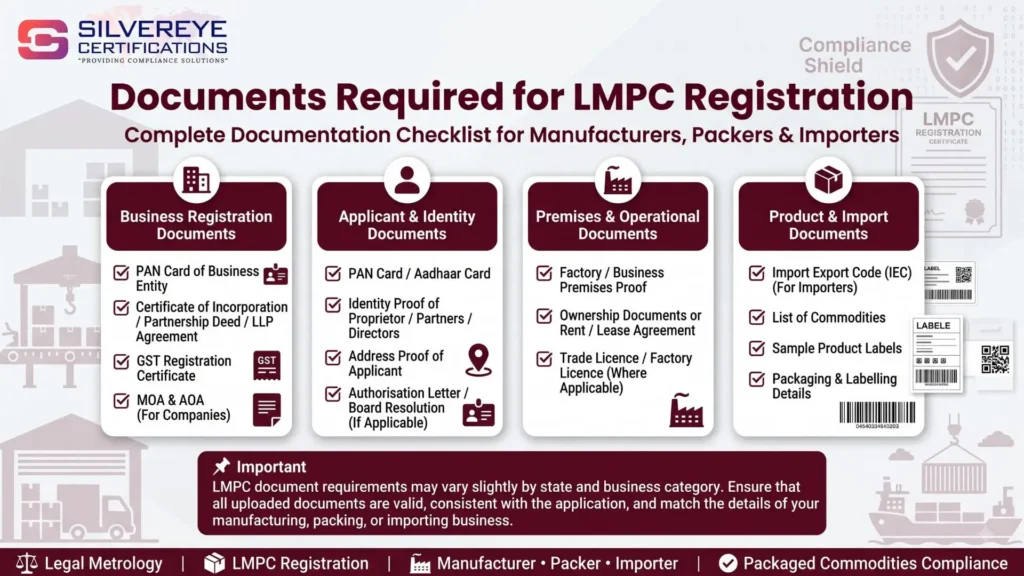
Documents Required for LMPC Registration For Packer
| Document | Why It's Needed |
| PAN card of the business and identity proof of applicant/partners/directors | Establishes the legal identity of the applicant |
| GST registration certificate | Confirms your registered business and tax status |
| Certificate of Incorporation / partnership deed / LLP agreement | Establishes the legal structure of the business |
| Proof of ownership or rent/lease agreement for the packing premises | Verifies the address where packing and labeling take place |
| Trade license, where applicable | Confirms your packing unit is authorized to operate at that address |
| Packing agreement or authorization letter (for contract/co-packers) | Establishes the relationship between the brand owner and the packer, and clarifies who declares what on the label |
| List of commodities to be pre-packed, with sample labels | Lets the department verify your declarations meet Rule 6 requirements, including correct “packed by” wording |
| Memorandum and Articles of Association (for companies) | Confirms the company's registered objects and structure |
Step-by-Step Process for LMPC Registration For Packers
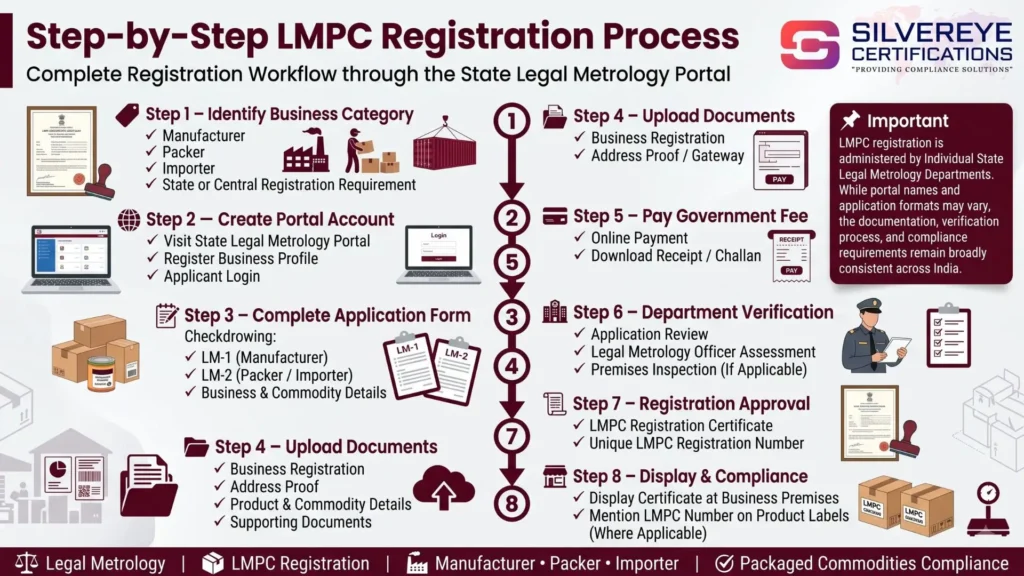
The packer registration workflow follows the same overall structure used on Legal Metrology portals nationwide (see our full state-by-state portal guide for exact links and screenshots):
- Confirm your category — Register specifically as a packer, and add manufacturer or importer categories too if your business also performs those roles.
- Create an account on the relevant portal — Your state's Legal Metrology portal, or the central portal if you sell across multiple states.
- Fill the packer registration form — Commonly referenced as Form LM-2, with your business details, packing premises address, and the full list of commodities you pre-pack.
- Upload your documents — PAN, GST, premises proof, your packing agreement if you're a contract packer, and sample labels showing correct “packed by” declarations.
- Pay the government fee — ₹500 under Rule 27, plus any additional state-specific charge, through the portal's payment gateway.
- Prepare for verification — Many states inspect the packing premises to confirm the address and packing setup match what's declared, though this can vary by state and scale of operation.
- Receive and display your certificate — Once approved, download your certificate, display it at your packing premises, and start quoting your registration number wherever required.
If You're a Contract Packer Working for Multiple Brands
Contract and co-packers occupy a slightly different position from single-brand packers, and it's worth understanding the two-sided responsibility involved:
- Your own packer registration generally covers your packing operation and premises — it establishes you as a legitimate packer under Rule 27.
- Each brand you pack for is separately responsible for making sure the final label correctly declares your role as “packed by,” along with the actual manufacturer's details and their own “marketed by” information where applicable.
- It's good practice — though not always a strict legal requirement — to keep a signed packing agreement or authorization letter on file for each brand relationship, since this is exactly what a state portal or inspecting officer may ask for to verify who's responsible for what.
- If you also manufacture some of what you pack (for example, formulating a private-label brand's product in-house before packing it), you may need to be declared as a manufacturer for that specific line, not just a packer.
Fees for Packer Registration
| Fee Component | Approximate Amount | Notes |
| Central Rule 27 registration fee | ₹500 (fixed) | Base statutory fee, payable regardless of state |
| State-level packer registration fee | ₹500 – ₹5,000, depending on state and product category | Some states charge per product line rather than a flat business-level fee |
| Renewal fee | Comparable to the original registration fee | Payable at each renewal cycle, where your state applies a fixed validity period |
Validity and Renewal for LMPC Registration For Packers
Validity terms vary by state. Some states issue packer registration for a fixed multi-year period, commonly cited in the 1-to-5-year range, while others — Punjab has been reported as an example — issue certain packer/importer registrations without a fixed expiry, relying on an amendment process for changes rather than a renewal cycle. Always confirm the specific validity model that applies to your state and category.
- Note your certificate's expiry date (where one applies) from the date of issuance
- File renewal well ahead of expiry, since operating on a lapsed registration carries the same risk as operating without one
- Use each renewal cycle to update your registration with any new products, brand relationships, or premises changes since your last filing
Penalties: What Happens If a Packer Skips Registration or Mislabels
- Rule 27 non-registration carries a fine of ₹4,000 for contravention, independent of any label-declaration penalty.
- Section 36(1) of the Legal Metrology Act, 2009 penalizes non-conforming label declarations with fines up to ₹25,000 for a first offence, up to ₹50,000 for a second, and ₹50,000 to ₹1,00,000 (or imprisonment up to 1 year, or both) for repeat offences.
- Missing the “packed by” qualifier doesn't just risk a fine — it can shift full legal responsibility for the package onto the packer or brand as the deemed manufacturer, even for defects in the underlying product they never made.
- Non-conforming stock can be seized under Rules 21 and 23, with the responsible party directed to re-pack or re-label the batch at their own cost.
- E-commerce listings can be suspended if a valid registration number isn't on file — marketplaces have tightened this check since the 2023 Bombay High Court ruling on platform liability for sellers' Legal Metrology compliance.
Common Mistakes LMPC Registration For Packers
- Assuming outsourced manufacturing means the compliance responsibility sits with the factory instead
- Printing only the brand name on the label without the “packed by” or “marketed by” qualifier
- Registering the business generically as a “seller” instead of specifically declaring packer status under Rule 27
- Not keeping a packing agreement on file for contract-packing relationships, making it harder to demonstrate the actual division of responsibility
- Failing to update the registration when adding a new product category or switching to a new contract manufacturer
- Letting the registration lapse because renewal tracking wasn't assigned to anyone
| Outsourcing manufacturing but handling your own packing? Run our free LMPC Applicability Check to confirm whether you need packer registration, manufacturer registration, or both — and get a clear answer on your label wording, documents, and cost, in under two minutes.→ Start the Free LMPC Applicability Check Prefer expert help? Silvereye Certifications can confirm your packer classification, review your label wording, and file your LMPC registration end-to-end. |
Conclusion
If there's one thing to take away from this guide, it's that outsourcing manufacturing doesn't outsource your Legal Metrology obligations. The moment your business takes a product and seals, labels, and sends it out for sale, you've stepped into the packer's role — and the law tracks that role separately from whoever actually made the product.
The businesses that get this right treat two things as equally important: filing the Rule 27 packer registration, and getting the “packed by” or “marketed by” wording exactly right on every label. Miss either one, and you're either unregistered or unknowingly carrying legal liability that should belong to your manufacturer.
If you're a private-label brand, a D2C company, or a contract packer working with multiple clients and you're not fully confident your registration and label wording line up correctly, it's worth having someone check before an inspector does. Silvereye Certifications works with packers across India — private-label brands and contract packers alike — to confirm the right registration, review label declarations for deemed-manufacturer risk, and file end-to-end with the correct state or central Legal Metrology portal.
Frequently Asked Questions
Do I need LMPC registration if I don't manufacture my own products?
Yes. If you pre-pack, label, and sell a commodity — even one made entirely by a third-party factory — you're the packer of record under Rule 2(g) and need packer registration.
What is the legal definition of a “packer” under Legal Metrology rules?
Rule 2(g) defines a packer as a person, firm, or HUF that pre-packs any commodity — in a bottle, tin, wrapper, or similar unit — for wholesale or retail sale, regardless of who manufactured it.
What happens if I don't mark my name as “packed by” on the label?
Under Rule 6's presumption, an unqualified name and address on a label is treated as the manufacturer's. You could be held legally responsible as the deemed manufacturer, even if you only packed and sold the product.
Is packer registration different from manufacturer registration?
Yes. They're separate categories under Rule 27, based on separate roles — manufacturing the product versus pre-packing it for sale. A business can hold one, the other, or both, depending on what it actually does.
How much does LMPC registration cost for a packer?
The base central fee under Rule 27 is ₹500. State-level packer registration typically adds ₹500–₹5,000 depending on the state and number of product categories.
What documents does a contract packer need that a regular packer doesn't?
Contract and co-packers typically need a packing agreement or authorization letter establishing the relationship with the brand they're packing for, in addition to the standard PAN, GST, and premises documents.
Can a private-label or D2C brand register as a packer without owning a factory?
Yes. Packer registration is based on where your packing and labeling premises are, not on owning manufacturing equipment. Many registered packers outsource production entirely and only handle final packing.
What's the penalty for a packer who skips registration?
Rule 27 contravention carries a fine of ₹4,000, in addition to potential fines up to ₹1,00,000 under Section 36 for non-conforming label declarations, and possible seizure of non-compliant stock.
How long is packer registration valid, and when should I renew?
Validity varies by state, commonly 1 to 5 years, though some states issue certain registrations without a fixed expiry and use an amendment process instead. File renewal well before your certificate's expiry date to avoid a compliance gap.
If my contract manufacturer is already LMPC-registered, do I still need to register as a packer?
Yes. Your manufacturer's registration covers their manufacturing role only. If you separately handle final packing, labeling, or marketing under your own brand, you need your own packer registration.