
- Every manufacturer who pre-packs its own output for sale in India needs LMPC registration under Rule 27 — this applies whether you run a large factory or a single small production unit.
- Legal Metrology defines “manufacturer” more broadly than most people expect — even a brand that only labels a product as its own, without physically making it, can be treated as the manufacturer under Rule 2(d).
- Registration costs a base ₹500 government fee under Rule 27, plus state-specific charges that vary by product category.
- Skipping registration isn't just a labeling risk — Rule 27 itself carries a separate ₹4,000 fine for non-registration, on top of Section 36 penalties for bad declarations.
Introduction
LMPC registration for manufacturers is the mandatory approval under Rule 27 of the Legal Metrology (Packaged Commodities) Rules, 2011 for any business that produces and pre-packs a commodity for sale in India. Under Rule 2(d), “manufacturer” includes not just the entity that physically makes the product, but also a brand that labels a product as made by itself, even if production is outsourced.
Manufacturers must apply within 90 days of starting to pre-pack goods, submit documents like PAN, GST, factory/premises proof, and a product list, and pay a base fee of ₹500 (plus state charges). Once approved, the certificate must be displayed at the manufacturing premises and the registration stays valid for a state-defined period, typically 1 to 5 years, before renewal is due.

If you run a production line — whether that's a food processing unit, a cosmetics lab, an electronics assembly line, or a small-batch home kitchen turning out packaged snacks — LMPC registration is one of the first compliance steps you need to get right, and one of the most misunderstood.
Manufacturers often assume that because they physically make the product, only they need to register — while private-label brands assume the opposite, that they're exempt because they don't run a factory. Neither assumption is safe. This guide covers exactly who counts as a manufacturer under Legal Metrology rules, what you need to register, how much it costs, and how to keep your registration valid year after year.
Who Counts as a “Manufacturer” Under Legal Metrology Rules?
This is worth slowing down on, because the legal definition is broader than the everyday meaning of the word. Rule 2(d) of the Legal Metrology (Packaged Commodities) Rules, 2011 defines a manufacturer as a person or company that either:
- Makes, produces, or creates a commodity themselves, or
- Puts a label on a package — or causes one to be put — that implies the commodity was made, manufactured, or produced by that person or company, even where the actual physical production happened elsewhere.
That second limb is the one that catches people off guard. If your brand sources a finished product from a contract factory but prints only your name on the package — without the qualifying words “manufactured by [factory name]” and “packed by / marketed by [your brand]” — the law can treat you as the manufacturer of record, with the legal responsibility that comes with it. This connects directly to the “deemed manufacturer” presumption under Rule 6: an unqualified name and address on a label is presumed to be the manufacturer's.
In practical terms, you're almost certainly a manufacturer for Legal Metrology purposes if you fall into any of these categories:
- You physically produce a commodity in your own facility and pack it yourself
- You produce a commodity and pack it, even at small or home-based scale, as long as it's pre-packed for retail or wholesale sale
- You outsource production but label the finished package as your own brand without correctly marking the actual manufacturer separately
- You assemble finished goods from components and sell the assembled product under your own name
Why LMPC Registration Matters for Manufacturers
Beyond simply avoiding penalties, LMPC registration gives manufacturers a few concrete, practical advantages:
- Legal standing to sell — without it, your pre-packed products aren't legally compliant for sale in India, regardless of how good the product itself is
- Marketplace approval — Amazon, Flipkart, and other platforms increasingly ask packaged-goods sellers for a valid LMPC registration number before approving a listing
- Cleaner audits and inspections — a registered manufacturer with correctly declared labels has a straightforward answer ready when a Legal Metrology Officer visits, rather than a scramble to explain missing paperwork
- Protection against “deemed manufacturer” disputes — clear registration and correct label wording establish exactly which party (you or your contract manufacturer) is responsible for what
- Smoother coexistence with FSSAI, BIS, and other approvals — LMPC registration is a separate, additional requirement, not a substitute, and having it in place avoids one more compliance gap during due diligence, funding rounds, or retail onboarding
Eligibility: Who Must Register, and Who's Exempt
If you pre-pack any commodity in a fixed quantity for retail or wholesale sale in India, you almost certainly need to register as a manufacturer — there's no minimum production volume or company-size exemption. A few categories sit outside the requirement, though these are fact-specific and worth confirming for your exact product:
- Bulk or wholesale packages above 25 kg or 25 litres, which fall under different rules than retail packaging
- Goods manufactured and packed strictly for industrial or institutional consumers, not retail sale
- Goods manufactured solely for export, and not sold within India
Outside these narrow exceptions, scale doesn't exempt you — a small home-based food business pre-packing 200g spice pouches has the same registration obligation as a large FMCG factory, because the requirement is tied to the act of pre-packing for sale, not to company size.
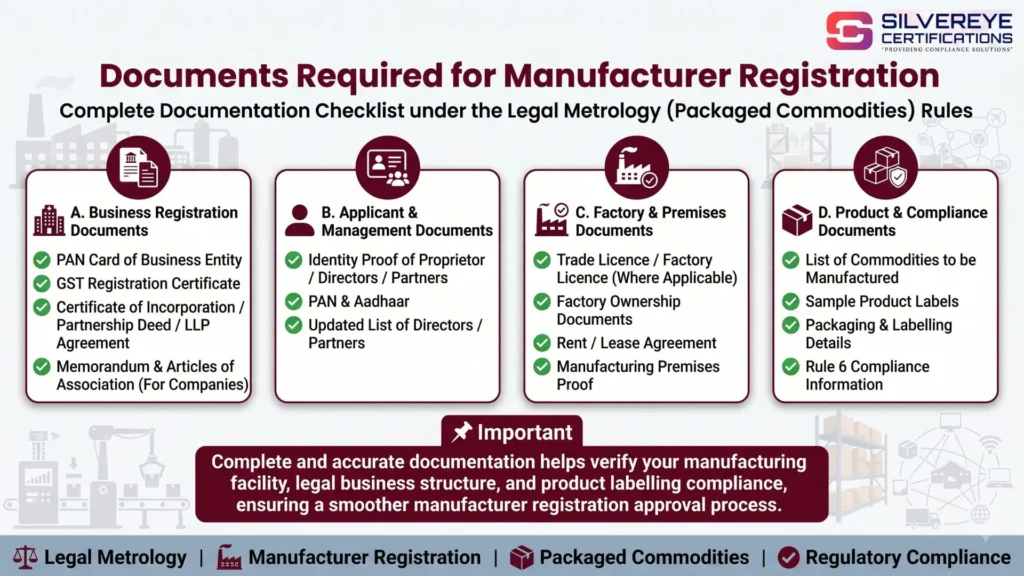
Documents Required for LMPC Registration For Manufacturers
| Document | Why It's Needed |
| PAN card of the business and identity proof of applicant/directors | Establishes the legal identity of the applicant |
| GST registration certificate | Confirms your registered business and tax status |
| Certificate of Incorporation / partnership deed / LLP agreement | Establishes the legal structure of the business |
| Trade license or factory license, where applicable | Confirms your manufacturing unit is authorized to operate |
| Proof of ownership or rent/lease agreement for the manufacturing premises | Verifies the address where production and packing take place |
| Memorandum and Articles of Association (for companies) | Confirms the company's registered objects and structure |
| List of commodities to be manufactured and packed, with sample labels | Lets the department verify your declarations meet Rule 6 requirements |
| List of directors/partners, updated as changes occur | Keeps the department's records of responsible persons current |
Step-by-Step LMPC Registration Process for Manufacturers
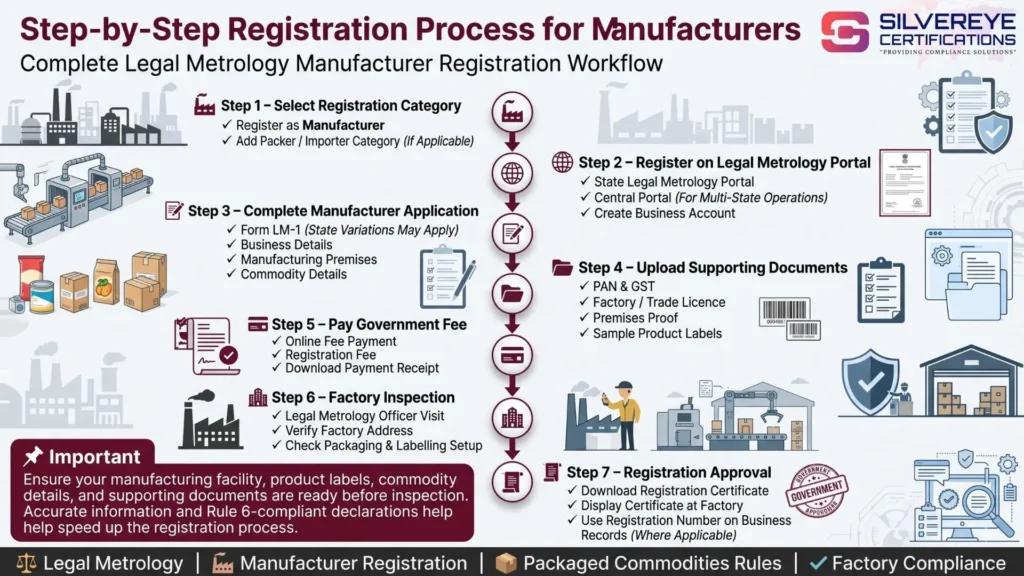
The manufacturer registration workflow follows the same core steps used across Legal Metrology portals nationwide (see our detailed state-by-state portal guide for exact URLs and screenshots):
- Confirm you're registering under the correct category — Manufacturer, and not packer or importer — unless you also perform those roles, in which case your application should reflect all applicable categories.
- Create an account on your state's Legal Metrology portal — Or the central portal if your products are sold across multiple states.
- Fill the manufacturer registration form — Commonly referenced as Form LM-1, with your business details, manufacturing premises address, and the full list of commodities you produce and pack.
- Upload your documents — PAN, GST, factory/trade license, premises proof, and sample labels showing your Rule 6 declarations.
- Pay the government fee — ₹500 under Rule 27, plus any additional state-specific charge, through the portal's payment gateway.
- Prepare for a premises inspection — Manufacturer applications commonly involve a physical visit by a Legal Metrology Officer to verify your factory address and packing setup against what you've declared.
- Receive and display your certificate — Once approved, download your registration certificate, display it prominently at your manufacturing premises, and start quoting your registration number wherever required.
Multiple Factories or Product Lines: Do You Need Separate Registrations?
This is a common question for growing manufacturers, and the honest answer is: it depends on your footprint, so confirm with your state Controller before assuming either way.
- If you operate more than one manufacturing unit, especially across different states, each premises is generally expected to be declared and verified — check whether your state treats this as one registration covering multiple declared premises, or as separate registrations per unit.
- Adding a new product category to an existing registered facility typically requires updating your registration rather than filing an entirely fresh application — but leaving it undeclared until an inspection finds it is a common, avoidable mistake.
- If you both manufacture and pack for other brands under contract, your registration should reflect that dual role — a manufacturer registration alone doesn't automatically cover third-party contract-packing activity if that's structured as a separate line of business.
Fees for Manufacturer Registration
| Fee Component | Approximate Amount | Notes |
| Central Rule 27 registration fee | ₹500 (fixed) | Base statutory fee, payable regardless of state |
| State-level manufacturer registration fee | ₹500 – ₹5,000, depending on state and product category | Some states charge per product line rather than a flat business-level fee |
| Renewal fee | Comparable to the original registration fee | Payable at each renewal cycle, where your state applies a fixed validity period |
Because state fee schedules are revised periodically, confirm the current figure for your state before budgeting — or use the free applicability check below for an estimate specific to your product and location.
Validity and Renewal for LMPC Registration For Manufacturers
Validity terms differ by state — some states issue manufacturer registration for a fixed multi-year period (commonly cited in the 1-to-5-year range), while others, such as Punjab, are reported to issue certain packer/importer registrations without a fixed expiry, relying instead on an amendment process for changes rather than a renewal cycle. Manufacturers should confirm their state's specific validity model rather than assuming a nationwide standard.
- Track your certificate's expiry date (if one applies) from the date of issuance, not your business start date
- File your renewal well ahead of expiry — operating past an expired registration carries the same risk as operating without one at all
- Use renewal as a checkpoint to update anything that's changed since your last filing — new product lines, an expanded factory, or a change in company structure
Label Declaration Duties Specific to Manufacturers
As the manufacturer, your name and address must appear on every package under Rule 6 — and if you're also the packer (the common case for an in-house production line), your declarations essentially cover both roles in one. Where you outsource packing to someone else, or where your brand doesn't physically manufacture but labels the product as its own under Rule 2(d), the label needs to clearly separate:
- “Manufactured by” — the entity that physically produced the commodity
- “Packed by” or “Marketed by” — the entity (often the brand) that pre-packed and is selling the product, if different from the manufacturer
Skipping these qualifying words is the single most common way a brand ends up legally treated as the manufacturer of a product it never physically made — with the corresponding liability if something on that label doesn't comply.
Penalties: What Happens If a Manufacturer Skips Registration
- Rule 27 non-registration itself carries a fine of ₹4,000 for contravention, separate from any label-declaration penalty.
- Section 36(1) of the Legal Metrology Act, 2009 penalizes non-conforming label declarations with fines up to ₹25,000 for a first offence, up to ₹50,000 for a second, and ₹50,000 to ₹1,00,000 (or imprisonment up to 1 year, or both) for repeat offences.
- Non-conforming or deceptively packaged goods can be seized under Rules 21 and 23, with the manufacturer directed to re-pack or re-label the entire affected batch at its own cost.
- Marketplace listings can be suspended or delisted if you can't produce a valid registration number when asked — a growing risk since the 2023 Bombay High Court ruling that e-commerce platforms can share liability for their sellers' Legal Metrology compliance.
Common Mistakes Manufacturers Make
- Assuming that because they physically make the product, they're automatically covered — without actually filing the Rule 27 application
- Registering the business but not declaring every manufacturing premises where production actually happens
- Printing a private-label brand name on the package without the “manufactured by” / “packed by” distinction, triggering deemed-manufacturer liability for the brand instead of the actual factory
- Adding a new product line to production without updating the registration to include it
- Letting the registration lapse because no one owns tracking the renewal date
- Submitting label samples that don't yet reflect the final Rule 6 declaration format, leading to rejection or delay
| Not sure if your setup counts as manufacturing? Whether you run a full factory, a small-batch production unit, or outsource manufacturing but label the product as your own, run our free LMPC Applicability Check to confirm exactly what registration you need and what it will cost — in under two minutes.→ Start the Free LMPC Applicability Check Prefer expert help? Silvereye Certifications can confirm your manufacturer classification, prepare your documents, and file your LMPC registration end-to-end. |
Conclusion
The most common mistake manufacturers make with LMPC registration isn't skipping it out of negligence — it's misjudging whether they even qualify as a manufacturer in the first place. Legal Metrology doesn't care what you call your business on your website; it cares what your label says and who your production process actually involves. If you make the product, you're a manufacturer. If you outsource production but put your name on the package without the right qualifying words, you can be treated as one too.
The safest approach is simple: map out exactly who makes your product, who packs it, and whose name goes where on the label — then register accordingly, get your Rule 6 declarations right from day one, and put a renewal reminder on your calendar so this never becomes an emergency.
If your production setup has grown, changed contract manufacturers, added new product lines, or you're just not confident your current labels correctly separate “manufactured by” from “packed by,” it's worth getting a second set of eyes on it. Silvereye Certifications works with manufacturers across India to confirm the right registration category, prepare compliant documentation, and file with the correct state or central Legal Metrology portal — so your factory floor and your paperwork are both actually compliant, not just one of the two.
Frequently Asked Questions
Does every manufacturer need LMPC registration, regardless of size?
Yes. There's no minimum production volume or business-size exemption — a small home-based unit pre-packing goods for retail sale has the same Rule 27 obligation as a large factory.
What is the legal definition of “manufacturer” under Legal Metrology rules?
Rule 2(d) defines a manufacturer as anyone who makes/produces a commodity, or who labels a package in a way that implies the product was made by them — even if actual production happened elsewhere.
Can a brand be treated as a manufacturer even if it outsources production?
Yes. If the label doesn't clearly mark the actual factory as “manufactured by” and the brand as “packed by” or “marketed by,” the law can presume the brand's name is the manufacturer's, making the brand legally responsible.
How much does LMPC registration cost for a manufacturer?
The base central fee under Rule 27 is ₹500. State-level manufacturer registration typically adds ₹500–₹5,000 depending on the state and number of product categories.
What documents does a manufacturer need for LMPC registration?
Core documents include PAN, GST certificate, business incorporation documents, trade/factory license, proof of manufacturing premises, and a list of commodities with sample labels. See the documents table above for the full list.
Does a manufacturer need separate registration for each factory?
This depends on your state — some expect each manufacturing premises to be declared and verified, potentially requiring registration or amendment per unit. Confirm the specific requirement with your state Controller of Legal Metrology.
Is manufacturer registration the same as a Legal Metrology license?
No. Manufacturer registration under Rule 27 covers businesses that pre-pack commodities for sale. A Legal Metrology license is a separate requirement that applies only if you also manufacture, sell, or repair weighing and measuring instruments.
What happens if a manufacturer doesn't register under Rule 27?
Rule 27 contravention carries a fine of ₹4,000, in addition to potential fines up to ₹1,00,000 under Section 36 for non-conforming label declarations, and possible seizure of the non-compliant stock.
How long is manufacturer registration valid?
Validity varies by state, commonly ranging from 1 to 5 years, though some states issue certain registrations without a fixed expiry and rely on an amendment process instead of renewal. Check the terms on your specific certificate.
Do I need to update my registration if I add a new product line?
Yes. New commodities should be added to your existing registration rather than left undeclared — inspectors checking your registered product list against what you're actually producing is a common source of penalties.