
- Mandatory for every manufacturer, packer, and importer who sells pre-packaged goods in India under the Legal Metrology (Packaged Commodities) Rules, 2011.
- Central Rule 27 registration carries a government fee of ₹500; state-level packer/importer registrations typically add ₹1,000–₹5,000, depending on the state and product category.
- Validity generally runs 1 to 5 years depending on the state and category — renewal must be filed before expiry to avoid a compliance gap.
- Non-compliance can mean fines up to ₹1 lakh, imprisonment up to 1 year, product seizure, and delisting from marketplaces like Amazon and Flipkart.
Introduction
LMPC registration is the mandatory approval under Rule 27 of the Legal Metrology (Packaged Commodities) Rules, 2011 that every manufacturer, packer, and importer of pre-packaged goods must obtain before selling in India. It registers your business name and address with the state Controller (or Director) of Legal Metrology and confirms that your product labels correctly declare MRP, net quantity, manufacturing date, and manufacturer/packer/importer details.
Registration must be filed within 90 days of starting the business, carries a base government fee of ₹500 (plus state-specific charges), and stays valid for 1–5 years depending on the state. Skipping it risks fines up to ₹1 lakh, goods seizure, and marketplace delisting.

If you manufacture, pack, or import any product sold in a sealed wrapper, box, bottle, or pouch in India — from a 50g spice sachet to an imported skincare bottle — this guide walks you through everything you need to know about LMPC registration in India: what it is, who needs it, how it differs from an LMPC license, the exact process, the declarations your label must carry, the documents and fees involved, and what happens if you skip it.
What Is LMPC Registration? (Legal Metrology Packaged Commodities Rules, Explained)
LMPC stands for Legal Metrology Packaged Commodities — the compliance framework that governs how pre-packaged goods are labeled and sold in India. It flows from two legal instruments:
- The Legal Metrology Act, 2009 — The parent law administered by the Department of Consumer Affairs, Ministry of Consumer Affairs, that replaced the earlier Standards of Weights and Measures Act and put weights, measures, and packaged-commodity regulation under one central framework.
- The Legal Metrology (Packaged Commodities) Rules, 2011 — The rulebook made under that Act, which prescribes exactly what a pre-packaged commodity's label must say (Rule 6), how net quantity is calculated (Rule 11), what counts as deceptive packaging (Rule 23), and — most relevant here — who must register before they can legally pre-pack or import goods for sale (Rule 27).
Under Rule 27, “every individual, firm, Hindu undivided family, society, company or corporation who or which pre-packs or imports any commodity for sale, distribution or delivery” must apply for registration of its name and address with the Director (central) or the Controller of Legal Metrology (state), accompanied by a government fee of ₹500. A new business must file this application within 90 days of starting to pre-pack or import goods.
LMPC registration is your business's formal enrolment with the Legal Metrology authorities as a legitimate manufacturer, packer, or importer of packaged goods — separate from your GST registration, FSSAI license, or BIS certification, and required in addition to them, not instead of them.
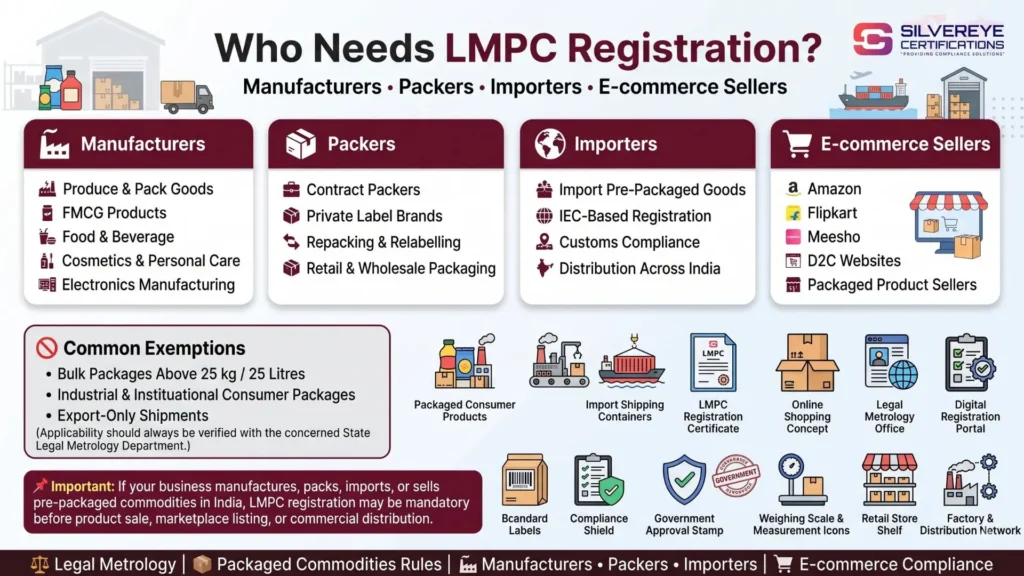
Who Needs LMPC Registration: Manufacturers, Packers, and Importers
LMPC registration applies broadly across FMCG, food, cosmetics, personal care, electronics, textiles, stationery, hardware, and industrial-consumables businesses — essentially anyone who sells a product in a sealed, pre-determined quantity rather than loose, weighed-in-front-of-the-customer form. The three registrant categories are:
Manufacturers
Any business that produces goods and packs them, in-house, into retail-ready units before sale. This includes FMCG brands, food and beverage companies, cosmetic and personal-care manufacturers, and electronics assemblers.
Packers
Any entity that pre-packs a commodity — whether made by itself or sourced from someone else — into a bottle, tin, wrapper, pouch, or box suitable for retail or wholesale sale. This specifically covers third-party contract packers and private-label businesses that outsource manufacturing but handle the final packing and labeling themselves.
Importers
Any person or firm bringing pre-packaged commodities into India from abroad for sale, distribution, or delivery. Importer registration is tied to your Import Export Code (IEC) and is usually the first compliance step before customs clearance and marketplace listing of an imported product.
E-commerce sellers
If you sell pre-packaged products on Amazon, Flipkart, Meesho, or your own D2C website, you are treated as the packer/manufacturer/importer of record for Legal Metrology purposes — marketplaces increasingly require sellers to furnish a valid LMPC registration number before listing packaged SKUs.
A narrow set of categories sit outside this requirement — for example, bulk/wholesale packages above 25 kg or 25 litres, goods packed for direct sale to industrial or institutional consumers, and export-only shipments not sold within India. These exemptions are fact-specific, so it's worth confirming applicability for your exact product and pack size with the state Legal Metrology office before assuming you're exempt.
LMPC Registration vs LMPC License: Which One Applies to You
These two terms are often used loosely and interchangeably, which causes real confusion. They cover different activities:
| Parameter | LMPC Registration (Rule 27) | Legal Metrology License |
| Who needs it | Manufacturers, packers, and importers of pre-packaged commodities for sale | Dealers, manufacturers, and repairers of weights and measures (weighing/measuring instruments) |
| What it covers | Your business identity — name, address, and the commodities you pre-pack or import | The instruments you make, sell, or repair (scales, weights, meters) and their accuracy/verification |
| Governing provision | Rule 27, Legal Metrology (Packaged Commodities) Rules, 2011 | Legal Metrology Act, 2009 and state Legal Metrology (Enforcement) Rules |
| Typical applicant | FMCG brand, food company, cosmetics brand, D2C seller, importer | Weighing-scale manufacturer, repair workshop, instrument dealer |
| Do you need both? | Only if you also manufacture, sell, or repair weighing/measuring instruments in addition to packing goods | Only if you also pre-pack or import commodities for sale |
Most product businesses — brands, packers, and importers of pre-packaged goods — only need LMPC registration. You would additionally need a Legal Metrology license only if your business also manufactures, sells, or repairs weighing and measuring equipment such as scales or dispensing meters.
Step-by-Step LMPC Registration Process (State Legal Metrology Portal)
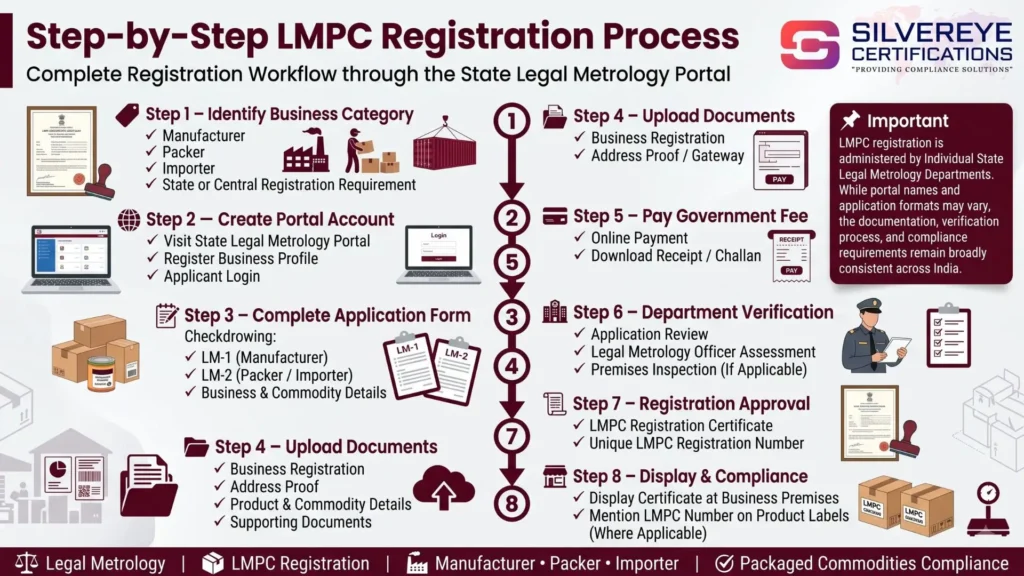
LMPC registration is administered by each state's Controller of Legal Metrology, so the exact portal name and workflow differ slightly by state — some states run a dedicated Legal Metrology e-portal, while others route applications through the state's e-District or single-window business portal. The core steps are consistent nationwide:
- Step 1 — Confirm your category: Decide whether you're registering as a manufacturer, packer, or importer, and whether your business needs central (multi-state operation) or state-specific registration.
- Step 2 — Visit the relevant state Legal Metrology Department's online portal and create a business login/applicant account.
- Step 3 — Fill the prescribed application form (commonly referenced as Form LM-1 for manufacturers and Form LM-2 for packers/importers, with state-specific numbering variations) with business details, premises address, and the list of commodities you pack or import.
- Step 4 — Upload the required documents (see Section 6) in the specified format and size.
- Step 5 — Pay the prescribed government fee online through the portal's payment gateway and retain the receipt/challan.
- Step 6 — A Legal Metrology Officer reviews the application and may schedule a physical inspection of your manufacturing/packing premises.
- Step 7 — On successful verification, the registration certificate is issued with a unique LMPC registration number — processing time varies by state, so build in a buffer before your planned launch or listing date.
- Step 8 — Display the certificate prominently at your registered business premises and quote the registration number on your product labels where required.
Tip: apply well before you start selling — Rule 27 requires new businesses to register within 90 days of commencing pre-packing or import, and marketplaces often ask for the certificate before approving your listing.
Mandatory Declarations Required on Every Package (MRP, Net Quantity, Date of Manufacture & More)
Rule 6 of the Legal Metrology (Packaged Commodities) Rules, 2011 sets out exactly what must appear on every pre-packaged commodity's label, regardless of category. Getting these declarations right is just as important as holding the registration itself — mismatched or missing declarations are one of the most common reasons for penalties even among registered businesses.
| Declaration | What It Must Show |
| Manufacturer/packer/importer details | Name and complete address of the manufacturer; the packer's name and address if different; and the importer's name and address for imported goods. |
| Common or generic name | The name by which the commodity is generally known or described in trade — for multi-item packs, the generic name and quantity of each item. |
| Net quantity | Quantity by standard weight, volume, or number, using standard units of measurement — with wrapper/packaging weight excluded from the net weight. |
| Month and year of manufacture/pack/import | The month and year the commodity was manufactured, packed, or imported, as applicable. |
| Maximum Retail Price (MRP) | The retail sale price inclusive of all taxes, clearly stated as “MRP incl. of all taxes.” Selling above the declared MRP is itself an offence. |
| Consumer care details | Name, address, and contact details (phone/email) of the person or office to be contacted for consumer complaints. |
| Country of origin | Mandatory for imported pre-packaged commodities. |
| Unit sale price | Price per standard unit of the commodity, where applicable to the product category. |
A recent development worth tracking for freshness: the Draft Legal Metrology (Packaged Commodities) Amendment Rules, 2025 propose additional digital-labeling and QR/barcode disclosure requirements aimed at e-commerce listings. If you sell online, keep an eye on the final notification, since it could add to the declarations above once formally enforced.
Documents Required for LMPC Registration
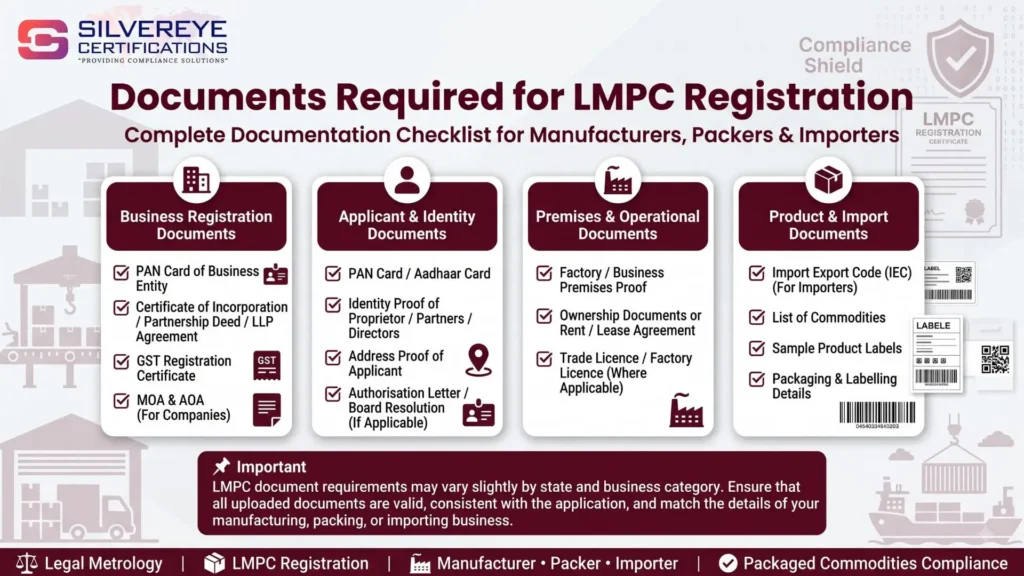
Document requirements vary slightly by category and state, but most applications need the following:
- PAN card of the business entity and identity proof (PAN/Aadhaar) of the applicant, partners, or directors
- Address proof of the applicant/partners/directors
- Certificate of Incorporation, partnership deed, or LLP agreement, as applicable
- GST registration certificate
- Proof of business premises — ownership document or a valid rent/lease agreement for the manufacturing or packing unit
- Memorandum of Association (MOA) and Articles of Association (AOA), for companies
- Import Export Code (IEC) — mandatory for importer registration
- List of commodities to be manufactured, packed, or imported, along with sample product labels
- Trade license or factory license, where applicable to the product category
- Authorization letter or board resolution, if the application is filed by an authorized representative rather than the proprietor/director directly
Keep scanned copies current and legible — outdated address proof or illegible uploads are a leading cause of processing delays.
LMPC Registration Cost and State-Wise Fee Variation
LMPC registration fees have two layers. The base fee under Rule 27 (central-level registration for pre-packing/importing any commodity) is ₹500. Separately, most states levy their own packer/manufacturer/importer registration or license fees under state Legal Metrology rules, and these do vary by state, by product category, and by how many product lines you're registering — so treat the figures below as an illustrative range rather than a fixed number for your state.
| Fee Component | Approximate Range | Notes |
| Central Rule 27 registration | ₹500 (fixed) | Statutory fee for registration as a person who pre-packs or imports commodities for sale |
| State packer/manufacturer registration | ₹1,000 – ₹5,000 per product line, per year | Varies by state; some states charge per product category rather than a flat fee |
| Instrument manufacturer/dealer license | ₹3,000 – ₹10,000 | Only applicable if you also manufacture, sell, or repair weighing/measuring instruments |
| Renewal fee | Comparable to the original registration fee | Payable at each renewal cycle; late renewal may attract additional charges |
Because state Legal Metrology departments revise fee schedules periodically, always confirm the current fee on your state's official portal — or use the free applicability check below, which tells you the current category, process, and indicative cost for your specific product and state.
Validity and Renewal of LMPC Registration
LMPC registration and license validity is not uniform across India — depending on the state and the category (registration vs instrument license), certificates are typically issued for anywhere between 1 and 5 years, with many states defaulting to a multi-year cycle to reduce repeat paperwork for compliant businesses.
- Track your expiry date from the day your certificate is issued, not from your business start date.
- File the renewal application in advance of expiry — most states expect this to be initiated well before the certificate lapses, since operating on an expired registration is treated the same as operating without one.
- Renewal generally follows a lighter version of the original process: the same portal, your existing registration number, updated documents where anything has changed (address, product list, ownership), and payment of the renewal fee.
- If you've added new product categories, opened a new packing unit, or changed your registered address since the last certificate, update these details as part of — or just before — renewal rather than waiting for an inspection to flag the mismatch.
Common Mistakes That Lead to Rejection or Delay
Most rejections and delays are avoidable. The recurring patterns are:
- Applying under the wrong category — for example, registering as a packer when you're actually also the manufacturer, or vice versa
- Mismatched documents — the address on your rent agreement doesn't match the address in the application form
- Missing the 90-day window for new businesses under Rule 27, which can trigger a compliance notice before the certificate is even issued
- Uploading label samples that don't carry all the Rule 6 declarations in the correct format
- Declaring net quantity in non-standard units instead of the prescribed weight/volume/number system
- Incomplete or illegible scanned documents, especially identity proof and premises ownership/rental proof
- Not updating the registration when a new product line or a new packing premises is added, leading to a mismatch found later during inspection
- Paying the fee without attaching the correct payment reference/challan to the application, which stalls verification
What Happens If You Skip LMPC Registration: Penalties and Marketplace Delisting Risk
Selling pre-packaged goods without registration — or with a package that doesn't carry the mandatory declarations — isn't a paperwork technicality; it's an enforceable offence under the Legal Metrology Act, 2009.
Statutory penalties
- Section 36(1): selling a pre-packaged commodity that doesn't conform to the required label declarations attracts a fine up to ₹25,000 for a first offence, up to ₹50,000 for a second offence, and ₹50,000 to ₹1,00,000 (or imprisonment up to 1 year, or both) for subsequent offences.
- Section 36(2): errors in declared net quantity beyond the prescribed tolerance attract a fine of ₹10,000 to ₹50,000 for a first offence, rising to up to ₹1,00,000 or imprisonment up to 1 year (or both) for repeat offences.
- Rule 32 separately penalizes contravention of the Packaged Commodities Rules themselves, independent of the Section 36 provisions.
- Non-conforming or deceptively packaged goods can be seized by a Legal Metrology Officer under Rules 21 and 23, and the manufacturer or packer can be directed to re-pack or re-label the entire batch at their own cost.
Marketplace delisting risk
This risk has grown sharply for online sellers. In 2023, the Bombay High Court held in Amazon Seller Services vs Legal Metrology Officer that e-commerce platforms can themselves be held liable for their sellers' Legal Metrology violations, with the court directing mandatory pre-listing compliance checks. In practice, this has pushed marketplaces like Amazon and Flipkart to demand valid LMPC registration details before approving or continuing a packaged-goods listing — meaning a lapsed or missing registration can get your SKUs suspended or delisted even if no government inspection has happened yet.
The combined effect: unregistered or non-compliant packaging exposes you to direct government penalties and to commercial risk from the very platforms you sell through — which is why treating LMPC as a launch-day requirement, not an afterthought, is the safer approach.
Conclusion: Getting LMPC Registration Right, the First Time
LMPC registration isn't a one-time formality you file and forget — it's an ongoing compliance thread that runs through your product labels, your state renewals, and increasingly, your marketplace listings. The businesses that stay out of trouble treat it the same way they treat GST or FSSAI: as a standing obligation with its own calendar, not a box ticked at launch.
To recap the core actions from this guide: identify whether you're a manufacturer, packer, or importer; register with the correct state Controller of Legal Metrology within 90 days of starting operations; get every Rule 6 declaration on your label exactly right; keep your documents and renewal dates current; and budget for both the central ₹500 fee and your state's additional charges. Get these five things right, and LMPC stops being a risk and becomes routine paperwork.
If you'd rather not track state-specific forms, fee schedules, and renewal windows yourself, Silvereye Certifications works with manufacturers, packers, and importers across India to handle LMPC registration, renewals, and label compliance reviews end-to-end — from checking applicability for your specific product to filing with the correct state Legal Metrology portal and following through to certificate issuance. For businesses juggling GST, FSSAI, BIS, and LMPC compliance at once, working with a firm like Silvereye Certifications can be the difference between a same-quarter launch and months of back-and-forth over a single mismatched document.
Frequently Asked Questions
What is LMPC registration in India?
LMPC registration is the mandatory approval under Rule 27 of the Legal Metrology (Packaged Commodities) Rules, 2011 that registers a manufacturer's, packer's, or importer's name and address with the state Controller of Legal Metrology before they sell pre-packaged goods in India.
Who needs LMPC registration?
Manufacturers who pack their own goods, third-party or contract packers, importers of pre-packaged commodities, and e-commerce sellers of packaged products all need LMPC registration, subject to limited exemptions for bulk/wholesale and institutional-use packs.
Is LMPC registration mandatory for e-commerce sellers?
Yes. If you sell pre-packaged goods on Amazon, Flipkart, Meesho, or your own website, you're treated as the manufacturer/packer/importer of record, and marketplaces increasingly require a valid LMPC registration number before approving your listing.
What is the difference between LMPC registration and an LMPC/Legal Metrology license?
Registration (Rule 27) covers businesses that pre-pack or import commodities for sale. A Legal Metrology license covers a separate activity — manufacturing, selling, or repairing weighing and measuring instruments. Most product businesses only need registration, not a license.
How much does LMPC registration cost?
The base central fee under Rule 27 is ₹500. State-level packer, manufacturer, or importer registration typically adds ₹1,000–₹5,000 depending on the state and number of product categories — always verify the current fee on your state's Legal Metrology portal.
How long does LMPC registration take to process?
Processing time varies by state and depends on document completeness and whether a premises inspection is required. It's sensible to apply several weeks before your planned launch or marketplace listing date rather than assuming same-week approval.
What is the validity period of an LMPC registration certificate?
Validity commonly ranges from 1 to 5 years depending on the state and category. Check the expiry date printed on your specific certificate, since it is not standardized nationwide.
What documents are required for LMPC registration?
Core documents include PAN and identity proof, business incorporation/GST documents, address proof of the premises, a list of commodities with sample labels, and — for importers — a valid Import Export Code (IEC). See Section 6 above for the full list.
Can one LMPC registration cover operations in multiple states
It depends on how you register. Central registration under Rule 27 is intended to cover pre-packing or import activity broadly, but many businesses with packing units or warehouses in multiple states also complete state-specific registrations to satisfy local Controllers — confirm the correct approach for your footprint with the relevant state office.
What happens if I sell packaged goods without LMPC registration?
You risk fines ranging from ₹25,000 up to ₹1,00,000 (or more for repeat offences), imprisonment up to 1 year in serious or repeat cases, seizure of non-compliant stock, and delisting or suspension from e-commerce marketplaces.