- BIS Certification for Cross Recessed Screws is now mandatory under QCO Amendment 2026 for all domestic manufacturers and importers.
- Products must conform to IS standards such as IS 1366, IS 6639, IS 7085, IS 2048, and other applicable Indian Standards notified in the amendment.
- The Bureau of Indian Standards (BIS) issues an ISI Mark license after product testing, factory audit, and document verification.
- Non-compliance after the QCO enforcement date attracts penalties, product recall, and import ban under the Bureau of Indian Standards Act, 2016.
Introduction
The BIS QCO Amendment 2026 makes ISI Mark certification compulsory for cross recessed screws (pan head, countersunk head, raised countersunk head, and hex head variants) under relevant IS standards. Manufacturers must apply via the BIS Connect portal, pass lab testing, and clear a factory inspection. Importers must obtain a Foreign Manufacturer Certification Scheme (FMCS) license. Validity is typically one to two years with annual surveillance.
What Is BIS Certification for Cross Recessed Screws?
BIS certification for cross recessed screws is an ISI Mark license granted by the Bureau of Indian Standards (BIS) that confirms a screw product meets the safety, dimensional, and performance requirements of the relevant Indian Standard. Under the Quality Control Order (QCO) Amendment 2026, this certification is no longer voluntary — it is a legal requirement for every manufacturer and importer who wants to sell cross recessed screws in the Indian market.

Cross recessed screws, commonly known as Phillips head or Pozidriv screws, are widely used in electronics, automotive, construction, furniture, and general engineering. The BIS QCO 2026 update covers a specific set of screw types and their governing IS standards, which are listed in detail in the table further below.
Why Has BIS Introduced the QCO Amendment 2026 for Cross Recessed Screws?
India's Quality Control Order framework, administered through the Ministry of Commerce and Industry and enforced by BIS, aims to eliminate substandard and counterfeit fasteners from the supply chain. Here is why the 2026 amendment matters:
- Consumer safety: Inferior screws can fail in critical assemblies, causing safety hazards in electronics and structural applications.
- Market standardization: The amendment aligns Indian fastener quality with global benchmarks such as ISO 7045, ISO 7046, and ISO 7047.
- Import quality control: Foreign manufacturers must now hold an FMCS license to export cross recessed screws to India.
- Anti-dumping protection: Mandatory BIS certification discourages dumping of low-quality fasteners, protecting domestic industry.
IS Standards Covered Under BIS QCO Amendment 2026 for Cross Recessed Screws
The following table lists all Indian Standards that fall under the BIS QCO Amendment 2026 for cross recessed screws. Each product requires a separate ISI Mark license against its specific IS number.
| IS Standard | Product Description | Screw Head Type | Drive Type |
| IS 1366 | Cross Recessed Pan Head Screws | Pan Head | Phillips / Pozidriv |
| IS 6639 | Cross Recessed Countersunk Flat Head Screws | Countersunk Flat Head | Phillips / Pozidriv |
| IS 7085 | Cross Recessed Raised Countersunk Oval Head Screws | Raised Countersunk Oval Head | Phillips / Pozidriv |
| IS 2048 | Cross Recessed Cheese Head Screws | Cheese Head | Phillips / Pozidriv |
| IS 1363 (Part 3) | Cross Recessed Pan Head Tapping Screws | Pan Head | Phillips |
| IS 6094 (Part 1) | Cross Recessed Countersunk Flat Head Tapping Screws | Countersunk Flat Head | Phillips |
| IS 6094 (Part 2) | Cross Recessed Raised Countersunk Oval Head Tapping Screws | Raised Countersunk Oval Head | Phillips |
| IS 7483 | Cross Recessed Wafer Head Screws | Wafer Head | Phillips / Pozidriv |
| IS 5369 | General Requirements for Screws, Bolts and Nuts | All variants | All recessed types |
| IS 1367 (Part 3) | Mechanical Properties of Fasteners — Bolts, Screws and Studs | All variants | All recessed types |
Note: The IS standards listed above are based on the BIS QCO framework applicable to cross recessed screws. Manufacturers should confirm the latest notified IS numbers from the official BIS website or the Gazette notification for the 2026 amendment before filing an application.
Who Needs BIS Certification for Cross Recessed Screws in 2026?
Domestic Manufacturers
Every Indian manufacturer producing cross recessed screws covered under the QCO Amendment 2026 must obtain an ISI Mark license before manufacturing and selling the product. This applies to:
- Large-scale fastener manufacturers with dedicated production lines
- Small and Medium Enterprises (SMEs) producing screws for OEMs or the open market
- Job workers and sub-contractors producing screws under a brand owner's label
Importers and Foreign Manufacturers
All importers bringing cross recessed screws into India must ensure the products carry the BIS ISI Mark. Foreign manufacturers who supply to Indian importers must hold a Foreign Manufacturer Certification Scheme (FMCS) license issued by BIS. Key points for importers:
- Each consignment at the port of entry will be checked for a valid ISI Mark.
- Products without BIS certification will be stopped at customs and may be seized or returned.
- An Indian importer cannot substitute a foreign manufacturer's BIS license — the foreign factory must hold its own FMCS license.
Eligibility Criteria for BIS ISI Mark License — Cross Recessed Screws
To be eligible for BIS certification for cross recessed screws, an applicant must meet the following conditions:
| Eligibility Criterion | Requirement |
| Legal Entity | Registered company, LLP, partnership, or proprietorship under Indian law (or equivalent for foreign manufacturers) |
| Manufacturing Facility | Dedicated production facility with required machinery for screw manufacturing and finishing |
| In-House Testing Lab | Calibrated testing equipment for dimensional, mechanical, and hardness testing as per IS standards |
| Raw Material Traceability | Documented records of steel wire/rod sourcing with material certificates |
| Quality Management System | Basic QMS or ISO 9001 is preferred; documented process controls are mandatory |
| Product Compliance | Product design and manufacturing process must conform to the applicable IS standard |
Documents Required for BIS Certification for Cross Recessed Screws
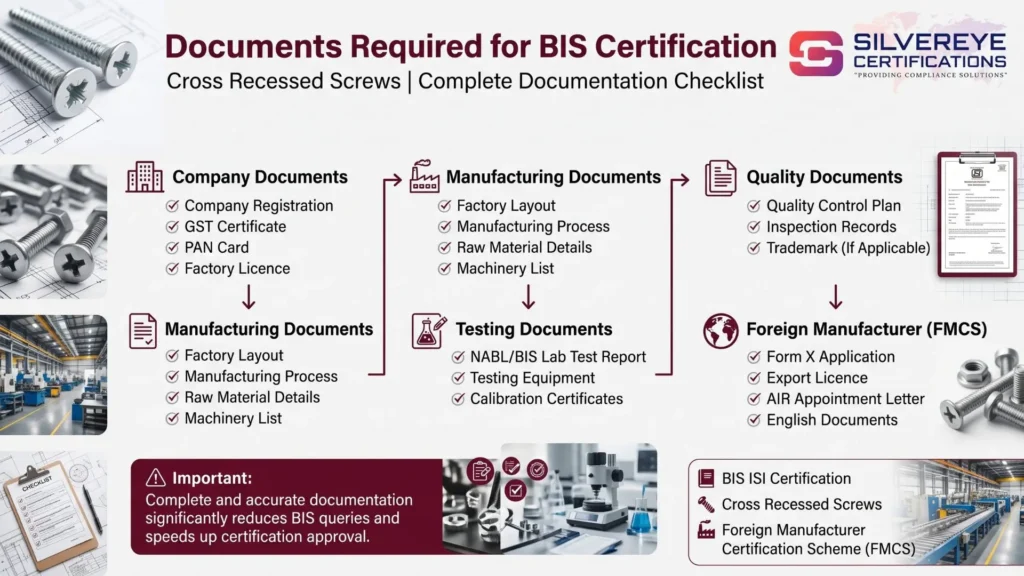
Gathering the right documents before you apply to BIS saves significant time. Here is a complete checklist of documents required:
For Domestic Manufacturers
- Duly filled BIS license application form (available on BIS Connect portal)
- Company registration certificate (Certificate of Incorporation / MSME Udyam certificate)
- GST Registration certificate
- PAN card of the company or proprietor
- Factory license / Industrial license
- Site plan and layout of the manufacturing unit
- List of raw materials with supplier details and mill test certificates
- List of machinery and equipment used in production
- List of in-house testing equipment with calibration certificates
- Detailed manufacturing process flowchart
- Quality control plan and inspection records
- Sample test reports from a BIS-recognized / NABL-accredited laboratory
- Trademark certificate (if applicable)
- Authorization letter for the signatory
For Foreign Manufacturers (FMCS)
- All documents listed above translated into English
- Valid export license from the country of origin
- Authorized Indian Representative (AIR) appointment letter
- AIR's address proof and identity proof
- Test report from a BIS-recognized laboratory
- Filled FMCS application form (Form X)
Step-by-Step BIS Certification Process for Cross Recessed Screws
Here is how the entire BIS ISI Mark certification process works for cross recessed screws in 2026:
| Step | Action | Who Does It | Timeline (Approx.) |
| 1 | Register on BIS Connect portal (www.bisconnect.gov.in) | Applicant | 1–2 days |
| 2 | Fill online application form and select applicable IS standard | Applicant | 1 day |
| 3 | Upload all required documents | Applicant | 2–5 days |
| 4 | Pay application and testing fees online | Applicant | 1 day |
| 5 | BIS scrutiny of application documents | BIS Officer | 7–15 working days |
| 6 | BIS draws samples from the factory for testing | BIS Officer | 1–2 days |
| 7 | Testing of samples at BIS-recognised / NABL laboratory | Lab | 15–30 days |
| 8 | BIS factory inspection and audit | BIS Inspector | 1–2 days |
| 9 | BIS evaluation of test reports and audit findings | BIS Officer | 7–10 working days |
| 10 | Grant of ISI Mark Licence (or communication of deficiencies) | BIS | 5–7 working days |
| 11 | Applicant addresses deficiencies if any and resubmits | Applicant | As required |
| 12 | ISI Mark Licence issued with unique Licence Number | BIS | 1–3 days |
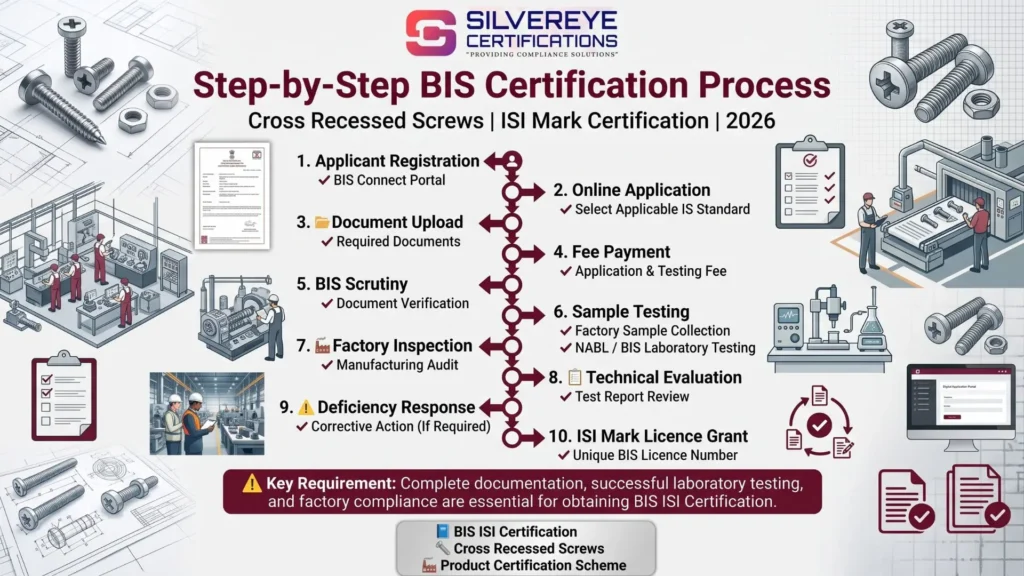
Total estimated timeline from application to license: 60 to 90 days for a well-prepared application. Incomplete documents or failed tests can extend this significantly.
BIS Certification Fees for Cross Recessed Screws — 2026 Schedule
BIS charges multiple types of fees during the certification and licence maintenance process. Here is an overview of the applicable fee heads (actual amounts are as notified by BIS and may be revised):
| Fee Type | Applicable Stage | Approximate Amount (INR) |
| Application Processing Fee | At the time of online application submission | Rs. 1,000 – Rs. 5,000 |
| Marking Fee (Annual) | Paid annually based on production quantity | Variable (as per BIS schedule) |
| Testing Charges | Sample testing at BIS/NABL lab per IS standard | Rs. 5,000 – Rs. 25,000 per IS |
| Factory Inspection Fee | Per factory visit by BIS officer | Rs. 5,000 – Rs. 15,000 |
| Surveillance Testing Fee | Annual/quarterly surveillance sample testing | Rs. 3,000 – Rs. 15,000 per visit |
| FMCS Application Fee (Foreign) | Foreign manufacturer application fee | As per BIS FMCS schedule |
| Renewal Fee | At the time of licence renewal | As per BIS schedule |
Important: BIS fees are revised periodically. Always check the current fee schedule on the official BIS website (www.bis.gov.in) or the BIS Connect portal before applying.
Validity and Renewal of BIS ISI Mark License for Cross Recessed Screws
License Validity
A BIS ISI Mark license for cross recessed screws is typically valid for one year and can be extended/renewed for up to two years at a time, subject to satisfactory surveillance and compliance.
Renewal Timeline
- Renewal application must be filed at least 30 days before the license expiry date.
- BIS conducts surveillance testing and a factory audit before renewing the license.
- If no major non-conformities are found, renewal is processed within 15 to 30 working days.
- Expired licenses must not be used; manufacturing or importing without a valid license attracts penalties under the BIS Act, 2016.
Surveillance Requirements
During the licence period, BIS carries out:
- Annual surveillance visits to the factory
- Random market sample collection and testing
- Quarterly production and sales reports from the licensee
- Review of internal quality control records
Benefits of BIS Certification for Cross Recessed Screws
Getting BIS ISI Mark certification for your cross recessed screws delivers significant business and compliance benefits:
| Benefit | Details |
| Legal Compliance | Avoids penalties, product seizure, and factory closure under BIS Act, 2016 |
| Market Access | Unlocks entry into government tenders, large OEM supply chains, and retail chains that insist on ISI-marked fasteners |
| Consumer Trust | ISI Mark signals product quality and safety, improving brand reputation |
| Export Readiness | BIS-certified products are easier to map to international standards for global exports |
| Competitive Advantage | Differentiates your screws from non-certified competitors, especially in B2B markets |
| Reduced Returns & Claims | Standardised manufacturing reduces product failures and customer complaints |
| Bank Loan / MSME Benefits | BIS certification is often required for MSME loan schemes and government procurement benefits |
Penalties for Non-Compliance with BIS QCO 2026 — Cross Recessed Screws
Selling, stocking, or importing cross recessed screws without a valid BIS ISI Mark after the QCO enforcement date is a punishable offence under the Bureau of Indian Standards Act, 2016:
- First offence: Fine up to Rs. 2 lakh and/or imprisonment up to one year
- Subsequent offence: Fine up to Rs. 5 lakh and/or imprisonment up to two years
- Seizure of non-ISI-marked products from the market or at ports of entry
- Import consignments can be detained, destroyed, or returned at the importer's cost
- Factory operations may be suspended pending compliance
BIS ISI Mark vs FMCS License: What Is the Difference?
| Parameter | ISI Mark Licence (Domestic) | FMCS Licence (Foreign Manufacturer) |
| Who Applies | Indian manufacturer | Foreign factory exporting to India |
| Application Portal | BIS Connect | BIS Connect (FMCS section) |
| Indian Representative | Not mandatory | Authorised Indian Representative (AIR) is mandatory |
| Factory Inspection | BIS officer visits Indian factory | BIS officer visits foreign factory |
| Testing Lab | BIS / NABL lab in India | BIS-recognised lab; testing may happen in India or abroad |
| Validity | 1–2 years | 1–2 years (same as domestic) |
| Mark on Product | ISI Mark with licence number | ISI Mark with BIS FMCS licence number |
Key Terms Related to BIS Certification for Cross Recessed Screws (Glossary)
| Term | Meaning |
| QCO (Quality Control Order) | A government notification that makes BIS certification mandatory for a specific product category |
| ISI Mark | India Standards Institute mark — the certification mark issued by BIS confirming product compliance |
| IS Standard | Indian Standard — a document published by BIS specifying quality, dimensions, and test methods for a product |
| FMCS | Foreign Manufacturer Certification Scheme — BIS licence for overseas manufacturers exporting regulated products to India |
| BIS Connect | Official online portal (bisconnect.gov.in) for BIS licence applications and tracking |
| NABL Lab | National Accreditation Board for Testing and Calibration Laboratories — accredited labs recognised for BIS testing |
| Surveillance | Periodic BIS visits and market testing to ensure ongoing compliance of licensed products |
| Phillips Drive / Cross Recessed Drive | A cross-shaped recess in the screw head designed for Phillips screwdrivers — basis of all screws covered by QCO 2026 |
| AIR (Authorised Indian Representative) | A person or entity in India appointed by a foreign manufacturer to liaise with BIS for FMCS certification |
| Licence Renewal | Process of extending a BIS ISI Mark licence before its expiry, after surveillance and compliance review |
Conclusion
The BIS QCO Amendment 2026 for cross recessed screws is a significant regulatory development that every screw manufacturer and importer in India must act on immediately. Getting BIS ISI Mark certification ensures your products are legally compliant, trusted by buyers, and ready for large-scale distribution across India.
Whether you are a domestic manufacturer applying for an ISI Mark licence or a foreign exporter pursuing an FMCS licence, the process is straightforward when you follow the correct steps, prepare accurate documents, and test your products at a recognised laboratory.
Frequently Asked Questions
Is BIS certification for cross recessed screws mandatory in 2026?
Yes. The BIS QCO Amendment 2026 makes ISI Mark certification compulsory for all cross recessed screws covered under the notified IS standards. Selling or importing non-certified screws is a punishable offence.
Which cross recessed screw types are covered under QCO Amendment 2026?
The order covers pan head, countersunk head, raised countersunk head, cheese head, wafer head, and tapping screw variants with cross recessed (Phillips or Pozidriv) drives. Refer to the IS standards table above for the complete list.
How long does BIS ISI Mark certification take for screw manufacturers?
For a well-prepared application with all documents ready, the process typically takes 60 to 90 days from submission to license grant. Incomplete applications or failed tests will extend this timeline.
Can a small screw manufacturer (MSME) also apply for BIS certification?
Yes. BIS ISI Mark certification is open to manufacturers of all sizes, including MSMEs. In fact, BIS offers simplified processes and fee concessions for small units under certain schemes.
What is the BIS certification fee for cross recessed screws?
The fee includes an application fee, marking fee (annual, based on production quantity), testing charges, and inspection fees. The total varies by product and production scale. Check the BIS fee schedule on www.bis.gov.in for current rates.
Does an importer need to get BIS certification separately?
The foreign manufacturer must hold a valid FMCS license from BIS. The Indian importer must ensure every consignment carries the ISI Mark. If the foreign manufacturer does not have FMCS, the goods will be stopped at Indian customs.
What happens if my existing stock of screws is not BIS-certified after the QCO enforcement date?
Existing non-ISI-marked stock cannot be sold after the QCO enforcement date. Selling such stock may lead to market seizure, fines, and prosecution under the BIS Act, 2016. It is advisable to clear non-certified stock before the enforcement date.
How long is a BIS ISI Mark license valid for cross recessed screws?
A BIS ISI Mark licence is typically valid for one to two years. It must be renewed before expiry. BIS conducts surveillance testing and factory audits during the validity period and before renewal.
Which laboratory can test cross recessed screws for BIS certification?
Samples must be tested at BIS-recognized or NABL-accredited laboratories. BIS publishes a list of approved labs on its website. Ensure the lab is recognized for the specific IS standard under which you are applying.
What are the main reasons for BIS license application rejection?
Common reasons include incomplete or incorrect documents, test report failures on dimensional or mechanical parameters, inadequate in-house testing facilities, and non-compliant manufacturing processes. Addressing these before applying significantly improves success chances.