

- The BIS Footwear QCO deadline has been officially extended from 31 July 2026 to 31 July 2027 via Gazette Notification S.O. 3038(E) dated 12 June 2026.
- Both domestic manufacturers and importers of leather and other material footwear must obtain mandatory BIS ISI mark certification before the new deadline.
- A new R&D exemption allows leather and footwear manufacturers to import up to 4,500 pairs per year without BIS certification — strictly for research and non-commercial use.
- Non-compliance after 31 July 2027 can attract penalties under the Bureau of Indian Standards Act, 2016, including seizure, fines, and legal action.
What Does the BIS Footwear QCO Deadline Extended to 2027 Mean?
The Government of India has extended the BIS Footwear QCO (Quality Control Order) deadline to 31 July 2027 through official Gazette Notification S.O. 3038(E) issued on 12 June 2026 by the Ministry of Commerce & Industry (DPIIT). This means all manufacturers and importers of footwear made from leather and other materials now have until 31 July 2027 to obtain mandatory BIS ISI mark certification under IS 15298.
A new provision also exempts import of up to 4,500 pairs per year for R&D purposes. Businesses must use this window to complete their BIS registration — failure to comply after the deadline will attract serious legal penalties.
What Is the BIS Footwear Quality Control Order?
India is one of the world's largest producers and exporters of footwear. To protect domestic consumers from substandard products and to ensure quality parity with global standards, the Government of India notified the Footwear made from Leather and other Materials (Quality Control) Order, 2024 under the Bureau of Indian Standards Act, 2016.

This order made it mandatory for all footwear manufacturers and importers — dealing in products made from leather, rubber, PU, EVA, and other materials — to obtain BIS certification and display the ISI mark before placing products in the Indian market.
The order is administered by the Bureau of Indian Standards (BIS) under the Ministry of Commerce and Industry. The relevant Indian Standards that apply to the QCO include IS 15298 (Safety Footwear) and related product-specific standards.
| Parameter | Details |
| Order Name | Footwear made from Leather and other Materials (Quality Control) Order, 2024 |
| Administered By | Bureau of Indian Standards (BIS), Ministry of Commerce & Industry |
| Gazette Reference (Original) | S.O. 1421(E), dated 15 March 2024 |
| First Amendment | S.O. 3700(E), dated 30 August 2024 |
| Latest Amendment | S.O. 3038(E), dated 12 June 2026 |
| Old Deadline | 31 July 2026 |
| New Deadline (2027) | 31 July 2027 |
| Applicable Standard | IS 15298 and related BIS product standards |
| Scheme | BIS ISI Mark Certification Scheme |
What Changed in the June 2026 Amendment?
The Ministry of Commerce and Industry (DPIIT) published the Footwear made from Leather and other Materials (Quality Control) Amendment Order, 2026 in the Gazette of India on 12 June 2026. This amendment makes two significant changes to the original 2024 QCO:
Deadline Extension from 31 July 2026 to 31 July 2027
The third proviso of Clause 2 in the original order has been amended. The date '31st July, 2026' has been substituted with '31st July, 2027'. This gives businesses one additional year to achieve BIS ISI mark certification for their footwear products.
New R&D Import Exemption (Up to 4,500 Pairs Per Year)
A new proviso has been inserted after the third proviso, creating a specific exemption for research and development imports. Key conditions of this exemption include:
- The exemption applies only to manufacturers of leather and footwear products.
- Up to 4,500 pairs may be imported in one year for R&D or non-commercial use only.
- The imported goods must not be sold commercially under any circumstances.
- All imported pairs must be physically marked and embossed with the words 'NOT FOR SALE'.
- Goods may ultimately be disposed of as scrap — they cannot enter the commercial supply chain.
- Manufacturers must maintain year-wise records of R&D imports and furnish them to the government on demand.
| Important: The R&D exemption is strictly limited to non-commercial purposes. Any misuse — such as selling exempted footwear in the market — will constitute a violation of the QCO and attract penalty under the BIS Act, 2016. |
Who Does the BIS Footwear QCO Apply To?
The BIS Footwear Quality Control Order applies to a wide range of stakeholders across the footwear supply chain in India. If you are in any of the following categories, you must comply by 31 July 2027:
Domestic Manufacturers
- Manufacturers producing footwear made from leather, synthetic leather, rubber, PU, EVA, TPR, or any other material in India.
- Small, medium, and large-scale footwear units across all states.
- Manufacturers supplying to retail chains, exports (for domestic marking compliance), and institutional buyers.
Importers
- Importers bringing footwear from any country into India for sale or distribution.
- Brands sourcing footwear from countries like China, Vietnam, Bangladesh, Indonesia, etc.
- Traders acting as importers-on-record for foreign footwear brands.
Who Is Exempt (As Per the QCO)?
- Footwear imported for R&D purposes (up to 4,500 pairs/year) — subject to the strict conditions listed above.
- Footwear that falls outside the product scope of the QCO (refer to BIS for product-specific clarification).
| Note: If you are unsure whether your specific product category falls under this QCO, consult a BIS-certified compliance consultant. The scope can include leather shoes, canvas shoes, rubber chappals, safety footwear, sports shoes, and more. |
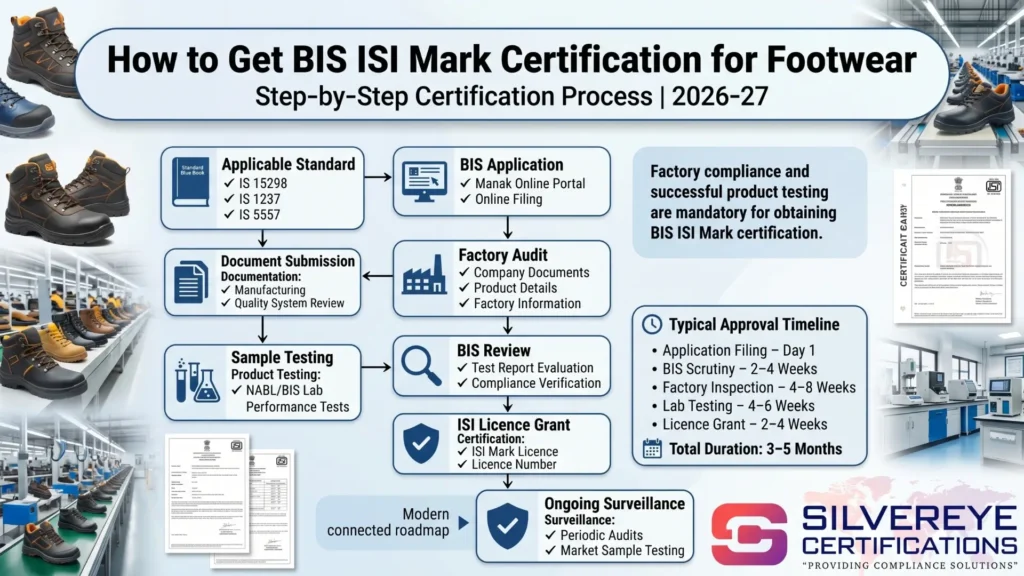
How to Get BIS ISI Mark Certification for Footwear: Step-by-Step Process
BIS certification for footwear is done under the ISI Mark Certification Scheme (Product Certification Scheme I). Here is the complete process, updated for 2026–27:
Step 1: Identify the Applicable Indian Standard
Before applying, confirm which BIS standard applies to your product. For footwear, the primary standards include:
- IS 15298 — Safety footwear (leather and rubber types)
- IS 1237 — Rubber-soled canvas footwear
- IS 5557 — All rubber boots
- Other product-specific standards as listed in the QCO schedule
Step 2: Apply Online via BIS Portal (manakonline.in)
The Bureau of Indian Standards has mandated all ISI certification applications to be submitted exclusively online via the Manakonline.in portal. Physical applications are no longer accepted. Complete the online application with all required details — company information, product details, and manufacturing unit address.
Step 3: Submit Required Documents
Upload all mandatory documents in the format prescribed by BIS. A detailed checklist is provided in the next section.
Step 4: BIS Factory Audit and Inspection
After application review, BIS officers will conduct a factory inspection and audit of your manufacturing premises. The audit checks:
- Manufacturing infrastructure and process capabilities
- In-house quality testing lab and equipment
- Calibration records and traceability
- Quality management and SOP documentation
Step 5: Product Sample Testing
Product samples will be drawn during the factory visit and sent to a BIS-recognized / NABL-accredited testing laboratory for testing against the applicable IS standard. The testing covers parameters such as:
- Tensile strength and elongation of sole material
- Tear strength and abrasion resistance
- Flexing resistance
- Water penetration and water absorption (where applicable)
- Slip resistance and energy absorption
Step 6: Grant of BIS ISI Mark License
If the factory audit and product testing are satisfactory, BIS grants the ISI Mark License. The manufacturer can then legally affix the ISI mark (along with the licence number) on all certified footwear products.
Step 7: Ongoing Surveillance
BIS conducts periodic surveillance visits (typically twice a year) and may draw market samples for re-testing. Failure to maintain product quality can lead to licence suspension or cancellation.
| Stage | Activity | Typical Timeline |
| 1 | Application filing on Manakonline.in | Day 1 |
| 2 | Scrutiny & deficiency clarification by BIS | 2–4 weeks |
| 3 | Factory audit & inspection by BIS officer | 4–8 weeks |
| 4 | Sample drawing & lab testing | 4–6 weeks |
| 5 | Test report review & licence grant | 2–4 weeks |
| Total | End-to-end (approximate) | 3–5 months |
Documents Required for BIS Footwear Certification
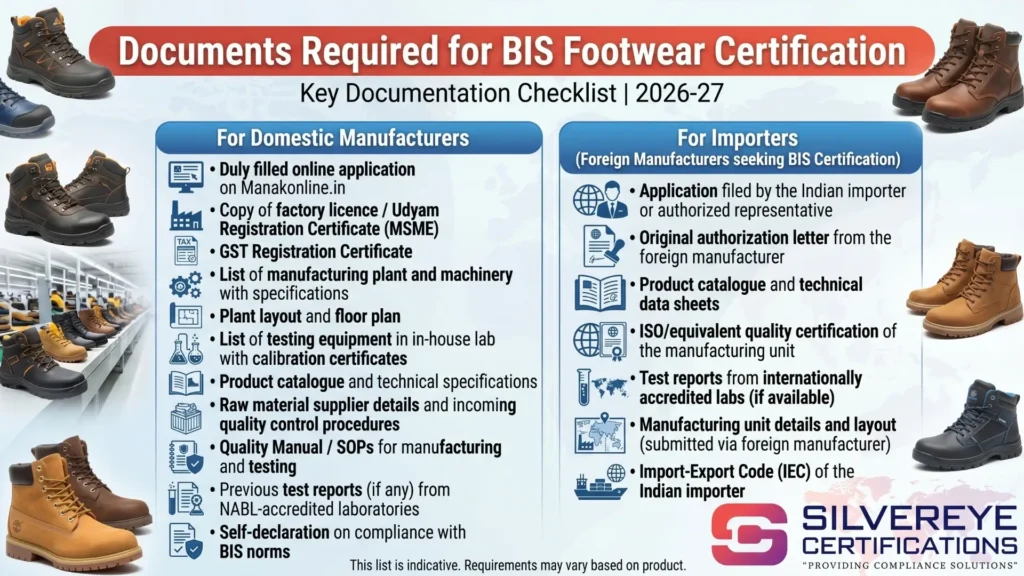
The following documents are required for domestic manufacturers applying for BIS ISI mark certification for footwear. Importers have a different set of requirements (detailed below).
For Domestic Manufacturers
- Duly filled online application on Manakonline.in
- Copy of factory license / Udyam Registration Certificate (MSME)
- GST Registration Certificate
- List of manufacturing plant and machinery with specifications
- Plant layout and floor plan
- List of testing equipment in in-house lab with calibration certificates
- Product catalogue and technical specifications
- Raw material supplier details and incoming quality control procedures
- Quality Manual / SOPs for manufacturing and testing
- Previous test reports (if any) from NABL-accredited laboratories
- Self-declaration on compliance with BIS norms
For Importers (Foreign Manufacturers seeking BIS Certification)
- Application filed by the Indian importer or authorized representative
- Original authorization letter from the foreign manufacturer
- Product catalogue and technical data sheets
- ISO/equivalent quality certification of the manufacturing unit
- Test reports from internationally accredited labs (if available)
- Manufacturing unit details and layout (submitted via foreign manufacturer)
- Import-Export Code (IEC) of the Indian importer
BIS ISI Mark Certification Fees for Footwear
BIS certification fees are governed by BIS Fee Regulations. As of 2026, the fee structure for ISI Mark certification under Scheme I includes the following components:
| Fee Component | Amount (Indicative) |
| Application/Marking Fee | As per BIS schedule — typically INR 1,000–5,000 depending on product/category |
| Licence Fee (Annual) | Based on production/import volume — refer to BIS fee schedule |
| Testing Charges | Borne by applicant; charged by testing laboratory (NABL-accredited) |
| Factory Inspection Charges | TA/DA of BIS officer as per government norms |
| Renewal Fee | Payable annually as per BIS regulations |
| Note: BIS fee structures are updated periodically. Always check the current fee schedule on the official BIS website (bis.gov.in) or Manakonline.in before applying. Consulting a certified BIS compliance partner helps avoid fee-related rejections. |
Validity and Renewal of BIS ISI Mark License for Footwear
License Validity
- BIS ISI mark licenses are typically granted for one year initially.
- Renewal can be done annually, subject to satisfactory surveillance audit and continued product compliance.
- The license number must be displayed alongside the ISI mark on every product.
Renewal Timeline
- Renewal applications should be filed at least 90 days before the license expiry date.
- BIS may conduct a renewal audit before re-issuing the license.
- Non-renewal while continuing to use the ISI mark constitutes a violation of the BIS Act, 2016.
Suspension and Cancellation
- BIS may suspend a license if surveillance samples fail testing.
- Repeated failures or misuse of the ISI mark can result in permanent cancellation.
- A cancelled license holder must immediately stop using the ISI mark on products.
Benefits of BIS ISI Mark Certification for Footwear Manufacturers
While BIS certification is mandatory under the QCO, it also offers strategic advantages to compliant businesses:
- Products with the ISI mark are legally allowed to be sold in the Indian market post the QCO deadline. Non-certified products will be barred. Market Access:
- The ISI mark is one of India's most recognized quality marks — it signals safety and reliability to end consumers. Consumer Confidence:
- Many government procurement tenders for footwear specifically require BIS certification. Institutional and Government Tenders:
- ISI-certified brands stand out in a competitive market where consumers are increasingly quality-conscious. Brand Differentiation:
- Meeting IS standards leads to measurable improvements in product quality and durability. Reduced Returns and Complaints:
- Demonstrating compliance with Indian quality norms builds credibility with international buyers too. Export Readiness:
Penalties for Non-Compliance After 31 July 2027
Once the extended deadline of 31 July 2027 passes, any manufacturer or importer of footwear without a valid BIS ISI mark licence will be in direct violation of the QCO. Under the Bureau of Indian Standards Act, 2016, the following consequences apply:
| Violation | Consequence Under BIS Act, 2016 |
| Selling non-ISI marked footwear covered under QCO | Fine up to INR 2 lakh for first offence; up to INR 5 lakh + imprisonment for repeat offences |
| Using ISI mark without a valid licence | Imprisonment up to 2 years and/or fine |
| Misrepresenting product as BIS certified | Criminal prosecution and product seizure |
| Importing non-compliant footwear for commercial sale | Seizure at customs, rejection of consignment, and financial penalty |
| Misuse of the R&D exemption (selling 'NOT FOR SALE' goods) | Criminal violation + revocation of exemption |
| Compliance Deadline: 31 July 2027 is a hard deadline. Ensure your BIS ISI mark license is in hand well before this date. The certification process takes 3–5 months — begin your application in Q3 2026 or earlier. |
Key Dates and Compliance Timeline at a Glance
| Date | Event | Action Required |
| 15 March 2024 | Original QCO notified (S.O. 1421(E)) | Awareness and planning |
| 30 August 2024 | First Amendment (S.O. 3700(E)) | Review changes, start preparation |
| 12 June 2026 | Second Amendment — Deadline extended to 31 July 2027 (S.O. 3038(E)) | Initiate BIS certification process NOW |
| Q3–Q4 2026 | Recommended window to apply for BIS certification | File application on Manakonline.in |
| Q1–Q2 2027 | BIS audit, testing, and licence grant | Cooperate with BIS inspection |
| 31 July 2027 | Final compliance deadline | Ensure ISI mark is on all products |
| Post 31 July 2027 | Market enforcement begins | Non-compliant products face seizure/penalty |
How Silvereye Certifications Can Help You Meet the BIS Footwear QCO Deadline
Achieving BIS ISI mark certification is not just a regulatory checkbox — it is a multi-step compliance journey that requires technical expertise, documentation precision, and process readiness. At Silvereye Certifications, we specialize in helping Indian and foreign footwear manufacturers navigate the BIS certification maze with confidence.
- End-to-end BIS ISI Mark application management for footwear manufacturers
- Gap assessment of your current factory setup against BIS audit requirements
- Documentation preparation: quality manuals, SOPs, test records, and BIS forms
- Coordination with NABL-accredited testing labs for sample submission
- Manakonline.in portal application filing and deficiency response management
- Post-license surveillance support and annual renewal assistance
- Importer compliance advisory including foreign manufacturer BIS certification support
| Get Started Today: The clock is ticking — 31 July 2027 is closer than you think. Contact Silvereye Certifications today for a free BIS readiness assessment and get your BIS Footwear certification process on track. |
Frequently Asked Questions
Has the BIS Footwear QCO deadline been officially extended?
Yes. The Government of India issued S.O. 3038(E) on 12 June 2026, officially extending the QCO compliance deadline from 31 July 2026 to 31 July 2027. This is a Gazette-notified extension and is legally binding.
Which footwear products are covered under the BIS QCO?
The QCO covers footwear made from leather and other materials including rubber, PU, EVA, synthetic leather, canvas, and more. Specific product categories are listed in the Schedule of the original 2024 order. If you are unsure whether your product is covered, consult a BIS compliance expert.
Can I still sell my footwear without BIS certification until 31 July 2027?
Yes. During the extended window (up to 31 July 2027), you may continue selling without BIS certification. However, we strongly recommend initiating the certification process immediately, as BIS certification takes 3–5 months under ideal circumstances.
What is the new R&D exemption introduced by the June 2026 amendment?
The amendment introduces an exemption allowing leather and footwear manufacturers to import up to 4,500 pairs of footwear per year without BIS certification — strictly for research, development, and non-commercial testing purposes. These pairs cannot be sold, must be marked 'NOT FOR SALE', and may be disposed of as scrap. Year-wise records must be maintained.
Do importers also need BIS certification, or is it only for domestic manufacturers?
Both domestic manufacturers and importers are covered under the BIS Footwear QCO. Importers must ensure that footwear they import for sale in India carries a valid BIS ISI mark. Certification is obtained by the foreign manufacturer through an authorized Indian representative, or the importer can apply under BIS norms.
Where do I apply for BIS ISI mark certification for footwear?
All applications must be submitted exclusively online through the BIS portal at manakonline.in. Physical or offline applications are not accepted. BIS mandated fully online submissions from June 1, 2026.
How long does BIS certification for footwear take?
The end-to-end process typically takes 3 to 5 months from the date of application, depending on BIS officer availability, testing laboratory schedules, and the completeness of your documentation. Apply as early as possible to avoid last-minute delays.
What are the penalties if I don't comply by 31 July 2027?
Non-compliance post 31 July 2027 can attract fines up to INR 2 lakh for a first offence and up to INR 5 lakh with imprisonment for repeat offences, under the BIS Act, 2016. Products can also be seized and consignments rejected at customs.
Can I get a further extension beyond 31 July 2027?
There is no official announcement of any further extension as of June 2026. Businesses should not plan on another extension and must use the current window to achieve full compliance by 31 July 2027.
Is there a list of NABL-accredited labs for footwear testing?
Yes. BIS-recognized and NABL-accredited testing laboratories for footwear testing are listed on the official NABL website (nabl-india.org) and also on bis.gov.in. Ensure you use only approved labs for sample testing, as reports from non-accredited labs are not accepted.