
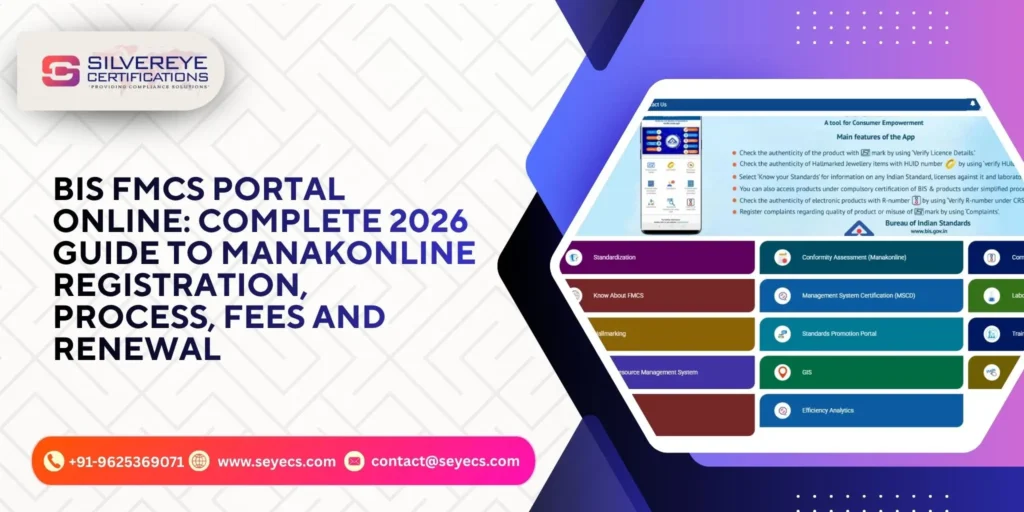
- BIS has made online filing through the Manakonline portal compulsory for every FMCS application from 1 June 2026.
- Apply using Form VI, upload your AIR authorization, factory layout and test reports digitally — no courier needed.
- Track factory inspection, sample testing and license status from a single login on manakonline.in.
- Renew, extend or add product varieties to your FMCS license online before the existing validity ends.
Introduction
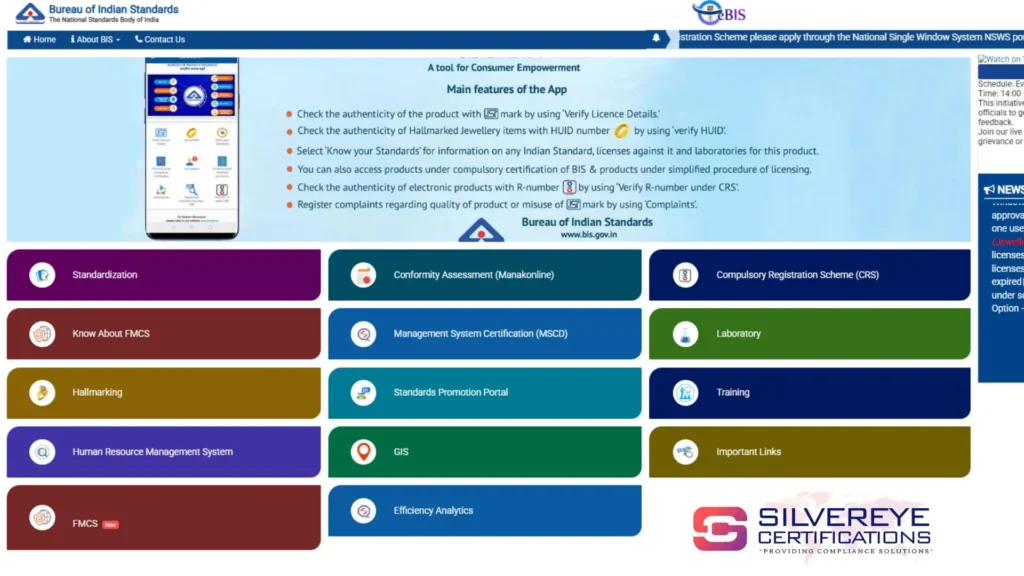
The BIS FMCS Portal Online is Manakonline.in, the official digital platform of the Bureau of Indian Standards (BIS) for the Foreign Manufacturers Certification Scheme (FMCS). Starting 1 June 2026, BIS made online submission compulsory for every FMCS application, ending the earlier paper-based system that required physical document dispatch to BIS headquarters in New Delhi.
Through this portal, overseas manufacturers can fill Form VI, upload company and product documents, appoint an Authorized Indian Representative (AIR), pay fees, track inspection status, and apply for license renewal — all from one dashboard. Once approved, the license lets manufacturers use the ISI Mark with a CM/L number on products exported to India.

For years, foreign manufacturers wanting to sell regulated products in India faced one of the most paperwork-heavy certification processes in the world — printing forms, getting them signed and stamped, and physically couriering them to the Bureau of Indian Standards (BIS) headquarters in New Delhi. That changed in 2026.
The entire Foreign Manufacturers Certification Scheme (FMCS) now runs through a single digital system: the BIS FMCS Portal Online, built on the Manakonline platform. Whether you’re a first-time exporter trying to understand what the FMCS portal is, or an existing CM/L license holder figuring out how renewal works under the new digital rules, this guide covers everything — eligibility, required documents, the step-by-step application process, fees, validity and renewal — based on the latest 2026 regulatory updates from BIS.
What Is BIS FMCS Certification— Foreign Manufacturers Certification Scheme?
FMCS, also called Scheme I certification, is the route through which BIS certifies manufacturing units located outside India. The scheme has been in operation since 2000 and currently runs under the BIS Act, 2016, and the BIS (Conformity Assessment) Regulations, 2018.
Here’s a detail many first-time applicants miss: an FMCS license is granted to a manufacturing facility, not just to a product. BIS evaluates your factory’s production setup, quality control systems and in-house testing capability — not only a sample sent in for testing.
FMCS applies to products covered under India’s Quality Control Orders (QCOs) — from electrical appliances, distribution transformers and steel products to agricultural equipment and several categories of consumer goods. The main exception is electronics and IT products notified by the Ministry of Electronics and Information Technology (MeitY), which are certified separately under the Compulsory Registration Scheme (CRS).
Once a license is granted, the manufacturer can affix the ISI Mark — India’s standard mark of quality and safety — on certified products. Every ISI Mark carries a unique license number in the format CM/L-XXXXXXXXXX, shown alongside the relevant Indian Standard (IS) number.
What Is the BIS FMCS Portal (Manakonline.in)?
The BIS FMCS Portal Online is the foreign-manufacturer module of Manakonline, BIS’s digital certification platform, accessible at manakonline.in. It is administered by the Foreign Manufacturers Certification Department (FMCD), the same department that has overseen FMCS since the scheme began.
Before this portal existed, the entire FMCS workflow — application forms, technical documents, agreements and fee receipts — moved on paper. Manufacturers prepared two complete hard-copy sets, signed and stamped by authorized company personnel, and sent them to their Authorized Indian Representative (AIR), who submitted them in person at BIS headquarters.
The FMCS portal online changes how documents move, not what BIS asks for. You still need the same technical information — factory details, test reports, AIR appointment — but now everything is filled, uploaded, tracked and paid for through one login on manakonline.in.
2026 Update: Online Filing Is Now Mandatory
This is the update every foreign manufacturer and AIR needs to act on: from 1 June 2026, BIS accepts FMCS applications only through the online portal. Offline, paper-based applications were accepted only until 31 May 2026.
If your company has an FMCS application that was filed offline before this cutoff, it continues to be processed under the earlier system. But any new application — and any renewal, amendment or inclusion request filed after 1 June 2026 — must go through Manakonline.
Alongside the move to online filing, the 2026 conformity assessment updates also introduced advance annual fee payment requirements for existing license holders. If a licensee fails to pay the annual fee or submit the required production and quantity details, BIS can suspend the license for up to 90 days, and cancel it if the lapse continues. AIRs are also facing closer scrutiny of their role during factory audits, product testing and post-certification surveillance.
For manufacturers, the practical takeaway is simple: register on the FMCS portal online now, even if your renewal isn’t due for months. Getting familiar with the dashboard, document upload formats and payment gateway ahead of time saves real headaches when a deadline approaches.
Benefits of Applying Through the BIS FMCS Portal Online
Moving FMCS online isn’t just a compliance formality — it changes the day-to-day experience of dealing with BIS in several practical ways:
- Faster processing: Application scrutiny, document checks and internal routing at FMCD happen digitally instead of waiting on courier transit times.
- Real-time status tracking: Log in anytime to check where your application stands — under review, audit scheduled, sample sent for testing, or license issued.
- One dashboard for everything: Applications, renewals, inclusions, fee payments and certificate downloads are all managed from the same Manakonline account.
- No courier dependency: Documents go directly to FMCD electronically, removing the cost, delay and risk of physical document loss in transit.
- Cleaner recordkeeping: Every submission, payment and communication is logged in the portal — useful during renewals, audits or license queries.
- Simplified renewals: The Operative Licenses section shows your license status and renewal eligibility, so you’re less likely to miss a deadline.
Who Is Eligible for FMCS Certification?
FMCS is aimed specifically at manufacturing units located outside India that want to export products to the Indian market. To be eligible, your setup typically needs to meet the following conditions:
- Your manufacturing unit is located outside India and produces a product covered under a mandatory Quality Control Order (QCO).
- The product conforms, or can be made to conform, to the applicable Indian Standard (IS) for that product category.
- Your factory has the manufacturing equipment and in-house testing facilities needed to produce and test the product per the IS specifications.
- Qualified quality control personnel and calibrated test equipment are available on site for ongoing production checks.
- You have appointed, or are ready to appoint, an Authorized Indian Representative (AIR) who is an Indian resident.
- A separate FMCS application is filed for each product variety and each manufacturing location — one license does not automatically cover multiple factories or product types.
If your product doesn’t fall under a notified QCO, FMCS in its mandatory form may not apply — though BIS does offer voluntary certification routes for many product categories. Before starting any FMCS portal application, confirm the current QCO status and applicable IS number for your specific product on the BIS website.
Documents Required for FMCS Portal Application
The FMCS portal online doesn’t reduce the documentation BIS expects — it just changes the submission format from physical to digital. Here’s what you’ll typically need to upload:
| Document | Why It’s Needed |
| Form VI (Application Form) | The prescribed FMCS application form, filled and submitted online. Captures details of the manufacturer, product, applicable IS and AIR. |
| Business registration / incorporation certificate | Official proof that your manufacturing company legally exists in its country of origin. |
| Factory layout diagram | A labeled diagram showing production areas, raw material and finished goods storage, the QC lab, and entry/exit points. |
| Manufacturing process flowchart | A step-by-step depiction of the production process, from incoming raw materials to the final packed product. |
| In-house test equipment details | List and calibration records of testing equipment available at the factory for quality checks. |
| Product test report | A test report from a BIS-recognized laboratory, which should not be older than 90 days at the time of submission. |
| AIR consent and authorization letter | A declaration from your Authorized Indian Representative agreeing to represent your company and comply with BIS rules and license terms. |
| Performance Bank Guarantee (PBG) | A bank guarantee, commonly around USD 10,000, submitted as part of the licensing agreement. |
| Indemnity bond and BIS agreement | Signed undertakings forming part of the formal licensing arrangement between the manufacturer and BIS. |
| KYC documents | Identity and address proof for both the manufacturer’s authorized signatory and the AIR. |
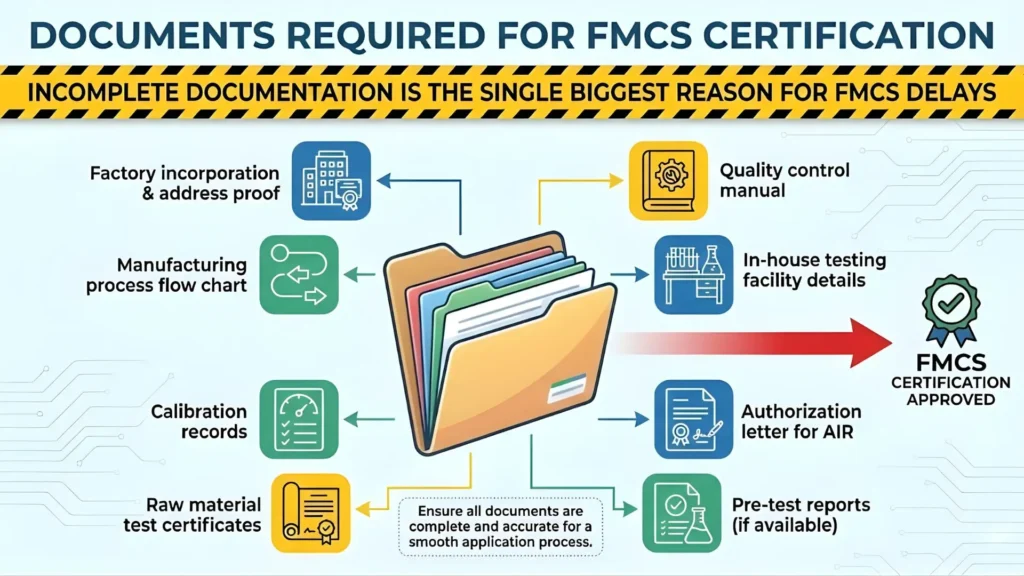
Keep digital copies in clean, clearly named and legible formats — the portal works best with properly labeled PDF or image files rather than scanned bundles of mixed documents.
Step-by-Step: How to Apply on the BIS FMCS Portal Online
While timelines vary by product category and how quickly documents are ready, the overall FMCS portal online application generally follows these stages:
- Identify the applicable Indian Standard (IS) — Confirm the IS number and current QCO status for your product on the BIS website before you do anything else — this determines the technical requirements and test protocols your factory must meet.
- Appoint your Authorized Indian Representative (AIR) — Choose an Indian resident who isn’t already representing another foreign manufacturer, and have them sign the required consent and undertaking.
- Register on the Manakonline portal — Create your account at manakonline.in and complete the entity registration steps for your company.
- Fill Form VI and upload supporting documents — Complete the online application form and attach the factory layout, process flowchart, test reports, AIR authorization and other required documents in digital format.
- Pay the application and inspection fees online — Use the portal’s payment gateway to pay the prescribed fees — the application will not move forward until payment is confirmed.
- BIS scrutiny of the application — FMCD reviews the submitted documents. If anything is missing or inconsistent, you’ll be notified by email through the portal.
- Factory audit scheduling and inspection — A BIS officer schedules and conducts a factory visit to verify the production process, testing facilities and quality systems, and may draw product samples on site.
- Product sample testing — Samples collected during the audit are sealed and sent to a BIS-recognized laboratory for testing against the applicable Indian Standard.
- License grant and CM/L number issuance — Once the audit and test reports are satisfactory, BIS grants the FMCS license and issues a unique CM/L license number for use with the ISI Mark.
- Download your e-certificate from the portal — Log in to Manakonline, go to your dashboard or ‘My Licenses’, and download the certificate for your records.
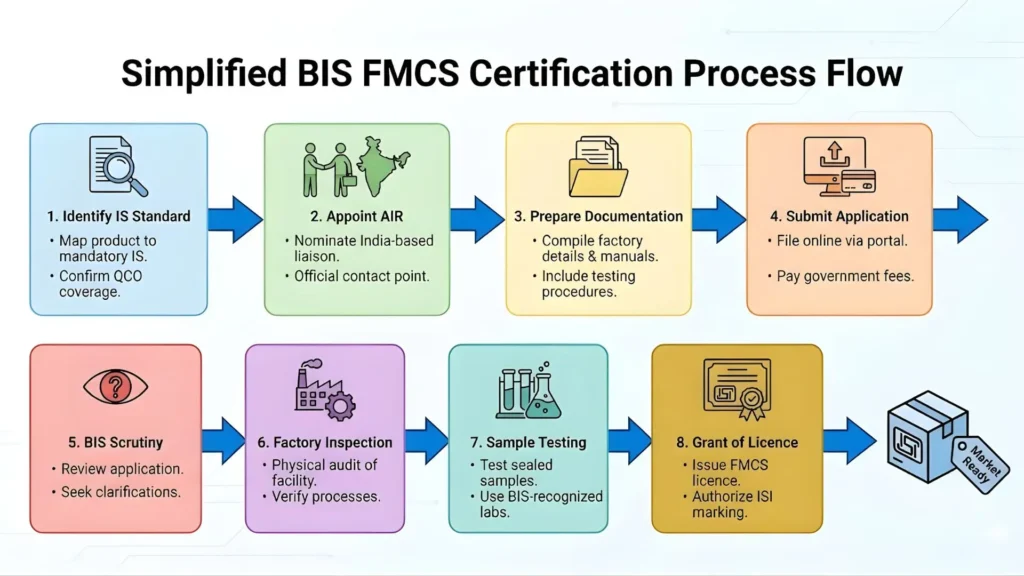
Most applications take roughly 90 to 120 days from submission to license grant, though the process can extend closer to six months depending on document completeness, audit scheduling and how quickly queries from BIS are answered.
BIS FMCS Portal Fees: What to Expect
FMCS certification involves several fee components, all paid through the portal’s payment gateway and exclusive of GST. The exact amounts depend on your product category, the applicable Indian Standard and BIS’s current fee schedule — always confirm figures on manakonline.in before budgeting. Broadly, the fee structure includes:
| Fee Component | What It Covers |
| Application fee | Covers processing of your Form VI submission and initial document review. |
| License (grant) fee | A one-time fee charged when BIS approves and issues the FMCS license. |
| Inspection / audit fee | Covers the cost of the BIS officer’s factory visit and on-site assessment. |
| Testing charges | Fees for testing product samples at a BIS-recognized laboratory. |
| Marking fee (advance, annual) | An advance minimum fee based on expected production or sales quantity, payable annually under the 2026 rules. |
| Renewal fee | Paid at the time of license renewal, for extensions ranging from one to five years. |
| Late renewal fee | An additional charge, commonly around ₹5,000, applies if renewal is filed after the license has already expired. |
Because the 2026 update requires marking fees to be paid in advance each year, it’s worth setting an internal reminder ahead of your license’s annual due date — missing this payment is one of the most common, and avoidable, reasons for license suspension.
FMCS License Validity and Online Renewal Process
An FMCS license is typically granted for a validity period of one to two years, depending on the product category and the terms set by BIS at the time of approval. The license is tied to a specific manufacturing facility and product variety, so any change in either may require a fresh application or an inclusion request.
- Renewing your license through the FMCS portal online is straightforward once you know where to look:
- Log in to your account on manakonline.in with your registered credentials.
- Open the Product Certification tile and select ‘Operative Licenses’ to view your current licenses and their validity dates.
- If your license is within the renewal window, an ‘Apply for Renewal’ option becomes available — click it to start the renewal application.
- Enter the required details, upload any supporting documents requested (renewal applications are typically supported by a chartered accountant’s certificate covering production and sales figures), and make the requisite fee payment.
- Renewal can extend the license for a minimum of one year up to a maximum of five years, depending on the fees paid and BIS approval.
- To add a new product variety under an existing license, use the ‘Apply for Inclusion’ option in the same Operative Licenses section.
If renewal is filed after the license has already expired, a late fee (commonly around ₹5,000) applies in addition to the regular renewal charges. And under the 2026 advance-fee rules, failing to pay the annual marking fee on time — even before your license formally expires — can lead to suspension of the license for up to 90 days, with cancellation possible if the lapse isn’t resolved.
Role of the Authorized Indian Representative (AIR)
The AIR is one of the most important relationships in the entire FMCS process, and the FMCS portal online doesn’t remove this requirement — if anything, the 2026 updates place more responsibility on the AIR than before.
- Must be an Indian resident, appointed specifically to represent your company before BIS.
- Can represent only one foreign manufacturer at a time — an existing AIR for another company cannot take on a second client.
- Submits and manages the FMCS application, renewals and inclusions on the portal on behalf of the manufacturer.
- Coordinates factory audit scheduling, communicates BIS queries back to the manufacturer, and tracks product sample testing status.
- Provides a formal consent and undertaking to comply with the BIS Act, rules, regulations and the terms of the BIS licence agreement.
- Acts as the primary point of contact for ongoing surveillance activities, including marking fee and quantity report submissions after the license is granted.
Common Mistakes to Avoid on the BIS FMCS Portal
A surprising number of FMCS delays come down to small, avoidable errors during the online application. Watch out for these:
- Uploading product test reports older than 90 days — these are typically rejected, forcing you to repeat testing and resubmit.
- Selecting the wrong Indian Standard (IS) number for your product, which can derail the entire application at the audit stage.
- Mismatched KYC details between the manufacturer’s documents and the AIR’s authorization letter.
- Missing or unclear factory layout diagrams and process flowcharts — a common reason for query emails from FMCD.
- Overlooking the advance annual marking fee payment introduced under the 2026 rules, which risks license suspension even for active license holders.
- Appointing an AIR who is already representing another foreign manufacturer, which is not permitted under FMCS rules.
- Waiting until after the license expires to start the renewal process, resulting in an avoidable late fee.
Conclusion
The shift to a fully online FMCS portal is one of the most significant operational changes for foreign manufacturers exporting to India in recent years. While the underlying eligibility rules, documents and Indian Standards haven’t changed, the way you interact with BIS has — everything from your first Form VI submission to your next license renewal now happens on Manakonline.
If your company already holds an FMCS license, it’s worth logging into the portal now to check your operative license status, confirm your AIR details are up to date, and review the advance annual fee requirement so you don’t risk suspension. If you’re applying for the first time, start by confirming the applicable Indian Standard for your product and lining up your AIR — the portal moves faster when your documentation is ready before you begin.
For manufacturers unfamiliar with Indian regulatory filings, working with an experienced BIS FMCS consultant can help you avoid the common documentation errors covered above and keep your application on track.
Frequently Asked Questions
What is the BIS FMCS Portal Online?
The BIS FMCS Portal Online is Manakonline.in, the official digital platform of the Bureau of Indian Standards used to apply for, manage and renew Foreign Manufacturers Certification Scheme (FMCS) licenses. It is administered by the Foreign Manufacturers Certification Department (FMCD) and replaces the earlier paper-based FMCS application system.
Is online application mandatory for FMCS in 2026?
Yes. From 1 June 2026, BIS accepts FMCS applications, renewals and inclusions only through the Manakonline portal. Offline, paper-based applications were accepted only until 31 May 2026, after which BIS does not process hard-copy FMCS submissions.
What is Form VI?
Form VI is the prescribed FMCS application form. It captures details about the manufacturer’s company, the product and applicable Indian Standard, the manufacturing facility, and the Authorized Indian Representative. Under the new system, Form VI is filled and submitted directly through the FMCS portal online.
Who needs to appoint an Authorized Indian Representative (AIR)?
Every foreign manufacturer without a branch office in India must appoint an AIR before applying for FMCS. The AIR must be an Indian resident, can represent only one foreign manufacturer at a time, and is responsible for coordinating documentation, audits and renewals with BIS.
How long does FMCS certification take to get approved?
Most applications take roughly 90 to 120 days from submission to license grant, though it can extend to around six months depending on document completeness, factory audit scheduling, test report turnaround, and how quickly queries raised by BIS are answered.
What documents do I need to upload on the FMCS portal?
Core documents include Form VI, the manufacturer’s business registration certificate, factory layout diagram, manufacturing process flowchart, in-house test equipment details, a product test report from a BIS-recognized lab not older than 90 days, AIR authorization letter, and supporting agreements such as the Performance Bank Guarantee and indemnity bond.
Are international certifications accepted instead of FMCS?
No. If a product falls under a mandatory Quality Control Order, an FMCS license from BIS is compulsory for sale in India, regardless of any certification the manufacturer already holds from another country’s standards body.
How much does FMCS certification cost?
FMCS fees include an application fee, license fee, inspection/audit fee, testing charges, and an advance marking fee, all exclusive of GST. The exact amount depends on the product category and applicable Indian Standard, and the current fee schedule is available on the Manakonline portal.
How long is an FMCS license valid?
An FMCS license is typically granted for one to two years, depending on the product category and the licensing terms set by BIS at the time of grant.
How do I renew my FMCS license through Manakonline?
Log in to Manakonline, open the Product Certification tile, and select ‘Operative Licenses’. If your license is approaching expiry, an ‘Apply for Renewal’ option appears — you can renew for a minimum of one year up to a maximum of five years by paying the license and marking fees.
What happens if I miss the annual fee payment?
Under the 2026 rules, failing to pay the annual marking fee or submit production details on time can lead to suspension of the FMCS license for up to 90 days. If the lapse continues, BIS can cancel the license entirely.
Can electronic products be certified under FMCS?
Generally no. Electronics and IT products notified by the Ministry of Electronics and Information Technology (MeitY) are certified under the separate Compulsory Registration Scheme (CRS), not FMCS. FMCS covers most other QCO-notified product categories.
What is the CM/L number on the ISI Mark?
CM/L stands for Certification Marking Licence. It is the unique licence number issued by BIS once an FMCS application is approved, displayed on the ISI Mark along with the relevant Indian Standard number, and can be verified on the Manakonline public license database.