

- BEE Star Label for imported appliances is mandatory before customs clearance — importing products in 26+ categories without a valid BEE registration can lead to detention, seizure, or destruction of the entire consignment at the port of entry.
- As an importer, you are personally responsible for obtaining BEE certification — the foreign manufacturer cannot hold the registration on your behalf. The BEE registration must be in the importer's name, with an Indian address and a valid IEC.
- The BEE certification process for importers must begin at least 8 to 16 weeks before the shipment lands — testing, document preparation, and portal approval take time, and customs will not release goods without a valid BEE registration number on the label.
- BEE import compliance covers multiple laws simultaneously — the Energy Conservation Act 2001, the Foreign Trade Policy, and Customs Act provisions all intersect when importing energy-consuming appliances into India.
Why BEE Star Label For Imported Appliances Is Non-Negotiable in 2026?
If you are an importer of electrical appliances or equipment into India, BEE Star Label certification is one of the most business-critical compliance requirements you will face. Miss it, and your consignment sits at the port. Get it wrong, and it gets destroyed. Get it right, and your goods clear customs, reach the market, and carry a star rating that consumers actively look for.

The Bureau of Energy Efficiency (BEE), a statutory body under the Ministry of Power, Government of India, administers the Standards and Labelling (S&L) Programme. This programme mandates that specific product categories — air conditioners, refrigerators, LED lamps, fans, televisions, washing machines, and others — must carry a valid BEE Star Label before they can be sold in India.
For importers, the compliance obligation is clear: you cannot import and sell these products in India unless the product is registered with BEE in your name, the BEE Star Label is affixed to every unit, and the registration is valid at the time the goods cross the Indian border.
The Legal Framework: What Laws Govern BEE Compliance for Importers?
BEE import compliance for appliances in India does not sit under one single law. It spans three overlapping regulatory frameworks. Understanding all three helps you avoid the costly mistake of assuming one compliance covers another.
| Law / Regulation | Administered By | Relevance to Importers |
| Energy Conservation Act, 2001 (amended 2022) | Bureau of Energy Efficiency (BEE), Ministry of Power | Mandates BEE Star Label on notified product categories. Prescribes penalties for non-compliance. |
| Foreign Trade (Development & Regulation) Act, 1992 — Foreign Trade Policy 2023 | DGFT, Ministry of Commerce | Import of notified goods without BEE label is treated as a violation of import conditions. Shipments can be detained at port. |
| Customs Act, 1962 — Customs Notifications | CBIC, Ministry of Finance | Customs officers verify BEE label compliance at the time of import clearance. Non-compliant goods are held, re-exported, or destroyed. |
| BEE Standards & Labelling Schedules | BEE, Ministry of Power | Product-specific technical standards and labelling requirements. Each schedule defines MEPS, star rating criteria, and label format. |
Which Imported Appliances Need BEE Star Label Certification?
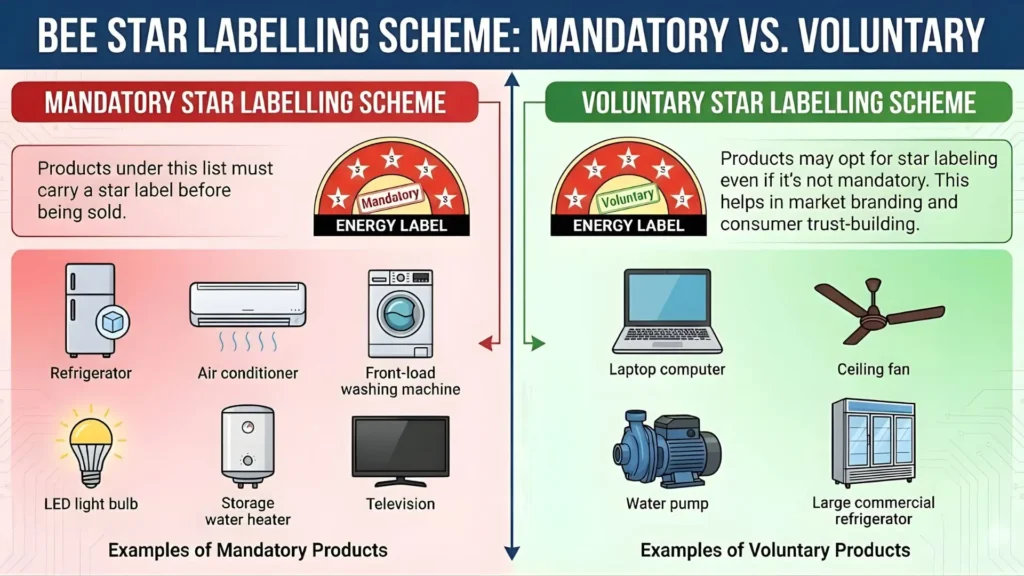
The BEE Standards and Labelling Programme covers two types of labelling: Mandatory and Voluntary. For importers, mandatory categories are the ones that require BEE certification before the goods can enter India through customs.
Mandatory BEE Labelling: Products That Cannot Be Imported Without Certification
As of 2026, the following product categories require mandatory BEE Star Label compliance for import into India:
| Product Category | Mandatory Since | Applicable Standard | Key Notes for Importers |
| Room Air Conditioner — Split & Window (Fixed Speed) | 2006 | IS 1391 Part 1 & 2 | Separate registration for each model and capacity |
| Room Air Conditioner — Inverter Type | 2018 | IS 1391 Part 1 | Annual MEPS revision — verify at time of testing |
| Refrigerator — Direct Cool | 2006 | IS 1476 Part 1 | Net volume and energy consumption must match label |
| Refrigerator — Frost Free | 2006 | IS 1476 Part 2 | Separate registrations for each model range |
| Ceiling Fan | 2010 | IS 374 | BEE revised star criteria in 2023 — check current norms |
| LED Lamp (Non-Directional) | 2015 | IS 16102 Part 1 | Annual MEPS — test reports must be current |
| LED Luminaire (Indoor) | 2017 | IS 10322 Part 5 | Multiple sub-categories — verify applicable IS |
| Washing Machine — Fully Automatic | 2013 | IS 302 Part 2 Sec 7 | Separate for top-load and front-load |
| Washing Machine — Semi-Automatic | 2013 | IS 302 Part 2 Sec 7 | Less common in B2B import — verify category status |
| Electric Storage Water Heater (Geyser) | 2010 | IS 2082 | Registration required for each wattage/capacity variant |
| Colour Television Set | 2014 | IS 616 | Includes smart TVs — LED and QLED panels covered |
| Distribution Transformer | 2009 | IS 1180 Part 1 | Critical for industrial importers — heavy penalty regime |
| Motors — IE2 and IE3 Class | 2017 | IS 12615 | OEM importers of industrial equipment — check embedded motor compliance |
| Light Commercial Air Conditioner | 2018 | IS 1391 | Covers cassette, ducted, and VRF systems |
Important for B2B Importers: If you import industrial equipment or machinery that contains a motor, compressor, or transformer covered under mandatory BEE labelling, the sub-component itself may need separate BEE compliance. Consult a regulatory expert before importing complex equipment.
Voluntary BEE Labelling: Should Importers Still Consider It?
Products under voluntary BEE labelling are not detained at customs for non-compliance. However, applying for voluntary BEE Star Label on imported products still makes commercial sense in India's 2026 market because:
- Large format retailers and e-commerce platforms increasingly prefer listed products with star ratings
- Government and institutional procurement often specifies minimum star ratings even for voluntary categories
- Voluntary certification today can become mandatory certification tomorrow — early compliance avoids emergency retrofitting
- For B2B buyers, BEE star rating on voluntary products is treated as a quality and reliability marker
Who Must Register: The Importer's Responsibility Under BEE Rules
One of the most common misconceptions among first-time importers is that the foreign manufacturer can hold or transfer BEE registration to them. This is not how BEE import compliance works in India.
The Importer Is the Responsible Party — Always
Under BEE's Standards and Labelling Programme, the entity that sells the product in India is responsible for the BEE registration. For imported goods, this is the Indian importer — the entity whose name appears on the import documents, holds the IEC, and receives the goods in India.
| Scenario | Who Registers With BEE? |
| Indian company importing and selling under its own brand | The Indian importer company |
| Indian company importing as exclusive distributor of a foreign brand | The Indian importer company (not the foreign brand owner) |
| Indian subsidiary of a foreign manufacturer importing goods for Indian sale | The Indian subsidiary (as the legal entity receiving and selling in India) |
| Trading company importing and selling in India | The trading company |
| Contract manufacturer outside India supplying to Indian buyer | The Indian buyer/importer |
| E-commerce seller importing through a fulfilment model | The Indian legal entity responsible for the import and sale |
Eligibility Checklist for Importers Applying for BEE Registration
- Registered legal entity in India (Private Limited, LLP, Partnership, Sole Proprietorship)
- Valid Import Export Code (IEC) issued by DGFT
- Active GST registration with a valid GSTIN
- PAN card of the company
- Authorization letter from the foreign manufacturer permitting the Indian importer to use the brand and model for BEE registration
- Product falls under a BEE-covered category
- Test report from a BEE-approved or NABL-accredited laboratory covering the applicable IS standard
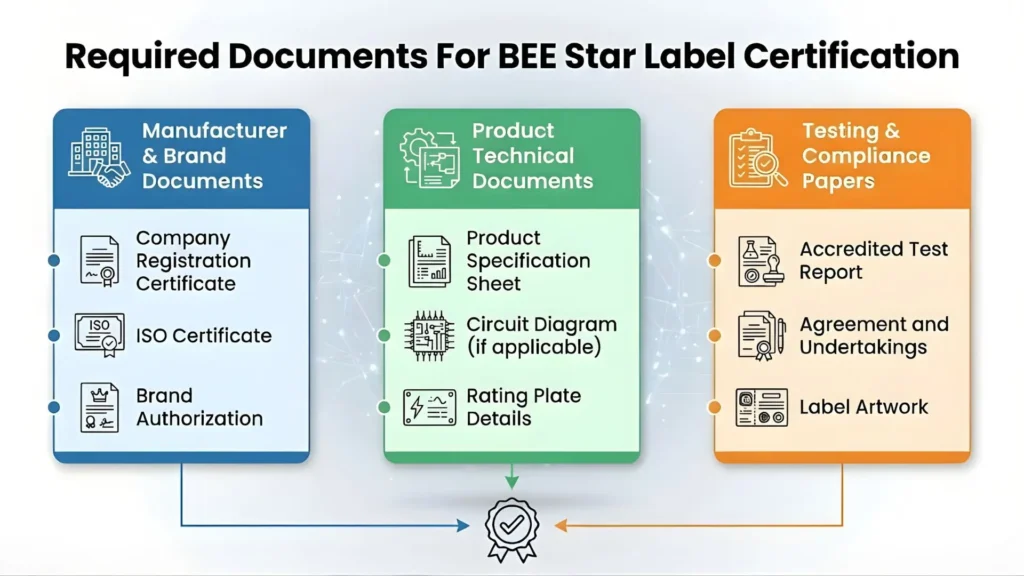
Complete Document Checklist for BEE Import Compliance
The document checklist for importers is more extensive than for domestic manufacturers. This is because you are dealing with both the Indian regulatory system (BEE, DGFT, Customs) and a foreign supply chain. Having every document ready before you begin the application dramatically reduces processing time.
Company Identity and Registration Documents
- Certificate of Incorporation or Shop and Establishment Registration
- PAN Card of the importing company
- GST Registration Certificate (GSTIN)
- Import Export Code (IEC) Certificate issued by DGFT
- Udyam Registration Certificate (if MSME — required for concessional fee)
- Cancelled cheque or bank account proof for the importing company
Authorization and Brand Documents
- Authorization Letter from Foreign Manufacturer: This is the single most important importer-specific document. The foreign manufacturer must provide a signed and company-stamped letter authorizing the Indian importer to apply for BEE registration for specific models and to use their brand name / trademark in India. The letter must specify model numbers, product categories, and the duration of authorization.
- Trademark / Brand Usage Agreement: If the imported product carries a foreign brand, the importer must be able to demonstrate legal authorization to use that brand in India. A trademark license or distribution agreement suffices.
- Foreign Manufacturer Details: Name, address, country, and company registration details of the foreign manufacturer.
Product and Technical Documents
- Test Report from a BEE-approved or NABL-accredited lab — must test as per the Indian Standard (IS) version cited in the current BEE Product Schedule
- Product technical specifications / datasheet (must match test report parameters)
- Photographs of the physical product: front view, rear view, label placement area, nameplate
- Model number and variant list — each variant with different energy consumption needs separate registration
- Bill of Materials (BOM) or component summary (required for some categories like transformers and motors)
- Sample BEE Star Label artwork designed as per BEE's current label template
Import-Specific Documents
- Copy of the original foreign test report (if testing was done abroad — see Section 6 on foreign test reports)
- Translation of foreign test report into English (certified translation required if original is in another language)
- Proof of product's country of origin (factory certificate or Certificate of Origin)
- IEC Certificate (mandatory — without this, BEE will not accept an import application)
Product Testing for BEE Import Compliance: Everything Importers Must Know
Testing is the technical foundation of BEE Star Label Certification. For importers, this is often the step that takes the most time and requires the most planning — especially when the product is manufactured overseas.
Where Must the Product Be Tested?
The product must be tested at one of the following:
- BEE-Approved Indian Test Lab: The safest and most straightforward route. Test reports from BEE-approved labs in India are accepted without question. The full list of approved labs by product category is published on beestarlabel.com.
- NABL-Accredited Indian Lab: NABL-accredited labs that have scope for the specific IS standard applicable to your product category are also accepted. Always verify that the accreditation scope explicitly covers the IS standard version specified in the current BEE Product Schedule.
- Foreign Lab with NABL MRA: Test reports from foreign laboratories that have a Mutual Recognition Agreement (MRA) with NABL are conditionally accepted. This is subject to BEE's verification and is not available for all product categories. Confirm acceptability with BEE before relying on a foreign test report.
Critical Rules About the Test Report
- The test must be conducted on a production-representative sample — not a specially built prototype or cherry-picked unit
- The test report must be dated not more than 2 years before the date of BEE application
- The test must cover all parameters specified in the BEE Product Schedule, not just select parameters
- The Indian Standard (IS) version cited in the test report must match the version in the current BEE Schedule — using an outdated IS version leads to rejection
- If MEPS for your product category has been revised since the test was conducted, the test report may be invalid even if it is less than 2 years old — verify this before applying
How Long Does Testing Take?
| Product Category | Typical Lab Testing Time | Key Consideration |
| Room Air Conditioner | 3 – 6 Weeks | Calorimeter testing — book lab slots in advance |
| Refrigerator | 3 – 5 Weeks | Multiple temperature cycle tests required |
| LED Lamp / Luminaire | 2 – 4 Weeks | Photometric and electrical tests both required |
| Ceiling Fan | 2 – 4 Weeks | Air delivery and power input tests |
| Washing Machine | 3 – 5 Weeks | Wash performance and energy cycle tests |
| Electric Geyser | 2 – 3 Weeks | Standing loss and input power tests |
| Distribution Transformer | 4 – 8 Weeks | High-power testing facility required — limited labs |
| Television | 2 – 4 Weeks | Picture mode energy measurement protocol |
| Motor (IE Class) | 3 – 6 Weeks | Load-based efficiency testing |
Step-by-Step BEE Certification Process for Importers of Appliances
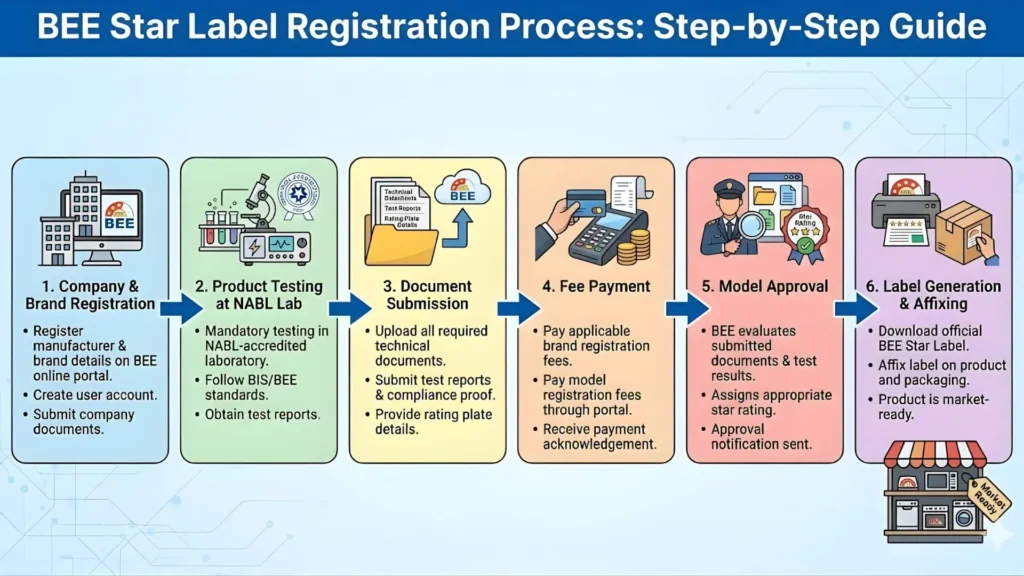
The BEE certification process for importers is entirely online through beestarlabel.com. Here is the complete step-by-step process for 2026, specifically written for importers — not domestic manufacturers.
Step 1: Confirm Your Product Category and Labelling Type
Go to bee star label and navigate to the Products section. Download the Product Schedule for your specific appliance category. Confirm whether your product falls under Mandatory or Voluntary S&L. Note the exact Indian Standard (IS) version specified — this is what your test report must comply with.
Step 2: Obtain the Manufacturer's Authorization Letter
Before doing anything else, obtain a signed authorisation letter from the foreign manufacturer. This letter must authorise you, by company name and IEC, to register the specified product models with BEE in India. Without this, your application will be rejected at the document scrutiny stage — no matter how good your test report is.
Step 3: Send Product Samples for Testing at a BEE-Approved Lab
Identify a BEE-approved or NABL-accredited lab for your product category. Send 2 to 3 production samples to the lab. Provide the lab with the relevant BEE Product Schedule so they test as per the correct IS standard and cover all required parameters. Collect the final signed test report.
Step 4: Register as a New User on the BEE Portal
Visit beestarlabel.com. Click on Manufacturer/Importer Registration. Select Importer. Fill in your company details: legal name, registered address, IEC number, GSTIN, and contact details. Submit and collect your login credentials from the registered email.
Step 5: Log In and Fill the Online Application Form
Log in to the portal. Click Apply for Registration. Select the product category and labelling type. Fill in all mandatory fields — this includes:
- Foreign manufacturer's name and country
- Brand name and model number of the product
- Energy consumption figures from the test report
- Star rating claimed based on energy consumption
- Product specifications as per BEE's prescribed format
- Indian importer's address and IEC number
Step 6: Upload All Documents
Upload scanned copies of all documents from the checklist. BEE accepts PDF and JPG formats. Maximum file size per document is typically 2 MB. All documents must be legible. The authorisation letter from the foreign manufacturer is the document most often flagged for issues — ensure it is on company letterhead, signed, and stamped.
Step 7: Pay the BEE Registration Fee Online
Navigate to the payment section. BEE registration fees can be paid via net banking or NEFT/RTGS. Keep the payment acknowledgement receipt — upload it as proof of payment on the portal.
Step 8: Submit and Track Your Application
Submit the complete application. You will receive an Application Reference Number. Use this to track your application status on the portal. BEE's technical team will review the application. If there are deficiencies — missing documents, test report discrepancies, label design errors — you will receive a deficiency notice. Respond within the stipulated time to avoid the application lapsing.
Step 9: Receive BEE Registration Certificate
On approval, BEE issues a Registration Certificate specifying the registration number, star rating, product model, importer name, and validity period. This certificate is the document customs will look for during import clearance.
Step 10: Affix BEE Star Label on Every Unit Before Customs Clearance
Generate the BEE Star Label using BEE's label tool on the portal — or design it per BEE's prescribed template. The label must be affixed to every unit before the goods reach the customs examination counter. You cannot affix labels post-clearance. The label must display the BEE registration number, star rating, energy consumption, and validity dates.
BEE Compliance at Indian Customs: How the Clearance Process Works
Understanding what happens at the port of entry is critical for importers. Customs clearance for BEE-mandatory products involves specific checks that go beyond the standard import documentation.
What Customs Officers Check at the Port
- Whether the product model is registered with BEE and the registration is currently valid
- Whether the BEE Star Label is physically affixed on every unit in the consignment
- Whether the label displays the correct BEE registration number, star rating, energy consumption, and validity dates
- Whether the importer's name on the BEE certificate matches the consignee on the import Bill of Entry
- Whether the product model and capacity on the BEE certificate matches the product in the shipment
What Happens if BEE Compliance Is Missing at Customs
| Non-Compliance Scenario | Likely Customs Action | Outcome for Importer |
| No BEE registration at all | Shipment detained. Show-cause notice issued. | Goods held at CFS. Warehousing costs accumulate. Re-export or destruction likely. |
| BEE registration valid but label not affixed on units | Shipment may be held pending label affixation or re-export | Some ports allow supervised labelling at bonded warehouse — not guaranteed everywhere |
| BEE registration expired at the time of import | Treated as non-registered product | Same as having no registration — detention or re-export |
| Model on BEE certificate does not match imported model | Treated as unregistered model | Show-cause notice, possible seizure |
| Importer name on BEE certificate does not match importer on Bill of Entry | Consignment flagged for irregular documentation | Held for investigation — significant delays |
| BEE label on units does not match registered label design | Label non-compliance notice | Goods held, may need re-labelling under supervision |
BEE Registration Fees for Importers: 2026 Fee Structure
BEE registration fees for importers follow the same structure as fees for domestic manufacturers. The fee is determined by the product category and the annual turnover or enterprise classification of the importing company.
| Enterprise Classification | Annual Turnover | Indicative Fee Per Registration |
| Micro Enterprise (Udyam) | Up to Rs. 5 Crore | Rs. 5,000 – Rs. 10,000 |
| Small Enterprise (Udyam) | Rs. 5 Cr to Rs. 50 Cr | Rs. 10,000 – Rs. 25,000 |
| Medium Enterprise | Rs. 50 Cr to Rs. 250 Cr | Rs. 25,000 – Rs. 75,000 |
| Large Company | Above Rs. 250 Crore | Rs. 75,000 – Rs. 2,00,000 |
| Renewal (all categories) | — | Approximately 50% of initial fee |
In addition to the BEE registration fee, importers should budget for:
- Lab Testing Fees: Rs. 20,000 to Rs. 2,00,000 depending on product category and number of models. AC and transformer testing tends to be the most expensive.
- Label Printing Costs: Variable based on order quantity. BEE labels must be printed at approved quality to maintain durability on the product.
- Regulatory Consultant Fees (if used): Rs. 15,000 to Rs. 75,000 per engagement depending on scope and number of models.
- Sample Shipping for Testing: Cost of shipping 2 to 3 units from overseas factory to Indian test lab — variable by product size and origin country.
BEE Registration Validity and Renewal Timeline for Importers
How Long Is a BEE Registration Valid?
BEE Star Label registration for imported appliances is typically valid for 1 to 2 years, depending on the product category. The validity period is printed on the Registration Certificate. Importing and selling products after the registration has expired is treated identically to having no registration at all.
| Product Category | Typical Validity | Renewal Notes |
| Room Air Conditioner (Fixed Speed) | 2 Years | MEPS revised frequently — fresh test may be needed |
| Inverter AC | 1 Year | Annual MEPS — fresh test report required at each renewal |
| Refrigerator (Direct Cool / Frost Free) | 2 Years | Check for revised MEPS before renewal |
| LED Lamp / Luminaire | 1 Year | Annual MEPS revision — test report typically needs refresh |
| Ceiling Fan | 2 Years | BEE revised criteria in 2023 — verify at renewal |
| Washing Machine | 2 Years | Test report older than 2 years will not be accepted |
| Electric Geyser | 2 Years | Straightforward renewal if model unchanged |
| Colour Television | 2 Years | Check for revised IS standard before testing |
| Distribution Transformer | 2 Years | High testing cost — plan renewal early |
| Motors (IE Class) | 2 Years | Verify IE class norms at renewal |
Step-by-Step BEE Registration Renewal Process for Importers
- Log in to beestarlabel.com using your importer credentials at least 3 months before expiry
- Navigate to Renewal Application for the specific registered model
- Verify whether MEPS norms have changed for your product category since the last registration
- If MEPS have changed or the previous test report is older than 2 years — commission fresh testing at a BEE-approved lab before applying for renewal
- Upload updated documents — including a renewed authorization letter from the foreign manufacturer if the previous one has expired
- Pay the renewal fee (approximately 50% of initial fee)
- Submit the renewal application and track approval status
- Receive the renewed Registration Certificate with the new validity period
- Update the BEE Star Label on all new shipments to reflect the new validity dates
Penalties for Non-Compliance: What Importers Risk
The consequences of BEE non-compliance for importers span three different legal frameworks — and they can stack on top of each other. Here is a realistic picture of the penalties:
| Violation | Applicable Law | Penalty |
| Selling without BEE registration (first offence) | Energy Conservation Act 2001 | Fine up to Rs. 10,000 |
| Selling without BEE registration (continuing default) | Energy Conservation Act 2001 | Rs. 10,000 plus Rs. 1,000 per day of default |
| Importing notified goods without BEE label | Foreign Trade Policy / Customs Act | Goods detained, re-exported, or destroyed at importer's cost |
| Misrepresentation of star rating on label | Energy Conservation Act 2001 + IPC provisions | Prosecution possible. Registration cancelled. |
| Selling after registration expiry | Energy Conservation Act 2001 | Same as no registration — fine + product recall risk |
| BEE label design not matching approved format | BEE S&L Programme Rules | Registration suspension, show-cause notice |
| Market surveillance failure (product does not match registered parameters) | BEE S&L Programme Rules | Registration cancellation, possible legal action |
Beyond financial penalties, non-compliance creates significant reputational risk for importers in India's B2B appliance market. Institutional buyers, large retailers, and e-commerce platforms increasingly audit supplier compliance. A BEE non-compliance incident can cost you commercial relationships that are worth far more than any regulatory fine.
BEE Star Label vs Other Import Compliance Requirements: What Importers Often Confuse
BEE Star Label certification is one of several compliance requirements for importing electrical appliances into India. Understanding how it relates to — and differs from — other schemes helps importers avoid the mistake of thinking one compliance covers all.
| Compliance Requirement | Governed By | Applies To | Relation to BEE |
| BEE Star Label | Bureau of Energy Efficiency (BEE) | Energy-consuming appliances in notified categories | Mandatory before sale / import of notified products |
| BIS CRS (Compulsory Registration Scheme) | Bureau of Indian Standards (BIS) | Electronics and IT goods — mobiles, laptops, adapters, etc. | Separate from BEE. Many products need both BEE and BIS CRS. |
| BIS ISI Mark | Bureau of Indian Standards (BIS) | Specific safety-critical product categories | Separate from BEE. ACs and geysers may need both. |
| WPC / ETA Approval | Wireless Planning & Coordination Wing (DoT) | Wi-Fi, Bluetooth, and wireless-enabled devices | Separate. Smart ACs and smart TVs may need WPC ETA in addition to BEE. |
| CDSCO Registration | Central Drugs Standard Control Organisation | Medical devices and medical electrical equipment | Separate scheme entirely — for medical electrical products only. |
| FSSAI (for food-adjacent appliances) | Food Safety and Standards Authority | Appliances used in direct food processing | Rare overlap — consult a specialist if applicable. |
Conclusion: BEE Import Compliance Is a Pre-Shipment Requirement
BEE Star Label for imported appliances is the most consequential pre-import compliance requirement for energy-consuming products in India. Unlike many other regulatory filings that can be done post-arrival, BEE compliance must be complete before your shipment departs the foreign country — or at the very latest, before it reaches the customs examination counter at the Indian port.
The process is systematic and fully manageable when approached with enough lead time. The importer must hold the registration, the test report must be fresh and from the right lab, the authorisation letter must be model-specific, and the label must be on every unit. Miss any one of these elements, and the consequences range from costly to catastrophic.
For importers who bring in multiple product lines or who are adding new models to an existing import portfolio, building a proactive BEE compliance calendar — with testing, registration, and renewal timelines mapped against import schedules — is the single best investment in smooth customs clearance.
If you are starting this process for the first time, or if you have had compliance gaps in the past, our team can help you map exactly what you need, in what sequence, and by when — to keep your shipments moving and your business compliant.
Frequently Asked Questions
Can I import appliances without BEE registration if the quantity is very small?
For commercial imports intended for sale in India, there is no quantity-based exemption from BEE mandatory labelling. Even importing a single unit of a mandatory-category product for commercial sale requires a valid BEE registration.
My foreign supplier says they already have BEE registration. Can I use their certificate?
No. BEE registrations are non-transferable. Even if your foreign supplier holds a BEE registration in their own name, this does not authorise you as the Indian importer to sell the product in India.
What if I have already shipped the goods and they are now stuck at customs without BEE certification?
This is a serious situation and unfortunately more common than it should be. Your immediate options are: apply for re-export of the goods to the country of origin, apply to BEE for an emergency/provisional clearance (rarely granted), or if the goods can be placed in a bonded warehouse, initiate BEE registration from that position while the goods wait.
How do I find the correct BEE-approved laboratory for my product category?
Visit beestarlabel.com and navigate to the Test Laboratories section. The portal lists approved labs categorised by product type. Cross-check the lab's NABL accreditation scope at nabl.gov.in to confirm that the specific IS standard for your product is within their accreditation scope. When in doubt, call the lab directly and confirm before sending samples.
Do I need a separate BEE registration for each product model I import?
Yes, in most cases. Each model with a different energy consumption figure requires its own BEE registration because the star rating is assigned per model based on energy consumption data from the test report.
Can the authorisation letter from the foreign manufacturer be in a language other than English?
BEE requires all application documents to be in English. If the foreign manufacturer issues the authorization letter in another language, a certified English translation must accompany it. The translation should be done by a certified translator or the company's official translator, with a declaration of accuracy.
What is the difference between a BEE registration number and a BIS registration number?
These are registrations under two completely different schemes. A BEE registration number is issued by the Bureau of Energy Efficiency for products under the Standards and Labelling Programme and relates to energy efficiency.
My product's energy consumption changed slightly after a design revision. Do I need a new BEE registration?
Yes. Any change in the product that affects energy consumption — including component substitutions, software/firmware changes that affect performance, or manufacturing process changes — requires fresh testing and either a new BEE registration or an updated model registration.
How does BEE market surveillance affect importers specifically?
BEE's market surveillance team purchases products from retail channels and tests them. If the tested product does not match the registered energy parameters, BEE issues a show-cause notice. For importers, this risk is amplified by supply chain variability — if your foreign manufacturer changes a component without informing you and the production product no longer matches the test sample, you bear the compliance liability in India even though the change was made overseas.
Is BEE certification required for appliances imported for personal use — not for sale?
Appliances imported purely for personal use (not for commercial sale) typically fall under the personal import baggage rules under the Customs Act and are not subject to BEE certification requirements.