
- EPR registration for Lithium-Ion Battery under Battery Waste Management Rules, 2022 is mandatory for every Lithium-Ion battery pack manufacturer, importer, and brand owner in India — non-compliance attracts Environmental Compensation.
- The Central Pollution Control Board (CPCB) manages the centralized EPR portal where producers must register, set annual targets, and file returns.
- Registration covers collection, recycling, and refurbishment targets for end-of-life lithium batteries — with validity tied to your EPR certificate cycle.
- This pillar guide covers eligibility, documents, step-by-step process, fees, renewal timeline, and the most common compliance questions for 2025-26.
What Is EPR Registration and Why Does It Matter for Lithium-Ion Battery Manufacturers?
If your business makes, imports, or sells lithium-ion battery packs in India, EPR registration is not optional — it is a legal requirement under the Battery Waste Management Rules, 2022 (BWMR 2022), notified by the Ministry of Environment, Forest and Climate Change (MoEFCC) on August 22, 2022.
Extended Producer Responsibility (EPR) shifts the financial and operational burden of end-of-life battery management from the government and consumers to the producers themselves. If you put a Lithium-Ion battery on the Indian market, you are responsible for collecting and recycling a defined percentage of it once the battery reaches end-of-life.

For Lithium-Ion battery pack manufacturers specifically, this means registering on the CPCB EPR portal, declaring your production or import volumes, setting annual collection and recycling targets, and submitting annual returns — every single year.
Failing to comply does not just risk a notice. Under BWMR 2022, non-compliant producers are liable for Environmental Compensation, which scales with the shortfall between your EPR target and actual collection/recycling achieved. The stakes are real, and the 2025-26 compliance cycle is already active.
Who Needs EPR Registration for Lithium-Ion Battery Packs?
BWMR 2022 uses the term 'Producer' broadly. You need EPR registration if you fall into any of the following categories:
- Manufacturers: Companies that manufacture Lithium-Ion battery packs in India, including OEMs assembling cells into battery packs for EVs, consumer electronics, energy storage systems, or industrial equipment.
- Importers: Businesses that import Lithium-Ion battery packs — whether as standalone products or embedded in devices — into India for sale or distribution.
- Brand Owners / Refurbishers: Entities that sell Lithium-Ion battery packs under their own brand name, even if the actual manufacturing is outsourced to a contract manufacturer.
- Bulk Consumers (in some cases): While BWMR 2022 primarily targets producers, bulk consumers of batteries (like large fleet EV operators) may have specific obligations depending on MoEFCC clarifications.
A common question we hear from businesses is: 'I am a contract manufacturer — do I need to register?' The answer is usually yes, unless the brand owner has explicitly taken on EPR responsibility in writing. When in doubt, register. It is always safer to be compliant.
Legal Framework: Battery Waste Management Rules 2022 at a Glance
| Rule / Provision | What It Covers |
| Rule 5 — Producer Obligations | Registration on EPR portal, setting EPR targets, filing annual returns |
| Rule 6 — EPR Target Setting | Minimum collection and recycling targets (% of batteries placed on market) |
| Rule 7 — EPR Certificate | Mechanism to meet targets via EPR certificates from registered recyclers/refurbishers |
| Rule 8 — Annual Return | Annual self-declaration of batteries placed on market and targets achieved |
| Rule 14 — Environmental Compensation | Penalty for non-achievement of EPR targets — scales with shortfall quantity |
| Schedule I | Category-wise targets for collection and recycling for 2023-24 through 2027-28 |
The rules apply to four broad battery categories: automotive batteries (including EV batteries), industrial batteries, portable batteries, and batteries used in light means of transport (e-bikes, e-scooters, etc.). Lithium-Ion battery packs span multiple categories depending on their application — which affects your specific EPR targets.
EPR Collection and Recycling Targets for Lithium-Ion Battery Packs (2024-25 to 2027-28)
One of the most searched questions on this topic is: 'What are the EPR targets for Lithium-Ion batteries in India?' Here is the latest target schedule under Schedule I of BWMR 2022:
| Financial Year | Collection Target (% of batteries placed on market 3 years prior) | Recycling / Refurbishment Target |
| 2024-25 | 40% | 25% of collected quantity |
| 2025-26 | 50% | 30% of collected quantity |
| 2026-27 | 60% | 35% of collected quantity |
| 2027-28 | 70% | 40% of collected quantity |
Note: Targets are based on the weight of batteries placed on the market in the corresponding base year (3 years prior). For example, your 2025-26 target is calculated on batteries you sold or imported in 2022-23. Always check CPCB notifications for category-specific nuances, as targets may vary between portable, automotive, and industrial battery segments.
Key Benefits of Getting EPR Registration For Lithium-Ion Battery Registration
Many manufacturers treat EPR registration as just another compliance checkbox. In reality, there are tangible business benefits to being registered and compliant:
- Legal Protection: An EPR certificate is your proof of compliance. Without it, your business faces Environmental Compensation notices, which can run into lakhs of rupees per tonne of shortfall.
- Market Access: Several B2B buyers — especially in the EV and electronics sectors — now require EPR compliance certificates from their battery suppliers as part of procurement.
- Export Readiness: EPR compliance in India aligns with global extended producer responsibility trends (EU Battery Regulation, for example), making your supply chain documentation stronger for export markets.
- Avoid Supply Chain Disruption: Non-compliant manufacturers risk CPCB action, which in extreme cases can include directives affecting production or import clearances.
- Brand Trust: Increasingly, corporate buyers and investors look at environmental compliance as a governance metric. EPR registration signals responsible manufacturing.
- Access to EPR Certificate Market: Registered producers can buy EPR certificates from registered recyclers to meet targets — which incentivises the formal battery recycling ecosystem in India.
Eligibility Criteria for EPR Registration For Lithium-Ion Battery
The CPCB EPR portal for batteries accepts registrations from the following:
| Entity Type | Eligibility Condition |
| Manufacturer | Registered business in India; produces Lithium-Ion battery packs or cells for domestic sale |
| Importer | Has a valid IEC (Import Export Code); imports batteries or battery-embedded products |
| Brand Owner | Sells batteries or battery-powered products under own brand in India |
| Recycler / Refurbisher | Registered under Hazardous Waste rules; authorised to issue EPR certificates |
| Collection Point Operator | Registered entity operating collection infrastructure for end-of-life batteries |
There is no minimum production threshold mentioned in BWMR 2022, which means even small-scale manufacturers or importers who place Lithium-Ion batteries on the Indian market are required to register. This is a common point of confusion — startups in the EV or consumer electronics space sometimes assume the rules only apply to large corporations. They do not.
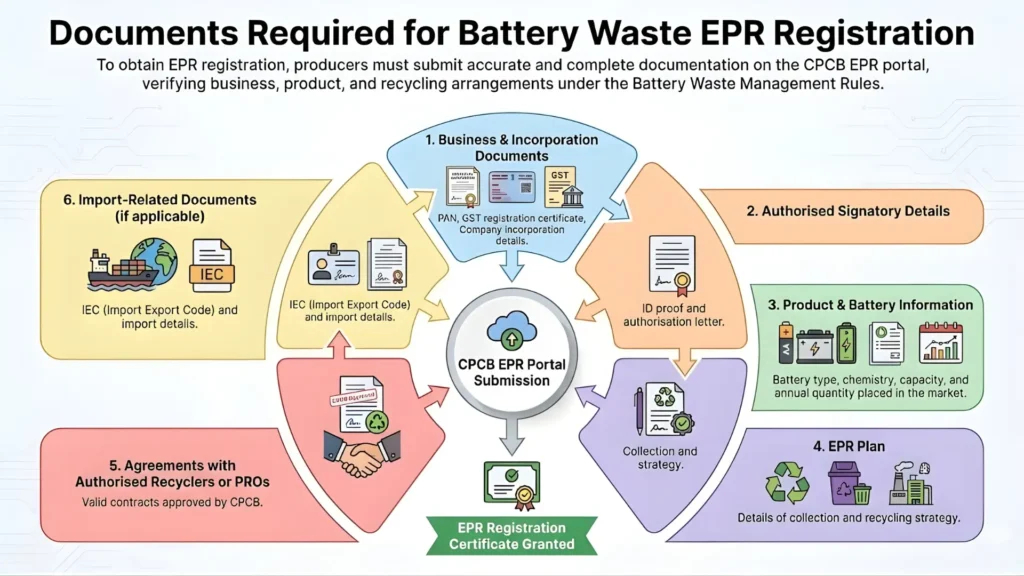
Documents Required for EPR Registration — Lithium-Ion Battery Pack Manufacturers
Before you begin the application on the CPCB EPR portal, keep the following documents ready. Uploading incomplete documents is one of the top reasons for application rejection or delays.
For Manufacturers:
- Certificate of Incorporation or Partnership Deed / Proprietorship proof
- GST Registration Certificate
- Consent to Establish / Consent to Operate from the State Pollution Control Board (SPCB)
- Factory / Manufacturing unit address proof
- PAN card of the company
- Authorized signatory details with board resolution or letter of authority
- Product details — HSN codes, battery chemistry (specify Lithium-Ion), application category (portable / automotive / industrial / LMT)
- Previous year's production data (in weight — metric tonnes)
- Details of existing collection or take-back arrangements, if any
For Importers (Additional / Instead):
- Import Export Code (IEC) certificate
- Sample import invoices / Bill of Entry for battery products
- List of products imported with battery specifications
For Brand Owners (Additional):
- Trademark registration or brand ownership proof
- Agreement with contract manufacturer (if manufacturing is outsourced)
All documents must be self-attested and uploaded in PDF format. The CPCB portal has a file size limit per upload, so ensure your scans are clear but compressed appropriately.
Step-by-Step EPR Registration Process For Lithium-Ion Battery
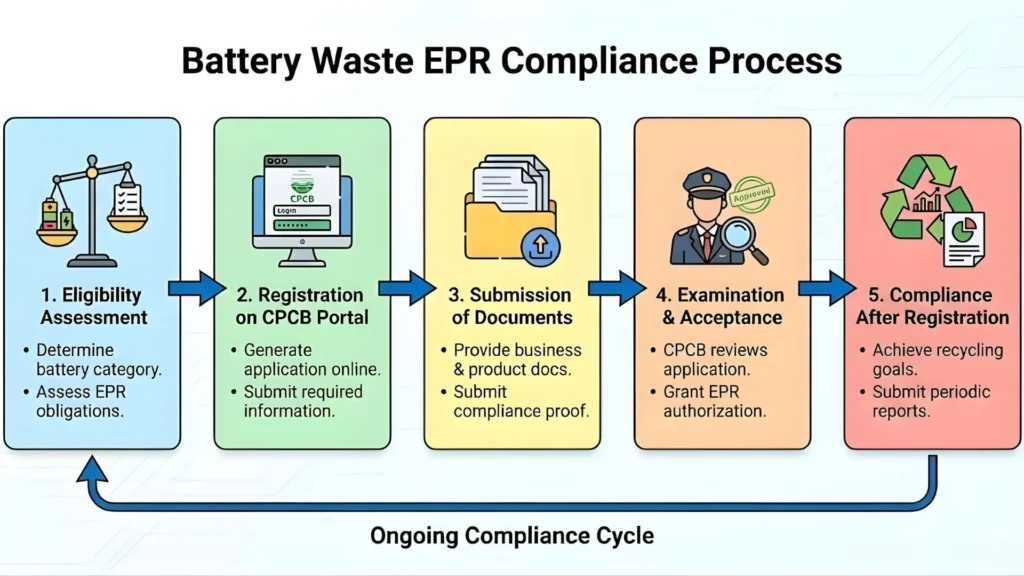
The registration process is entirely online via the CPCB EPR portal (eprsbwm.cpcb.gov.in). Here is the current process as of 2026:
Step 1 — Create Your Account
Visit the CPCB EPR portal and register as a new user. Select your entity type (Manufacturer / Importer / Brand Owner). You will need a valid email ID and mobile number for OTP-based verification. Keep these credentials safe — all future filings happen through the same login.
Step 2 — Fill the Registration Application
Log in and navigate to 'Apply for EPR Registration.' You will be asked to fill in:
- Basic company details (name, address, CIN/LLPIN, PAN, GST)
- Nature of business and battery categories dealt in
- Annual production or import volumes (in metric tonnes) for the previous financial year
- Application category for your batteries (portable, automotive, industrial, LMT)
- Details of collection and recycling partners, if already tied up
Step 3 — Upload Documents
Upload all required documents in PDF format. Double-check every upload is legible. Blurry scans or mismatched documents are the most common reason for delays.
Step 4 — Submit and Pay Registration Fee
Review your application thoroughly before submitting. Once submitted, you will see a payment gateway link. Pay the applicable registration fee (see Fee section below) online. Save your payment receipt.
Step 5 — Application Review by CPCB
After submission, the CPCB regional office reviews your application. They may raise queries or request clarifications — typically within 30 to 60 working days. Respond promptly to any queries raised on the portal to avoid delays.
Step 6 — Receipt of EPR Registration Certificate
Once the application is approved, you receive your EPR Registration Certificate digitally on the portal. Download and store this certificate — you will need it for annual returns, and buyers may ask for it as part of compliance documentation.
EPR Registration Fees for Lithium-Ion Battery Pack Manufacturers
Registration fees are based on your annual production or import quantity of batteries. Below is the general fee structure as applicable under BWMR 2022 and CPCB guidelines (fees are subject to revision — always verify on the official portal before applying):
| Annual Production / Import Quantity | Registration Fee (Approx.) |
| Up to 10 MT per annum | ₹5,000 |
| 10 MT to 50 MT per annum | ₹10,000 |
| 50 MT to 500 MT per annum | ₹25,000 |
| Above 500 MT per annum | ₹50,000 |
Important: These fees cover registration only. Achieving your EPR targets (collection and recycling) may involve additional costs — either through your own collection infrastructure or by purchasing EPR certificates from registered recyclers. The EPR certificate market in India is still evolving, and certificate prices vary based on battery chemistry, weight, and supply-demand dynamics.
Validity of EPR Registration Certificate
EPR registration certificates issued under BWMR 2022 are valid for five years from the date of issuance. However, this does not mean you only interact with the portal once in five years. Annual compliance obligations continue every year throughout the certificate's validity period, including:
- Filing your Annual Return by the due date (typically June 30 of the following financial year)
- Updating your production or import volumes each year
- Reporting EPR certificate purchases from recyclers/refurbishers
- Uploading proof of collection and recycling activities
Failing to file annual returns on time — even if your registration is valid — can result in the CPCB flagging your account as non-compliant. This can trigger Environmental Compensation notices.
EPR Certificate Renewal: Timeline and Process
Your EPR registration certificate needs to be renewed before expiry. Here is the timeline and process:
| Activity | Recommended Timeline |
| Begin renewal process | 6 months before certificate expiry |
| Compile past 5 years' compliance data | 4–5 months before expiry |
| Submit renewal application on CPCB portal | 3 months before expiry |
| Respond to CPCB queries (if any) | Within 15 days of query receipt |
| Receive renewed certificate | Typically 30–60 working days after submission |
Do not wait until the last month to initiate renewal. CPCB processing times can vary, and if your certificate lapses, you are technically operating without valid EPR registration — which is a compliance violation.
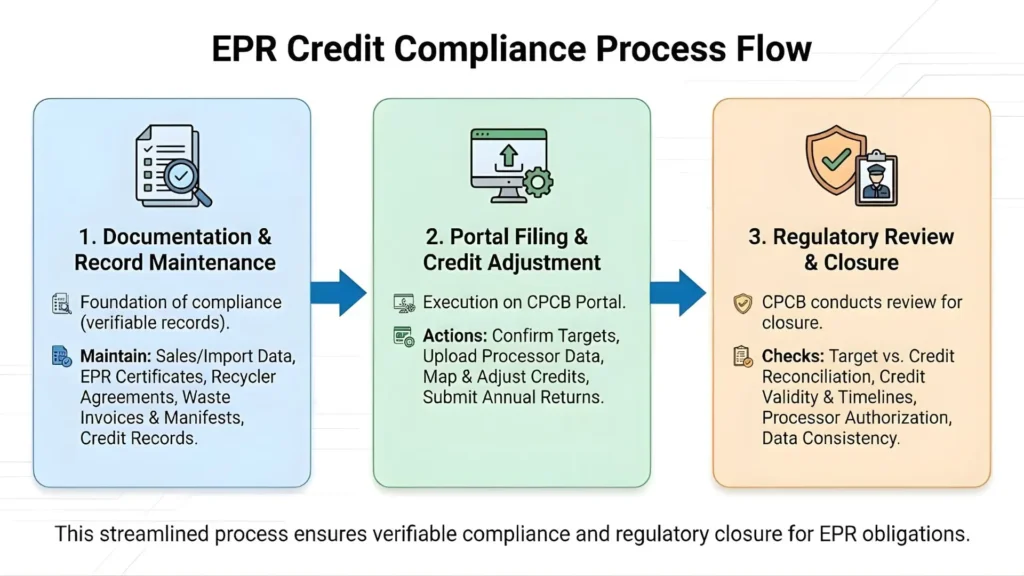
Annual Return Filing for Lithium-Ion Battery Pack Producers
Annual returns are a critical ongoing obligation for every registered producer. Here is what the annual return process looks like:
- Filing Period: Annual returns for a financial year (April to March) are typically due by June 30 of the following year. For FY 2025-26, the return due date is June 30, 2026.
- Data Required: Weight of Lithium-Ion batteries placed on the market during the year (in MT), weight of end-of-life batteries collected, weight sent for recycling or refurbishment, EPR certificates procured (with certificate numbers and issuing recycler details).
- Shortfall Declaration: If you have not met your EPR target, you must declare the shortfall. Environmental Compensation is levied on the unmet quantity.
- Third-Party Verification: CPCB may require third-party verification of collection and recycling data in some cases. Keep all invoices, gate passes, and recycler receipts ready.
How the EPR Certificate Market Works for Battery Producers
One of the most practical aspects of EPR compliance is the EPR certificate mechanism. If you cannot achieve your collection/recycling target through your own infrastructure, you can purchase EPR certificates from CPCB-registered recyclers or refurbishers who have actually processed end-of-life batteries.
Here is how it works in practice:
- A registered recycler collects and processes end-of-life Lithium-Ion batteries.
- The recycler uploads verified recycling data on the CPCB portal and generates EPR certificates equivalent to the quantity recycled.
- You (the producer) purchase these EPR certificates on the portal, and they are mapped against your EPR targets.
- The certificates serve as proof that your EPR obligation for that quantity has been fulfilled.
The EPR certificate market for batteries in India is still maturing. Pricing is not standardized and varies significantly. It is advisable to tie up with one or more registered recyclers early in the financial year rather than scrambling to buy certificates at the last minute, when prices tend to spike.
2025-26 Compliance Updates: What Lithium-Ion Battery Manufacturers Must Know
The EPR landscape for batteries in India is evolving. Here are key updates relevant for the 2025-26 compliance cycle:
- Higher Targets Active: The 50% collection target and 30% recycling target for 2025-26 are now in effect. This is a significant step-up from prior years. Producers who have been relying on EPR certificates from the open market need to plan procurement early.
- Stricter Portal Verification: CPCB has been tightening the verification of data uploaded on the EPR portal — especially for recycler-generated EPR certificates. Ensure your certificates are from CPCB-verified recyclers with valid authorizations.
- EV Battery Focus: With India's EV market growing rapidly, CPCB is paying closer attention to automotive Lithium-Ion battery EPR compliance. EV manufacturers and battery pack suppliers are under heightened scrutiny.
- Digital Record-Keeping: CPCB increasingly expects producers to maintain digital records (invoices, gate passes, weight slips) that can be uploaded during audits or verification exercises.
Conclusion
EPR registration for Lithium-Ion battery pack manufacturers in India is a non-negotiable regulatory obligation — and the compliance bar is rising every year. The 2025-26 targets are tougher than 2024-25, and by 2027-28, manufacturers will need to account for collecting 70% of their battery volumes from end-of-life streams.
The good news is that the CPCB EPR portal is fully operational, the EPR certificate market is growing, and the registered recycler ecosystem is expanding. Manufacturers who get their registration in order, file annual returns on time, and build relationships with certified recyclers are in a much stronger position — both legally and commercially.
If you are a Lithium-Ion battery pack manufacturer, importer, or brand owner who has not yet registered, the time to act is now. Delays only narrow your window to meet targets for the current financial year without incurring Environmental Compensation.
Frequently Asked Questions
Is EPR registration mandatory for small Lithium-Ion battery pack manufacturers in India?
Yes. BWMR 2022 does not exempt small manufacturers. If you place Lithium-Ion batteries on the Indian market — regardless of scale — you must register on the CPCB EPR portal and meet annual EPR targets. There is no minimum threshold exemption.
What is the difference between EPR registration and EPR certificate?
EPR registration is your enrolment on the CPCB portal as a producer. An EPR certificate is a tradeable document issued by registered recyclers that represents a specific quantity of Li-Ion batteries recycled or refurbished. Producers buy these certificates to meet their annual EPR targets.
How long does EPR registration approval take?
Typically 30 to 60 working days after submitting a complete application, provided there are no queries from CPCB. Incomplete applications or delayed responses to queries can extend this timeline significantly.
What happens if I miss my EPR target for a year?
If you fall short of your EPR target, you are liable to pay Environmental Compensation for the shortfall quantity. The EC rate is set by CPCB and tends to increase with repeated non-compliance. You must also declare the shortfall in your annual return.
Can I buy EPR certificates from any recycler?
No. You can only purchase EPR certificates from recyclers who are registered on the CPCB EPR portal and hold a valid CPCB authorisation for battery recycling under the Hazardous Waste Management Rules. Certificates from unregistered recyclers will not be accepted.
I am an EV manufacturer who sources battery packs from a third-party supplier. Who needs to register — the battery supplier or the EV manufacturer?
Both may need to register depending on who places the battery on the market. If the battery supplier sells the pack to you (the EV manufacturer), the supplier is the producer for EPR purposes.
What is the annual return filing deadline for FY 2025-26?
The annual return for FY 2025-26 is generally due by June 30, 2026. Check the CPCB portal for the official due date, as CPCB occasionally extends deadlines. File early to avoid last-minute portal congestion.
Is there a fee to purchase EPR certificates from recyclers?
EPR certificate prices are not regulated — they are market-determined through agreements between producers and registered recyclers.
Do Lithium-Ion batteries embedded in electronic products (laptops, mobile phones) require separate EPR registration under battery rules?
Yes. Under BWMR 2022, producers of electronics containing Li-Ion batteries have EPR obligations for the battery component under battery rules, in addition to any obligations under E-Waste Management Rules for the device itself. Producers need to assess and manage both sets of EPR obligations.
How often does the CPCB update EPR targets for batteries?
EPR targets are pre-defined in Schedule I of BWMR 2022 up to 2027-28. Beyond that, MoEFCC is expected to revise targets through gazette notifications. It is advisable to monitor MoEFCC and CPCB circulars regularly to stay ahead of any target revisions.