
- CE marking products is legally mandatory for 30+ product categories entering the European Economic Area — no CE mark means no legal sale, full stop.
- In 2026, new rules under the EU AI Act, Machinery Regulation, and Battery Regulation have expanded CE marking obligations to entirely new product types.
- CE marking costs range from EUR 500 for simple self-certified products to EUR 50,000+ for high-risk medical devices or AI systems requiring Notified Body assessment.
- Non-compliance carries serious consequences: EU market bans, mandatory product recalls, fines up to EUR 100,000, and criminal liability in certain member states.
What Is CE Marking and Why Does It Matter in 2026?
If you manufacture, import, or distribute products for the European market, CE marking is not optional — it is a legal requirement under EU law. The letters 'CE' stand for Conformite Europeenne, French for European Conformity. The CE mark on a product tells buyers, regulators, and customs authorities that the manufacturer has assessed the product against all applicable EU legislation covering safety, health, and environmental protection.

CE marking is Europe's minimum safety standard for market access. It is not a quality award or a premium badge — it is a baseline legal obligation. Without it, your product is illegal to sell, distribute, or even display for sale in the EEA.
In 2026, CE marking matters more than ever. The European Commission has tightened enforcement across multiple sectors, introduced entirely new CE marking obligations for AI systems, updated machinery safety rules, and launched the Ecodesign for Sustainable Products Regulation (ESPR) which affects documentation requirements across dozens of categories. The compliance landscape has shifted significantly — even for manufacturers who already have CE marks from previous years.
Complete List of CE Marking Products: Every Category Covered (2026)
CE marking applies to specific product categories defined under EU directives and regulations. Not every product needs a CE mark — only those covered by relevant legislation. Below is the most comprehensive and up-to-date list of CE marking products, including 2026 additions and regulatory updates.
| S.No. | Product Category | Applicable Directive / Regulation | Directive Code | NB Required? |
| 1 | Low Voltage Electrical Equipment | Low Voltage Directive | 2014/35/EU | No (Module A) |
| 2 | Electromagnetic Compatibility Products | EMC Directive | 2014/30/EU | No (usually) |
| 3 | Radio & Wireless Equipment | Radio Equipment Directive (RED) | 2014/53/EU | Yes (some cases) |
| 4 | Machinery & Industrial Equipment | Machinery Regulation | (EU) 2023/1230 | Depends on risk |
| 5 | Medical Devices (Class I–III) | Medical Device Regulation | (EU) 2017/745 | Yes (Class II/III) |
| 6 | In Vitro Diagnostic Devices | IVD Regulation | (EU) 2017/746 | Yes (Class B–D) |
| 7 | Active Implantable Medical Devices | MDR (applies from 2026 fully) | (EU) 2017/745 | Yes — always |
| 8 | Personal Protective Equipment (PPE) | PPE Regulation | (EU) 2016/425 | Yes (Cat. II & III) |
| 9 | Toys & Children's Products | Toy Safety Directive | 2009/48/EC | No (self-cert.) |
| 10 | Construction Products | Construction Products Regulation (CPR) | (EU) 305/2011 | Yes (3rd party) |
| 11 | Pressure Equipment | Pressure Equipment Directive (PED) | 2014/68/EU | Yes (higher risk) |
| 12 | Simple Pressure Vessels | Simple Pressure Vessels Directive (SPVD) | 2014/29/EU | Yes |
| 13 | Gas Appliances | Gas Appliances Regulation (GAR) | (EU) 2016/426 | Yes — always |
| 14 | Lifts & Elevators | Lifts Directive | 2014/33/EU | Yes — always |
| 15 | Measuring Instruments | Measuring Instruments Directive (MID) | 2014/32/EU | Yes |
| 16 | Non-Automatic Weighing Instruments | NAWI Directive | 2014/31/EU | Yes |
| 17 | Recreational Craft & Watercraft | Recreational Craft Directive (RCD) | 2013/53/EU | Yes (most types) |
| 18 | Marine Equipment | Marine Equipment Directive (MED) | 2014/90/EU | Yes — always |
| 19 | Explosives for Civil Use | Explosives Directive | 2014/28/EU | Yes — always |
| 20 | Pyrotechnic Articles | Pyrotechnics Directive | 2013/29/EU | Yes |
| 21 | Aerosol Dispensers | Aerosol Dispensers Directive | 2016/1041/EC | No |
| 22 | Hot Water Boilers | Ecodesign / Energy-related Directive | (EU) 2009/125/EC ext. | No |
| 23 | Energy-related Products (ErP) | Ecodesign Directive / ESPR (2026) | 2009/125/EC + ESPR | No |
| 24 | Noise Emission — Outdoor Equipment | Outdoor Noise Directive | 2000/14/EC | Yes (some) |
| 25 | Cableway Installations | Cableway Regulation | (EU) 2016/424 | Yes — always |
| 26 | Civil Explosives & Ammunition Transfers | Transfer of Explosives Directive | 2014/28/EU related | Yes |
| 27 | Appliances Burning Gaseous Fuels | GAR (replaces Directive 2009/142/EC) | (EU) 2016/426 | Yes — always |
| 28 | Electrical Equipment for ATEX Zones | ATEX Equipment Directive | 2014/34/EU | Yes — always |
| 29 | Civil Aviation Equipment | EASA / Aviation Safety Regulation | (EU) 2018/1139 | Yes |
| 30 | Batteries & Accumulators (2026 update) | EU Battery Regulation (new 2026 rules) | (EU) 2023/1542 | Yes (EV & industrial) |
| 31 | Rail Interoperability Products | Rail Interoperability Directive | (EU) 2016/797 | Yes — always |
| 32 | High-Risk AI Systems (NEW 2026) | EU AI Act | (EU) 2024/1689 | Yes — Conformity Assess. |
| 33 | Pressure Cookers & Consumer Appliances | LVD + EMC (combined compliance) | 2014/35 + 2014/30/EU | No (Module A) |
| 34 | Footwear with PPE Properties | PPE Regulation (Category I) | (EU) 2016/425 | No (self-cert.) |
| 35 | Respirators & Breathing Apparatus | PPE Regulation (Category III) | (EU) 2016/425 | Yes — always |
| 36 | Hearing Protection Devices | PPE Regulation (Category II) | (EU) 2016/425 | Yes |
| 37 | Safety Helmets & Head Protection | PPE Regulation (Category II/III) | (EU) 2016/425 | Yes |
| 38 | Chemical Protective Clothing | PPE Regulation (Category III) | (EU) 2016/425 | Yes — always |
| 39 | Fire Detection & Alarm Systems | CPR + LVD (dual directive) | 305/2011 + 2014/35 | Yes |
| 40 | Surgical Implants | MDR (fully in force 2026) | (EU) 2017/745 | Yes — always |
| 41 | Blood Glucose Monitors & Diagnostics | IVDR | (EU) 2017/746 | Yes (Class B–D) |
| 42 | Ventilators & Life Support Equipment | MDR — Class III | (EU) 2017/745 | Yes — always |
| 43 | Powered Industrial Trucks (Forklifts) | Machinery Regulation | (EU) 2023/1230 | Yes |
| 44 | Industrial Robots & Cobots | Machinery Regulation (2026 expanded scope) | (EU) 2023/1230 | Yes |
| 45 | Portable Power Tools (Drills, Saws) | Machinery Regulation + LVD | 2023/1230 + 2014/35 | No (Module A often) |
| 46 | Laser Products & Equipment | LVD + EMC (combined) | 2014/35 + 2014/30 | No |
| 47 | Mobile Phones & Tablets | RED + EMC + RoHS | 2014/53 + 2014/30 | Yes (RED specific) |
| 48 | Laptops & Computers | LVD + EMC + RED (if wireless) | Multi-directive | No (usually) |
| 49 | Smart Home Devices & IoT Products | RED + EMC + LVD + Cyber Resilience Act | 2014/53 + CRA 2024 | Yes (CRA for cyber) |
| 50 | Electric Vehicles & Components | Battery Reg + Machinery + Type Approval | Multi-directive 2026 | Yes — multiple NBs |
| 51 | LED Lighting Products | LVD + EMC + ErP | Multi-directive | No (Module A) |
| 52 | Solar Panels & Photovoltaic Systems | LVD + EMC + CPR (if structural) | Multi-directive | No (usually) |
| 53 | Wind Turbines (Small-scale) | Machinery Regulation + LVD | 2023/1230 + 2014/35 | Yes |
| 54 | Fire Extinguishers | PED + CPR (structural mount) | 2014/68 + 305/2011 | Yes |
| 55 | Refrigerants & Cooling Equipment | ErP + F-Gas Regulation | 2009/125 + 517/2014 | No (ErP self-cert.) |
| 56 | Food Contact Materials (Machinery) | Machinery Regulation + food safety regs | 2023/1230 | Depends |
| 57 | Textile Products (ESPR 2026) | ESPR Ecodesign (pilot 2026 categories) | ESPR (EU) 2024/1781 | No (DPP required) |
| 58 | Furniture with Built-in Electronics | LVD + EMC + ErP | Multi-directive | No |
| 59 | Medical Software (SaMD) | MDR (Software as Medical Device) | (EU) 2017/745 | Yes (Class IIb/III) |
| 60 | Cybersecurity Products (NEW 2024–2026) | Cyber Resilience Act (CRA) | (EU) 2024/2847 | Yes (Critical Cat.) |
2026 Key Addition: High-risk AI systems and products with embedded AI (such as AI-assisted medical devices, autonomous machinery, and biometric ID systems) now carry mandatory CE marking obligations under the EU AI Act (EU) 2024/1689. Additionally, all connected products are subject to the new Cyber Resilience Act (CRA) (EU) 2024/2847, which introduces cybersecurity CE marking requirements. These are the two most significant additions to the CE marking product list in 2026.
EU CE Marking Directives & Regulations: Full Reference Table 2026
Understanding which directive governs your product is the foundation of CE marking compliance. A product can fall under multiple directives simultaneously — this is called a 'multi-directive product' and requires compliance with all applicable legislation before the CE mark can be affixed.
| Directive / Regulation | Code | Covers | Status 2026 |
| Low Voltage Directive (LVD) | 2014/35/EU | Electrical equipment 50V–1000V AC / 75V–1500V DC | Active |
| EMC Directive | 2014/30/EU | Electromagnetic interference & immunity | Active |
| Radio Equipment Directive (RED) | 2014/53/EU | Radio, wireless, Bluetooth, Wi-Fi, cellular devices | Active — new cyber rules 2025 |
| Machinery Regulation | (EU) 2023/1230 | Industrial & consumer machinery, robots, AI-powered machines | Active — replaced 2006/42/EC |
| Medical Device Regulation (MDR) | (EU) 2017/745 | All medical devices Class I–III, implants, SaMD | Active — full transition 2026 |
| IVD Regulation (IVDR) | (EU) 2017/746 | In vitro diagnostic devices | Active — tiered transition ongoing |
| PPE Regulation | (EU) 2016/425 | Personal protective equipment all categories | Active |
| Toy Safety Directive | 2009/48/EC | Toys for children under 14 | Active |
| Construction Products Regulation (CPR) | (EU) 305/2011 | Building and construction materials | Active — revision pending |
| Pressure Equipment Directive (PED) | 2014/68/EU | Pressure vessels, steam boilers, pipelines | Active |
| Simple Pressure Vessels Directive | 2014/29/EU | Simple pressure vessels (air, nitrogen) | Active |
| Gas Appliances Regulation (GAR) | (EU) 2016/426 | Gas cooking, heating, hot water appliances | Active |
| Lifts Directive | 2014/33/EU | Passenger and goods lifts | Active |
| Measuring Instruments Directive (MID) | 2014/32/EU | Gas, electricity, water, heat meters | Active |
| NAWI Directive | 2014/31/EU | Non-automatic weighing instruments | Active |
| Recreational Craft Directive (RCD) | 2013/53/EU | Leisure boats, personal watercraft | Active |
| Marine Equipment Directive (MED) | 2014/90/EU | Marine safety equipment on ships | Active |
| Pyrotechnics Directive | 2013/29/EU | Fireworks, theatrical pyrotechnics | Active |
| ATEX Directive | 2014/34/EU | Equipment for explosive atmospheres | Active |
| Outdoor Noise Directive | 2000/14/EC | Outdoor power equipment noise levels | Active |
| Cableway Regulation | (EU) 2016/424 | Cable cars, ski lifts, gondolas | Active |
| Explosives for Civil Use Directive | 2014/28/EU | Civil explosives, blasting equipment | Active |
| Ecodesign Directive (ErP) | 2009/125/EC | Energy-related products (being replaced by ESPR) | Active — ESPR transition |
| Ecodesign for Sustainable Products (ESPR) | (EU) 2024/1781 | Wide range: textiles, furniture, electronics, steel, cement | NEW — pilot categories 2026 |
| EU Battery Regulation | (EU) 2023/1542 | All batteries: portable, EV, industrial, LMT | NEW obligations from 2026 |
| EU AI Act | (EU) 2024/1689 | High-risk AI systems across 8 defined categories | NEW — CE marking from 2026 |
| Cyber Resilience Act (CRA) | (EU) 2024/2847 | All connected digital products with software | NEW — phased 2024–2027 |
| General Product Safety Regulation (GPSR) | (EU) 2023/988 | All consumer products not covered by specific directives | Active from Dec 2024 |
| Rail Interoperability Directive | (EU) 2016/797 | Rail infrastructure and rolling stock subsystems | Active |
| Recreational & Watercraft Safety | 2013/53/EU | Jet skis, sailing yachts, motor boats | Active |
How to Get CE Marking: Step-by-Step Certification Process (2026)
Getting CE marking is a structured legal process — not just a label you apply. Every step below is a genuine compliance requirement. Skipping any step creates legal liability for the manufacturer or importer.
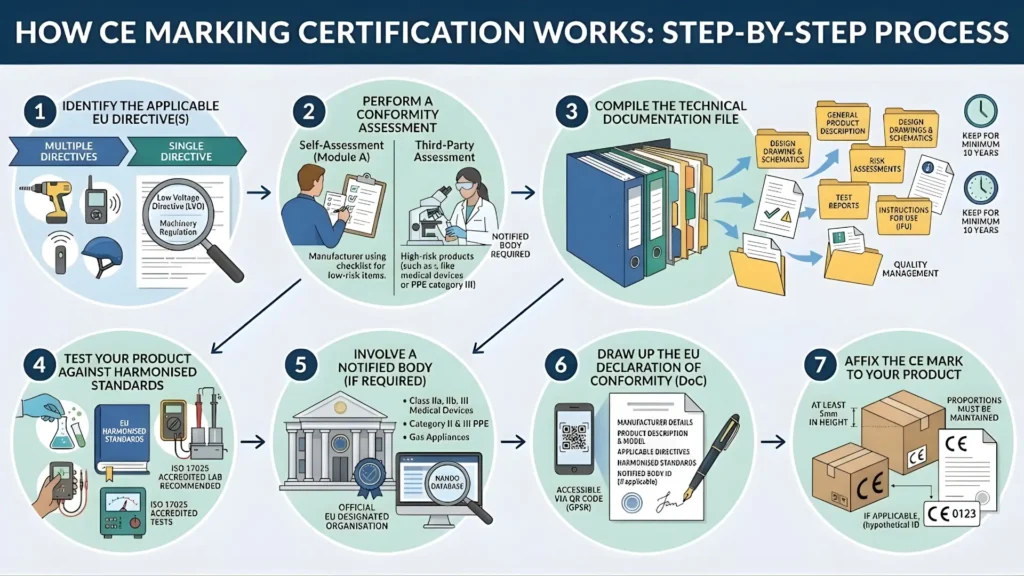
Step 1 — Identify All Applicable Directives
Start by determining which EU directives and regulations apply to your product. A single product can fall under multiple directives. For example, a wireless medical monitor must comply with the MDR, RED, and EMC Directive simultaneously. Missing a single directive invalidates the entire CE marking.
Step 2 — Check the Essential Requirements
Each directive defines 'essential requirements' — the minimum safety, health, and environmental standards your product must meet. These are non-negotiable. In 2026, ESPR has added sustainability and repairability requirements for many product categories that previously only faced safety obligations.
Step 3 — Select the Conformity Assessment Module
Depending on your product's risk level, you will use one of the following assessment modules:
| Module | Name | Who Assesses | When Used |
| A | Internal Production Control | Manufacturer (self-cert.) | Low-risk products: toys, simple electronics, aerosols |
| B | EU-Type Examination | Notified Body | First step for higher-risk products; NB issues cert. |
| C | Conformity to Type | Manufacturer after Module B | Used after Module B to confirm production matches type |
| D | Production Quality Assurance | Notified Body oversees QMS | Ongoing production of higher-risk products |
| E | Product Quality Assurance | Notified Body | End-product quality system oversight |
| F | Product Verification | Notified Body | Each batch or unit tested by NB |
| G | Unit Verification | Notified Body | Each individual unit assessed — very high risk |
| H | Full Quality Assurance | Notified Body | Entire quality system certified: design to production |
Step 4 — Test Against Harmonized EN Standards
Harmonized European Standards (EN standards) published in the EU Official Journal provide a technical roadmap to prove compliance. Testing against these gives you a legal 'presumption of conformity' with the relevant directive. Testing can be done by an accredited in-house lab or an external test house — always retain full test reports.
Step 5 — Compile the Technical File
The technical file is the legal backbone of your CE marking. It must include: full product description, design drawings, risk assessment, test reports, list of applied harmonised standards, instructions for use, and any Notified Body certificates. In 2026, the EU Digital Product Passport (DPP) requirement means some product categories (batteries, textiles) must also include a digital version of this data.
Step 6 — Draft the EU Declaration of Conformity (DoC)
The EU Declaration of Conformity is a signed legal document declaring full compliance with all applicable directives. It must be signed by the manufacturer or their EU Authorised Representative. It must be retained for a minimum of 10 years and provided to market surveillance authorities on request.
Step 7 — Affix the CE Mark and Place on Market
Once all steps are complete, you can legally affix the CE mark. The mark must be at least 5mm tall, visible, legible, and indelible. Your manufacturer name and address must also appear on the product or packaging — a legal requirement that has been strictly enforced from 2021 onward. You are now legally permitted to place the product on the EEA market.
CE Marking Cost Guide: Realistic Budget Breakdown for 2026
One of the most searched questions around CE marking is: how much does it cost? The honest answer is it varies enormously by product type, risk category, number of applicable directives, and whether a Notified Body is required. Here is a realistic, up-to-date cost guide for 2026:
| Cost Component | Low-Risk Product | Medium-Risk Product | High-Risk Product |
| Technical documentation & risk assessment | EUR 500–1,500 | EUR 2,000–5,000 | EUR 5,000–15,000 |
| Product testing (lab fees) | EUR 800–3,000 | EUR 3,000–10,000 | EUR 10,000–30,000 |
| Notified Body assessment | Not required | EUR 3,000–10,000 | EUR 15,000–50,000+ |
| CE marking consultancy | EUR 500–2,000 | EUR 2,000–7,000 | EUR 5,000–15,000 |
| Translation of documents | EUR 200–500 | EUR 500–1,500 | EUR 1,000–3,000 |
| Annual NB surveillance audit | N/A | EUR 1,000–3,000/yr | EUR 3,000–8,000/yr |
| TOTAL ESTIMATED RANGE | EUR 1,500–6,000 | EUR 8,000–25,000 | EUR 25,000–100,000+ |
| Typical Examples | Simple toys, LED lighting, aerosols | Machinery, PPE Cat. II, radio equipment | Medical devices, AI systems, gas appliances |
Important note: The most expensive CE marking mistake is not the certification cost — it is non-compliance. A product recall from the EU market, enforcement action, and reputational damage can cost orders of magnitude more than proper certification. Always invest in getting it right the first time.
Critical CE Marking Updates in 2026: What Has Changed
The EU regulatory environment has undergone its most significant expansion in over a decade. Manufacturers and importers must understand these 2026 changes — ignorance is not a legal defence under EU market surveillance rules.
1. EU AI Act — CE Marking Now Required for High-Risk AI
The EU AI Act (Regulation (EU) 2024/1689) is the world's first comprehensive AI law and introduces CE marking obligations for high-risk AI systems. This includes AI used in: medical devices, critical infrastructure, employment screening, credit scoring, biometric identification, law enforcement, education, and migration management. High-risk AI systems must undergo a mandatory conformity assessment (often requiring a Notified Body), register in the EU AI database, and carry the CE mark before being placed on the EU market. For manufacturers of AI-powered products, this is the most impactful regulatory change of 2026.
2. Cyber Resilience Act (CRA) — CE Marking for Connected Products
The Cyber Resilience Act (EU) 2024/2847 introduces mandatory cybersecurity requirements for virtually all connected digital products placed on the EU market. From 2027 (with phased requirements from 2025), products with digital elements — from smart home devices and routers to industrial control systems — must carry CE marking that demonstrates cybersecurity compliance. Critical products require third-party Notified Body assessment. This affects an estimated 90% of IoT product manufacturers.
3. New Machinery Regulation (EU) 2023/1230
The new Machinery Regulation fully replaced the old Machinery Directive 2006/42/EC and is now the applicable law for all machinery placed on the EU market. Key changes include: expanded scope to cover AI-integrated machines and collaborative robots (cobots), new software safety requirements, updated risk assessment obligations, and new provisions for substantially modified machinery. If you sell industrial or commercial machinery and have not updated your technical documentation under the new regulation, you are currently non-compliant.
4. EU Battery Regulation (EU) 2023/1542 — New 2026 Obligations
From 2026, the EU Battery Regulation introduces significant new CE marking-related requirements for industrial batteries, EV batteries, and LMT (light means of transport) batteries. These include carbon footprint declarations, recycled content requirements, and Digital Battery Passport (DBP) obligations. EV battery manufacturers face the most demanding new requirements, but any company producing or importing lithium-ion batteries above certain capacities must review compliance status immediately.
5. Ecodesign for Sustainable Products Regulation (ESPR)
The ESPR (EU) 2024/1781 expands the old Ecodesign Directive far beyond energy-related products. In 2026, pilot categories subject to ESPR ecodesign requirements include textiles, furniture, electronics, steel, cement, and chemicals. Compliance with ESPR is tied to CE marking documentation for affected products, and the Digital Product Passport (DPP) framework — rolling out progressively from 2025 — is a genuine operational burden that manufacturers must begin preparing for now.
6. General Product Safety Regulation (GPSR) — In Force Since December 2024
The GPSR (EU) 2023/988 replaced the old General Product Safety Directive and has been in full force since December 13, 2024. Its key changes affecting CE marking include: expanded definition of 'product' now covering digital and software components; direct compliance obligations for online marketplaces (not just manufacturers); 72-hour serious incident notification timelines; stricter market surveillance and recall procedures; and new manufacturer identification requirements that reinforce existing CE marking labelling rules.
Notified Bodies for CE Marking: What They Are and When You Need One
A Notified Body (NB) is an organization designated by an EU member state to carry out independent third-party conformity assessments. They are authorized by national governments and overseen by the European Commission. Using the right Notified Body is critical — using the wrong one (i.e., one not authorized for your specific directive) makes your CE marking legally void.
- There are over 1,600 Notified Bodies registered in the NANDO (New Approach Notified and Designated Organizations) database.
- Each NB is authorized for specific directives and product categories — always verify on the official NANDO database before engaging one.
- Notified Bodies are mandatory for: Class II and III medical devices, Category II and III PPE, gas appliances, ATEX equipment, lifts, pressure equipment above certain thresholds, and now high-risk AI systems.
- Average lead times for medical device Notified Body assessment in 2026 range from 12 to 24 months due to high demand post-MDR transition — plan accordingly.
- Notified Body fees are not regulated — they vary significantly. Always compare at least 2 to 3 quotes for high-cost assessments.
| How to find your Notified Body: Go to the official European Commission NANDO database at ec.europa.eu/growth/tools-databases/nando — search by directive and product category. Only organisations listed here are legally recognised for CE conformity assessment. |
UKCA vs CE Marking in 2026: What Every Manufacturer Needs to Know
Since Brexit, manufacturers selling on both sides of the Channel must navigate two separate marking regimes. Here is the full comparison for 2026:
| Factor | CE Marking (EU) | UKCA Marking (GB) |
| Geographic scope | 30 EEA countries (EU + Norway, Iceland, Liechtenstein) | Great Britain (England, Scotland, Wales only) |
| Northern Ireland | CE mark required under Windsor Framework | CE mark accepted — UKCA not required |
| Legal basis | EU Directives and Regulations | UK domestic legislation (mirrors EU at Brexit date) |
| Third-party bodies | EU Notified Bodies (NANDO-registered) | UK Approved Bodies (UKAS-accredited) |
| Mutual recognition | Not mutually accepted in UK (GB) | Not mutually accepted in EU/EEA |
| Test result sharing | EU test results do not count for UKCA | UK test results do not count for CE |
| AI Act / CRA | Applies fully from 2026 | No equivalent UK legislation yet (as of 2026) |
| ESPR / Battery Reg | Applies fully from 2025–2026 | No equivalent UK legislation yet |
| Status 2026 | Mandatory for EEA market access | Mandatory for GB market (UKCA deadline confirmed) |
| Key risk | No CE = illegal to sell in EEA | No UKCA = illegal to sell in Great Britain |
If you are selling into both the EU and UK markets, you effectively need two separate compliance programmes. There is no shortcut — test results, Notified Body certificates, and declarations of conformity from one regime do not transfer to the other. Build this into your product development budget from day one.
Conclusion: CE Marking in 2026 Is More Complex — and More Enforced — Than Ever
The CE marking landscape in 2026 represents the most significant expansion of EU product compliance requirements in the past decade. The EU AI Act, the Cyber Resilience Act, the new Machinery Regulation, expanded Battery Regulation obligations, and the rollout of the Ecodesign for Sustainable Products Regulation mean that the list of CE marking products has grown substantially — and the penalties for non-compliance are being enforced more rigorously than ever.
For manufacturers and importers, the message is clear: review your CE marking status now, not when a customs officer or market surveillance authority flags your product. If you are entering the EU market for the first time, working with an accredited CE marking consultant or specialist testing house is the fastest and safest route. If you are an established manufacturer, check whether any of the 2026 regulatory changes affect your existing products and update your technical documentation accordingly.
The fundamental principle of CE marking has not changed: it is a manufacturer's declaration that their product is safe, legally compliant, and ready for the European market. Getting it right protects your customers, your business, and your market access. Getting it wrong in 2026 carries consequences that far outweigh the investment in proper compliance.
Frequently Asked Questions
What does CE marking mean on a product?
CE marking means the manufacturer has declared that the product complies with all applicable EU health, safety, and environmental directives. It is a legal requirement for placing the product on the EEA market, not a quality badge. The CE mark indicates compliance — it does not mean the product was independently tested by a government body (unless a Notified Body was involved).
Which products are required to have CE marking?
Over 60 product categories require CE marking for EU market access. These include electrical and electronic equipment, machinery, medical devices, PPE, toys, construction products, pressure equipment, gas appliances, lifts, radio and wireless devices, measuring instruments, marine equipment, batteries, and from 2026, high-risk AI systems and cybersecurity products under the EU AI Act and Cyber Resilience Act.
Can I sell without CE marking in the EU?
No. Selling products that require CE marking without it is illegal in all 30 EEA countries. Consequences include: product seizure by customs, mandatory recall at the manufacturer's expense, fines up to EUR 100,000 depending on the member state, and in serious cases, criminal prosecution. Market surveillance authorities actively check for compliance at borders and in the marketplace.
Do I need a Notified Body for CE marking?
Not always. Notified Bodies are only mandatory for higher-risk product categories. Products like toys, simple electrical equipment, aerosol dispensers, and many machinery types allow self-certification (Module A). However, gas appliances, lifts, Class II and III medical devices, Category II and III PPE, ATEX equipment, and high-risk AI systems always require a Notified Body — no exceptions.
How much does CE marking cost in 2026?
CE marking costs range from approximately EUR 1,500 to EUR 100,000 or more depending on product complexity and risk level. A simple self-certified product (like LED lighting or a toy) typically costs EUR 1,500 to EUR 5,000 in total including testing and documentation. A complex medical device or AI system can cost EUR 50,000 to EUR 100,000 when Notified Body fees, testing, and ongoing surveillance are included.
Can a non-EU manufacturer apply for CE marking?
Yes. Non-EU manufacturers can obtain CE marking for their products. However, they must appoint an EU Authorised Representative (AR) — a person or company legally established in an EU or EEA member state. The AR's name and address must appear on the product or its packaging alongside the manufacturer's details. The AR is legally accountable for CE compliance in the EEA if the manufacturer cannot be reached.
Does CE marking expire?
CE marking does not have a fixed expiry date, but it can become invalid if: the product design changes substantially, applicable directives are updated or replaced, harmonised standards referenced in your DoC are withdrawn, or your Notified Body certificate expires. Best practice is to review CE documentation every 2 to 3 years and immediately after any product modification.
What is the difference between CE marking and UKCA marking?
CE marking is required to sell in the European Economic Area (30 countries). UKCA marking is required to sell in Great Britain (England, Scotland, Wales) following Brexit. The two marks are not mutually recognised — having one does not satisfy the requirement for the other. Northern Ireland continues to accept CE marking under the Windsor Framework. Manufacturers selling in both markets need separate compliance processes for each.
Do AI products need CE marking in 2026?
Yes — from 2026, high-risk AI systems as defined under the EU AI Act (Regulation (EU) 2024/1689) are required to carry CE marking. This includes AI used in medical devices, critical infrastructure, employment screening, biometric identification, credit decisions, and law enforcement. The conformity assessment for high-risk AI systems is rigorous and typically requires a Notified Body. Additionally, connected products containing AI software must also comply with the Cyber Resilience Act, which introduces separate CE marking cybersecurity obligations.