
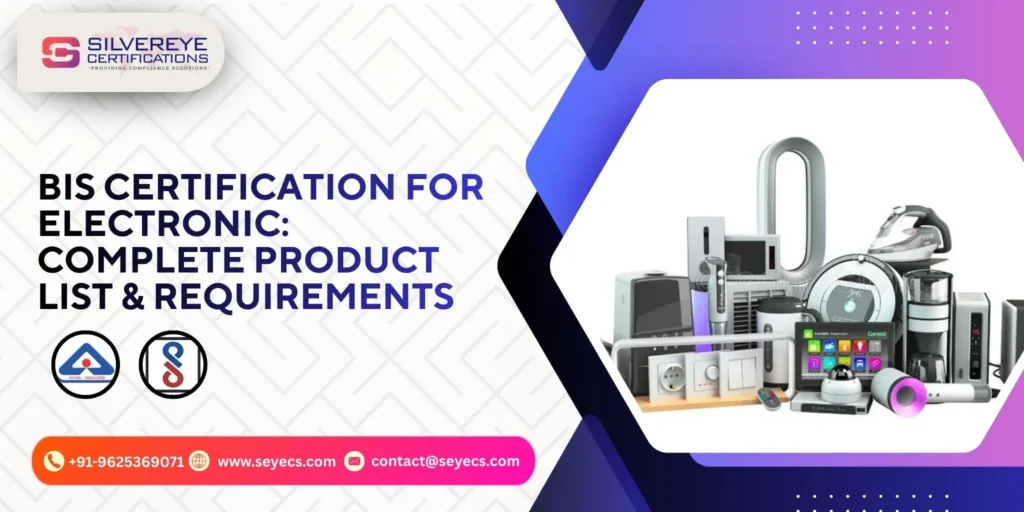
- 75+ product categories — mobiles, laptops, adapters, LEDs, and set-top boxes cannot be legally sold in India without BIS CRS registration.
- IS/IEC 62368-1:2023 is now the active standard — products certified under IS 13252 or IS 616 must plan their re-testing for renewal immediately.
- Foreign manufacturers must appoint an Authorized Indian Representative (AIR) — direct overseas applications are not accepted by BIS.
- Penalties under BIS Act 2016 start at ₹1 lakh fine, with repeat offences attracting up to ₹10 lakh fine plus imprisonment.
Introduction
If you are manufacturing, importing, or selling any electronic product in India in 2026, BIS certification for electronic products is not optional — it is a legal requirement. The Bureau of Indian Standards has tightened enforcement significantly over the past 18 months. Customs officials now cross-verify BIS R-numbers at ports in real time. Major e-commerce platforms like Amazon India and Flipkart run automated compliance checks before activating product listings.
This guide is written for manufacturers, importers, startup founders, and brand owners who want a clear, honest, and actionable understanding of BIS CRS registration in 2026. No jargon, no fluff — just everything you need to know to get your product into the Indian market legally and efficiently.
What Is BIS Certification for Electronic Products?
BIS certification for electronic products is a mandatory product registration that confirms your device has passed safety testing under a recognized Indian Standard. It is issued by the Bureau of Indian Standards, which operates under the Ministry of Electronics and Information Technology (MeitY).
For electronics, this certification is administered under the Compulsory Registration Scheme (CRS) — originally notified by the Ministry of Electronics and Information Technology (MeitY) in 2012. Under this scheme, it is illegal to manufacture, import, sell, or stock specified electronic products in India without a valid BIS registration number, also called the R-Number.
The R-Number printed on your product or packaging is visible, verifiable proof that your device has been tested, reviewed, and approved by BIS. It is not just a sticker — it is a legal license to sell in India.
Why Was the Compulsory Registration Scheme (CRS) Created?
India's electronics market saw explosive growth after 2010. With that growth came a flood of substandard, counterfeit, and unsafe products — cheap chargers catching fire, laptop adapters failing voltage tests, LED drivers failing within weeks of use. The CRS was India's direct response to protect consumers and establish a fair playing field for compliant manufacturers.
Today, BIS enforcement is aggressive and data-driven. In 2025 alone, BIS conducted more than 400 surprise inspections across electronics markets in Delhi, Mumbai, and Bengaluru. Seizures of non-certified goods have doubled compared to 2022 figures.
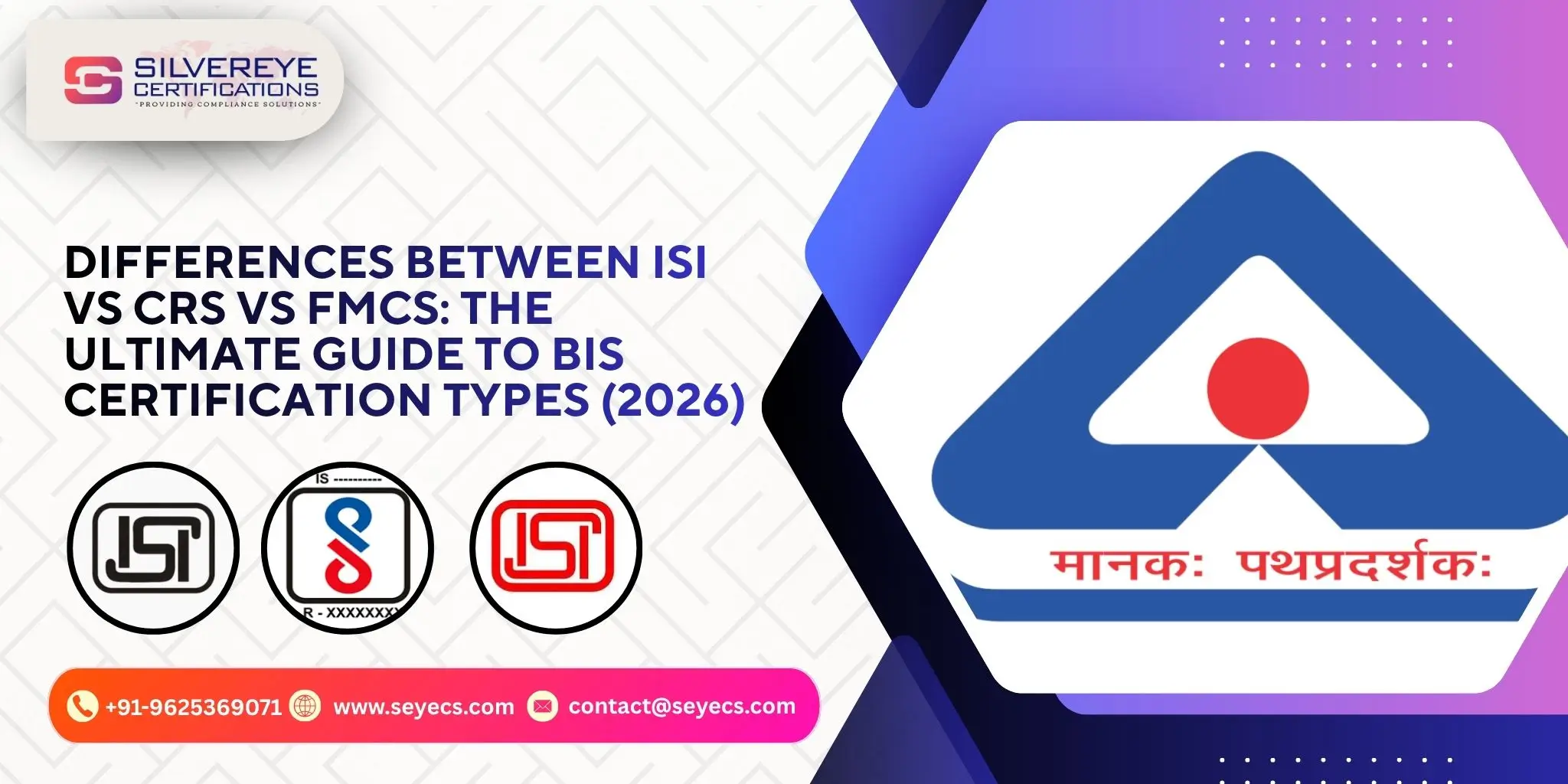
BIS CRS vs. ISI Mark: What Is the Difference?
Most importers and manufacturers use these two terms interchangeably. They are actually two separate certification schemes under BIS with different requirements and processes.
| Feature | BIS ISI Mark (Scheme I) | BIS CRS (Scheme II) |
| Factory Audit Required | Yes — BIS officer visits factory | No factory audit required |
| Product Testing | Required at BIS lab | Required at recognized lab |
| Self-Declaration Allowed | No | Yes, with supporting test report |
| Typical Products | Switches, cables, LT switchgear | Laptops, mobiles, adapters, LEDs |
| Applicable Standards | IS 694, IS 302, IS 1554 | IS 13252, IS/IEC 62368-1, IS 16102 |
| Renewal Frequency | Annual inspection | Every 2 years |
| Application Process | Offline + factory visit | Fully online via BIS portal |
For 90% of electronics manufacturers and importers, CRS (Scheme II) is the applicable path. The ISI Mark scheme requires a BIS officer to physically visit your factory, which is a more time-consuming and expensive process. CRS allows you to test your product at a BIS-recognized laboratory, prepare your documentation, and apply online — no factory visit needed.
The 2026 Standard Update You Cannot Ignore: IS/IEC 62368-1
This is the single most important regulatory development in BIS electronics compliance right now, and many manufacturers are still unaware of it.
What Changed?
Historically, India used two separate safety standards for electronic products:
- IS 13252 — covering IT equipment such as laptops, tablets, and power adapters
- IS 616 — covering Audio/Video equipment such as televisions, speakers, and amplifiers
From 2026 onwards, India is actively transitioning to a single unified standard: IS/IEC 62368-1:2023. This is India's adoption of the international IEC 62368-1 standard, which has already replaced IEC 60950-1 (IT equipment) and IEC 60065 (AV equipment) in most major global markets including the EU, USA, and Japan.
Key Changes Under IS/IEC 62368-1:2023
- Replaces both IS 13252 and IS 616 with one comprehensive framework for IT and AV products
- Uses a Hazard-Based Safety Engineering (HBSE) methodology instead of prescriptive design rules
- Introduces new energy source classifications (ES1, ES2, ES3) and updated temperature limits
- Covers converging products (smart TVs, multimedia devices, IoT hubs) under a single test standard
- Requires updated documentation including safety instructions aligned to the new standard structure
What Should You Do Right Now?
If your product is already certified under IS 13252 or IS 616: Check your certificate expiry date. Renewals in 2026 and 2027 will require re-testing under IS/IEC 62368-1. Do not wait for the expiry date — plan re-testing at least 3 to 4 months in advance to avoid gaps in your registration.If you are launching a new product in 2026: Apply directly under IS/IEC 62368-1 from day one. Applying under the old standard is not accepted for new applications in most product categories.
Complete BIS CRS Product List 2026: What Requires Certification?
The 'Electronics and Information Technology Goods (Requirement for Compulsory Registration) Order' now covers 75+ product categories. Below is a structured breakdown of products that require BIS certification for electronic products under the CRS scheme.
IT and Computing Equipment
| Product | Applicable Standard |
| Laptops, Notebooks, Tablets | IS/IEC 62368-1 / IS 13252 |
| Desktop PCs and Workstation Servers | IS/IEC 62368-1 |
| Printers, Scanners, Plotters | IS/IEC 62368-1 |
| UPS (Uninterruptible Power Supply) | IS 16242 |
| Computer Monitors (LED/LCD) | IS/IEC 62368-1 |
| External Hard Drives and SSDs | IS/IEC 62368-1 |
Mobile and Wearable Devices
| Product | Applicable Standard |
| Mobile Phones and Smartphones | IS 13252 / IS/IEC 62368-1 |
| Smart Watches and Fitness Bands | IS/IEC 62368-1 |
| Wireless Earbuds (TWS) | IS/IEC 62368-1 |
| Bluetooth Speakers (Portable) | IS/IEC 62368-1 |
| Wireless Headphones | IS/IEC 62368-1 |
Power and Charging Equipment
| Product | Applicable Standard |
| Power Adapters and Chargers | IS 13252 / IS/IEC 62368-1 |
| Power Banks | IS 16046 (Battery Safety) |
| USB Type-C Chargers (GaN and standard) | IS 13252 (updated spec) |
| Solar Inverters (below 10kW) | IS 16221 — newly mandatory in 2026 |
Lighting Products
| Product | Applicable Standard |
| LED Lamps (Self-Ballasted) | IS 16102 |
| LED Drivers and Modules | IS 16102 |
| LED Street and Area Lighting | IS 10322 |
| LED Panel Lights for Commercial Use | IS 16102 |
Audio-Visual and Home Electronics
| Product | Applicable Standard |
| Smart TVs | IS/IEC 62368-1 |
| Set-Top Boxes (DTH and Cable) | IS/IEC 62368-1 |
| Electronic Video Game Consoles | IS/IEC 62368-1 |
| CCTV Cameras and DVR/NVR Recorders | IS 13252 + Essential Requirements (ER) |
| Wi-Fi Routers and Access Points | IS/IEC 62368-1 |
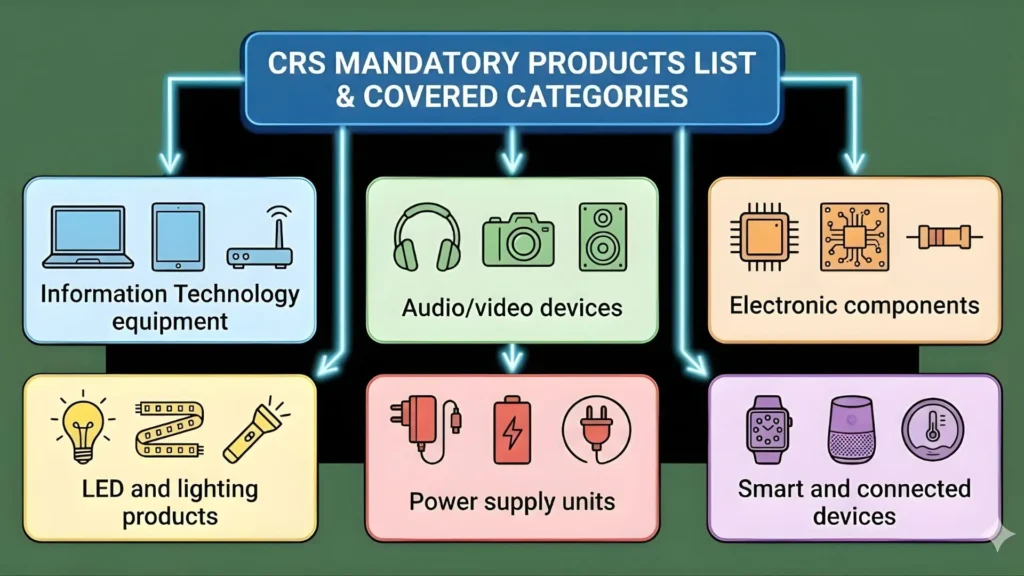
2026 New Additions and Important Updates
| CCTV Cameras: Cybersecurity 'Essential Requirements' testing is now mandatory in addition to standard electrical safety tests — formalized in late 2025. Solar Inverters: Rooftop and small industrial solar inverters are now under mandatory CRS through a new Quality Control Order effective 2026. Smart Meters: BIS is expected to bring smart electricity meters under CRS through a separate QCO expected mid-2026. GaN Chargers: USB Type-C Gallium Nitride chargers now fall explicitly under IS 13252 updated specifications. |
Who Needs BIS CRS Certification for Electronic Products?
Indian Manufacturers
If your factory is located in India and you produce any product on the notified CRS list, you must register under the CRS before the product leaves your facility for commercial sale. Registration applies per product model — each distinct model needs its own BIS R-Number.
Foreign Manufacturers (China, Vietnam, Taiwan, South Korea, and Others)
If your manufacturing facility is located outside India, you cannot apply for BIS CRS registration directly. This is a hard legal requirement under the BIS Act 2016. You must appoint a legally designated Authorized Indian Representative (AIR).
The AIR must meet all of the following conditions:
- Be an Indian resident individual or an Indian-registered company (Pvt. Ltd., LLP, or sole proprietorship)
- Accept full legal responsibility for the product's compliance in India on behalf of the foreign manufacturer
- Sign an Affidavit cum Undertaking before a notary — this is a legal liability document
- Hold the BIS registration certificate in their name on behalf of the overseas manufacturer
- Respond to BIS notices, queries, and enforcement actions within required timelines
There are no exceptions to the AIR requirement. BIS does not process applications submitted directly from foreign addresses.
Indian Importers and Brand Owners (White-Label Products)
This is a commonly misunderstood area, especially for Indian startups sourcing generic products from China and applying their own brand labels. Here is how it actually works:
Scenario A — Factory has an existing BIS certificate: The Chinese manufacturer already holds a valid CRS registration for the product. To add your brand name to their certificate, they must apply to BIS to amend the existing registration. Your brand can be listed, but the certificate remains with the factory. If you change suppliers, you lose access to that registration.
Scenario B — Factory has no BIS certificate: You will need to fund the complete testing and registration process under the factory's name. The factory owns the certificate, your brand name is listed on it. This creates a supply chain dependency that needs careful contractual planning.
Documents Required for BIS CRS Registration in 2026
Getting documentation right is where most first-time applications fail. Here is a complete, verified checklist.
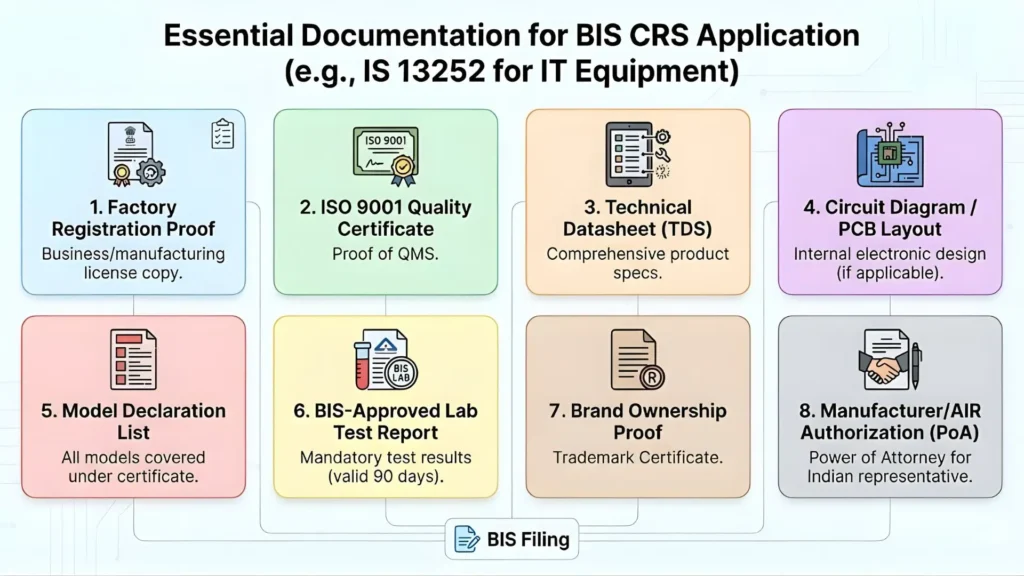
Documents Required from All Applicants
- Certificate of Incorporation of the manufacturing company
- Trademark registration certificate (for brand owners applying with own brand name)
- Product test report from a BIS-recognized laboratory — issued within the last 3 months
- Critical Component List (CCL) — must match the exact components in the tested sample
- PCB layout and schematic / circuit diagram of the product
- User manual in English — mandatory requirement
- Bill of Materials (BOM) aligned precisely with the CCL
- Declaration of Conformity signed by an authorized signatory
Additional Documents for Foreign Manufacturers
- AIR Nomination Form — signed by both the manufacturer and the Indian representative
- Affidavit cum Undertaking — notarized by a registered notary in India
- Power of Attorney (POA) in favour of the AIR
- Factory address proof — must match exactly with the business registration certificate
- Manufacturer's business licence (English translation if in another language
Step-by-Step BIS CRS Registration Process in 2026
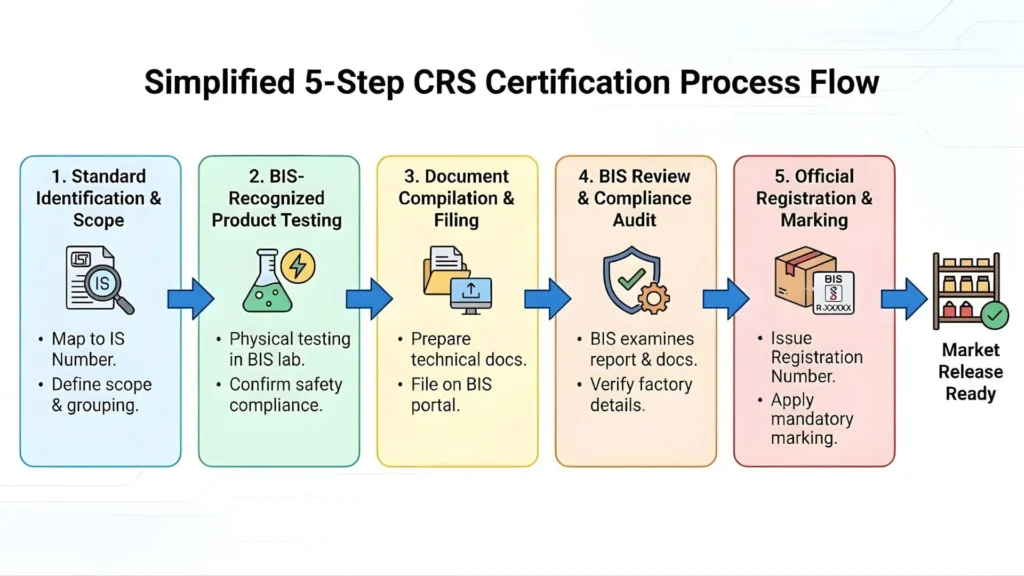
Step 1 — Select a BIS-Recognized Testing Laboratory
You must submit your product samples only to a BIS-recognized laboratory. Private, in-house, or non-accredited third-party labs are not accepted. BIS-recognized electronics testing labs are located in Delhi (STQC Faridabad), Bengaluru, Mumbai, Chennai, and Hyderabad. Some international labs with Indian partnerships also accept samples.
Submit at least 3 samples of the exact same production-specification unit. If a sample fails testing, you will need additional units for re-testing.
Step 2 — Product Testing Under IS/IEC 62368-1 or Applicable Standard
- Testing typically covers the following parameters:
- Electrical safety: dielectric strength, earth continuity, leakage current tests
- Temperature tests: abnormal operating condition and fault condition temperature rise
- Mechanical safety: enclosure strength, stability, fastening of parts
- Flammability: material and component burn resistance tests
- Battery safety (where applicable): IS 16046 Part 1 and Part 2 for cells and packs
- Cybersecurity Essential Requirements: applicable to CCTV cameras and network-connected products
Testing time: typically 10 to 20 working days depending on product complexity and laboratory queue. Complex products such as smartphones and laptops may take longer.
Step 3 — Prepare and Submit Application on BIS Online Portal
Once the test report is issued:
1. Create or log into the manufacturer profile on the BIS online portal at www.bis.gov.in
2. Upload the test report and all supporting documents in the prescribed format
3. Pay the government application and processing fees online
4. The AIR completes and submits the digital filing for foreign manufacturer applications
Step 4 — BIS Officer Review and Query Resolution
BIS officers review submitted applications typically within 5 to 10 working days. If a query is raised, you will receive a written notice with a defined response window. Missing the query deadline means your application is closed and you must restart the process from the beginning.
Step 5 — Grant of Registration Certificate and R-Number
Once the application is approved, BIS issues the Registration Certificate along with your unique R-Number. You can now:
- Print the R-Number on your product label and packaging — it must be clearly visible
- Import and sell the product legally across India
- Provide the certificate to retailers, e-commerce platforms, and customs authorities when requested
Total end-to-end timeline (first-time application): 6 to 12 weeks depending on testing queue, documentation accuracy, and BIS officer processing time.
BIS Certification Cost Breakdown 2026
Understanding actual costs helps you plan your product launch budget accurately. Costs have two components: laboratory testing fees and BIS government fees.
Laboratory Testing Fees (Estimates for 2026)
| Product Type | Estimated Lab Cost (INR) |
| Simple Power Adapter or Charger | ₹25,000 – ₹45,000 |
| LED Lamp or LED Driver | ₹30,000 – ₹55,000 |
| Bluetooth Speaker / TWS Earbuds | ₹50,000 – ₹80,000 |
| Laptop or Tablet | ₹65,000 – ₹1,10,000 |
| Smartphone | ₹75,000 – ₹1,25,000 |
| Power Bank (battery testing included) | ₹90,000 – ₹1,50,000 |
| Smart Watch or Fitness Band | ₹60,000 – ₹95,000 |
| CCTV Camera (with ER cybersecurity testing) | ₹70,000 – ₹1,20,000 |
| Smart TV | ₹80,000 – ₹1,30,000 |
Prices vary by laboratory, standard version, and product complexity. Always get quotes from at least 2 recognized labs before committing.
BIS Government Fees (2026)
| Fee Type | Amount |
| Application Fee | ₹1,000 |
| Processing Fee | ₹25,000 |
| Registration Fee (2-year validity) | ₹2,000 |
| Total Government Fee | ~₹28,000 + applicable GST |
Renewal Fees
Renewal does not require re-testing unless the applicable standard has changed or you have modified the product. Renewal fees are approximately ₹15,000 to ₹20,000 in government and processing charges.
Cost-Saving Strategy: Series Registration for Multiple Models
| If you have multiple product models that share the same PCB design, core components, and circuit architecture, BIS allows you to register them as a series under a single application. This can reduce overall testing costs by 40% to 60% for brands launching multiple SKUs simultaneously. Example: A brand with 5 charger models using the same base circuit can submit a single application covering all 5 models. Important: Any model with a different PCB design, transformer, or battery specification must be tested and registered separately. |
BIS Certificate Validity, Renewal, and Lapse Rules
| Detail | Information |
| Initial Certificate Validity | 5 years from date of issue |
| Renewal Cycle | Every 5 years |
| Re-Testing Required on Renewal? | Only if the standard has changed or product has been modified |
| Documents Required for Renewal | Production report, factory declaration, updated test report (if applicable), renewal fee payment |
| Consequences of Lapsed Certificate | Must restart full process from product testing — no grace period |
| Can You Sell During Renewal Period? | Yes, if renewal application is filed before expiry and certificate is under active review |
Do not let your certificate lapse. There is no grace period under BIS rules. The day after expiry, your product is legally unregistered and cannot be imported, listed, or sold in India.
What the February 2026 Amendment Changed for All Three Schemes
The BIS (Conformity Assessment) Amendment Regulations, 2026 — gazette notification F. No. BS/XI/11/01/2025-26, dated 25 February 2026 — introduced changes that every ISI Mark, CRS, and FMCS licence holder needs to understand.
- Validity extended to five years. Previously, ISI Mark licenses and CRS registrations operated on shorter renewal cycles. The amended regulations now allow both initial grant and renewal for up to five years — significantly reducing administrative overhead.
- Annual fee remains payable every year — in advance. The five-year validity does not eliminate the annual fee obligation. The fee must be paid before the due date each year, regardless of how many years remain on the license.
- Automatic suspension for non-payment — no notice required. This is the most operationally significant change. If the annual fee is not paid by the due date, the license is automatically suspended from that date. There is no grace period. There is no advance warning from BIS. The suspension is immediate and self-executing.
- 90-day recovery window. Once suspended for non-payment, you have 90 days to pay the outstanding fee plus a late fee of ₹5,000. Payment within this window lifts the suspension. Failure to pay within 90 days results in automatic cancellation.
- CRS now formally includes foreign manufacturers. The revised Scheme II explicitly recognizes foreign manufacturers, requiring them to appoint an AIR and submit the relevant affidavit forms — closing a gap that previously created regulatory ambiguity for foreign electronics brands. MSME fee concessions for CRS. From the gazette date through 31 May 2029: 80% concession for micro enterprises and startups, 50% for small enterprises, 20% for medium enterprises. From 1 June 2029, a flat 20% concession for all MSMEs.
Penalties for Selling Electronic Products Without BIS CRS Certification
This is where businesses consistently underestimate their risk. Under the BIS Act 2016, the consequences of selling, importing, or storing non-certified electronic products are legally significant:
| Violation | Penalty |
| First offence: selling/importing without BIS registration | Fine of ₹1 lakh to ₹5 lakh |
| Repeat offence | Fine up to ₹10 lakh + imprisonment up to 2 years |
| Customs seizure at port of entry | Entire consignment held; demurrage charges accumulate daily |
| E-commerce listing without valid R-Number | Automatic delisting on Amazon, Flipkart, Meesho, and others |
| Warehouse storage of uncertified goods | BIS field teams conduct surprise raids on storage facilities |
A common misconception is that small importers or marketplace sellers are below BIS's enforcement radar. This is no longer the case. BIS enforcement has specifically and repeatedly targeted mid-size importers and marketplace sellers since 2024. E-commerce platforms now share seller compliance data with BIS directly.
How to Verify Whether a BIS Certificate Is Genuine
Before importing goods from any supplier claiming BIS certification, always verify the registration independently. Fake R-numbers have been widely reported in the market.
Two Ways to Verify a BIS R-Number
- Method 1: BIS Care App — available on Android and iOS. Scan or manually enter the R-Number to instantly see the registration details.
- Method 2: BIS Website — visit www.bis.gov.in, navigate to the CRS portal, and enter the 8-digit registration number.
A genuine certificate will display the manufacturer name, product description, applicable standard, R-Number, and exact expiry date. If the R-Number returns no result or shows 'Cancelled' status — do not proceed with the purchase or shipment.
Conclusion
BIS certification for electronic products under theCRS scheme is not a bureaucratic formality — it is the legal foundation of doing business in one of the world's fastest-growing electronics markets. In 2026, enforcement is stricter, the notified product list is longer, and the transition to IS/IEC 62368-1 is actively underway and cannot be ignored.
Whether you are a manufacturer in China looking to enter Indian retail, an Indian startup building a new connected device, or an importer bringing in audio equipment — getting your BIS CRS registration right from the beginning saves you from customs delays, product seizures, and reputational damage that can take months to recover from.
The three things that matter most: start your testing timeline early, get your documentation right the first time, and always verify your product category against the latest Quality Control Order before assuming you are outside the scope of CRS.
| Need help with your BIS CRS registration? The process has clear steps, but the documentation requirements are detailed and frequently cause delays for first-time applicants. Understanding exactly what BIS expects at each stage is the difference between a 6-week approval and a 4-month back-and-forth. |
Frequently Asked Questions
Is BIS CRS certification mandatory for all electronic products sold in India?
Yes, for all products on the notified CRS list — currently covering 75+ product categories. Selling, importing, or stocking any product from the notified list without a valid BIS R-Number is a criminal offence under the BIS Act 2016.
Can I sell my product while the BIS application is being processed?
No. The product cannot legally enter India or be offered for sale until the R-Number is officially issued and physically printed on the product and its packaging.
Does a foreign manufacturer need a physical office in India?
No. You do not need a physical office in India. However, you must appoint an Authorized Indian Representative who is legally resident in India and willing to accept compliance liability on your behalf.
What is IS/IEC 62368-1 and why does it matter in 2026?
IS/IEC 62368-1 is India's adoption of the global IEC 62368-1 standard for audio/video, IT, and communication technology equipment. It replaces both IS 13252 and IS 616. All new applications from 2026 onwards must use this standard, and existing certifications must transition to it on renewal.
Can one BIS certificate cover multiple product models?
Yes, through series registration. Models that share the same base circuit design and core components can be grouped under a single application, significantly reducing testing and registration costs.
What happens if my product fails laboratory testing?
You will need to identify the failing component or design issue, produce corrected samples, and re-submit for testing. This typically adds 2 to 4 weeks and additional laboratory fees to your timeline.
How do I check if my product category requires BIS certification?
Check the latest Quality Control Orders on the official BIS website (www.bis.gov.in) or the MeitY portal. The CRS product list has expanded considerably since 2022, so if your product uses any electrical or electronic components, always verify before assuming you are out of scope.