

- Understand the IRDAI-approved eligibility criteria before you apply — save time and avoid rejection
- Get the exact list of documents required for a smooth and fast IMF registration process
- Know the registration fees, timelines, and compliance rules that every new IMF must follow
- Avoid the most common mistakes that delay Insurance Marketing Firm registration approvals
Introduction
If you have been thinking about starting your own insurance distribution business in India, then Insurance Marketing Firm registration is the most structured, legally sound, and IRDAI-recognized path available to you right now. Whether you are a financial consultant, a seasoned insurance agent, or an entrepreneur looking to build something meaningful in the financial services space — this guide gives you everything you need in one place.
No jargon. No fluff. Just a clear, practical, step-by-step breakdown of how the entire process works in 2026.
What Is an Insurance Marketing Firm (IMF)?
An Insurance Marketing Firm, commonly called an IMF, is a registered entity that is officially authorized by the Insurance Regulatory and Development Authority of India (IRDAI) to market and distribute insurance products from multiple insurers — both life and general insurance — under a single roof.

This is what makes an IMF stand apart from a regular insurance agent or corporate agent. An IMF can work with up to two life insurers and two general or health insurers at the same time, giving it the ability to offer a wider product range and serve customers far more comprehensively.
Insurance Marketing Firm registration essentially allows you to build a full-service insurance distribution business, with proper regulatory backing and complete legal protection.
Who Should Consider Insurance Marketing Firm Registration?
Before diving into the process, it helps to understand whether an IMF is the right fit for your goals.
You should seriously consider Insurance Marketing Firm registration if you:
- Are currently working as an insurance agent and want to scale up your operations
- Run a financial advisory firm and want to offer insurance products as part of a complete wealth management service
- Are an entrepreneur looking to enter the insurance distribution sector with a licensed, compliant business model
- Want to associate with multiple insurers rather than being locked into a single company's product portfolio
- Are looking for a business model with lower startup costs compared to setting up an insurance broker firm
The IMF model is designed for small to mid-sized players who want professional credibility, multi-insurer access, and regulatory compliance — all under one registration.
IRDAI Guidelines: The Legal Foundation of IMF Registration
The Insurance Marketing Firm registration framework is governed by the IRDAI (Registration of Insurance Marketing Firm) Regulations, 2015, along with subsequent amendments. IRDAI introduced the IMF concept specifically to bring more structured, customer-focused entities into insurance distribution.
Key regulatory highlights you should know:
- An IMF must be registered as a Private Limited Company, Public Limited Company, Limited Liability Partnership (LLP), or a Cooperative Society under applicable Indian laws.
- The registration is valid for three years and must be renewed before expiry
- An IMF is required to employ at least one Specified Person who holds a valid insurance agent license
- The IMF must operate from a fixed place of business with proper signage and records
Understanding these guidelines upfront will help you structure your business correctly from day one, rather than making costly corrections later.
Key Benefits of Insurance Marketing Firm Registration
This is the section most people skip — and it is honestly the most important one to read before you make your decision. Insurance Marketing Firm registration is not just a legal formality. It opens up a range of real, tangible business advantages that directly affect how much you earn, how fast you grow, and how much your customers trust you.
Here are the top benefits explained in full, so you can make a completely informed decision.
| S.No. | Benefit | Impact |
| 1 | IRDAI Regulatory Legitimacy | Builds customer trust instantly |
| 2 | Multi-Insurer Tie-Ups | Wider product range, better customer service |
| 3 | Diversified Income Streams | Financial stability and growth |
| 4 | Team Scalability | Grow revenue beyond individual capacity |
| 5 | Non-Insurance Financial Products | One-stop advisory platform |
| 6 | Lower Setup Cost vs. Broking | Accessible entry for entrepreneurs |
| 7 | Brand Identity | Long-term market positioning |
| 8 | IRDAI Grievance Framework | Professional dispute protection |
| 9 | Business Continuity | Transferable, long-term business asset |
| 10 | Government Scheme Participation | New revenue from inclusion initiatives |
Eligibility Criteria for Insurance Marketing Firm Registration
Meeting the eligibility criteria is the first real checkpoint in the Insurance Marketing Firm registration journey. IRDAI has laid out specific conditions that your firm must satisfy before an application is even submitted.
Here is a clear breakdown:
| Eligibility Parameter | Requirement |
| Entity Type | Private Limited Co., Public Limited Co., LLP, or Cooperative Society |
| Minimum Paid-Up Capital | ₹10 lakh (for Pvt/Public Ltd); ₹5 lakh (for LLP/Cooperative) |
| Principal Officer Qualification | Graduate with 50 hours of prescribed insurance training |
| Principal Officer Experience | Minimum 2 years in insurance or financial services |
| Specified Persons | At least 1 qualified, licensed insurance agent on the payroll |
| Net Worth Requirement | Positive net worth at the time of application |
| Prior Disqualification | None of the directors/partners should have been convicted or blacklisted |
One thing many applicants miss is the Principal Officer training requirement. The 50 hours of prescribed training from an IRDAI-recognized institution is non-negotiable, and the certificate must be obtained before filing your application.
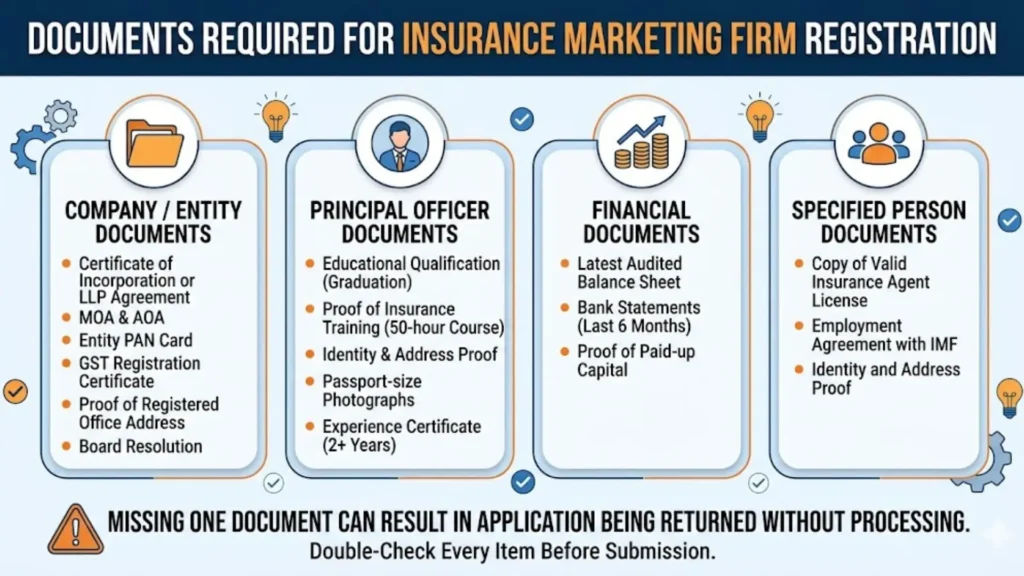
Documents Required for Insurance Marketing Firm Registration
Getting your paperwork right is honestly half the battle. A complete and well-organized document submission significantly reduces back-and-forth with IRDAI and speeds up your approval timeline.
Here is the full list of documents typically required during Insurance Marketing Firm registration:
Company / Entity Documents:
- Certificate of Incorporation (for companies) or LLP Agreement
- Memorandum of Association (MOA) and Articles of Association (AOA)
- PAN Card of the entity
- GST Registration Certificate
- Proof of registered office address (utility bill, rent agreement, or ownership documents)
- Board Resolution authorizing the Insurance Marketing Firm registration application
Principal Officer Documents:
- Educational qualification certificates (graduation degree minimum)
- Proof of insurance training (50-hour course completion certificate from IRDAI-recognized institute)
- Identity proof (Aadhaar, PAN, or Passport)
- Address proof
- Passport-size photographs
- Experience certificate showing minimum 2 years in insurance or financial services
Financial Documents:
- Latest audited balance sheet or financial statements
- Bank statements (last 6 months)
- Proof of paid-up capital
Specified Person Documents:
- Copy of valid insurance agent license
- Employment agreement with the IMF
- Identity and address proof
Missing even one document can result in your application being returned without processing. So go through this list carefully and double-check every item before submission.
Step-by-Step Insurance Marketing Firm Registration Process
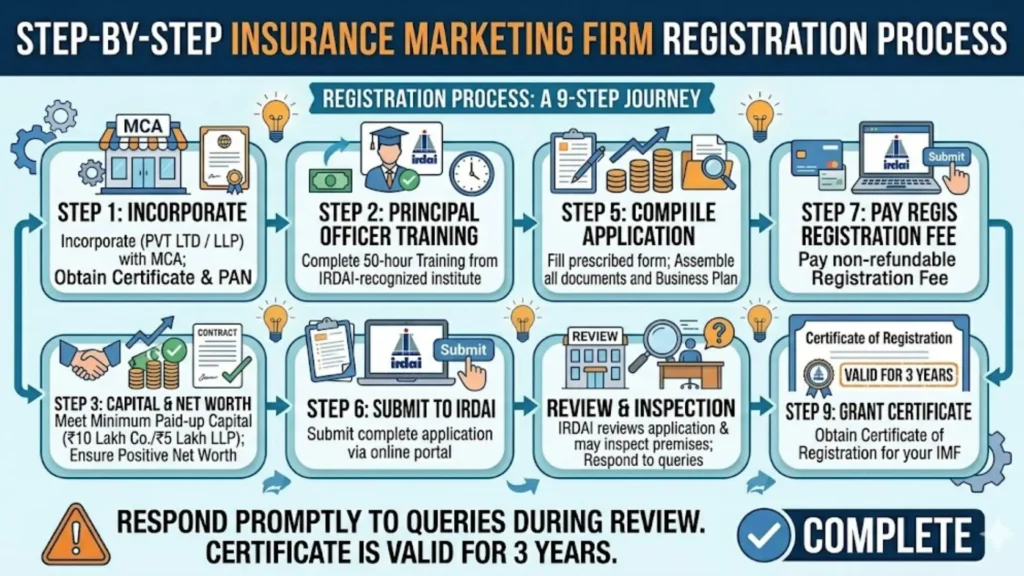
Now let us walk through the actual Insurance Marketing Firm registration process from start to finish.
Step 1: Incorporate Your Entity
Before you even approach IRDAI, you need to have a properly incorporated entity. If you do not already have a Private Limited Company or LLP registered, start here. File your incorporation documents with the Ministry of Corporate Affairs (MCA) and obtain your Certificate of Incorporation and PAN.
Step 2: Complete the Principal Officer Training
Your designated Principal Officer needs to complete the 50-hour prescribed training from an IRDAI-recognized training institute. This step is mandatory. Do not skip it or try to substitute it with any other certification.
Step 3: Arrange Your Capital and Net Worth
Make sure your entity meets the minimum paid-up capital requirement — ₹10 lakh for a company or ₹5 lakh for an LLP. Your financial statements should clearly reflect a positive net worth.
Step 4: Appoint and Hire Specified Persons
Hire at least one Specified Person — meaning a person holding a valid, in-force insurance agent license issued by IRDAI. This person must be a salaried employee of your IMF, not a contractor.
Step 5: Prepare and Compile Your Application
Fill out the prescribed application form as per IRDAI's Insurance Marketing Firm registration regulations. Compile all the documents listed above in proper order. Prepare a detailed business plan if required.
Step 6: Submit Application to IRDAI
Submit your complete application to the IRDAI office. As of 2026, IRDAI has been progressively moving towards online submission through its IRDAI Integrated Grievance Management System and official portal. Check the IRDAI website for the latest submission guidelines.
Step 7: Pay the Registration Fee
Pay the applicable registration fee at the time of submission. The fees are fixed by IRDAI regulations and are non-refundable.
Step 8: IRDAI Review and Inspection
IRDAI will review your application and may conduct a due diligence inspection of your office premises. They may also call for additional documents or clarifications during this stage. Respond promptly to any query raised.
Step 9: Grant of Certificate of Registration
Once IRDAI is satisfied with your application, they will issue the Certificate of Registration for your Insurance Marketing Firm. This certificate is valid for three years.
Insurance Marketing Firm Registration Fees
| Category | Registration Fee |
| New Registration | ₹10,000 |
| Renewal (every 3 years) | ₹5,000 |
| Duplicate Certificate | ₹500 |
These fees are subject to revision by IRDAI. Always cross-check the latest fee schedule on the official IRDAI website before submitting your payment.
Compliance Obligations After Registration
Getting your Insurance Marketing Firm registration is just the beginning. Maintaining your registration requires ongoing compliance — and this is where many firms stumble.
Here are the key compliance requirements you must stay on top of:
- Renewal of Certificate: Your IMF certificate must be renewed every three years before the expiry date
- Specified Person Licensing: All Specified Persons must hold valid, in-force insurance agent licenses at all times
- Record Maintenance: Maintain proper records of policies sold, customer details, and commissions received
- Reporting to IRDAI: File annual returns and reports as required by IRDAI regulations
- Principal Officer Continuity: If your Principal Officer leaves, you must appoint a qualified replacement promptly and notify IRDAI
- Multi-Insurer Tie-ups: Ensure your tie-up agreements with insurers are formally documented and on record
- Grievance Redressal: Maintain a proper customer grievance redressal mechanism as mandated
Staying compliant is not just about avoiding penalties — it also builds the kind of professional reputation that helps your IMF grow through trust and referrals.
Common Mistakes to Avoid During Insurance Marketing Firm Registration
People make certain mistakes repeatedly during the Insurance Marketing Firm registration process, and most of them are completely avoidable.
1. Applying Without Complete Documentation - Incomplete applications are returned, causing significant delays. Build a checklist and verify every document before submission.
2. Skipping the Principal Officer Training - The 50-hour IRDAI-prescribed training is a hard requirement. There are no shortcuts here. Plan for this well in advance.
3. Hiring Specified Persons on a Contract Basis - IRDAI requires Specified Persons to be salaried employees of the IMF. Freelancers or consultants do not qualify.
4. Not Planning for Minimum Capital - Some applicants assume they can meet the capital requirement informally. All capital must be properly reflected in your financial statements and bank accounts.
5. Delaying Renewaln- Many IMFs forget to track their certificate expiry date and miss the renewal window. Set calendar reminders well in advance of your three-year renewal date.
Why Insurance Marketing Firm Registration Makes Business Sense in 2026
The Indian insurance sector is in a period of significant growth. Insurance penetration is steadily increasing, IRDAI is actively pushing for broader distribution reach, and digital tools have made it easier than ever to reach and serve customers across tier-2 and tier-3 cities.
Setting up a properly registered Insurance Marketing Firm gives you:
- Regulatory legitimacy — customers trust you because you are IRDAI-registered
- Product flexibility — you can offer products from multiple insurers, not just one
- Business scalability — you can expand your team by bringing in more Specified Persons
- Income diversification — earnings from multiple insurers across life, health, and general insurance categories
- Brand credibility — operating as a registered firm is far more credible than working as an individual agent
In 2026, with insurance awareness growing fast and the digital-first customer expecting more product choice, the IMF model is genuinely well-positioned for sustainable, long-term growth.
Conclusion
Insurance Marketing Firm registration is one of the most practical and well-structured ways to enter India's insurance distribution market with full regulatory backing. The process is clearly defined, the eligibility criteria are achievable for most serious applicants, and the business opportunity on the other side is genuinely substantial.
If you are ready to take the next step, start with your entity incorporation, arrange your Principal Officer training, and get your documents in order. The sooner you begin, the sooner you will have a registered IMF ready to serve customers and grow.
Take the right steps today — because building a compliant, trusted insurance marketing business in 2026 is not just a good idea, it is a genuinely smart long-term investment.
Frequently Asked Questions
Can a sole proprietor apply for Insurance Marketing Firm registration?
No, a sole proprietor cannot apply for Insurance Marketing Firm registration. IRDAI mandates that only formally incorporated entities are eligible. This means your business must be registered as one of the following before you apply — a Private Limited Company, Public Limited Company, Limited Liability Partnership (LLP), or Cooperative Society.
How long does the Insurance Marketing Firm registration process take?
In most cases, the end-to-end Insurance Marketing Firm registration process takes between 30 to 90 days from the date of complete application submission.
Can an IMF sell both life and general insurance products?
Yes, and this is one of the most attractive features of Insurance Marketing Firm registration. An IMF is permitted to enter into tie-up agreements with up to two life insurance companies, two general insurance companies, and two standalone health insurance companies.
What happens if an IMF's Specified Person resigns or leaves?
If a Specified Person leaves your IMF, you must take immediate action. First, you are required to notify IRDAI about the change. Second, you must onboard a replacement Specified Person — someone holding a valid, in-force IRDAI insurance agent license — as soon as possible.
Is Insurance Marketing Firm registration valid pan-India or only in specific states?
Insurance Marketing Firm registration issued by IRDAI is valid across the entire country. IRDAI is a central regulatory authority, meaning its approvals carry nationwide recognition.
What is the difference between an Insurance Marketing Firm and an Insurance Broker?
Both are IRDAI-regulated entities that distribute insurance products, but there are key differences. An Insurance Broker can work with an unlimited number of insurers, charges a broking fee (in some cases), and is subject to a higher net worth requirement — typically ₹75 lakh for composite broking. An IMF, on the other hand, has a lower capital requirement, is limited to tie-ups with up to six insurers (across categories), and earns through standard agent commissions rather than broking fees.
Can a registered IMF also offer mutual funds or other financial products?
Yes, within certain conditions. An IRDAI-registered IMF is permitted to offer other financial products beyond insurance, provided the Specified Persons handling those products hold the relevant licenses or certifications for those products.
What are the renewal requirements for an Insurance Marketing Firm registration?
Your IMF's Certificate of Registration is valid for three years from the date of issue. Before it expires, you must apply for renewal and pay the applicable renewal fee — currently ₹5,000 as per IRDAI regulations.
Can an existing insurance agent convert their practice into an IMF?
Yes, an insurance agent can absolutely transition to the IMF model — and for many agents, this is a natural and highly beneficial progression. To do so, the agent would first need to incorporate a proper legal entity (Private Limited Company or LLP), complete the required Principal Officer training if they are taking on that role, and then file for Insurance Marketing Firm registration with IRDAI.
What are the penalties for operating an Insurance Marketing Firm without a valid registration or after certificate expiry?
Operating as an Insurance Marketing Firm without a valid IRDAI Certificate of Registration — or continuing to operate after your certificate has expired without timely renewal — is a serious regulatory violation. IRDAI has the authority to impose monetary penalties, cancel the registration, blacklist the principals involved, and take other regulatory action under the Insurance Act.