- FSSAI New Turnover Threshold 2026 has officially changed the annual turnover limits for basic registration, State license, and Central license — and if you run any food business in India, these new limits are already in effect from 1st April 2026 as per the official order dated 13th March 2026.
- FSSAI registration limit has been raised to ₹1.5 crore annual turnover — which is honestly a big relief for thousands of small food businesses, home kitchens, tiffin services, and street vendors who were previously stuck paying for a State license they never really needed
- FSSAI State license and Central license eligibility has been completely restructured — State license now covers businesses earning between ₹1.5 crore and ₹50 crore, while Central license kicks in only when your turnover crosses ₹50 crore, which frees up a lot of mid-size businesses from unnecessary central-level compliance
- FSSAI food business compliance has genuinely become more practical — perpetual validity means no more stressful annual renewals, risk-based inspections replace the old fixed renewal cycles, and street food vendors finally get dedicated relief from the dual compliance burden they have been dealing with for years
Introduction
FSSAI revised turnover threshold 2026 is the most important regulatory update every food business owner in India needs to understand right now — whether you run a home kitchen selling pickles online, a mid-size food processing unit, or a national food brand.
The Food Safety and Standards Authority of India (FSSAI) has officially revised the annual turnover limits that decide whether your food business requires a basic registration, a State license, or a Central license. The new rules are in effect from 1st April 2026, and they replace every earlier classification criterion under the Food Safety and Standards (Licensing and Registration of Food Businesses) Regulations, 2011.
This is not just a number change. It reshapes compliance obligations for millions of Food Business Operators (FBOs) across India — from street food vendors and tiffin services to cloud kitchens, food processors, and multinational food companies.
In this guide, you will find everything: what changed, who is affected, the complete document list, the step-by-step application process, eligibility criteria, key benefits, and answers to the most common questions people are asking right now.
What Is FSSAI and Why Is Registration or Licensing Mandatory?
The Food Safety and Standards Authority of India (FSSAI) is the government body responsible for regulating food safety across the country. It was set up under the Food Safety and Standards Act, 2006 and works under the Ministry of Health and Family Welfare, Government of India.
FSSAI exists to make sure that whatever food reaches your plate — whether it comes from a local street stall, a supermarket shelf, or an online delivery platform — is safe to eat. To do that, FSSAI makes it mandatory for every person or business involved in food to hold a valid registration or license before they start operating.
No registration or license means you are running your food business illegally — and the consequences are serious enough that it is simply not worth the risk.
Who Exactly Is a Food Business Operator?
A Food Business Operator (FBO) is anyone — an individual, a partnership firm, a private company, or any other organization — who is involved in any food-related activity. The definition is broad on purpose, because the food supply chain is long and every part of it needs to be accountable.
Here is what counts as a food business under FSSAI:
- Manufacturing — if you produce, process, or package any food product, you are an FBO
- Trading — buying and selling food items, whether wholesale or retail, falls under this
- Storage — running a warehouse, cold storage, or food godown counts as a food business
- Distribution — managing the supply chain or logistics for food products
- Transportation — if your trucks or vehicles carry food goods, FSSAI applies to you too
- Catering — restaurants, hotels, dhabas, office canteens, and cloud kitchens all need FSSAI credentials
- Retail — grocery stores, supermarkets, kirana shops, and online food platforms are all covered
- Import and Export — bringing food into India or sending it out requires FSSAI compliance
- Street Food Vending — whether you have a fixed stall or a mobile cart, you are an FBO under FSSAI
If your work touches food in any way — at any stage between production and the consumer — you need to be registered or licensed.
What Actually Happens If You Don't Have FSSAI?
This is where a lot of small business owners take a gamble they really should not. Operating without a valid FSSAI registration or license is a punishable offence under the Food Safety and Standards Act, 2006 — and the penalties go beyond just a fine.
Here is what you are actually risking:
- Financial penalty — you can be fined up to ₹5 lakh simply for running a food business without a license, even if your food is perfectly safe
- Business closure — food safety officers have the authority to seal your premises on the spot
- Product seizure — your entire food stock can be confiscated and destroyed, with no compensation
- Criminal prosecution — if adulteration or a serious safety violation is involved, you are looking at criminal charges, not just a fine
- Platform delisting — if you sell on Swiggy, Zomato, Amazon, or any other major food platform, they require your FSSAI number as a condition of listing; without it, your account gets removed
The good news is that getting registered or licensed under the new 2026 thresholds is easier and more affordable than it has ever been. There is genuinely no reason to delay.
The Official Order
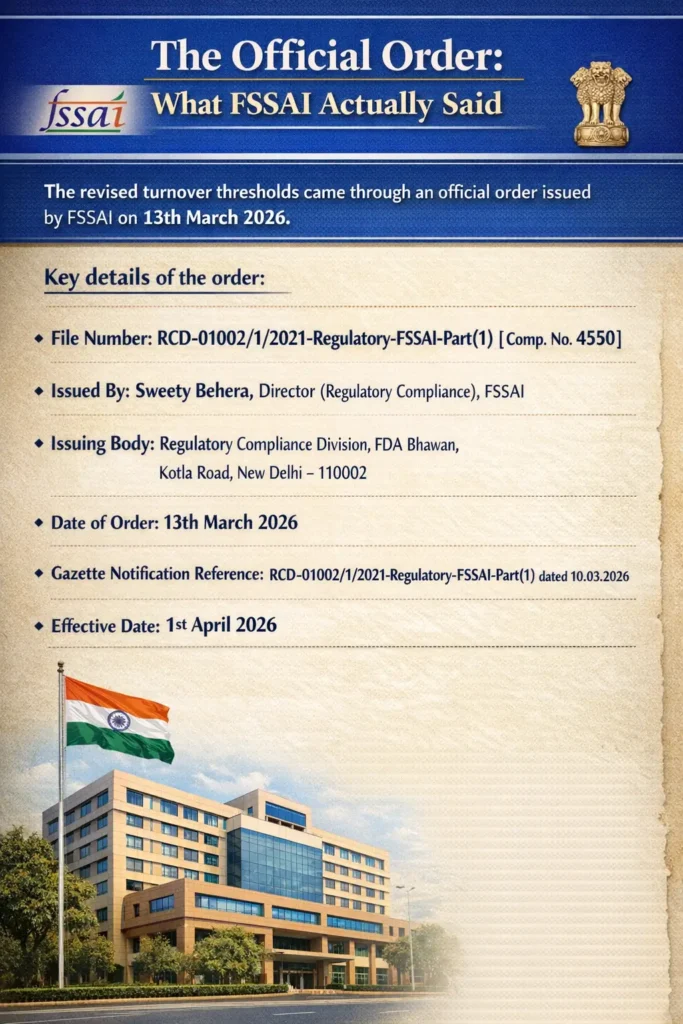
The revised turnover thresholds came through an official order issued by FSSAI on 13th March 2026.
Key details of the order:
- File Number: RCD-01002/1/2021-Regulatory-FSSAI-Part(1) [Comp. No. 4550]
- Issued By: Sweety Behera, Director (Regulatory Compliance), FSSAI
- Issuing Body: Regulatory Compliance Division, FDA Bhawan, Kotla Road, New Delhi – 110002
- Date of Order: 13th March 2026
- Gazette Notification Reference: RCD-01002/1/2021-Regulatory-FSSAI-Part(1) dated 10.03.2026
- Effective Date: 1st April 2026
The order was addressed to all Food Business Operators, Commissioners of Food Safety of all States/UTs, Directors of all Regional Offices of FSSAI, and the Chief Technical Officer (CTO) of FSSAI for uploading on the official website.
This order was backed by:
- Recommendations of NITI Aayog's High Level Committee on Non-Financial Regulatory Reforms
- Approval of the Food Authority
- Approval of the Ministry of Health and Family Welfare
- The gazette notification of the Food Safety and Standards (Licensing and Registration of Food Businesses) Amendment Regulations, 2026
FSSAI New Turnover Threshold 2026
Here is the revised classification table, exactly as specified in the official FSSAI order dated 13th March 2026:
| Type of FSSAI Credential | Annual Turnover Threshold |
| FSSAI Basic Registration | Annual turnover up to ₹1.5 Crore |
| State License | Annual turnover above ₹1.5 Crore and up to ₹50 Crore |
| Central License | Annual turnover above ₹50 Crore |
This order supersedes all earlier FSSAI orders and regulations relating to turnover thresholds or categorization criteria under the Food Safety and Standards (Licensing and Registration of Food Businesses) Regulations, 2011.
Old vs New: How the Thresholds Changed
The previous thresholds had been in place since the original 2011 Regulations. Here is a direct comparison:
| FSSAI Category | Old Annual Turnover Threshold | New Annual Turnover Threshold (2026) | Change |
| Basic Registration | Up to ₹12 Lakh | Up to ₹1.5 Crore | 12.5x increase |
| State License | ₹12 Lakh – ₹20 Crore | ₹1.5 Crore – ₹50 Crore | Significantly wider band |
| Central License | Above ₹20 Crore | Above ₹50 Crore | 2.5x higher entry point |
What This Means in Plain Terms
- A food business earning ₹80 lakh per year previously needed a State license. Under the new rules, it only needs basic registration.
- A food company with ₹25 crore turnover previously needed a Central license. It now only needs a State license.
- The compliance burden on small and medium food businesses has been dramatically reduced.
Why FSSAI Revised These Thresholds — The Policy Rationale
The revision was not arbitrary. It came from a structured policy process:
NITI Aayog's Role
NITI Aayog constituted a High Level Committee on Non-Financial Regulatory Reforms to identify ways to reduce unnecessary compliance burdens on businesses across India. One of its key findings was that the 2011-era FSSAI thresholds were severely outdated — they were set when ₹12 lakh was a meaningful revenue milestone for a small business, but over 15 years of economic growth and inflation had made that figure almost irrelevant.
The Core Problems the Revision Solves
- Outdated thresholds: ₹12 lakh registration ceiling had not kept pace with inflation or business growth since 2011.
- Over-compliance burden on small businesses: Many small dhabas, home food entrepreneurs, and tiffin services were forced into State licensing requirements that were designed for much larger operations.
- Dual compliance for street vendors: Street food vendors were caught in a situation where they had to comply with two separate regulatory systems simultaneously — this has now been addressed.
- Rigid validity periods: Annual or periodic license renewals created administrative burden for both businesses and regulators. The new amendment introduces perpetual validity with risk-based inspections instead.
- Lack of flexibility for the Food Authority: The earlier rules required fresh regulatory amendments every time thresholds needed updating. The new enabling provision allows FSSAI to revise thresholds by order alone.
Who Is Eligible for What? Complete Eligibility Criteria
Eligibility for each type of FSSAI credential is primarily determined by annual turnover, but there are other criteria too.
FSSAI Basic Registration — Eligibility
You are eligible for basic FSSAI registration if:
- Your annual turnover is up to ₹1.5 crore
- You are a small food retailer, street food vendor, or petty food manufacturer
- You are a home-based food business (home baker, homemade food seller)
- You operate a small dhaba, tea stall, or juice shop
- You are a hawker or itinerant food vendor
- You run a small catering business serving local functions or offices
- You are a small distributor, transporter, or storage operator with turnover below ₹1.5 crore
- You are a temporary stall holder at events and fairs
FSSAI State License — Eligibility
You need a State license if your annual turnover is above ₹1.5 crore and up to ₹50 crore, and you are:
- A mid-size food manufacturer or processor
- A restaurant chain operating within one state
- A food trading company with moderate turnover
- A hotel, restaurant, or catering business with significant revenue
- A cold storage operator with annual turnover within the State license range
- A food retailer operating multiple outlets within a state
- A cloud kitchen brand or meal kit company in growth phase
FSSAI Central License — Eligibility
You need a Central license if your annual turnover is above ₹50 crore, or you are:
- A large food manufacturer or processor
- A food business operating in more than one state
- An importer of food products into India
- An exporter of food products from India
- A food business operating from a central government establishment
- A company supplying food to railways, airlines, or defence establishments
- A large e-commerce food platform or marketplace
Note: Even if your turnover is below ₹50 crore, certain business types — such as importers, exporters, and multi-state operators — may still require a Central license based on the nature of operations, not just turnover. Always verify with FSSAI or a licensed food compliance consultant for your specific situation.
FSSAI Basic Registration
What Is FSSAI Basic Registration?
FSSAI basic registration is the entry-level food safety credential for small food businesses in India. It is issued as a FSSAI Registration Certificate and carries a 14-digit registration number that must be displayed at your business premises and on your food labels and packaging.
Who Should Apply?
- Petty retailers selling food items directly to consumers
- Home food businesses and cottage food operators
- Street food vendors, hawkers, and mobile food carts
- Small dhabas, tea stalls, paan shops, juice bars
- Small catering businesses
- Any food business with annual turnover up to ₹1.5 crore
Features of Basic Registration (Post 2026 Amendment)
- Perpetual validity — no more annual or periodic renewal requirement
- Subject to risk-based inspections by food safety officers
- Lower compliance burden compared to licensing
- Single-window application through the FoSCoS portal
FSSAI State License
What Is an FSSAI State License?
A State license is a food safety license issued by the State Food Safety Commissioner for medium-scale food businesses operating within a single state with annual turnover above ₹1.5 crore and up to ₹50 crore.
Who Should Apply?
- Mid-size food manufacturers and processors
- Restaurants, hotels, and catering businesses with significant revenue
- Food retailers operating multiple outlets within a state
- Cold storage and warehousing operators (within State license turnover range)
- Distributors and transporters with relevant turnover
Features of State License (Post 2026 Amendment)
- Perpetual validity — subject to risk-based inspections
- Issued and monitored by State Food Safety Authority
- Must display license number on premises and packaging
- Business changes (premises, product range, partners) require intimation to State Authority
FSSAI Central License
What Is an FSSAI Central License?
A Central license is the highest level of FSSAI credential, issued by the Central Licensing Authority (FSSAI headquarters) for large-scale food businesses with turnover above ₹50 crore, or for businesses engaged in import/export or multi-state operations.
Who Should Apply?
- Large food manufacturers and processors
- Food importers and exporters
- Multi-state food business operators
- Businesses supplying food to government, railways, defence, or airlines
- Large e-commerce food platforms
Features of Central License (Post 2026 Amendment)
- Perpetual validity — subject to regular risk-based inspections
- Stricter compliance requirements than registration or State license
- Must maintain food safety management systems
- Subject to third-party audits and periodic lab testing requirements
Documents Required for FSSAI Basic Registration
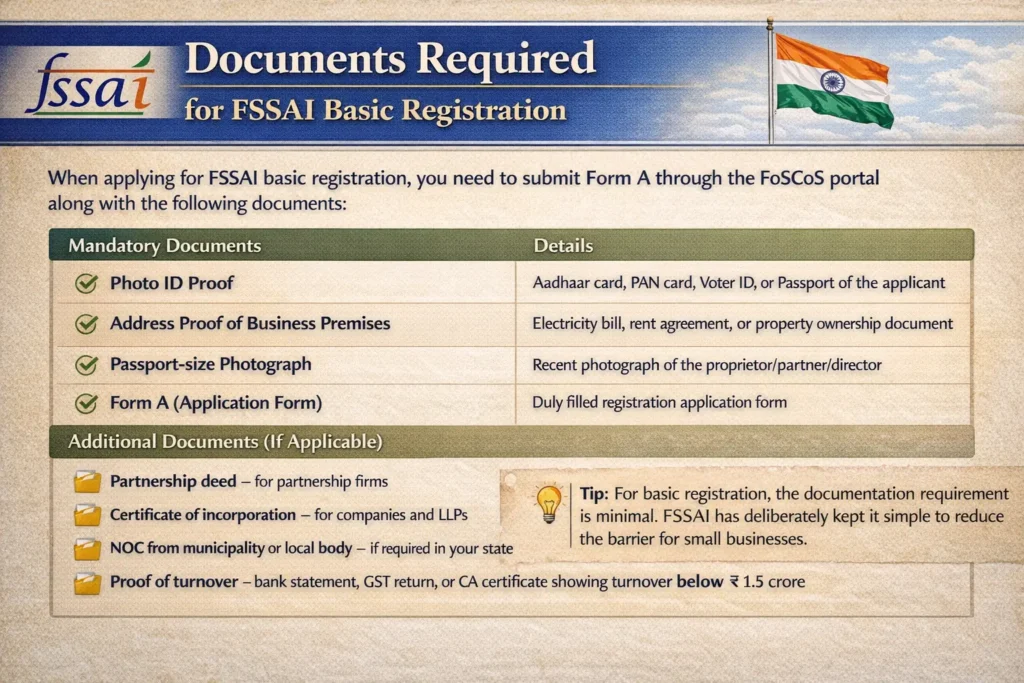
When applying for FSSAI basic registration, you need to submit Form A through the FoSCoS portal along with the following documents:
Mandatory Documents
| Document | Details |
| Photo ID Proof | Aadhaar card, PAN card, Voter ID, or Passport of the applicant |
| Address Proof of Business Premises | Electricity bill, rent agreement, or property ownership document |
| Passport-size Photograph | Recent photograph of the proprietor/partner/director |
| Form A (Application Form) | Duly filled registration application form |
Additional Documents (If Applicable)
- Partnership deed — for partnership firms
- Certificate of incorporation — for companies and LLPs
- NOC from municipality or local body — if required in your state
- Proof of turnover — bank statement, GST return, or CA certificate showing turnover below ₹1.5 crore
Tip: For basic registration, the documentation requirement is minimal. FSSAI has deliberately kept it simple to reduce the barrier for small businesses.
Documents Required for FSSAI State License
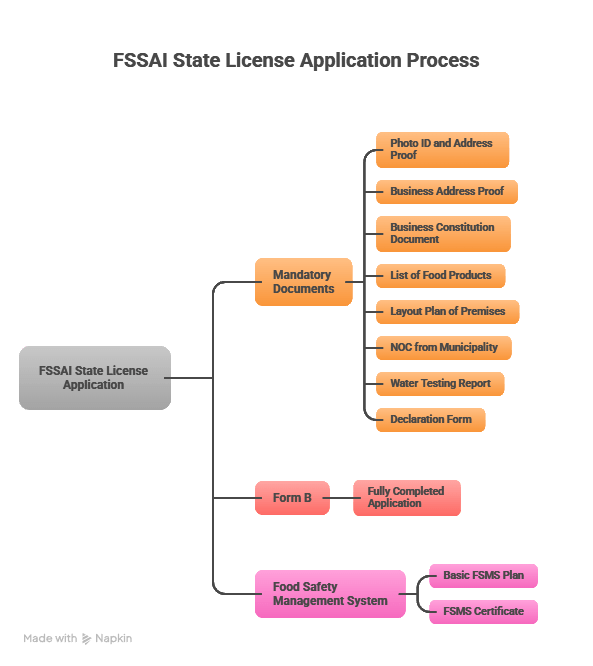
State license applications are filed through Form B on the FoSCoS portal. The document list is more detailed:
Mandatory Documents
| Document | Details |
| Photo ID and Address Proof | Aadhaar, PAN, Voter ID, or Passport of proprietor/partners/directors |
| Business Address Proof | Rent agreement, electricity bill, or property document of food business premises |
| Business Constitution Document | Partnership deed / Certificate of Incorporation / MOA & AOA for companies |
| Form B (Application Form) | Fully completed State license application |
| List of Food Products | Complete list of food products to be manufactured, processed, or traded |
| Layout Plan of Premises | Scaled layout/map of the processing or business area |
| Food Safety Management System (FSMS) Plan | Basic FSMS plan or certificate (if applicable) |
| NOC from Municipality | Health/trade NOC from local municipal body |
| Water Testing Report | Certificate of potable water supply for food manufacturing units |
| Declaration Form | Self-declaration by the applicant about accuracy of information |
Additional Documents Based on Business Type
- Proprietorship: Aadhaar and PAN of proprietor
- Partnership Firm: Partnership deed and PAN of all partners
- Private/Public Limited Company: Certificate of incorporation, MOA, AOA, board resolution, PAN of directors
- LLP: LLP agreement and PAN of designated partners
- Food Manufacturer/Processor: List of machinery and equipment installed
- Milk Processing Unit: Proof of milk procurement/sourcing
- Cold Storage: Temperature maintenance record system details
Documents Required for FSSAI Central License
Central license applications are also filed through Form B on FoSCoS, but with a more comprehensive document set:
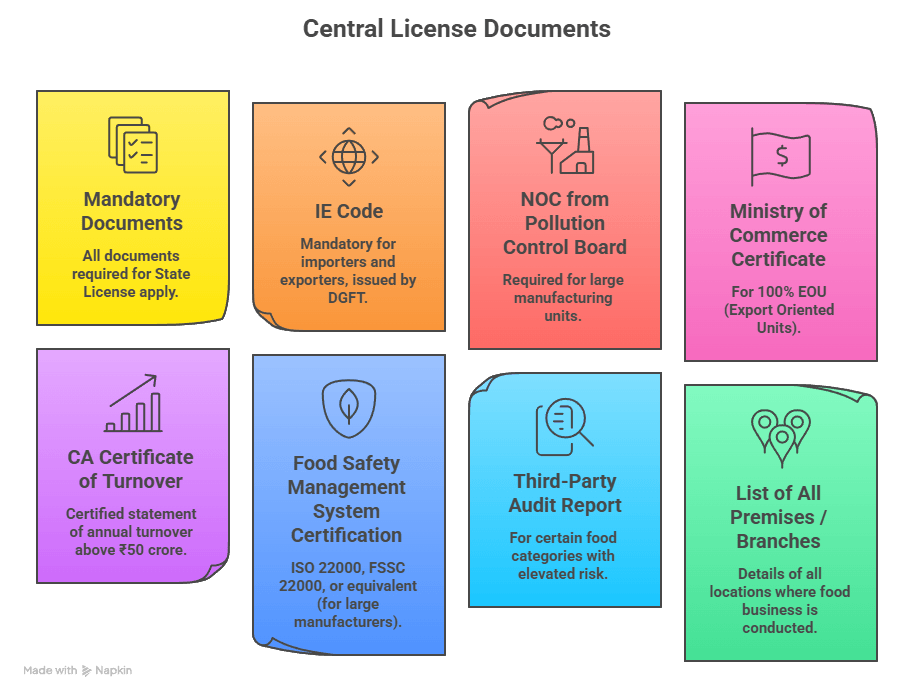
Mandatory Documents
| Document | Details |
| All documents required for State License | (As listed above — all apply) |
| IE Code (Importer Exporter Code) | Mandatory for importers and exporters, issued by DGFT |
| NOC from Pollution Control Board | Required for large manufacturing units |
| Ministry of Commerce Certificate | For 100% EOU (Export Oriented Units) |
| CA Certificate of Turnover | Certified statement of annual turnover above ₹50 crore |
| Food Safety Management System Certification | ISO 22000, FSSC 22000, or equivalent (for large manufacturers) |
| Third-Party Audit Report | For certain food categories with elevated risk |
| List of All Premises / Branches | Details of all locations where food business is conducted |
For Import/Export Businesses Specifically
- Valid Import Export Code (IEC) from DGFT
- Port of entry/exit details
- Product-specific clearance documents (e.g., FSSAI Product Approval for certain categories)
Step-by-Step Application Process on FoSCoS Portal
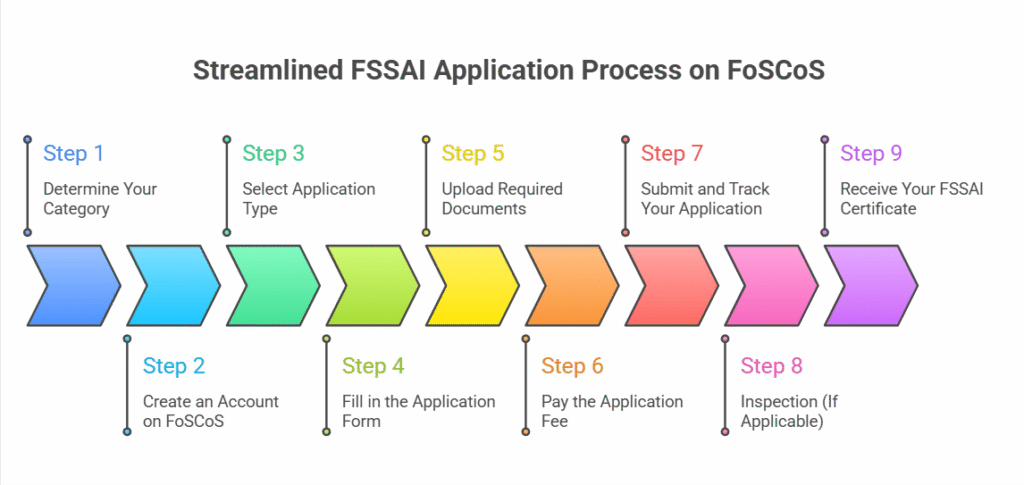
FSSAI applications are submitted digitally through the Food Safety Compliance System (FoSCoS) portal at foscos.fssai.gov.in. Here is the complete process:
Step 1: Determine Your Category
Before applying, determine whether you need:
- Basic Registration (turnover up to ₹1.5 crore)
- State License (turnover ₹1.5 crore – ₹50 crore)
- Central License (turnover above ₹50 crore)
Use the revised thresholds effective 1st April 2026 as your guide.
Step 2: Create an Account on FoSCoS
- Visit foscos.fssai.gov.in
- Click on "Sign Up" and register using your mobile number or email ID
- Verify your OTP and complete the basic profile setup
Step 3: Select Application Type
- Log in to your FoSCoS account
- Click on "Apply for License/Registration"
- Select the appropriate form:
- Form A — for Basic Registration
- Form B — for State License or Central License
Step 4: Fill in the Application Form
Provide the following details accurately:
- Personal information of proprietor/partners/directors
- Business name and nature of food business
- Complete address of food business premises
- Type of food products handled, manufactured, or sold
- Annual turnover (as per the revised thresholds)
- Details of food safety measures in place
Step 5: Upload Required Documents
Upload all mandatory documents in the prescribed formats:
- Accepted formats: PDF, JPG, PNG
- File size limit: Generally up to 1–2 MB per document
- Ensure documents are clear, legible, and current
Step 6: Pay the Application Fee
Pay the prescribed FSSAI fee online through the portal:
| Category | Fee |
| Basic Registration | ₹100 per year (now perpetual — check portal for current fee) |
| State License | ₹2,000 – ₹5,000 depending on the nature and scale of business |
| Central License | ₹7,500 per year of license (check portal for latest schedule) |
Note: Fee structures are subject to revision. Always verify the current fee on the FoSCoS portal or FSSAI's official website at the time of application.
Step 7: Submit and Track Your Application
- After payment, submit the application
- You will receive an application reference number
- Track your application status on FoSCoS under "Track Application"
Step 8: Inspection (If Applicable)
- For State and Central licenses, a food safety officer may inspect your premises before the license is granted
- For basic registration, inspection may be triggered post-registration on a risk-based basis
- Ensure your premises are compliant with FSSAI hygiene and safety norms before inspection
Step 9: Receive Your FSSAI Certificate
- Once approved, your FSSAI registration certificate or license will be issued digitally
- Download and print your certificate from the FoSCoS portal
- Display it prominently at your business premises
- Add your 14-digit FSSAI number to all food labels and packaging
What If You Already Have an FSSAI License or Registration?
If you currently hold an FSSAI credential and the new thresholds change your category:
- No immediate cancellation of your existing credential
- You can apply for modification/upgrade/downgrade through the FoSCoS portal
- If your turnover has dropped below ₹1.5 crore and you hold a State license, you may apply to convert to registration
- If your turnover has grown above your current category's limit, upgrade before operating above threshold
Key Benefits of the Revised Turnover Thresholds
The FSSAI revised turnover threshold 2026 brings tangible, real-world benefits — and not just on paper.
For Small Food Businesses
- Simpler compliance: Moving from State license requirements to basic registration means far less paperwork, fewer inspections, and lower fees.
- Lower cost: Registration fees are significantly lower than State license fees.
- Faster onboarding: Registration applications are processed faster than full licensing applications.
- Less documentation: The document list for registration is much shorter than for a license.
For Medium-Scale Food Businesses
- Freed from Central license burden: Businesses with ₹20–50 crore turnover no longer need a Central license — a State license now suffices.
- Reduced audit frequency: Risk-based inspection replaces fixed periodic audits, meaning compliant businesses face fewer disruptions.
For Large Food Corporations
- Clearer threshold: The ₹50 crore Central license trigger is a more meaningful benchmark than the earlier ₹20 crore limit.
- Regulatory certainty: FSSAI now has the power to revise thresholds by order alone — no waiting for gazette amendments.
For the Food Ecosystem at Large
- Encourages formalisation: More small businesses will register when the process is simpler and the requirement is proportionate to their scale.
- Reduces grey market operations: Simplifying compliance reduces the incentive to operate informally.
- Supports Atmanirbhar Bharat and ease of doing business goals — aligned with central government's priority to reduce regulatory friction for micro, small, and medium enterprises.
Perpetual Validity — What It Actually Means
One of the most significant provisions in the FSSAI Amendment Regulations 2026 is the introduction of perpetual validity for both FSSAI registration and licenses.
What Was the Old System?
Under the earlier regulations, FSSAI registration and licenses were issued for fixed periods — typically 1 to 5 years — after which the FBO had to apply for renewal. Missing the renewal deadline could result in the credential lapsing, meaning the business would technically be operating without valid FSSAI authorisation.
What Does Perpetual Validity Mean?
- Your FSSAI registration or license, once granted, does not expire after a fixed period.
- You do not need to file periodic renewal applications.
- Your credential remains valid as long as:
- Your business remains compliant with FSSAI norms
- You have not violated food safety standards
- You have not been subject to suspension or cancellation
Subject to Risk-Based Inspections
Perpetual validity does not mean permanent freedom from scrutiny. It comes with a condition:
- FSSAI will conduct risk-based inspections of food businesses
- The frequency and intensity of inspections will depend on the risk profile of your business — what kind of food you handle, your scale, your compliance history, and factors like whether you serve vulnerable populations (children, hospitals, etc.)
- Low-risk businesses (e.g., a small grocery store) will face less frequent inspections than high-risk businesses (e.g., a dairy processor or a packaged food manufacturer)
Risk-Based Inspections Under the New Framework
The shift from time-based renewals to risk-based inspections is a major philosophical change in how FSSAI monitors food businesses.
How Risk Is Assessed
FSSAI categorises food businesses by risk level based on:
| Risk Factor | Description |
| Nature of food product | Ready-to-eat vs raw, processed vs unprocessed, perishable vs shelf-stable |
| Vulnerability of consumers | Products intended for infants, elderly, or patients carry higher risk |
| Scale of operation | Larger operations with greater reach attract more scrutiny |
| Compliance history | Businesses with prior violations are flagged for more frequent checks |
| Type of operation | Manufacturing and processing carry higher risk than retail or storage |
Penalties for Non-Compliance
The FSSAI revised thresholds make it easier to comply — but the penalties for not complying remain serious.
Key Penalties Under the Food Safety and Standards Act, 2006
| Violation | Penalty |
| Operating without registration or license | Up to ₹5 lakh |
| Selling food not meeting FSSAI standards | Up to ₹5 lakh |
| Manufacturing or selling substandard food | Up to ₹5 lakh |
| Selling adulterated food (not injurious to health) | Up to ₹3 lakh |
| Selling adulterated food (injurious to health) | Up to ₹10 lakh |
| False labelling or misleading advertisements | Up to ₹10 lakh |
| Selling unsafe food (causing grievous hurt) | Imprisonment up to 7 years + ₹10 lakh fine |
| Selling unsafe food (causing death) | Imprisonment for life + ₹10 lakh fine |
These penalties apply regardless of turnover category. A basic registration holder and a Central license holder are both subject to the same penalty framework for safety violations.
Conclusion
The FSSAI revised turnover threshold 2026 is genuinely good news for India's food sector. Registration now covers up to ₹1.5 crore, State license goes up to ₹50 crore, and Central license kicks in only above ₹50 crore. Add perpetual validity and risk-based inspections to the mix, and compliance has never been more straightforward for food businesses of every size.
But knowing the rules and acting on them are two different things. If your turnover has shifted categories, your documents need updating. If you are starting fresh, now is the right time to get your FSSAI status in order. Either way, do not sit on it — the new thresholds are already in effect.
Need Help With FSSAI Registration or Licensing?
Silvereye Certifications helps food businesses across India get their FSSAI registration and licensing done correctly and completely — without the confusion of doing it alone. Whether it is a fresh registration, a State license, or a Central license, the team handles the entire process end to end.
You focus on your food business. Let Silvereye Certifications handle the compliance.
Frequently Asked Questions
What is the new FSSAI registration turnover limit from April 2026?
The new FSSAI registration threshold is annual turnover up to ₹1.5 crore. Any food business with turnover within this limit qualifies for basic registration.
What is the new FSSAI State license turnover range?
State license now applies to food businesses with annual turnover above ₹1.5 crore and up to ₹50 crore.
Who needs an FSSAI Central license after April 2026?
Any food business with annual turnover above ₹50 crore, as well as importers, exporters, and certain multi-state operators regardless of turnover, need a Central license.
When did the revised FSSAI turnover thresholds become effective?
The revised thresholds came into effect on 1st April 2026, as per the official order dated 13th March 2026.
Do I need to renew my FSSAI registration or license every year now?
No. Under the 2026 amendment, FSSAI registration and licenses have perpetual validity — they do not expire. However, your credential remains valid only if you maintain compliance.
My current turnover is ₹80 lakh. Do I need a State license or registration?
Under the new rules, ₹80 lakh falls well within the ₹1.5 crore registration threshold — so you only need basic FSSAI registration.
I currently hold a State license with a turnover of ₹40 lakh. Can I downgrade to registration?
Yes. Since your turnover is below the new ₹1.5 crore registration threshold, you are now eligible for basic registration. You can apply for a modification on the FoSCoS portal.
Does this order apply to online food businesses and cloud kitchens?
Yes. All food businesses operating in India — whether physical or online, including cloud kitchens, home food sellers, and food e-commerce sellers — must comply with FSSAI categorisation norms.
What is FoSCoS and where do I apply for FSSAI registration?
FoSCoS (Food Safety Compliance System) is FSSAI's official digital platform for all licensing and registration applications.
I am a home baker selling on Instagram. Do I need FSSAI registration?
Yes. If you are selling food products — even through social media — you are an FBO and must hold at minimum a basic FSSAI registration.
What documents do I need for basic FSSAI registration in 2026?
You need a photo ID (Aadhaar/PAN), address proof of your business premises, a passport-size photograph, and the filled Form A. The process is simple and can be done online.
Is there a penalty for continuing to operate under an old license category that no longer applies?
FSSAI has not announced an automatic transition or a specific penalty for holding a higher-category license than required. However, you are advised to update your FSSAI credential on FoSCoS to reflect the correct category under the new thresholds.
What is risk-based inspection and how often will my business be inspected?
Risk-based inspection means FSSAI will inspect your premises based on the assessed risk level of your food business — not on a fixed calendar. Low-risk businesses may rarely face inspections; high-risk businesses (like dairies or large manufacturers) will be inspected more frequently.
Can FSSAI revise the thresholds again in the future?
Yes. One of the key provisions of the 2026 amendment is that the Food Authority can specify or revise turnover thresholds at any time by order, without needing to go through a full regulatory amendment process. So the ₹1.5 crore and ₹50 crore limits could be updated in the future.