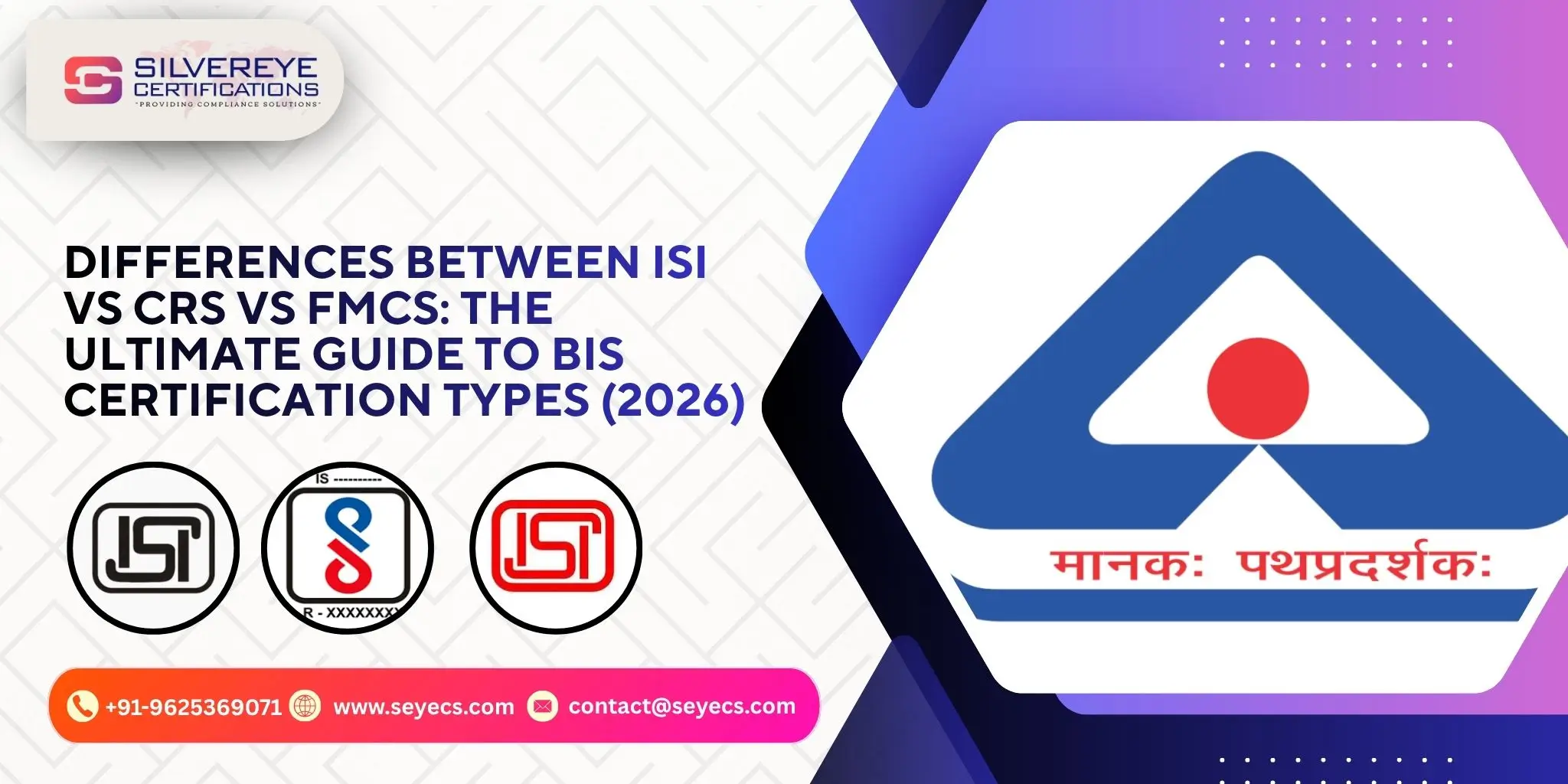
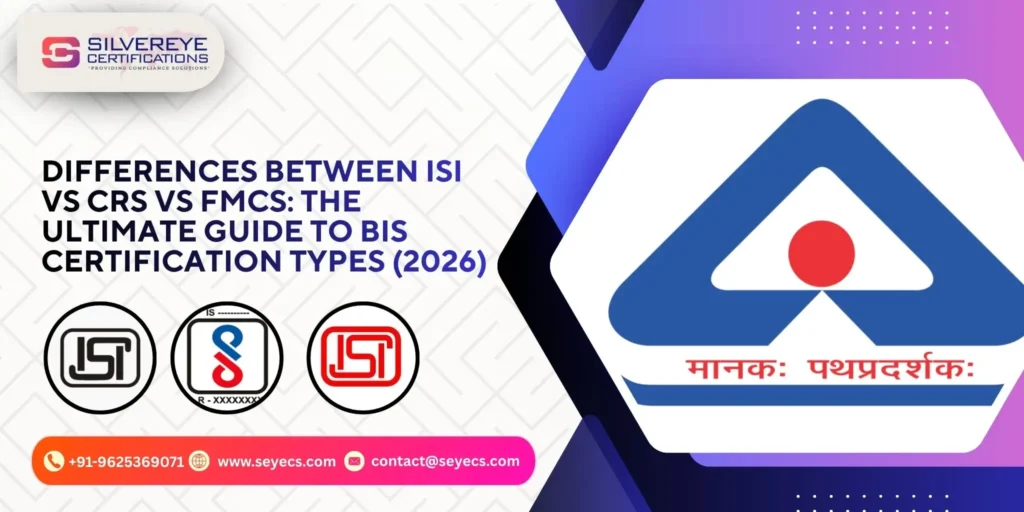
- Differences Between ISI vs CRS vs FMCS are not interchangeable; they refer to different schemes under the Bureau of Indian Standards (BIS) based on product risk and manufacturer location.
- ISI Mark (Scheme-I): The "Gold Standard" for high-risk products (Steel, Cement, Toys). It is the strictest scheme, requiring mandatory factory audits and lab testing. Timeline: 3–4 months.
- CRS (Scheme-II): A simplified "Registration" scheme for Electronics & IT (Laptops, Phones). It relies on NABL lab reports and usually requires no factory visit. Timeline: 20–30 days.
- FMCS: The specific license route for Foreign Manufacturers to obtain the ISI Mark. It requires appointing an Authorized Indian Representative (AIR) in India.
- Eligibility Rule: Licenses are granted only to the factory (manufacturing unit). Importers and traders are not eligible.
Introduction
Every year, thousands of consignments get held at Indian ports. Not because of fraud. Not because of missing duties. Because the manufacturer or importer did not know which BIS certification their product needed — or worse, assumed that having some form of international certification was enough.
A CE mark from Europe means nothing at Nhava Sheva or Chennai port. A UL mark from the United States carries zero weight with a BIS customs officer. What matters at an Indian port is one thing: does your product have the specific BIS certification number that Indian law requires for its category? An R-Number for electronics. A CM/L Number for industrial and safety goods. And if that number is missing from your packaging, your shipment does not move — not today, not tomorrow, not until the paperwork is right.
The longer it sits, the more it costs. Port demurrage in India is not a minor inconvenience. Depending on the port, the terminal, and the size of the consignment, detention charges accumulate daily — and for a shipment held for two or three weeks while a compliance issue gets resolved, those charges can run into lakhs of rupees before a single unit reaches a warehouse.
What makes this particularly frustrating is that in most cases, the problem was entirely avoidable. Not because the manufacturer cut corners or ignored the rules — but because they genuinely did not know that ISI Mark, CRS, and FMCS are three separate certification pathways that work differently, cost differently, take different amounts of time, and apply to fundamentally different product categories.
A foreign electronics brand that files under FMCS when CRS was the correct route adds four to five months to their market entry timeline — and potentially tens of lakhs in unnecessary costs including an international factory inspection they never needed. A domestic manufacturer who applies under the wrong IS Code faces rejection and has to restart the entire process. An importer who assumes they can hold the BIS licence in their own name discovers, after weeks of preparation, that BIS does not grant licences to traders — it grants them to factories.
Differences Between ISI vs CRS vs FMCS — And Why the Wrong Choice Costs You Months
Most businesses find out which BIS scheme they needed after they filed under the wrong one. The differences between ISI vs CRS vs FMCS are not minor technicalities — they directly affect your budget, timeline, and customs clearance. Getting it wrong means:
- Wasted lab fees — paid once for the wrong scheme, paid again for the right one
- Lost months — FMCS takes 4–6 months; CRS takes 20–30 days. One wrong assumption and your launch is delayed by a quarter
- Port detention — wrong certification format means your consignment does not clear customs
- Rejected applications — a product under mandatory ISI Mark cannot be filed under CRS, no matter how well the paperwork is prepared
Know your scheme before you file. Everything else depends on it.
Why Does BIS Have Three Different Certification Schemes?
Before getting into the specifics of each scheme, it is worth understanding why three separate pathways exist in the first place — because the answer tells you almost everything you need to know about which one applies to you.
The Bureau of Indian Standards does not treat all products the same way because all products do not carry the same risk. A structural steel beam holding up a building and a Bluetooth speaker sitting on your desk are both consumer products — but the consequence of each one failing is categorically different.
Scheme I — the ISI Mark — was built for products where failure has serious safety consequences. Cement that crumbles. Pressure cookers that explode. Helmets that crack on impact. For these products, the government's position is that a manufacturer's self-declaration is not sufficient. An officer needs to walk through the factory, verify the process, and independently test a sample before any certification is granted.
Scheme II — CRS — was built for the electronics and IT sector, where the safety concern is more controlled (electrocution, fire risk, electromagnetic interference) and the product cycle is much faster. A mobile phone model that takes four months to certify is commercially obsolete before it reaches shelves. CRS was designed to match the pace of the technology sector — faster, leaner, built on lab testing and self-declaration rather than factory audits.
FMCS — the Foreign Manufacturers Certification Scheme — is not a separate product mark at all. It is the administrative route through which a factory located outside India applies for the ISI Mark. The end result is identical to domestic Scheme I certification. The process is more complex because it crosses international borders.
That is the foundation. Everything else flows from it.
Benefits of BIS Certification — What You Actually Gain Beyond Compliance
| Benefit | What It Actually Means in 2026 |
| Market Access | Mandatory for government tenders, organised retail onboarding, and e-commerce listings in mandatory categories |
| Consumer Trust | ISI Mark recognition actively promoted through BIS consumer campaigns — strongest it has been in years |
| Premium Pricing | Government-verified safety claims justify higher margins against uncertified competitors |
| Legal Protection | Valid licence is your immediate defence during warehouse raids, port detentions, and enforcement checks |
| Export Advantage | BIS standards recognised in Nepal, Bhutan, Bangladesh, and several African markets |
| Operational Improvement | Certification process identifies and fixes manufacturing gaps that reduce long-term defect costs |
| E-Commerce Compliance | Active BIS scanning of Amazon and Flipkart listings — certified products stay live, uncertified ones get removed |
Scheme I — The ISI Mark: India's Strictest Quality Standard

The ISI Mark is the oldest, most recognised, and most rigorous BIS certification in India. ISI stands for Indian Standards Institution — the predecessor body to the Bureau of Indian Standards. When most people say "BIS Certified," this is what they are picturing: the familiar mark stamped on cement bags, pressure cookers, steel bars, LPG cylinders, and children's toys.
It operates under Scheme I of the BIS (Conformity Assessment) Regulations, 2018, and it is the framework that every other BIS scheme is measured against.
Which Products Require the ISI Mark?
Scheme I covers what the BIS framework classifies as high-risk or core infrastructure products — goods where a quality failure carries serious consequences for safety, health, or structural integrity.
The mandatory ISI Mark categories include:
Construction and Infrastructure Materials
- Cement (all grades)
- Structural steel and TMT bars
- Copper wire rods
- Glass and float glass
Consumer Safety Products
- Pressure cookers and pressure vessels
- Helmets — motorcycle, industrial, and cycling
- Toys (all categories)
- Tyres — two-wheeler, passenger vehicle, and commercial
Chemicals and Industrial Products
- Caustic soda
- Boric acid
- Methanol and industrial solvents
- Fertilisers
Electrical and Household Products
- Electrical wiring and cables
- Switches, sockets, and plugs
- Water heaters and geysers
- LPG cylinders and regulators
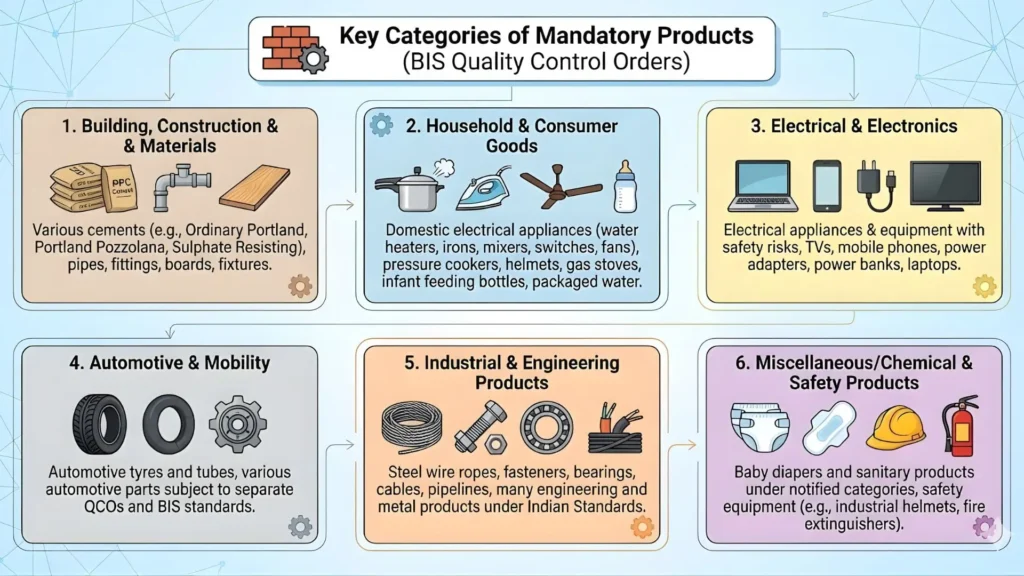
This list has expanded considerably in 2025–26 as new Quality Control Orders have brought additional product categories under mandatory ISI Mark certification. If your product sits near any of these categories, verifying the current QCO status on manakonline.in before assuming voluntary status is strongly advised.
Documents Required for ISI Mark Certification
| Document | Purpose |
| Factory Licence or DIC Registration | Proof that the manufacturing unit is legally established at the stated address |
| Certificate of Incorporation | For companies — confirms legal entity status |
| Aadhaar and PAN of Authorised Signatory | Identity verification for the person signing the application |
| Premises Proof | Rent agreement or property documents for the factory location |
| Trademark Registration Certificate | Or a notarised affidavit if the brand is not yet registered |
| Manufacturing Process Flowchart | Step-by-step diagram from raw material intake to finished product |
| Machinery List | Make, model, capacity, and quantity of all production equipment |
| In-House Lab Equipment List | Testing instruments available on-site with specifications |
| QC Personnel Details | Name and qualifications of your Quality Control In-charge |
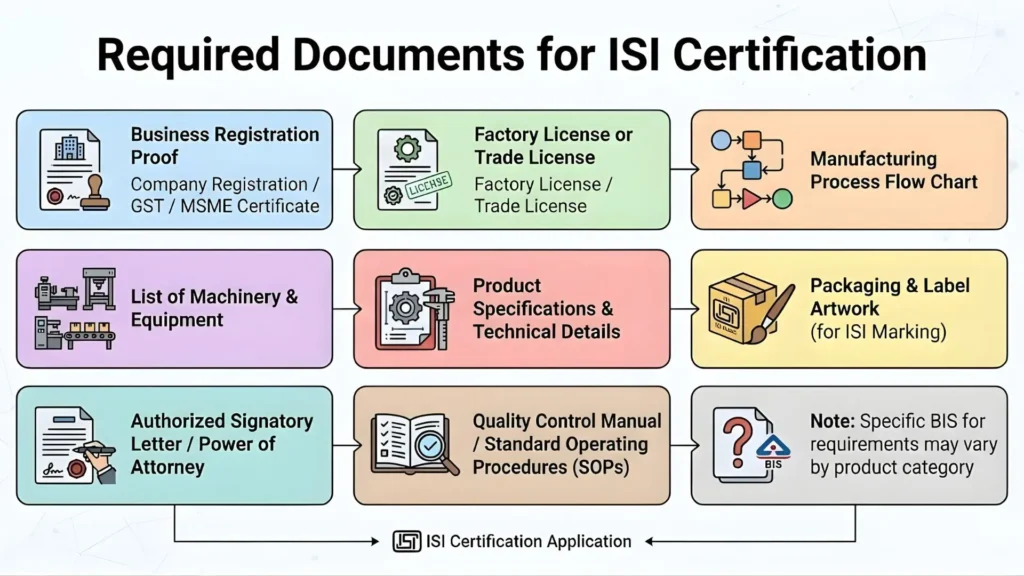
Incomplete documentation is the most common and most avoidable cause of application rejection and delay. Every document needs to be consistent — the address on your factory licence must match the address on your application, which must match the address your BIS officer will visit.
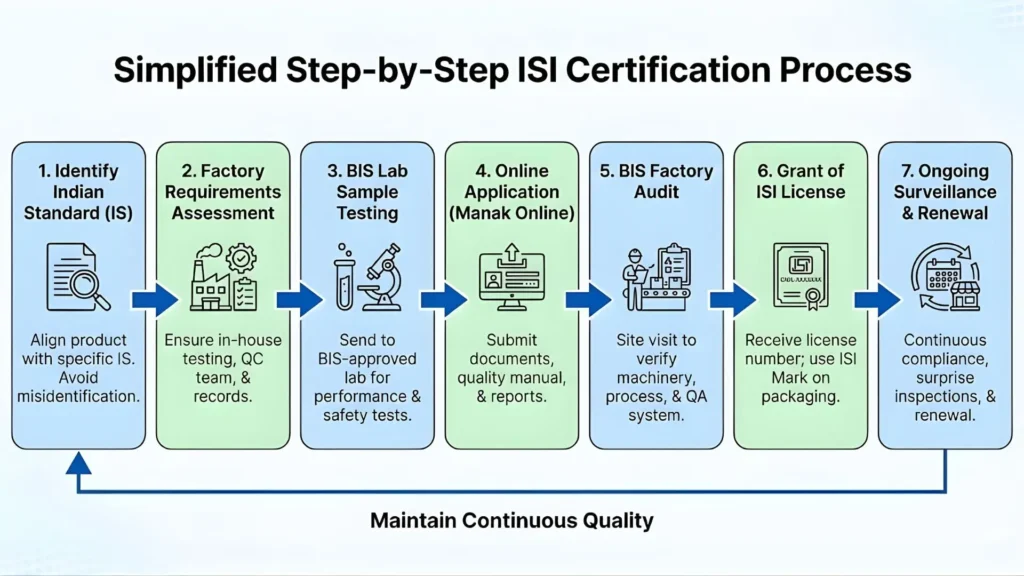
The ISI Mark Certification Process — Step by Step
Step 1 — Identify the Applicable IS Code
Every ISI Mark product has a specific Indian Standard (IS Code) that defines the technical requirements it must meet. Finding the correct IS Code for your exact product is the first and most critical step — an application filed under the wrong standard will be rejected.
Step 2 — Submit Application on Manak Online
File your application at manakonline.in, upload all required documents, and pay the application fee. The portal is the single point of submission — physical submissions are no longer accepted for most product categories.
Step 3 — Factory Audit
A BIS scientist visits your manufacturing facility. This is not a paperwork review — the officer physically inspects your machinery, verifies your in-house testing capability, and walks through your production process. Any discrepancy between your submitted documents and what actually exists in the factory creates a problem at this stage.
Step 4 — Sample Sealing and Dispatch
During the factory visit, the BIS officer draws random samples from your production line and seals them in your presence. These sealed samples are sent to a BIS-recognised NABL laboratory for independent testing against the applicable IS Code.
Step 5 — Grant of Licence
If the factory inspection report and the laboratory test report both clear, BIS issues your CM/L Number — your Certification Marks Licence. This number must appear on every unit and every pack of your certified product.
| Key Feature | Detail |
| Full Form | Indian Standards Institution |
| Applicable To | Domestic manufacturers in India |
| Product Focus | Construction, safety, chemicals, consumer durables |
| Factory Visit | Mandatory |
| Testing Requirement | In-house lab capability + independent NABL lab |
| Licence Format | CM/L-XXXXXXX |
| Typical Timeline | 3–4 months |
| Validity (2026) | Up to 5 years (amended Feb 2026) |
| Annual Fee | Payable in advance — automatic suspension for non-payment |
Scheme II — CRS: The Fast-Track Route for Electronics and IT
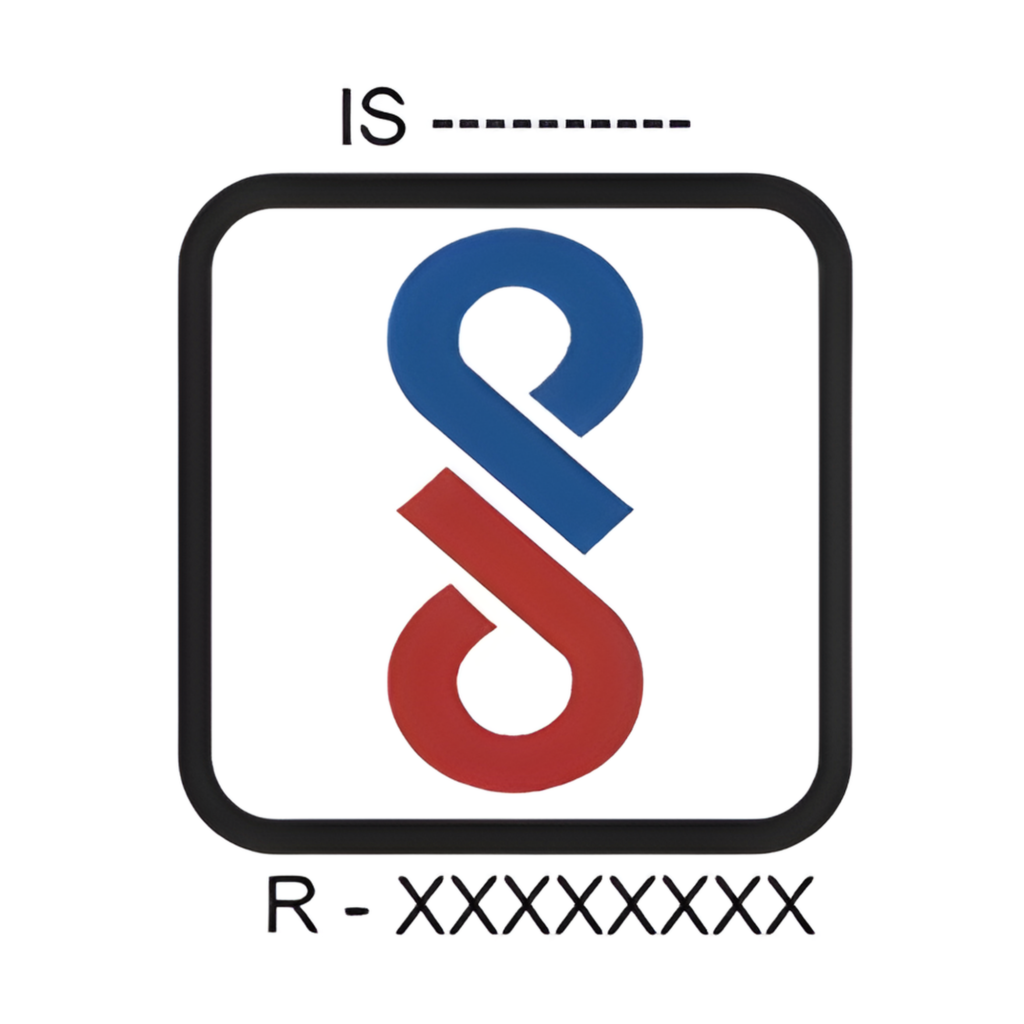
CRS stands for Compulsory Registration Scheme. It was launched by MeitY — the Ministry of Electronics and Information Technology — and operates as Scheme II under the BIS Conformity Assessment Regulations. It is designed specifically for the electronics and IT product sector, where product cycles are short, global competition is intense, and a four-month certification timeline is commercially unworkable.
The fundamental difference from Scheme I is in the mechanism. CRS operates on conformity based on self-declaration — the manufacturer declares that their product meets the applicable Indian Standard, backed by a test report from a BIS-recognized laboratory. There is no mandatory factory audit for standard CRS products.
This is what makes it faster. And this is also what makes the lab test report the most critical document in the entire application.
Which Products Fall Under CRS?
CRS covers a wide and growing range of electronics, IT hardware, and renewable energy products:
IT Hardware
- Laptops, notebooks, and tablets
- Printers and scanners
- Desktop computers and monitors
Consumer Electronics
- Mobile phones and smartphones
- Bluetooth speakers and wireless audio devices
- Smartwatches and fitness trackers
- TWS earbuds and headphones
- Set-top boxes and streaming devices
Power Components
- Power adapters and chargers
- LED drivers and LED luminaires
- Lithium-ion battery packs and cells
- UPS systems
Renewable Energy Products
- Solar photovoltaic modules
- Solar inverters and charge controllers
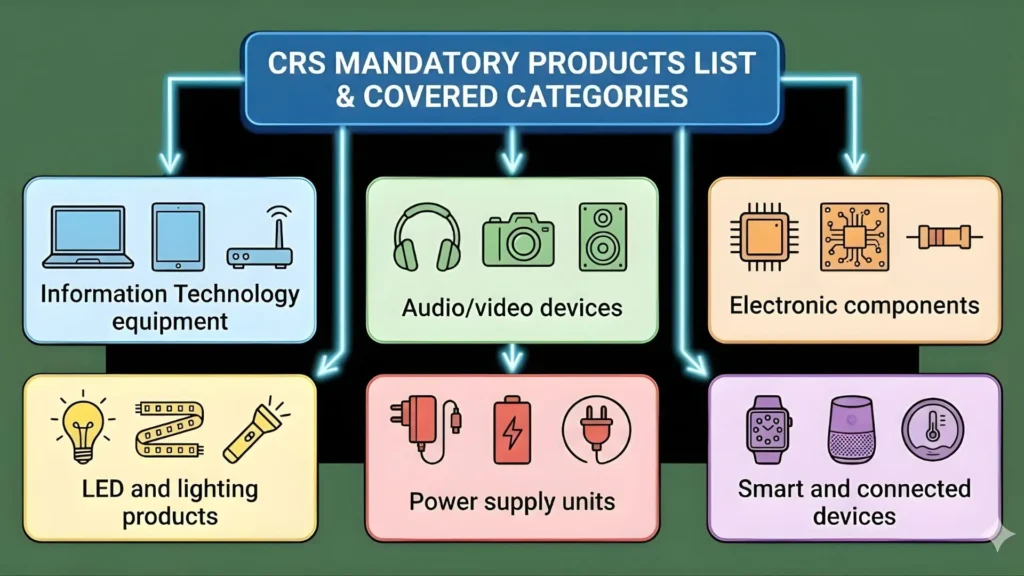
The CRS product list is updated regularly by MeitY. New product categories are added as the government identifies electronics segments where safety standardization is required.
Documents Required for CRS Registration
| Document Category | Specific Requirements |
| Business Proof | Factory licence, Certificate of Incorporation, or ISO certificate — must show manufacturing address |
| Trademark | Valid Trademark Registration Certificate — mandatory. If you are not the brand owner, an authorisation letter from the trademark holder is required |
| PCB Layout and Circuit Diagram | Technical schematics of the device |
| User Manual | English-language manual with complete technical specifications |
| Critical Component List (CCL) | Internal components — PCB, battery, fuse — listed with their individual certification details |
| Test Report | Original test report from BIS-recognised NABL lab — valid for 90 days from date of issue |
| Self-Declaration Undertaking | Signed by the CEO or Managing Director |
| AIR Nomination (Foreign Manufacturers) | Form III A, B, or C as applicable — appointment of Authorised Indian Representative |
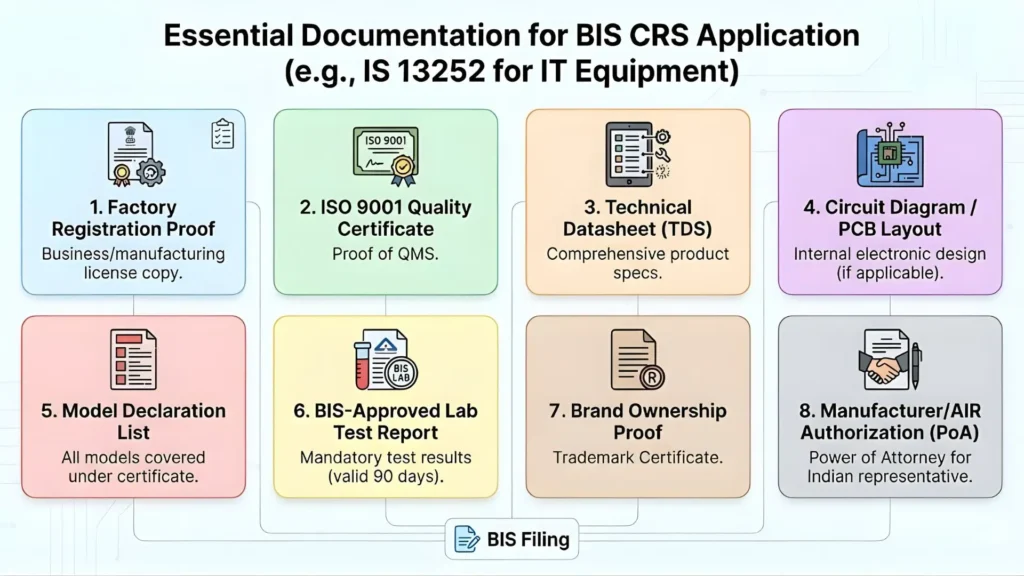
One detail that catches applicants: the test report has a 90-day validity window. If your application submission is delayed and the report expires, you need a fresh test — which means fresh lab fees and a fresh timeline. Move quickly once you have the report in hand.
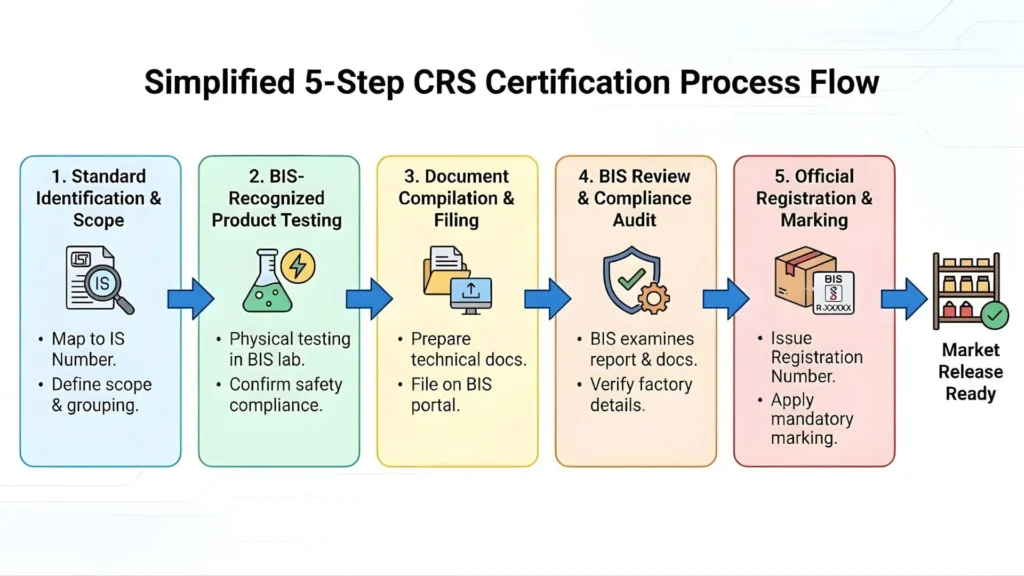
The CRS Registration Process — Step by Step
Step 1 — Generate a Test Request
Register on the BIS Connect portal and generate a Test Request for your specific product model. Each model requires its own separate registration — a single CRS registration does not cover multiple product models.
Step 2 — Send Samples to NABL Lab
Submit product samples to a BIS-recognised NABL laboratory in India. The lab tests against the applicable Indian Standard — for most IT hardware, this is IS 13252; for LED products, IS 16102; for mobile phones, IS 13252 with additional RF requirements.
Step 3 — Receive Test Report and Submit Application
Once the lab issues the test report, submit your full application (Form-I) on the CRS portal along with the self-declaration undertaking and all supporting documents.
Step 4 — BIS Scrutiny
BIS officers review the test report and documentation. Unlike ISI Mark, this review happens entirely on paper — no factory visit is scheduled for standard CRS products. If documents are complete and the test report is clean, the application moves through efficiently.
Step 5 — R-Number Issued
BIS issues your Registration Number — the R-Number in the format R-XXXXXXX. This number, along with the BIS Standard Mark, must appear on your product and its packaging before it enters the Indian market.
| Key Feature | Detail |
| Full Form | Compulsory Registration Scheme |
| Applicable To | Domestic and foreign manufacturers |
| Product Focus | Electronics, IT hardware, renewable energy |
| Factory Visit | Not required for standard products |
| Testing Requirement | Independent NABL lab test report |
| Licence Format | R-XXXXXXX |
| Typical Timeline | 20–30 days |
| Validity (2026) | Up to 5 years (amended Feb 2026) |
| MSME Concession | 80% / 50% / 20% till May 2029 |
| Annual Fee | Payable in advance — automatic suspension for non-payment |
FMCS — The ISI Mark Route for Foreign Manufacturers

This is where the most confusion exists — and it is worth clearing up directly.
FMCS stands for Foreign Manufacturers Certification Scheme. It is not a separate product mark. You will never see a product on a store shelf labelled "FMCS Certified." There is no such thing as an FMCS mark.
FMCS is the administrative route — the specific process pathway — that a factory located outside India follows to obtain the ISI Mark. The outcome of a successful FMCS application is identical to a successful domestic Scheme I application: the ISI Mark with a CM/L number on the product.
Think of it this way. A factory in Pune applies for the ISI Mark through the domestic route. A factory in Guangzhou applies for the same ISI Mark through the FMCS route. The mark on the finished product is the same. The process to get there is different because it crosses international borders and involves a physical inspection abroad.
The Authorised Indian Representative — The Most Critical Decision in FMCS
Every FMCS application requires the appointment of an Authorised Indian Representative before the application can proceed. This is not optional and cannot be bypassed.
Your AIR is your legal interface with the Bureau of Indian Standards in India. They:
- Sign and submit documentation on your behalf
- Receive all BIS correspondence and official notices
- Carry legal accountability for the accuracy and completeness of your application
- Act as the on-ground point of contact when BIS has queries or requires additional information
The choice of AIR is genuinely one of the most consequential decisions in the FMCS process. An AIR who is unfamiliar with BIS procedures, slow to respond to queries, or managing too many applications simultaneously can stall your certification for months without you realizing it — because all the delays happen on the Indian side, which you have no direct visibility into from abroad.
An experienced, dedicated AIR is not an administrative formality. It is the difference between a four-month certification and a nine-month one.
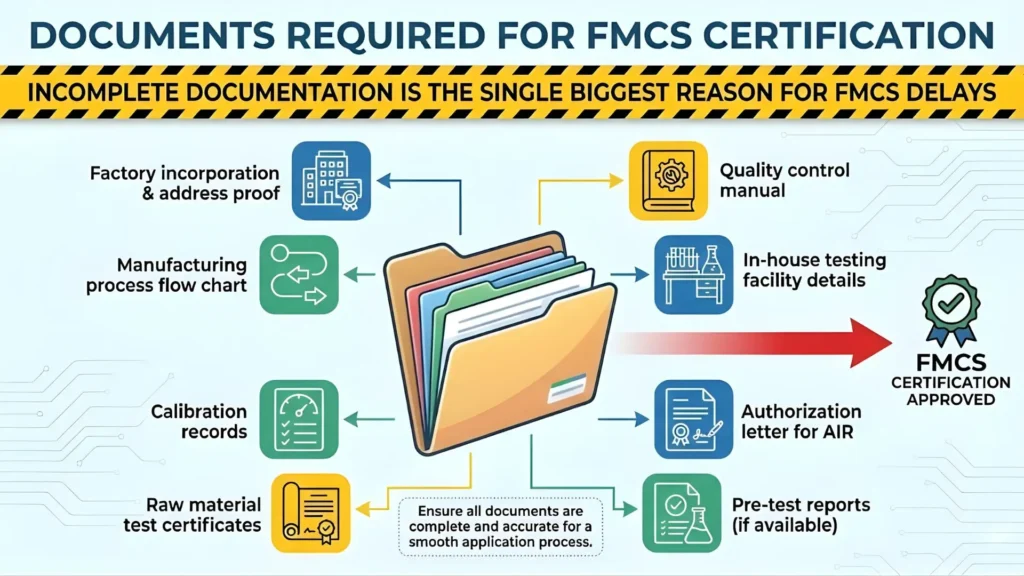
Documents Required for FMCS Certification
| Document | Purpose |
| Business Licence or Certificate of Incorporation | Issued by your local government — confirms the factory's legal existence |
| Form-VI — AIR Nomination Form | Legal appointment of your Authorised Indian Representative |
| Passport Copy of CEO or Authorised Signatory | Identity verification for the foreign factory's representative |
| Manufacturing Process Flowchart | Detailed diagram from raw material to finished product — must match actual factory process |
| Performance Bank Guarantee (PBG) | USD 10,000 — submitted after approval, before licence is issued |
| Factory Premises Proof | Ownership or lease documents for the manufacturing facility |
| Machinery and Equipment List | All production equipment with make, model, and capacity |
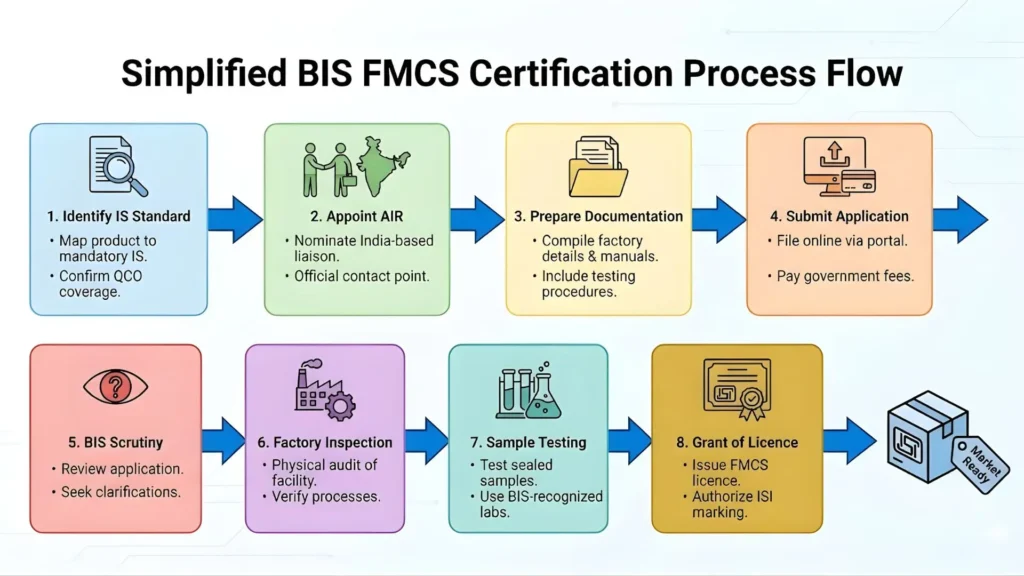
The FMCS Certification Process — Step by Step
Step 1 — Application Submission and AIR Appointment
Your AIR submits the online application via the BIS portal and sends physical copies to the FMCD — Foreign Manufacturers Certification Department — in Delhi. Both digital and physical submissions are required.
Step 2 — Document Scrutiny and Audit Planning
BIS reviews all submitted documentation. Once satisfied, they calculate the inspection fee — which includes the cost of the BIS officer's travel to your factory abroad.
Step 3 — Factory Inspection Abroad
A BIS scientist travels to your manufacturing facility — wherever in the world it is located. The inspection mirrors the domestic Scheme I audit: machinery verification, quality control assessment, production process review, and sample sealing. All international travel costs — airfare, accommodation, and per diem — are borne by you, the applicant. For factories in distant locations, this cost alone can run into several lakhs of rupees.
Step 4 — Laboratory Testing in India
Sealed samples travel to India and are tested at a BIS-recognised NABL laboratory against the applicable Indian Standard.
Step 5 — Performance Bank Guarantee and Licence Grant
Once the test report clears, you submit a Performance Bank Guarantee of USD 10,000 to BIS. This PBG serves as a financial security — released when the licence is eventually surrendered or cancelled. After PBG submission, BIS issues your CM/L Number (FMCS).
| Key Feature | Detail |
| Full Form | Foreign Manufacturers Certification Scheme |
| Applicable To | Factories located outside India |
| End Result | ISI Mark — identical to Scheme I |
| Factory Visit | Mandatory — BIS officers travel to foreign factory |
| Travel Cost | Borne entirely by applicant |
| AIR Requirement | Mandatory — must be appointed before application |
| Performance Bank Guarantee | USD 10,000 — submitted post-approval |
| Licence Format | CM/L-XXXXXXX (FMCS) |
| Typical Timeline | 4–6 months |
| Validity (2026) | Up to 5 years (amended Feb 2026) |
Eligibility Criteria — Who Can Actually Apply for BIS Certification?
Before you spend time preparing documents, mapping out your factory layout, or shortlisting laboratories — there is one question that needs a clear answer first.
Are you actually the right entity to be filing this application?
Because BIS has a very specific answer to that question. And it is stricter than most people expect. Getting this wrong does not just waste time — it means your application was never going to be approved regardless of how well everything else was prepared.
Domestic Manufacturers — Factories Located in India
If you own or operate a manufacturing facility in India that produces goods falling under a mandatory BIS certification category, you are eligible to apply. The application is filed in the name of that specific factory — not your corporate headquarters, not your registered office, not your brand entity.
The BIS officer will visit that factory. Your machinery, production process, raw material controls, and in-house testing capability will be assessed at that location. The licence, when issued, is tied to that address.
One detail that regularly surprises manufacturers with multiple production sites: a BIS licence issued for your plant in one city does not cover production at your facility in another. Each manufacturing location requires its own separate licence, its own separate factory inspection, and its own separate lab testing. Two factories making the identical product still need two licences.
Foreign Manufacturers — Factories Located Outside India
If your manufacturing facility is based outside India — whether in China, Vietnam, South Korea, Germany, Taiwan, or anywhere else — you are still eligible to apply for BIS certification, but through the appropriate route for your product category.
For industrial, construction, safety, and consumer durables: you apply under FMCS — Scheme III. For electronics and IT products: following the February 2026 amendment, you apply under CRS — Scheme II.
In both cases, the eligibility principle is identical to the domestic route. The license is granted to the overseas manufacturing facility — not to your Indian distributor, not to your international holding company, and not to whoever handles your Indian sales. The factory is the applicant. Everything else in the application structure supports that.
Difference Between ISI, CRS & FMCS Certification in India
| Feature | ISI Mark (Scheme I) | CRS (Scheme II) | FMCS (Scheme III) |
| Who Can Apply | Indian manufacturers | Indian + foreign manufacturers | Foreign manufacturers only |
| Product Categories | Steel, cement, chemicals, safety products, consumer durables | Electronics, IT hardware, renewable energy | Same as Scheme I — for imported goods |
| Primary Safety Focus | Structural safety and raw material quality | Performance safety in use | Same as Scheme I |
| Factory Visit | Mandatory | Not required (standard products) | Mandatory — abroad |
| Travel Cost | Borne by BIS | Not applicable | Borne entirely by applicant |
| AIR Required | No | Yes (foreign applicants) | Yes — mandatory |
| Marking Format | ISI Logo + CM/L Number | BIS Standard Mark + R-Number | ISI Logo + CM/L Number (FMCS) |
| Bank Guarantee | Not required | Not required | USD 10,000 PBG |
| Typical Timeline | 3–4 months | 20–30 days | 4–6 months |
| Validity (2026) | Up to 5 years | Up to 5 years | Up to 5 years |
| Annual Fee | Yes — advance payment | Yes — advance payment | Yes — as per scheme |
| Auto Suspension | Yes — non-payment | Yes — non-payment | Yes — as applicable |
| MSME Concession | As per scheme | 80/50/20% till May 2029 | As applicable |
| Market Surveillance | Factory + market sampling | Market + e-commerce platforms | Customs + market sampling |
What the February 2026 Amendment Changed for All Three Schemes
The BIS (Conformity Assessment) Amendment Regulations, 2026 — gazette notification F. No. BS/XI/11/01/2025-26, dated 25 February 2026 — introduced changes that every ISI Mark, CRS, and FMCS licence holder needs to understand.
- Validity extended to five years. Previously, ISI Mark licenses and CRS registrations operated on shorter renewal cycles. The amended regulations now allow both initial grant and renewal for up to five years — significantly reducing administrative overhead.
- Annual fee remains payable every year — in advance. The five-year validity does not eliminate the annual fee obligation. The fee must be paid before the due date each year, regardless of how many years remain on the license.
- Automatic suspension for non-payment — no notice required. This is the most operationally significant change. If the annual fee is not paid by the due date, the license is automatically suspended from that date. There is no grace period. There is no advance warning from BIS. The suspension is immediate and self-executing.
- 90-day recovery window. Once suspended for non-payment, you have 90 days to pay the outstanding fee plus a late fee of ₹5,000. Payment within this window lifts the suspension. Failure to pay within 90 days results in automatic cancellation.
- CRS now formally includes foreign manufacturers. The revised Scheme II explicitly recognizes foreign manufacturers, requiring them to appoint an AIR and submit the relevant affidavit forms — closing a gap that previously created regulatory ambiguity for foreign electronics brands. MSME fee concessions for CRS. From the gazette date through 31 May 2029: 80% concession for micro enterprises and startups, 50% for small enterprises, 20% for medium enterprises. From 1 June 2029, a flat 20% concession for all MSMEs.
Which Scheme Do You Actually Need? A Decision Guide
| Your Situation | Scheme You Need |
| Indian factory — industrial, construction, or safety product | ISI Mark — Scheme I |
| Indian factory — electronics or IT product | CRS — Scheme II |
| Foreign factory — electronics or IT product | CRS — Scheme II (post Feb 2026 amendment) |
| Foreign factory — industrial, construction, or safety product | FMCS — Scheme III |
| Importer or trader — no manufacturing facility | Cannot hold licence; can act as AIR for foreign factory |
| Brand owner — outsourced manufacturing | Ensure your contract manufacturer holds the licence |
Cost and Timeline — What to Budget Realistically
| Scheme | Typical Timeline | Key Cost Factors |
| CRS — Electronics | 20–30 days | Lab testing ₹25,000–₹60,000 + Government fee approximately ₹50,000 for 5 years |
| ISI Mark — Domestic | 3–4 months | Application fee + lab testing (variable by product) + volume-based marking fee |
| FMCS — Foreign | 4–6 months | Lab testing + audit travel costs (applicant-borne) + USD 10,000 Performance Bank Guarantee |
One cost that surprises almost every FMCS applicant: the auditor travel expense. BIS officers travelling from India to a factory in China, Vietnam, or Europe travel business class, and all accommodation and per diem costs sit with the applicant. For factories in geographically distant locations, this figure alone can exceed ₹5–8 lakhs before a single test has been run.
The Four Reasons Getting This Right Matters Beyond Compliance
1. Accurate Budgeting — Avoiding Financial Surprises
Mistaking an FMCS application for a CRS application is a serious financial error. CRS requires lab fees and a government registration charge. FMCS requires auditor travel costs, lab fees, and a USD 10,000 bank guarantee. The gap between those two cost structures can run into twenty to thirty lakhs of rupees. Getting the scheme right at the start is the only way to forecast costs accurately.
2. Realistic Launch Timelines — Protecting Stakeholder Commitments
CRS takes three to four weeks. ISI and FMCS take three to six months. If you have promised a product launch date to a retail partner or made inventory commitments based on a CRS-speed assumption for a product that actually requires FMCS, you are heading toward a painful conversation with your stakeholders — and potentially significant contract penalties.
3. Customs Clearance — Avoiding Port Detention
Customs officers at Indian ports are trained to match product categories to certification formats. Electronics without an R-Number, industrial goods without a CM/L Number — these do not clear customs. They sit at the port accumulating demurrage charges until the right documentation is produced or the consignment is returned. The correct scheme, correctly applied, is what keeps your supply chain moving.
4. Legal Protection — The ISI Mark Cannot Be Misused
Printing the ISI Mark on a product that is actually covered under CRS is not a branding error. It is a criminal offence under the BIS Act, 2016. The ISI Mark is a legally protected government mark — its unauthorised use carries penalties including fines and imprisonment. Correct scheme classification is not just commercially smart. It is legally necessary.
Common Mistakes That Cost Businesses Months and Money
Filing under the wrong scheme - Foreign electronics manufacturers applying under FMCS instead of CRS is the most frequent and most expensive mistake. FMCS takes four to six months and involves a factory inspection. CRS takes three to four weeks and does not. Identifying the correct scheme before filing the application saves the entire FMCS timeline.
Assuming the importer can hold the licence - The BIS licence belongs to the manufacturing entity — always. Importers and traders cannot be licence holders regardless of their commercial relationship with the factory. Their role in the BIS structure, if any, is as an Authorised Indian Representative.
Treating one license as a blanket cover - A CM/L Number issued for your factory in Surat does not cover your factory in Coimbatore. Each manufacturing location requires its own separate license. Each product model under CRS requires its own separate registration.
Missing the annual fee due date post-February 2026 - The amendment has removed the buffer that many license holders relied on. Automatic suspension is now immediate on the due date — no notice, no warning. Businesses that managed their BIS compliance reactively rather than proactively are the ones getting caught. Submitting documents without internal consistency checks. The address in your factory license, your process flowchart, your application form, and the facility a BIS officer physically visits must all match. A discrepancy anywhere in that chain creates a query — and queries create delays.
Choosing a BIS Consultant: Why Expertise Matters
Yes, you can file for BIS certification on your own. The government portal is open to everyone. But here's what most people find out the hard way — the paperwork is the easy part.
Where applications actually break down:
- Lab failures cost double. A minor packaging error on your sample means the lab rejects it. You pay the full testing fee again, from scratch. We review samples before submission to catch these issues early.
- Foreign brands carry legal risk. Someone needs to be your Authorised Indian Representative — legally accountable if something goes wrong. We take on that role, so the liability doesn't sit with you.
- Audit documents must match exactly. A small inconsistency between your Process Flowchart and Machinery List can stall your certification for months. We align every document before the auditor walks in.
At Silvereye Certifications, we've handled BIS audits, FMCS factory visits, and CRS test report submissions across product categories. We know where files get stuck and how to keep yours moving.
Less friction. Faster approvals. You stay focused on your market.
Conclusion
ISI, CRS, and FMCS are not three names for the same thing. They are three distinct pathways built for three distinct situations — and the one that applies to your business is determined by what your product is, where it is manufactured, and what risk category it falls under.
Getting this right at the start is not administrative detail work. It is the decision that determines your budget, your timeline, your customs clearance strategy, and your legal standing in the Indian market.
- Selling laptops or mobile phones? CRS is your route. Three to four weeks. No factory audit.
- Manufacturing steel, cement, or pressure cookers in India? ISI Mark. Three to four months. Factory inspection required.
- Running a factory outside India that wants to supply the Indian market? FMCS for industrial goods. CRS for electronics. Bank guarantee required for FMCS. AIR required for both.
In 2026, with enforcement at ports and in markets more active than it has been in years, and with the February amendment tightening how licences are maintained, there is no room for scheme confusion.
Know your scheme. File correctly. And make sure your annual fee is paid before the due date — because the suspension that follows if it is not happens automatically, without warning, and on the day you missed.
Frequently Asked Questions
What is the difference between ISI Mark and BIS Certification?
BIS Certification is the broader framework. ISI Mark is one specific type of BIS Certification — Scheme I, for high-risk and industrial products. CRS and FMCS are the other two pathways under the same BIS framework. When people say "BIS Certified," they usually mean ISI Mark, but the term technically includes all three schemes.
Is FMCS a separate mark from ISI?
No. FMCS is the process route, not the end product. A factory in China that successfully completes FMCS certification receives the ISI Mark — the same mark that a domestic Indian factory receives through Scheme I. The mark on the product is identical. The route to get there is different.
Can an importer apply for BIS certification?
No. BIS licenses are granted to manufacturing entities only. Importers cannot hold a BIS license in their own name. However, an importer can serve as the Authorized Indian Representative for a foreign manufacturer — which means they handle the application process and communications with BIS on the factory's behalf, while the license itself is issued to the factory.
How long does BIS Certification take in 2026?
CRS typically takes 20–30 days. ISI Mark takes 3–4 months. FMCS takes 4–6 months, sometimes longer depending on inspection scheduling and lab queue times.
What happens if I use the wrong BIS mark on my product?
Using the ISI Mark on a product that should carry a CRS R-Number is a criminal offence under the BIS Act, 2016. It can result in fines, market blacklisting, and criminal prosecution. The correct mark must match the correct scheme for your product category.
Do I need separate licences for each product?
Under CRS, yes — each product model requires its own registration. Under Scheme I and FMCS, each manufacturing location requires its own license, and each distinct product category typically requires a separate application.
What changed with BIS licenses in February 2026?
The February 2026 amendment extended license validity to up to five years for both ISI Mark and CRS, introduced automatic suspension for non-payment of annual fees effective from the due date, created a 90-day recovery window with ₹5,000 late fee, formally recognized foreign manufacturers under CRS, and introduced MSME fee concessions for CRS applicants through May 2029.