

- It's a two-form process: Most applicants file both ANF 1 (applicant profile) and ANF 2M (item-specific application) together, not ANF 2M alone.
- Approval isn't always local: Simple cases are cleared by the Regional Authority, but sensitive or high-value items go before the EXIM Facilitation Committee (EFC) at DGFT Headquarters, which meets monthly.
- The fee scales with shipment value: Expect ₹1 per ₹1,000 of CIF value, capped between a ₹500 minimum and a ₹1,00,000 maximum per application.
- Approval isn't the end of compliance: Most Import Authorizations carry an Actual User Condition, and imported goods generally cannot be transferred to another party for two years without DGFT permission.
Introduction
DGFT Import Authorization is the government permission required to legally import goods classified as “Restricted” under India’s ITC (HS) Code. To apply, an importer with a valid Import Export Code (IEC) files Form ANF 2M along with ANF 1, a proforma invoice, technical write-up, and CIF value details, either online on the DGFT portal or with the concerned Regional Authority.
The application is reviewed by the Regional Authority or, for sensitive items, by the EXIM Facilitation Committee at DGFT Headquarters. The registration fee is based on CIF value (minimum ₹500), and approval usually takes 15 to 60 working days depending on whether other ministries need to clear the item first.
What Is DGFT Import Authorization?
DGFT Import Authorization is the formal government approval that an importer must obtain before bringing a “Restricted” category product into India. It is issued under the Foreign Trade Policy by the Directorate General of Foreign Trade (DGFT), Ministry of Commerce and Industry, and functions as a legal precondition for customs clearance — without it, restricted goods cannot be cleared at any Indian port. Unlike a general trade license, this authorization is issued for a specific product, quantity, value, and end use, so a fresh or amended application is typically needed for each distinct import requirement.
Who Needs to Apply for DGFT Import Authorization?
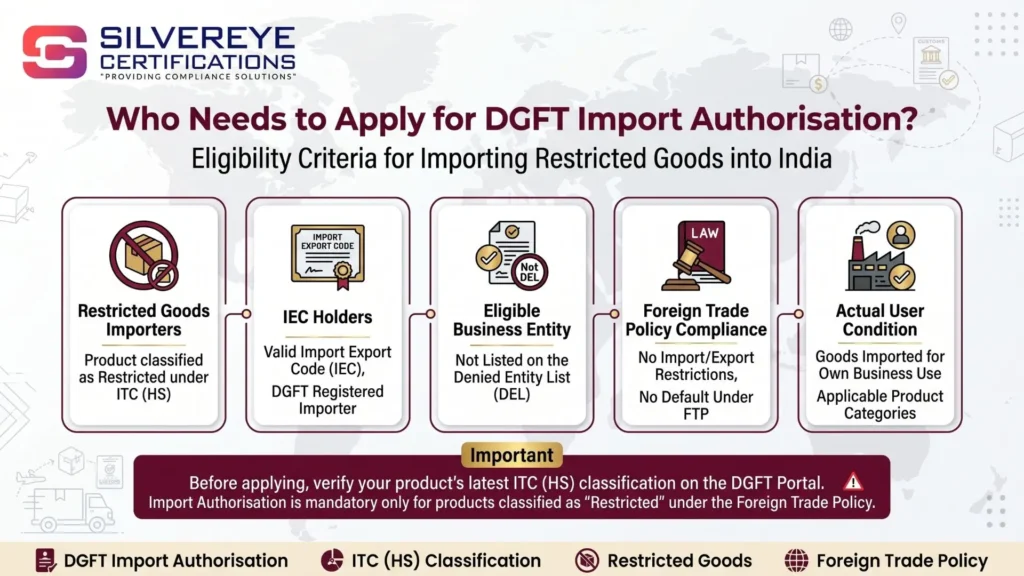
You need to go through this application process if:
- The product you want to import carries a “Restricted” status under the current ITC (HS) classification.
- You hold a valid Import Export Code (IEC) — this is checked automatically since the application is filed under your IEC profile.
- Neither you nor any director, partner, proprietor, or trustee of your firm appears on DGFT’s Denied Entity List (DEL).
- Your firm has not been declared a defaulter or made ineligible for import/export under any provision of the Foreign Trade Policy.
- You can fulfil the Actual User Condition where applicable, meaning the goods will be used by your own business and not resold as-is.
Documents Required For DGFT Import Aurthorization
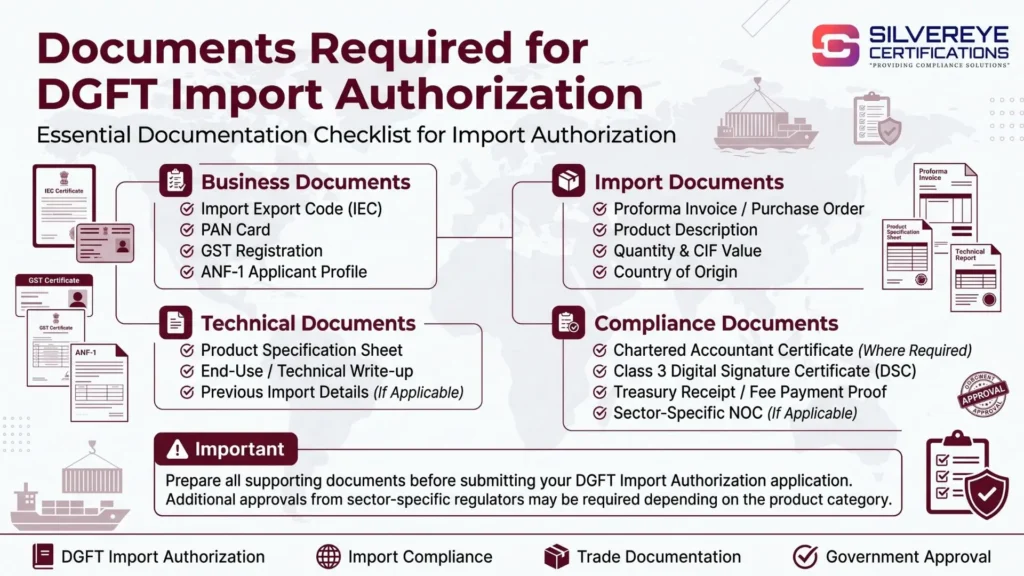
Having these ready before you log in to the DGFT portal saves a significant amount of back-and-forth:
- Import Export Code (IEC) certificate
- PAN and GST registration of the applicant entity
- ANF 1 — applicant profile form (not required as a separate hard copy if the application is filed electronically)
- Proforma Invoice or Purchase Order from the overseas supplier, showing item description, quantity, unit of measurement, country of origin, and CIF value in Indian and foreign currency
- Technical write-up or product specification sheet explaining the intended end use
- Details of similar imports made in the preceding three years, if any, including authorization numbers
- Chartered Accountant / Cost Accountant certificate, for specific categories such as ammunition imports
- Class 3 Digital Signature Certificate (DSC) of the person authorized to sign on behalf of the firm
- Treasury Receipt (TR) or Demand Draft / online payment proof for the application fee
- Any sector-specific NOC — for example, from CDSCO for drugs or the Wildlife Crime Control Bureau for wildlife-derived items
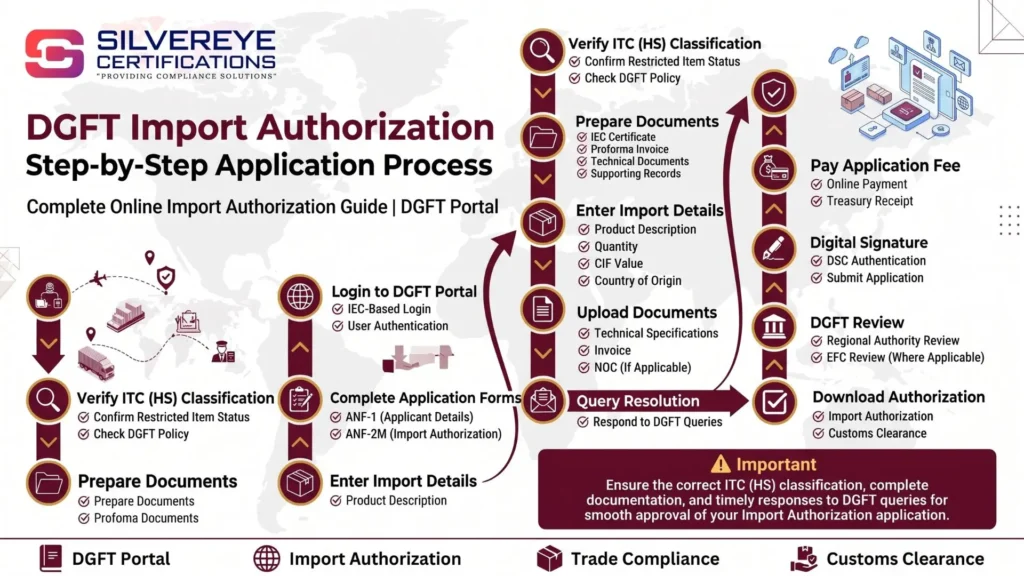
DGFT Import Authorization: Step-by-Step Application Process
- Confirm the item is genuinely “Restricted”: Search the exact ITC (HS) code on the DGFT website’s Import, Export & SCOMET Policy section before you prepare any paperwork — classifications are revised often.
- Gather your documentation: Assemble the IEC copy, proforma invoice, technical write-up, and past-import history listed above so the application can be filled in one sitting.
- Log in to the DGFT portal: Access dgft.gov.in with your IEC-based user credentials. First-time users must complete registration before proceeding.
- Fill ANF 1 (applicant details): This captures your firm’s profile, IEC, bank details, and past compliance record. It is filed alongside ANF 2M, not as a standalone document, when submitted electronically.
- Fill ANF 2M (item-specific application): Navigate to Services > eCOM Applications > Restricted Item Import, and enter the product description, quantity, CIF value, country of origin, and whether you are a manufacturer or an authorized agent.
- Declare compliance clauses: The form requires a declaration that none of your firm’s directors, partners, or trustees are on the Denied Entity List, and that the firm has not been declared a defaulter under the Foreign Trade Policy.
- Upload supporting documents: Attach the proforma invoice, technical specifications, past import details, and any sector-specific NOC in the prescribed format.
- Pay the application fee: Complete payment electronically and retain the Treasury Receipt or payment confirmation, which must be uploaded with the application.
- Sign and submit with your DSC: Every page of the application must effectively be authenticated by the applicant; the DSC digitally covers this requirement for the electronic filing.
- Submission routing — Regional Authority or DGFT Headquarters: Routine applications are processed by the concerned Regional Authority (RA). For certain categories, a self-attested copy along with proof of RA submission must also reach DGFT Headquarters in New Delhi.
- EXIM Facilitation Committee review, where applicable: Sensitive or high-value cases are placed before the EXIM Facilitation Committee (EFC), an inter-ministerial body that typically meets once a month; if a case is deferred for want of comments from a concerned ministry, it is taken up in a subsequent meeting.
- Respond to queries within the window: If DGFT flags missing information, you generally have 90 days to respond before the application is treated as withdrawn.
- Receive and download the Authorization: Once approved, download the Import Authorization from your DGFT dashboard and present it to Customs at the time of clearance, along with your commercial invoice and bill of entry.
DGFT Import Authorization Fees
| Application Type | Fee |
| New Import Authorisation | ₹1 per ₹1,000 of CIF value; minimum ₹500, maximum ₹1,00,000 |
| First Revalidation | ₹500 per application |
| Amendment (item, quantity, or value change) | Nominal fee as prescribed on the DGFT portal |
Fees are payable electronically and are periodically revised by DGFT notification, so verify the current rate on the portal before submitting payment.
Processing Timeline For DGFT Import Authorization
| Stage | Typical Duration |
| Initial screening after submission | A few working days |
| Document verification by Regional Authority | 1 to 2 weeks |
| Decision on straightforward applications | 15 to 30 working days |
| Cases requiring EFC review or another ministry's NOC | 40 to 60 days, sometimes longer if deferred at EFC |
Validity, Amendment, and Revalidation
Once issued, an Import Authorisation is valid for the period specified on the document itself, which depends on the product category and the terms set by the Regional Authority or DGFT Headquarters. Key points to track after approval:
- If you cannot use the authorization within its original validity, you can apply for revalidation before it lapses; DGFT Headquarters may grant this on merit.
- Amendments — such as a change in item description, quantity, CIF value, or unit of measurement — must be applied for online before the goods are shipped.
- For amendment applications, original documents may need to be presented physically to DGFT Headquarters for endorsement.
- Each page of any physical submission must be signed by the applicant, and any self-attested copy sent to DGFT Headquarters should be accompanied by proof of submission to the Regional Authority.
Post-Approval Compliance You Cannot Skip
Getting the authorisation approved is not the finish line — DGFT continues to monitor how the imported goods are used:
- Actual User Condition: If your authorization carries this condition, the imported goods must be used by your own business for the stated purpose, not resold or transferred as-is.
- Two-year transfer restriction: Goods imported under many restricted-item authorizations cannot be transferred to another party for two years without DGFT’s written permission, though this requirement does not apply if the goods are re-exported.
- Record retention: Keep the authorization, invoices, and bill of entry on file, since DGFT or Customs can call for verification of end use during or after the validity period.
- Renewal tracking: Diarise the authorization’s expiry date well ahead of time so a revalidation application can be filed before it lapses.
Common Reasons Applications Get Delayed or Rejected
- Filing under an outdated ITC (HS) code that no longer matches the product’s current classification
- Mismatch between the CIF value on the proforma invoice and the value entered in ANF 2M
- Missing ANF 1 details or an incomplete applicant compliance declaration
- Absence of a mandatory sectoral NOC, causing the file to be returned or deferred at EFC
- Failure to respond to a DGFT query within the stipulated window, leading to deemed withdrawal
- Submitting only to the Regional Authority when the item category also requires a copy to reach DGFT Headquarters
2026 Update: What's Changed Recently
DGFT continues to revise which items require Import Authorization and how applications are processed. Notable recent developments include a March 2026 circular placing temporary restrictions on specific gold and silver jewellery ITC (HS) codes until 30 June 2026, the movement of plain and unstudded silver jewellery (CTH 7113) into the Restricted category through a September 2025 notification, and a revised SCOMET list issued under Notification No. 31/2025-26. Because these changes affect which products need an Import Authorization in the first place, it is worth re-checking your product’s classification even if you imported the same item freely in the past.
How Silvereye Certifications Can Help
The DGFT Import Authorization process has several moving parts — correct ITC (HS) classification, dual-form filing, Regional Authority versus DGFT Headquarters routing, and EFC review for sensitive items — and a single missed detail can add weeks to your timeline. Silvereye Certifications assists importers with product classification checks, preparing ANF 1 and ANF 2M filings, coordinating sectoral NOCs, tracking application status, and managing revalidation and amendment deadlines so approved authorizations don’t lapse mid-shipment.
Conclusion
The DGFT Import Authorization process rewards preparation: knowing your product’s exact ITC (HS) status, filing ANF 1 and ANF 2M together with consistent CIF values, and understanding whether your case will be cleared at the Regional Authority level or needs to go before the EXIM Facilitation Committee. Most delays trace back to avoidable gaps — an outdated classification check, a missing NOC, or an unanswered query — rather than the process itself being unreasonable. Building a simple pre-application checklist and tracking your authorisation’s validity and post-approval conditions will keep your imports moving without port-side surprises.
If you would prefer expert hands-on support instead of navigating the Regional Authority and DGFT Headquarters workflow alone, Silvereye Certifications can manage the classification check, documentation, filing, and follow-up for your Import Authorization from start to finish.
Frequently Asked Questions
What is DGFT Import Authorization?
It is the government permission required from the Directorate General of Foreign Trade before importing goods classified as “Restricted” under the ITC (HS) Code, without which customs will not clear the shipment.
Which form is used to apply for DGFT Import Authorization?
Form ANF 2M is the primary application form for restricted item imports, typically filed together with ANF 1, which captures the applicant’s profile.
Is IEC mandatory for DGFT Import Authorization?
Yes. A valid Import Export Code is required before you can apply, since the application is filed and tracked under your IEC-based DGFT portal account.
Who approves the Import Authorization — Regional Authority or DGFT Headquarters?
Routine applications are handled by the concerned Regional Authority. Sensitive or higher-value cases are reviewed by the EXIM Facilitation Committee at DGFT Headquarters, which meets roughly once a month.
How much does DGFT Import Authorization cost?
The standard fee is ₹1 per ₹1,000 of CIF value, subject to a minimum of ₹500 and a maximum of ₹1,00,000, paid electronically.
How long does the DGFT Import Authorization process take?
Straightforward applications are often decided within 15 to 30 working days. Cases needing EFC review or another ministry’s clearance can take 40 to 60 days or longer.
What happens if my application is incomplete?
DGFT will raise a query or reject it with reasons stated. You typically have 90 days to rectify and resubmit before the application is treated as withdrawn.
Can an Import Authorization be amended after approval?
Yes. You can apply online to amend item description, quantity, CIF value, or unit of measurement before the goods are shipped, subject to DGFT approval.
Can imported goods be sold or transferred immediately after clearance?
Not always. Many Import Authorizations restrict transfer of the goods for two years without DGFT permission, unless the goods are being re-exported.
What is the Actual User Condition in an Import Authorization?
It means the imported goods must be used by the applicant’s own business for the declared purpose rather than resold or passed on to a third party, unless the authorisation says otherwise.