

- ESI registration is mandatory for factories and establishments with 10 or more employees (20 in a few states) once any employee earns up to ₹21,000 a month.
- Employers pay 3.25% and employees pay 0.75% of wages (4% total) — and the government charges zero fee for the registration itself.
- The entire process is online through the Shram Suvidha Portal, and registration must be filed within 15 days of the law becoming applicable to you.
- 2026 update: the Code on Social Security's new wage definition (effective 21 November 2025, with Central Rules notified on 8 May 2026) has quietly widened who counts as "covered" under ESI, even though the ₹21,000 ceiling itself hasn't changed.
Introduction
ESI registration is the process of enrolling a factory or establishment under the Employees' State Insurance Act, 1948, with the Employees' State Insurance Corporation (ESIC). It becomes mandatory the moment an eligible unit employs 10 or more people (20 in some states) and at least one employee earns up to ₹21,000 a month (₹25,000 for persons with disabilities).

Registration is free, done online via the Shram Suvidha Portal, and must be completed within 15 days of becoming applicable. Once approved, the employer gets a permanent 17-digit registration code, and employees get an Insurance Number and e-Pehchan card, entitling them to medical, sickness, maternity, disablement, and dependants' benefits. Employers contribute 3.25% and employees 0.75% of wages every month. In 2026, the Code on Social Security's revised wage definition has widened who gets covered, without changing the ₹21,000 wage ceiling itself.
What Is ESI Registration and Why Does It Exist?
ESI stands for Employees' State Insurance — a self-financed social security and health insurance scheme created under the Employees' State Insurance Act, 1948. It's administered by the Employees' State Insurance Corporation (ESIC), an autonomous body functioning under India's Ministry of Labour and Employment. The scheme itself went live on 24 February 1952 in Kanpur, making it one of the oldest social security programmers in the country, and it has since expanded to cover all 740 districts of India.
ESI registration, in practical terms, is the act of enrolling your factory, shop, or establishment — and every eligible employee working there — into this scheme. Once registered, a small slice of every eligible employee's wages, matched by a larger employer contribution, is pooled into the ESI fund. In return, the employee and their dependents get access to free, cashless medical treatment plus a set of cash benefits during sickness, maternity, disability, or the unfortunate death of the earning member due to an employment injury.
For an employer, ESI registration is not optional once the eligibility conditions are met — it is a statutory compliance requirement, similar to GST or PF registration, and skipping it exposes the business to interest, damages, and even prosecution, which we'll cover later in this guide.
Who Needs ESI Registration?
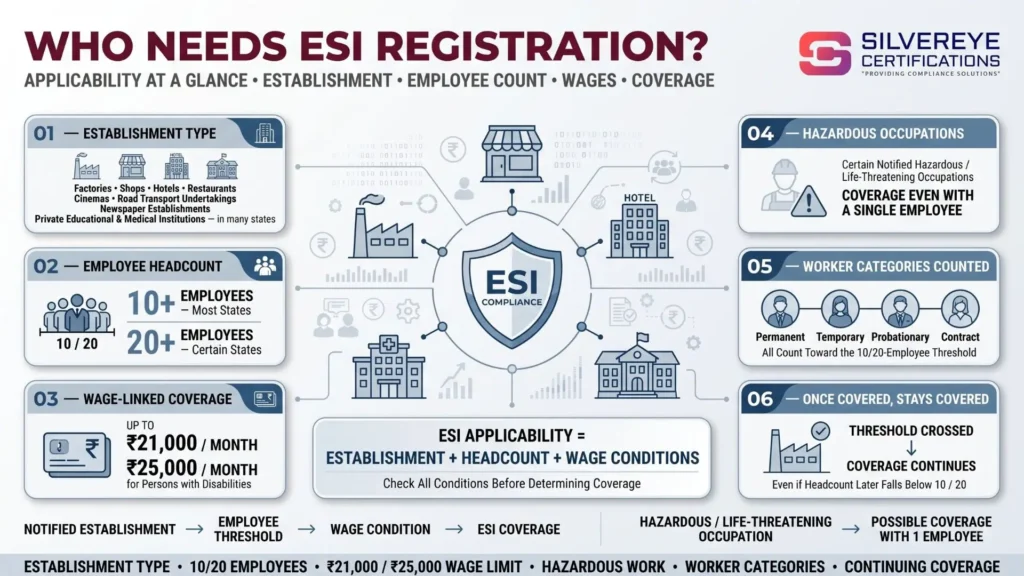
ESI registration applies to non-seasonal factories and a wide list of notified establishments once headcount and wage conditions are both met. Here's the applicability at a glance:
| Condition | Requirement |
| Establishment type | Factories, shops, hotels, restaurants, cinemas, road transport undertakings, newspaper establishments, and (in many states) private educational and medical institutions |
| Employee headcount | 10 or more persons in most states; 20 or more in a handful of states that have set a higher threshold |
| Wage-linked coverage | Applies to employees earning up to ₹21,000/month (₹25,000/month for persons with disabilities) |
| Hazardous occupations | Certain hazardous or life-threatening occupations notified by the Central Government are covered even with a single employee |
| Worker categories counted | Permanent, temporary, probationary, and contract employees are all counted toward the 10/20-employee threshold |
| Once covered, stays covered | An establishment that crosses the threshold remains covered even if headcount later drops below 10 (or 20) |
A common misconception is that only "factories" need ESI. In reality, most states have used their power under Section 1(5) of the ESI Act to extend the scheme to shops, commercial establishments, private hospitals, educational institutes, and even security and cleaning agencies. If you employ 10+ people anywhere in India and pay wages within the ceiling, it's safer to assume ESI applies to you and verify with the state notification, rather than assume it doesn't.
ESI Eligibility Criteria for Employees
On the employee side, eligibility comes down to two simple checks — where they work, and how much they earn:
- The employee must work at an establishment that is already covered under the ESI Act.
- Their gross monthly wages must not exceed ₹21,000 (₹25,000 for an employee with a disability).
- There is no minimum or maximum age limit for coverage.
- Apprentices engaged under the Apprentices Act, 1961 are excluded from ESI — but trainees hired under a company's own certified Standing Orders are treated as regular employees and are covered.
- Employees whose average daily wage is up to ₹176 are exempt from paying their own 0.75% share — though the employer must still contribute its 3.25% share for them.
- Once an employee is enrolled, they continue to be an "insured person" for the rest of the ongoing contribution/benefit cycle even if a mid-period increment pushes their wages above ₹21,000; coverage stops going forward only from the next contribution period.
Benefits of ESI Registration
For Employees and Their Families
- Medical Benefit: Free, comprehensive medical care for the insured person and family from day one of eligibility, with no cap on treatment expenditure.
- Sickness Benefit: Cash compensation (roughly 70% of average daily wages) during certified sickness, for up to 91 days a year.
- Maternity Benefit: Paid leave for confinement, miscarriage, or sickness arising from pregnancy, at full average daily wage rate.
- Disablement Benefit: Monthly payment for temporary or permanent disablement caused by an employment injury or occupational disease.
- Dependants' Benefit: Monthly pension paid to the family if an employee dies due to an employment injury.
- Funeral Expenses: A fixed lump sum paid toward funeral expenses of an insured person.
- Unemployment Allowance: Cash support under the Atal Bimit Vyakti Kalyan Yojana for insured persons who lose their job involuntarily, subject to conditions.
- Confinement and physical rehabilitation expenses, plus extended sickness benefit for certain long-term diseases.
For Employers
- Legal compliance and protection from penalties, prosecution, and reputational damage tied to non-registration.
- A healthier, more secure workforce, which typically improves retention and reduces absenteeism-related disputes.
- No separate group medical insurance obligation for ESI-covered employees, since ESIC handles medical care directly.
- Easier due diligence during tenders, funding rounds, and statutory audits, since ESI compliance is a standard checklist item.
2026 Update: What's Changing Under the Code on Social Security
This is the section most existing ESI guides get wrong or leave out entirely — so here are the facts as they stand in 2026, based on official notifications.
India's four new Labour Codes, including the Code on Social Security, 2020 ("SS Code"), are designed to eventually replace the ESI Act, 1948 along with eight other social security laws. The SS Code's wage-related provisions, including a new, broader definition of "wages" under Section 2(88), came into force on 21 November 2025. Then, on 8 May 2026, the Ministry of Labour and Employment notified the Code on Social Security (Central) Rules, 2026, operationalizing several parts of the Code — including provisions touching ESI, provident fund, gratuity, maternity benefit, and gig and platform worker coverage — under one consolidated framework.
Here's what actually matters for employers right now:
- The ₹21,000 monthly wage ceiling for ESI coverage (₹25,000 for persons with disabilities) has NOT changed as of 2026, despite years of industry demand to raise it to ₹25,000 or ₹30,000.
- What has changed is the definition of "wages" itself. The new definition requires that at least 50% of an employee's total remuneration be treated as "wages" for statutory purposes. In practice, this means allowances that were earlier kept outside the wage base to reduce ESI exposure now often get added back into the calculation — so an employee whose gross salary structure was engineered to sit above ₹21,000 may still fall within the ESI wage ceiling once the 50% rule is applied.
- ESIC has already begun clarifying this in writing — a letter dated 4 June 2026 to the Telangana Labour Law Consultants Association confirmed that the new wage definition has been effective since 21 November 2025, and that compliance with the Central SS Rules became mandatory from 8 May 2026.
- A one-year transition period applies from the SS Code's commencement, running until on or about 20–21 November 2026. During this window, the existing ESI Act, 1948 rules, schemes, and registration process continue to operate wherever the new Code hasn't yet been fully notified or operationalized — so employers should not assume the old ESI Act has disappeared; it is being phased out gradually, not overnight.
- The SS Code also lays the legal groundwork for extending social security, including ESI-linked benefits, to gig and platform workers through separate schemes — though this piece is still being built out and is not yet part of standard employer ESI registration in 2026.
Documents Required for ESI Registration
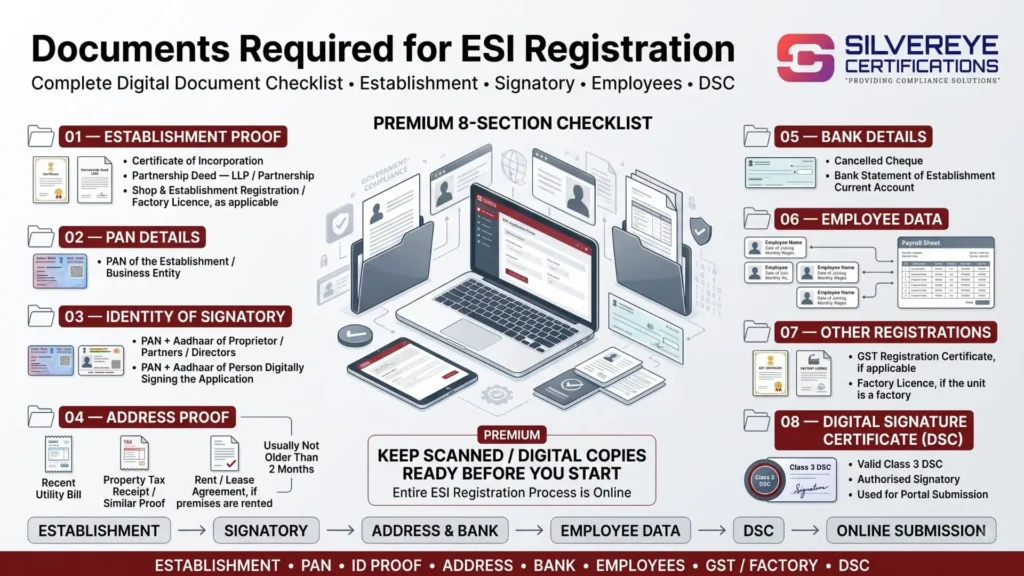
Since the entire process is online, keep scanned/digital copies of the following ready before you start:
| Category | Documents |
| Establishment proof | Certificate of Incorporation (company) / Partnership Deed (LLP or partnership) / Shop & Establishment Registration or Factory Licence, as applicable |
| PAN details | PAN of the establishment/business entity |
| Identity of signatory | PAN and Aadhaar of the proprietor, partners, or directors, and of the person who will digitally sign the application |
| Address proof | A recent utility bill, property tax receipt, or similar document (usually not older than 2 months); rent or lease agreement if the premises are rented |
| Bank details | Cancelled cheque or bank statement of the establishment's current account |
| Employee data | List of all employees with name, date of joining, and monthly wages |
| Other registrations | GST registration certificate, if applicable; factory licence, if the unit is a factory |
| Digital Signature Certificate (DSC) | A valid Class 3 DSC of the authorised signatory, used to submit the application on the portal |
Step-by-Step ESI Registration Process (2026)
ESI registration is completed entirely online through the Unified Shram Suvidha Portal (USSP) — the same single-window platform the Ministry of Labour and Employment uses for EPF, ESI, and other labour-law filings. Here's the process in order:
- Step 1 — Sign up: Go to the Shram Suvidha Portal and register as an employer using your name, email ID, mobile number, and a verification code.
- Step 2 — Verify: Confirm your email link and enter the OTP sent to your registered mobile number.
- Step 3 — Create login: Set up a unique User ID and password (both case-sensitive) and log in to your new employer dashboard.
- Step 4 — Start the application: From the dashboard, select "Registration for EPFO-ESIC" and choose the ESIC registration option.
- Step 5 — Fill Form-1: Complete the Employer's Registration Form (Form-1) with establishment details — legal name, constitution, nature of business, date of commencement, and employee headcount.
- Step 6 — Upload documents: Attach the scanned documents listed in Section 6, matched to the file formats and size limits the portal specifies.
- Step 7 — Submit with DSC: Verify every field, attach your Digital Signature Certificate, and submit the application.
- Step 8 — Verification: ESIC reviews the application; if any document or detail is unclear, you may be asked for clarification or a correction.
- Step 9 — Get your 17-digit code: On approval, ESIC issues a permanent 17-digit employer registration number — this is your establishment's unique ESI identity for every future filing.
- Step 10 — Register employees: Log in again to enrol each eligible employee, generating their individual Insurance Number and e-Pehchan (e-identity) card, which they use to access medical benefits at any ESI dispensary or hospital.
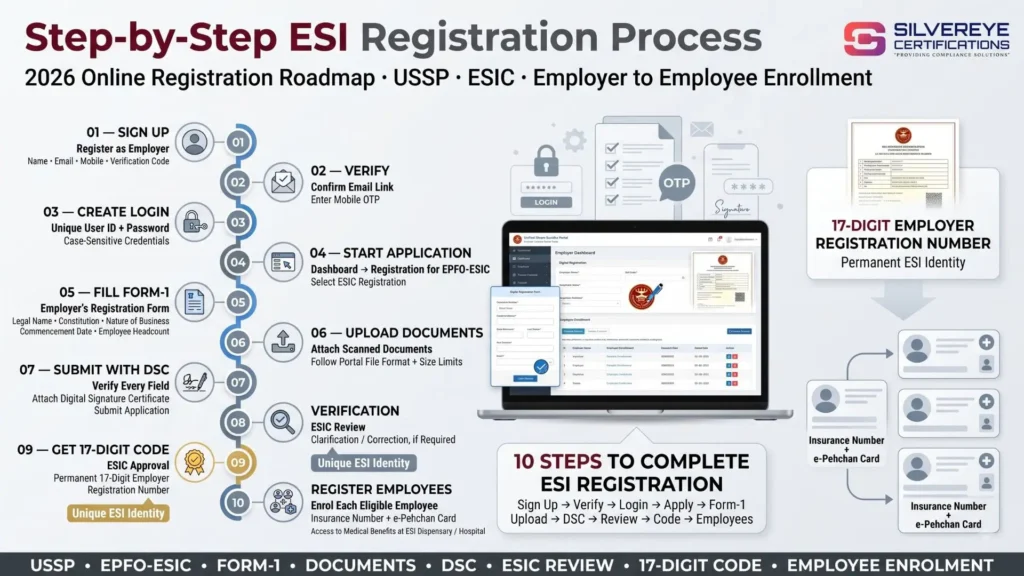
In practice, employer code generation typically takes about 7 to 15 working days from submission, assuming documents are accurate and complete on the first attempt. Errors or mismatched details (a very common one: PAN not matching the entity name) are the biggest cause of delay.
ESI Registration Fees and Cost
There is no government fee for ESI registration. ESIC does not charge anything to sign up an establishment or generate the 17-digit employer code — the process is completely free when done directly on the Shram Suvidha Portal.
The actual cost employers incur is the ongoing statutory contribution, not a one-time registration fee:
| Component | Rate | Who Pays |
| Employer's contribution | 3.25% of employee's wages | Employer |
| Employee's contribution | 0.75% of employee's wages | Employee (deducted from wages) |
| Total contribution | 4.00% of wages | Combined, deposited by employer |
| Professional/consultant fee (optional) | Typically ₹1,000–₹5,000, varying by provider and case complexity | Employer, only if outsourcing the filing |
These contribution rates have been in force since 1 July 2019 and remain unchanged as of 2026. Any amount an employer deducts from an employee's wages toward ESI is legally treated as money held in trust for the government — delaying its deposit is treated far more seriously than an ordinary payment delay.
Validity and Renewal of ESI Registration
ESI registration, once granted, is permanent — it does not expire and does not need to be renewed year after year. The 17-digit employer code remains valid for the entire lifetime of the establishment, unless the business is formally closed, merged, or de-registered.
What does need regular attention is compliance, not renewal:
- Monthly contributions must be calculated and deposited by the 15th of the following month through the ESIC-integrated challan system.
- The scheme runs on two contribution periods each year — 1 April to 30 September, and 1 October to 31 March.
- Benefits linked to each contribution period become payable in the corresponding benefit period — 1 July to 31 December, and 1 January to 30 June respectively.
- Employee additions, exits, and wage revisions must be updated on the portal on an ongoing basis, not just at year-end.
There is no annual "ESI renewal fee" or renewal certificate to apply for. If anyone asks you to pay for "ESI registration renewal," treat that as a red flag — what genuinely needs continuous attention is monthly contribution filing, not renewal.
Compliance Calendar: Returns and Key Timelines
| Compliance Activity | Due Date / Frequency |
| Initial ESI registration | Within 15 days of the establishment becoming eligible (crossing the headcount/wage threshold) |
| Monthly contribution payment | By the 15th of the following month, via the ESIC online challan |
| New employee enrolment | At the time of joining, before or alongside the first wage payment |
| Contribution Period 1 | 1 April – 30 September |
| Contribution Period 2 | 1 October – 31 March |
| Benefit Period (for Period 1 contributions) | 1 July – 31 December |
| Benefit Period (for Period 2 contributions) | 1 January – 30 June |
| Record maintenance | Ongoing — wage registers, attendance, and inspection books must be kept current and available for inspection |
Penalties for Non-Registration or Late Compliance
ESI compliance is enforced with real financial and legal consequences, not just a formality:
- Interest: Simple interest at 12% per annum is charged on delayed contribution payments, under Regulation 31 of the ESI (General) Regulations.
- Damages: Additional damages of up to 25% of the contribution amount can be levied depending on the length of the delay, under Section 85-B of the Act.
- Prosecution: Section 85 of the ESI Act allows for prosecution of employers who fail to register, deduct, or deposit contributions — this can include fines and imprisonment for serious or repeated violations.
- Recovery as arrears of land revenue: Unpaid dues can be recovered by ESIC using powers similar to those used for recovering government revenue.
- Employee trust breach: Since the employee's 0.75% share is deducted from their salary, failing to deposit it is treated as a more serious breach than a routine late payment — it's money withheld from an employee's statutory benefit, not just a missed company expense.
ESI Coverage for Different Categories of Employees
A frequent question employers ask is whether every kind of worker on their payroll counts. Here's the practical breakdown:
| Category | ESI Status |
| Permanent employees within wage limit | Covered |
| Contract, casual, and temporary workers within wage limit | Covered — counted both for the headcount threshold and for individual coverage |
| Employees earning above ₹21,000/₹25,000 | Not covered under ESI (may still need EPF or other benefits separately) |
| Apprentices under the Apprentices Act, 1961 | Excluded from ESI |
| Trainees under a company's certified Standing Orders | Covered — treated as regular employees, not apprentices |
| Employees with average daily wage up to ₹176 | Covered, but exempt from paying their own 0.75% contribution share |
Common Mistakes Employers Make With ESI Registration
- Waiting to "see if headcount stabilises" before registering — the 15-day clock starts the moment you cross the threshold, not when you decide you're sure.
- Structuring salaries with inflated allowances purely to keep gross wages above ₹21,000 — a practice that is now riskier under the SS Code's 50% wage-floor rule discussed in Section 5.
- Treating registration as a one-time task and forgetting monthly contribution deadlines, which is where most penalties actually originate.
- Not updating employee additions and exits promptly on the ESIC portal, which creates mismatches during inspection.
- Assuming a “shop” or “service business” is automatically exempt — most states have extended ESI coverage well beyond factories.
- Losing track of the employer login credentials or DSC renewal, which can quietly block monthly filings for weeks.
Should You Register Yourself or Get Professional Help?
Because there's no government fee, many small businesses attempt ESI registration on their own — and for a simple, single-location establishment with clean documents, that's entirely doable. Where professional support genuinely pays off is in three situations: multi-state establishments navigating different state thresholds, businesses whose wage structures need a compliance audit under the new SS Code wage definition, and companies that want ongoing monthly contribution management instead of tracking it manually every 15th of the month.
This is exactly where a specialized compliance partner like Silvereye Certifications adds value — not by making registration more complicated, but by making sure it's done correctly the first time, on schedule, and in a way that stays compliant as the Labour Codes continue rolling out through 2026.
Conclusion
ESI registration is one of the few statutory compliances in India where the government charges nothing at the front end, yet the cost of getting it wrong — through delay, incorrect wage structuring, or missed monthly filings — is genuinely steep. With the Code on Social Security's new wage definition now live and the transition period running through November 2026, this is a good year for every eligible employer to double-check both their applicability and their wage structures, not just their paperwork.
Whether you're registering for the first time, auditing your salary structure against the new 50% wage rule, or simply want your monthly ESI filings handled without last-minute stress, getting it right the first time protects your employees' benefits and your business from avoidable penalties.
Need Help With ESI Registration or Compliance?
Silvereye Certifications helps businesses across India complete ESI registration correctly the first time — from eligibility assessment and document preparation to filing on the Shram Suvidha Portal and ongoing monthly compliance support. If you're unsure whether your establishment is covered, or your salary structures need a review under the new Code on Social Security wage rules, the team at Silvereye Certifications can guide you through it end to end, so you stay compliant without the guesswork.
Frequently Asked Questions
What is ESI registration in simple terms?
It's the process of enrolling your establishment and its eligible employees under the Employees' State Insurance Act, 1948, with ESIC, so that employees earning up to ₹21,000/month get access to medical, sickness, maternity, and disability benefits, funded jointly by employer and employee contributions.
Is ESI registration mandatory for small businesses in India?
Yes. The moment a factory or establishment employs 10 or more people (20 in a few states) and at least one employee falls within the wage ceiling, registration becomes a legal requirement, not a choice — regardless of whether you're a factory or a service business.
What is the current ESI wage limit in 2026?
₹21,000 per month in gross wages for most employees, and ₹25,000 per month for employees with disabilities. This ceiling has not been revised in 2026, even though the underlying wage definition used to calculate it has changed under the Code on Social Security.
How much do the employer and employee contribute to ESI?
The employer contributes 3.25% of the employee's wages, and the employee contributes 0.75%, adding up to a total contribution of 4%. These rates have been unchanged since 1 July 2019.
Is there any government fee to register for ESI?
No. ESIC does not charge any government fee for employer registration. The process is free when completed directly on the Shram Suvidha Portal; only optional professional/consultant charges apply if you choose to outsource the filing.
How long does ESI registration take to complete?
Once documents are submitted correctly, the 17-digit employer registration code is typically issued within about 7 to 15 working days. Incomplete forms or mismatched PAN/entity details are the most common cause of delay.
Does ESI registration need to be renewed every year?
No. ESI registration is a one-time, permanent registration that stays valid for the life of the establishment. What needs ongoing attention is monthly contribution payment and employee updates — not an annual renewal.
What happens if an employer doesn't register for ESI on time?
The employer becomes liable for simple interest at 12% per annum on unpaid contributions, damages of up to 25% under Section 85-B, and possible prosecution, fines, or imprisonment under Section 85 of the ESI Act for continued non-compliance.
Are contract and temporary employees covered under ESI?
Yes. Contract, casual, and temporary employees are counted both toward the 10/20-employee applicability threshold and for individual coverage, as long as their wages fall within the ESI ceiling.
What is the 2026 update under the Code on Social Security that affects ESI?
The Code on Social Security's new wage definition, effective 21 November 2025, requires at least 50% of an employee's total pay to count as "wages." With Central Rules notified on 8 May 2026, this can pull employees back into ESI coverage even without any change to the ₹21,000 ceiling, especially where salary structures previously relied on large non-wage allowances.
Who is exempt from paying their own ESI contribution?
Employees whose average daily wage is up to ₹176 are exempt from paying their 0.75% share, though the employer must still contribute its 3.25% share on their behalf.
Can an establishment cancel or surrender its ESI registration?
Yes, but only through a formal closure/de-registration process with ESIC, typically triggered by the establishment shutting down, and only after all pending contributions and dues are cleared. It cannot simply lapse or be ignored.