

- Prior authorization is mandatory: DGFT restricted goods cannot legally cross Indian customs without an approved Import or Export Authorization, regardless of shipment value.
- Application happens online: Every restricted goods registration is filed digitally via Form ANF 2M on the DGFT portal, using a valid IEC and a Digital Signature Certificate (DSC).
- Fees depend on CIF value: The government charges ₹1 per ₹1,000 of CIF value, subject to a minimum of ₹500 and a maximum of ₹1,00,000 per application.
- The restricted list keeps changing: Items such as silver and platinum articles moved from ‘Free’ to ‘Restricted’ in 2025–26, so always verify your ITC (HS) code status before shipping.
Introduction
DGFT restricted goods registration is the process of obtaining an Import Authorization or Export Authorization from the Directorate General of Foreign Trade (DGFT) before trading goods classified as ‘Restricted’ under India’s ITC (HS) Code. Any business holding a valid Import Export Code (IEC) can apply online on the DGFT portal using Form ANF 2M, along with documents such as the IEC copy, PAN, proforma invoice, and end-use details.
The fee is calculated on the CIF value of the goods (minimum ₹500), and approval usually takes between 15 and 60 working days. Shipping restricted goods without this authorization can lead to customs detention and penalties under the FTDR Act, 1992.
What Are DGFT Restricted Goods?
Under India’s Foreign Trade Policy, every product traded across the border falls into one of four categories, and the Directorate General of Foreign Trade (DGFT) decides which category applies through the ITC (HS) — Indian Trade Classification based on the Harmonized System. “Restricted” goods are not banned; they are goods that can be legally imported or exported only after the trader obtains prior permission, known as an Import Authorization or Export Authorization, from DGFT. Trading these items without that permission is treated the same as violating a prohibition, and shipments are typically held at the port until the paperwork is sorted out.
| Category | What It Means | Example |
| Free | No licence needed; can be traded freely | Most finished consumer goods, general merchandise |
| Restricted | Needs a DGFT Import/Export Authorization before trade | Certain chemicals, wildlife-derived products, silver/platinum jewellery under current notifications |
| Prohibited | Cannot be traded under any circumstances | Items banned under CITES, tallow, fat and oil of animal origin |
| Canalised / STE | Only specific government-designated agencies can import/export | Petroleum products, select agricultural commodities |
Why Does DGFT Regulate Restricted Goods?
DGFT places goods under the restricted category for a handful of consistent reasons, and understanding these helps applicants anticipate what documentation an approving authority will ask for:
- National security — Dual-use, defence, and strategic items (covered under the SCOMET list) need government oversight.
- Public health and safety — Pharmaceuticals, drugs, and certain chemicals require sectoral regulator clearance, such as from the CDSCO.
- Environmental protection — Wildlife products, ozone-depleting substances, and hazardous waste fall under international treaty obligations like CITES and the Basel Convention.
- Domestic industry and economic balance — Items like handloom carpets or seasonal restrictions on pulses and bullion protect local producers or manage trade balance during market volatility.
Legal Framework Governing DGFT Restricted Goods
- DGFT restricted goods registration does not exist in isolation — it operates under a defined legal structure that every importer or exporter should be familiar with:
- Foreign Trade (Development & Regulation) Act, 1992 (FTDR Act): The parent legislation that empowers DGFT to regulate, restrict, or prohibit the import and export of goods.
- Foreign Trade Policy (FTP) 2023: The current operative policy document that lays down the procedures, authorisations, and schemes for cross-border trade.
- ITC (HS) Classification of Export and Import Items: The master list, maintained and updated by DGFT, that tags every product code as Free, Restricted, Prohibited, or State Trading.
- SCOMET List (Appendix 3): A specialised restricted category covering Special Chemicals, Organisms, Materials, Equipment and Technologies with strategic or dual-use significance.
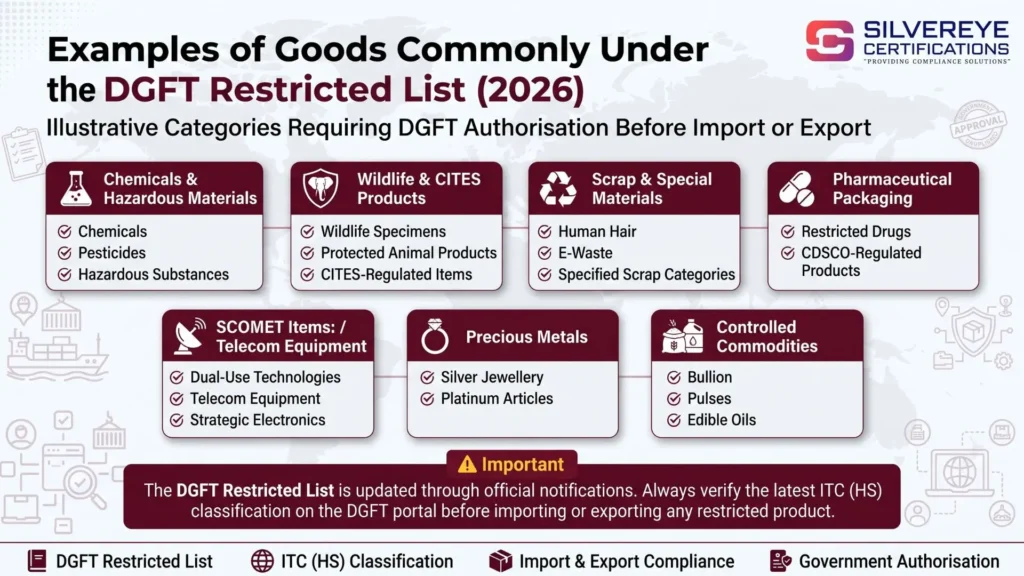
Examples of Goods Commonly Under the DGFT Restricted List (2026)
The restricted list is dynamic and revised through periodic notifications, so treat the examples below as illustrative rather than exhaustive. Always cross-check the current ITC (HS) code on the DGFT portal before you ship:
- Certain chemicals, pesticides, and hazardous substances
- Wildlife products and specimens covered under CITES
- Human hair, e-waste, and specified scrap categories
- Select pharmaceuticals and drugs requiring CDSCO clearance
- SCOMET items — dual-use technologies, specific electronic and telecom equipment
- Plain silver and unstudded silver jewellery under CTH 7113, and platinum articles under ITC (HS) 71141920, both moved from Free to Restricted in recent notifications
- Seasonal or emergency restrictions on select bullion, pulses, or edible-oil categories, imposed during periods of price or supply volatility
Who Needs DGFT Restricted Goods Registration?
You need to apply for a DGFT restricted goods authorisation if:
- You import or export a product whose ITC (HS) code is currently marked “Restricted.”
- You hold, or are in the process of obtaining, a valid Import Export Code (IEC) issued by DGFT — this is a non-negotiable prerequisite.
- Your business entity has a valid PAN and, where applicable, GST registration matching the IEC records.
- You can meet the Actual User Condition, where the imported item must be used by the applicant and not resold, if the authorization specifies this.
- You have no unresolved default, blacklisting, or pending investigation with DGFT or Customs that would disqualify the application.
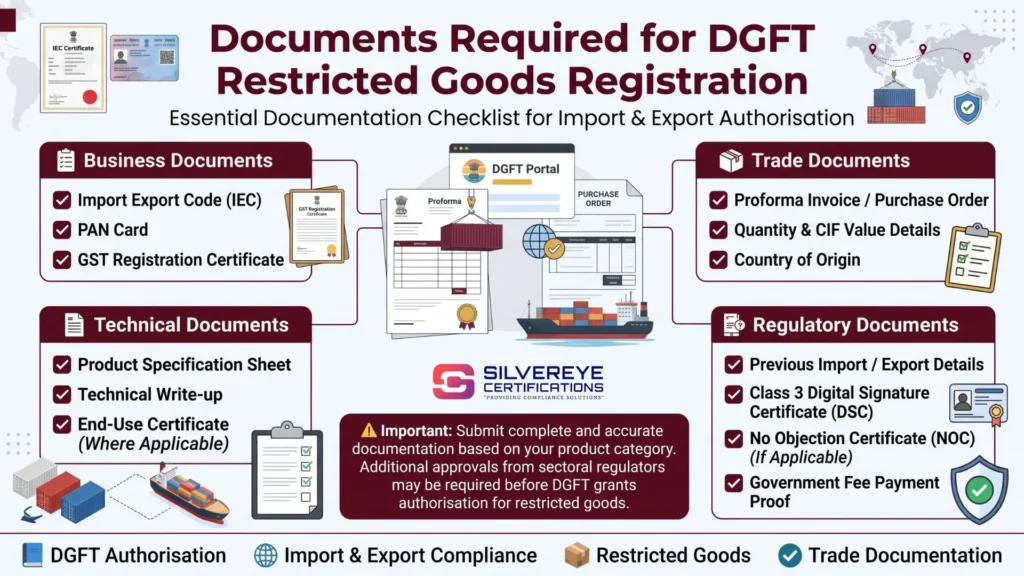
Documents Required for DGFT Restricted Goods Registration
Document requirements vary slightly by product, but a standard application file includes:
- Import Export Code (IEC) certificate copy
- PAN card and GST registration certificate of the applicant firm/company
- Proforma Invoice or Purchase Order from the overseas supplier (for imports) or the foreign buyer (for exports), showing quantity, unit of measurement, country of origin, and CIF value
- Technical write-up or product specification sheet describing end use
- End-Use Certificate, where the authorization demands proof of intended use
- Details of similar imports/exports made in the preceding three years, if any
- Class 3 Digital Signature Certificate (DSC) of the authorized signatory, needed to sign the online application
- No Objection Certificate (NOC) from the relevant sectoral regulator, if applicable — for example, CDSCO for drugs or the Wildlife Crime Control Bureau for wildlife-derived items
- Proof of application fee payment
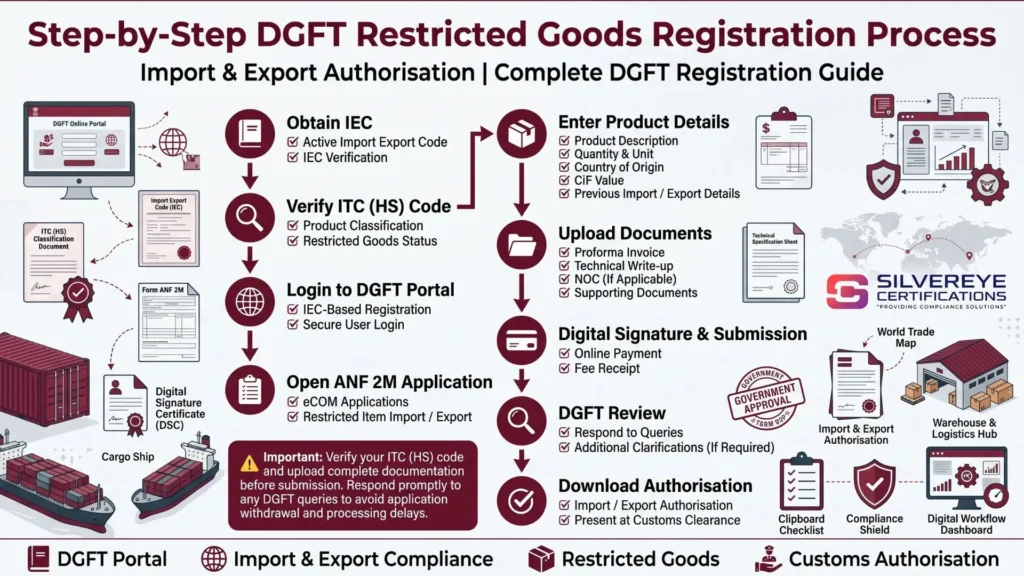
Step-by-Step DGFT Restricted Goods Registration Process
- Confirm or obtain your IEC: An active Import Export Code is mandatory before you can apply for any restricted goods authorization.
- Verify the ITC (HS) classification: Check the current status of your product code under the Import, Export & SCOMET Policy section of the DGFT website — classifications change frequently.
- Register or log in on the DGFT portal: Visit dgft.gov.in and complete IEC-based user registration if you have not already, then log in with your credentials.
- Open the correct application form: Go to Services > eCOM Applications > Restricted Item Import/Export, and select Form ANF 2M.
- Fill in product and shipment details: Enter item description, quantity, unit of measurement, country of origin, CIF value in Indian and foreign currency, and details of past imports/exports of the same item.
- Upload supporting documents: Attach the proforma invoice, technical write-up, NOCs, and other documents listed above in the prescribed format.
- Pay the application fee online: Complete payment through the DGFT portal’s electronic payment gateway and retain the receipt for upload.
- Sign digitally and submit: Authenticate the application using your DSC and submit it for scrutiny.
- Respond to queries promptly: If DGFT raises a query or flags the application as incomplete, you generally have 90 days to respond, or the application is treated as withdrawn.
- Download the Authorization: Once approved, download the Import or Export Authorization and present it to Customs at the time of clearance.
DGFT Restricted Goods Registration Fees (2026)
| Application Type | Fee Structure |
| New Import/Export Authorisation | ₹1 per ₹1,000 of CIF value; minimum ₹500, maximum ₹1,00,000, paid electronically |
| First Revalidation of Authorisation | ₹500 per application |
| Amendment (item, quantity, or value change) | Nominal fee as prescribed on the DGFT portal at the time of application |
Government fees are revised from time to time through official notifications, so always confirm the exact applicable amount on the DGFT portal before submitting payment.
Validity and Renewal of DGFT Restricted Goods Authorization
The validity period of an Import or Export Authorization is specified on the authorization itself and varies by product category and the terms set by the concerned Regional Authority or DGFT Headquarters. If you are unable to utilize the authorization within its original validity:
- Export Authorizations can generally be revalidated for six months at a time, up to a maximum of twelve months, at the discretion of DGFT Headquarters.
- Revalidation for the period lost due to delay is often permitted without an additional fee, subject to the specific terms of the authorization.
- Amendments — such as adding new items, or reducing quantity, CIF value, or unit of measurement — can be requested online before the shipment is made.
- Original physical copies of the authorization may need to be presented to DGFT Headquarters for revalidation or amendment endorsements.
Processing Timeline For DGFT Restricted Goods Authorization
While actual timelines vary by product complexity and whether other ministries need to weigh in, a typical restricted goods application moves through these stages:
- Initial screening of the application: a few working days after submission
- Document verification: roughly one to two weeks
- Final decision on straightforward applications: 15 to 30 working days
- Overall timeline for applications needing inter-agency clearance (such as CDSCO or MoEFCC sign-off): approximately 40 to 60 days
Penalties for Trading Restricted Goods Without Authorization
Skipping DGFT restricted goods registration is not a minor compliance gap — it carries real commercial consequences:
- Shipments can be detained at the port until documentation is regularized, leading to demurrage and storage costs.
- Goods may be confiscated under the Customs Act, 1962.
- Monetary penalties can be imposed under the FTDR Act, 1992.
- DGFT can suspend or cancel the trader’s Import Export Code, halting all future trade activity.
- Repeated violations can damage a company’s standing with customs and regulatory authorities, affecting future authorized economic operator (AEO) status or facilitation benefits.
2026 Regulatory Updates Every Trader Should Know
The restricted goods list is one of the most frequently amended parts of India’s trade policy. Recent changes relevant to 2026 include:
- A DGFT circular dated 16 March 2026 placed temporary restrictions on specific gold and silver jewellery items (including ITC (HS) codes 71131144 and 71131145) until 30 June 2026, linked to unusual pricing dynamics in global bullion markets.
- A September 2025 notification moved plain and unstudded silver jewellery under CTH 7113 into the Restricted category, with the restriction period running until 31 March 2026.
- Platinum articles under ITC (HS) 71141920 shifted from Free to Restricted with immediate effect under a separate DGFT notification.
- The SCOMET list (Appendix 3) was revised via Notification No. 31/2025-26 dated 23 September 2025, effective 30 days after issuance.
Because these changes can take effect with limited notice, the safest practice is to check the “Regulatory Updates → Import, Export & SCOMET Policy” section of the DGFT website against your specific ITC (HS) code before every shipment, not just at the start of a business relationship.
Common Mistakes Importers and Exporters Make
- Assuming a product is “Free” based on outdated information, without checking the latest ITC (HS) notification
- Applying with an IEC whose details (address, directors, bank account) do not match current business records
- Mismatch between the CIF value declared in the application and the value shown on the commercial invoice
- Missing a mandatory NOC from a sectoral regulator, causing the application to be returned
- Not tracking the application status on the DGFT portal, resulting in deemed withdrawal after the 90-day response window lapses
- Ignoring the Actual User Condition attached to certain authorizations, risking future disqualification
How Silvereye Certifications Can Help
Handling DGFT restricted goods registration internally can be time-consuming, especially when a product needs clearance from more than one regulator or when classification itself is unclear. Silvereye Certifications works with importers and exporters to classify products correctly under the ITC (HS) system, prepare and cross-check documentation, coordinate NOCs with sectoral bodies, file the ANF 2M application, and track it through to approval — while also flagging revalidation and renewal deadlines so authorizations do not lapse mid-shipment.
For businesses trading regularly in restricted categories, this kind of ongoing compliance support reduces the risk of port delays, penalties, and IEC-related disruptions.
Conclusion
DGFT restricted goods registration exists to keep sensitive categories of trade — whether tied to national security, public health, the environment, or domestic industry — under proper government oversight, without shutting the door on legitimate business. For importers and exporters, the practical takeaway is straightforward: confirm your product’s current ITC (HS) status before every shipment, keep your IEC and documentation audit-ready, and file the ANF 2M application well ahead of your shipping timeline rather than after goods are already in transit. Because the restricted list is revised frequently — as seen with the recent changes to silver, platinum, and SCOMET items — staying current is as important as getting the first application right.
If you would rather not track every DGFT notification yourself, Silvereye Certifications can manage the classification check, documentation, and application process on your behalf, helping you avoid port delays and compliance penalties while keeping your restricted goods trade running smoothly.
Frequently Asked Questions
What is DGFT restricted goods registration?
It is the process of applying to the Directorate General of Foreign Trade for an Import or Export Authorization before trading goods that are classified as “Restricted” under the ITC (HS) Code, so that customs clearance can proceed legally.
How do I check if my product is restricted under DGFT?
Search your product’s ITC (HS) code in the Import, Export & SCOMET Policy section on the DGFT website (dgft.gov.in). The classification will show whether the item is Free, Restricted, Prohibited, or Canalised.
Is an IEC mandatory before applying for restricted goods authorisation?
Yes. A valid Import Export Code is a prerequisite for filing any restricted goods application — without it, the DGFT portal will not let you proceed.
What is Form ANF 2M?
ANF 2M is the standard online application form on the DGFT portal used to apply for Import Authorization of restricted items, along with the prescribed supporting documents.
How long does it take to get DGFT restricted goods authorization?
Simple applications are often decided within 15 to 30 working days. Cases requiring clearance from another ministry or regulator can take 40 to 60 days overall.
What is the fee for DGFT restricted item registration?
The standard fee is ₹1 per ₹1,000 of the CIF value of the goods, with a minimum of ₹500 and a maximum of ₹1,00,000, paid electronically through the DGFT portal.
Can a DGFT restricted goods authorization be renewed or revalidated?
Yes. Export Authorizations can typically be revalidated for six months at a time, up to a maximum of twelve months, at the discretion of DGFT Headquarters, usually on payment of the prescribed revalidation fee.
What happens if I import or export restricted goods without authorization?
Customs can detain or confiscate the shipment, DGFT can impose penalties under the FTDR Act, and your IEC may be suspended, which stops all future import-export activity until resolved.
What is the difference between restricted and prohibited goods?
Restricted goods can be legally traded once you obtain the required DGFT authorization. Prohibited goods cannot be imported or exported under any circumstances, regardless of licensing.
Can a restricted goods authorization be amended after it is issued?
Yes. You can apply online to amend details such as item description, quantity, CIF value, or unit of measurement before the goods are shipped, subject to DGFT approval.