
- Mandatory compliance deadline is 02 August 2026 — all manufacturers, importers, and brands must obtain BIS certification under the updated IS 10322 (Part 5/Sec 1): 2026 before this date or risk legal penalties and market ban.
- The 2026 revision replaces the 2012 edition and aligns Indian standards with the global IEC 60598-2-1: 2020 framework, raising safety and performance benchmarks for fixed LED luminaires and fancy lights.
- Testing must be done at a BIS-recognized NABL-accredited laboratory — self-declaration or non-accredited test reports are not accepted under the updated scheme.
- Both domestic manufacturers and foreign importers are required to obtain a valid BIS CRS registration before selling fixed general purpose LED luminaires or fancy lights in the Indian market.
Introduction: Why Fixed General Purpose LED Luminaires Need BIS Certification in 2026
Walk into any hardware store in India today and you will find dozens of fixed LED luminaire brands competing for shelf space. Some are brilliant products built on solid engineering. Others cut corners on safety, use substandard driver components, and overheat in ways that pose a real fire risk to homes and offices.
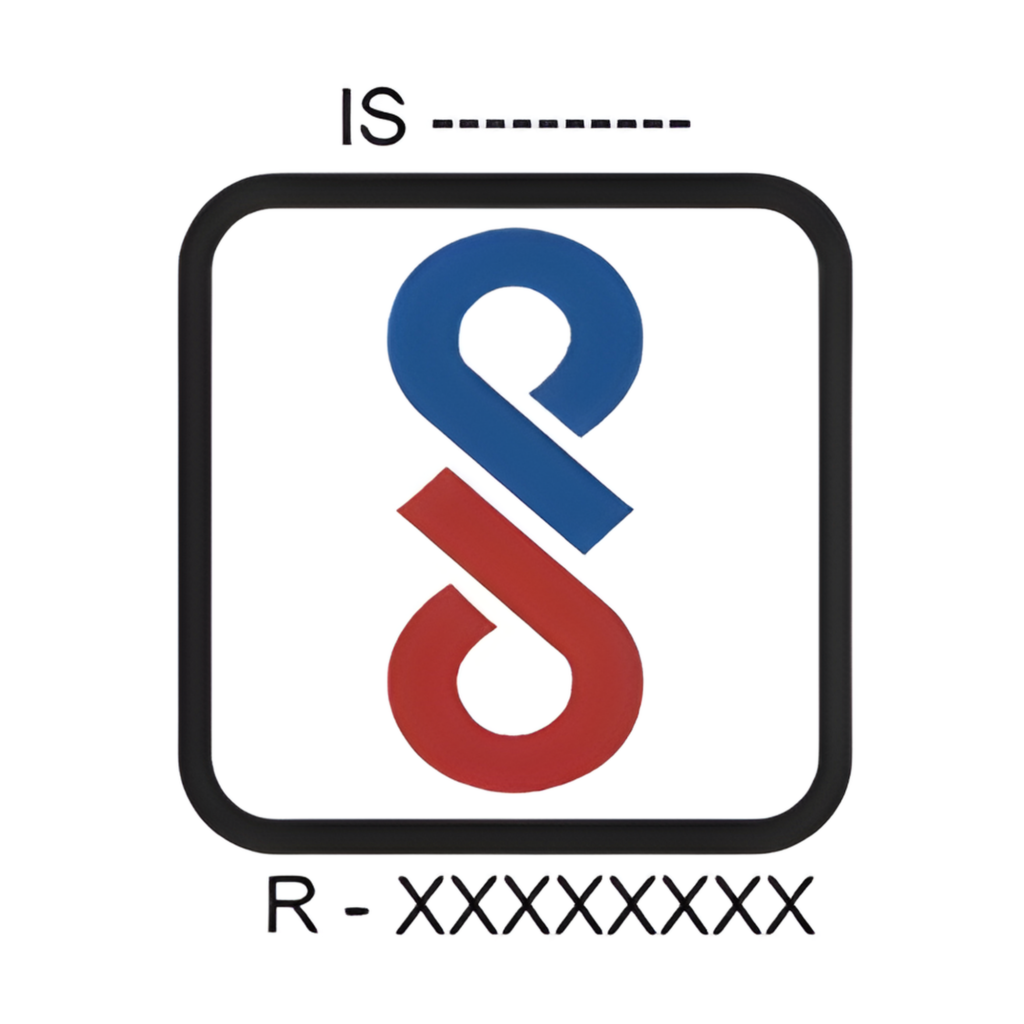
This is exactly why the Bureau of Indian Standards (BIS) mandates certification for fixed general purpose LED luminaires under IS 10322 (Part 5/Sec 1). With the 2026 revision now in effect from 02 August 2026, the Indian government has raised the bar significantly. The updated standard incorporates requirements from the international benchmark IEC 60598-2-1: 2020, covering a wider product range including decorative and fancy lights used in residential interiors.
If you are a manufacturer producing panel lights, downlights, surface-mounted LED fixtures, or decorative fancy lights, or if you are a brand importing such products from China, Taiwan, or South Korea for sale in India — you need to understand every aspect of this certification framework. This guide covers everything from what the standard means, who needs it, the complete step-by-step process, documents required, testing parameters, timelines, costs, and the critical changes introduced in 2026.
What Are Fixed General Purpose LED Luminaires?
Fixed general purpose LED luminaires are lighting fixtures that are permanently or semi-permanently installed in a building's infrastructure. They are designed to provide general ambient, task, or accent illumination using LED light sources. Unlike portable lamps or torch-type products, these luminaires are mounted to ceilings, walls, floors, or embedded in architectural surfaces.
Typical products covered under IS 10322 (Part 5/Sec 1) include:
| Product Type | Common Names | Mounting Style |
| Recessed downlights | Spotlights, pot lights, can lights | Ceiling-embedded |
| Surface-mounted panels | LED panel lights, flat lights | Ceiling/wall surface |
| Batten fixtures | LED tube batten, strip light holder | Ceiling/wall surface |
| Track lights (fixed) | Rail spotlights | Ceiling track |
| Decorative fancy lights | Chandeliers, ceiling roses, fairy light fixtures | Ceiling suspended |
| Architectural wash lights | Cove lights, cornice lights | Wall/ceiling inset |
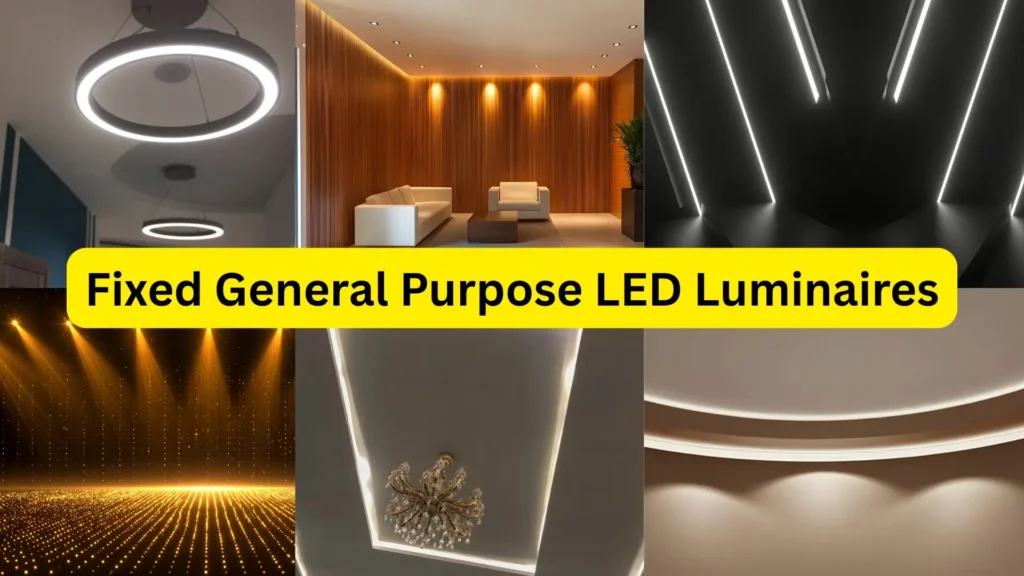
The inclusion of fancy lights under IEC 60598-2-1: 2020 means decorative luminaires with ornamental elements — which were earlier sometimes sold without any safety certification — now fall squarely within the mandatory compliance net.
Understanding the Standards: IS 10322 (Part 5/Sec 1): 2012 vs 2026
What Did IS 10322 (Part 5/Sec 1): 2012 Cover?
The 2012 edition of this standard was based on the then-current version of IEC 60598-2-1 and established basic requirements for electrical safety of fixed luminaires, insulation resistance and dielectric strength, thermal endurance and temperature rise limits, mechanical strength and enclosure robustness, photobiological safety (basic provisions), and wiring and terminal markings.
While adequate for its time, the 2012 standard had not kept pace with rapid LED technology evolution. LED drivers became far more sophisticated, colour-rendering requirements became more critical, flicker and stroboscopic effects became recognised health concerns, and fancy light designs grew far more complex. All of this created gaps in the compliance framework.
What Changed in IS 10322 (Part 5/Sec 1): 2026?
The 2026 revision is a substantive upgrade. It directly adopts IEC 60598-2-1: 2020 as its technical backbone, which means Indian certification now mirrors the most current global requirement for fixed luminaires. Key changes include:
| Parameter | IS 10322: 2012 | IS 10322: 2026 (New) |
| Base standard alignment | IEC 60598-2-1 (older edition) | IEC 60598-2-1: 2020 |
| Flicker & stroboscopic effect | Not specifically addressed | Mandatory measurement requirements |
| LED driver safety | Basic provisions | Detailed requirements for control gear |
| Photobiological safety | Basic risk grouping | Expanded blue light hazard assessment |
| Fancy lights coverage | Limited | Explicitly included under the standard |
| Ingress protection (IP) marking | Covered | More granular testing requirements |
| Energy efficiency linkage | Indirect | Aligned with BEE star rating parameters |
| Thermal management | Basic | Detailed junction temperature provisions |
| Marking & labelling | Basic CRS mark | Enhanced labelling with rated parameters |
| Important Compliance Deadline |
| The effective date for mandatory compliance under IS 10322 (Part 5/Sec 1): 2026 is 02 August 2026. |
| From this date, no manufacturer can sell fixed general purpose LED luminaires or fancy lights in India without a valid BIS certification under the 2026 edition. |
Who Needs BIS Certification for Fixed LED Luminaires? (Eligibility)
This is one of the most common questions asked by businesses in the lighting industry. The short answer is: if your product falls under the definition of a fixed general purpose LED luminaire or fancy light, and you sell it in India — you need this certification.
Entities required to obtain BIS certification:
- Indian manufacturers producing fixed LED luminaires at facilities within India
- Foreign manufacturers exporting fixed LED luminaires to India (requires Foreign Manufacturer Certification Scheme — FMCS)
- Importers and brand owners selling white-label or OEM LED luminaires in India under their own brand name
- E-commerce sellers listing fixed LED luminaires on platforms like Amazon, Flipkart, or Meesho — marketplace compliance requirements mandate certified products
- Project suppliers and contractors supplying luminaires for large commercial, residential, or government infrastructure projects
Who is exempt?
The standard carves out a small set of exceptions. Luminaires manufactured exclusively for export and not sold within India do not require BIS certification under this scheme. Similarly, R&D prototypes that are clearly not offered for sale are outside the scope. However, any product physically placed on sale — even as a sample or trial batch — triggers the certification requirement.
Scope of IEC 60598-2-1: 2020 for Fancy Lights
The inclusion of fancy lights under IEC 60598-2-1: 2020 in the new IS 10322 (Part 5/Sec 1): 2026 framework is a significant policy shift worth understanding in detail. Fancy lights — also called decorative luminaires — include products like:
- Pendant chandeliers with LED sources
- Multi-arm decorative ceiling fixtures
- String-style LED decorative fixtures for permanent installation
- Ornamental wall sconces with LED technology
- Designer architectural statement luminaires
Until recently, many decorative fancy light products were sold without any safety testing simply because their ornamental nature placed them in a grey area of the regulatory landscape. The 2026 update closes that gap by explicitly bringing fixed fancy lights under mandatory BIS certification.
What IEC 60598-2-1: 2020 specifically requires for fancy lights:
- Creepage distances appropriate for decorative component materials
- Temperature rise testing on decorative elements — fabric shades, crystal components, plastic ornaments
- Mechanical stability under load — chandelier arm stress testing
- Cord grip and suspension testing for pendant installations
- Flammability classification of decorative materials
- Electrical isolation between LED driver and decorative metal components
Complete Documents Required for BIS Certification
Getting your documents right the first time is the single most effective way to avoid application delays. Here is the complete checklist for fixed general purpose LED luminaires BIS certification:
| Document | Details |
| BIS application form | Filled online through BIS portal (manakonline.in) |
| Certificate of incorporation | Company registration document |
| GST registration certificate | Valid GSTIN |
| Factory layout plan | Scaled drawing of manufacturing premises |
| Process flow chart | Complete manufacturing process from PCB assembly to final testing |
| Test report from NABL lab | Testing against IS 10322 (Part 5/Sec 1): 2026 parameters |
| Product technical file | Schematics, BOM, circuit diagrams |
| Authorised signatory details | Board resolution / power of attorney |
| Brand owner agreement | If product is branded by a different entity than manufacturer |
| Quality manual | ISO 9001 or equivalent QMS documentation preferred |
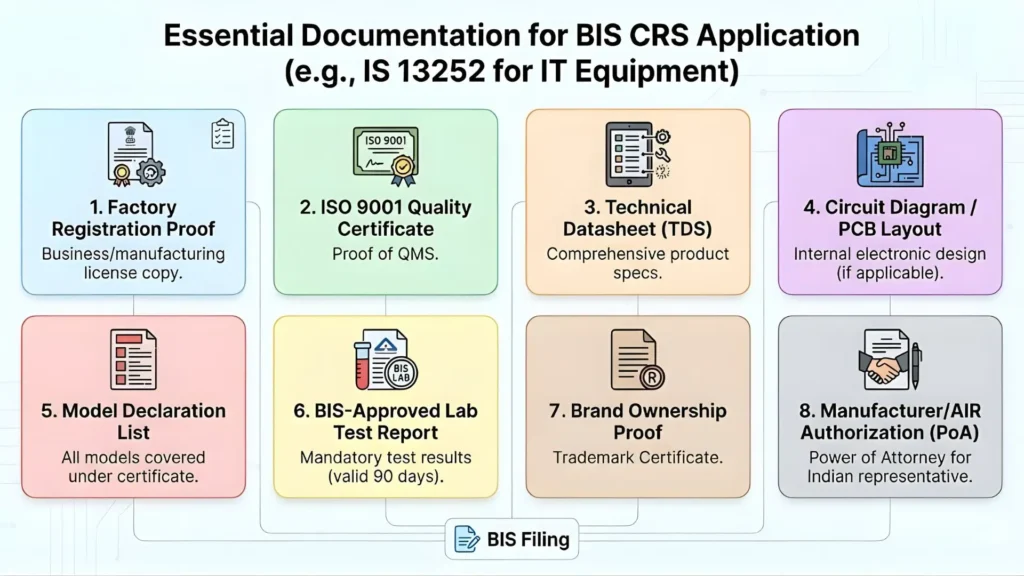
For foreign manufacturers applying under FMCS, additional documents include a valid factory certification from the country of origin, a notarised authorised Indian representative agreement, and translated documents where originals are in a non-English language.
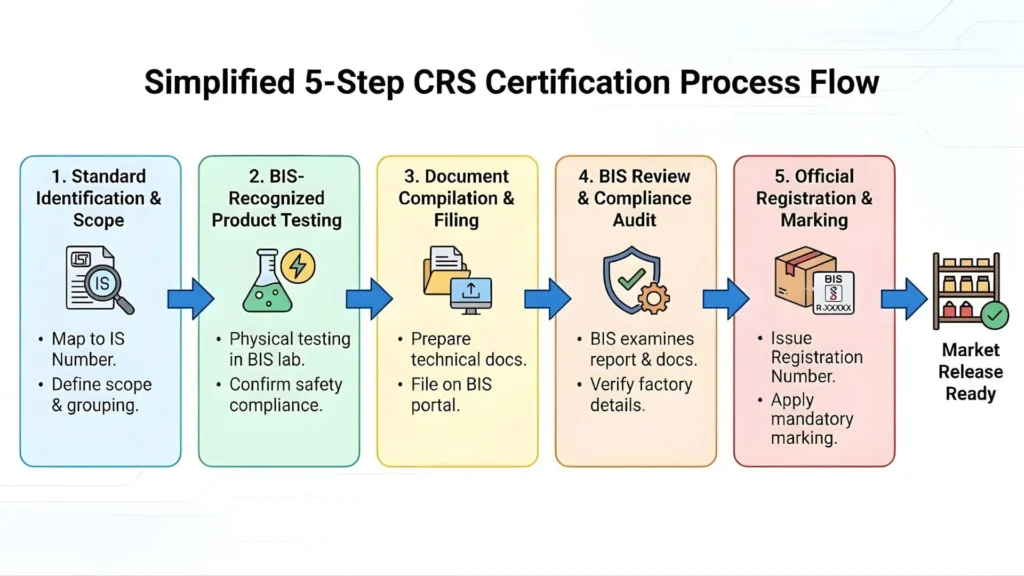
Step-by-Step BIS Certification Process
The certification process for fixed LED luminaires has multiple stages. Understanding each stage helps you plan timelines and avoid surprises.
Stage 1: Pre-Application Preparation
Before submitting any application, get your product tested at a BIS-recognised NABL-accredited laboratory. This is non-negotiable. The test report must reference IS 10322 (Part 5/Sec 1): 2026 — reports against the 2012 edition will not be accepted from 02 August 2026 onwards.
Simultaneously, prepare your complete technical file including circuit schematics, component specifications for the LED driver, LED module data sheets, thermal management design rationale, and IP rating test evidence if applicable.
Stage 2: Online Application Submission
Log onto the BIS MANAK Online portal (manakonline.in) and create a manufacturer account. Select the correct scheme — CRS Mark Scheme for Indian manufacturers or FMCS for foreign manufacturers. Fill in the product details, upload all documents, pay the prescribed application fee, and submit.
Stage 3: Document Scrutiny by BIS
After submission, a BIS officer reviews your documents for completeness and technical accuracy. This stage typically takes 15 to 30 working days. Common reasons for rejection at this stage include incomplete test reports, missing product family declarations, or discrepancies between the test report and the submitted BOM.
Stage 4: Grant of License
BIS grants an CRS Mark License with a specific license R number. This license permits you to affix the CRS mark on your fixed LED luminaires and sell them across India.
Stage 6: Post-License Surveillance
BIS does not stop at licence grant. Ongoing surveillance through periodic factory visits and market sample testing continues throughout the licence validity period. If market samples are found non-conforming, BIS has the authority to suspend or cancel the licence and initiate legal action.
Key Testing Parameters Under IS 10322 (Part 5/Sec 1): 2026
Testing is the technical heart of the certification process. Your lab-tested samples must pass all of the following key parameters:
Electrical Safety Tests
- Dielectric strength (hi-pot) test at 2U+1000V
- Insulation resistance measurement
- Earth continuity for Class I luminaires
- Protective earthing conductor current test
Thermal Tests
- Temperature rise test on winding, contacts, external surfaces
- Thermal endurance under abnormal operation
- LED junction temperature stability assessment
Photobiological Safety Tests
- Blue light hazard (BLH) group classification per IEC 62471
- UV and IR emission assessment
Mechanical and Physical Tests
- Impact test — pendulum and spring hammer as applicable
- Ingress protection (IP rating verification)
- Mechanical strength of suspension systems for fancy lights
- Glow-wire test on polymeric components
Photometric and Energy Tests
| Test Parameter | Description |
| Luminous flux | Total light output in lumens |
| Luminous efficacy | Output per watt — lm/W |
| Power factor | Ratio of real power to apparent power |
| Flicker index & percentage | Temporal light modulation measurement |
| Colour rendering index (CRI) | Ra value — quality of colour reproduction |
| Colour temperature (CCT) | Kelvin value — warm/cool light tone |
| Standby power | Power consumed in standby or off state |
Benefits of Getting BIS Certified for Fixed LED Luminaires
Market Access and Legal Protection
Certified products can be freely sold across all Indian retail, wholesale, and e-commerce channels. Without certification from 02 August 2026, your products can be seized at the border or pulled from shelves with no recourse.
Competitive Differentiation
The CRS mark communicates safety and quality to buyers who are increasingly aware of cheap, uncertified LED products causing fires and premature failures. It is a genuine competitive advantage in tendering for government and institutional projects.
Export Facilitation
BIS-certified products aligned with IEC 60598-2-1: 2020 have an easier path to certifications in Middle Eastern, African, and Southeast Asian markets that recognise IEC-aligned Indian standards.
Reduced Liability
If a non-certified luminaire causes a fire or electrical accident, the manufacturer and importer face criminal liability under the Bureau of Indian Standards Act, 2016. A valid BIS licence significantly reduces this exposure.
E-Commerce Platform Compliance
Amazon Business, GeM portal, and Flipkart B2B now enforce BIS certification as a mandatory listing requirement for LED products. Without it, your listings will be removed.
Timeline and Cost Overview
| Activity | Estimated Time | Approximate Cost (INR) |
| NABL lab testing — IS 10322: 2026 | 30–45 working days | Rs. 35,000 – Rs. 80,000 |
| Document preparation | 7–15 days | Internal cost |
| BIS application fee | At submission | Rs. 1,000 – Rs. 5,000 |
| Factory inspection | 20–40 days after doc clearance | Rs. 10,000 – Rs. 20,000 |
| Grant of license | 15–30 days after inspection | Included in licence fee |
| Annual license fee | Per year | Rs. 5,000 – Rs. 25,000 |
| Total typical timeline | 3–5 months total | Rs. 70,000 – Rs. 1,50,000+ |
Costs vary based on the number of product models, the complexity of the luminaire, and whether overseas testing is needed for FMCS applicants.
Common Mistakes to Avoid During Certification
- Testing against the old IS 10322: 2012 edition after the 02 August 2026 deadline — always confirm your lab is testing to the 2026 edition
- Submitting test reports for a product family without a proper family justification document — each variant with a different LED driver, LED module, or power rating typically requires separate evidence
- Incorrect IP rating claims on marketing materials that differ from what was tested — BIS inspectors check marketing claims against test evidence
- Factory quality control records not maintained adequately — BIS expects documented inspection at incoming, in-process, and final inspection stages
- Not updating the licence when product specifications change — any change in LED module, driver IC, PCB layout, or housing material must be notified to BIS
2026 Updates: What Has Changed and What You Need to Do Right Now
The 02 August 2026 deadline is the key compliance trigger every manufacturer and importer must build their roadmap around. Here is a practical action checklist:
| If you currently hold a BIS licence under IS 10322: 2012 |
| You must transition your licence to the 2026 edition. BIS has issued transition guidance requiring existing licensees to get fresh test reports against the 2026 standard and update their technical file. Specific timelines for existing licence holders should be confirmed directly with your BIS regional office. |
| If you are applying for the first time |
| Apply only against the 2026 edition. Any application submitted after the enforcement date referencing the 2012 standard will be rejected. |
| If you are an importer of fancy lights |
| Previously, many decorative LED fixtures were imported without BIS compliance on the basis that they were purely decorative. That interpretation no longer holds. Get your suppliers' products tested and certified under IEC 60598-2-1: 2020 / IS 10322: 2026 immediately. |
| If you sell through e-commerce |
| Begin the certification process at least 4–5 months before August 2026 to account for lab testing queues and BIS processing time. |
Conclusion: Act Before the August 2026 Deadline
The mandatory BIS certification requirement for fixed general purpose LED luminaires and fancy lights under IS 10322 (Part 5/Sec 1): 2026 is not a future concern — it is an immediate business imperative. With the 02 August 2026 enforcement date approaching, manufacturers, importers, and brand owners have a finite and shrinking window to complete NABL testing, file BIS applications, pass factory inspections, and receive their licenses.
The 2026 standard is more rigorous, more comprehensive, and more aligned with global best practices than its 2012 predecessor. That is actually a good thing for the industry — it separates products built to last from those built to cut corners. If your LED luminaires are well-designed and manufactured responsibly, certification is a process you will pass. The cost and time investment is real but entirely manageable when planned early.
Start today: identify your NABL-accredited test laboratory, confirm they are testing to the IS 10322 (Part 5/Sec 1): 2026 edition, get your samples into the queue, and begin preparing your technical file and factory documentation in parallel. Four to five months of lead time is realistic for most applicants. Leaving it to the last quarter before August 2026 risks missing the deadline entirely.
| Read More :- CDSCO Registration |
| Read More :- WPC ETA Certificate for Bluetooth Devices |
| Read More :- EPR Certification |
Frequently Asked Questions
Is BIS certification mandatory or voluntary for fixed LED luminaires in India?
It is mandatory under the Electronics and Information Technology Goods (Requirement for Compulsory Registration) Order. Selling uncertified products is a legal offence under the BIS Act, 2016.
Can I use a foreign test report (CE, UL, TUV) instead of Indian NABL testing?
No. BIS requires testing specifically against IS 10322 (Part 5/Sec 1): 2026 at a BIS-recognised Indian NABL laboratory. Foreign safety certificates are not accepted as substitutes, though they can be submitted as supplementary evidence.
Does every LED luminaire model need a separate BIS licence?
BIS permits product family certifications under defined conditions where multiple models share the same critical components — driver, LED module, housing material. A technical justification document is required to group models into a family. Outside that family definition, each significantly different product requires its own licence.
What happens if I am caught selling uncertified fixed LED luminaires after August 2026?
BIS can initiate enforcement action including product seizure, financial penalties up to Rs. 2 lakh per offence, and criminal prosecution under Section 29 of the BIS Act, 2016. For repeat violations, imprisonment is also a prescribed consequence.
Is IEC 60598-2-1: 2020 the same as IS 10322 (Part 5/Sec 1): 2026?
The new IS 10322: 2026 is technically equivalent to IEC 60598-2-1: 2020 with Indian amendments. Products already tested and certified to IEC 60598-2-1: 2020 in Europe or other markets will still need to undergo formal testing at an Indian NABL lab, but the technical gap is far smaller than with the old 2012-based standard.