
- EPR registration for Plastic Waste is legally mandatory for every producer, importer, and brand owner using plastic packaging in India — no turnover exemption exists, and CPCB is actively issuing crore-level penalty notices in 2026.
- Five plastic categories carry different recycling targets — from 30% for multi-layer packaging to 50% for rigid plastics — and missing annual targets triggers Environmental Compensation even if you have physically recycled the material.
- The entire process runs on the CPCB portal at eprplastics.cpcb.gov.in — registration, target tracking, certificate trading, and annual return filing all happen in one place with no offline alternative.
- EPR certificates are bought and sold digitally — prices range from ₹4,000 to ₹20,000 per MT depending on category, and certificates from non-compliant recyclers will not count toward your legal obligation.
Introduction: Why Every Business Selling in Plastic Packaging
Let's be direct with you. If your business makes, imports, or sells products in plastic packaging — and you have not yet registered for EPR — you are already operating outside the law.
That is not a scare tactic. That is the reality of India's Extended Producer Responsibility (EPR) framework under the Plastic Waste Management Rules, 2022. And in 2026, enforcement is no longer a distant possibility. The CPCB is actively issuing notices, demanding Environmental Compensation, and publishing names of non-compliant entities online.
This blog covers everything you need to know — from what EPR registration actually means, to how the registration process works, what documents you need, how EPR certificates are bought and sold, and what happens if you ignore it. We have kept it practical and plain-language, because compliance paperwork is already complicated enough without jargon making it worse.
| Key Fact: EPR Registration in India is governed by the Plastic Waste Management (PWM) Rules, 2016, as fundamentally overhauled in 2022 and further updated in 2024. The Central Pollution Control Board (CPCB) administers the national EPR portal at eprplastics.cpcb.gov.in. |
What is EPR Registration for Plastic Waste?
Extended Producer Responsibility — EPR — shifts the responsibility for post-consumer plastic waste from local governments and informal waste pickers to the businesses that create and profit from plastic packaging.
If you put plastic packaging into the Indian market — whether as a manufacturer, importer, or brand owner — you are legally responsible for ensuring that a prescribed percentage of that plastic is collected, recycled, or processed every year. You are not just paying a tax and walking away. You are accountable for the actual outcome.
The CPCB operationalises this through a digital portal where businesses register, declare their plastic quantities, receive annual targets, and then procure EPR Certificates from registered recyclers to demonstrate fulfilment of those targets.
The plastic your packaging generates does not disappear when the consumer throws it away. EPR forces businesses to take ownership of that journey — from consumption to recycling or responsible processing.
Who Needs EPR Plastic Waste Registration?
This is the question we get asked the most: "Does this apply to my business?" The answer is almost certainly yes if you fall into any of these three categories:
| Entity Type | Who They Are | Common Examples |
| Producers | Any person or company that manufactures or intends to manufacture plastic packaging material in India | PET bottle makers, plastic bag manufacturers, multi-layer film producers |
| Importers | Any entity that imports products packaged in plastic, or imports plastic packaging material into India | FMCG companies importing goods, raw material importers using plastic containers |
| Brand Owners | Any person who sells or markets a product in India under their own brand using plastic packaging | Food and beverage brands, cosmetics companies, D2C businesses, e-commerce sellers with private labels |
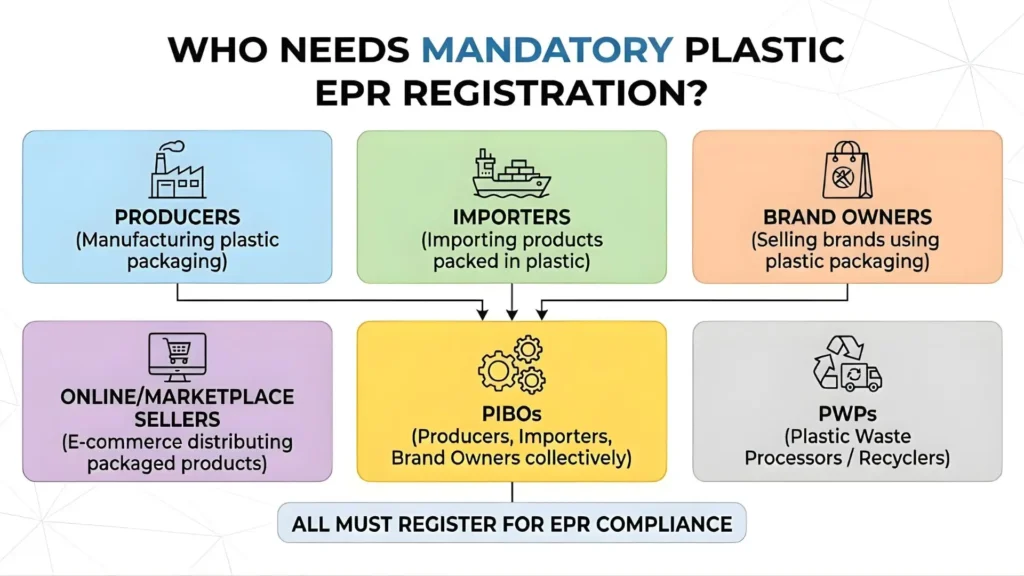
| Important for E-Commerce Sellers: Even if you are a small seller on Amazon, Flipkart, or Meesho — if you sell under your own brand label and use plastic packaging, you are classified as a Brand Owner and must register for EPR. There is currently no turnover-based exemption. |
What Types of Plastic Packaging Are Covered?
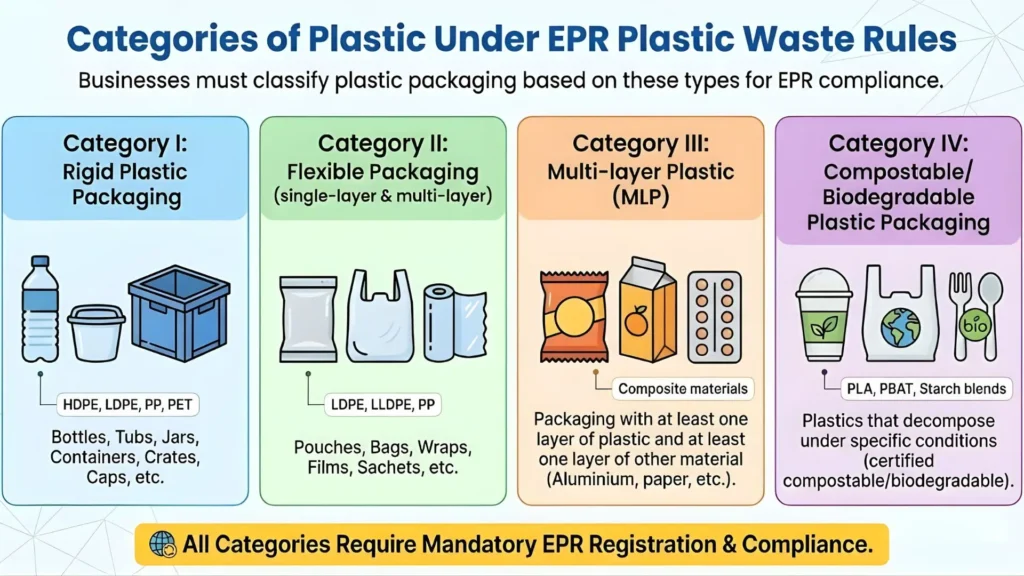
The PWM Rules divide plastic packaging into five categories. Your EPR obligation depends on which categories you use:
| Category | Description | Real-World Examples |
| Category I | Rigid plastic packaging | Bottles, jars, cans, boxes, buckets, trays |
| Category II | Flexible plastic packaging below 75 microns | Pouches, wrappers, carry bags, sachets, films |
| Category III | Multi-layered plastic packaging (MLP) | Chips packets, juice cartons, toothpaste tubes, sauce pouches |
| Category IV | Plastic carry bags and packaging films 75 microns and above | Grocery bags, stretch wrap, cling films |
| Category V | Plastic sheets and articles used in industries | Agricultural films, construction sheeting, industrial wrapping |
India's Plastic Problem in 2026: Why EPR Cannot Be Ignored
India generates over 3.5 million tonnes of plastic waste every year. A significant portion of this ends up in rivers, landfills, agricultural land, and eventually the ocean. India consistently ranks among the world's top contributors to plastic pollution — and a large share of that plastic originates from consumer packaging.
The informal waste sector, primarily rag pickers and small-scale kabadiwallas, handles much of this recycling — but they focus on high-value plastics. Flexible films, multilayer packaging, and small sachets are largely uncollected because they are uneconomical to recycle informally.
EPR is designed precisely to address this gap. By making businesses financially responsible for their plastic's end-of-life, it creates economic incentives for collecting and processing the harder, lower-value categories of plastic waste.
In 2024-25, CPCB reported that over 14,000 entities had registered on the EPR portal — a significant jump from previous years. But compliance rates remain uneven. Thousands of brand owners and importers remain unregistered, and many registered entities are not meeting their annual targets. This is precisely why enforcement has intensified in 2026.
The Legal Framework: PWM Rules 2022 and 2024 Amendments
Understanding the legal backbone of EPR helps you recognise your obligations clearly and avoid the kind of mistakes that lead to Environmental Compensation notices. Here is how the regulatory framework has evolved:
| Year / Event | What Changed |
| 2016 | Plastic Waste Management Rules notified. Set up basic framework for local body responsibilities and began the conversation on producer accountability. |
| 2018 | Amendment formally introduced the concept of EPR for plastic packaging producers. |
| February 2022 | Landmark overhaul of PWM Rules. Mandatory EPR targets introduced, CPCB portal launched, five-category system for plastic packaging established, certificate trading mechanism created. |
| July 2022 | 19 single-use plastic items banned outright. EPR framework tightened for remaining plastic packaging categories. |
| 2023 | EPR Certificate marketplace goes live on CPCB portal. PIBOs can now buy and sell certificates digitally from registered recyclers. |
| 2024 | Recycling targets increased for multiple categories. Financial provisions for non-compliance revised upward. New reporting formats and annual return templates introduced. |
| 2025-2026 | Enforcement intensifies. CPCB issues Environmental Compensation orders to defaulters. State PCBs conduct active inspections. Large brands receive EC notices running into crores. |
Four Terms You Must Understand Before Registering
- EPR Obligation — The tonnage (in metric tons) of plastic packaging waste your business must ensure is collected, recycled, or processed in a given financial year.
- EPR Certificate — A tradeable digital document issued by a CPCB-registered recycler confirming that a specific quantity of plastic waste from a specific category has been processed.
- Environmental Compensation (EC) — The financial penalty levied by CPCB for shortfall in EPR target fulfillment. It applies per MT of unmet obligation.
- PRO (Producer Responsibility Organisation) — A third-party organisation registered with CPCB that helps your business meet EPR obligations through waste collection and recycling networks.
Legal Requirements Under the PWM Rules: What You Must Do
Understanding what the law actually requires — not just that it exists — helps you build a compliance programme that holds up under scrutiny.
- Register before you introduce plastic into the market. You cannot legally sell or distribute plastic-packaged products in India without a valid, current EPR registration. This applies from day one of your business operations, not after you reach a certain scale.
- Declare your plastic quantities accurately. Every financial year, you must declare the volume (in metric tonnes) of each category of plastic packaging you introduce into the market. These declarations determine your annual EPR targets. False or understated declarations are a criminal offence under the Environment Protection Act, 1986.
- Meet your annual recycling and end-of-life targets. Your targets are set based on your declarations and the applicable percentages for each plastic category. Meeting them requires procuring EPR certificates from CPCB-registered recyclers — either directly through the portal marketplace or via a registered Producer Responsibility Organisation (PRO).
- File your annual return by the deadline. Typically September 30 for the preceding financial year, though you should always verify the current CPCB notification. Missing this deadline is treated as zero fulfilment — meaning Environmental Compensation applies to your full annual obligation, regardless of what you actually recycled.
- Renew your registration annually. EPR registration is not a one-time process. Annual renewal requires filing the previous year's return and updating any changed business details.
- Use only registered recyclers and PROs. EPR certificates are only legally valid when issued by CPCB-registered recyclers and traded through the portal. Certificates from unregistered or non-compliant recyclers — regardless of the price you paid — do not count toward your obligation. Always verify a recycler's registration status and Consent to Operate before purchasing.
- Maintain records. Keep documentation of all plastic quantities introduced, certificates procured, annual returns filed, and correspondence with CPCB and State PCBs. These records are essential if your compliance is ever audited or challenged.
EPR Targets and Obligations: What You Must Achieve in FY 2025-26
Your EPR "target" is not a flat number. It depends on your plastic category, how much you introduce into the market, and the financial year. Here is the current target structure for FY 2025-26:
| Plastic Category | Recycling Target | End-of-Life Target | Notes |
| Category I — Rigid Plastics | 50% of quantity introduced | 50% | No landfill permitted |
| Category II — Flexible (below 75 microns) | 50% | 50% | Balance via co-processing |
| Category III — Multi-layer Plastic | 30% recycling | 70% co-processing or energy recovery | Strictly no landfill |
| Category IV — Carry Bags 75 microns+ | 50% | 50% | As per CPCB norms |
* Targets are subject to revision. Always verify the current schedule at eprplastics.cpcb.gov.in before filing your annual return.
How Your Annual EPR Obligation is Calculated
| Calculation: Formula: EPR Obligation (MT) = Total Plastic Packaging Introduced into Market (MT) x Applicable Target Percentage for the Category |
For example: A brand owner introduces 200 MT of rigid plastic (Category I) in FY 2025-26. Their recycling obligation = 200 x 50% = 100 MT. They must procure EPR certificates worth 100 MT from certified recyclers on the CPCB portal to be fully compliant.
Step-by-Step: How to Register for EPR on the CPCB Portal (2026)
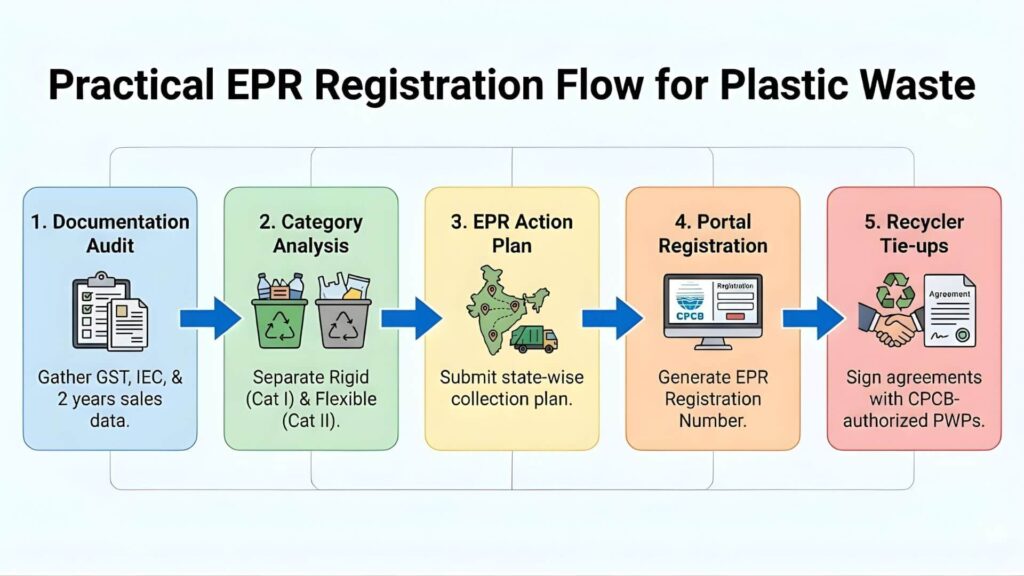
The entire EPR registration process happens on the CPCB portal at eprplastics.cpcb.gov.in. There is no offline process. Here is exactly what you do, step by step:
| Step | Action | What You Need to Do |
| 1 | Create Portal Account | Visit eprplastics.cpcb.gov.in. Register a new account using your business PAN, GST number, and authorised email ID. Keep login credentials secure. |
| 2 | Select Your Entity Type | Choose between Producer, Importer, or Brand Owner. If your business qualifies under multiple categories, check whether you need separate registrations or a combined declaration. |
| 3 | Upload All Documents | Upload all required business and compliance documents in PDF format (see the document checklist below). Files must typically be under 2MB each. |
| 4 | Declare Your Plastic Usage | Declare the quantity in metric tons of each category of plastic packaging you have introduced into the market in the previous financial year. This data determines your targets. |
| 5 | CPCB and SPCB Review | Your application is reviewed by CPCB and the relevant State Pollution Control Board. Processing typically takes 15 to 30 working days in 2026 if documents are complete. |
| 6 | Receive EPR Registration Certificate | On approval, you receive your EPR Registration Certificate with a unique registration number. This is your proof of legal compliance and must be renewed annually. |
| 7 | Review Your Annual Targets | Your EPR targets for the year are auto-generated on your portal dashboard based on your declared plastic quantities. Review them carefully. |
| 8 | Procure EPR Certificates | Purchase EPR certificates from registered recyclers on the portal marketplace, or work through a registered PRO to meet your annual obligation. |
| Pro Tip: Start your registration at least 60 to 90 days before the financial year-end. Applications submitted close to March 31 face significant backlogs. You cannot legally introduce plastic packaging into the market without a valid, current EPR registration. |
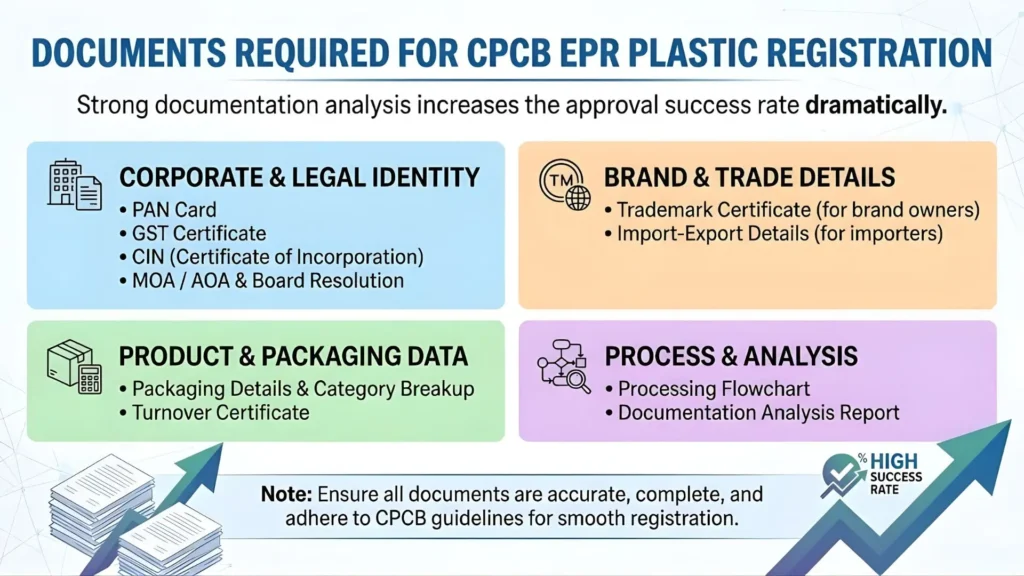
Documents Required for EPR Registration
Document rejection is the single biggest reason for delayed registrations. Get all of this ready before you begin — it will save you weeks.
| Document | Why It Is Needed | Format and Notes |
| Certificate of Incorporation / Partnership Deed / MSME Certificate | Establishes legal status and type of business entity | Self-attested PDF copy |
| PAN Card of the Entity | Tax identity and primary identifier for registration | PDF — must match business name exactly |
| GST Registration Certificate | Confirms business activity and registered address | PDF — address must match other documents |
| Factory Licence or Trade Licence | Mandatory for manufacturers and producers | PDF — must be current and valid |
| Consent to Operate (CTO) from State PCB | Required for producers; confirms environment compliance of manufacturing unit | Issued by State Pollution Control Board |
| Import Export Code (IEC) | Mandatory for importers — without this, importer registration cannot proceed | Issued by DGFT |
| Audited Annual Reports or CA-Certified Sales Data | Used to declare volume of plastic packaging introduced into market | CA-certified for large entities; internal data acceptable for SMEs with supporting invoices |
| Board Resolution or Authorisation Letter | Authorises the signatory submitting the application on behalf of the company | On company letterhead, signed by Director or Partner |
| Previous Year EPR Compliance Report | Required for entities renewing an existing registration | As filed on the CPCB portal |
| Cancelled Cheque or Bank Details | For any financial transactions processed through the portal | Scanned clear copy in PDF |
| Critical: Common Mistake: Many applications are rejected because documents carry name mismatches — for example, the PAN is in the company's full legal name but the GST certificate uses a shortened trade name. Ensure every single document reflects the exact same entity name before uploading. |
EPR Certificate Market Prices: Indicative Rates for 2026
Certificate prices vary based on plastic category, supply and demand, and recycler availability. These are indicative market ranges as of early 2026:
| Plastic Category | Approximate Rate (per MT) | 2026 Trend |
| Category I — Rigid Plastics (PET, HDPE) | Rs. 4,000 to Rs. 8,000 per MT | Stable, slight upward pressure |
| Category II — Flexible Films | Rs. 8,000 to Rs. 14,000 per MT | Rising due to limited recycler capacity |
| Category III — Multi-layer Plastic (MLP) | Rs. 12,000 to Rs. 20,000 per MT | High demand, prices volatile |
| Category IV — Carry Bags 75 microns+ | Rs. 5,000 to Rs. 9,000 per MT | Moderate, relatively stable |
* These rates are indicative only. Actual prices are set by buyers and sellers on the CPCB marketplace and fluctuate with market conditions.
Important Rules for Certificate Trading
- Certificates are only valid when traded between registered entities on the CPCB portal. Informal or offline transactions are not recognised under the rules.
- Certificates are category-specific. A Category I certificate cannot satisfy a Category III obligation — even if the quantities match.
- Certificates have a validity tied to the financial year. Unused certificates from a previous year may not automatically carry forward — check current CPCB circulars.
- Always verify the registration status and Consent to Operate of any recycler before purchasing certificates. Invalid certificates purchased from non-compliant recyclers do not count toward your obligation.
Penalties for Non-Compliance: What Is at Stake in 2026
This is not an area where a "wait and see" approach is wise. Here is what non-compliance actually looks like in 2026:
| Type of Default | How EC Is Applied | Consequence |
| Shortfall in annual EPR obligation | EC levied per MT of shortfall at CPCB-notified rates for each plastic category | Proportional to shortfall volume — no upper cap |
| Operating without EPR registration | Flat EC plus possible suspension of operations | Back-dated EC from year of obligation; escalates each quarter |
| Non-filing of Annual Return by deadline | Treated as 100% shortfall for the financial year | EC on full EPR obligation even if you actually met targets physically |
| False or fraudulent declaration of plastic quantities | Criminal prosecution under Environment Protection Act, 1986 | Imprisonment and heavy fines — separate from and in addition to EC |
| Urgent: 2026 Enforcement Update: CPCB has begun issuing Environmental Compensation orders to PIBOs who failed to meet FY 2023-24 and FY 2024-25 targets. Several large brand owners have already received EC demands running into crores. If you have unresolved compliance gaps from previous years, address them proactively — voluntary disclosure and remediation is treated more favourably than enforcement action. |
Beyond Financial Penalties: Other Real Consequences
- Cancellation of EPR registration, legally preventing you from introducing plastic packaging into the market
- Public listing on CPCB's non-compliance disclosure portal — damaging to brand reputation and investor relations
- Adverse impact on environmental clearances and approvals for plant expansions or new projects
- Difficulty renewing Consent to Operate certificates from State PCBs, which can disrupt manufacturing
- Loss of contracts with institutional buyers, retailers, and export partners who require ESG compliance documentation
Conclusion
If there is one thing to take away from this guide, it is this: EPR registration for plastic waste is not a future problem you can defer. It is a current legal obligation that thousands of Indian businesses are already navigating — and that the CPCB is actively enforcing.
The process is not impossibly complex. With the right documents, a clear understanding of which plastic categories you use, and a reliable recycler or PRO relationship, compliance is achievable for businesses of any size.
But it does require attention, time, and follow-through — particularly for the annual return, certificate procurement, and target tracking. Do not treat this as a one-time checkbox. Build it into your annual compliance calendar the same way you would GST filing or factory licence renewal.
| Next Step: Ready to register or need to review your compliance status? Visit the official CPCB EPR portal at eprplastics.cpcb.gov.in. For complex cases involving multiple entity types, large plastic volumes, or unresolved past compliance gaps, consult a registered environmental compliance advisor before filing. |
Frequently Asked Questions
Is EPR registration mandatory for small businesses and startups?
Yes, without exception. The PWM Rules do not provide any exemption based on turnover, employee count, or business age. If you sell products under your own brand in plastic packaging — even as a day-one startup — you are legally required to register. The only genuine exemption is for businesses that use absolutely no plastic packaging across any of their products.
How long does it take to get an EPR registration in 2026?
With a complete and correctly filed application, processing takes approximately 15 to 30 working days as of 2026. If documents are incomplete or there are queries from CPCB or the State PCB, this can extend to 45 to 60 days. Always apply at least two months before you need the certificate.
What is the difference between a PRO and a recycler?
A recycler physically processes plastic waste and generates EPR certificates based on that processing. A PRO is an intermediary organisation that manages the collection, transportation, and recycling process on your behalf by working with a network of registered recyclers. Both must be independently registered with CPCB. When you work with a PRO, they procure and transfer certificates to your portal account.
Can an importer and brand owner be the same company?
Yes, this is very common. If your company imports goods in plastic packaging and also sells them under its own brand in India, you carry obligations as both an importer and a brand owner. The portal allows you to declare both roles under a single registration in most cases, but you must declare the plastic quantities for each role separately.
What happens if I miss the annual return filing deadline?
Missing the deadline is treated by CPCB as if you have zero fulfilment for the year — meaning Environmental Compensation is levied on your full annual obligation, even if you physically met the targets and have the certificates. The annual return deadline has typically been September 30 for the preceding financial year, but always verify the current CPCB notification since deadlines can shift.
Can I buy EPR certificates in advance to cover future years?
Certificates are issued for specific financial years and are generally consumed against the obligation of that year. Carry-forward of unused certificates into subsequent years is not automatically permitted and depends on specific CPCB notifications. Do not rely on banking certificates from previous years without confirming current rules on the portal.
Is the annual registration renewal process the same as first-time registration?
Renewal is simpler than first-time registration. For renewal, you primarily need to file your Annual Return for the previous year (declaring plastic quantities introduced and EPR obligations fulfilled), upload any updated documents where changes have occurred, and confirm your details. Renewal windows typically open in April and May of the new financial year.