
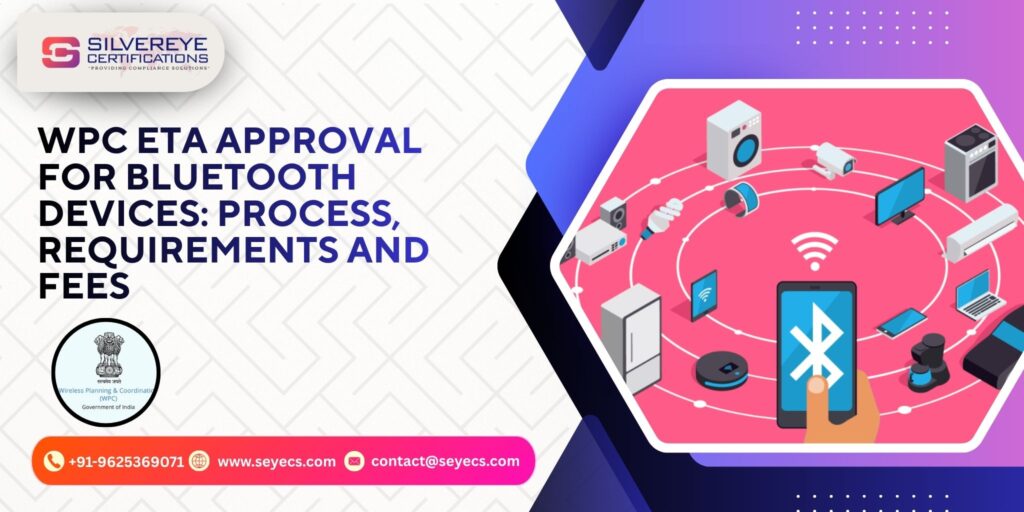
- WPC ETA Approval for Bluetooth devices are mandatory in India, governed by the Wireless Planning & Coordination Wing under DoT to regulate de-licenced frequency usage in the 2.4 GHz band.
- Most Bluetooth products qualify for the simplified "Self-Declaration" route, but importing without proper WPC certification leads to customs seizures, penalties up to ₹5 lakh, and product confiscation.
- The approval process involves NABL-accredited RF testing, AIR appointment, Saral Sanchar portal registration, and certificate download—typically completed in 4–6 weeks with correct documentation.
Quick Summary: WPC ETA Approval is the mandatory government certification for any Bluetooth device imported, manufactured, or sold in India. Governed by the Wireless Planning & Coordination Wing under the Department of Telecommunications, this approval confirms your device operates within India's de-licensed 2.4 GHz frequency band without causing radio interference.
Introduction
India's wireless device market has grown at a pace that the regulatory framework has had to keep up with — and it has. The Ministry of Communications has progressively tightened enforcement around wireless equipment compliance since 2021, and by 2025-2026, the consequences of non-compliance are not administrative inconveniences. They are business-ending events.
Customs authorities at major ports — Mumbai, Delhi, Chennai, Bengaluru — are now actively cross-checking wireless device shipments against WPC ETA records. E-commerce platforms including Amazon India and Flipkart require WPC certificate numbers before any Bluetooth product listing goes live. And institutional buyers — large electronics retail chains, hospital procurement teams, corporate IT departments — now include WPC compliance as a standard vendor qualification criterion.
The regulatory logic behind all of this is straightforward. Bluetooth devices operate on India's de-licensed 2.4 GHz frequency band. De-licensed means you do not pay for spectrum access — but it does not mean unregulated. The Wireless Planning & Coordination (WPC) Wing requires every device operating in this band to carry a valid Equipment Type Approval (ETA), proving it will not interfere with critical communication infrastructure — defense networks, aviation systems, hospital equipment, emergency services.
For businesses importing Bluetooth earbuds from China, manufacturing smart speakers domestically, distributing BLE asset trackers, or selling fitness wearables online — the WPC ETA Approval is the single piece of documentation that separates a smooth market entry from a shipment stuck at customs for 47 days with demurrage charges accumulating daily.
What Is WPC ETA Approval and What Does It Actually Confirm?
WPC ETA stands for Wireless Planning & Coordination Equipment Type Approval. It is India's official certification that confirms a wireless device — in this case, a Bluetooth product — meets the technical standards prescribed by the Department of Telecommunications for operating in the 2.4 GHz de-licensed band.
Without a valid WPC ETA Certificate, a Bluetooth device is technically illegal toimport, sell, stock in commercial quantities, or list for sale in India. This is not a grey area — it is explicitly prohibited under the Indian Wireless Telegraphy Act, 1933, which remains the foundational legislation governing wireless equipment in the country.
The Role of the Wireless Planning & Coordination (WPC) Wing
The WPC Wing functions under the Department of Telecommunications (DoT) and is India's national radio frequency manager. Its core mandate is spectrum allocation, interference prevention, and equipment compliance enforcement for anything that transmits or receives wireless signals in Indian territory.
For Bluetooth devices specifically, WPC verification goes beyond simply checking whether the device works. Their technical assessment confirms:
- The device operates within the 2400 to 2483.5 MHz frequency range as permitted under India's National Frequency Allocation Plan (NFAP) 2022
- Transmission power does not exceed 100 mW EIRP (Equivalent Isotropic Radiated Power) — approximately 20 dBm — for general consumer Bluetooth devices
- The device employs Frequency Hopping Spread Spectrum (FHSS) or Adaptive Frequency Hopping (AFH) techniques to minimise interference with co-existing devices in the same band
- The RF characteristics documented in the test report match the actual device being sold in the Indian market
Why the 2.4 GHz Band Requires Regulation Despite Being De-Licensed
The de-licensed designation of the 2.4 GHz band is frequently misunderstood. It means individual users do not need a spectrum license to operate devices in this range — unlike telecom operators who bid for 4G and 5G spectrum. It does not mean the band is free from regulatory oversight.
The 2.4 GHz band is shared by Bluetooth, Wi-Fi, microwave ovens, baby monitors, and a growing range of IoT devices. Without mandatory quality and power standards, poorly designed devices can interfere with medical monitoring equipment in hospitals, disrupt aviation ground communication systems, and affect defence installations near borders. The WPC ETA requirement is the mechanism that prevents this.
The National Frequency Allocation Plan 2022 explicitly states that equipment operating in de-licensed bands must obtain WPC approval before import or sale. This is the regulatory foundation for the ETA requirement.
Which Bluetooth Devices Require WPC ETA Certification?
The scope of the WPC ETA requirement covers virtually all Bluetooth-enabled devices intended for commercial sale, import, or distribution in India. Here is a category-wise breakdown of what falls under mandatory certification.
Audio Devices
| Product Type | Bluetooth Configuration | WPC ETA Required | Key Compliance Note |
| TWS (True Wireless Stereo) Earbuds | Classic BT + BLE | Yes — Mandatory | Most commonly flagged at customs; high import volume |
| Over-Ear and On-Ear Headphones | Classic BT or BT 5.x | Yes — Mandatory | Applies regardless of price point or brand tier |
| Neckband Earphones | BT 4.x / 5.x | Yes — Mandatory | Includes hybrid wired+wireless designs |
| Gaming Headsets with BT | BT + 2.4 GHz dongle | Yes — Both radios need separate approval | Dongle may require additional WPC consideration |
| Portable Bluetooth Speakers | Classic BT or BT 5.x | Yes — Mandatory | Applies from entry-level to premium segments |
| Home Theatre Systems with BT | BT 5.x multi-channel | Yes — Mandatory | Multi-driver systems need same certification |
| Soundbars with Bluetooth | BT + Wi-Fi (dual radio) | Yes — Both radios | Each wireless technology assessed independently |
Wearable Technology
| Product Type | Wireless Technology | WPC ETA Required | Key Compliance Note |
| Smartwatches with Bluetooth | BT 4.x / 5.x | Yes — Mandatory | Includes basic trackers and advanced health monitors |
| Fitness Bands | BLE (Bluetooth Low Energy) | Yes — Mandatory | BLE's low power does not exempt it from WPC |
| Smart Rings with BLE | BLE | Yes — Mandatory | Emerging category — fully covered under MDR/WPC framework |
| Smart Glasses with BT Audio | BT 5.x | Yes — Mandatory | Includes open-ear audio glasses |
| Devices with BT + Wi-Fi + Cellular | Multi-radio | Yes — Each radio separately | BT and Wi-Fi covered under Self-Declaration; cellular requires separate approval |
| Medical Wearables with BLE | BLE | Yes — Mandatory | Often mistakenly assumed exempt due to medical classification |
Industrial, IoT and B2B Devices
| Product Type | Use Case | WPC ETA Required | Common Mistake |
| BLE Asset Tracking Tags | Warehouse and inventory management | Yes — Mandatory | Importers assume 'low power' means exempt — it does not |
| Bluetooth Temperature Loggers | Cold chain and pharma logistics | Yes — Mandatory | Pharma importers have faced customs holds for missing ETA |
| Smart Locks with BLE | Access control systems | Yes — Mandatory | Sometimes imported under general hardware — flagged at customs |
| BLE Pet Trackers | Pet monitoring and GPS | Yes — Mandatory | Consumer product regulations apply fully |
| BLE Elderly Care Devices | Fall detection and monitoring | Yes — Mandatory | Medical-adjacent devices not exempt from WPC |
| Industrial BT Scanners | Barcode and data capture | Yes — Mandatory | Enterprise buyers increasingly verify WPC before purchase |
| Bluetooth-Enabled Drones (Remote) | Remote control systems | Yes + DGCA compliance | Dual compliance needed — WPC for BT radio, DGCA for drone |
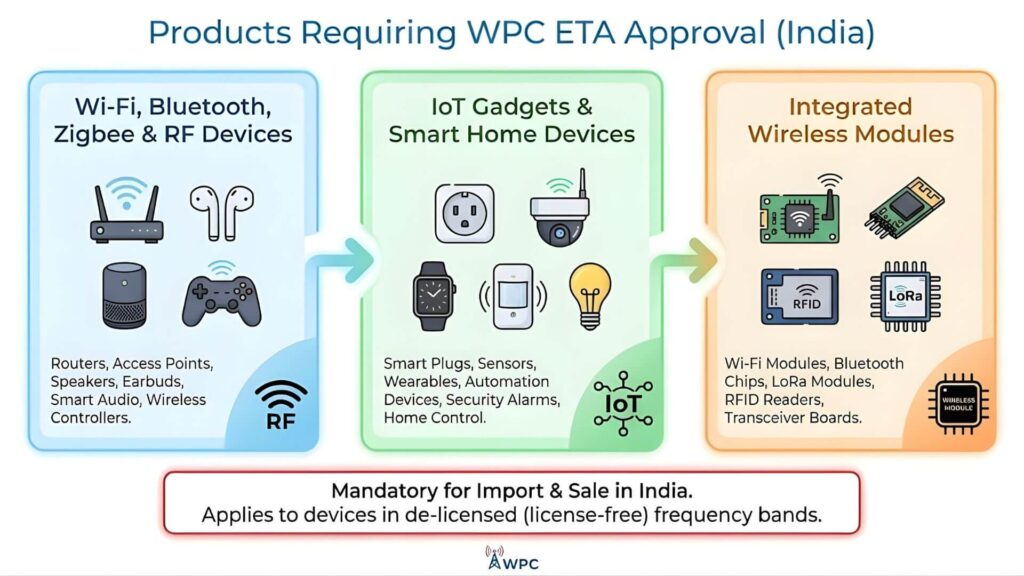
BLE (Bluetooth Low Energy) is not exempt from WPC ETA requirements simply because of its low power output. The obligation is frequency-band based, not power-level based. Any device transmitting in the 2.4 GHz band for commercial use in India needs the approval.
Does the Bluetooth Version (4.0, 5.0, 5.3, 5.4) Affect Your Approval?
This is one of the most frequently asked questions, and the answer is important to understand correctly. Bluetooth version does not create separate WPC approval categories. Classic Bluetooth, Bluetooth 4.0 LE, Bluetooth 5.0, and the latest 5.4 all operate in the same 2.4 GHz ISM band and follow the same WPC ETA pathway.
What the version does affect is the testing protocol nuances at the lab level:
- Bluetooth 5.0's optional 2 Mbps PHY mode receives additional RF scrutiny due to its higher data rate and its effect on spectrum occupancy
- Bluetooth 5.2 LE Audio with LC3 codec does not change WPC requirements — codec processing happens after the radio transmission layer, which is what WPC regulates
- Bluetooth 5.3 and 5.4 with enhanced connection subrating may require labs to run additional test sequences — confirm with your NABL lab before submission
The practical implication: if you upgrade your product's Bluetooth chipset from 4.2 to 5.0 and the model number changes, you need a fresh WPC ETA. If the model number stays the same but the chipset changes internally, you also need a new ETA — hardware changes void the existing certificate.
The ETA Through Self-Declaration Route: What It Is and Who Qualifies
The Self-Declaration route, introduced in 2021 and refined through subsequent DoT notifications, is the most significant development in WPC compliance for Bluetooth device businesses. It has transformed what was once a 3-to-6-month manual review process into a 48-to-72-hour automated approval for qualifying devices.
Understanding this route correctly — and knowing exactly what disqualifies a device from using it — is the difference between weeks of waiting and a certificate by end of the week.
Self-Declaration vs. Traditional ETA: Side-by-Side Comparison
| Aspect | Traditional WPC ETA | Self-Declaration Route |
| Processing Method | Manual review by WPC officials with multiple evaluation rounds | Automated system processing through Saral Sanchar portal |
| Timeline | 3 to 6 months | 48 to 72 hours after submission |
| Eligibility | All wireless devices including high-power and specialised equipment | Low-risk devices in de-licenced bands — Bluetooth at or below 100 mW EIRP in 2.4 GHz |
| Documentation Required | RF test reports, technical specs, business documents, AIR authorization | Identical documentation — same rigour, faster processing |
| Post-Approval Surveillance | Standard market compliance audits | Enhanced post-market audit rights — WPC can verify declarations at any time |
| Penalty for False Declaration | Standard penalties under Wireless Telegraphy Act | Severe — includes certificate revocation, prosecution, and import ban |
| Best Suited For | High-power devices, specialised wireless, defence or aviation adjacent | Standard consumer Bluetooth devices, BLE products, standard IoT tags |
Technical Eligibility Criteria for Self-Declaration (2026)
Your Bluetooth device qualifies for the Self-Declaration route if it satisfies all of the following:
- Operating frequency falls entirely within 2400 to 2483.5 MHz — the standard Bluetooth range of 2402 to 2480 MHz sits comfortably within this
- Transmission power does not exceed 100 mW EIRP (20 dBm) — standard Class 2 Bluetooth devices transmit at approximately 2.5 mW, well within this limit
- The device employs FHSS or AFH as per Bluetooth SIG specifications, confirmed in the RF test report
- The product carries a valid FCC (United States) or CE (European Union) certification from its country of origin — this serves as preliminary evidence of design compliance
- The device is not a combination product that includes a high-power radio above 250 mW
Devices That Do Not Qualify for Self-Declaration
- Combo devices pairing Bluetooth with a cellular modem transmitting above 250 mW — these require the traditional ETA route
- Bluetooth-enabled medical devices intended for diagnostic or therapeutic use — these often require a separate CDSCO evaluation alongside WPC
- Aviation communication equipment with Bluetooth integration
- Defence or security devices with Bluetooth connectivity
- Any device where the manufacturer has not obtained FCC or CE certification in the country of origin
Submitting a Self-Declaration for a device that does not meet the eligibility criteria is treated as a false declaration — not merely a procedural error. The consequences include certificate revocation, prohibition from future applications, and prosecution under the Indian Wireless Telegraphy Act, 1933.
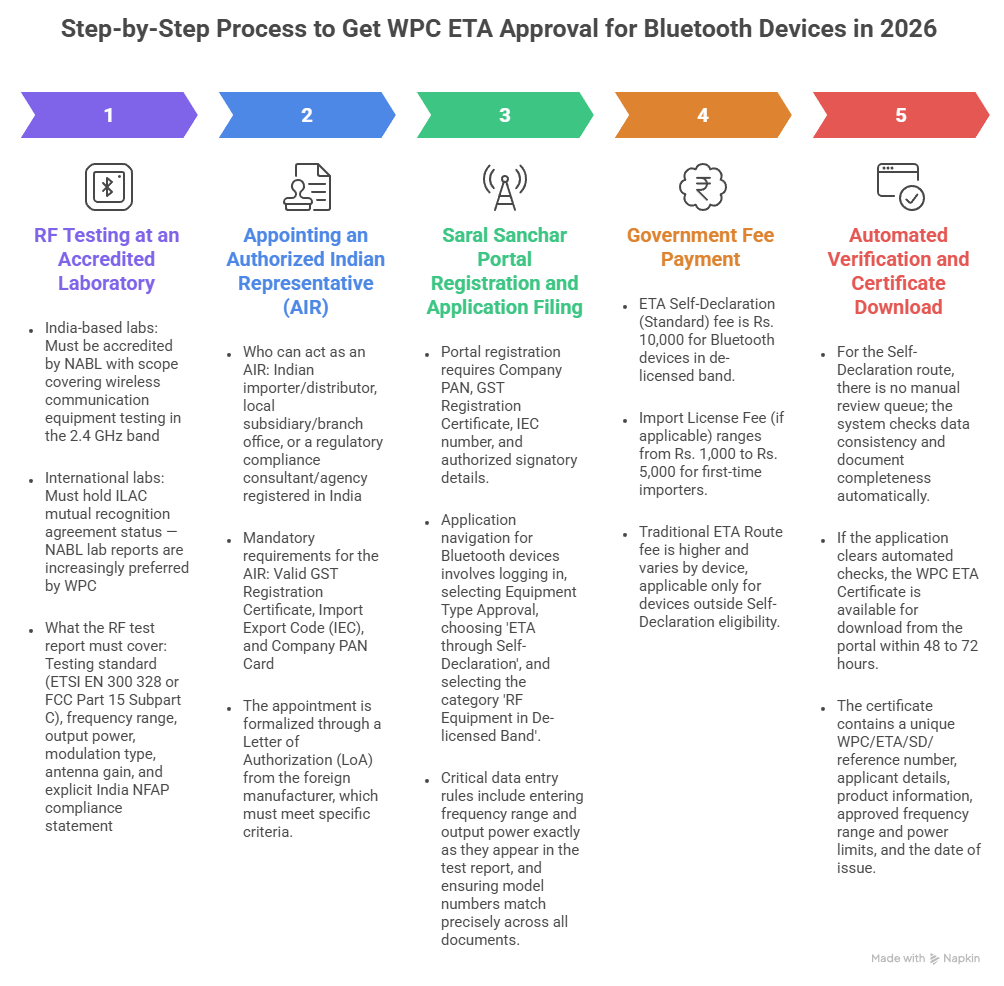
Step-by-Step Process to Get WPC ETA Approval for Bluetooth Devices in 2026
The WPC ETA process is entirely digital, managed through the Saral Sanchar portal operated by the Department of Telecommunications. There is no physical submission of documents or devices. What makes or breaks most applications is the quality of preparation before submission — specifically, the RF test report and the accuracy of data entry on the portal.
Step 1: RF Testing at an Accredited Laboratory
Before opening the Saral Sanchar portal, your Bluetooth device must have a valid RF test report from an accredited laboratory. This is the technical foundation of your entire application — every other step depends on the accuracy and completeness of this document.
Laboratory accreditation requirements:
- India-based labs: Must be accredited by NABL (National Accreditation Board for Testing and Calibration Laboratories) with scope specifically covering wireless communication equipment testing in the 2.4 GHz band
- International labs: Must hold ILAC (International Laboratory Accreditation Cooperation) mutual recognition agreement status — however, as of 2025-2026, NABL lab reports are increasingly preferred by WPC to avoid Indian NFAP clause gaps
What the RF test report must cover:
- Testing standard: ETSI EN 300 328 (the most widely accepted standard for 2.4 GHz wideband devices) or FCC Part 15 Subpart C
- Frequency range: Must state the exact operating range (e.g., 2402 to 2480 MHz) — not a generalized '2.4 GHz' notation
- Output power: Measured EIRP value in dBm — the exact figure, not rounded
- Modulation type: For BLE this is GFSK; for Classic Bluetooth this varies by version
- Antenna gain: Required for the WPC portal's technical data fields
- Explicit India NFAP compliance statement: This is the clause most international test reports miss, and it is the most common reason for rejection when using overseas lab reports
Request your testing lab to explicitly include an India NFAP 2022 compliance confirmation in the test report. Many labs add this on request without additional cost or retesting. If your international lab report does not include this, you will need to get the device re-tested at an NABL lab in India.
Step 2: Appointing an Authorized Indian Representative (AIR)
Foreign manufacturers cannot apply for WPC ETA directly. They must appoint an Authorized Indian Representative (AIR) — a locally registered Indian entity that takes legal responsibility for the device's WPC compliance declaration in India.
Who can act as an AIR:
- The Indian importer or distributor of the product
- A local subsidiary or branch office of the foreign manufacturer
- A regulatory compliance consultant or agency registered in India
Mandatory requirements for the AIR:
- Valid GST Registration Certificate — must be active, not suspended
- Import Export Code (IEC) issued by DGFT
- Company PAN Card
The appointment is formalized through a Letter of Authorization (LoA) from the foreign manufacturer. The LoA must:
- Be printed on the foreign manufacturer's official letterhead
- Be specifically addressed to the WPC Wing, Government of India
- Name the Indian entity as the authorized representative
- List the exact model numbers for which authorization is granted — a blanket LoA without model numbers is typically rejected
- Be signed and stamped by a senior executive (Director, CEO, or Compliance Head) of the manufacturer
Do not appoint a freight forwarder as your AIR. Freight forwarders do not have the technical knowledge to respond to WPC queries about device specifications. If WPC raises a technical query and the AIR cannot respond accurately, the application stalls. Appoint a technically capable entity — your Indian distributor or a compliance specialist — who understands the product.
Step 3: Saral Sanchar Portal Registration and Application Filing
All WPC ETA applications are processed through the Saral Sanchar portal (saralsanchar.gov.in), operated by the Department of Telecommunications. First-time applicants must create a company profile before filing.
Portal registration requirements:
- Company PAN for GSTN authentication
- GST Registration Certificate — GSTN authentication must succeed before the profile is activated
- IEC number
- Authorized signatory details with government-issued ID
Application navigation for Bluetooth devices:
- Log in to Saral Sanchar portal with verified credentials
- Navigate to the Equipment Type Approval section
- Select 'ETA through Self-Declaration' (for qualifying Bluetooth devices)
- Choose the category: 'RF Equipment in De-licensed Band'
- Fill in all technical parameters exactly as they appear in your RF test report
- Upload all required documents in PDF format within the file size limits
- Review all entries — particularly frequency values and output power — before payment
Critical data entry rules that prevent rejection:
- Enter the frequency range as it appears in the test report: '2402 to 2480 MHz' not '2.4 GHz'
- Enter output power as the exact measured value: '18.5 dBm' not '20 dBm' (even if 20 dBm is within the permitted limit)
- Model number must match exactly across the test report, LoA, product label photo, and application form — character by character
Step 4: Government Fee Payment
After completing the application form, government fees are paid online through BharatKosh — India's government payment portal integrated with Saral Sanchar. Payment is made before final submission.
| Fee Component | Amount (INR) | Payment Mode | Note |
| ETA Self-Declaration (Standard) | Rs. 10,000 | Online via BharatKosh | Standard fee for Bluetooth devices in de-licenced band |
| Import License Fee (if applicable) | Rs. 1,000 to Rs. 5,000 | Online via BharatKosh | Required for first-time importers — separate from ETA fee |
| Traditional ETA Route (if applicable) | Higher — varies by device | Online via BharatKosh | Applicable only for devices outside Self-Declaration eligibility |
After payment, the system generates a unique Application Reference Number. Keep this number — it is used for all tracking, correspondence, and customs documentation.
Step 5: Automated Verification and Certificate Download
Once the application is submitted and payment is confirmed, the Saral Sanchar system runs an automated verification of the submitted data. For the Self-Declaration route, there is no manual review queue — the system checks data consistency and document completeness automatically.
If the application clears automated checks, the WPC ETA Certificate is available for download from the portal within 48 to 72 hours. The certificate contains:
- A unique WPC/ETA/SD/ reference number
- The applicant's (AIR's) name and details
- The product model number and description
- The approved frequency range and power limits
- The date of issue
This WPC ETA number must appear on the product packaging and is the reference number required for customs clearance, e-commerce platform listing, and institutional buyer verification.
Save both the digital certificate and a physical copy. WPC certificates are frequently requested during customs clearance, and having the certificate number readily available on your shipping documents significantly reduces port processing time.
Complete Documents Checklist for WPC ETA Approval (2026)
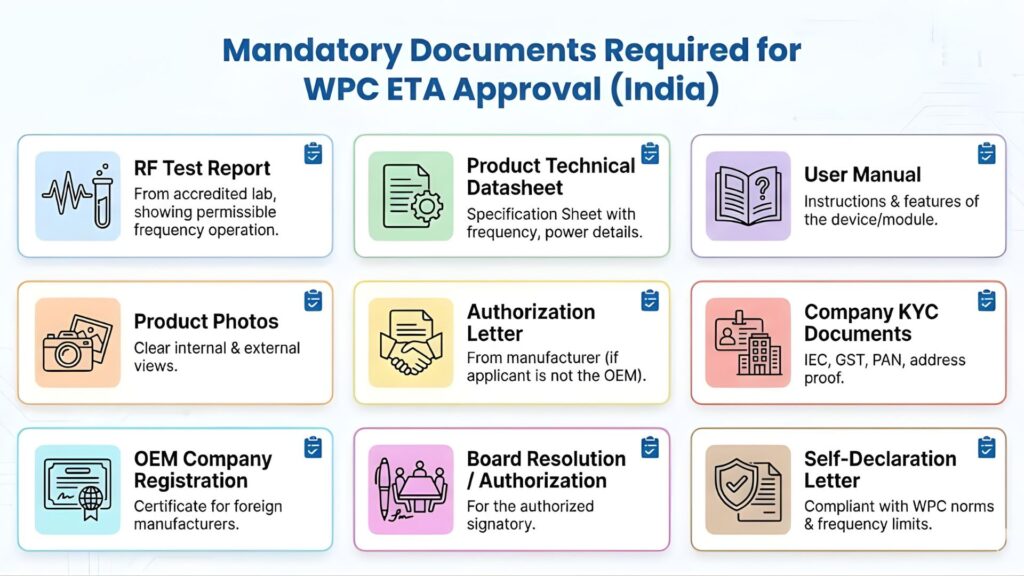
Document accuracy is where the majority of application rejections originate. A model number that differs by one character between the test report and the application form is enough to trigger rejection. Use this checklist methodically before submission.
Category 1: Technical Documents
| Document | Specification Required | Common Mistake to Avoid |
| RF Test Report | From NABL (India) or ILAC-accredited lab; must cover 2.4 GHz BT band; must reference ETSI EN 300 328 or FCC Part 15 | Using a report that does not include India NFAP 2022 compliance statement |
| Technical Data Sheet | Must list exact frequency range (MHz), modulation type, output power (dBm), and antenna gain | Using a marketing brochure instead of a proper technical specification sheet |
| Product Photos | Clear images showing all sides of the device — front, back, and label | Blurry images or missing label shots leading to query |
| Label / Marking Photo | Close-up of the product label showing model number and brand name — must match application exactly | Model number on label differs from test report due to revision suffix |
| User Manual (PDF) | English language manual; used to cross-verify features and technical claims | Submitting a preliminary manual with specifications different from test report |
Category 2: Business and Legal Documents (AIR)
| Document | Specification Required | Common Mistake to Avoid |
| GST Registration Certificate | Must be current and active — not suspended | AIR's GST suspended for unrelated compliance reasons, causing automatic rejection |
| Import Export Code (IEC) | Issued by DGFT; must be in the AIR's name | IEC not linked to current GST — causes portal authentication failure |
| Company PAN Card | PAN of the Indian entity acting as AIR | Individual PAN submitted instead of company PAN |
| Authorized Signatory ID | Government-issued ID (Aadhaar, Passport, or Voter ID) of the person signing the application | ID not matching the name registered as authorized signatory on the portal |
Category 3: Authorization Documents (Foreign Manufacturer to Indian AIR)
| Document | Specification Required | Common Mistake to Avoid |
| Letter of Authorization (LoA) | On foreign manufacturer's letterhead; addressed to WPC Wing; lists specific model numbers; signed by senior executive | Generic LoA without model numbers, or signed by a junior employee without authority |
| Manufacturer's Company Profile | Brief document establishing the manufacturer's identity and business — requested by some states/portals | Not prepared in advance, causing delays when requested |
WPC ETA Approval: Complete Fee Structure and Realistic Timeline (2026)
Many businesses plan their product launch timelines based on the 48 to 72 hour portal processing time alone. The complete end-to-end timeline — from deciding to apply to holding the certificate — is a different number. Plan accordingly.
| Stage | Activity | Realistic Timeline | Estimated Cost (INR) | Notes |
| 1 | RF Testing at NABL/ILAC Lab | 7 to 15 working days | Rs. 15,000 to Rs. 50,000 | Timeline varies by lab workload and device complexity; NABL lab recommended |
| 2 | LoA and Document Preparation | 1 to 3 days | Nil (internal effort) | LoA from foreign manufacturer can take time if overseas — factor in time zone delays |
| 3 | AIR Appointment and Portal Registration | 1 to 2 days | Nil (internal effort) | GSTN authentication can take 24 hours if first-time portal registration |
| 4 | Government Fee Payment | Instant (online) | Rs. 10,000 (Self-Declaration) | BharatKosh payment is immediate; keep receipt for records |
| 5 | Portal Processing (Self-Declaration) | 48 to 72 hours | Nil | Automated — no manual review; accurate data entry is the only variable |
| 6 | Query Resolution (if raised) | 3 to 10 days | Nil (internal effort) | If the portal flags a data mismatch or document issue — resolve and resubmit |
| 7 | Certificate Download | Immediate after approval | Nil | Certificate available on portal; download and store multiple copies |
Realistic end-to-end timeline for a prepared applicant using a domestic NABL lab: 3 to 4 weeks. For applicants using international labs whose reports require supplementary India NFAP testing: 5 to 7 weeks. Plan your import and launch schedule around the 4-week mark to avoid delays.
WPC ETA Certificate Validity, Renewal and Key Rules
| Aspect | Rule / Status | Practical Implication |
| Certificate Validity | Valid for the specific model as approved — no fixed expiry under Self-Declaration route | The certificate remains valid as long as the model hardware and name remain unchanged |
| 5-Year Review | WPC may require renewal with updated RF test report after 5 years to ensure compliance with current NFAP — verify latest DoT notification | Keep track of certification date and monitor DoT notifications for renewal requirements |
| Change in Model Name Only | New ETA Required — even if internal hardware is identical | A simple rebrand or variant suffix triggers a fresh application and fee |
| Change in Bluetooth Chipset or Antenna | New ETA Required — hardware changes void the existing certificate | Chip shortages causing component substitutions invalidate existing ETA |
| Change in Output Power or Frequency | New ETA Required | Any RF parameter change — even within permitted limits — needs fresh certification |
| Certificate Transferability | Allowed — once ETA is issued for a specific model, other importers can reference the same ETA number for importing that model | Multiple distributors can import the same certified model without each applying separately |
| Lost Certificate | Re-download from Saral Sanchar portal using Application Reference Number | Portal retains records — no need to reapply for a lost certificate |
WPC ETA and Customs Clearance: What Importers Need to Know
Customs clearance for Bluetooth devices at Indian ports is where the consequences of missing WPC ETA become immediate and expensive. Customs officers at major ports routinely cross-check wireless device shipments against WPC records, and the enforcement has intensified in 2025-2026 following DoT's directive to ports to tighten wireless equipment compliance checks.
What Customs Requires for Bluetooth Device Clearance
- Valid WPC ETA Certificate number — either referenced on the shipping documents or submitted separately to customs
- The WPC certificate number must match the exact model number being imported
- The AIR named on the WPC certificate must match the importer of record on the Bill of Entry
- For shipments importing a model for the first time, some customs ports require a physical copy of the WPC certificate
Consequences of Arriving at Customs Without WPC ETA
- Shipment detention: Goods are held at the customs warehouse — demurrage charges accumulate from day one
- Compulsory examination: Customs may open and inspect consignments, adding time and handling costs
- Seizure: If the consignment is deemed in violation of the Wireless Telegraphy Act, customs has the authority to seize the goods
- Penalty: Fines of up to Rs. 5 lakh per consignment can be imposed under the Indian Wireless Telegraphy Act, 1933
- Destruction order: In cases of repeated non-compliance, goods can be ordered destroyed rather than re-exported
E-Commerce Platform Requirements (2026)
| Platform | WPC ETA Requirement | BIS Requirement | Verification Process |
| Amazon India | Mandatory — WPC/ETA number must be uploaded against the product listing | Mandatory for CRO-covered products | Automated system check; manual review for first-time categories |
| Flipkart | Mandatory — certificate upload required at product listing stage | Mandatory for applicable products | Seller compliance team verification |
| Meesho | Mandatory for Bluetooth category products | Mandatory where applicable | Upload during seller onboarding |
| Nykaa / Purplle (wearables) | Mandatory for Bluetooth-enabled beauty/wellness devices | Mandatory where applicable | Category-specific compliance check |
Why Choose Silvereye Certifications for WPC ETA Approval?
The WPC ETA process has a straightforward structure on paper. In practice, the errors that derail applications are almost always in the details — a test report missing an India NFAP statement, an LoA without the right model numbers, a portal data entry that rounds a power figure. These are entirely avoidable errors, but only if you know where to look.
Silvereye Certifications handles WPC ETA approvals as a core practice, not a peripheral service. Our approach:
- Pre-submission document audit: Every document is reviewed against WPC's current requirements before the application is filed — not after it is rejected
- Lab coordination: We work with NABL-accredited labs and know which labs have the specific scope coverage WPC accepts without query
- Data entry verification: Technical parameters are cross-checked between the test report and the portal application before submission to eliminate mismatch rejections
- AIR services: We can act as your Authorized Indian Representative with active GST and IEC — or support your own AIR appointment if preferred
- Multi-product and multi-model management: For businesses launching multiple Bluetooth SKUs, we manage parallel applications to compress the overall timeline
Silvereye Certifications provides end-to-end WPC ETA management for importers, manufacturers, and brands. Our pre-submission audit approach is specifically designed to eliminate the rejection cycle that adds weeks to product launch timelines.
Conclusion: Three Things That Determine Whether Your WPC Application Succeeds
The Self-Declaration route has made WPC ETA Approval for Bluetooth devices genuinely fast — 48 to 72 hours of portal processing is a remarkable improvement over the months-long traditional route. But the speed of the portal only delivers results if the application going into it is correct.
After handling WPC ETA applications across hundreds of Bluetooth products, three factors consistently determine whether an application succeeds on the first submission or enters a cycle of queries and rejections:
- Lab selection: Choose an NABL or ILAC lab whose accreditation scope explicitly covers the 2.4 GHz Bluetooth band, and confirm that the report will include an India NFAP 2022 compliance statement. A rejected test report means starting the testing process over.
- Data accuracy: Enter frequency and power values from your test report exactly as they appear — not rounded, not generalised. A single digit mismatch triggers an automatic portal rejection.
- AIR appointment: Appoint a technically capable entity with an active GST registration. Your AIR must be able to answer WPC's technical queries if they arise — a freight forwarder cannot do this.
Get these three rights, and your WPC ETA Certificate will be ready within days of submission. View this certification not as a bureaucratic hurdle but as the access credential to India's Rs. 80,000 crore consumer electronics market — a market where compliant businesses are increasingly the only one’s institutional buyers, e-commerce platforms, and large retailers will work with.
Frequently Asked Questions
Is WPC ETA Approval mandatory even if my Bluetooth device already has FCC and CE certification?
Yes. FCC (United States) and CE (European Union) certifications are internationally recognised and serve as evidence of design compliance — they are actually required as supporting documents for the Self-Declaration route. However, they do not substitute for WPC ETA Approval, which is a separate India-specific requirement. A device with FCC and CE but without WPC ETA cannot be legally imported or sold in India.
Can a foreign manufacturer apply for WPC ETA directly?
No. The WPC ETA application must be filed by an Authorized Indian Representative — a locally registered Indian entity with a valid GST and IEC. The foreign manufacturer must formally appoint this AIR through a Letter of Authorization that specifically names the models covered.
How long is the WPC ETA certificate valid for?
The WPC ETA certificate is valid for the specific approved model and remains valid as long as the hardware and model name remain unchanged. There is no automatic expiry under the current Self-Declaration framework, but WPC may require renewal after 5 years to ensure continued NFAP compliance. Monitor DoT notifications for any updates to renewal requirements.
Do I need separate WPC ETA for each model variant (e.g., same earbuds in different colours)?
If the model number is the same across colour variants and the hardware is identical, a single WPC ETA covers all variants. If your colour variants carry different model numbers — which is common in consumer electronics — each model number requires its own WPC ETA application and fee.
My Bluetooth device has Wi-Fi as well. Do I need two WPC ETAs?
Yes. Each wireless technology requires separate WPC assessment. A device with Bluetooth and Wi-Fi needs WPC ETA covering both the 2.4 GHz Bluetooth band and the Wi-Fi band (2.4 GHz and/or 5 GHz). Both are typically covered in the same application for dual-radio devices, but the test report must address both radios independently.
Can I import a single unit of a Bluetooth device without WPC ETA?
A single unit imported for personal use falls under a general personal import exemption — you are not required to hold WPC ETA for this. However, the moment you import commercial quantities for the purpose of sale, distribution, or business use, WPC ETA is mandatory. E-commerce sellers who import small batches are not exempt from this requirement.
If another importer already has WPC ETA for my product model, can I use their certificate?
Yes — WPC ETA certificates are transferable in the sense that once a specific model is certified, any importer can reference that certificate number to import the same model. This is one of the significant commercial advantages of the WPC system. If your supplier already has a WPC ETA for the model, request the certificate number and reference it in your import documentation.
What happens if my Bluetooth chipset supplier changes due to a shortage?
If the chipset change alters any RF parameter — operating frequency range, output power, modulation type — the existing WPC ETA is voided and a fresh application is required. If the new chipset is a direct drop-in replacement with identical RF characteristics, you should retain documentation from both chipset manufacturers confirming equivalence — and ideally get a supplementary test report to support continued use of the existing ETA.
How do I check if a WPC ETA certificate is valid?
The WPC certificate number can be verified on the Saral Sanchar portal's public certificate verification section. Enter the certificate number to confirm its validity, the model it covers, and the issuing AIR. Institutional buyers and customs officers use this verification tool routinely.
Is WPC ETA required for Bluetooth modules used inside another product?
Yes. Bluetooth modules embedded in a final product — even if the module itself was originally certified separately — require WPC ETA for the finished product as it is sold in the Indian market. The final product's ETA accounts for the specific antenna configuration, enclosure effects, and operating parameters of the complete device, not just the bare module.