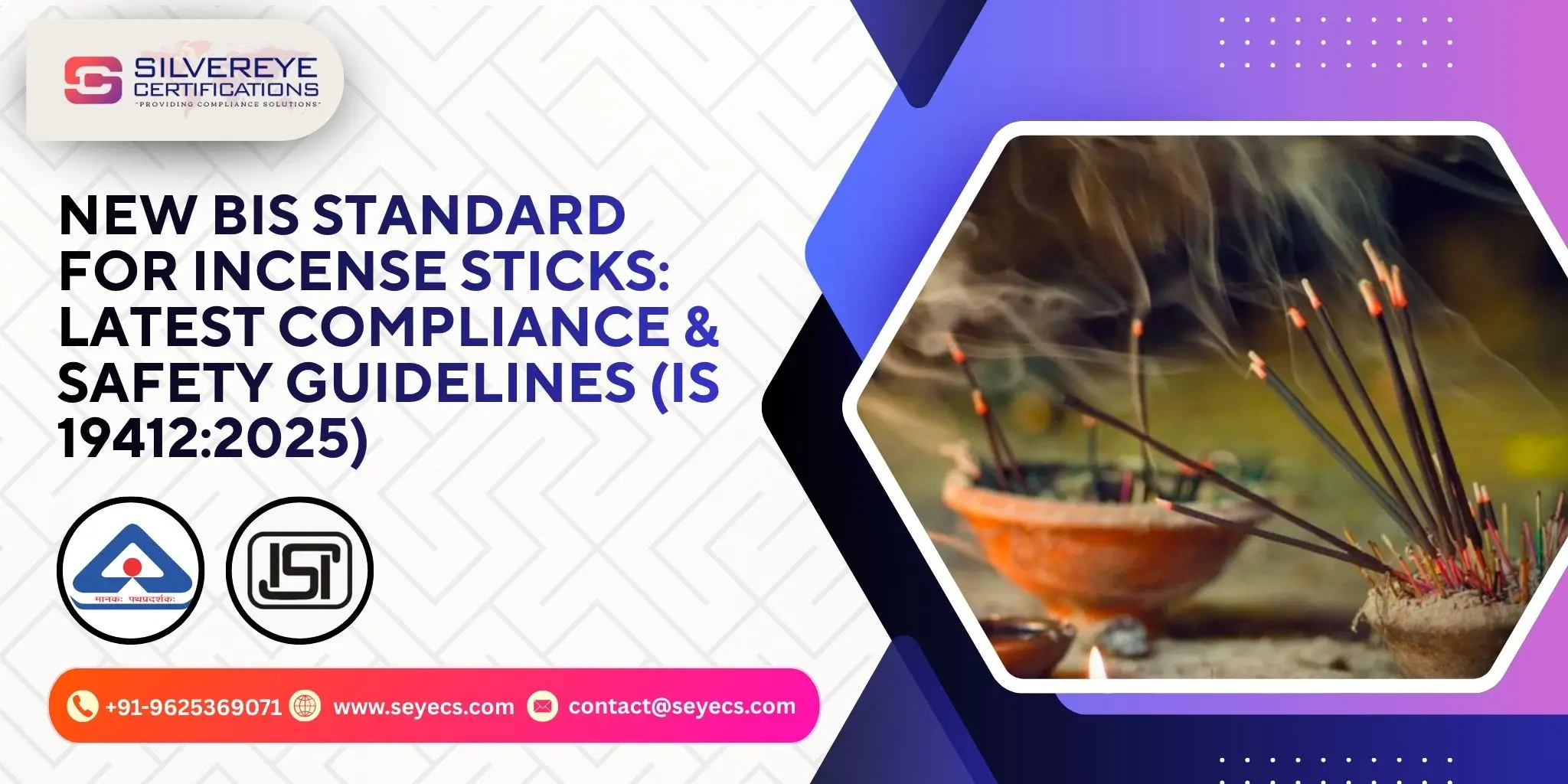

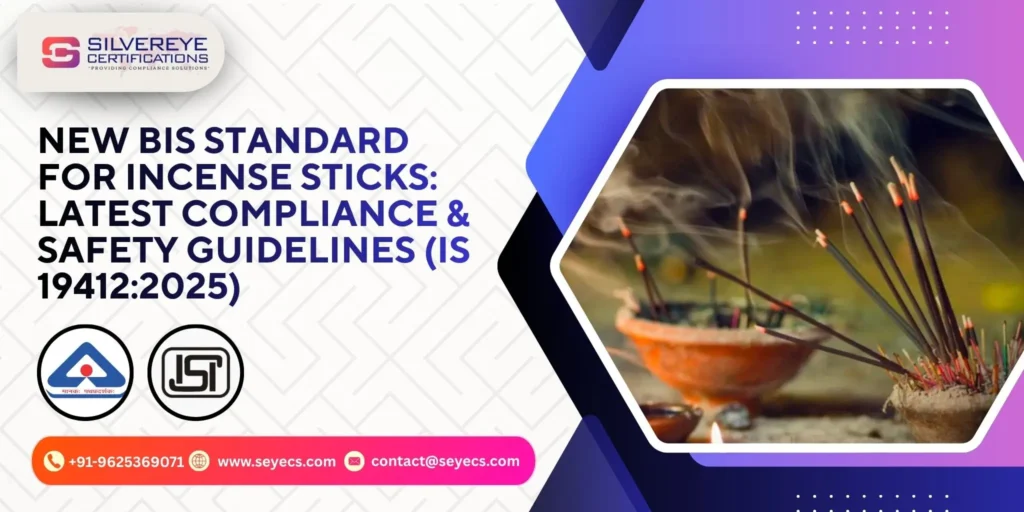
- New BIS Standard For Incense Sticks Under IS 19412:2025 the first dedicated safety standard for incense sticks, banning toxic chemicals like Alethrin and Benzyl Cyanide.
- Impact on Manufacturers: Compliance requires strict raw material sourcing, lab testing for banned substances, and new labeling protocols to earn the BIS Standard Mark.
- Market Shift: While currently voluntary, early adoption offers a massive competitive edge in the ₹8,000 Cr domestic market and protects against future Quality Control Orders (QCOs).
Introduction
There is a quiet revolution happening inside India's agarbatti industry — and most manufacturers have not noticed it yet.
For decades, the incense stick business ran on tradition, trust, and very little regulation. You sourced your bamboo, mixed your paste, dipped your sticks in fragrance, packed them in bright boxes, and sent them to market. Nobody asked too many questions about what went into that fragrance compound. Nobody tested the smoke. And nobody defined what "safe" even meant for a product that millions of Indian families burn inside their homes, temples, and meditation rooms every single day.
That changed on 24 December 2025.
On National Consumer Day, Union Minister Pralhad Joshi unveiled IS 19412:2025 — India's first dedicated safety standard for incense sticks. It is not a minor update to an existing rule. It is a completely new framework, built from the ground up, that for the first time treats the agarbatti as what it actually is: a consumer product that enters Indian homes and gets inhaled by real people. If you manufacture, import, brand, or retail incense sticks in India, this standard affects you — whether you have registered for BIS certification yet or not.
New BIS Standard for Incense Sticks: What Every Agarbatti Manufacturer Must Know Before It Becomes Mandatory

For decades, nobody really asked what went into an incense stick. You sourced your bamboo, mixed your paste, added fragrance, and sent your product to market. That era is officially over.
On 24 December 2025, India's Bureau of Indian Standards released IS 19412:2025 — the country's first dedicated safety standard for incense sticks. This is not a tweak to an old rule. It is a completely new framework that, for the first time, looks at the finished agarbatti as a consumer product that real people burn inside their homes, temples, and bedrooms every single day.
What changed? The standard now sets clear limits on harmful emissions like Carbon Monoxide and Nitrogen Oxides, bans specific chemicals like Alethrin, Cypermethrin, and Benzyl Cyanide from formulations, and requires your fragrance compounds to meet IFRA safety guidelines — with documentation to prove it.
Right now, as of April 2026, IS 19412:2025 is voluntary. But if you have watched how BIS standards work in India, you already know a Quality Control Order is coming. When it does, manufacturers with their licence in place will keep selling. Everyone else will be scrambling through a 60-day certification process with no room for error.
The smarter move is to start now — while the window is open and the pressure is off.
Why Did India Need a Dedicated Standard for Incense Sticks?
The honest answer is that the industry had been running on a blind spot for a long time.
Reports from bodies including CSIR-IITR had been flagging for years that burning certain low-quality incense sticks inside enclosed spaces releases Volatile Organic Compounds (VOCs) and Particulate Matter (PM 2.5) at levels that rival cigarette smoke. The culprit in many cases was not the bamboo or the natural masala — it was the synthetic fragrance compounds and chemical additives that cheaper manufacturers were using to produce stronger smells, longer burn times, and mosquito-repellent effects without disclosing any of it on the packaging.
The rise of "mosquito repellent agarbattis" brought this to a head. Many of these products were being sold in the spiritual incense section of retail stores with no indication that they contained active insecticides. A family burning a Mosquito Agarbatti in their bedroom before sleeping had no way of knowing they were inhaling compounds like Alethrin or Cypermethrin — chemicals that, with daily exposure in enclosed spaces, carry real risks for respiratory health and neurological function. IS 19412:2025 is the government's answer to that gap.
What is IS 19412:2025 ?
IS 19412:2025 is the Bureau of Indian Standards' first comprehensive, product-specific safety and quality standard for incense sticks — what the industry knows as agarbattis. It was developed by the BIS Fragrance and Flavour Sectional Committee (PCD 18) in collaboration with:
- CSIR-CIMAP — Central Institute of Medicinal and Aromatic Plants
- CSIR-IITR — Indian Institute of Toxicology Research
- CSIR-CFTRI — Central Food Technological Research Institute
- FFDC Kannauj — Fragrance and Flavour Development Centre
- AIAMA — All India Agarbatti Manufacturers Association
This was not a standard written by bureaucrats who had never seen a factory floor. The industry was in the room when it was drafted. That matters — it means the requirements are grounded in manufacturing reality, not theoretical ideals.
Before IS 19412:2025, the closest thing the industry had was IS 13582, which covered incense raw materials in a broad and incomplete way, and separate standards for mosquito coils. There was no single document that looked at the finished agarbatti — stick, paste, and fragrance together — as a complete system and asked: is this safe to burn inside a home? IS 19412:2025 does exactly that.
Which Products Does IS 19412:2025 Cover?
The standard recognises that Indian agarbatti manufacturing is not uniform. It explicitly classifies products into three categories:
| Type | Description |
| Machine-Made | High-volume, uniform sticks — typically dipped in liquid fragrance |
| Hand-Made | Traditional hand-rolled sticks, often from cottage industries |
| Traditional Masala Incense Sticks | Dough-based sticks (Flora/Durbar style) where fragrance is kneaded into the paste |
What IS 19412:2025 does not yet cover: Dhoop sticks, cones, cups, and logs are not formally included under this specific standard. However, the raw material and chemical safety principles set here are already influencing how manufacturers of these formats approach compliance — and similar standards for these formats are expected to follow.
For exporters specifically, even if your format is not yet covered domestically, international buyers in the EU and US are already applying equivalent chemical safety requirements to all incense formats. IS 19412:2025 gives you an Indian-government-backed document to demonstrate that compliance.
The Core Technical Requirements — What Your Product Must Now Meet
Raw Material Standards
The era of "whatever burns" is over. IS 19412:2025 sets clear requirements for every layer of the product:
- Base Stick: Must be dry, pest-free bamboo — no compromising on the core material
- Binders (Jigat/Machilus): Must be natural and free from synthetic adulterants that produce black smoke during burning
- Fragrance Compounds: Must comply with IFRA (International Fragrance Association) safety guidelines — which means your fragrance supplier needs to be able to provide documentation, not just a sample
Burning Performance Requirements
Your stick needs to perform consistently — not just in your best batch, but across your entire production run:
- Ignition: The stick must light reliably and hold its flame
- Burning Rate: Burn time must be consistent and meet standardised benchmarks based on stick dimensions — a 9-inch stick burning out in 10 minutes does not pass
- Ash Behaviour: Ash must not fall hot (burn risk) or fly easily (creates indoor air quality issues)
Fragrance Performance
Smelling good in the box is not enough. The standard tests for:
- Fragrance consistency during the full burn (not just the first few minutes)
- Specified shelf life retention — your product must perform at the end of its shelf life, not just when it is fresh
Chemical Safety and Emissions
This is the most consequential section for most manufacturers. The standard sets defined limits on Carbon Monoxide (CO) and Nitrogen Oxides (NOx) emissions during combustion — two outputs that directly affect indoor air quality in enclosed puja rooms and meditation spaces.
The Banned Chemicals List — Where Many Existing Formulations Will Fail
This is the section that every manufacturer needs to read carefully before submitting an application — because this is where a lot of current formulations quietly fail.
Prohibited Insecticidal Chemicals
If any of the following appear in your incense stick formulation — even in trace amounts — your product will not pass IS 19412:2025:
| Banned Chemical | Why It Is Banned |
| Alethrin | Respiratory distress and neurological risk with daily inhalation in closed spaces |
| Permethrin | Active insecticide — not safe for continuous indoor inhalation |
| Cypermethrin | Classified as a potential endocrine disruptor |
| Deltamethrin | Active pesticide — requires CIB licence for legitimate use |
| Fipronil | Toxic to nervous system; banned in many household product categories globally |
If you are currently selling "Mosquito Repellent Agarbattis" without a CIB (Central Insecticides Board) licence, you are already non-compliant — not just with IS 19412:2025, but with existing Indian pesticide regulations.
Prohibited Synthetic Fragrance Intermediates
These are the chemicals that create cheap, strong-smelling fragrances — and the reason many inexpensive agarbattis smell unusually intense:
| Banned Intermediate | Risk Profile |
| Benzyl Cyanide | Toxic on inhalation; potential carcinogen when combusted |
| Ethyl Acrylate | Classified as a possible human carcinogen |
| Diphenylamine | Respiratory and skin sensitiser |
The practical implication here is that if you are sourcing fragrance compounds from suppliers who cannot provide a "Free from Prohibited Substances" certificate for each batch, you have a supply chain problem that needs to be resolved before you apply for certification — not after.
Is IS 19412:2025 Mandatory Right Now?
Currently — as of April 2026 — IS 19412:2025 is a voluntary standard. No Quality Control Order (QCO) has been issued making it compulsory.
But voluntary does not mean irrelevant. Here is the realistic picture:
The government's pattern with product safety standards is consistent: voluntary first, QCO follows. Products like footwear, wood-based boards, and industrial fasteners all sat on the voluntary list until a QCO moved them to mandatory overnight. When that QCO lands, there is no grace period for intent — either your licence is in place or you are in violation.
For the incense industry, the signals are clear. The standard was launched by a Union Minister on National Consumer Day — not a low-profile regulatory release. The domestic incense market is valued at over ₹8,000 crore. Health advocacy around indoor air quality is growing. A QCO for incense sticks is not a question of if — it is a question of when. Manufacturers who wait for the QCO to apply are the ones who find themselves scrambling through a 60-day certification process while their competitors who applied early are already marking and selling.
Who Should Apply for IS 19412:2025 BIS Certification?
| Business Type | Should You Apply? | Why |
| Domestic Agarbatti Manufacturer | Yes — now, not after QCO | Competitive advantage + QCO readiness |
| Cottage Industry / Hand-Made Unit | Yes — MSME fee concessions apply | Formalise your quality and access modern trade |
| Brand Owner (Outsourced Manufacturing) | Yes — ensure your manufacturer applies | You carry product liability even if you don't make it |
| Importer (Vietnam/China origin) | Prepare now — FMCS route | As QCOs tighten, FMCS will become mandatory |
| Retailer | Stock certified products proactively | Legal protection if consumer complaints arise |
Documents Required for the Agarbatti BIS Licence
Missing documents are the single most common reason BIS applications stall. Get this list complete before you touch the Manak Online portal.
Statutory and Business Documents
- GST Registration Certificate
- MSME/Udyam Registration or Certificate of Incorporation
- Factory premises proof — sale deed, rent agreement, or property tax receipt
- Identity proof of Authorised Signatory — Aadhaar and PAN
Technical and Manufacturing Documents
- Manufacturing Process Flowchart — every step from bamboo splitting to dipping to packaging, in sequence
- Machinery List — make, capacity, and quantity of all mixers, extruders, dryers, and dipping equipment
- Raw Material Specifications — test certificates for charcoal powder, jigat, wood powder, bamboo sticks, and fragrance compounds
- Factory Floor Plan — layout showing production zones, storage areas, and quality control section
Quality Control Documents
- List of in-house testing equipment with specifications
- Name and qualification of your Quality Control Chemist or QC In-charge
- If outsourcing testing — consent letter from a BIS-recognised laboratory
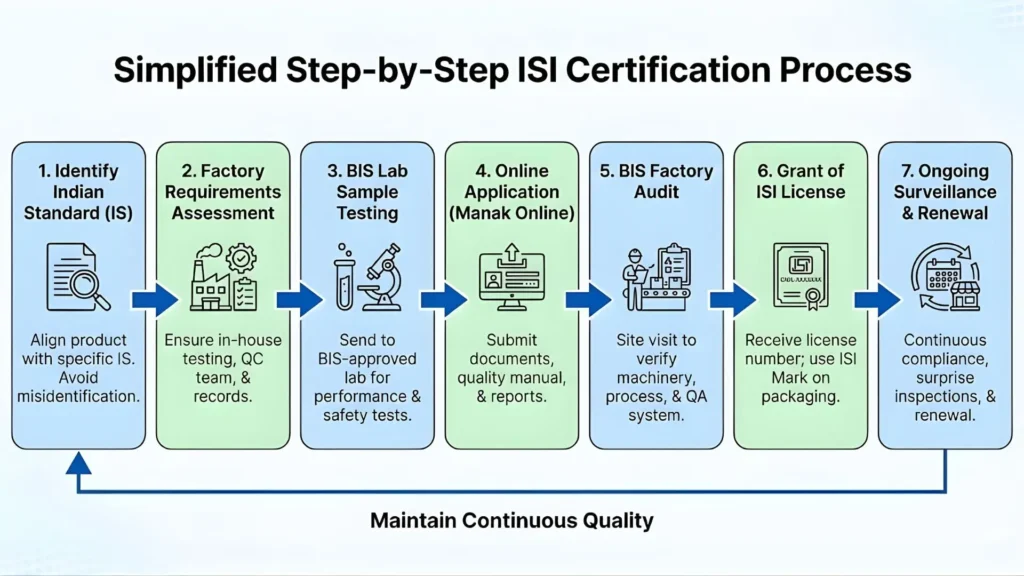
Step-by-Step Process to Get Your Agarbatti BIS Licence
Step 1 — Application Submission on Manak Online
Register on the BIS Connect portal at manakonline.in. Select IS 19412:2025 as the applicable standard, complete Form-V, upload your documents, and pay the application fee. Do not rush this step — incomplete uploads are the most avoidable source of delay.
Step 2 — Scrutiny and Query Resolution
BIS officers review your submission and raise queries if there are discrepancies — address mismatches, machinery capacity gaps, missing certificates. Respond to every query within the window given. Delays at this stage are entirely within your control.
Step 3 — Preliminary Factory Inspection
A BIS scientist visits your manufacturing facility and physically verifies:
- All machinery listed in your application is present and operational
- Your in-house quality control setup matches what you documented
- The production process runs as described in your flowchart
- Random samples are drawn from your finished product lot for independent testing
Step 4 — Laboratory Sample Testing
Sealed samples from your factory inspection go to a BIS-recognised third-party laboratory for:
- Dimensional consistency testing
- Burning quality assessment — ignition, burn rate, ash behaviour
- GC-MS (Gas Chromatography-Mass Spectrometry) screening for all banned chemicals
- Fragrance retention testing
This is the stage where timelines can stretch. BIS-recognised labs that run GC-MS analysis can have queue times of two to three weeks during busy periods. Pre-testing privately before your official application — what the industry calls a pre-audit test — eliminates the risk of a surprise failure at this stage.
Step 5 — Grant of Licence
If both the factory inspection and lab reports clear, BIS issues your CM/L number — your Certification Marks Licence. You are now authorised to print the ISI Mark on your packaging.
Step 6 — Marking and Labelling
Every packet must carry:
- The ISI Mark with your CM/L number in the format CM/L-XXXXXXX
- Generic name: "Incense Sticks" or "Agarbatti"
- Type classification: Machine-Made, Hand-Made, or Traditional Masala
- Net quantity — weight or number of sticks
- Batch number and manufacturing date
- Approximate burning time
- Safety advisory: "Use in well-ventilated spaces"
Cost and Timeline
Cost Breakdown
| Cost Head | Estimated Amount | Notes |
| Application Fee | ₹1,000 | Non-refundable, paid at submission |
| Annual Licence Fee | ₹1,000 | Recurring yearly fee |
| Audit Fee | ₹7,000 per man-day | For BIS officer's factory visit — excludes travel and stay |
| Lab Testing Charges | On Actual | Lab Testing Charges |
| Minimum Marking Fee | On Actual | Annual royalty for ISI Mark usage — volume-based above minimum |
| Consultancy Fee | Variable | Professional support for documentation and liaison |
Note on Marking Fee: If your annual production volume is high enough, your marking fee is calculated per unit of output. If production is low, you pay the minimum marking fee regardless. Factor this into your pricing model from the beginning.
Certification Timeline For India
| Stage | Approximate Duration | What Happens |
| Application Filing | Day 1–5 | Form-V submission and document upload |
| Scrutiny and Query | Day 6–15 | BIS reviews documents; queries must be resolved promptly |
| Factory Audit | Day 16–30 | BIS officer visits and draws samples |
| Lab Testing | Day 31–50 | Samples tested at third-party laboratory |
| Grant of Licence | Day 51–60 | CM/L number issued if tests clear |
| Total | 45–60 Days | Can extend to 90 days if samples fail or documents are incomplete |
Licence Validity and Renewal
| Parameter | Detail |
| Initial Validity | 1 year for the first licence term |
| Renewal Period | Renewable for 1 to 5 years in subsequent cycles |
| Renewal Window | Apply at least 1 month before expiry |
| Late Renewal | Permitted up to 90 days post-expiry with ₹5,000 late fee |
| Production Reporting | Monthly or quarterly production data must be submitted to BIS online |
| If Licence Expires | Stop printing the ISI Mark immediately — continuing to mark is a violation |
The Business Case for Getting Certified Now
This is where the conversation shifts from compliance to commercial strategy.
Modern trade access is tightening. Retail chains like DMart, Reliance Retail, and quick-commerce platforms including Blinkit and Zepto are making BIS certification documentation a standard part of their supplier onboarding in 2025–26. A certified product gets listed. An uncertified one does not get a meeting.
Premium pricing becomes defensible. Once your packaging carries the ISI Mark, your "Chemical-Free" or "Natural" claim is backed by a government certification rather than your own marketing copy. That verification is what separates a product that can command ₹80 a pack from one stuck competing at ₹30.
Government and institutional supply opens up. Bulk orders from government procurement bodies, temple trusts, and large institutions increasingly carry BIS certification as a supplier requirement. Without the licence, your business is structurally excluded from these channels.
Export markets get easier. EU and US buyers already demand REACH compliance and non-toxic certificates for incense imports. IS 19412:2025 gives you an Indian-government-backed document that speaks to those requirements — reducing the cost and complexity of meeting them market by market.
The QCO is coming. When it arrives, the manufacturers who spent months getting certified during the voluntary period will already be selling. The ones who waited will be scrambling.
What This Standard Means for Workers and the Environment
This dimension of IS 19412:2025 does not get enough attention.
The women who roll agarbattis by hand in cottage industries across Karnataka, Gujarat, and Uttar Pradesh are the first people exposed to whatever chemicals go into the paste. They work with these materials for hours every day, in conditions that are often poorly ventilated. Banning toxic compounds like Alethrin and Ethyl Acrylate from the formulation is not just a consumer protection measure — it is a direct health protection measure for the workforce that makes these products.
From an environmental standpoint, cleaner burning formulations produce lower pollutant loads. In a country where indoor air quality is already a significant public health concern, reducing the chemical burden from a product burned in hundreds of millions of homes daily is a meaningful contribution — not a regulatory abstraction.
Conclusion
IS 19412:2025 is not a bureaucratic formality. It is the first time the Indian government has formally defined what safe incense looks like — and it draws a clear line between manufacturers who are serious about product safety and those who are not.
For manufacturers who have always used quality raw materials and avoided chemical shortcuts, this standard is validation. The certification process confirms what you already know about your product and gives you a mark that communicates it to every retailer, institutional buyer, and consumer who picks up your box.
For manufacturers whose current formulations rely on synthetic chemical shortcuts to hit price points and performance claims — the reckoning is here. Not as a fine or a raid, not yet. But the framework is in place. The QCO will follow. And the manufacturers who restructured their formulations and got certified during the voluntary window will be the ones still selling when it does.
The era of unregulated smoke is ending. The future belongs to clean, certified, and transparent agarbattis.
How Silvereye Certifications Saves You Time
While the official timeline is 60 days, errors in documentation can drag this out to 6 months. Silvereye Certifications pre-audits your documents and coordinates with labs to ensure your application moves through the "Green Channel," potentially cutting your waiting time by 30%.
Frequently Asked Questions
Is IS 19412:2025 mandatory right now?
No — as of April 2026, it remains a voluntary standard. However, the pattern with BIS standards is clear: a Quality Control Order making it mandatory is expected. Manufacturers who apply now are protecting themselves against a compliance deadline they cannot currently predict.
Can Mosquito Repellent Agarbattis get certified under IS 19412:2025?
No. If your product contains active insecticides like Alethrin or Transfluthrin, it requires a CIB (Central Insecticides Board) licence — not BIS certification under IS 19412. The two regulatory frameworks do not overlap.
Which chemicals must be removed from my formulation?
All insecticides — Alethrin, Permethrin, Cypermethrin, Deltamethrin, Fipronil — and prohibited fragrance intermediates including Benzyl Cyanide, Ethyl Acrylate, and Diphenylamine must be completely absent from your product.
Does IS 19412:2025 cover Dhoop sticks, cones, or cups?
No. This standard applies specifically to bamboo-core and masala incense sticks. Dhoop, cones, and cup formats are not currently covered — but similar standards are expected to follow given the regulatory direction.
What happens if my sample fails the lab test?
Your application is rejected and fees are forfeited. You must reformulate and reapply from the beginning. This is precisely why a pre-audit private lab test before your official BIS application is strongly recommended — identifying a failure before the official test costs far less than restarting the entire process.
Are there fee concessions for small manufacturers?
Yes. MSME enterprises qualify for subsidised marking fees. Micro enterprises and startups receive the most significant concessions. Check current MSME concession rates on manakonline.in as these are updated periodically.
How long is the licence valid?
Initially one year. From the second term onwards, you can renew for blocks of one to five years based on your compliance record.
Will IS 19412:2025 certification help with export markets?
Yes, meaningfully. It serves as a government-backed clean label guarantee that addresses the chemical safety requirements EU and US buyers apply to incense imports — reducing the documentation burden when entering export markets.
How long does certification take?
Typically 45 to 60 days, provided your factory audit goes well and your samples pass the lab tests on the first try.
How long is the license valid?
It is granted for 1 year initially. After that, you can renew it for blocks of 1 to 5 years based on your compliance track record.