
- How BIS Registration Works starts with one non-negotiable step — finding the exact Indian Standard (IS Code) that governs your product, getting it tested at a NABL-accredited lab, and submitting the right technical documents to the Bureau of Indian Standards. Skip or rush any one of these, and your application stalls.
- BIS Certification is not optional if your product falls under a Quality Control Order (QCO). Electronics, steel, chemicals, toys — the government has made compliance a legal requirement, not a suggestion. Selling without it puts your license, inventory, and business at genuine legal risk.
- Yes, you can apply directly through the official BIS portal — and many manufacturers do. But the reality is, one wrong document, a mismatched IS Code, or a failed lab sample can set you back months. Working with someone who knows the process reduces that risk significantly and gets your product to market faster.
Introduction
If you're a manufacturer or importer in India, there's a good chance you've already heard the term "BIS certification" — possibly from a buyer who won't place an order without it, a customs officer who flagged your shipment, or a distributor who flagged it as a compliance requirement.
The confusion around how BIS Registration Works is legitimate. The process touches multiple moving parts — the Bureau of Indian Standards, NABL-accredited laboratories, specific Indian Standard (IS) Codes, Quality Control Orders issued by different Ministries, and a documentation checklist where a single mismatch can delay your entire application.
And in 2026, the stakes are higher than they've ever been.
The Indian government has expanded mandatory BIS coverage to hundreds of product categories under Quality Control Orders (QCOs). Electronics, steel, chemicals, toys, footwear, household appliances — products that previously operated in a grey zone are now firmly under mandatory compliance. Customs enforcement at ports has tightened. Enforcement drives at warehouse and retail levels have become more frequent. Selling a QCO-covered product without a valid BIS license is not a procedural lapse anymore — it is a criminal offense under the BIS Act, 2016, carrying penalties that include imprisonment and fines starting at ₹2 Lakhs.
Most guides on BIS certification either give you a surface-level overview that leaves out the hard parts, or they reproduce the official government language without explaining what it means in practice.
This guide does neither.
What you'll find here is a clear, step-by-step breakdown of the BIS registration process as it actually works — which scheme applies to your product, what documents you need and why, what the process costs, how long it realistically takes, and exactly where applications tend to break down. Whether you're applying for an ISI Mark for a manufactured product or a CRS registration for an electronics import, this guide covers both.
What Is BIS Certification, and Why Does It Matter in 2026?
The Bureau of Indian Standards (BIS) is India's official national standards body, set up under the BIS Act, 2016. It operates under the Ministry of Consumer Affairs, Food and Public Distribution. Its core job is to define minimum safety, quality, and performance requirements for products sold in India — and to make sure those requirements are actually met.
That last part matters. BIS isn't just a certification body that hands out marks. It has enforcement powers. It can direct raids, order seizures, and initiate criminal proceedings. Understanding that changes how you think about this process.
What Does BIS Certification Actually Mean for Your Product?
If your product falls under a mandatory category, a BIS license is not optional — it is the legal permission to manufacture, import, store, or sell that product in India. Without it, you are operating outside the law, regardless of how good your product actually is.
The driving license comparison is overused but still accurate. A skilled driver without a license is still breaking the law. A quality product without BIS certification is still non-compliant. The quality of the product and its legal status are two separate things entirely.
Quality Control Orders: Where the Mandatory Requirement Comes From
BIS certification becomes legally required through Quality Control Orders (QCOs) — notifications issued by Central Government Ministries. When a QCO is issued for a product category, BIS registration becomes mandatory from the date specified in that notification.
Different Ministries issue QCOs for their respective sectors. MeitY covers electronics and IT goods. The Ministry of Steel covers steel products. The Ministry of Chemicals covers fertilizers and chemical compounds. The Ministry of Commerce has issued QCOs covering footwear and textiles. Each notification specifies the applicable Indian Standard, the effective date, and the certification scheme required.
As of 2026, the number of product categories under mandatory QCOs has grown substantially. Electronics, structural steel, cement, toys, LED lighting, footwear, household appliances, fertilizers — these are established categories. New additions continue to be notified. Checking whether your specific product is covered should be the first thing you do, not the last.
What Actually Happens If You Sell Without a BIS License
This is where the consequences are worth spelling out clearly, because they are not just administrative penalties.
Under Section 29 and Section 30 of the BIS Act, 2016, selling, stocking, or importing a product that is required to carry the Standard Mark but does not — is a criminal offense. The Act specifies:
- Imprisonment of up to two years
- A fine of ₹2 Lakhs or ten times the value of the goods seized, whichever amount is higher
- Physical seizure of inventory — at the factory, warehouse, port, or retail point
- Cancellation of government procurement eligibility
Enforcement in 2026 is more active than it was even two years ago. BIS surveillance teams conduct market checks. Customs officers at major ports are specifically trained to flag non-compliant goods. State consumer protection authorities run periodic checks on retail channels.
The risk isn't theoretical. It's operational.
ISI Mark vs. CRS Registration: Which Scheme Actually Covers Your Product?
This is the question most manufacturers get wrong — not because the answer is complicated, but because they assume the scheme without verifying it. Applying under the wrong certification track wastes time, costs money, and in some cases results in an outright rejection that forces you to restart from zero.
There are two primary BIS certification schemes. They are structurally different, apply to different product categories, and involve different processes entirely. Here is what each one actually means in practice.
Scheme I — The ISI Mark (Product Certification Scheme)
The ISI Mark is BIS's original certification model, and it remains the more demanding of the two. It exists for products where a quality failure doesn't just inconvenience a buyer — it can physically harm someone.
Think about what's in this category: structural steel used in buildings, pressure cookers used daily in kitchens, tyres on highways, chemicals used in industrial processes. These are not products where a minor quality shortfall is acceptable. The certification requirements reflect that.
What products fall under Scheme I:
Cement, hot rolled and cold rolled steel, stainless steel utensils, condensed milk, infant formula and certain processed food products, industrial chemicals including caustic soda and toluene, toys, tyres, automobile components, water heaters, pressure cookers, and electrical cables — among others. The full list is governed by Schedule II of the BIS (Conformity Assessment) Regulations, 2018, and updated through QCO notifications.
What the process actually involves:

Getting an ISI Mark is a two-stage process. First, your product must be tested at a BIS-recognized laboratory and pass all parameters under the applicable Indian Standard. Second — and this is what distinguishes Scheme I from everything else — a BIS officer physically visits your manufacturing facility for an inspection.
That factory audit is not a formality. The officer examines your raw material sourcing and incoming quality checks, your production machinery and its maintenance records, and most critically, your in-house quality control lab. You are required to have a functioning in-house lab capable of testing the product against the Indian Standard on an ongoing basis. If your equipment is missing, uncalibrated, or your QC staff cannot demonstrate test procedures when asked, the audit raises a Non-Conformity — and the process stops until it's resolved.
This is why ISI Mark applications take 3 to 4 months on average. The lab testing alone can take 15 to 30 days for certain product categories. The factory audit queue depends on BIS officer availability in your region. Both stages have to clear before the license is granted.
Scheme II — CRS (Compulsory Registration Scheme)
The Compulsory Registration Scheme was introduced specifically because the electronics and IT products sector moves faster than the traditional ISI Mark process could handle. New product models launch constantly. Testing requirements needed to be rigorous but the certification timeline needed to be practical.
CRS is a registration-based model, not a license-based one. The distinction matters: under CRS, BIS does not grant you a license after auditing your factory. It registers your product based on a test report from an accredited laboratory. The manufacturer or importer self-declares conformity, supported by that lab evidence.
What products fall under Scheme II:
Mobile phones, feature phones, laptops, tablets, notebook computers, power banks, LED lamps and luminaires, LED drivers, smart televisions, smartwatches, power adapters and chargers, solar photovoltaic modules and inverters, set-top boxes, and a range of audio-video equipment. The Electronics and IT Goods (Compulsory Registration) Order has been progressively expanded since it was first introduced, and the scope of CRS-covered products continues to grow.
What the process actually involves:
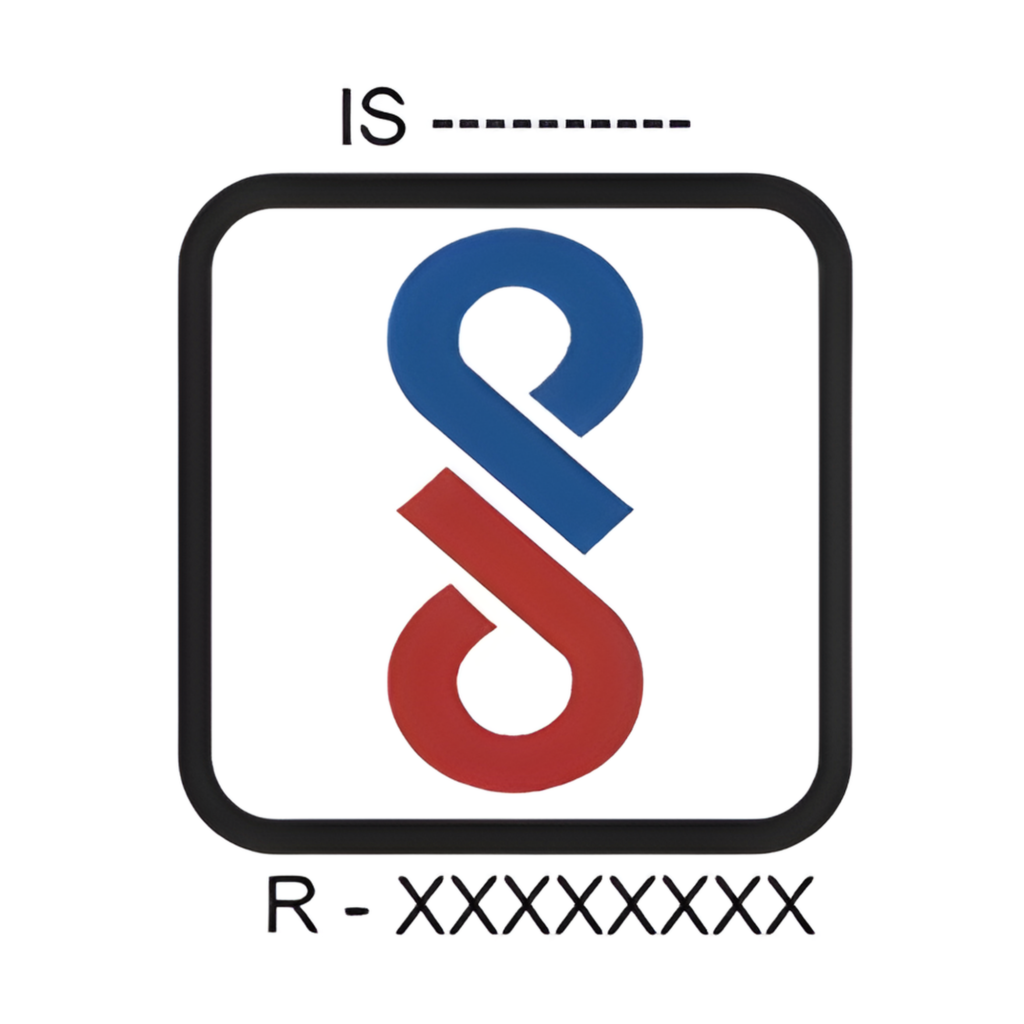
For CRS, the process is cleaner. You send product samples to a BIS-recognized, NABL-accredited laboratory. The lab tests the product against the applicable Indian Standard — for electronics this is typically a combination of safety and EMI/EMC standards. If the product passes, you submit the test report through the Manak Online portal along with your supporting documents. BIS reviews the application and, if everything is in order, issues your R-Number registration.
No factory visit. No audit queue. This is why CRS registrations typically complete in 20 to 30 working days under normal processing conditions.
One thing worth flagging: the absence of a factory audit doesn't mean oversight ends at registration. BIS conducts market surveillance on CRS-registered products. If a product in the market is found non-compliant through a surveillance sample, the registration can be suspended or cancelled — and the consequences under the BIS Act apply in full.
A Practical Way to Think About the Difference
If your product is something that gets installed, consumed, or used in a way where a failure could cause physical harm — Scheme I likely applies. If your product is an electronic or IT good that connects, charges, displays, or processes — Scheme II likely applies.
When in doubt, the right approach is to check the specific QCO notification for your product category on the BIS website at bis.gov.in. The notification will explicitly name the applicable Indian Standard and the certification scheme required. Do not guess this. The IS Code and scheme type are foundational — everything else in the application is built on getting these two things right.
Key Benefits of Obtaining BIS Registration
Most manufacturers think about BIS certification purely as a compliance requirement — something you do to avoid penalties. That framing undersells what a valid BIS license actually does for your business on a practical, day-to-day level.
Here is what changes once you're certified:
Legal Standing and Operational Security
- Your manufacturing unit, warehouse, and retail distribution partners are protected from enforcement action by BIS surveillance teams and state consumer protection authorities
- Customs clearance for your products becomes straightforward — no flags, no detentions, no demurrage charges piling up while an officer waits for compliance documentation
- You can respond to any market complaint or show-cause notice from a position of documented compliance, not scrambling to explain a gap
Access to Markets You Simply Cannot Enter Without It
- Government procurement channels — Railways, Defence, CPWD, PSUs — mandate BIS certification as a baseline eligibility requirement for suppliers. No license means no tender eligibility, regardless of your pricing or product quality
- Large organised retail chains require BIS certification before onboarding a vendor. This applies across electronics, appliances, building materials, and FMCG categories
- E-commerce platforms in regulated categories now require sellers to upload a valid BIS license or R-Number at the time of product listing. Non-compliant listings get delisted
Consumer Confidence That Translates Into Sales
- The ISI Mark carries decades of recognition among Indian consumers, particularly in categories like electrical appliances, food products, and children's goods
- In purchasing decisions — especially at the mid-market and mass-market price points — the ISI Mark functions as a trust shortcut that compensates for limited brand awareness
- It supports a defensible price premium over non-certified competitors selling visually similar products
Internal Quality Improvement You Don't Expect But Benefit From
- The mandatory lab testing process forces a structured review of your product against specific safety and performance parameters — one that internal quality checks often miss
- Maintaining BIS compliance requires keeping your in-house QC lab calibrated and functional, which raises your baseline production standards over time
- Manufacturers consistently report a reduction in field failures, customer returns, and after-sales service costs after going through the certification process
Export and Cross-Border Trade Advantages
- Several countries in the SAARC region and parts of Africa recognise Indian Standards in bilateral trade agreements, which can simplify conformity assessment requirements for exports
- For Indian manufacturers supplying to multinational companies with Indian operations, BIS certification often satisfies the supplier qualification criteria for global procurement teams
Who Can Apply for BIS Registration? Eligibility Criteria for 2026
Before you spend a single rupee on lab testing or document preparation, answer one question honestly: do you actually qualify to apply?
This isn't a formality. BIS registration has specific eligibility conditions depending on who you are, where your factory sits, and what size your business is. Getting this wrong means filing an application that's headed for rejection before a single officer reviews it.
Here is what you need to know.
For Domestic Manufacturers — ISI Mark (Scheme I)
You must be the actual manufacturer — not a trader or distributor
The ISI Mark license is issued exclusively to the manufacturing unit — the entity that physically makes the product. Traders, distributors, and resellers cannot apply or hold an ISI Mark license in their own name, regardless of how long they have been in the business. If your role in the supply chain is buying and reselling, you are not eligible. The factory that manufactures the product is.
Your factory must be operational and based in India
BIS requires your manufacturing unit to be physically running and actively producing the product at the time of application. A factory that is under construction, temporarily shut down, or currently making a different product category does not qualify. The address you put on the application must be the address where production actually happens — a registered office address cannot substitute for a manufacturing address.
Brand ownership or written authorization is mandatory
You must either own the brand under which the product will be certified — supported by a trademark registration certificate or a filed trademark application — or hold a written brand authorization letter from the brand owner. BIS does not register products under unverifiable brand names.
Your factory documents must be consistent
GST registration, factory license under the Factories Act, and your incorporation or partnership documents must all carry the same entity name and manufacturing address. Any mismatch across these three triggers a query. Resolve inconsistencies before filing.
The In-House Lab Requirement — What the Official BIS Documents Actually Say
This is where most guides get it wrong — and where a genuine update from BIS's own product manuals matters for your application planning.
The conventional understanding is that ISI Mark applicants must have a fully equipped in-house quality control laboratory. That is partially correct. What the official BIS Product Manuals — published directly on bis.gov.in — actually state is more nuanced, and it varies by your business size.
For Large-Scale Manufacturers:
As per Section 2.3 and 2.3.1 of BIS Product Manuals (verified across multiple IS codes including IS 7532, IS 2269, IS 7485, IS 2046, and others on bis.gov.in):
"Large scale manufacturers shall maintain an in-house laboratory equipped at least with test facilities for routine tests. Alternatively, in lieu of an in-house laboratory, large scale manufacturers can also utilize the provisions of Sharing of testing facilities as per the Guidelines for Grant of Licence available on BIS website www.bis.gov.in (Under Conformity Assessment > Product Certification Process)."
Large-scale manufacturers can apply for ISI Mark certification without an in-house lab, provided they formally use the Shared Testing Facilities route documented under Annexure-X of the BIS Guidelines for Grant of Licence. This is not a workaround — it is an officially documented alternative within the BIS framework itself.
For MSMEs (Micro, Small, and Medium Enterprises):
The same Product Manuals explicitly state a broader set of options for MSMEs:
"Utilization of cluster based test facilities by MSMEs or the provisions of Sharing of testing facilities or get testing done from BIS recognized/empaneled laboratory or any other laboratory having valid NABL accreditation as per IS/ISO/IEC 17025."
MSMEs therefore have three legitimate routes instead of building their own lab:
- Use a cluster-based testing facility set up by an MSME cluster or industry association
- Use shared testing facilities under the BIS Sharing guidelines
- Get routine tests done at any NABL-accredited BIS-recognized laboratory
This is a meaningful operational difference for smaller manufacturers, and it is grounded in the official BIS documentation — not in informal practice or consultant advice.
What this means practically: If you are an MSME or a large-scale manufacturer without an in-house lab, you are not automatically disqualified from ISI Mark certification. What you must do is formally structure your Quality Assurance Plan around one of the above alternatives, maintain test records for all tests carried out, and ensure the arrangement is in place and documented before the BIS factory audit.
For MSMEs — Additional Eligibility Provisions in 2026
Beyond the testing flexibility, MSMEs receive specific concessions under the BIS framework that affect eligibility and cost:
Marking Fee Concession: As of January 2026, BIS revised its Marking Fee Notification. Micro enterprises receive an 80% concession on marking fees, and this concession has been extended through 31st May 2026. Small enterprises receive a proportionally lower concession rate. You must be registered on the Udyam portal to claim these concessions.
Staggered QCO Compliance Timelines: For new product categories brought under mandatory QCOs, MSMEs consistently receive extended compliance deadlines. For example, under the Furniture QCO effective February 2026, MSMEs with plant investment below ₹25 Lakhs and turnover below ₹2 Crore and registered on Udyam are permanently exempted. Under the Household Electrical Appliances QCO effective March 2026, small enterprises have until 1st January 2027 and micro enterprises until 1st April 2027 to comply — while general manufacturers had to comply from October 2026.
These timelines are product-specific and change with each new QCO. Always check the specific notification for your product category.
For Foreign Manufacturers — FMCS Scheme
The factory must be located outside India
FMCS is the certification route for overseas manufacturing units supplying QCO-covered products to the Indian market. The Indian importer cannot hold this license on behalf of the foreign factory.
An Authorized Indian Representative is mandatory
The foreign manufacturer must formally nominate an Authorized Indian Representative — an India-based company or individual — through Form VI or Form VII under BIS regulations. The AIR holds legal responsibility for the product's compliance in India. This is a substantive legal commitment, not a formality.
Factory inspection applies
For FMCS applications under Scheme I equivalence, BIS conducts a physical factory inspection at the overseas facility. The manufacturer bears the travel and accommodation costs of the BIS inspection team — this is a standard, non-negotiable condition of FMCS.
Eligibility Criteria for CRS Registration (Scheme II) — 2026
CRS operates on a fundamentally different model from the ISI Mark, and the eligibility conditions reflect that. Understanding these differences upfront saves you from applying under the wrong scheme or preparing documentation that doesn't fit the process.
You Must Be the Manufacturer — Not a Trader, Distributor, or Retailer
Just like Scheme I, CRS registration is granted only to the manufacturing unit. Traders, distributors, and retailers who stock and sell electronics products cannot apply for or hold a CRS registration in their own name.
What makes CRS slightly different is the practical reality of electronics supply chains. Many businesses source products from OEM factories and sell under their own brand. In this situation, the OEM factory is the eligible applicant — but the brand owner's authorization must be formally documented. BIS has significantly tightened scrutiny of brand ownership relationships in 2026. If you are selling under a brand you do not own, or sourcing from a factory without a clear written authorization agreement, your application will be questioned at review stage.
Your Product Must Fall Under a Notified CRS Category
Not every electronic product requires CRS registration. Your specific product must fall under a category notified under the Electronics and IT Goods Quality Control Order issued by MeitY, or under the Solar Photovoltaic Systems, Devices and Components Order issued by the Ministry of New and Renewable Energy.
As of 2026, over 76 product categories are covered under CRS, including mobile phones, feature phones, laptops, tablets, desktop computers, monitors, printers, power banks, LED lamps, LED drivers, smart televisions, set-top boxes, CCTV cameras, power adapters and chargers, solar PV modules, and UPS systems. New categories continue to be added through QCO expansions. If you are unsure whether your specific product model is covered, check the official CRS portal at crsbis.in or the product list maintained on bis.gov.in before starting any process.
No In-House Laboratory Required — But Lab Testing Is Mandatory
This is where CRS is structurally different from the ISI Mark. There is no requirement for an in-house quality control laboratory under Scheme II. No factory audit is conducted in most cases. The registration is based on a self-declaration of conformity, supported by mandatory product testing at a BIS-recognized, NABL-accredited external laboratory.
Your product samples are sent to a BIS-recognized lab, the lab tests the product against the applicable Indian Standard, and if the product passes, you submit that test report as part of your application. The test report must be current — not older than 90 days at the time of application submission.
The absence of a factory audit does not mean oversight ends at registration. As of 2026, BIS has made post-registration market surveillance significantly more active. Random samples are purchased from the market and tested independently. If a product in the market is found non-compliant with its registered standard, the registration can be suspended or cancelled — and penalties under the BIS Act apply in full.
Self-Declaration of Conformity Through Forms II and III
Under CRS, the applicant formally self-declares that the product conforms to the applicable Indian Standard. This is done through Form II (Declaration of Conformity) and Form III (Undertaking), submitted through the CRS portal. These forms carry legal weight — a false declaration is an offense under the BIS Act. Do not treat them as administrative formalities.
For Foreign Manufacturers: Authorized Indian Representative Is Mandatory
Foreign manufacturers must appoint an Authorized Indian Representative before creating login credentials on the CRS portal. The AIR manages the registration process on behalf of the overseas manufacturer, submits and responds to queries, and holds legal responsibility for the product's compliance in India. This is not optional — the portal does not allow a foreign manufacturer to proceed without AIR credentials being in place.
How BIS Registration Works in 2026: Step-by-Step Process for ISI Mark, CRS and FMCS
Getting BIS certified is not a single process. Which scheme you follow — ISI Mark, CRS, or FMCS — changes your timeline, documents, costs, and what happens during review. Here is how each one works, without the fluff.
Scheme I — ISI Mark Registration
Applies to domestic manufacturers of steel, cement, chemicals, toys, pressure cookers, water heaters, household appliances, and furniture under mandatory QCOs.
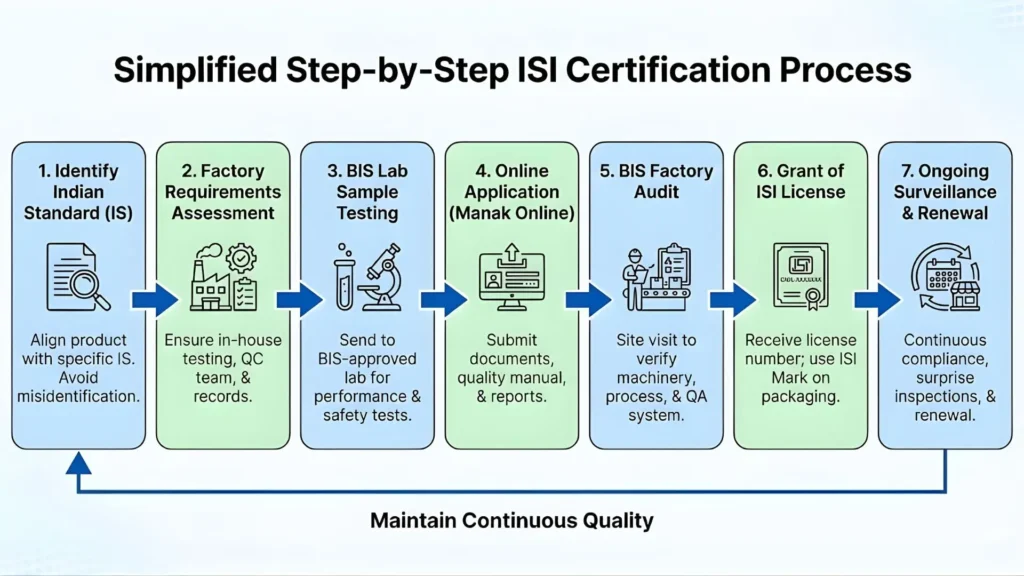
Step 1 — Find Your Correct IS Code
Every product has a specific Indian Standard governing it. "Steel" is not an IS code — IS 2062 for Hot Rolled Structural Steel is. Applying under the wrong IS code means rejection and non-refundable fees. Verify your IS code against the latest QCO notification on bis.gov.in before touching anything else.
Step 2 — Choose Your Application Route
BIS offers two options under Scheme I:
- Option 1 — Factory inspection first, then sample testing. Timeline: approximately 4 months
- Option 2 — Lab testing first, then factory inspection. Timeline: approximately 1 month
Option 2 is faster and more predictable for most applicants.
Step 3 — Product Testing at a BIS-Recognized NABL Lab
Send production batch samples to a BIS-recognized laboratory — not just any NABL lab. The lab must specifically hold BIS recognition for your product category. Your test report must not be older than 90 days at the time of application submission. If the product fails even one parameter, the process stops. You fix the defect, manufacture a fresh batch, and pay lab fees again from zero.
Step 4 — File Application on Manak Online Portal
Go to manak.bis.gov.in. Create your factory profile, upload documents, and pay ₹1,000 application fee plus initial license fee. Every document — GST certificate, factory license, incorporation papers — must carry the same entity name and manufacturing address. Any mismatch triggers a query that stalls processing. File separate applications for each product and each factory location.
Step 5 — Factory Audit
A BIS officer visits your manufacturing facility and evaluates three things: your production machinery and calibration records, your raw material quality controls, and your in-house QC lab or documented shared testing arrangement. If equipment is missing, uncalibrated, or your staff cannot demonstrate test procedures, the officer raises a Non-Conformity and the audit fails. Run a mock audit internally before the visit — it is worth the time.
Step 6 — License Grant
Once the audit clears and lab report is on record, BIS issues your CM/L Number. Print the ISI Mark with this number on every unit before it leaves your factory. BIS conducts ongoing market surveillance throughout your license period.
Scheme II — CRS Registration
Applies to electronics and IT products under MeitY QCOs and solar products under MNRE orders. No factory audit in most cases.
Important: CRS uses a completely separate portal — crsbis.in — not Manak Online.
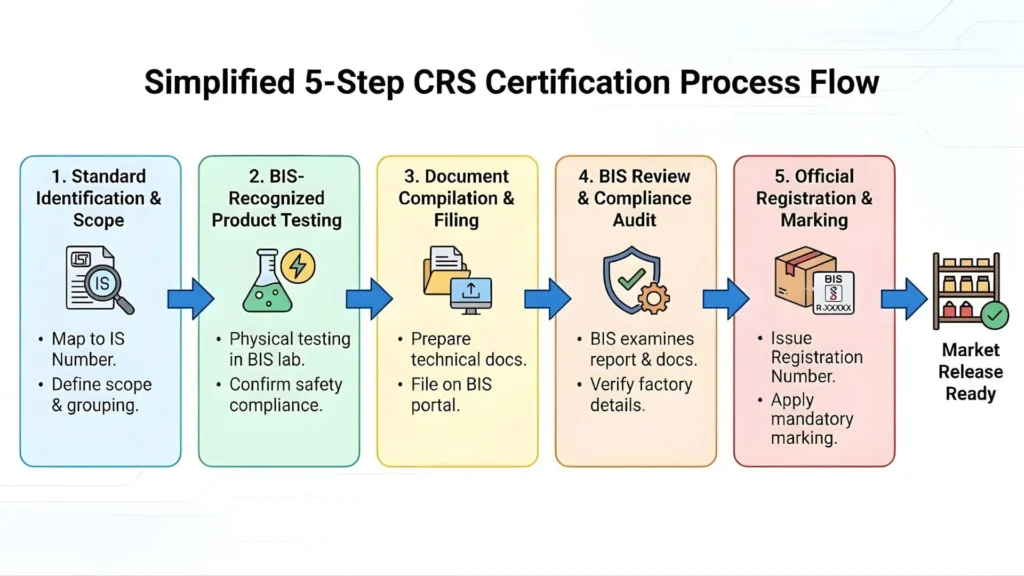
Step 1 — Confirm Your Product Is on the CRS Notified List
Check crsbis.in or MeitY QCO notifications to confirm your specific product model falls under a covered category. Over 76 product types are currently notified including mobile phones, laptops, LED lamps, power banks, smart TVs, power adapters, CCTV cameras, and solar PV modules.
Step 2 — Register on the CRS Portal
Create your organization profile on crsbis.in with your factory name, manufacturing address, and a government-issued document proving manufacturing activity at that address. ISO certificates alone are not accepted as address proof. Foreign manufacturers must have their AIR credentials in place before the portal allows them to proceed.
Step 3 — Generate a Test Request and Send Samples
Create a test request through the portal. A QR code is generated — affix this to your product sample before dispatching it to a BIS-recognized lab. The lab tests the product against the applicable Indian Standard. Testing typically takes 10 to 15 working days. A failed test closes the request — you fix, remanufacture, and restart.
Step 4 — Submit Application with Self-Declaration
Upload your passing test report and complete two legally binding forms:
- Form II — Declaration of Conformity with the applicable Indian Standard
- Form III — Undertaking for ongoing compliance and BIS surveillance access
These are not formalities. A false declaration is an offense under the BIS Act, 2016. Pay the government fee of ₹53,000 plus 18% GST per test report. Additional test reports for the same registration cost ₹10,000 each.
Step 5 — BIS Review and R-Number Grant
BIS reviews the application. Queries are communicated through the portal and must be resolved within the specified timeframe. Once cleared, BIS issues your 10-digit R-Number. Print this number alongside the BIS Standard Mark on the product and packaging as per BIS guidelines. Registration is valid for five years, renewable for up to five years. Apply for renewal at least three months before expiry.
Step 6 — Stay Compliant After Registration
In 2026, post-registration market surveillance under CRS is significantly more active. BIS randomly purchases registered products from retail and online channels for independent testing. Any product change — component substitution, design modification, safety-relevant alteration — must be assessed before continuing sales under the existing R-Number. An undisclosed change can result in registration suspension.
FMCS — Foreign Manufacturers Certification Scheme
Applies to overseas manufacturing units supplying QCO-covered products to India. Covers all product categories except electronics and IT goods notified by MeitY — foreign manufacturers of electronics go through CRS, not FMCS. Managed by the Foreign Manufacturers Certification Department (FMCD) at BIS headquarters, New Delhi.
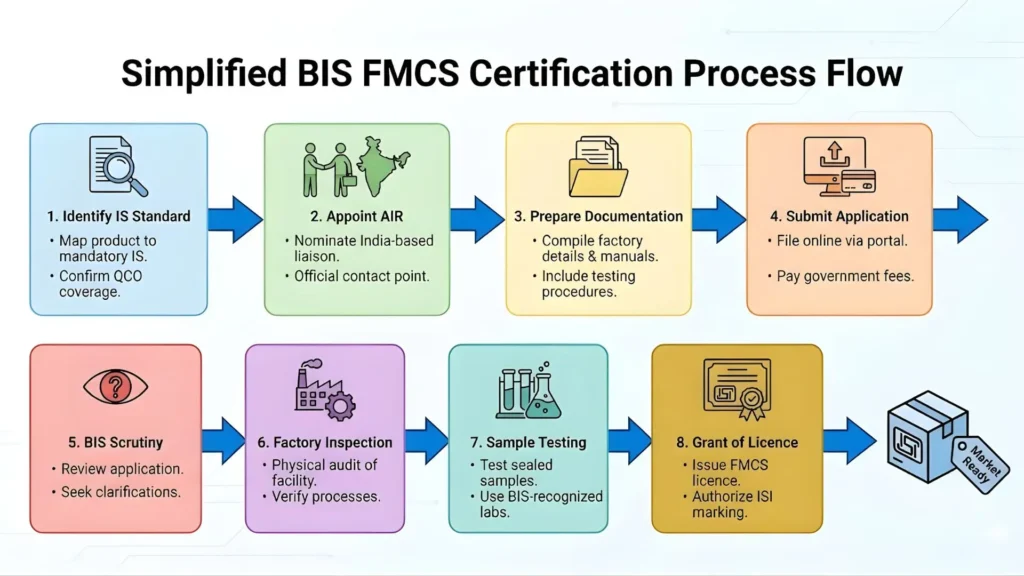
Step 1 — Verify Your IS Code and QCO Coverage
Same starting point as the domestic ISI Mark process. International certifications like CE, UL, or ISO do not replace Indian Standard compliance. Only test reports from BIS-recognized laboratories against the applicable IS are accepted under FMCS.
Step 2 — Nominate an Authorized Indian Representative
Before filing anything, nominate an Authorized Indian Representative (AIR) — an Indian-resident individual or entity who acts as your legal point of contact with BIS. Their name appears on the license. They manage communications, coordinate audit logistics, respond to BIS queries, and carry legal responsibility for compliance in India. Nominate through Form VI or Form VII. This step cannot be skipped or deferred.
Step 3 — Prepare and Submit Application to FMCD
FMCS requires both online submission through the BIS portal and a physical hard copy sent to FMCD at BIS headquarters, New Delhi — unlike CRS which is fully online. Your package includes factory documents, machinery and lab equipment lists, process flowchart, brand authorization, and AIR nomination forms. All documents must be in English or carry certified English translations. Payment is in USD. SAARC country manufacturers may pay in USD or INR. File separate applications for each product and each factory location.
Step 4 — Application Scrutiny and Query Resolution
FMCD officials review your application against the applicable Indian Standard. Missing or inconsistent documents trigger written queries through the AIR. Once your application is complete and in order, BIS assigns an auditor and confirms an audit date with mutual agreement between BIS and the manufacturer.
Step 5 — Overseas Factory Audit
A BIS auditor travels to your manufacturing facility overseas. The audit covers production machinery, raw material quality controls, and in-house QC lab capability — same structure as the domestic audit. The manufacturer bears all travel and accommodation costs for the BIS inspection team. Budget for this when planning your FMCS cost.
At the close of the audit, the BIS officer seals product samples directly from your production floor and dispatches them to a BIS-recognized laboratory for testing. You do not arrange testing independently before the audit under FMCS — sample collection happens during the visit itself.
Step 6 — Testing, Review, and License Grant
Lab results are reviewed at FMCD. If the product passes all parameters and the audit was satisfactory, BIS grants the license. You receive a CM/L Number — same format as the domestic ISI Mark. Print the Standard Mark with this number on your products per the license schedule.
License validity is one year — shorter than the domestic ISI Mark. Annual renewal is required. Ongoing surveillance visits to the overseas facility occur during the license period. The full FMCS process typically takes six months under normal conditions with complete documentation and a first-pass audit.
Documents Required for BIS Registration in 2026: The Complete Checklist
Incomplete or mismatched documentation is the leading cause of delays in the BIS system. Have all of these ready before you begin.
| Document Category | Specific Requirement |
| Manufacturing Address Proof | Factory license, GST certificate, or Certificate of Incorporation showing the manufacturing address |
| Authorized Signatory | Aadhaar card, PAN card, and authorization letter on company letterhead |
| Process Documentation | Manufacturing flowchart showing each production step |
| Machinery Details | List of production equipment with make, model, and capacity |
| Quality Control Equipment | In-house lab instrument list with valid, current calibration certificates |
| Lab Test Report | Original report from BIS-recognized NABL laboratory (within 90 days of submission) |
| Brand/Trademark Proof | Trademark registration certificate OR brand owner authorization letter |
| For Foreign Manufacturers | Form-VI or Form-VII: Nomination of Authorized Indian Representative (AIR) |
How Much Does BIS Registration Cost in 2026?
The total cost is not a fixed number — it's a combination of government fees, lab charges, and professional service fees if you use a consultant.
| Cost Component | Estimated Amount (INR) | Paid To |
| Application Fee | ₹1,000 (non-refundable) | BIS (Government) |
| Annual License Fee | ₹1,000 minimum | BIS (Government) |
| Marking Fee | Based on production volume (~₹0.40 per unit, varies) | BIS (Government) |
| Lab Testing Fee | ₹20,000 to ₹3,00,000+ (depends on product) | NABL Accredited Lab |
| Factory Inspection Fee | ₹7,000 per audit day (ISI Mark only) | BIS (Government) |
| Consultancy Fee | Variable (one-time project fee) | Certification Consultant |
Important note on lab fees: The range is genuinely wide. Testing a simple electrical accessory can cost around ₹15,000–25,000. Testing a lithium-ion battery pack, a grade of specialty steel, or a chemical compound can cross ₹1.5 Lakhs per sample. Get a lab quote specific to your product category before budgeting.
BIS Registration Timelines in 2026: What to Realistically Expect
For CRS (Electronics & IT Goods)
- Lab Testing: 10–15 working days
- BIS Portal Processing: 10–15 working days
- Total realistic timeline: 20–30 working days
For ISI Mark (Steel, Chemicals, Toys, Appliances)
- Lab Testing: 15–30 days (some chemical and mechanical tests take up to 28 days individually)
- Factory Audit Queue: 30–45 days (varies significantly based on BIS officer availability and regional office workload)
- Total realistic timeline: 3–4 months
These are realistic estimates under normal processing conditions. Delays from documentation queries or audit rescheduling can extend these timelines further.
License Validity and Renewal: What You Need to Know
BIS registration is not a one-time permanent approval.
- Initial validity: 1–2 years from the date of grant
- Renewal: Does not require fresh product testing (unless the underlying Indian Standard has been revised)
- Renewal process: Submit your production data for the period and pay the applicable marking fees
- Extended validity: Once renewed, licenses can be extended for up to 5 years at a time
The one rule that catches people off guard: If your license lapses before you renew it, there's no simple reinstatement. You restart the entire process — including fresh lab testing and, for ISI Mark holders, a new factory audit. This can set you back months and cost lakhs.
Start your renewal application at least 3 months before the expiry date. Put a calendar reminder right now.
Direct Application vs. Professional Consultancy: An Honest Comparison
Path 1: Apply on Your Own Through the Government Portal
This is entirely possible and legitimate. The BIS portal is open to all manufacturers, and there's no rule requiring you to hire a consultant.
The direct route works best for companies with a dedicated in-house compliance team that has solid technical knowledge of Indian Standards, lab coordination experience, and familiarity with BIS query responses. Official applications go to: www.bis.gov.in
Path 2: Work With a Certification Consultant
Most businesses — especially those applying for the first time or managing multiple product certifications simultaneously — find that professional guidance saves significant time and reduces the risk of costly rejections.
A good consultant handles lab selection and sample coordination, document pre-auditing, technical responses to BIS officer queries, and factory audit preparation including mock audits.
| Feature | Direct Application | With a Consultant |
| Application portal | You manage it directly | Consultant manages on your behalf |
| Total cost | Government fees + lab fees only | Gov + lab fees + service fee |
| Lab coordination | You identify the lab, manage samples | Handled and followed up daily |
| Document accuracy | Your responsibility | Pre-audited before submission |
| Rejection risk | Higher (technical oversights common) | Lower (pre-compliance checks) |
| BIS query handling | You draft technical responses | Engineer drafts precise responses |
| Audit preparation | You prepare on your own | Mock audit conducted beforehand |
There's no universally right answer. If you have technical bandwidth in-house and the time to manage it, go direct. If you want speed, certainty, and an expert buffer between you and BIS scrutiny, a consultant's service fee is usually far cheaper than a single rejection and restart cycle.
Conclusion
Getting BIS certified in 2026 is more demanding than it was even two or three years ago — more product categories are covered, enforcement is sharper, and the documentation requirements have tightened. But the fundamentals haven't changed: identify the right IS code, test your product in a recognized lab, submit clean documentation, and clear the audit if required.
Done right, BIS certification isn't just a compliance checkbox. It's a credibility asset — one that opens procurement channels, protects your supply chain, and signals quality to every buyer who looks at your product.
You now have the full picture of how the process works, what it costs, and how long it takes. The next step is to verify whether your product falls under a QCO and identify your applicable Indian Standard. Everything else follows from there.
Ready to certify your product for the Indian market?
Stop worrying about complex paperwork and start selling.
Contact SEYECS Today for a free compliance assessment of your product.
Frequently Asked Questions
Is BIS registration mandatory for imported products?
Yes. Quality Control Orders apply equally to domestic manufacturers and foreign factories. If you're importing a regulated product into India, the overseas factory must hold a valid FMCS (Foreign Manufacturers Certification Scheme) license. Customs can refuse clearance otherwise.
How do I check whether my product needs BIS certification?
Visit the Mandatory Certification section on bis.gov.in. Products are organized by category, with the relevant IS code and QCO notification linked. Electronics, steel, cement, toys, footwear, chemical fertilizers, and household appliances are among the most commonly mandated categories.
Can an importer or trader apply for BIS certification?
No. The license is granted to the manufacturing unit — the physical factory. An importer cannot hold a BIS license in their own name. However, an importer can serve as the Authorized Indian Representative (AIR) for a foreign manufacturer under the FMCS scheme.
What happens if my product sample fails lab testing?
The specific application request is closed. You analyze the root cause of the failure, modify your production process or materials, manufacture a compliant batch, and restart the testing phase — paying lab fees again from the beginning.
Can I sell my product while my BIS application is pending?
No. Selling a QCO-covered product without a valid BIS license is a legal violation even while your application is under review. You must wait for the license to be granted before putting the product on the market.
What is the FMCS scheme for foreign manufacturers?
FMCS (Foreign Manufacturers Certification Scheme) is BIS's certification pathway for factories based outside India. It follows broadly the same testing and audit requirements as the domestic ISI Mark scheme but involves cross-border coordination with an Authorized Indian Representative.
How long does the entire BIS registration process take?
CRS (Electronics): 20–30 working days.
ISI Mark (Steel/Chemicals): 3–4 months (due to factory inspection queues).